Of bread and roses

Bread and Roses
Bread and Roses

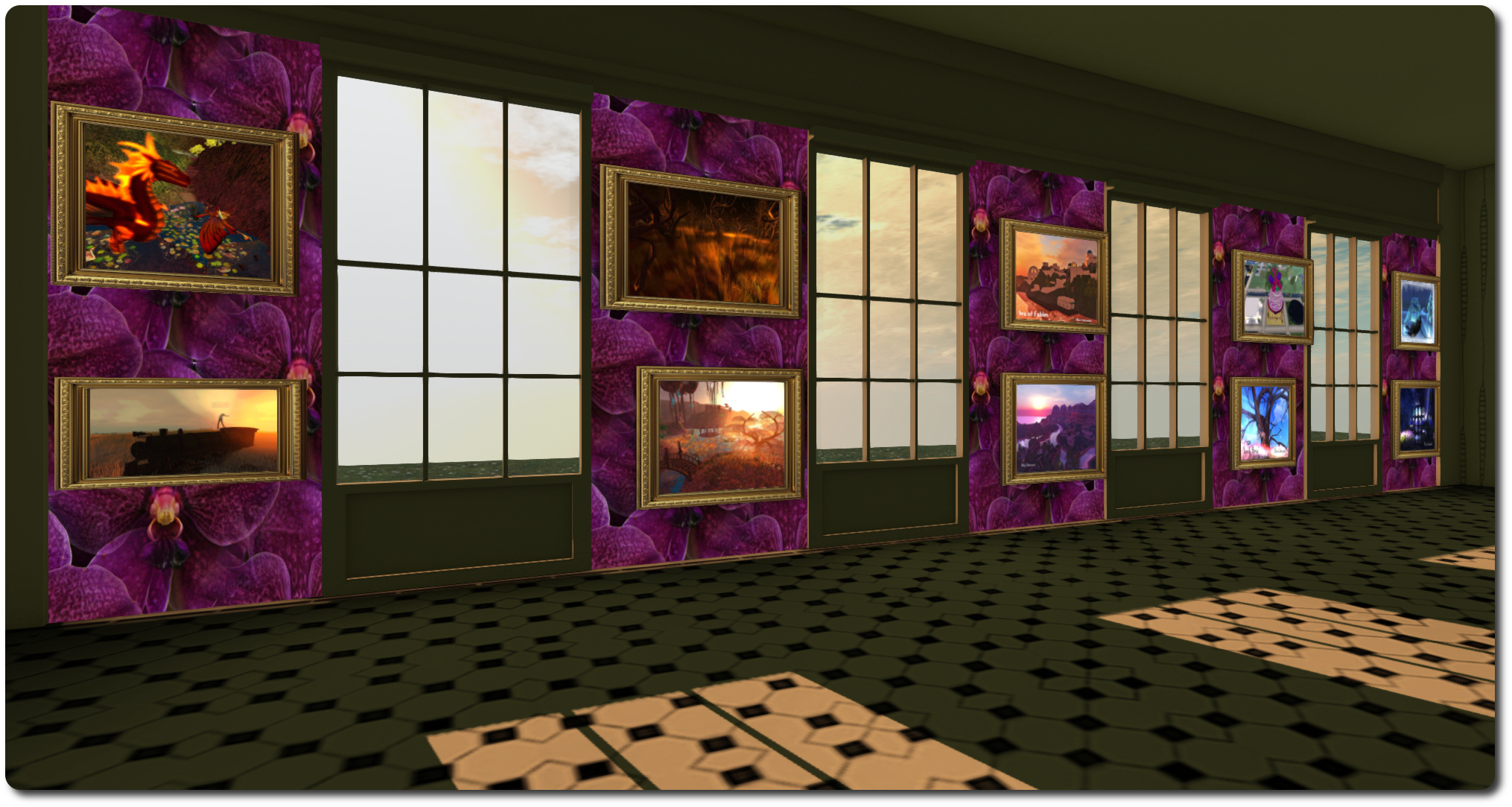
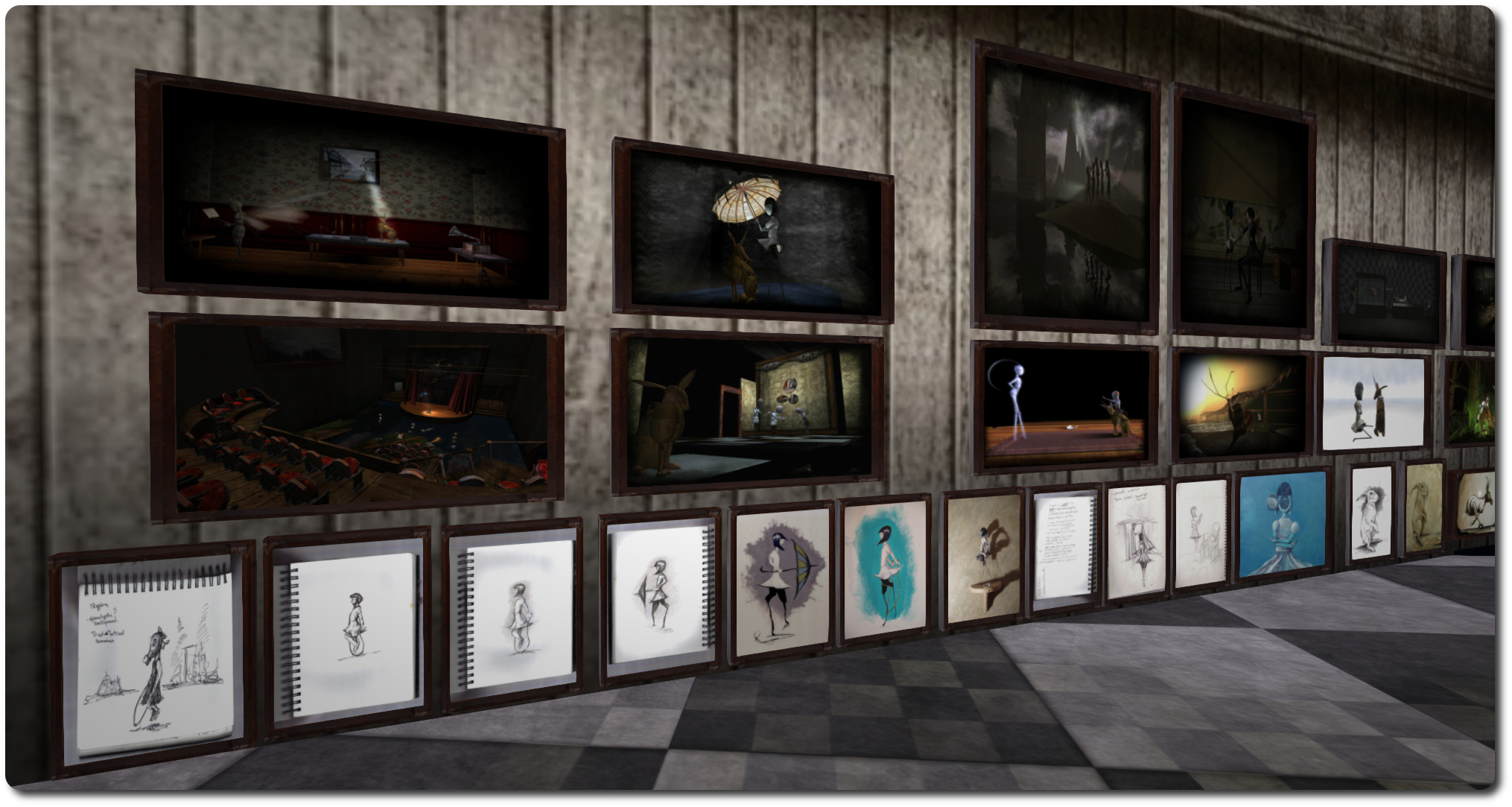
Bread and Roses, located at LEA13, is an interactive, educational installation commemorating the 1912 Lawrence Textile Strike, and which is open now through until the end of December 2014.

The strike, which commenced on January 1st, 1912, was prompted by textile mill owners in the town of Lawrence, Massachusetts, arbitrarily cutting workers pay after a new law reduced the working week from 56 hours to 52. The cut, amounting to around 30 cents, equated to the loss of around three loaves of bread for the already hard-pressed working families in the town (hence one of the strike’s other names: “The Three Loaves Strike”).

To put this in perspective, the staple diet of mill workers and their families in Lawrence was bread and molasses. Meat was a luxury few could afford. What’s more, the conditions were so harsh that the mortality rate for children was 50% by age six, and that 36 out of every 100 mill workers, male or female, were dead by the age of 25. Families were crammed into poorly maintained tenement blocks; thus the pay cut was, to say the least, cruelly severe.

With its largely immigrant population (some 51 different nationalities), the work force in Lawrence had been deemed by more conservative trade unions to be too ethnically divided to be properly organised. However, under the guidance of the Industrial Workers of the World (IWW), representatives of which had been active in the town ahead of the imposition of the pay-cut, the strike grew within a week to encompass some 20,000 workers and ran through a harsh winter prior to both sides reaching agreement.
Bread and Roses
Bread and Roses

The strike particularly came to the attention of the United States as a whole (and the rest of the world) after local police attempted to prevent IWW from sending 100 children from striking families in Lawrence to Philadelphia to stay with the families of supporters of the strike until it had reached a conclusion. Arriving at the railway station, the police drew their batons and began clubbing mothers and children alike, in full view of the press, resulting in Congressional hearings being called.

In the end, the mill owners acceded to the demands of the strike organisers. Pay was raised, working conditions were improved – but it was in the end something of a pyrrhic victory.  The IWW refused to enter into written agreements, allowing the mill owners to slowly but surely take back the concessions made, whilst also removing union representatives from their workforce.
Bread and Roses
Bread and Roses

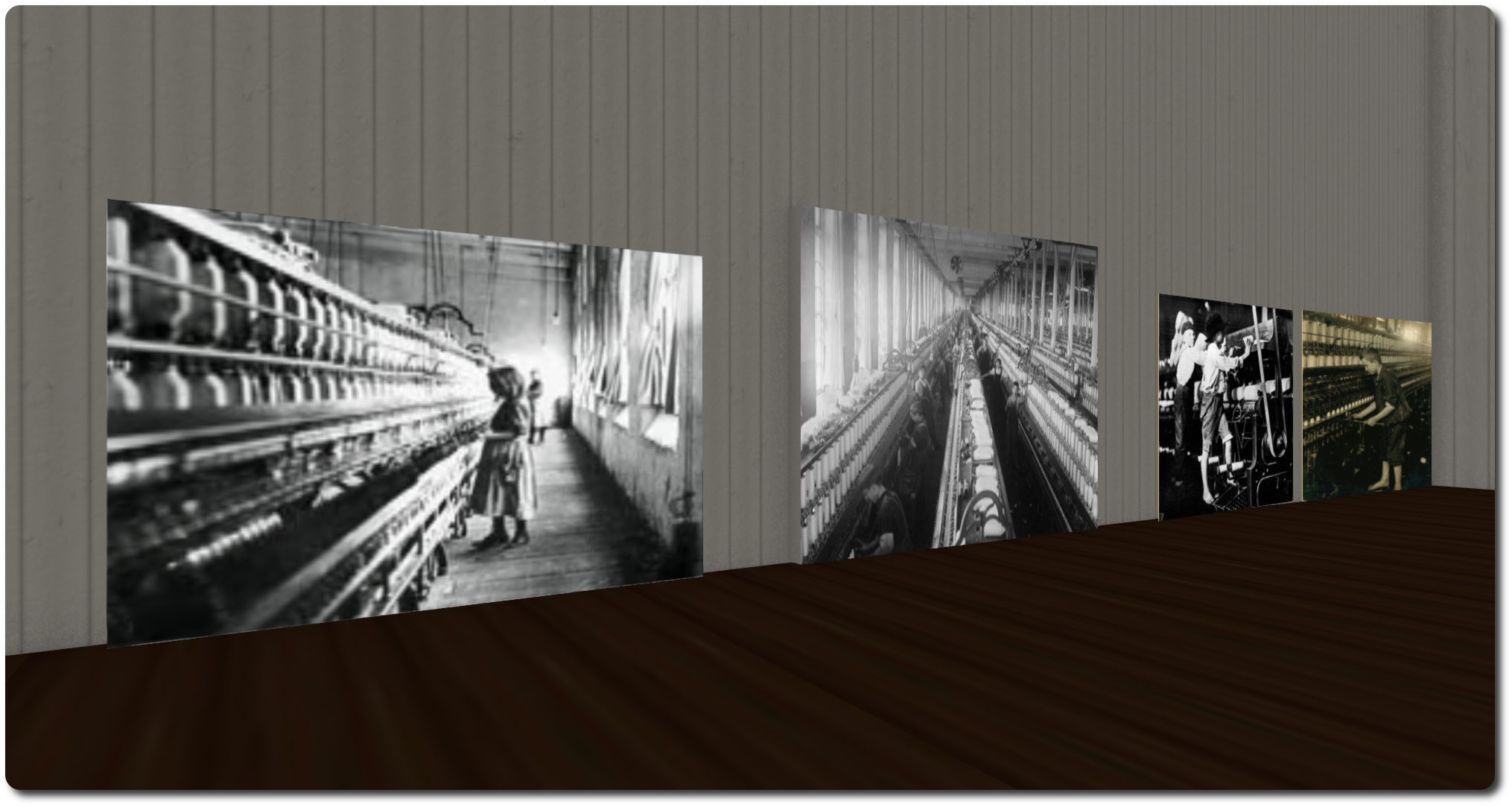
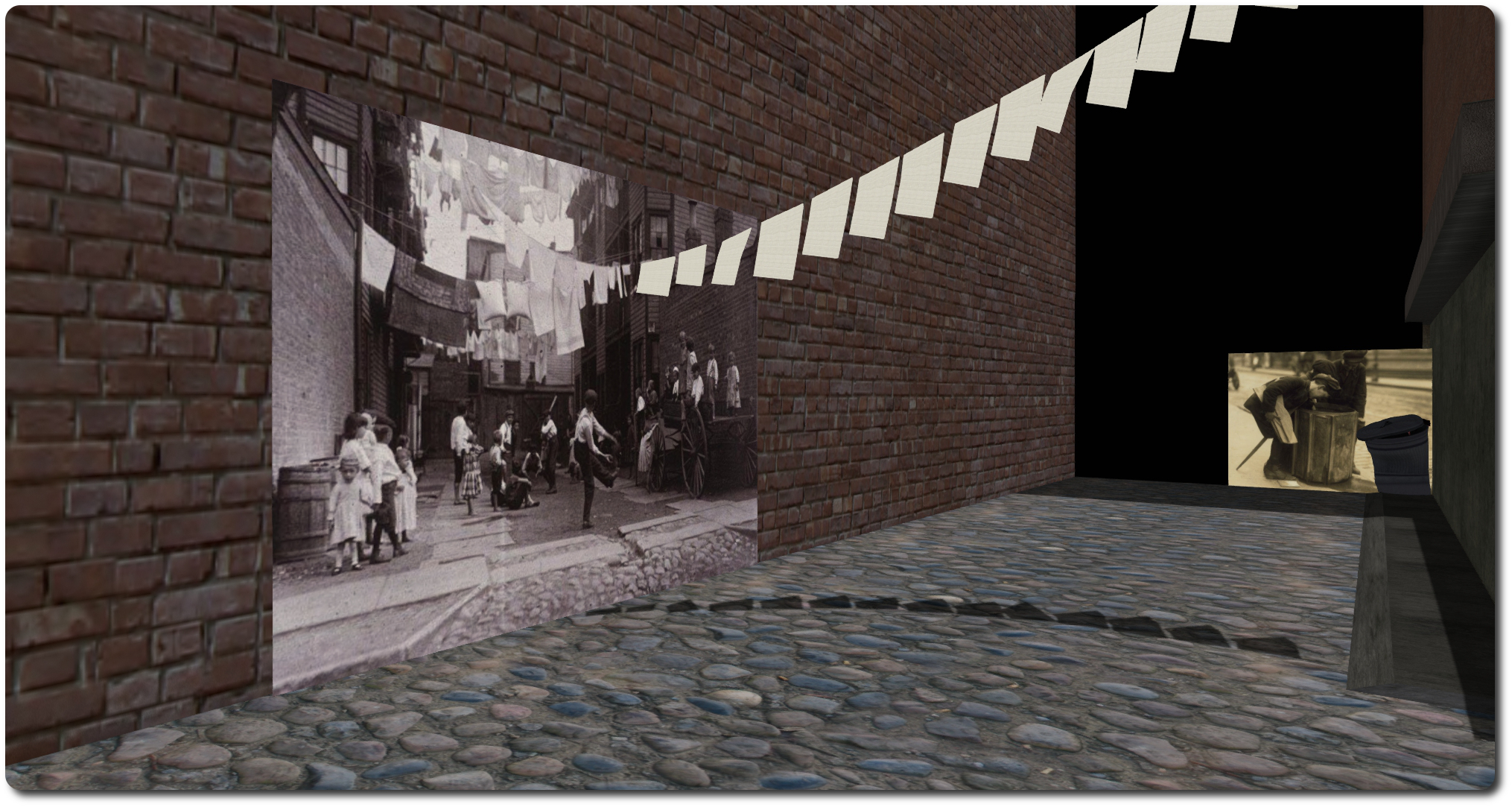
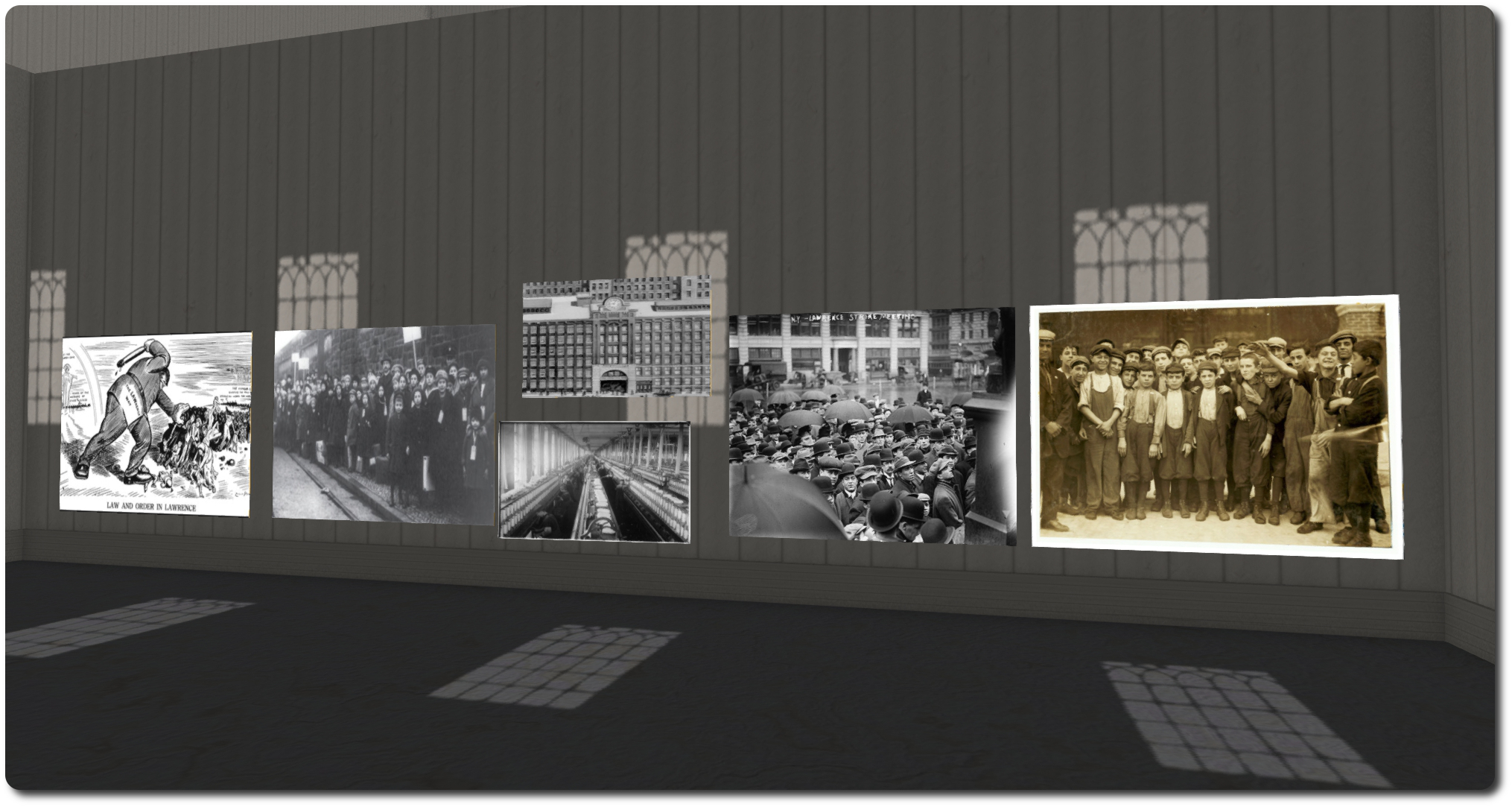
The installation at LEA13 is the brainchild of Canadian-born Dr. Sharon Collingwood (aka Ellie Brewster in SL), a Professor in the Women’s Studies department at The Ohio State University, Columbus, Ohio. It’s an interactive piece, aimed a school students, and offers plenty to do.   A tour through the set takes students through a mill where images provide visual and text-based information on the strike, while large blue buttons provide additional information or questions to be answered by students. In addition, there are media elements and links to external web resources.

As well as examining the strike, the installation also offers some social commentary as well; not just in the strong contrast between the houses and attitudes of the well-to-do mill owners and the frightful conditions endured by the workers – but also in the often entirely blinkered viewpoints of movements which marked the times. The latter is perhaps most clearly demonstrated in the house occupied by the (white, middle-class) suffragettes, citing the strike as an example of the “power” embodied within women, whilst ignoring the black scullery maid in the kitchen…
Bread and Roses
Bread and Roses

An exploration of the installation will reveal it to be seemingly incomplete. There are empty rooms, etc. This is intentional, as it is hoped that students will add to the exhibit throughout its duration. In addition, students can assume one of four identities prior to explore the exhibit and, for the benefit of those who may not be familiar with using Second Life, there is a brief set of tutorial items offering basic instructions on finding one’s way around the viewer.

All told an interesting glimpse into history, and a useful educational tool. Those wishing to use the classroom facilities within the exhibit should contact Ellie Brewster in-world.

And the title of the piece? “Bread and Roses” was another name by which the strike came to be known, after being incorrectly linked to the strike by author Upton Sinclair. The origins of the phrase in fact seem to lie with labour union leader, Rose Schneiderman, who was not directly involved in matter in Lawrence, but who stated during a speech that, “The worker must have bread, but she must have roses, too.” This in turn inspired James Oppenheim to write a poem of the same name, which in turn became a song strongly associated with labour movements and the concepts of fair wages and dignified working and living conditions.


Bread and Roses: Joan Baez and her sister, Mimi Farina, who founded “Bread and Roses”, a nonprofit co-operative organisation, designed to bring free music and entertainment to institutions: jails, hospitals, juvenile facilities, nursing homes, and prisons.

Related Links

Of trees, cultural hysteria and shit

LEA_square_logo_60Over the years, AIR has presented artists with the opportunity of using a full sim region and offering SL residents immersive environments they can enjoy. Over the years, this has led to some fascinating and quite amazing installations which might otherwise never have seen the light of day. Other times, it has to be said, the results have been less than satisfying.

As life has been keeping me a tad busy of late, I decided to combine recent visits to three of the current LEA Artist In Residence (AIR) installations into a single article. Into which of the above two categories they might fall is a matter of individual choice.

Travel Narratives into Trees

Uan Ceriaptrix uses Travel Narratives into Trees to offer visitors insight into the things that please him: natural environments unfettered by the imprint of human intervention, coloured by the natural flora and fauna within it, how these define reality for us, and the responses they evoke within us.

Travel Narratives into Trees, LEA14

Or at least, that’s the intent. On an island which itself has a distinctly organic shape, perhaps a creature swimming in the sea. From this rise a series of leafless trees, almost claw-like in their appearance. Eye-like buds grow from the trees, while your path along the island creature is marked by giant ants, flowers and the skeletal forms of what might be dogs.  The path leads to a smaller island, guarded by crocodiles (complete with a pose, if you fancy being their next meal) and on which can be found a teleporter leading you up to the second part of the installation.

Here sits a desert-like landscape, albeit one with plenty of trees and shrubs, in the midst of which sits a gigantic hollow tree which appears to be part study, part laboratory. Stairs and platforms wind their way upwards inside and around it, leading the visitor to various scenes of labour.

Travel Narratives into Trees, LEA14

Metaphor is strong here, with clues provided by the artist’s biography and the notes accompanying the build. Whether the metaphor measures up to the visitor’s eye, however, is perhaps questionable.

Cultural Hysteria

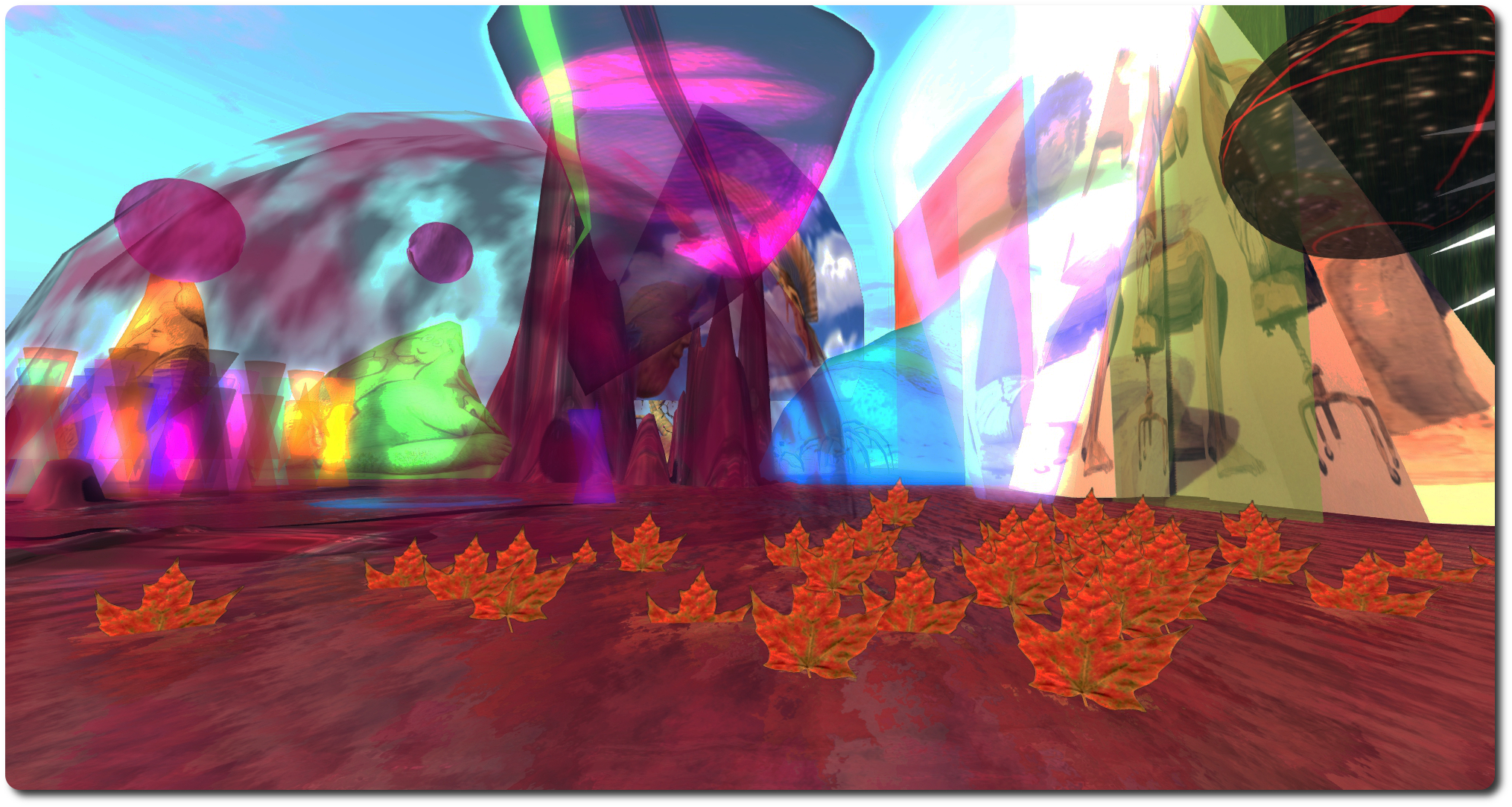
Mario Zecca’s Cultural Hysteria is designed to be a piece that grows of the months of its existence. Starting with the build at ground  / water level, successive platforms will be added over time,  with the installation as a whole used as a venue for music, dance and poetry events.

Cultural Hysteria, LEA15

Mario says of the installation, “the textures in the 3D prims, were derived from a process of  automatic drawing. I used color or scribbles to create a texture or area and then allowed the images to arise. These are images that I have “drawn” from my imagination, the feedback from a lifetime of studying while I enjoyed cartoons, comic books, illustration and academic drawing. While building the installation here I had my avi walk around to get the walking point of view and perspective. My goal is to share and convey, in the form of an immersive visual environment, the unknown, undocumented and unmeasured language of art.”

Cultural Hysteria, LEA15

The result is certainly colourful, and does require a fair amount of camming around to see. The region is filled with prims, some flexi, some static, some of which display static images, others moving images, some of which have glow applied, and so on. In terms of potential appeal, however, I’m really not sure how this installation will strike people. Perhaps we’ll only be able to really make a determination once all the levels have been added and, as Mario promises, the title of the piece becomes evident as they arrive.

Ovis Aries

So to Sheep – or to use the Latin as creator Sowa Mai (aka artist Stephen Beveridge) does, Ovis Aries. From the start, this piece is somewhat unusual and hard to define. Take the description, for example:

Sowa Mai has once again sidestepped his original idea and brought us a complete bastardization of the whole Second Life art ouvre.  With this pile of shit he has left on our doorstep it is safe to say this will be the last time he is invited to participate. Don’t miss it.

Ovis Aries, LEA22
Ovis Aries, LEA22

Well, errm. Yes. Interesting reading. Taking the proverbial pee? And if so, at whom? The artist himself, or the “whole Second Life art ouvre”? It would be easy to conclude the latter, but let’s not be so hasty.

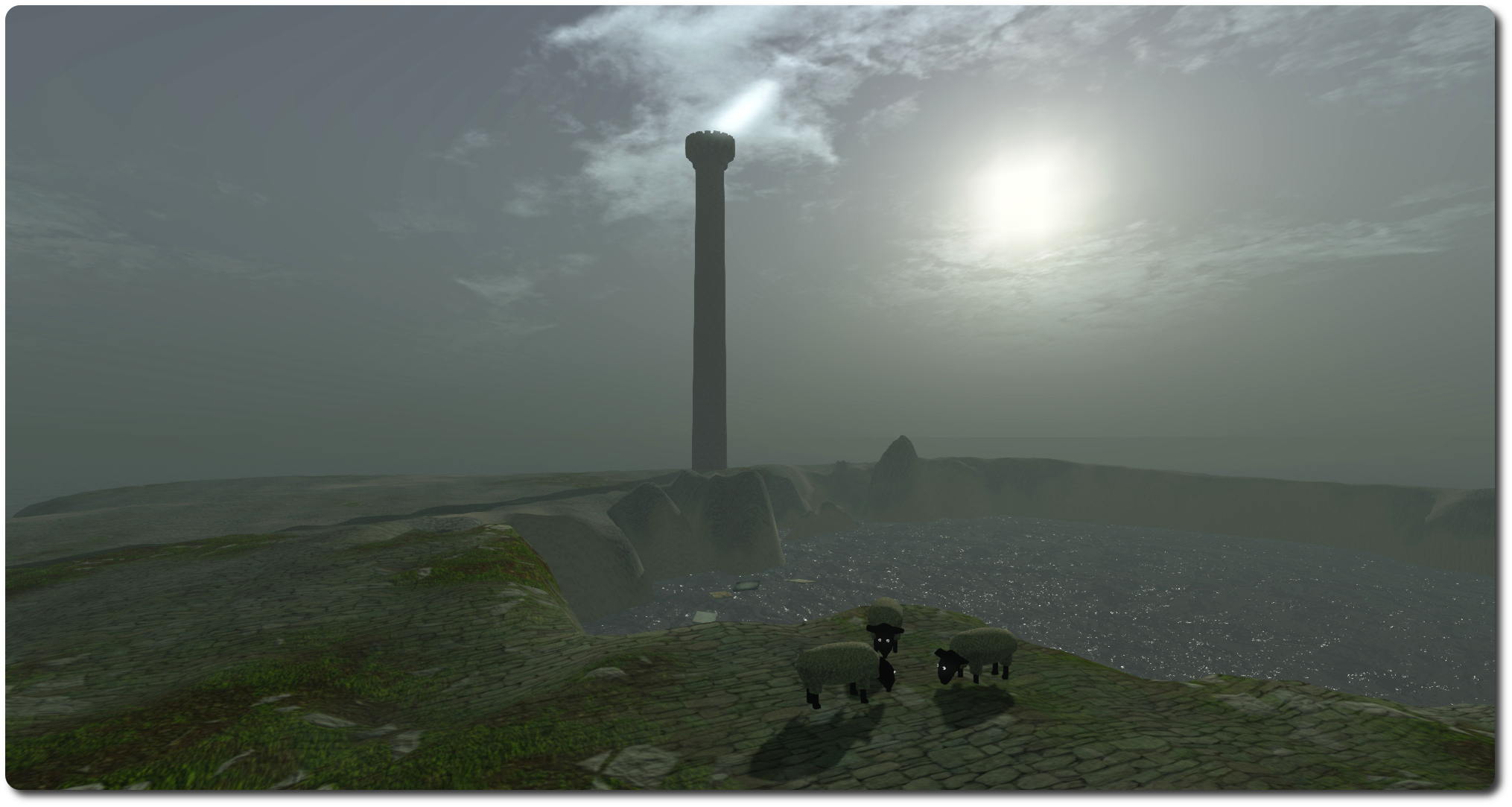
Your arrival is marked by a trio of sheep, one of whom can be chatty. If you’re on your own, it will initially discard with any pleasantries with a curt, “Go get a friend and we’ll talk…”. However, wait long enough, or have someone else present, and the sheep will engage in some ostentatious art babble – a poke, perhaps, at the world of art critics?

Ovis Aries, LEA22
Ovis Aries, LEA22

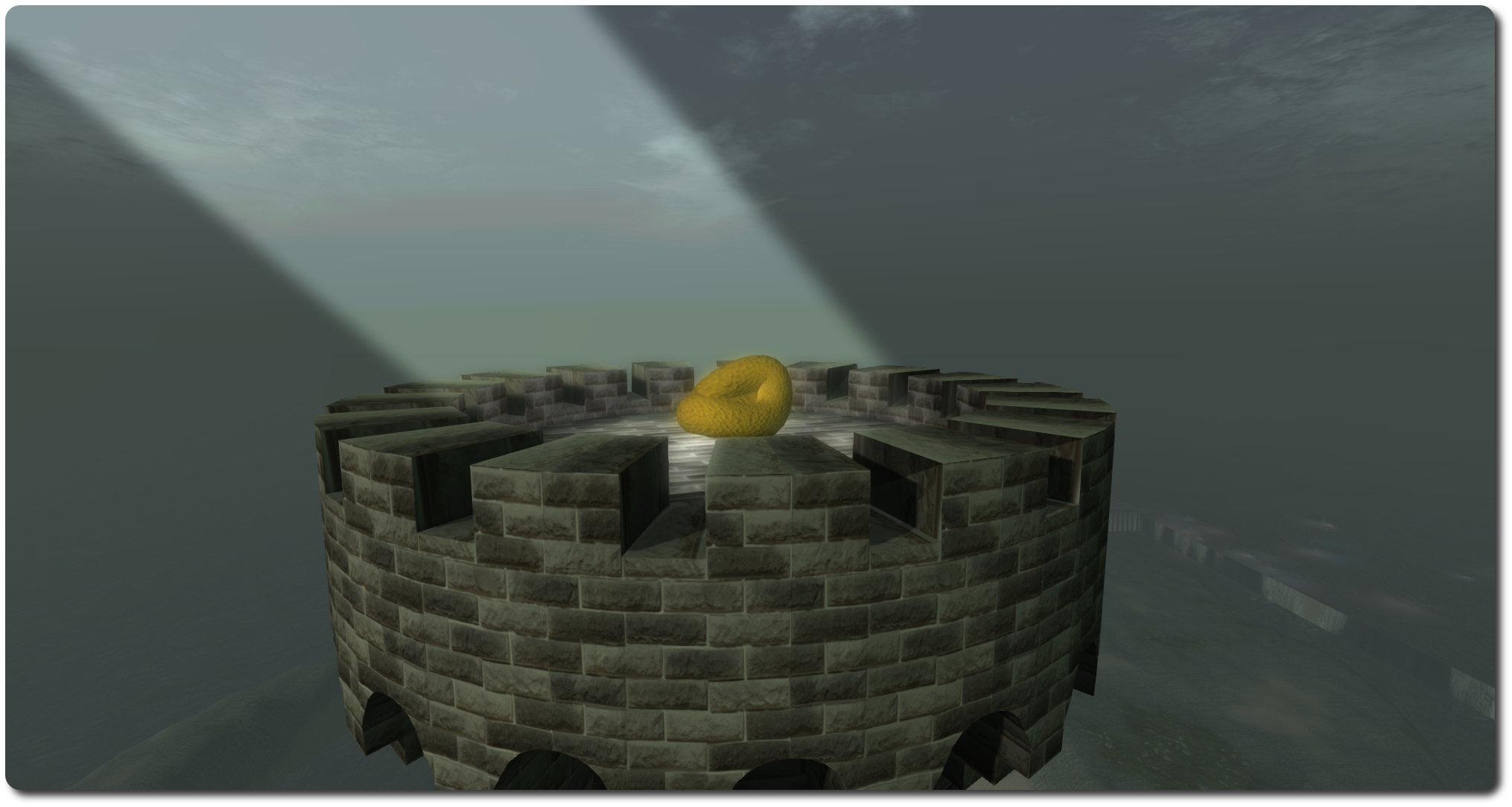
The sheep stand on a barren landscape enclosing, quarry-like, a body of water and shrouded in an evocative, misty windlight. A single stone  tower rises from this landscape, while four transparent prims located to one side of the land offer a sound scape of crowd noises. At the top of the tower, celestially spotlighted sits … a turd, while down just above the water (and below it, for those who look) are images of the artist’s real-life abstract art.

Again, metaphor runs strong here, right down to the title of the piece. For those looking for a clue as to intent of this piece, a note card from the artist available at the landing point might hold a clue or two, dwelling as it does on issues of judgement. There is also a hint of questioning identity as well, found both within the note card and perhaps in the way the images of the artist’s work are presented.

Given that judgement does play a role in the artist’s definition of the work, I’ll leave it to you to form your own opinion of this installation – exactly as he intended.

Related Links

Follow your soul

Follow Your Soul
Follow Your Soul

Follow Your Soul is the title of Eliza Cabassoun’s new exhibition of photography and art now open at LEA6 as part of the Linden Endowment for the Arts Full Sim Arts series sponsored by the University of Western Australia (UWA).

The exhibition features a mixture of Eliza’s physical world photography, her Second Life photography and sculptures, and her poetry. It is very much a personal piece, although one with a message for everyone, as reflected in Eliza’s own words usefd to introduce it:

Everyone has a place where they found their soul.  This is where I found mine.  I found mine in a cabin by a lake where the fog rises in the morning into the mountains like a warm blanket.  I began writing novels here and taking photos here.  Nature can bring forth great inspiration, simply from towering trees or just the midnight sounds of tree frogs and rain hitting a tin roof … This lake is where I followed my soul to realize I have two gifts–writing and photography–and a part of my soul will always be here.

Follow Your Soul
Follow Your Soul

The Lake is represented by the flooded centre of the region and features a central island topped by a rounded pavilion, connected to the shore by a long wooden bridge. The cabin Eliza writes about is represented by a LAQ cottage, which serves as the landing point for visitors and the teleport point for reaching other elements of the exhibit.

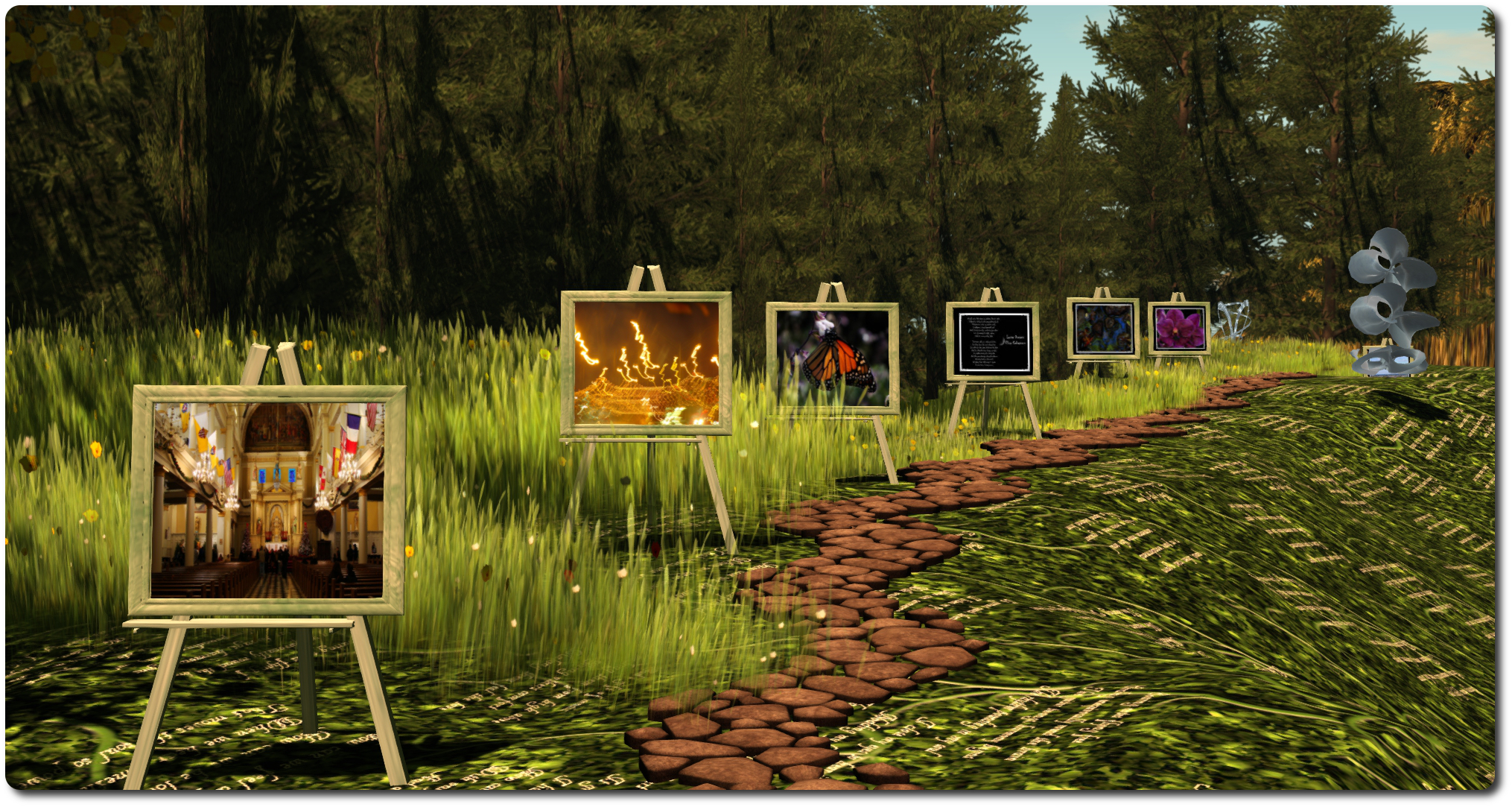
From the cottage, one can follow a path around the periphery of the lake, viewing Eliza’s physical world photography along the way, the path bordered on either side by easels displaying her work, the very ground beneath them displaying the stanzas of her poem Follow Your Soul. Some of the images on the easels also form backdrops for her poetry, while scattered among the easels are some of Eliza’s SL sculptures.

The walk around the lake has a slightly seasonal feel to it, with some of the trees coloured in the reds and yellows of autumn, their leaves falling gently to the ground and others – while admitting they are fir trees – are a rich green and suggestive of summer. There’s even a section where the ground is covered with snow, and pictures here all of a decidedly wintry theme.

Follow Your Soul
Follow Your Soul

The teleport system will carry you up to the poetry garden, where there are make images of Eliza’s photographs forming backdrops to her poems, many of which will undoubtedly strike a chord or two in the hearts of those reading them. The teleporters also provide access to a small gallery of Eliza’s SL photography, which should not be missed during a visit.

Related Links

Bryn Oh: exploring the country of an artist’s mind

Byrn Oh retrospective, LEA9

Bryn Oh is perhaps one of Second Life’s most respected and well-known artists. Her work spans the last seven years of SL’s history, and her installations have been visited by many in that time, whilst also making frequent appearances in the Destination Guide. Over the years, her pieces have grown from static sculptures to region-wide art-focused experiences, rich in narrative and elements of gameplay. It also spans the virtual and physical divide, having appeared at exhibitions, shows and festivals around the globe, marking her as an internationally regarded digital artist – in every sense of the word “digital”.

Such is the extent of Bryn’s work, that and in-depth retrospective is perhaps long overdue. Chance Acoustic and Art Blue have offered a modest, but attractive means of celebrating Bryn’s work through A Room for Ferrisquito. However, Bryn’s catalogue is so vast, it cries out for something more extensive.

Byrn Oh retrospective, LEA9

Until recently, Bryn has fought shy of offering such a retrospective herself. However, she was recently invited to participate in the Art & Algorithms digital festival in Titusville, Florida, where she is one of a number of digital artists exhibiting their work through the festival’s digital lounge, and thus Bryn Oh retrospective 2007-2014, has been born.

This is a comprehensive study of her work, which might be said to span two locations in SL. The primary focus for the retrospective is a region-wide installation at LEA9, where visitors can explore the development of her art over the years chronologically. The second element – primarily aimed towards to the Art and Algorithms event, is an invitation for them to experience The Singularity of Kumiko on her home region of Immersiva – where she states she has instructed Mr. Zippers not to slaughter anyone should they do so!

The LEA9 installation is an immersive, multi-faceted endeavour involving elements of her work in both 3D and 2D together with information boards and links to machinina pieces on YouTube. Interestingly, most of the pieces on display are not Bryn’s own choices; as far as possible they’ve been drawn from suggestions and requests provided by members of her Immersiva in-world group.

Byrn Oh retrospective, LEA9

Putting some of this together wasn’t easy, as Bryn informed me on inviting me to take a look around LEA9. “I discovered that all my really old work from 2007 etc., are now all unlinked and the prims migrated in some cases!” she said. However, if any of the early pieces on display had to be put back together, I’d say the time spent doing so has been more than worth it, because LEA 9 presents the visitor with a fascinating voyage through Bryn’s work – and more.

Those familiar with Bryn’s art over the years will doubtless recognise many of the items on display and regard them with fond memories; they may even trigger reminiscences about art, SL and more. Each year is presented in it own space or spaces, combining individual pieces with sets from some of Bryn’s more immersive, region-wide designs. Large signs denote the years as you come to them – make sure yo take the welcoming note card on your arrival, and do take your time exploring; there is a lot to see and read – and not all of it in the exhibition spaces, as noted there are a number of opportunities to watch machinima of Bryn’s work, such as the one below for Condos in Heaven.

Bryn is known for giving insight into her creations through the pages of her blog, where she frequently allows us glimpse her creative thinking. In many ways, this retrospective is a deeper extension of that process. Exploring it, I felt I was not so much looking back over her work of the last seven years but had in fact entered her “Country of the Mind”.

Byrn Oh retrospective, LEA9

I make no apologies for using a fictional construct, as given form by Greg Bear, to describe my response to viewing this installation; if anything I’d say it was actually appropriate. “Bryn Oh” came into being as a way of exploring whether a digital character unaligned with any physical identity could gain acceptance as an artist in her own right; given the world-wide renown Bryn’s work has attained, there is little doubt she has achieved this goal.

But creativity is rarely purely an outward expression; through the creative process, we often define or enhance or influence or own thinking and perhaps reflect facets of our personalities back to ourselves as much as display them outwardly. As such, wandering through these spaces within LEA9 gave me the sensation that I was witnessing not only the growth of Bryn’s artistry within SL, but was also seeing the growth of her persona as a distinct entity separate from the human mind behind her. It’s as if each of the pieces on display, from the small to the large, form aspects of her “big and little selves”, to use Bear’s terminology, each reflecting a facet of her creativity and drive, which blend together and with her Primary Self – the human mind behind her – adding to her growth as a distinct personality. I actually mentioned this idea to Bryn as I toured LEA9; I’m not entirely sure what she thought of my perspective – but she seemed intrigued.

My point here is that this installation is more than just a simple retrospective display of past works; there is something very tactile about it which speaks as a voyage through the developing of Bryn as a personality as much as to the creative beauty of her work. As such, it is a fascinating place to visit and in which to dwell.

Byrn Oh retrospective, LEA9

Certainly, this is an installation – a country – worthy of careful exploration. There is a visual and written richness to it that is engaging and well deserving of  the time one can spend immersed within it. I can honestly say I have spent more than two hours within the installation following Bryn’s invitation, and I will doubtless be returning to it again.

Highly recommended.

Related Links

Taking a vision quest with Black Elk

BE-8_001
Black Elk, LEA1

Livio Oak Korobase returns to the LEA on Wednesday September 17th, with a new installation entitled Black Elk at LEA 1. The installation draws on the life and writings of Black Elk, a medicine man (wičháša wakȟáŋ) of the Oglala Lakota,  born in 1863, and author of The Sacred Pipe and Black Elk Speaks, a book responsible for sparking a renewal of interest in Native religions, based as it is on Black Elk’s experiences and those of the Lakota people.

Livio takes for the central theme of the installation, Black Elk’s great vision, which came to him as a boy of nine, while ill. In the vision, he was visited by the Wakinyan, Thunder Beings, who took him with them to the centre of the earth, and to the central mountain of the world, the axis of the six sacred directions, watched over by the Grandfathers.

This was the first of many vision he had throughout his life, and which, when he related it to the medicine men of his tribe when 17 years of age, established him as a great medicine man himself.

Black Elk, LEA1
Black Elk, LEA1

Symbolism is strong in the work at LEA 1 – as you might expect, given the focus – with horses, birds, bison, fish and more featuring large (literally as well as figuratively), together with more sacred characters. Around and among these hang quotes from Black Elk, powerful statements on who we are, where we come from and what we are a part of – that we are all, really, one nation; joined together and sharing hopes, loves, fears, life – and death. These words were formed through an early life marked by war and conflict and events such as Wounded Knee.

Given this, it should come as no surprise to see a quote by John F. Kennedy sitting alongside those of Black Elk. The quote is from Kennedy’s June 1963 Commencement Address at American University, given in the wake of the Cuban Missile Crisis, an event which came so close to visiting a global calamity on the world, and time when Kennedy, whose early adult years were also shaped by war and conflict, resolved that East and East must find the ways and means to live and work together as peoples of a single world. In this, they offer something of a latter-day reflection of Black Elk’s words.

Black Elk, LEA1
Black Elk, LEA1

When visiting, I would recommend that you use the region’s default windlight setting – used to take the images seen here – as this will allow you to experience the installation to the fullest, the use of reflective surfaces is very well executed, and gives a further depth to the piece. Also, if you don’t feel like walking everywhere, there is a horse rezzer, so you can ride around the pieces in the installation – and don’t miss the two teleport arrows at the arrival point to get you to the more elevated parts of the installation; and do keep an eye out for Livio’s signature Creature!

All told, a thought-provoking piece, beautifully executed and well worth visiting.

Black Elk, LEA1
Black Elk, LEA1

Related Links

M*A*S*H remembered


4077th MASH - LEA2
4077th MASH – LEA2 – click any image for full size

Open now at LEA2, is a homage to what remains both one of the most highest rated shows in US television history, and one of the most internationally popular and instantly recognisable: M*A*S*H.

Created by Tahiti Rae, the build lovingly recreates the 4077th Mobile Army Surgical Hospital from the era of seasons 6 through 8. Within it are all the familiar sets and locations. The Swamp, the Nurses’ Quarters, the tents of Colonel Sherman Potter, Father Mulcahy and Major Margaret “Hot Lips” Houlihan, the OR and offices – right out to the motor pool (remember Staff Sergeant Luther Rizzo?) and Rosie’s, the off-camp bar; all have their places here.

“I chose to build my representation based on this television series because so many people all over the world personally relate to how the human spirit, humour, diversity, skill and love can bring people together, regardless of War,” Tahiti said of the piece, “Does War send us apart?  Or actually bring us together?”

4077th MASH - LEA2
4077th MASH – LEA2

She continues, “To me, war has never changed. It’s always been either self-defence or defending the freedom of a friend. Otherwise, it is intolerant aggression.  Regardless, the human spirit always prevails.  And this particular portrait of those who went through the Korean War, based on real surgeons on the front lines, brought into our living rooms what they suffered, laughed about and loved in such a profound way, that it touched us all.”

You might wonder how I can pin-down the period of the show represented by the build. Well, such is the care with which Tahiti has put this all together, the clues are all there to be seen, both indoors and outside. One only has to explore to find them. And exploration is very much the key to this installation.

You start at an arrival point high overhead – a triage or pre-op station, if you will – where you can find information on the build and on M*A*S*H itself. From here you can teleport down to the region, arriving at the 4077th, as so many personnel did, at the helipad located on a mound to one side of the camp.

4077th MASH - LEA2
4077th MASH – LEA2

Walk down the worn track from the pad, and you’re free to explore the camp as you will. Do make sure you have local sounds enabled to full appreciate things, and keep an eye out for the clipboards located in places like quarters, the OR and so on – they contain information and video links related to both popular moments in the show and the experiences of actual Korean War veterans.

Within these clips is one from one of the most poignant moments from the show, which in its own way, underlines the complete futility and indiscriminate nature of war: Radar’s announcement that Colonel Henry Blake’s plane, transporting him home after having completed his tour of duty, had been shot down over the Sea of Japan with no survivors.

The level of detail in the build really is wonderful – as noted above, there are enough clues to pin down the approximate point in the series the camp represents. There may even be individual clues which allow the time to be pinned down even closer than I’ve managed; but the key thing is, it’s all here – from Colonel Potter’s beloved Sophie, to the small memorial to Colonel Blake, through to Hawkeye’s trademark red bathrobe and signature Groucho Marx nose / glasses and on to … well, visit and see for yourself!

4077th MASH - LEA2
4077th MASH – LEA2

Around the periphery of the build are what appear to be some incongruities, such as a “tiny” military encampment and a sniper’s position, uniformed soldiers, all from eras much later than that of Korea – perhaps a reminder of conflicts which exist to this day.

As well as leading you to those, exploration of the region is important as it will bring you eventually to the story’s end – a music video and then a final teleport (reached via a bus; your only clue!

Those who know and love the series will understand the symbolism presented at the “The End”, as they follow Tahiti’s directions and explore each of the rooms. The reference to the show’s final episode and the experiences within it of the linchpin of the series: Dr. Benjamin “Hawkeye” Pierce, as portrayed by the brilliant Alan Alda.  Work your way up through the rooms to Hawkeye’s and then step out onto the fire escape. This will take you to a final goodbye – M*A*S*H style (although there are teleports back to the start point and back down to the 4077th).

I’ll leave the final word on the build to Tahiti, “In a time of great conflict on this planet, I wanted to recreate MASH because I think it’s important that we remember how war separates us, and yet also how it brings us together.  I am humbled and honored to bring back the full gamut of emotion that the writers and actors burned into our memories with this television series.  We use the past as part of our foundation for the future.”

Related Links