The algorithms of art

Art and Algorithms Digital Arts Festival
Art and Algorithms Digital Arts Festival – Jo Ellsmere: Biomechanical (click any image for full size to see the details)

The Art and Algorithms Digital Arts Festival, currently located on LEA8, will be closing at the end of December 2014, and if you haven’t already paid it a visit, I would recommend that you do. It is a continuation of the Second Life element of the art festival of the same name, which was held in Titusville, Florida, between October 3rd and 12th, 2014.

Arranged around a central landing point area are eight individual exhibition spaces offering one or more pieces by well-known SL artists. Each exhibit is highly individual in terms of subject matter, and despite the fact they are all packed into a single region, they each offer an individual environment, complete with custom media streaming and parcel windlight presets.

The landing area, designed by Pixel Sideways, initially served as a tutorial area for people entering SL for the first time from the Titusville festival; as such, it may not appear to hold much of interest to the established SL user. However, I’d suggest having a little look around, as there are several points of interest to be found, including a teleport to Pixels’ own display area located high over the region. The music stream provided in the arrival area might also be of interest as well, given it is being driven by solar radiation levels being recorded by NASA’s Lunar Reconnaissance Orbiter as it orbits the Moon!

Art and Algorithms Digital Arts Festival
Art and Algorithms Digital Arts Festival – Ub Yifu: The Tree People, “an absorbing immersive environment, which is at the same time a tribute to Nature and its many gifts, the mysterious duality of life, and the creative people who explore virtual worlds in search of their holy grail”

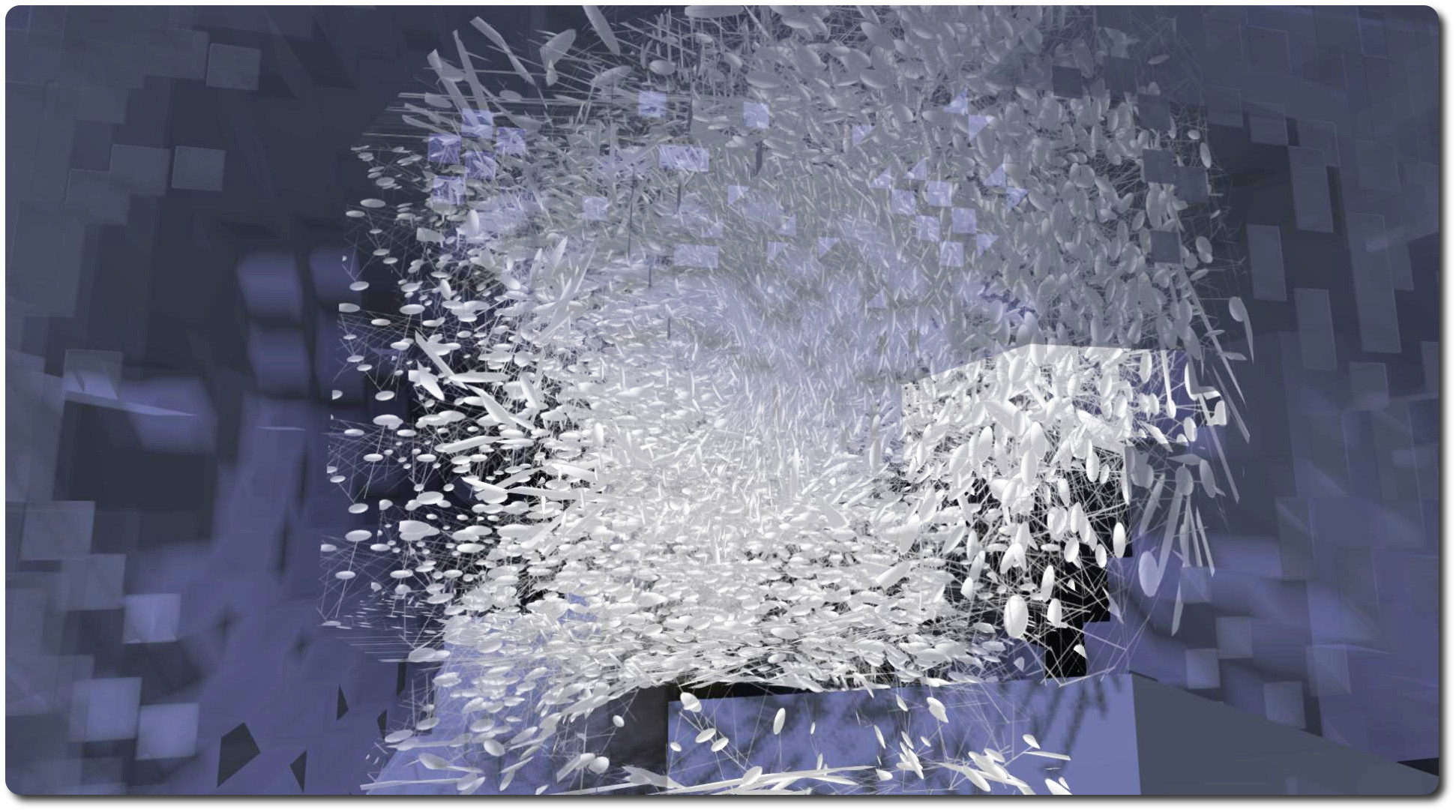
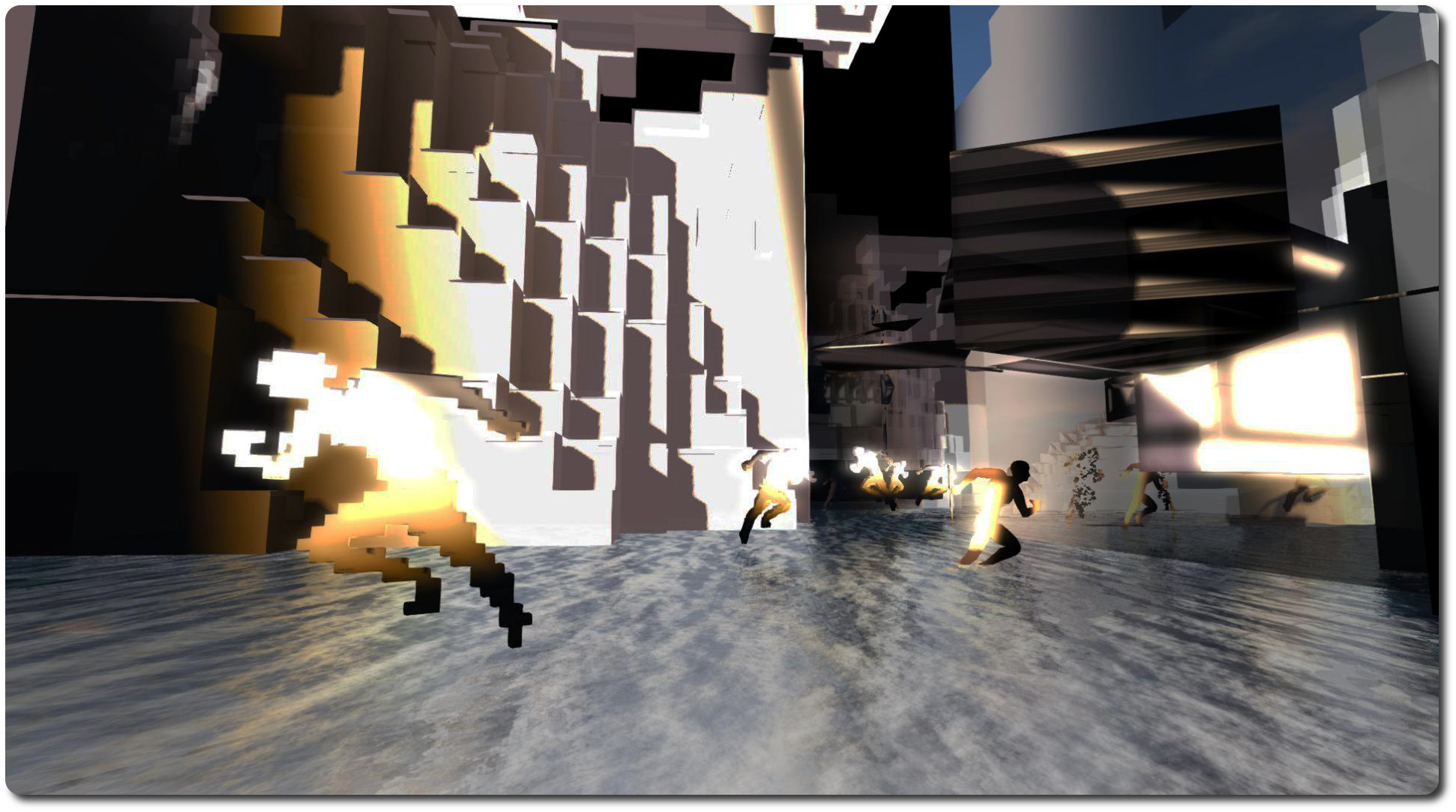
The first of the installations on display to capture my attention when visiting was Jo Ellsmere’s Biomechanical, picture at the top of this article. A homage to V. Meyerhold’s biomechanics system developed to help train actors, it was first seen as a part of the digital element of The Golden Age of the Russian Avant Garde, by Peter Greenaway (UK) and Saskia Boddeke (Holland) which I wrote about in May 2014, and makes a welcome return here. The piece features five avatars beautifully scripted to move through as series of synchronised actions, both as a single unit and as five unique elements within that unit, a slight syncopation to their movements giving them a time-lapsed grace.

Jo also shares the stage with Pyewacket Kazyanenko for Interstellar Princess, which they disarmingly refer to as simply, “a complete understanding of the universe, why it is as it is and why it exists at all”! Featuring a small army of bots named for the phonetic alphabet, and a similar number of televisions (make sure you run media in the parcel), it’s a curious piece.

Art and Algorithms Digital Arts Festival
Art and Algorithms Digital Arts Festival – Lollito Larkham: Petit-Gris (Little Gray), the Plutoian who passes the days listlessly, moving about his home, reading about alleged “humans” and tale of the wonderful planet Earth, his mood swinging between hope and despair that he’ll ever be able to see it for himself

The origins of ALEA FUKUSHIMA apparently lie in a dream artist Artistide Despres had, in which he imagined a scientist-musician who was able to neutralize the radioactivity at the Fukushima nuclear power plant by transforming the energy into music. This is an interactive piece, musical instruments in the “reactor building” responding directly to avatars.

In another of the overhead domes, Feathers Boa offers visitors Painting in Three Dimensions,  retrospective of her work from the period of 2007-2010. All of the pieces here also respond to the presence of an avatar, changing as you approach them and then step away from them.

Art and Algorithms Digital Arts Festival
Art and Algorithms Digital Arts Festival – in A Comfortable Skin, Gracie Kendal continues her exploration of society’s obsession with appearance, identity, and acceptance, using both physical and virtual avatars. Don one of the paint-splattered skins she offers, jump into the images of physical world locations and similarly-attired “avatars” and take a picture of yourself. Are you comfortable in the skin you’re in?

Glyph Graves presents three pieces for the price of one: Ghost Flora, Breeze, and Forest of Water. The latter two pieces are presented in one of ground-level exhibition spaces, while Ghost Flora can be seen in the waters surrounding the central landing / tutorial area.

Together, these works make up an interesting exhibition, each of them showing various facets of artistic expression and the versatility available within virtual environments like Second Life for immersive art.

Related Links


Kosmic algorithms

Project Algorithm: "observabalh" by Nino Vichon
Project Algorithm: “Observatorim” by Nino Vichon

In November, I wrote about Giovanna Cerise’s latest full region installation, Chaos, Kosmos, currently open on LEA21 as a part of the 7th round of LEA artist In Residence grants.

the initial installation has been extended with three airborne platforms offering pieces by three artists Giovanna invited to participate in her work. Together, all three are referred to as “Project Algorithm”, and each appears to be designed to carry forward something of the original theme of Chaos. Kosmos – examining the relationship between two seemingly opposite elements which may actually be two sides of the same coin. In the case of the original piece, this involves examining the relationship between the ordered cosmos and its chaotic origins (which it still, despite its own order, also echoes).

The three new pieces on offer are reached via the spherical teleport at the Chaos, Kosmos landing point.  As they are all independent works, the order in which they are visited doesn’t appear to be important. As such, I’m tackling them here on the basis of height above ground – from the lowest to the highest.

Project Algorithm: "Live and Die" by Pol Jarhead
Project Algorithm: “Live and Die” by Pol Jarvinan

So the first piece is Live and Die, by Pol Jarvinan, which appears to examine the relationship between life and death; neither of which can exist without the other, and yet both are opposed to one another. The relationship is presented, to my eyes at least, on a number of levels.

The major part of the piece, when cammed around, can give an impression of a graveyard, the black and white shapes frequently forming crosses as the camera moves – the field of death. In the centre of this is a small region of colour – life. Yet even this colour exhibits something of an ebb and flow: the word LIVE is green / healthy; the word DIE is pale / sickly. between them lie a series of geometric shapes in a rusted hue; suggestive of ageing. Throughout the piece are black-and-white circles which, as the camera moves, can appear to be individual or overlapping, perhaps again symbolic of the relationship the exists between being and not being.

Project Algorithm: "observatorim" by Nino Vichon
Project Algorithm: “observatorim” by Nino Vichon

Nino Vichon opts to examine the algorithm – or relationship – between fantasy and prediction through his piece, Observatorium. Here, he sets out the view while appearing separate, fantasy and prediction are perhaps intertwined.  Neither requires linear steps in understanding, and both can be based upon creative or intuitive leaps of the imagination as much as anything else. As such, they are not mutually exclusive in application; rather they are complimentary.  He illustrates this through the examples of chemistry and its relationship with alchemy (from which it grew), and astronomy and its relationship with astrology (ditto).

The uppermost platform is home to Daco Monday’s Chaos, perhaps the most involved and perplexing of the three pieces. It is defined as “the Algorithm of history”, although quite how it should be interpreted is difficult to discern.

There is a quote within the piece, “la luce diurna e razionalista della storia moderna si va spegnendo il suo astro declina avanza il crepuscolo e ci avviciniamo alla notte” – which, I think is a reference to Novoe srednevekov’e (“The End of Our Time”, also known as “The New Middle Ages”) by the religious and political philosopher / Christian universalist Nikolai Berdyaev.

Project Algorithm: Chaos by Daco Monday

As I have no idea if I’m barking up the wrong philosophical tree here or not, I’m loathe to plumb this piece further in writing (although I’ve been mentally scratching my head over it during the course of the last 24 hours…). Therefore, should you wish yo know more, I can only suggest you go take a peek for yourself.

Project Algorithm will remain open, along with Chaos, Kosmos, until the end of December 2014.

Related Links

  • Chaos, Kosmos SLurl (Rated: General) – use the teleport sphere at the landing point to reach the platforms.

Qualia: looking through the eyes of Mary*

Qualia: The Sentience of Being

I’ve become something of a fan of Frankx Lefarve’s work over the last couple of years, and always look forward to his installations. They are invariably thought-provoking and beautiful in both design and execution.

This month, he is once more back at LEA18, the location for his last LEA piece, Insidious: the Spread of Ideas, which I reviewed here. Now, and open through until the end of the year, he brings us Qualia: The Sentience of Being, which takes as its basis Frank Jackson’s thought experiment, Mary’s Room.

Jackson, a philosopher best known for his primary focus of studying philosophy of mind, epistemology, metaphysics, and meta-ethics, offered Mary’s Room as a philosophical illustration of his argument against physicalism, the thesis that the universe is entirely “physical” in nature, consisting only of the kind of entities postulated by physics.

Qualia: The Sentience of Being

In Jackson’s experiment, Mary is a brilliant scientist forced to investigate the world from a black-and-white room. and via a black-and-white monitor. However, she is able to  acquire all the physical information she needs to understand the concepts of colour, and  the ability to comprehend the wavelength combinations from the sky which stimulate the eye and, in doing so, lead to the various nervous interactions which result in our uttering the phrase, “the sky is blue”, and so on. Thus, she has all the physical knowledge to understand the world beyond her monochromatic room, and to acknowledge the physical interactions that go on within it.  But is this really the sum total of the universe beyond her room, and in acquiring the physical knowledge, has she reached the fullest extent of her learning? Thus, Jackson asks:

What will happen when Mary is released from her black and white room or is given a colour television monitor? Will she learn anything or not? It seems just obvious that she will learn something about the world and our visual experience of it. But then is it inescapable that her previous knowledge was incomplete. But she had all the physical information. Ergo there is more to have than that, and Physicalism is false.

Qualia: The Sentience of Being

With Frankx’s piece, the visitor initially arrives in Mary’s room, beyond which lies a world of colour and movement, accessed by approaching one of four walls in the room, which will open automatically. Which wall you opt to open first is up to you; they are marked with various items: Buddha (which you face on arrival), clock, mosaic and lightning, but the order in which they are taken is not necessarily important. Be aware that the walls may be a tad slow in responding as you approach them.

Outside of each wall, set against the backdrop of the universe, are walkways, each of which leads to spaces, guarded by what might be called star gates through which you must pass to fully see see beyond them. In certain ways, these might be said to echo the discoveries Mary might have made following her exit from her observation space. Four example, in one, there are elements of red, perhaps signifying the ripening tomato Jackson mentions and, more subliminally in shape and colour, the heart, our engine of life; in others we see flashes of blues and yellows as we step into them, suggestive of the sky, and so on.

This is a deceptively complex piece, one slightly Bowman-esque in its leanings (Bowman as in, “My God, it’s full of stars!”) if handled correctly. The simplest route through the work is to travel back and forth from the black-and-white room, visiting each of the main segments in turn. However, there is another way, pointed-to in the introductory note card, and which I recommend.

Qualia: The Sentience of Being

There is a transparent path connecting each of the four main segments which leads one through the intervening geometric forms spaced in a circle between them. You may need to use CTRL-ALT-T at times to see the path (I recommend toggling on and off when needed; otherwise the red interferes with the installation). This will take you on an unfolding journey through the installation which may well lead to an entirely different perspective.

I have no idea if echoes of David Bowman’s journey through the star gate of 2001: A Space Odyssey is intentional or simply a case of my own projection onto the piece. However, it seemed to resonate with the overall theme of the work; that there is more to our universe than can be adequately explained by our understanding of the physical. Indeed, to go further, that our discovery of such other things – up to and including intelligences far superior to our own – might actually redefine our understanding of the “physical”,  just as in Jackson’s thought experiment, Mary’s experiences in the world of colour may have reshaped her perceptions.

Qualia: The Sentience of Being

Related Links

* With apologies to the Sutherland Brothers for the reworking of their lyric!

Rebirth … together!

2Lei Rebirth together: Mistro Hifeng
2Lei Rebirth … together: Mistro Hifeng

Open now, and with events running through until the end of November 2014 at LEA 6, under the umbrella of the LEA / UWA Full Sim Art series is Rebirth … together, presented by the 2Lei collaborative.

Now in its fifth year, 2Lei began as a project involving artists, gallery owners, musicians, etc., with the aim of raise awareness and disseminate events related to the International Day for the Elimination of Violence Against Women, which falls on November 25th.

Rebirth ... together: Krikket Blackheart
Rebirth … together: Krikket Blackheart

The installation / event is described by the organisers thus:

This year’s theme is “Rebirth… together!”. We cannot just denounce: we must dare to hope, to dream, to act, to make the dream come true and springboard for new dreams. Dreams in which men and women cooperate together to build a more just, more healthy society, in which violence does not represent the instrument upon which to convey anger, frustration, fear, and aggression.

We wish every woman’s heart beat be as strong as the drum of life. No woman will be forgotten or left behind. The “Rebirth” marks the passage of the works of artists who are exhibiting in these spaces, and the performers who will take turns on stage. The program is rich and detailed, and offers many insights. Now we want to talk about “rebirth”. A rebirth towards a world where people can live, breathe, and dream without the fear of having to defend themselves. We are reborn together in front of each painting, opera, photograph, theater or musical show that a fragment of this kaleidoscope of images, desires, dreams, passions, and every project of rebirth involves. Primarily this involves the denunciation of what is evil, of what is burning, what clip wings, and cuts short lives. Then, after the denunciation, comes the dream: the work, the strength to believe it, and to make it happen together. “TOGETHER” is the keyword of a true renaissance. And we will be the first to give testimony. Men and women who, together, believe in this project and have put in place. Thank you for sharing this journey with us.

Rebirth … together features works by artists from across Second Life and the world at large, spread across several gallery areas within the region, both at ground / water level and on floating islands overhead. All offer a mixture of 2D and 3D art, with pieces focusing on the many different ways in which violence against women can take, be it physical, emotional, mental, verbal, etc., some of which are quite striking in context and form. There are also a number of event areas scattered through the installation, which will be active through most of the remaining 10 days of the event.

Rebirth ... together: LookAtMy Back
Rebirth … together: LookAtMy Back

The programme for these events days comprises (all times SLT):

  • Friday, November 21st, 2014:
    • 13:30: “RELIVE” – Art exhibition by various artists (Duna Gant) featuring music by Morlita Quan and Ultraviolet Alter
    • 14:30: – A tour of the 2Lei installation
  • Saturday, November 22nd, 2014:
    • 13:30: SoloDonna even area – Sniper Siemens – Elettra Beardmore
    • 14:45: Music by Andromeda Slade
  • Sunday, November 23rd, 2014:
    • 13:30: Live concert by Musicante Malandrino with a Surprise Guest!
  • Monday, November 24th, 2014:
    • 13:30: L’Arme d’Amour (Viola Tatham, Andromeda Slade) present I Loved Her More Than Her Life, a one-act play written by Cristina Comencini
    • 14:00: Rosanna Tafanelli, Francesco Bonetto, Lapsus Weinstein and Alejandra Balhaus discuss issues of violence against women
  • Tuesday, November 25th, 2014:
    • 13:00: Reading and music by Libriamo Tutti – Imparafacile (Imparafacile group)
    • 14:00: Idee Libere Alternative (Francy Lytton, MarinellaMonti) present a reading of Women in rebirth by J. Folla edited by Margherita Hax, followed by a live concert by Trinity Ermingtrood and then poems by Cordediseta Rosea
    • 15:30: Official closing of the live events for this year’s 2Lei
  • Sunday, November 30th, 2014:
    • 11:00: STAND!  – the SL Fashion World Stand with 2Lei (by Mila Tatham, Aliza Karu, Bodza Blackadder, Absinthe Montenegro)
    • 13:30: Particle Show by Tansee Resident with music by Andromeda Slade
    • 14:30: Break all – together!
Rebirth ... together: Rubin Mayo, stage set for Donna in Rinascita
Rebirth … together: Rubin Mayo, stage set for Donna in Rinascita

Since 2012, 2Lei has offered events throughout the year and has participated in other SL activities with featured art exhibitions. In 2014, for example, 2Lei was represented at the SL11BCC celebrations with works by Paola Mills, and a mesh sculpture composed by Moore Tone, with creative contributions of all 2Lei committee members. Those interested in tracing the history of 2Lei may wish to visit the retrospective display area in the south-east corner of the region.

Related Links

The chaotic balance of a cosmos

Chaos, Kosmos
Chaos, Kosmos, LEA21

Chaos, Kosmos, now open at LEA21, is Giovanna Cerise’s latest full region installation. It offers a fascinating environment intended to reflect the idea of the relationship between the cosmos and chaos as seen through the lens of ancient Greek cosmology; the one (the cosmos) having arisen from the other (chaos), and which itself is still reflective of its origins, prompting generations of thinkers, philosophers and scientists to understand its structure and order, and impose upon it an order of their own.

This is an incredibly intricate – and at first glance, no pun intended, chaotic – installation. Structures exists on multiple levels, each comprising a mix of solid-looking and semi-transparent prims. All appear haphazard in design and placement – but all have an underlining organised structure, arising from the use of algorithms in their creation. Flowcharts representing these algorithms lie under, around and on the structures, further suggesting the orderliness of their form and design in contrast to their undisciplined appearance.

Chaos, Kosmos
Chaos, Kosmos, LEA21

Givanna describes this relationship thus, “the beautiful, good and rational order of the world, which always comes from a messy background. The Chaos is not definitely passed by the construction of an intelligible world and of the shapes, but it still continues to be as the foundation on which also the Kosmos stand.”

It’s a very visual representation of a complex concept  – one which, I have to say, works very well. So much so that I’d suggest that more than one visit will be required to understand all of the subtle complexities in the design, and that in doing so, the visitor is liable to have their perceptions challenged and challenged again – just as the cosmos has persistently challenged us to re-evaluate our thinking about it.

Chaos, Kosmos
Chaos, Kosmos, LEA21

Order from disorder – or at least the unformed – also arises in art, through all its many mediums, as Giovanna notes, “It could be understood as a creative act of the artist who derives a sense and an aesthetic and meaningful order from the formless matter.” Again, this is strongly reflected in the nature and style of this installation as a whole, and also in much subtler aspects of the work. One element of the piece, for example, features a design representative of a human hand on which neumes appear, a clear reference to music, reminding us of the link between music and mathematics, here forming almost tonal algorithms which echo the foundations of the installation itself.

The best way to observe the piece as the artist intended is to set your windlight to sunset or midnight, although other lighting works well with many of the structures; then use the teleport system (indicated by the compasses) to move around the elements of the build in the order Giovanna desired. Once you have completed an initial circuit, I’d recommend spending a little time flying and observing for yourself, as there is a lot to seen beyond the preset teleport destinations.

Chaos, Kosmos
Chaos, Kosmos. LEA21

All told, an intriguing installation – one which will open to the public through until the end of December 2014 as a part of the current round of the LEA’s Artist In Residence programme.

Related Links

A visit to a Sister Planet

Sister Planet
Sister Planet LEA27

Sister Planet is Kimika Ying’s latest installation at the LEA, and given I enjoy science-fiction and have a bit of an interest in space exploration and astronomy, it’s one that should be right up my street. It takes as its theme what is often referred to as Earth’s “sister planet”, Venus (so-called because it has a similar size, gravity, and bulk composition to that of Earth). But what is presented here is not the Venus known to science today, but rather the Venus science-fiction once presented to us, even as late as the 1940s: a warm, wet planet with verdant rainforests existing under its heavy clouds.

Here, then, is a world from an alternative universe, where human beings have started to explore, establishing a small base on the edge of a verdant rainforest surrounded by hills and strange rocky outcrops, and above which the odd volcano or two pokes its snout.

Sister Planet
Sister Planet LEA27

The forest itself is both strangely terrestrial in nature, and also very alien, while the base camp mixes parts of old rockets with pot-bellied units sitting on spindly legs. Above the trees and beneath the clouds, strange green creatures fly, often chasing large seed pods which periodically drift up into the sky. The creatures have no wings as such, but propel themselves by a sudden spinning motion, which also gives them their name; while under the canopy of trees, other strange flora and fauna reside.

Of course, we now know that all the early hopes of Venus really being a sister planet to Earth have been well and truly dashed; the planet is in fact one of the most inhospitable places in the solar system; yet the old science-fiction stories might, under other circumstances have been right. The orbit of Venus sits just beyond the inner edge of what is called the “circumstellar habitable zone”, or “Goldilocks zone”, the region around a star within which planetary-mass objects with sufficient atmospheric pressure can support liquid water at their surfaces, and thus possibly offer conditions suitable for the advent of life. As such, an exploration of what / if with regards to Venus perhaps isn’t in appropriate.

Sister Planet
Sister Planet LEA27

Sadly, however, I’m not sure that this installation succeeds in doing that; while the blog that  accompanies the installation makes for good reading, chart as it does both the development of the idea and Kimika’s leap into mesh content creation, I’m not sure it achieves anything else. Certainly, as one who very much enjoyed at appreciated Kimika’s Oceania Planetary Park, which formed a part of the fifth round of LEA AIR grants, I came away from Sister Planet somewhat disappointed.

Related Links