Speculum is the title of Giovanna’s Cerise’s new installation at LEA6, the home of the UWA’s Full Sim Arts series.
While the title of the piece may give rise to thoughts of certain medical examinations, let me assure you that this is not the intent here. Giovanna is using the word purely to mean “mirror”, and quite without any hint of medical connotations at all, although there are a number of oddly endearing figures earnestly peering into what appear to be mirrored lenses close to the landing point.
The mirror, as multiplicity and continuous playback. The mirror, where the invisible overlaps the original and the hidden appears suddenly. The mirror, as an illusion of which you can not do without. The mirror as a projection in an unreal dimension. The mirror that opens the door to …
Beyond the figures with their little eyepieces held up to their lens-like heads, is a truly astonishing build, which Giovanna recommends is viewed using either the Verdigris windlight setting or a sunset setting. I used both, and they serve the installation well.
The main parts of the build comprise huge, intricate wooden structures, gigantic lattices of beautiful complexity, which hold aloft great cog-like discs representing mirrors. Three of these rise from the waters of the region, their mirrors pointing skywards, while a fourth floats overhead, holding its mirrors upright.
Between and under these stands another construct, a huge rectangular piece, partially wreathed in shadow, within which sits a series of white convex forms, again suggestive of mirrored lenses. To fully appreciate this piece, you not only need to see it from without, but also travel through it (click the single mirror cog raised on a pole at the landing point to be teleported). The optical effects seen as you walk through the “lenses” and shadow areas can be striking.
Giovanna has always shown great aptitude in using light and space in her work, as well as using geometric forms and structures, and her artistry with all of them is very much on display here. This is a stunning and immersive build, and will remain in place through March. I do thoroughly recommend you pay a visit.
I’ve been something of a fan of the work of Lorin Tone and Madcow Cosmos for a good while now; ever since their 2011 Through the Lens of Dreams exhibit (see here) in fact. As I understand that Madcow is not quite so involved in SL nowadays as was once was the case, I was intrigued when I saw that Lorin had been awarded a region as a part of the 8th round of the LEA’s Artists In Residence programme, and wondered what might be popping-up.
MadTone is the title of the exhibit, and it opened on Sunday, February 15th. Developed by Lorin with help from partner Judi Newall, together with Kelly Shergood and Xon Halostar, it presents marvellous visual creations with carefully designed sound scapes, so be sure to have local sounds enabled when visiting!
Those who have visited previous installations by Lorin and Madcow are liable to recognise some of the pieces displayed here. There are, for example, items here from the likes of In the Belly of the Whale, the collaborative installation led by Eupalinos Ugajin and Ole Etzel in January 2014, and from Of Sound Mind from September 2012. As such, and while it is not perhaps intended in such a manner, the installation represents something of a retrospective of Lorin’s partnership with Madcow. It’s certainly a reminder of their whimsical creative genius.
Exploration is not as a straightforward as it may seem; there is no set path, and there is a lot to see on land, in the air and under the water. To make sure you get a good feel of all there is to discover, you can hop on to a dragon a short distance from the landing point, and it will take you on a flight around the region and introduce you to points of note within it, allowing you to get a good feel for the installation, ready for a more leisurely explore and play once the dragon has dropped you off (there’s a teleporter system to get you back to the ground if you hop off the dragon at one of the airborne pieces).
If you enjoy light-hearted, interactive installations with a touch of whimsy about them, I’ve little doubt you’ll find MadTone pleasing to the eye and ear. Similarly, if you’re someone who has enjoyed Lorin’s and Madcow’s work in the past, it offers a happy trip down memory lane. If you’re somewhere between the two – go visit anyway!
And when you do, keep an eye out for the talkative turtle / frog and its Shakespearian insults! 😉 .
During the Round 6 of the Artist In Residence (AIR) series at the Linden Endowment for the Arts (LEA), Sniper Siemens produced a wonderful retrospective on Second Life, looking back over the platform’s history from 2001 through until 2014, with a small peep at what might be coming.
At the time of that exhibition, Sniper had just two weeks to get everything together and create the installation. as a result, as delightful as it was, much was left unsaid.
Now, as a pert of the AIR Round 8 submissions, Sniper has returned to the LEA to present a re-worked and expanded look at SL’s long and tangled history with The Greatest Story Ever Told, which officially opens to the public at 15:00 SLT on Saturday, February 7th, 2015. Having been given the opportunity to have a preview walk through the installation, I can say that it is, quite simply, superb.
As with the original, the visitor is taken on a chronological walk through SL’s vast and tangled history, only here the journey starts in 1999, and instead of walking through a watery domain, one is lead through a wooded landscape along a series of paved footpaths which allow the platform’s history to unfold as one progresses along them.
And history is quite literally everywhere, right down to the names of the paths themselves, which start off evocatively enough: Battery Street (complete with a model of the Lab’s offices there), which is followed by Da Boom, Natoma, Ritch, Zoe – all the names of some of the original 16 regions which comprised Second Life at its “birth”, and which were themselves drawn from the names of streets around the Lab’s original base of operations in Linden Street, San Francisco (and the fact that several of them are all the locations of eateries / hostelries was, I’m sure, entirely coincidental 🙂 ).
The paths lead the visitor chronologically through SL’s history, with information boards, images and interactive elements, together with a small army of little residents and Lindens, encompassing key events and changes. The information provided is drawn from a number of sources, including the Second Life wiki and the wiki’s History of Second Life pages. Several of the boards make for interesting reading, as they present information written at the time some events were unfolding, thus given them an added sense of presence.
As with the original presentation, both technical and social changes are documented, with many of the “blanks” in the original now completed. As a result, a much richer picture of Second Life is painted, the good and the bad, the ups and the downs, and some events are put into their proper perspective – such as the FBI’s 2007 look into certain activities in SL. Nowadays, this is often seen causing the Lab to later ban gambling on the platform. However, as the information provided in The Greatest Story Ever Told reveals, this really is a case of post hoc, ergo propter hoc., and the circumstances of both the investigation and the reasons for banning gambling on the platform are quite different.
The path eventually leads the visitor to 2015, and a brief look at what the Lab’s next generation platform might hold for us. It is followed by a little Linden and resident holding a sign: This is not the end – a clever play on the fact that this isn’t the end of the installation, as the path leads on to a retrospective of the Burning Life (now BURN2) event in SL, and in a more subtle touch, to the fact that the new platform doesn’t mean Second life is coming to an end.
The Greatest Story Ever Told – LEA17: … and correcting the misconceptions around the FBI’s 2007 investigation of certain activities in SL …
There is a lot to take in with this installation; not only through the information boards and images and little vignettes one passes, but also in the overall way in which everything is presented. Take, for example, use of high walls along two sides of the installation which, while preventing any overlap between it and the neighbouring installations, combines with the setting of The Greatest Story to remind us of something of SL’s “walled garden” reputation. Then there is the way in which many technical elements intrinsic to SL’s development are also presented: windlight, projected lighting, mesh, materials.
All told, this quite simply a brilliant expansion of the original concept, and I’m really pleased that Sniper has been given the opportunity to revisit the subject, expand upon it, and in doing so, has retained the same touch of humour in many of the individual pieces presented within it. The Greatest Story Ever Told is a genuine delight, something everyone should find the time to visit and walk through.
Given the nature of the installation, I’ll leave the final words here to Sniper:
The History of Second Life is the story of all us.
Every single person who has decided to be part of it must to thank a small group of peoples that one day they saw a vision. If today you can rez a prim, drive a car or dance in a disco, it is possible thanks to this small group of people. Many others have continued to maintain it and develop it, even without a remuneration. So, learn to respect those who allowed this and enjoyed the best Second life.
As a reminder: the Greatest Story Ever Told – SL History 1999-2015 opens to the public at 15:00 SLT on on Saturday, February 7th. Note that teleports may not work until then.
Oberon Omura, who helps me keep abreast of things that are happening in the SL art world, sent me a little missive about Lemonodo Oh’s new installation at LEA24, which opened on Thursday, January 28th.
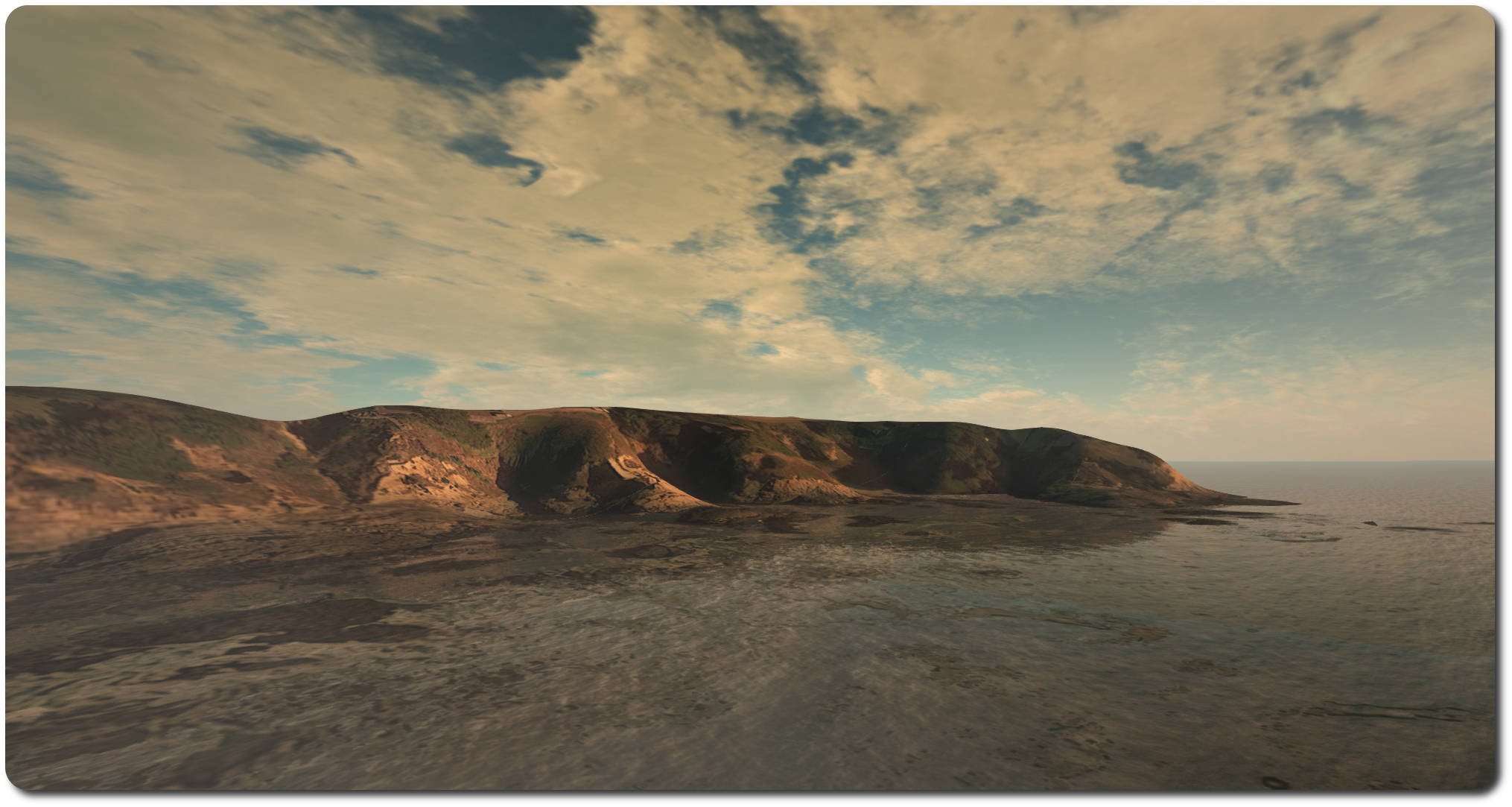
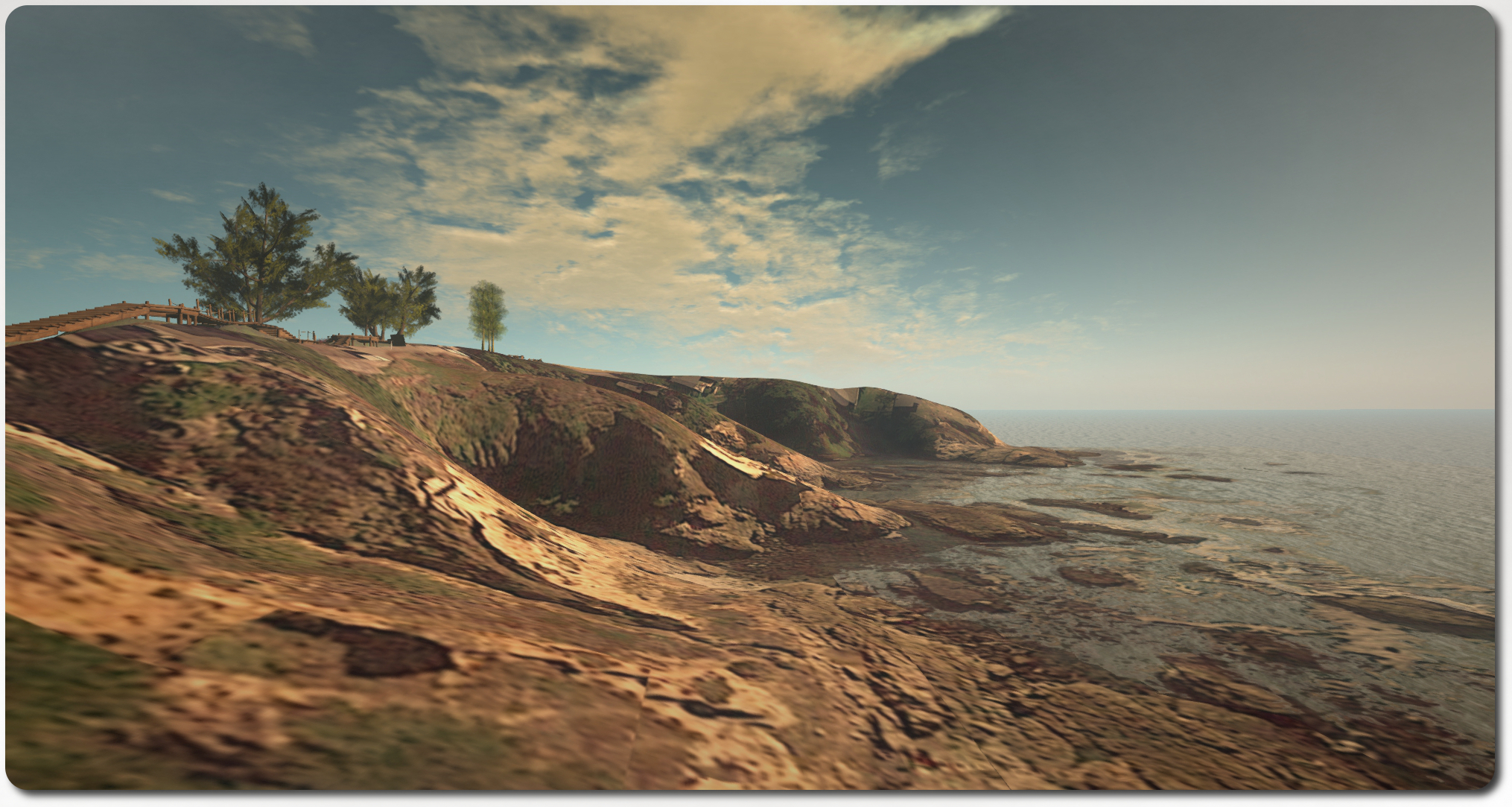
Borderlines is described by the artist as being inspired by the walks across SL organised by Vanessa Baylock, which caused him to come up with “defining a three-dimensional study area of a coastal region in maps and translating it to 64 sq m meshes and flat prims as appropriate.”
The result is what I’d define as an interpretation of a stretch of coastline, rather than a representation of that coastline. While the images used on the mesh and prim elements may well have been drawn from images available on Google Maps (and from, I believe, California), when put together as a whole and viewed panoramically under the right lighting, they could easily be part of the coastline from almost anywhere in the world; for my part, and while twiddling around with windlights, I was very much reminded of parts of both the Devonshire / Cornish coastline in the south-west of England and also of the Yorkshire coast.
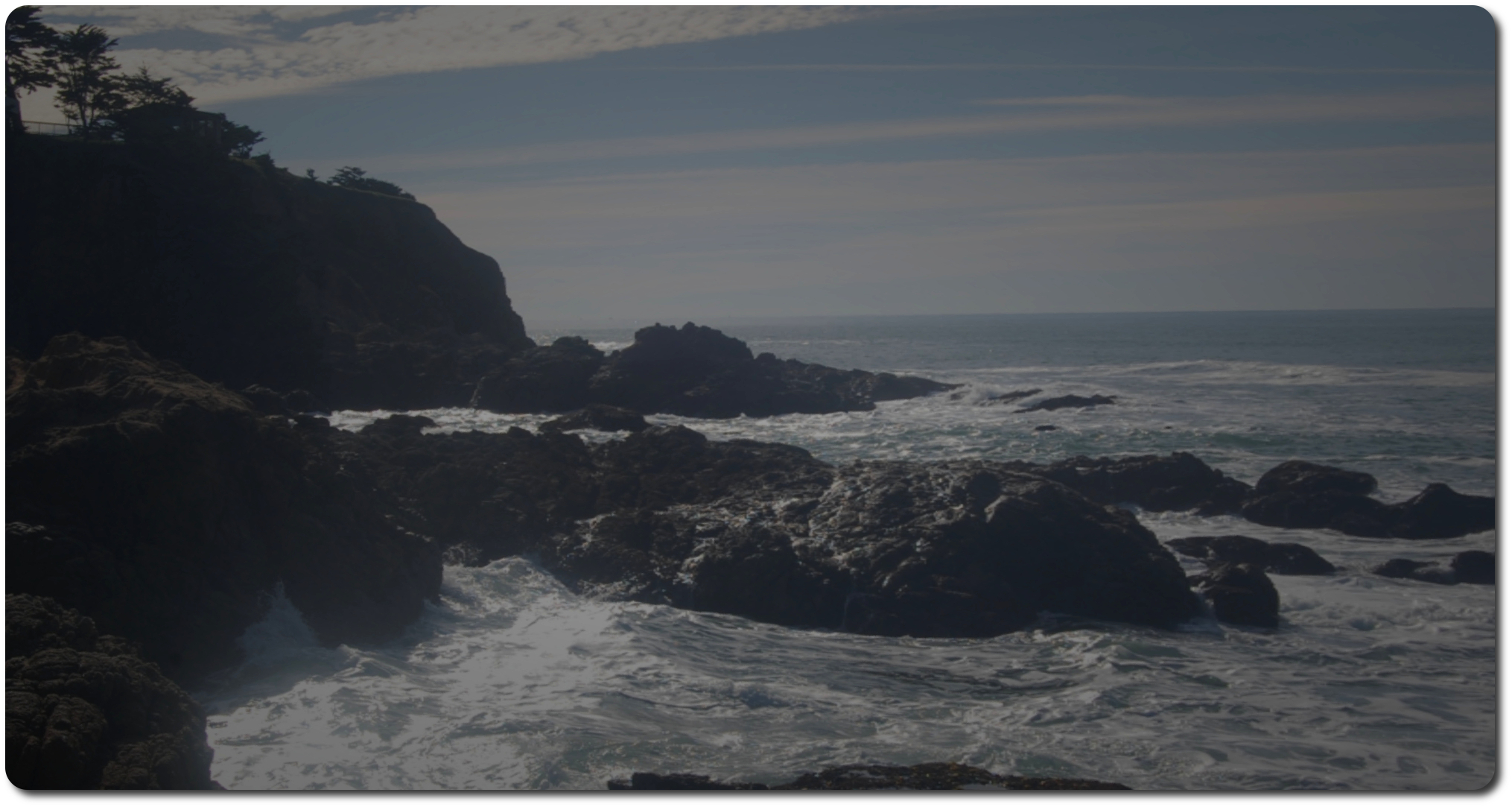
Scattered across the low-lying areas of the installation are a number of dramatic photographs which, if not of the same areas of coastline as represented in the model, bear a strong resemblance to them in places. These are cleverly hidden from view until approached, when they slow fade into view, and add a striking new depth to the piece.
Lemonodo notes that while the project hasn’t worked out entirely as conceptualised, it nevertheless involves a number of borderlines – hence the title. Some of these may be obvious, others not so, Lemonodo doesn’t enter into specifics, so it is up to observer to hypothesize. Several did suggest themselves to me, including the use of the region boundary between this installation and that of the Medici University on LEA23 (which involves Vanessa Baylock whose grid-wide walks initially inspired this piece, remember).
I confess to being more intrigued by matters of perception and contrast, particularly when looking at the coastline from various distances and camera positions, and the manner in which it presents itself to the viewer and the (perhaps untended) questions on perception and depth raised by the inclusion of Lemonodo’s quite beautiful photographs (of which I’d frankly like to see more) against the background of the somewhat “flat” appearance of the Google Maps images when see up close and as they form the backdrop to the photos.
However you look at Borderlines, be it as art or an experiment in modelling or perception, Borderlines offers an intriguing addition to the current selection of Artist In Residence builds at the LEA.
Now open at LEA 6, as a part of the University of Western Australia’s Full Sim Art series, is Lives of the Monster Dogs, an installation by Vilvi Rae.
Located on a set of white platforms that are themselves visually stunning (and something of a tribute to the monumentalism architectural style of Alvar Aalto) which rise from the otherwise flooded region, the exhibit showcases art from furry fandom, the subculture interested in fictional anthropomorphic animal characters with human personalities and characteristics.
“Furries have been part of Second Life right from the beginning (although only part of the fandom inhabits Second Life),” Vilvi notes. “Furry fandom is many things for many different people. Many artists inside the fandom express themselves through art depicting furry characters.”
Vilvi has curated the pieces displayed in the installation, taking time and effort to seek the artists’ permission to reproduce their work in-world. The result is an engaging, informative display, with over 30 pieces of art from a number of artists on offer to visitors. In addition, one of the platforms includes a small media centre providing links to Vilvi’s own excellent machinima on Vimeo, including the award-winning Sun Dog, which took the 2nd Runner-up prize in the UWA-sponsored Machinima section of the 2014 Screen My Shorts Project Homeless short film challenge.
Everything about this exhibition has been carefully and beautifully executed, including the title itself, which as Vilvi notes, is drawn from the 1997 novel of the same name by Kirsten Bakis. Touch any of the pictures on display and you’ll receive information on the piece and its artist in local chat, while the minimalist form of the structural components ideally presents the works on display. Finally, the exhibition is topped through the use of Fox Amoore’s music stream.
I confess to not having come across the latter until visiting Lives of the Moster Dogs, but the music is not only fitting given Fox’s links to the furry community, it is in itself outstanding, and my thanks go to Vilvi for introducing me to it – do make sure you have music streaming turned on as you walk through the installation.
All told, a superb exhibit, perfectly showcasing the artistic talent within the furry community; Lives of the Monster Dogs will remain open through until the end of January 2015.
As I wrote back in October 2014, Mistero Hifeng is a remarkable artist, straddling the physical and virtual. His sculptures and 2D art are visually stunning, mixing the real with the surreal, and I’ve been and an admirer of his work since first noticing it on a number of regions around SL.
An awardee of a full region under the Linden Endowment for the Arts 8th round of Artists in Residence, Mistero has just opened his exhibit on LEA29 to the public.
Bordered on two sides by tall cliffs and open to the sea on the other two, the region somewhat resembles the half region given over to his gallery and sky store: a watery environment with sandbars and small sandy islands, across which his sculptures are ranged, some of them resized to quite large dimensions, making them both easier to appreciate and also quite intimidating in scale.
For anyone who has seen Mistero’s pieces, some of those will doubtless be familiar: the katana wielding chess pieces of Voltare, the haunting faces and figures of Chiuso nella gabbia di un’eta’, the surreal Quante volte ho detto al cielo io, the unsettling Prendimi L’anima, and so on.
However, there are also some newer pieces here as well, such as Come fosse…niente…, and Per Te, both of which I found particularly striking and evocative. Standing, or should I say gracefully arched, over some of the pieces is the imposing figure of Veglio su di te, while scattered across the water is a series of untitled female figures standing beneath umbrellas.
I will confess that I couldn’t entirely escape a slight feeling that I was visiting a commercial extension to Mistero’s gallery, which I’m sure is not the artist’s intent. However, leaving this niggle aside, there is no denying that the additional room offered by a full region does allow several of the pieces to be impressively resized and displayed, as noted. If you have never seen Mistero’s work before, this is perhaps an ideal way of acquainting yourself with it




 Inara Pey: Living in a Modemworld