A Mindfulness retreat in Second Life

Centre for Mindfulness, February 2021
Mindfulness means maintaining a moment-by-moment awareness of our thoughts, feelings, bodily sensations, and surrounding environment, through a gentle, nurturing lens.

– The Greater Good, University of California, Berkeley

Modern life means we tend to always be on the go, both physically an mentality.  If we’re on on our way from something, we tend to hurrying to something else; if were not thinking about tomorrow, we’re reviewing yesterday; we have very little time in which we allow ourself to simply be in the now.

With the SARS-CoV-2 pandemic still raging around the world, even with the bright promise of vaccines and a growing confidence that it can at last be brought to ground and controlled, life has been and remains even more chaotic and stressful, both as we carry concerns about the pandemic and concerns for ourselves, our families and our income whilst also become impatient for a future where we can resume more “normal” lives.

Centre for Mindfulness, February 2021

Hence why perhaps now more than ever  we need the means to escape daily pressures and find room to simply be – and Second Life with all of its potential for freedom of expression, creativity and so on, can be an ideal channel through which we can do this. But even so, we all tend to spend our time in-world doing things and staying occupied; we rarely take a moment to be Mindful of ourselves, to be aware of what our bodies are experiencing and what we are thinking and feeling in the moment we are experiencing them.

It’s easy to stop noticing the world around us. It’s also easy to lose touch with the way our bodies are feeling and to end up living ‘in our heads’ – caught up in our thoughts without stopping to notice how those thoughts are driving our emotions and behaviour.

– Professor Mark Williams, Oxford Mindfulness Centre

Centre for Mindfulness, February 2021

The Centre for Mindfulness is an environment created within Second Life to help anyone who wishes to regain their sense of balance and self. The work of Cythe (Cytheria Teardrop) with the assistance of Anna Timmerman, the Centre has recently completed a relocation to a sky platform over Cythe’s Full region (which has the the added Private region LI bonus), to provide the complete experience for those wishing to re-centre themselves.

An important part of mindfulness is reconnecting with our bodies and the sensations they experience. This means waking up to the sights, sounds, smells and tastes of the present moment. That might be something as simple as the feel of a banister as we walk upstairs.

– Professor Mark Williams, Oxford Mindfulness Centre

Centre for Mindfulness: Meditation lesson; February 2021

Ringed by mountains that suggest it might be located within the highlands of Japan or the mountains of Nepal or Tibet, the setting offers the ideal environment for those who wish to de-stress, either on their own or through scheduled events (details of which can be found on the Centre’s website and on the information board at the the in-world landing point).

In terms of its design, the platform is divided into a number of areas,  all of which can be reached via the landing point’s teleport station  or on foot – but I very much recommend the latter, as it presents far more of the location’s natural beauty. Located within a Zen Garden watched over by a seated Buddha, the landing point offers circular walks to be enjoyed in their own right as a means to lose oneself in the act of walking.

Centre for Mindfulness, February 2021

This garden also offers paths to two of the centre’s facilities  – the Soul Meet, within its walled garden, and the Peaceful Minds pavilion sitting over a pool of calming water. Both of these play host to events at the Centre – at the time of my second visit, a class in meditation was taking place within the pavilion, underlining the fact that whilst in the virtual realm the Centre is very much about our condition in the physical.

Another important part of mindfulness is an awareness of our thoughts and feelings as they happen moment to moment. It’s about allowing ourselves to see the present moment clearly. When we do that, it can positively change the way we see ourselves and our lives.

– Professor Mark Williams, Oxford Mindfulness Centre

Beyond the gardens, a bridge reaches out to a peak offering the opportunity to perform simple yoga exercises alongside your avatar at the Happy Stretch gazebo – just follow the information boards on the gazebo’s walls. The bridge also provides a view down over a crater-like lake. Reach via path, stair and walkway and sitting on the the waters of the lake is the Tranquillity Bath, where your avatar can rest and you can  learn about the restorative power of the Osen.

Centre for Mindfulness, February 2021

Across the ridge of the gardens and to the east, is a second body of water. Reached via a walk along the ridge and between tress, it is home to the Dreaming Buddha, it is a place where swan boats can be ridden in a perpetual circle while you turn your thoughts inward and in peace.

Also close to the landing point is the Coin Store. To encourage participation in the Centre’s activities, visitors can earn CfM coins and exchange them for selected items. While I’m not sure the idea of involvement for reward is entirely in keeping with a genuine desire to reach a state of Mindfulness, I do understand the reason for including it; Second Life has more than enough to distract the mind and keep it occupied, that having a means to entice return visits can only help with on-going participation.

Centre for Mindfulness, February 2021

With space to explore, room for centre staff and what looked to be additional facilities waiting to come on-stream together with a full schedule of events open for anyone to join in, The Mindfulness Centre has a lot offer open minds. My thanks to Malburns for pointing me towards it by way of The World of Yana.

SLurl Details and Link

The captivating realm of Thor’s Land in Second Life

Land of Thor, February 2021

Land of Thor is possibly one of the most unusual and engaging realms we’ve visited in Second Life. Described as being “loosely based on Norse mythology”, we  found the region to be an engaging curio of exploration during the time of our first visit back in February 2018, whilst a recent return to visit one of the art galleries within the region see: Moni and Traci at Midgard Gallery in Second Life) gave rise to a desire to re-visit and explore once more. In doing so, we discovered that much has changed – and also remained somehow the same – greatly adding to the region’s appeal as a place to be explored.

Surrounded by mountains and itself a rugged domain with changes in elevation marked by great cliffs and domed hills which are home to, or guardians of, high tables of rock and land, the region can be somewhat divided into areas that take their name from Norse mythology: Niflheimr (“land of Mist or “world of the darkness”);  Álfheimr (“Land Of the Elves” or “Elfland”); Jötunheimr (the land of the Giants); Vanaheimr (“home of the Vanir“) Midgardr (“middle enclosure”or Earth) and Seidr Gallery, which I assume is a reference to seiðr, or old Norse magic.

Land of Thor, February 2021

A teleport system available at the landing point provides a quick means of jumping between these locations – but I would strongly suggest avoiding it; paths and stairs also interconnect almost the entire region and offer a far more rewarding means of seeing all that it has to offer, including the secrets that might otherwise remain hidden. I  should also note that for those wanting to eschew walking and teleport system, a dragon ride might also be taken to fly around the region (or you might try pulling Mjölnir from the rock in which it is partly embedded and whirling it around to fly from point to point – but good luck with that! 🙂 )..

Each of the realms noted above presents a different aspect of Land of Thor to enjoy, reflecting – at least in part – the realms from which they take their names.

Land of Thor, February 2021

For example, Álfheimr, lying to the north-east of the region remains unchanged since our original visit of three years ago – just as one might expect of a land that is home to ageless elves. With its garden-like setting (complete with somewhat Arthurian elements that add to the overall mysticism of the region) and its rather delightfully eclectic mix of ideas and objects, Álfheimr remains a place to relax as time seems to stand frozen, as indicated by the clocks with hands that never move, one of which has doves caught forever within a beat of their wings  hanging in the air above it, and the little trains that forever circle their tracks, never arriving at their destination.

Similarly, Jötunheimr sits on a high plateau and a tall peak to the south-east, marked by the presence of huge figures who – if I might borrow from a more modern mythology, that of Babylon 5 – appear in part as “giants in the playground”, disinterested in the little people who might roam the landscape, instead enjoying the views their high perches afford, and in the case of one, looking set to launch a Spitfire into the air (perhaps the ‘plane is a new airborne ride for the local Valkyrie? 🙂 ).

Land of Thor, February 2021

Midgardr, meanwhile, occupies the region’s lowlands, which are more extensive than you might think. A deep gorge cuts into the region from the south, presenting a sheltered bay in which a town has sprung up. But no abode of Vikings is this; with its large warehouse, brick-built shops, street lighting, bicycles and more, it is a thoroughly modern setting, albeit one watched over by whatever gods might dwell within the high castles above.

These lowlands also skirt the plateaus to offer paths around the water’s edge that may take visitors by way of streams and bridges to low-lying houses sitting at the water’s edge and the realm of Vanaheimr, or to the broad meadow of Niflheimr. It is here that – if not already found as a result of wandering feet and carefully prying eyes – a secret of the region is revealed: there is as much to be found underground as above it.

Land of Thor, February 2021

For beneath and within the high tables of rock and the peaks that in place rise from them are great caverns awaiting discovery. Admittedly, at the time of our visit, one of the – and the most obvious to spot, simply because it is still being worked on – sits under the cliffs to the north of Niflheimr, in the roots of the uplands that present more elements of the region to be appreciated, from gardens to  a coffee shop and summer houses an waterfalls. The other caverns are all homes to art galleries, one of which is fairly extensive and has secrets of its own to be revealed by careful explorers (make sure you follow all of the arrows!).

Dominating the region are two great castles, one of which was present at our last visit. Neither appears to be directly accessible, although they are connected one to another by their own teleport system (which includes a hidden nod to Asgard’s Bifrost) and a great elevated stone causeway. Given their isolated nature, I assume they are the private residences of Land of Thor’s designers, Thor (Anaadi) – who also holds the region – and Selim Noland.

Land of Thor, February 2021

I mentioned above that “almost” all of the public places within the region can be reached on foot as well as by the landing point teleport system. However, there is one exception, that of Seidr Gallery. This resides high in the sky over the region, thus requiring the use of the teleport in order to reach it. At the time of our visit, it was hosting art by みどり (Midori Rotaru), some of which can also be found within one of the ground-level gallery spaces.

Land of Thor is genuinely a place deserving of careful exploration as there is so much waiting to be found – not all of which I’ve covered here. It can place something of a load on a system when visiting, so a little juggling with settings might be required – but the rewards in doing so are more than worth it.

Land of Thor, February 2021

SLurl Details

A return to Where Our Journey Begins in Second Life

Where Our Journey Begins, February 2021

Update: Where Our Journey Begins has been relocated, and the SLurl in this piece updated as a result.

Where Our Journey Begins is a homestead region held and designed by Vivian Ewing. It’s a place we first visited fairly recently – in September 2020, in fact. However, after getting several nudges from people that the region has been redressed for the coming Spring, I suggested to Caitlyn that we hop over and take another look.

The changes made since that first visit of ours are extensive; yet at the same time, there is much about the setting that does offer a sense of continuation from that iteration to this: the curtain wall of cliffs with their waterfalls (now to the south-east of the region, rather than to the north), the use of granite-like tables of rock on which to site some of the region’s buildings, etc. This mix gives the region a pleasing sense of the familiar couple with discovery.

Where Our Journey Begins, February 2021

The land itself also offers a reminder of the former build: a large arc of land sweeping from the north-east and round to the south-west, those high falls dropping from its eastern face into a large pool of water. This in turn splits the lowlands by means of two streams that flow west and north respectively, trapping a wedge of land between them. And just off the shoreline of this wedge is a small circular island that serves as the landing point for visitors, connected as it is to the rest of the region by an ageing wooden bridge.

Across the bridge, and under the shade of ginkgo biloba and cherry blossom trees, and the turns of gulls circling above them, a track offers a choice of direction across the land, with the shorter arm directing visitors to where a path winds up the table of rock occupying the centre of this island, the longer offering a path around its base.

Where Our Journey Begins, February 2021

Which of these you take is entirely up to you. If you want to avoid getting your feet wet, then the path up to the top of the squat plateau is the best means of reaching the north-eastern “headland”, going by way of two high bridges. The first of these spans the gorge between the first plateau on the island and the second, home to a small summer house  and with a much longer rope-and-wood bridge extending across the broad valley of the stream below to reach the north-east uplands.

The latter are home to a flat-topped house with flat-topped / adobe walls and an external stairway leading to the upper floor. Hemmed by trees and shrubs, it looks west towards the sea, the region’s lighthouse just visible through the foliage of two aged and gnarled trees standing guard over a garden swing. Sitting at the foot of one of these trees, and marked by a large urn, is an overgrown path that leads down, somewhat precipitously, to a small sheltered beach.

Where Our Journey Begins, February 2021

This is actually one of two beaches within the setting, the other being off to the west, reached via the second arm of the track leading away from the landing point’s bridge. steps down from this arm of the track point the way to it by way of a farm small holding with water tower, shed, tractor and livestock. Bracketing the track on its other side from the steps is a old paved area the marks the entrance to the gorge between the two humps of the island’s plateaus. It  is home to a ice cream stall and outdoor seating – although those wishing for a little refreshment will have to wait in line behind the little girl who is passing on her order!

Beyond this, the track ends at a low flight of steps and a choice of routes: either across a little arched bridge crossing the second of the region’s streams, or continuing eastwards to under the broad shade of great oak trees.

Where Our Journey Begins, February 2021

A chapel and open, grassy space lie across the bridge, a pastor waiting within the chapel to conduct wedding services for L$300, the space outside being suitable for the after-service photographs. Off to the east and beyond the oak trees, there sits a caravan that looks to have been converted into a more permanent residence, complete with creature comforts such as satellite TV and a curtained deck overlooking the region’s pool and waterfalls. Like the house up on the uplands, it is unfurnished, so you’ll have to let your imagination fill in the details.

Throughout the setting are numerous touches of detail that make it ideal for photography, and a good number of places to sit and pass the time. Good use is made of EEP settings to produce a unique ambient environment,  complete with rainbow for those prepared to play with the Sun position via Personal Lighting. Admittedly, the colours of the rainbow will be inverted thanks to a rendering bug (unless you are using the latest Love Me Render viewer from the Lab}, but the LMR 5 viewer does mean a fix for this issue should be filtering through to all viewers in due cause.

Where Our Journey Begins, February 2021

Overall, Where our Journey Begins remains a pleasing visit with more than enough to engage the Second life tourist.

SLurl Details

A return to Tonarino in Second Life

Tonarino, February 2021

On February 1st, we dropped in on Tonarino, the Full region held and designed by 秋元のん (n0rik0). At the time, the focus of our visit was the region’s sky platform, Nekomachi Street (see: The cats of Tonarino in Second Life), but I noted we also hopped down to see what had changed within the region’s ground level design since our last visit in December 2019 (as recorded in Tonarino: an oriental curio in Second Life), and I promised to provide an update.

Well, truth be told, first looks tended to suggest not a lot had changed; the majority of the region is still given over to a large landmass in part cut through by the single line of a railway track that terminates abruptly alongside a little station building, while a small stream slices through the bedrock. Around both lies a landscape suggestive of the outskirts of a town somewhere; the kind of place most people only see whilst rapidly passing through with barely a thought for those whole live there.

Tonarino, February 2021

However, further examination revealed to us that things had changed since December 2019 – although obviously I cannot say quite when they changed; and changed enough to provide a reason for further exploration and looking around.

In this, the most noticeable change lay to the north-west. where the land rises in rocky steps to overlook the rest of the region and particularly overshadows the local school.

Tonarino, February 2021

When we visited in 2019, I noted this was the home of a temple sitting within  a small garden area and overlooking a large traditional Japanese house occupying a shoulder of rock below it. Well, the temple is still there, complete with its little refreshment stand for those needing sustenance after the climb up to it or after a period of sustained prayer. However, and if memory serves, it has now descended from the uppermost table of rock upon which it once sat, to occupy the same elevation as once was occupied by the large house.

Instead, the high table of rock that was once home to the temple is now a lookout point with vending machines and seating. Below it, the walled house has also gone, replaced by a group of restaurant stalls sharing a common outdoors space for patrons, who can be entertained by two more of the remarkable juggling cats by 丸角の人 (shiro0822), who also make up the inhabitants of Nekomachi Street up on the sky platform.

Tonarino, February 2021

I admit, I’m not totally convinced about the nature of the food being served in one of the restaurant stalls, given it is being prepared and offered for consumption by red-faced little demons, so the fact the area also has a little shrine of its own sitting within a bamboo fenced enclosure is perhaps handily placed for those wishing to ward of any wicked spirits that may have been delivered to them with their meal! The shrine and its Torii gate also mark the path to where a stone stairway descends the snowy slopes between the little houses that cling to them, offering a further route back to (or from) the lowlands.

Elsewhere are other subtle changes. One of the private islands to the west side of the island has been removed; elements within the building site have changed (although overall progress on whatever is to be built / installed appears to be a little slow!) an there is what appears to be some work to be finished off behind the school, although visitors can still cross the footbridge and visit the café – although I’m not sure if the quizzes there are still being held.

Tonarino, February 2021

What I find particularly engaging with Tonarino is the manner in which it naturally suggests it is a work-in-progress, so to speak, with the excavator and building blocks in a cleared field, etc..  At the same time the careworn look of the buildings and houses give them a lived-in feel that suggests that while they may be less than pristine, they have the comfortable look and feel to those living within the little town.

Certainly Tonarino remains a place with plenty of opportunities for photography under almost any environment settings, and which – again like so many careworn places in the physical world – has little spots of beauty that suddenly leap out at you as you explore. And that very much retains it as a place worth looking at.

Tonarino, February 2021

And for those who wish to see Nekomachi Street’s marvellous cats, just look for the kitty dancing at the mouth of a road tunnel. Pat his head gently and he’ll get you there 🙂 .

SLurl Details

Dya’s Little Jordan in Second Life

Dya’s Little Jordan, February 2021

The start of February saw me hop over to tour Dya OHare’s latest design at her homestead region after receiving an invitation from her to do so. It’s a setting that sees Dya move away from the Americas, which have been a focus for her last two designs (see:  Dya’s Scent of the Caribbean in Second Life and Dya’s Southern Twilight), and instead turn to the Middle East for inspiration.

As its name suggestions, Dya’s Little Jordan is a take on the Kingdom of Jordan, and it has quite a lot to offer Second Life photographers. However, I’ll state up-front that, thanks to past idiocy on the part of some visiting Dya’s builds, group membership (L$300, so not a fortune) is now required to access Dya’s region, so do keep that in mind. I’ll also confess that Jordan isn’t a country with which I’m overly familiar outside of reading about it, so I have no idea whether the entire setting is drawn from actual places to be found in that country, or just parts of it are, and the rest is down to Dya’s imagination.

Dya’s Little Jordan, February 2021

The landing point is located in a small waterfront area, the open waters before it suggestive, perhaps of the Dead Sea rather than the river Jordan itself. Here, with a souk to attract tourists, the promise of coffee and sea food all separated from the water by a curtain of palm trees, visitors might wander or sit, boats bobbing on the water just across the road.

The southern end of this road ends at a small motel, the hard surface giving way to a beach backed by a number of house built to traditional designs, but with modern trappings that include – for one at least – a swimming pool. Behind these houses sits a more desert-like landscape that runs eastwards away from the town, and northward behind it.

Dya’s Little Jordan, February 2021

A second road cuts through this desert, vanishing into a tunnel on the east side of the region, where an off-region surround takes over, extending the rugged landscape off to the horizon. Between the hills and the town, this desert area offers several points of interest, from dun-coloured houses belonging to the local livestock farmers, and the region’s take on the Al-Khazneh mausoleum in Petra, which lies tucked away behind curtains of rock that form narrow defiles that must be travelled to reach it.

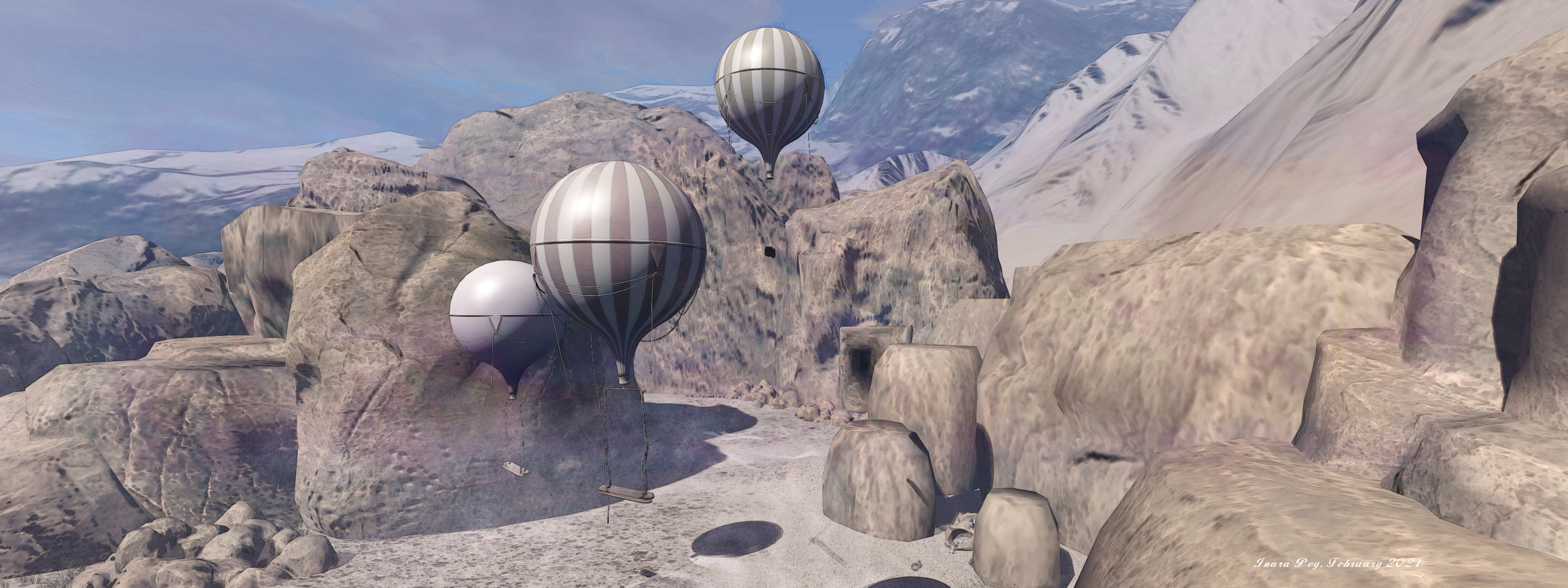
Elsewhere awaiting discovery is a camp site of traditional tents and, a little surprisingly, a trio of balloons that float within wind-blown sands and offer swings on which to sit as little shooting stars whip past. Goats and sheep are to be found across the landscape, together with a small train of  dromedary camels.

Dya’s Little Jordan, February 2021

Those who fancy may also find camel rezzers that allow them to take a ride around the region, whilst for the less adventurous, a little jeep rezzer offer the means to go for a drive and a bicycle rack at the information centre will provide visitors with a pedal bike. Dya also allows those with wearable horses, etc., to mount up and see the region by hoof or wheel. The information centre also provides a very short introduction to the Kingdom of Jordan, for those who would like to know a little more about the country, but who don’t necessarily want to wade through the minutiae of a Wikipedia entry!

As with all of Dya’s region builds, Little Jordan is very easy on the eye and the viewer. There are numerous things to see and enjoy, and a good number of opportunities for photography. Should you opt to enter the mosque, however, do follow the examples at the entrance and remember to remove your shoes!

Dya’s Little Jordan, February 20221

SLurl Details

The cats of Tonarino in Second Life

Nekomachi Street, Tonarino

This is the first of two pieces on  Tonarino, a Full region we originally visited just over a year ago in December 2019 (see: Tonarino: an oriental curio in Second Life). At that time, the region was a ground-level build, the work of 秋元のん (n0rik0), offering a Japanese urban design theme that was photogenic and fun to explore.

However, not long after our initial visit, n0rik0 extended the region design with the inclusion of a sky platform – Nekomachi Street – which we actually managed to miss at the time it was available. So, when I noted by way of Annie Brightstar’s Scoop-it pages that Nekomachi Street was back, I knew it was time for a return visit to Tonarino, starting with the sky platform lest it only be available for a limited time, and then progressing to the ground to see what has changed there.

Nekomachi Street, Tonarino

The clue to the theme of the sky platform, if the preceding shots above haven’t actually given it away, is in the name – neko, as in cat, so “Nekomachi” could be taken literally as “cat town” or “cat city”, with the setting itself being precisely that: a street scene featuring cats. However, these are not your average domesticated cats, as clever as they may be. These are cats that are completely anthropomorphic and who have overcome the limitations of not having an opposable thumb, in order to create a very human-like life for themselves in what is a delightful continuation of the overall Japanese theme for the region.

For those who visited the location in its past iteration, I understand that outside of the restaurant specialising in crab delicacies, not much has changed between this iteration of Nekomachi Street and the last. Which doesn’t mean it shouldn’t be re-visited; quite the reverse, I’d say: the entire setting is utterly adorable, whether or not you have seen it before.

Nekomachi Street, Tonarino

These feline characters – from sets by 丸角の人 (shiro0822), and sold under their Maru Kado brand (just search for “cats” to list the three sets) – are going about their daily lives just as we humans might. In this, n0rik0 has sown considerable creativity in how the various cats are presented and what they are doing.

Take the crab restaurant, which I’ve arbitrarily selected as a landing point for the article (the setting does have a more “formal” point of arrival / departure, but I’ll come to that later). Here, a kimono-wearing cat is clearly being tempted by the window display as she walks by – and is about to be further tempted by the platter (of samples?) a member of staff is holding by the entrance, whilst inside customers are happily eyeing their meals of fresh crab and supping beer.

Nekomachi Street, Tonarino

Further down the road from the restaurant, another cat is on his pizza delivery round, skilfully managing his bicycle while holding aloft a veritable tower of boxed pizzas, meals the group of cats and kittens putting on their own show outside the local cinema might actually enjoy, although they seem quite wrapped up in their dancing. Around a corner, meanwhile, another cat has stopped his little van above the local river to appreciate the view. A few metres away, another cat peruses the outdoor racks of the local bookshop while inside, the shop owner stands engrossed in one of his tomes.

Throughout the setting, around every corner and within many of the little shops and stores, similar scenes unfold, from the mechanic taking a break from work to enjoy and garden lunch and a read of a newspaper, to the baker and the happy-go-lucky delivery cats with their cart. Unsurprisingly, food does play a considerable role in daily life here – but name me a cat that doesn’t consider every minute of the day to be approximately half-past dinner time and therefore ideal for a snack?

Nekpmachi Street, Tonarino

However, the most endearing little scene awaits discovery along the eastern street.

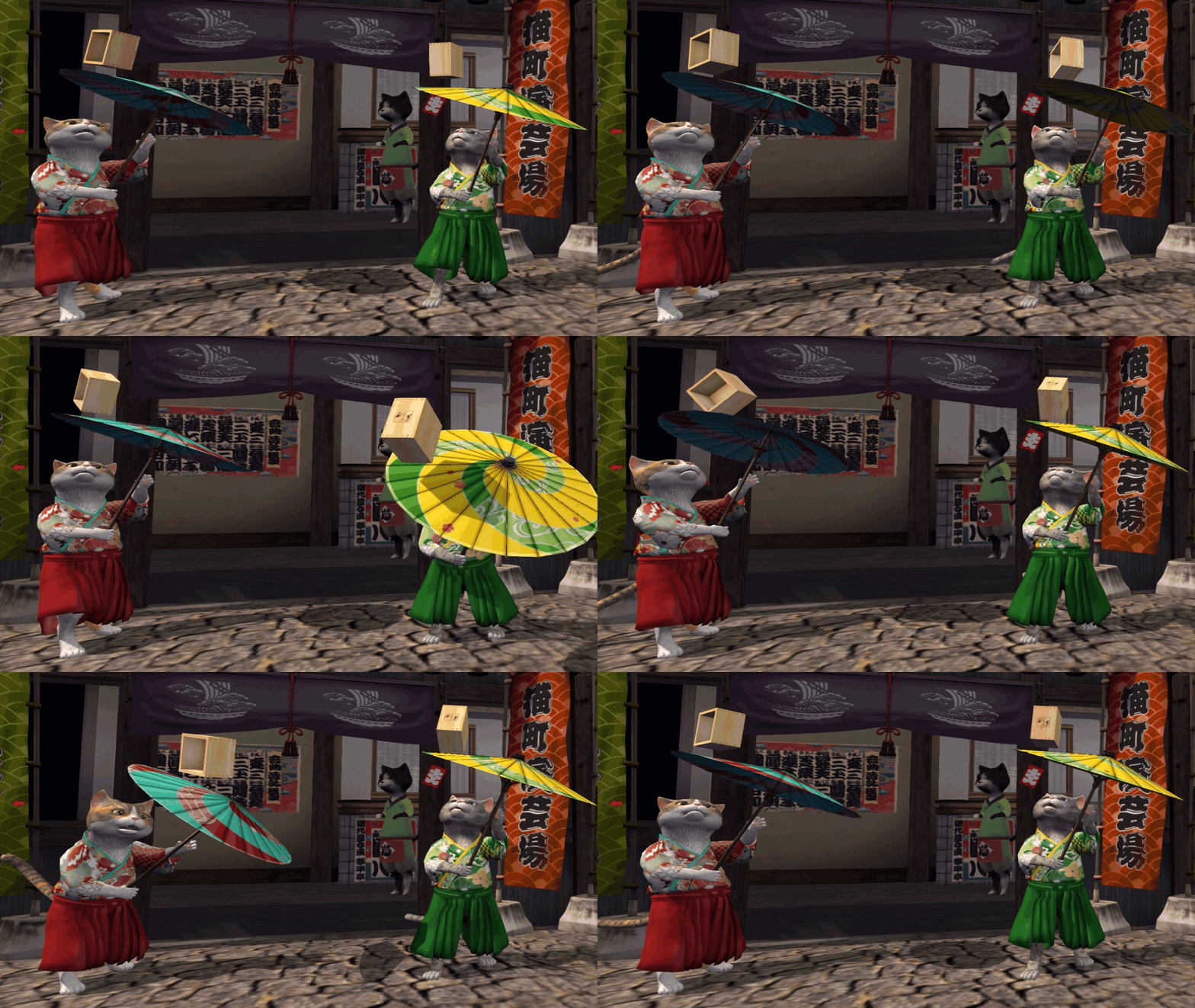
Here, outside the local theatre and before a growing crowd, two highly skilled jugglers put on a show intended to entice people into the theatre – and their use of parasols and little boxes is a delight to watch. Animesh in nature, these are part of a gacha set by shiro0822, items of which can be obtained from the Maru Kado in-world store.

Juggling Cats

Just across the road from the theatre is a little alley linking the street with another, and which is notable for the little work cat climbing out of the manhole there. However, more than just working, he offers the way down to the ground level, and forms the “official” landing point for Nekomachi Street – touching his head will deliver you to the ground-level town, but I’ll be covering that in the follow-up to this article in due course.

SLurl Details