Update February 20th 2014: Linden Lab discontinued Creatorverse on February 19th, 2014. As such, links to the Creatorverse website, various app stores, etc;, have been removed as no longer valid.
April 19th saw the Android and Kindle Fire versions of Creatorverse made available for free, following in the footsteps of the iOS version.
Interestingly, the move has been without any formal announcement from Linden Lab, although the Creatorverse website has been updated to note the app is now free on all three platforms. I actually only found out as a result of an update message appearing on my device on April 19th. Of course, there’s not much to say on the matter which hasn’t already been said with the iOS announcement – but it’s hard not to escape the feeling than the lack of any bell-ringing concerning the Android / Kindle move pretty much suggests that Creatorverse is now not so much a “fire and forget” product as a “fired and forgotten” product where the Lab is concerned.
The update brings with it a slight change to the user interface, which now includes a shopping basket for in-app purchases of “add-on” packs.
The updated Creatorverse UI with the new shopping basket for in-app purchases (top right)
The first three of these are a Rocket Tool, priced at £0.64 ($1.00), a Power Pack, a Forces Pack and a Portal Pack, each priced at £1.29 ($), which appear to have superseded the original “Advanced Creator Pack” referred to in the original LL press release marking the pricing restructure. For those who have previously purchased Creatorverse, the Power Pack, Forces Pack and Portal Pack are all denoted as “Purchased” in the shopping options, as they all form a part of the original Creatorverse release.
A further change in the UI is that the forces button is removed from the left side of the screen – which has led to at least one mistaken report that the forces capabilities, etc., have been “removed” from the application and must be repurchased. This isn’t the case as indicated above. Rather, a new set of buttons for defining forces, etc., can be accessed at the bottom of the screen. For those obtaining The updated version of Creatorverse for the first time, one assumes these new buttons will only become available as the additional packs are purchased.
The new in-app purchase capability which recognises the fact I already have a “paid” version of the app, and so marks the appropriate optional packs as “purchased” for me
Back when Creatorverse was made free on iOS, I ruminated if it might not be a canny move on LL’s part – or the last attempt to eek a return out of a floundering app. My preference was for the former; however, users don’t agree, and reading through some of the comments left on Google Play and the Apple App store, reaction has been negative.
For my part, I admit I gave up on Creatorverse a while ago. That is not in itself an indictment of the application – it didn’t have any major appeal for me to start with. Rather, it is a reflection of the fact that I’m more interested in other offerings from LL.
Not that you’d guess that from the contents of this blog :D.
Linden Lab have announced that as from April 2nd, 2013, Creatorverse, the first in their new range of products to be released in a “full” version, is available free-of-charge for the Apple iOS (iPad, iPod Touch and iPhone) – however, “advanced tool” packs will now be sold within the application itself.
The announcement of the move reads in part:
SAN FRANCISCO – April 2, 2013 – Linden Lab, the makers of shared creative spaces including Second Life®, PatternsTM, and dioTM, today announced that CreatorverseTM for iOS is now available for free. Previously, Linden Lab had offered Creatorverse for iOS for $4.99, and Creatorverse Lite for free, but now Creatorverse is available for iOS as a single, free app. Creatorverse for Android and for Kindle Fire will soon follow the same model.
The announcement goes on:
For more complex creations, packs of advanced tools like teleporters and motors, are now available for purchase within the app. In addition, a new capability for Creatorverse, thrusters, are now available in the Rocket Tool Pack, which will allow users to easily add rockets, jetpacks, and more to their Creatorverse designs.
Creatorverse – “Full” version now free on iOS – other than “advanced tools” – Android and Kindle to follow
The the first of the “advanced tools” packs will be an “Advanced Creator Pack” priced at $4.99 However, all those who have purchased Creatorverse for iOS prior to the pricing model change will receive this pack free of charge – and it is assumed the same offer will be extended to Kindle / Android users when these versions also switch to the new pricing model. Whether or not other “add-on” packages will be offered at the same price remains to be seen – but it appears likely.
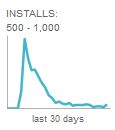
Downloads rapidly tumbled on Google Play (Dec 2012)
It’s been hard to gauge how Creatorverse has faired since being launched; while initial interest was high, it did appear – within the Android market at least, to tail-off very quickly, with downloads plummeting rapidly. Today, downloads appear to be so low, they are no longer graphically represented on Google Play
As I commented on the launch of the “Lite” version of the application, it’s hard to judge the move on LL’s part – is it a clever marketing ploy or a further attempt to bolster an application which isn’t actually making much headway?
Doubtless, there will be many who see the move in terms of the latter.
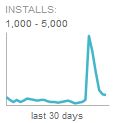
Creatorverse Lite downloads on Google Play (Mar 2013)
However, offering the app free, but holding the more advanced tools back as a purchasable option could actually be a canny move – and it is possible that downloads of the Lite version of Creatorverse have encouraged LL to think in these terms. These appear to be running at a somewhat higher daily average compared to the full-price version – which is suggestive that there is a market for the free version of the app out there, and that the marketing additional features and capabilities in “advanced” tool packs could be a tidy way for LL to continue to generate revenue off the back of that popularity, and to maintain interest in the product as a whole.
In this regard, the idea of generating income from “expansion packs” isn’t new – it’s something those at LL with a background in games will be very familiar with. What’s more, it is putting Creatorverse in the same marketing model as Versu.
Update, October 9th, 2014: Linden Lab announced that development work on Patterns has been discontinued.
Patterns, Linden Lab’s sandbox building game available for Windows and the Mac, which launched on October 2012 utilising Steam as the initial download mechanism before becoming directly available via the Lab’s own Patterns website, has now moved to the Steam Early Access platform.
Launched on March 21st, Early Access allows users to play games that are currently in development. It initially kicked-off with a total of twelve titles in various stages of development, and which users can purchase and play. In return, developers gain access to community feedback, players can play games in alpha or beta stages, and Steam gets to remain the one-stop shop for digital downloads.
As such, Patterns – which remains in its Genesis Release phase and at the Genesis price of £6.99 ($9.99) – is an ideal candidate for the new Steam service, as it brings the game to the attention of a much wider audience than has perhaps been available to it until now.
Patterns now available as a part of Steam’s Early Access platform
Coming alongside the move, the Patterns Community page on Steam has also been updated with news on the move, commenting in part:
We first launched Patterns as a ‘genesis release’ in October 2012, and we are now happy to make it available to everyone on Steam as part of the Early Access program. We are still very early in the game’s development, but have already made many updates. If you’re interested in seeing how Patterns has grown and improved so far, check out our update history in the News section.
As genesis release users, your feedback will help shape Pattern’s evolution. Please keep the comments, screenshots, videos and your thoughts coming! Know that we are reading and paying attention to your feedback, even if we are not able to respond to every post with a comment.
Since its initial launch, Patterns have continued to be enhanced, with both bug fixes and new features being regularly added to the game – many of the latter in direct response to ideas and input from Genesis users. These new features include additional worlds, more substances for building, more formations, some with new – such a slide, bounce and fly.
More enhancements and capabilities – again, some of which have been user-requested – are due in the future, including a multi-player mode, the ability to build personalised worlds and shared them with other users,
The caption says it all (courtesy Linden Lab)
Of all the new products launched to date by Linden Lab, Patterns is the one which potentially has the most visible traction – the Steam / Genesis user community is active, the community pages contain a good mix of discussion, ideas and Q&A, and the game appears to have picked-up a good level of support and enthusiasm from non-SL users – something which could bode well now it is effectively available on a more widespread basis within the Steam community.
Update, February 19th, 2014: dio was discontinued by Linden Lab on February 19th, 2014. Links to the dio website, etc, have therefore been removed from this article.
dio, Linden Lab’s browser-based “social experience” reaches two months of age this week. Whether this will be accompanied by any updates remains to be seen. So far, there appears to have been only one significant update to the application, which appeared at the end of February, a month after the original launch. As I’ve not really commented on dio for a while, I thought I’d take time out and have a poke at some of the updated features.
The Updates
“Live Chat” / Comments
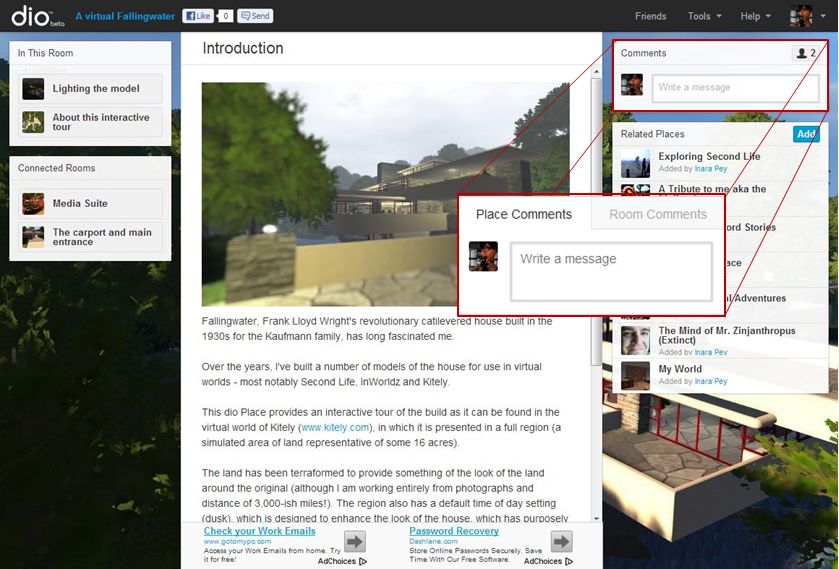
When browsing dio Places, perhaps the most obvious update is that Comments have now been expanded to include Places as well a rooms. I’ve previously been critical of the idea that dio presents “persistent live chat” when in fact the “chat” element is more of a basic message board service, limited by the fact it only applies to rooms – so any conversations which might occur in real-time can ge abruptly interrupted as one person shifts to another room without warning.
The dio product team have addressed this by adding a new tab to the Comments panel. Entitled “Place”, it does exactly what it says on the label – allows comments to be made about a Place, rather than a room, and to be accessible from any room visited within the Place.
The old dio Comments panel (main picture) and the new, tabbed approach for commenting on rooms and Places (inset)
New Editing Buttons
The updates also bring a set of new on-screen editing buttons what are immediately available at the top of a page on creating a room. These provide easy insertion / creation of:
Photos
Videos
Inventory objects
Exits to other rooms
All of these work on the same principles as the initial release of dio, although the editing screens for the options have been revised somewhat (see below).
The new buttons options displayed at the top of each room when in edit mode, allowing object, etc., to be added directly to the room.
Additionally, a new option is provided – that of Text, which opens a simple text editor which can be used to generate simple blog-style entries for a room. Currently, there is no means of formatting text, so how useful this option might be remains to be seen. Once created, text objects appear in the In This Room panel along with all other types of object. Text objects can also been assigned Actions as well, which offers interesting options with their use; for example, in an adventure game Place, a text object could be set as a map with both explanatory text (or perhaps a riddle as to what it means), which can be taken by others. They then have the choice of both looking at the map and reading the associated explanation / riddle.
The much-anticipated storytelling app is being made free-of-charge and is bundled with a tutorial, a “scene” and a “full length” story, with other titles to be offered at $4.99 each and offered “periodically”.
The press release announcing the lauch reads in part:
A product of Linden Lab’s acquisition of LittleTextPeople earlier this year, Versu provides unique narrative experiences in which the reader is an integral part of character-driven interactive stories. In Versu, you take on a character with distinct preferences, concerns, and desires, as you explore and change a story through your decisions and interactions with other characters. The characters you encounter are endowed with sophisticated artificial intelligence and have their own unique personalities, motivations, and emotional reactions as you interact with them. The decisions you make and how you treat other characters define your character in the story and influence the narrative, giving each title the potential for many unique experiences to explore. In the future, the tool set used to build these immersive stories will be made available to users, enabling readers to insert their own characters and scenes into the narratives they explore.
The Versu website provides more information on the titles released with the app:
An Introduction to Society: a piece approximately 5 minutes in length and designed as a tutorial / introduction to Versu with a lighthearted theme, covering the basics of interacting with the app – understanding objectives and achievements, playing settings and directing a chosen character. The story involves Lucy, a schoolgirl receiving instruction from her grandmother about how to behave herself in polite society. There are several possible outcomes to the story, as well as a little background on characters who may appear again in future titles.
The Unwelcome Proposal: in this scene, adapted from Pride and Prejudice and which runs some 5 – 10 minutes as a further introducion to Versu, Elizabeth’s cousin Mr Collins is full of reasons why they should be married. She disagrees, but can she convince him her refusal is sincere? Users can play as either Elizabeth or Mr Collins, exploring routes through Austen’s story and drawing heavily on her original text.
The first Versu title, offered at $4.99
The House on the Cliff: a full-length original story running to some 30-45 minutes by Emily Short. An accident to a carriage and mail-coach strand a group of strangers in a desolate stretch of coastland. The only source of shelter is an ancient, rambling estate, where neither servants nor master appear to be at home. Users can pick character from a wide selection and play through the story, forming alliances or finding enemies among the other travelers. Tasks within the story include working to recover from the crash, uncovering the secrets of the estate, and the option to pursue aims unique to the chosen character.
A Family Supper: offered at $4.99, this is a full length story of around 30-45 minutes. The Quinn family is hosting a small house party, but an unconventional guest threatens their peace with sonnets, vegetarianism, and a gift for finding everyone’s sore points. When secrets start coming to light and a corpse appears, it’s up to you to bring about justice – if justice is what you want. Players can choose between one of two characters, Lucy, who is staying with her hosts, or another character who is present only for supper — at the Quinns’ estate. As the evening progresses and things begin to go wrong, help to discover what has really happened, and decide how it should best be resolved — if you don’t provoke your hosts to throw you out of the house first, that is!
Of these stories A Family Supper is perhaps somewhat familiar, given the story outline was referred to briefly when the Versu wesbite was open to public viewing at the start of 2013, so presumably, the other character which can be adopted by users is that of “Miss. Bates”. Similarly, The House on the Cliff would appear to be the ghost story hinted at as well. Where there is a very clear difference between the accidental exposure if the website and the launch of the product, is that the “leak” of the website indicated that Versu would be browser-based, rather than a dedicated app.
While Versu is initially only available for the iPad, a version for Android is promised soon. Going on the launch of Creatorverse, any wait for this to happen shouldn’t be that long – although it is uncertain whether the Android product will be aimed solely at tablets or accessible on devices with smaller screens.
A video released with the launch, explains more about the app and the stories, with insights from creators Emily Short and Richard Evans, as well as an unusually gravel voiced Rod Humble.
An interesting aspect with Versu – and in keeping with the idea of “shared creative spaces” – is that while the initial offerings are authored by the team from LittleTextPeople, users will in the future have the option of writing and published their own Versu stories, as noted on the Versu website:
As a content creator, you’ll be able to create your own characters, improvise new dialogue and gestures for them, and even build entirely new stories and games for others to enjoy.
How this will work, and what options may be included in order for budding authors to monetise their stories is unclear – so eyes need to be kept on the Linden Research and Versu websites to catch upcoming announcements as / when the self-authoring capabilities are launched. However, this does go some way to explaining the references to “user-generated” content found in the Versu Terms of Service during the time when the website was accidentally revealed to the public in January.
Of all the new products the Lab initially announced, Versu is the one that has grabbed my attention the most, although I admit I was surprised by dio, launched at the end of January. The press release, Versu website and launch video have again piqued my interest even if, as a non-Apple user, I’ll have to be patient before I can get my little paws on a version (assuming that the Android version will be playable on small-screen devices as well). Certainly, of all the products launched to date, Versu would seem to have the most solid means of building a reliable (if possibly not overly large) revenue stream from the off, through the periodical release of engaging titles, should the app build up a reasonable following.
Update, February 19th, 2014: dio was discontinued by Linden Lab on February 19th, 2014. Links to the dio website, etc., have therefore been removed from this article.
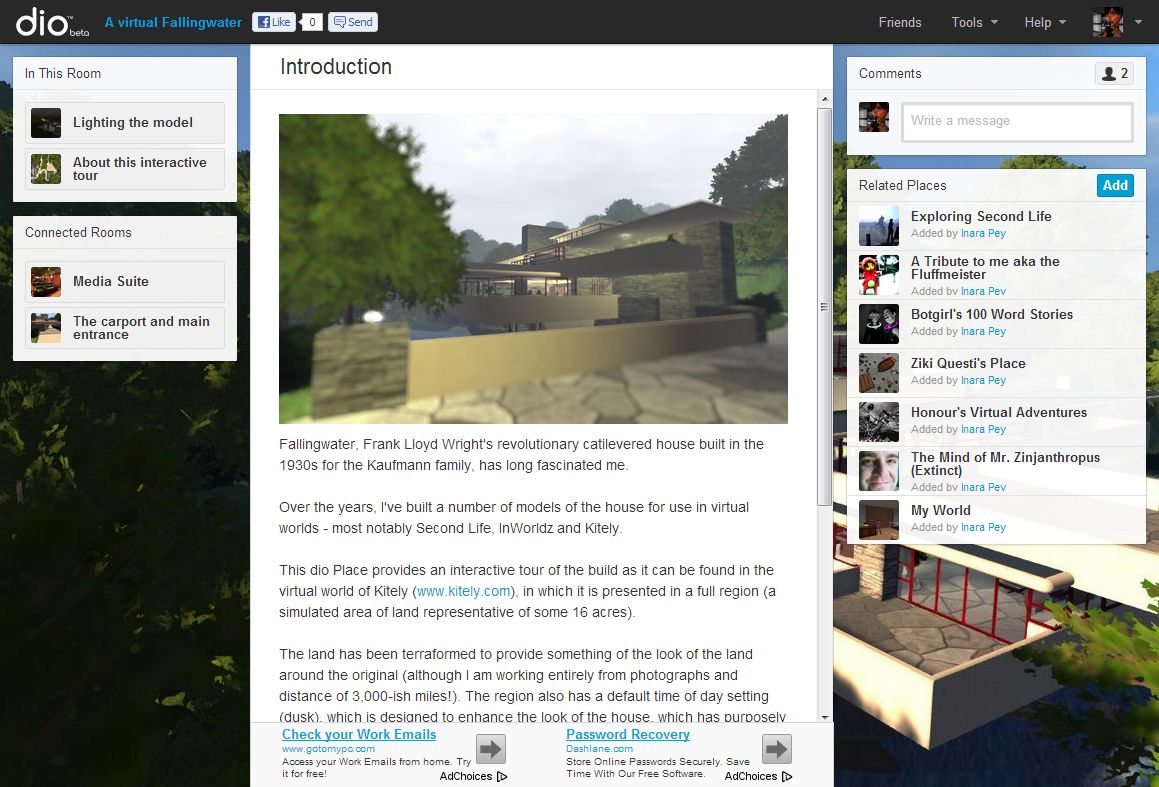
Since then, as time allows (and there hasn’t been a lot of it), I’ve been dabbling some more and building various bits. The first of these is an attempt to build an interactive tour. Unsurprisingly, the subject matter is Fallingwater, Frank Lloyd Wright’s seminal build, and particularly my efforts to emulate this remarkable house in the virtual world of Kitely.
The start of the tour: An introductory page isn’t a requirement for a dio place, however, I’ve included one to give people some background on things.
The tour is intended to let people understand something of the build – what it is, where it resides, etc., before allowing them to set off to explore it on their own, moving through the various dio “rooms” (which I’ve roughly aligned to rooms and parts of the Fallingwater build) where they can see images and find out more about both the real and virtual Fallingwater as interpreted by myself.
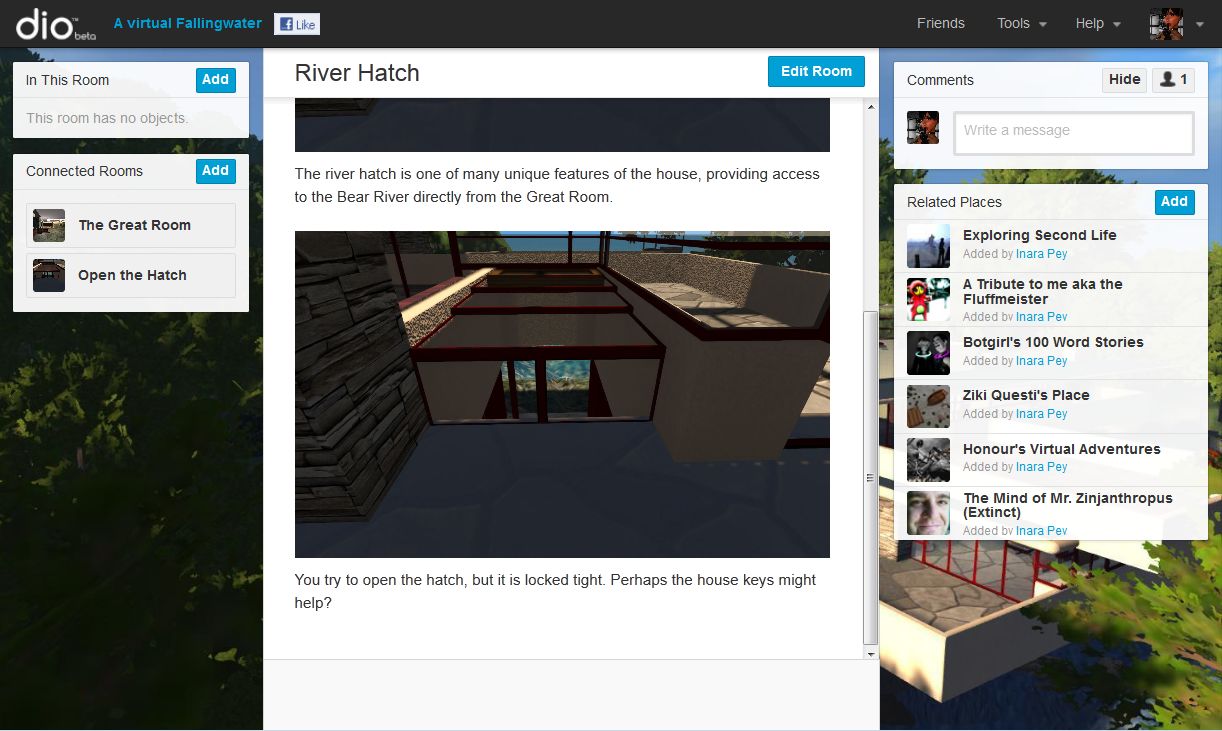
To add a little fun, I’ve added one (so far) inventory item, which must be collected in order for the house to be fully explored (I may add more at some point), and also added some other interaction using the “Appear / Disappear” actions.
Adding a little interactivity
There is a degree of logic to be followed with the tour – the introduction and the “media suite” can only be accessed at the start. This is to encourage people to do a complete circuit of the place (in whatever direction they choose), but I’m also aware it might be a tad irritating to some. So I’ll be curious as to feedback – if any …
The tour can be found on the dio Community page, or for those signed-up to dio, you can jump to it from here.
The “Explore” object is a means by which I’ve hidden objects until such time as Explore is opened – a useful means of controlling information flow in complex rooms
 Update February 20th 2014: Linden Lab discontinued Creatorverse on February 19th, 2014. As such, links to the Creatorverse website, various app stores, etc;, have been removed as no longer valid.






 Inara Pey: Living in a Modemworld