Second Life viewer arrives on Desura

Update: Linden Lab sold Desura to Bad Juju Games on November 5th, 2014.

Alongside other quiet moves on the Lab’s part, such as Patterns appearing on Desura, then Versu getting some new titles, it seems Second Life has now also appeared on the Lab’s recently acquired digital distribution service.

Given the move to add Patterns to Desura, the arrival of Second Life isn’t that surprising. It’s more than likely been anticipated by most SL users since Desura was acquired in July.
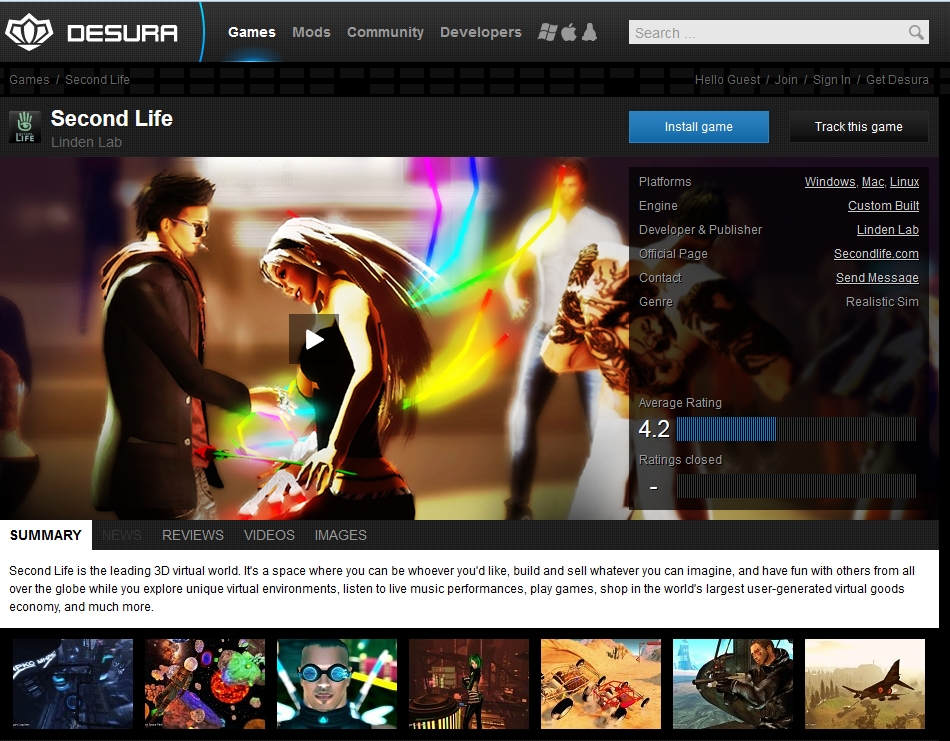
Second Life on Desura

The SL Desura page features the last promo video to have been produced / commissioned by the Lab (September 2012), which focuses strongly on the gameplay elements within the platform while touching on other aspects such as socialising and building. It’s not the strongest way to promote SL in some respects, given some of the images tend to play into stereotypes (the long zooms into bustlines, for example, suggestive of teenage oogling), but hey, SL is supposed to have seen a shift in demographics…

What is interesting about SL’s arrival on Desura is that it appears to have caused more people who use the service to wake up to the fact that it has been acquired by the Lab (announcements of the acquisition were somewhat muted elsewhere on the website at the time). Reactions to both the arrival of Second Life and the acquisition, visible in the comments on the SL page, have been mixed but swaying towards the negative.

Out of interest, I tried the download / install process using the Desura desktop service. It was fast, using a “local” mirrored site in the Netherlands, and handled both the download and initial installation of the viewer in a single pass.
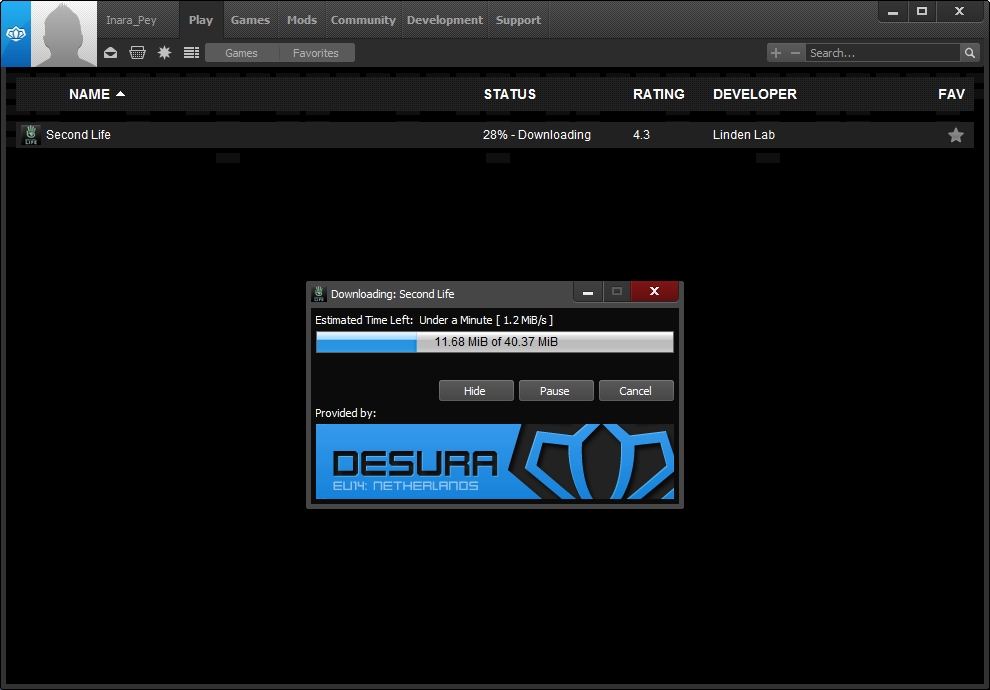
SL-desura
Installing the SL viewer via Desura

The release version of the viewer is called Second Life Release Desura, and installs into a folder (under Windows at least) by that name. Interestingly, the viewer is built of a 3.6.5 code base, not the current 3.6.4. Once installed, the viewer fired-up – and had an oopsie with the media webkit failing.
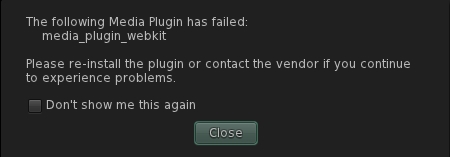
webkitGiven SL has only recently arrived on Desura, I was a little surprised when clearing the error message left the screen displaying a mandatory update warning; perhaps this was to fix the webkit issue. I let the update complete, and the viewer restart … and was again confronted with the webkit failure message. As this doesn’t occur with any version of the viewer obtained directly from LL, I can only assume it is a problem within the Desura offering. Closing-down the viewer and restarting clears the message but even so, assuming others get the same warning, I can’t help but think it’s not the most confidence-building thing to see after a first-time install. Similarly, it’s a shame that the link on the update pop-up which supposedly offers more information (i.e. release notes) goes to a blank wiki page.

Once I had shut down and restarted, the viewer ran through the usual CREATE ACCOUNT / CONTINUE options. Out of curiosity, I created a throwaway account and logged-in to the new “Social Island” arrival points which are being tested, and landed on a stack of people’s heads – so it would appear a fair few are trying SL out (although not necessarily via Desura, admittedly). I didn’t go further than this, as I intend to take another look at the “new” new user islands in the future and perhaps update on my original report.

All-in-all, not a surprising move, although equally, one not without some rough edges which might cause irritation if seen by many. Whether this move is the final nail in the coffin of the Steam link-up (prematurely) announced almost a year ago remains to be seen.

Related Links

Versu: update and new titles

LL logoIt appears that after moaning a little about the Lab not updating Versu, the Lab has … updated Versu.

Version 1.3 of the “living stories” platform sees Versu freed from the perils of internet connectivity, allowing you to “read on the beach, the plane, anywhere you like!” (subject to roaming agreements, sundry charges and so on and so forth, obviously). A small step, perhaps, but a welcome one, given I’d been worrying that Versu was going the way of Creatorverse and was on a “fire and forget” trajectory.

More particularly, and equally quietly, the Lab added two more titles to the Versu range at the start of August. Whereas the initial stories marking Versu’s launch were all set in the Regency period, the new titles, Office Politics: The Interview and Office Politics: The Launch Party, are comedic pieces set in a modern office environment (“Disruptive Technologies”), which introduce a cast of characters common to both, including:

  • Dave, the overly friendly boss who really wants to be liked and respected
  • Alice, the snarky feminist graphic designer who wishes she could just make art
  • Patrick, the former frat boy who thinks he’s way better with the ladies than he actually is
  • Jordan, the keener fresh out of business school
  • Linus, the quiet senior programmer who resents all the constant distractions from his real work
  • Storm, the ambiguously gendered die-hard fan of the hit TV series, Professor Whatever.
Versu has two new titles in a new setting

Both of the new stories are penned by Deirdra Kiai (“Squinky” for short!), a writer, musician and games developer. Commenting on her decision to go the route of a modern setting, she says,

I found the choice of a modern-day high-tech office to be ideal to write for in this system, because of all the meticulous social rules and procedures involved in a corporate setting. I also thought it would be a great excuse for characters of varying ages, backgrounds, and beliefs to come together and clash with one another in interesting and sometimes comedic ways.

An interesting side-point to this is that Deirdra has created an additional game Jamey Beanman’s Burrito Quest, based in the same universe as Office Politics, which uses dio. However, at the time of writing this article, the dio space had been set to private / limited access, and so could not be investigated.

The arrival of new titles for Versu is long overdue, given it is nine months since the app launched, and during that time there has been little or no news on it or its future development from the Lab, although Richard Evans has been talking about the potential of the Versu engine in a range of simulation activities. If the Lab really want to keep interest in the app alive, I can’t help but feel that they should be doing more to ensure that titles are regularly released – and nine months doesn’t entirely fit “regularly” that well. They also need to see a more diverse range of titles produced, and as such these two new pieces  – presumably the first of a series – is a good step in that direction.

There’s still no news as to whether Versu will move beyond the iPad and into the Android, Windows and Linux tablet realms. A move to Android had been promised prior to the app’s launch, but again, whether this is going to be the case is only likely to be discovered if / when the Lab announce it.

In the meantime, for those of you who do have Versu – or at least have an iPad and are looking for a fun, interactive read, go take a look at Deridra’s titles!

Related Links

Patterns: now on Desura & the Lab teams with Alienware again

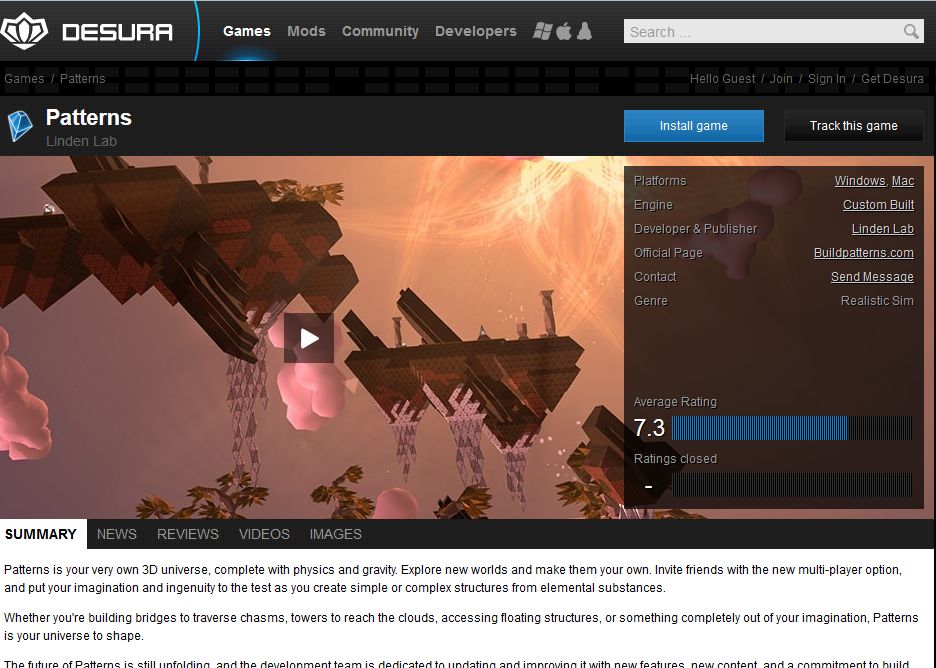
Patterns on Desura
Patterns on Desura

Update: Linden Lab sold Desura to Bad Juju Games on November 5th, 2014.

Update, October 9th, 2014: Linden Lab announced that development work on Patterns has been discontinued.

I’ve been keeping an eye on Desura for a while, mainly to see if any rebranding commences. In doing so, I came across the fact that Patterns is now available on the Lab’s latest acquisition.

Whether the Lab heard my speculation on the subject of Patterns and Desura or not I’ve no idea* , but Patterns appeared on Desura  at the start of August, just after I last poked at the digital distribution service. It arrived with a “special offer” of an additional 25% off the purchase price (so 75% off rather than the “usual” 50% for the Genesis version). This offer ended on Monday 5th August, and the price is now back to the 50% off the “Alpha” price.

Response from the Desura community has so far been small but positive, with most ratings sitting at 8-10 (out of 10). The Desura web page includes a Vimeo version of the Lab’s last video promo for Patterns, which appeared back in early July. This is actually quite stylish and something of a departure for the Lab video-wise (as have their Blocksworld promo videos – have they hired in a new team for marketing, or are the Boldai team having an additional impact? :P).

Patterns Competition

Patterns-compWhile I may not have received notification of Pattern’s arrival on Desura, I did receive an e-mail notifying me of Patterns-based competition the Lab is running in conjunction with Dell / Alienware.

The competition appears to have launched on August 12th, and is linked to via the Patterns website, Patterns on Desura and Patterns on Steam. On offer to the winner is an Alienware X51 gaming desktop.

Entrants to the competition are required to design and construct a unique alien landscape within Patterns using the in-game shapes and abilities offered in the game and then upload a screen shot of the build to the Alienware competition web page before September 15th, 2013.

An Alienware Arena account is required to enter the competition, and as has ben the case in the past, the competition is only open to legal residents of the United States (other than Rhode Island and US Territories), and entrants must be 13 years of age or older. The winner will be selected through a split between public voting (open to Alienware Arena members) and “Expert Judging”, and based on a combined score from both. Judging criteria will be on the originality / creativity within a build and relevance to Alienware / Dell.

Further details on the competition can be found on the Alienware Arena Patterns Competition page, as can the Contest Rules.

Continue reading “Patterns: now on Desura & the Lab teams with Alienware again”

Desura and Linden Lab: through the founder’s eyes

Update: Linden Lab sold Desura to Bad Juju Games on November 5th, 2014.

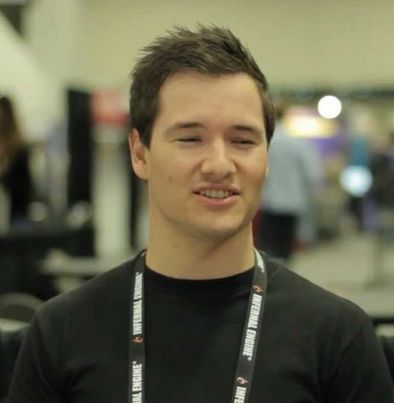
I came across a short interview conducted by the Linux-focused Root Gamer with Desura founder Scott Reismanis held shortly after the news broke that the Lab had acquired the digital distribution service, but which seems to have gone unnoticed elsewhere.

Since the announcement of the acquisition, there has been considerable interest in whether it means Desura / LL will compete more directly with others in the same marketplace – notably Steam. In a recent interview with Gamasutra’s Kris Ligman, which I also covered here, Rod Humble had a few pokes at this himself (although some of his comments on competition would appear to have a much wider context which includes Second Life). Reismanis sees the “competition” element of the acquisition in terms of providing Desura with much-needed additional ability to pro-actively attract games developers, rather than having to react to overtures from games developers, commenting:

Scott Reismanis
Scott Reismanis

At the moment we are largely dependent on developers reaching out to us about getting published – that’s what our small team had time to do. With Linden Lab help we will expand our team working with the game developers helping us target and bring more on board.

In reading both Reismanis’ and Humble’s comments around the acquisition, it would appear that both are very much of the same mind in how they regard the Lab’s initial relationship with Desura and in terms of future plans.

Both, for example, couch the Lab’s role as initially being more supportive than directive; providing additional muscle in key areas to assist the Desura team to carry on with their business in a more structured and focused manner, rather than the Lab charging in and absorbing everything and trying to reinvent the wheel. In this, the approach appears to be more of a partnership more than an outright acquisition and, given the marketplace is new to Linden Lab, not an unwise move.

Not that this means there won’t be any visible changes. Work is already underway to overhaul (or at least update) the Desura client in order to make the Lab’s involvement more apparent. Exactly what form this will take isn’t clear at present, but the work is seen as priority, although dependent upon Desura (or the Lab?) bringing in new staff.

Desura and the Lab: proceeding more as a partnership? (image courtesy of Root Gamer)

The interview also hints that both Humble and Reismanis share the same grand ambitions for the future of a service – and that the ambitions may have been there prior to the acquisition (and by extension, might have been one of the reasons the Lab was attracted to Desura).

Commenting on the Desura blog about the acquisition following the formal announcement, Reismanis give additional insight as to what he believes this means for developers and customer using the service:

To date Desura has been built and run by a dedicated small team – and it’s grown to the point where we list over 1,000 games and have served over 1,000,000 customers. We are very passionate about the developers and community we represent, and I want to assure you now this policy isn’t changing.

With Linden Lab’s support, we plan on expanding our team and providing you with more co-ordinated coverage, sales, marketing efforts, reporting, and assistance from us. We want to solve challenges like discoverability and giving your customers’ choice, and we look forward to doing so. We are going to continue to polish and innovate so Desura stands out and does its most important job better: getting your game into customers’ hands.

So far reaction to the acquisition from within the Desura community appears to be mostly positive, with those responding to the news wishing Reismanis and his team good luck, although there are obviously some questions about what it means in practice for game developers in terms of publishing, DRM, etc., – all of which are liable to only become clearer once the initial dust has settled and both the Desura team and the Lab have worked out priorities and directions and have settled into working together over long distances.

It’ll be interesting to see how this develops over time, starting with the roll-out of the new Desura client, and whether the approach does develop along lines of a partnership rather than a buy-out, and if so, for how long.

Related Links

Blocksworld +1 week: opinions favourable

LL logoBlocksworld has been out a week now. I covered the launch on August 1st, but as I don’t have a iPad, I’m stuck with pining for its possible appearance as an Android app in order to review it myself (even though I haven’t got an Android tablet either *cough*).

This leaves me reliant upon reviews posted elsewhere. So, as with the early appearance of Creatorverse, I’ve been keeping an eye on the Lab’s press page and waiting for a number of reviews to pop-up there. It’s not an ideal way of doing things, but as the likes of 148apps and Kotaku do generally appear in the listings, I decided to see what comes up as well as Googling for reviews.

Overall, and allowing for it being early days, the reactions of reviewers seem favourable. Rob Rich over at 148apps gives Blocksworld a solid four (out of five) stars, noting that the interface is easy to grasp, building is relatively quick and easy to learn, and that the ability to create and build with blocks is something kids the world over can identify with. However, he also notes that there are some inherent weaknesses in the app: vehicles can be difficult to drive, and connecting blocks to build things is limited (you can only connect blocks face-on). As such, he notes that it is fun to play with, but in terms of using it as a form of a game, it’s not so much fun to play.

Mike Fahey over at Kotaku has a fair amount of experience in reviewing the Lab’s products. His reviews are always informative and also lighthearted at times, making them a fun read. It’s actually his reviews I turned to in order to get a handle on both Patterns and Creatorverse before I had access to either. In reviewing Blocksworld he notes that:

Linden Lab is all about creating, or at least they have been since Rod Humble took charge, transforming the company behind Second Life into a company that creates creativity. It was as if Linden Lab only made doughnuts before he arrived, and now they’re making a wide variety of pastries. The delicious, sexy, wildly deviant doughnuts are still there, but then so is Creatorverse and Patterns and Blocksworld and maybe, if we’re very good, some scones.
Blocksworld promotional image (courtesy of Linden Lab)

Like Rob Rich, he comments on the overall simplicity of design and that the UI is very easy to grasp. He also delves more into the mechanics of the app, noting that using it can be approached in a number of ways, from “dive in a build” through to using the supplied “kits” to learn how to build specific items and use specific capabilities.

Interestingly, both reviews touch upon a fact hitherto unmentioned here: that the number of blocks you can use is limited. If you run out, you have to either “win” more or purchase more.

“Winning” additional blocks is a case of using the in-built kits, each of which includes a puzzle / challenge. Build the kit, complete the challenge and your reward is more blocks.

Continue reading “Blocksworld +1 week: opinions favourable”

dio gets an overhaul, but will it increase the appeal?

dio-logoUpdate, February 19th, 2014: dio was discontinued by Linden Lab on February 19th, 2014. Links to the dio website, etc., have therefore been removed from this article.

I received an e-mail on July 30th informing me that dio (remember that?) has received a major overhaul, with the upshot being, in the words of the e-mail, “dio is now focused on making it easy to turn your photos into interactive experiences to share. Just upload a picture, then tag it with interactive hotspots to add photos, text, and videos. You can even create an interactive album by linking to other images.”

The update means that some concepts previously found within the application have vanished – there are no scripted objects and no “rooms” for example. What there is instead is what might be sort-of described as “Flickr with hotspots”.

Essentially, under the new dio, you can still create places, which now comprise one of more “scenes”. Each scene is a photo (without or without a short description) into which you can embed text, other photos, videos and links to other scenes, all with considerable ease. Scenes can be stand-alone, or can be linked together to create things like photo albums or interactive tours, and so on. All this has, apparently, been done in response to requests from users.

A Quick Look

Getting started with the new dio – assuming you have an account – is easy enough. Just log-in and click on the Star Creating! button.

The new dio banner.
The new dio banner and “start” button

This leads you to a page where you create your new “scene”. Here you can enter a title, select a photo to upload to dio from your hard drive (or enter a suitable URL for an image) to form the background to the scene. Once you’re happy, save it.

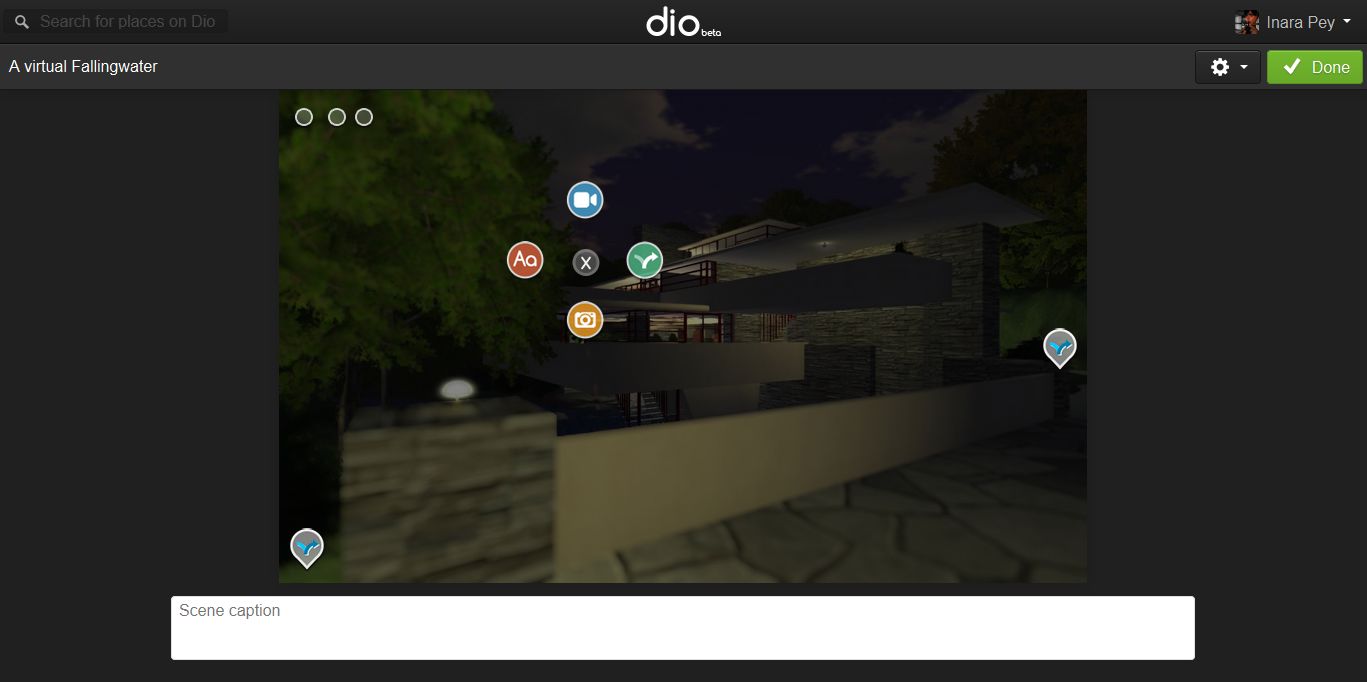
The image is displayed as it will appear to others, and you can start adding elements to it. This is done by entering the Edit mode (button on the top right of the window), then clicking on the photo itself to display the hotspot options.

Creating hotspots for a dio place

There are four types of hotspot at present:

  • Text – for unformatted text (i.e. you can arrange the text into distinct paragraphs, but they’ll all be concatenated into a single block of text on saving, so best to keep things short)
  • Other photos (with text captions if you want)
  • videos
  • links to other scenes.

To create a new hotspot, click on the required hotspot icon. This opens a window with easy-to-follow instructions. When you’re done, click Save in the window to save the hotspot on the photo. There is no limit to the number of each type of hotspot you can add to a given scene / photo, and the art of dio is, as with the previous version, having an idea of what you want to achieve and then working out how best to achieve it.

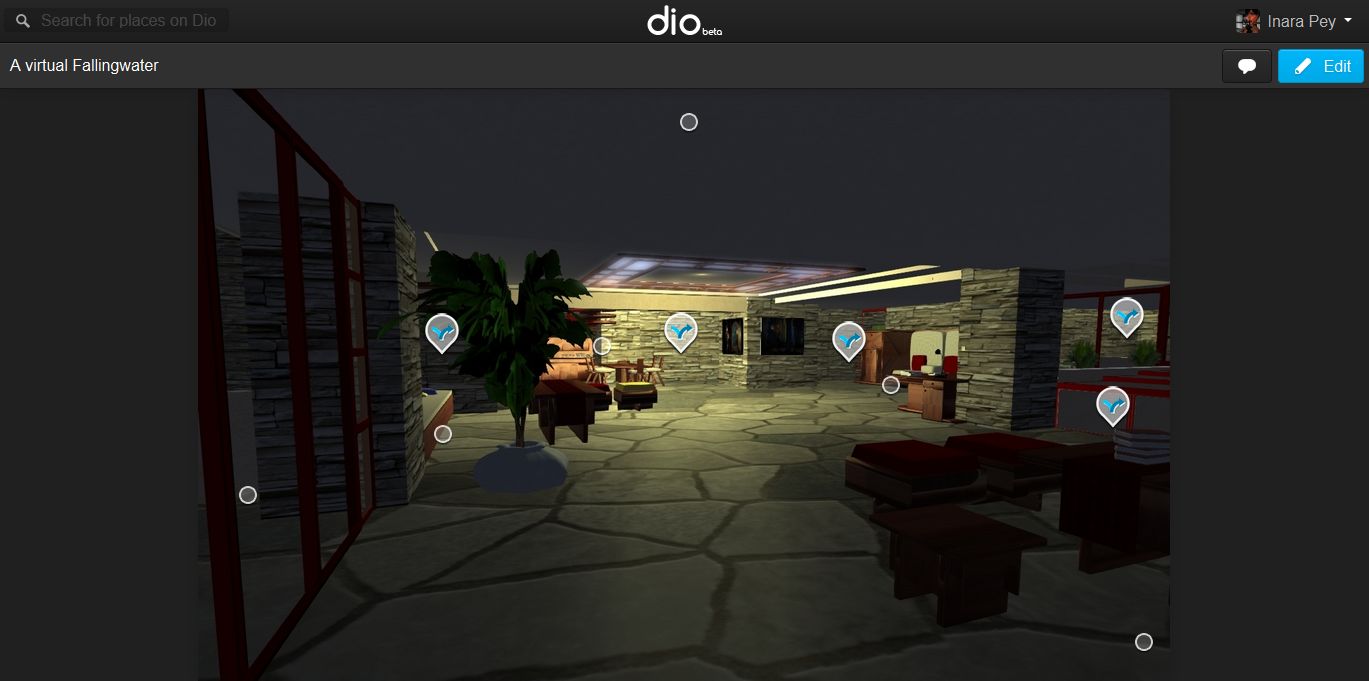
An example of a scene with lots of hotspots

And that’s really it (for the present), as far as I can see.

Note that if you have previously created a place in dio, it may well have been made “Private” and viewable only to you. To enable it as “Public” again, go to any scene within the place and click the Edit button, then click the cog button which will be displayed next to it, and select Place Settings. You can then flick it back over to Public.

For those navigating your places / scenes, it is simply a matter of clicking the available hotspots in whichever photo comes up. As with the original version of dio, if someone who is logged-in to the application leaves your place at a particular scene, they’ll be returned to it the next time they access that particular place (users who are not logged-in will return to the first scene in the place.

Feedback

The overhaul gives dio a much cleaner look and feel when trying to do something with it. The concepts are very easy to grasp if you’ve used the previous version, and rebuilding previous places isn’t as onerous as I thought it would be, while putting together a new scene / place is very quick and easy (I did this in – quite literally – 2 minutes).

A noticeable absence from the revised dio is Google Adsense. Originally, the Lab has intended to “profit share” on people’s dio creations using Adsense, which was visible at the bottom of the “old” dio pages, but which is absent the new. Have LL abandoned the idea?

The hotspots idea is interesting and certainly allows a good degree of creative use of pictures. I found it very easy to re-work my Fallingwater tour on the fly (although it will need more TLC before I’m happy with it again). However, one thing I would like to see changed in the icons used for finished hotspots. When creating new hotspots, each icon is clear: a camera for adding photos, text for adding text, a video camera for videos, and a double arrow for links to other scenes. However, only the latter icon is displayed in completed scenes; text, photos and video all have the same nondescript dot which is hardly attention-grabbing.

That said, the opportunities to create fun scenes using hotspots seems pretty broad and limited only by one’s imagination. Want to share you YouTube videos in a different way? Here’s how (and yes, videos now play on being selected, no more additional faffing around); want to be silly with videos and photos? You can; and people can leave you their thoughts! Oh wait, they can on Flickr as well.

And therein lies the rub. OK, so dio has entertaining little bells to it. You can embed pictures in pictures, text in pictures and video in pictures, you can link pictures with other pictures and so on and so forth. But, the question still remains – why? As easy as the new UI is, the fact remains that if you want to share a bunch of photos with friends, it’s still easier to slap them up on Flickr or a similar site, and all the pretties be damned. As it is, dio is increasingly looking like it is trying to be far too many things, and that like Jack, it’s going to remain master of none.

The new update is nice and neat (although LL have some catch-up work to do as far as the “about dio” page is concerned – it still references the “old” beta) and it’s easy grasp. Whether it increases dio’s appeal, however, remains to be seen. I’ll be honest here and say that, given the lack of visible activity with the application prior to the arrival of the Lab’s e-mail, I had actually thought dio was DOA.

Related Links