Annabel Lee in Second Life

DaphneArts: Annabel Lee

Angelika Corral and SheldonBR, curators of DaphneArts, have something of an affinity with the work of Edgar Allen Poe. In 2017 they hosted an exhibition of art marking 208th anniversary of his birth, and they have also produced works of their own focused on Poe, notably Dream Within A Dream, based on Poe’s poem A Dream Within A Dream, and a static installation modelled on Fall of the House of Usher.

Dream Within A Dream formed the leaping-off point for a series of immersive installations they have produced (and which has most recently encompassed the works of John Donne – see No man is an island). Now, and with an official public opening on September 2nd, 2019, they have returned once more to Poe, with a new immersive installation Annabel Lee, based on Poe’s poem of the same name.

Annabel Lee was the last poem Poe composed; it explores the themes of death, love and the hereafter – all common these for Poe – wrapped within a “ballad” about the death of a beautiful woman. Within it, the narrator recounts his love for the woman – Annabel Lee – which began many years ago in a “kingdom by the sea”. He believes their love was so intense, the angels themselves became envious to the extent they caused her death. Nevertheless, he believes that the love they shared was so deep, neither angels nor the grave can constrain it, and that their souls remain entwined. And so it is, each night he dreams of her, as he lies beside her tomb.

DaphneArts: Annabel Lee

Like so many of Poe’s poems, Annabel Lee is complex as much as it is dark. There is something of an autobiographical element to it, another facet oft present in Poe’s work. He himself fell in love with his cousin, Virginia Clemm, and in the words of the poem – “she was a child” – being just thirteen when Poe married her, and she died just two years prior to the poem being written. Thus there is an element that in writing about the loss of “Annabel Lee”, Poe is perhaps drawing on personal experience.

In keeping with these immersive environments designed by Sheldon and Angelika, a visit commences in a sky box, where visitors are given an interactive HUD as a temporary attachment, and which should be accepted (it will be automatically be attached, and should detach on leaving – if not, just click the Stop button, when displayed). The skybox also includes instructions on setting your viewer’s environment (if you are using Firestorm, then the local windlight should apply via that viewer’s parcel windlight support). Once the viewer is set in accordance with the recommendations, visitors are free to take the teleport board to the ground level and the installation itself.
DaphneArts: Annabel Lee

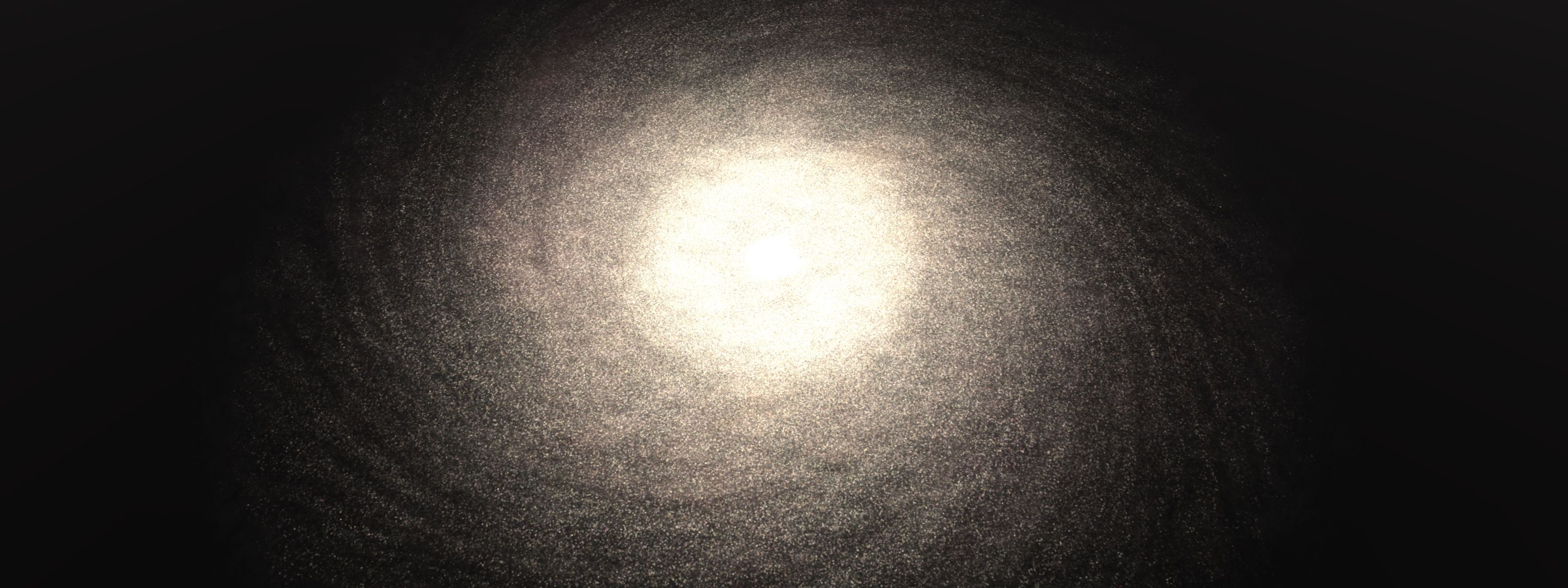
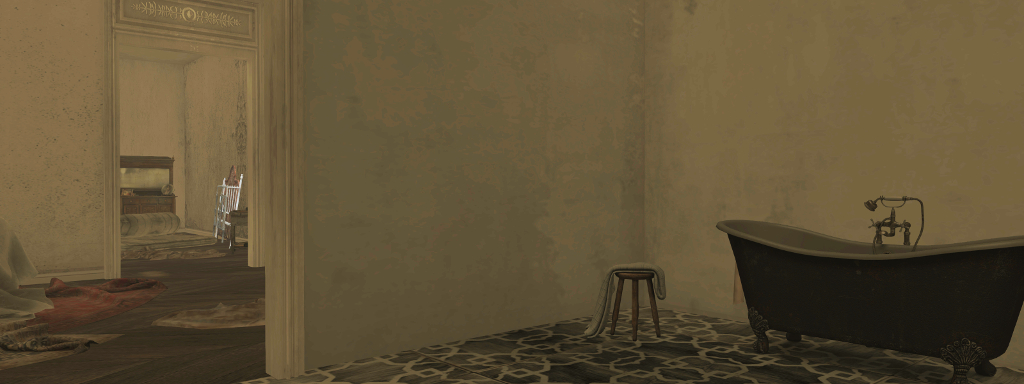
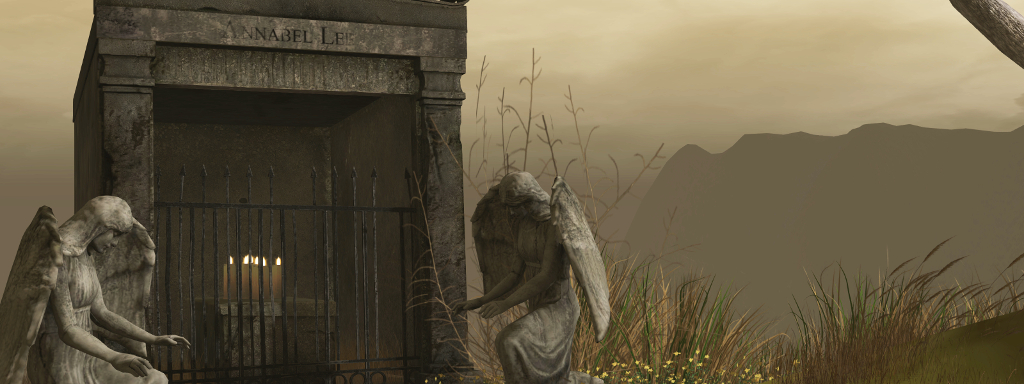
The ground level presents the poem through what Sheldon and Angelika call “Magical Realism” – the use of sounds, visuals and the spoken word (in this case, Angelika reading the poem) – to evoke a sense that the visitor is immersed within its unfolding story. It’s a technique that might also be described as “immersive literary allegory”: a visual setting that both directly frames the telling of the poem’s story (the “kingdom by the sea”) and the passing of Annabel Lee (shown through the presence of her tomb), whilst also offering cues to the deep story of love and loss.

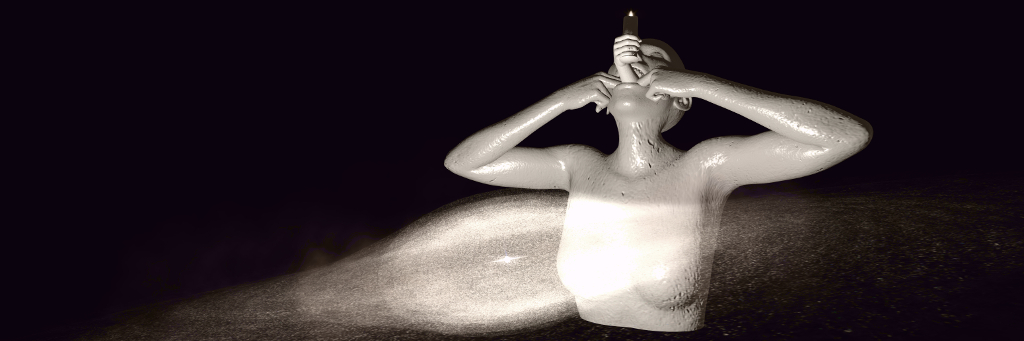
This latter aspect is shown through the use of elements such as the candles (a clear symbol associated with death) and the path they mark (representing the path we follow through life to its eventual end, which is in turn symbolised by the tomb), and by the house. The latter (perhaps best explored after hearing the poem throughout), shows signs of past habitation with rooms and furniture slowly mouldering. However, these are themselves more broadly representative of the memories of love and life shared but which have come to an end; the memories we fight to hold on to after the passing of a loved one, but which inevitably age and fade with the passing of time.
DaphneArts: Annabel Lee

So it is that this is a deeply atmospheric and evocative setting; one that should be experienced rather than described. It sets Annabel Lee, the poem, almost as fairytale without in any way destroying or distorting the emotional span of the original.

SLurl Detail

No Man Is An Island in Second Life

DaphneArts: No Man Is An Island

No man is an island is the opening line from a poem by English poet and cleric John Donne which perhaps is more often referenced via quotations of its final lines,  And therefore never send to know for whom the bell tolls; It tolls for thee.

However, this poem actually originated as a passage  of greater length and written in prose as Meditation 17, from Donne’s Devotions Upon Emergent Occasions. Originally written in late 1623 (and published the following year), Devotions was written whilst Donne was recovering from a but unknown illness (possibly relapsing fever or typhus), and forms a reflection of death, rebirth and the Elizabethan concept of sickness as a visit from God, reflecting sinfulness, with each of the 23 devotions within it a meditation on a single day of Donne’s illness.

DaphneArts: No Man Is An Island

I mention this because No Man Is An Island is also the title of the latest immersive installation by Angelika Corral and Sheldon Bergman, artist curators of DaphneArts, with the installation itself marking the reopening of the gallery at a new location in Second Life.

Taking its lead from Devotions, the installation offers the opportunity to reflect on Donne’s words as they came to be written in the poem, using a visual setting, music and the spoken word. Full instructions are provided at the landing point – and if you are using the Firestorm viewer, then you should automatically receive the required windlight environment setting. You should also accept the HUD that is offered on arrival. This will attach itself to your world view to present you with a “letterboxed” style view of your surrounding. If, by chance, you’re not using Firestorm and / or the HUD doesn’t attach (or you accidentally reject its request to attach), instructions and an option to obtain the HUD can be found on the wall of the arrival area.

DaphneArts: No Man Is An Island

The main setting for the installation and the poem’s recital is very atmospheric – and made more so by the music (played as local sounds, not via any audio stream). Across a windswept stretch of sand stands the silhouette of a lighthouse drawn against the heavy sky, a hut below it lit from within.  A candle-lit bridge, with more candles scattered over sand and rocks despite the rain, beckon you forward to hut and lighthouse.

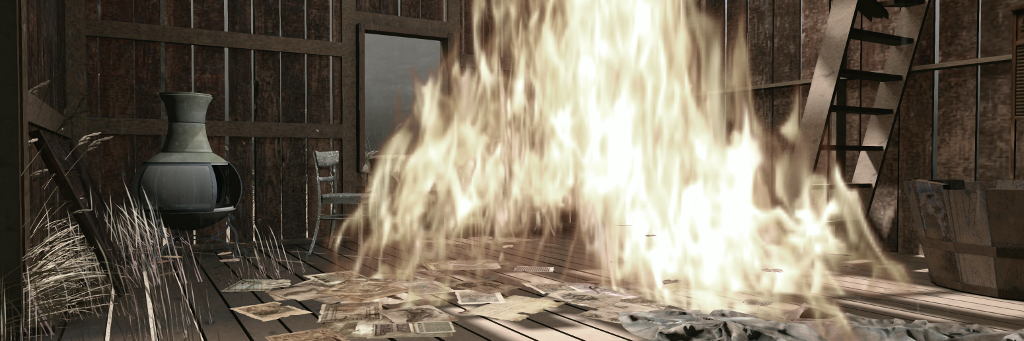
As you approach the hut, the light from within is revealed as a fire, burning brightly in the single room and consuming pages of manuscripts together with a shroud-like blanket. More candles  light the way up the lighthouse and its single door. Inside lies the opportunity to listen to a recital of the poem, and contemplate the sculptures that sit within the lighthouse walls.

DaphneArts: No Man Is An Island

Perhaps disarmingly simple in appearance, No Man Is An Island is actually nuanced and layered in presentation. Within Meditation 17, Donne is considering the nature of death (his own), and its impact (on him, if it is fact claiming another and not him), noting:

No man is an Iland, intire of it selfe; every man is a peece of the Continent, a part of the maine; if a Clod bee washed away by the Sea, Europe is the lesse …. any mans death diminishes me, because I am involved in Mankinde;  

Thus, within the hut with have the fire and the burning of manuscripts, many of the pages painstakingly written and illustrated by hand. They represent the idea that a loss does not just impact the one or the few, but lessens the whole; in their burning, the pages are not just lost to whomever set them ablaze, but are lost also to all who might otherwise have read them. Similarly, the blanket with its edge caught within the flames might be taken as a death shroud, symbolising, Donne’s view that any mans death diminishes me, because I am involved in Mankinde

DaphneArts: No Man Is An Island

In addition, the presence of the lighthouse offers reference to life and death, presenting a balance of views that reflects Donne’s thoughts. On the one hand, it was once perhaps the loneliest job on Earth, undertaken in isolation, would his passing of a lighthouse keeper really be missed by the world? But on the other, the role by its very nature was to protect the lives of those at sea, steering them away from the risk of death through the loss of the vessel beneath them – so yes, the loss of a lighthouse man could be sorely missed by the rest of us.

Other references are more obvious – the island-like setting, the rain (the curtained veil of death) – even our place in the cosmos (or what Donne might have regarded as God) is brought into focus, both visually and through the eternal questions repeatedly asked at the landing point.

SLurl Detail

Nativo in Second Life

DaphneArts: Nativo

Nativo, featuring the art, words and voice of Italian physical world artist Stefano Mingione, and which has been open for that last month at DaphneArts, is the latest in a series of installations presenting a broad canvas of artistic expression which can combine multiple approaches into a single installation / expression of ideas which are intended to be viewed as a whole, rather than just as individual elements, be they drawing, sculptures or poems.

An artist working in a range of media – drawings, paintings, sculptures, digital media, written word – Mingione tends to identify himself more thematically, through his focus on the dualities present in life. Birth and death, happiness and despair, hope and fear, youth and age; and this is very much in evident in Nativo.

DaphneArts: Nativo

The exhibition space is split into two parts – although together they form a whole. The main exhibition area, where  visitors first arrive, forms a cylindrical hall in which eleven draws are displayed. Some appear to have religious connotations, offered through titles such as Santissima Trinità (Holy Trinity) or La Caduta dell’Angelo (The Fall of An Angel), or through their subject matter – as with  Padre Perché Io Disegno (Father Because I Draw).

However, religious overtones – entirely in keeping with the idea of duality in life, expressing both the earthly and spiritual – are only part of what these images have to offer.  Collectively, they provide an expression of thinking about left, death and all that lies between in a manner – to my eye at least – not that far removed from the art of Hieronymus Bosch, another artist who pondered (agonised over?) dualities through his work (and even through his patronage).

DaphneArts: Nativo

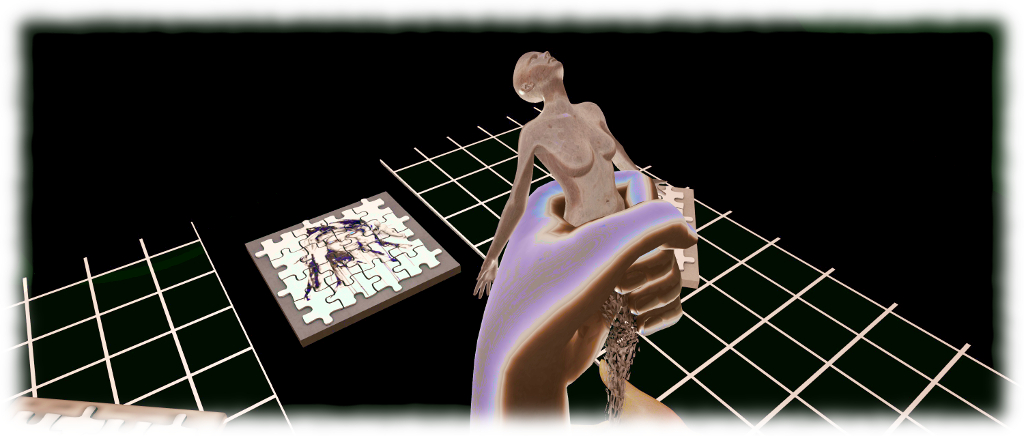
A single walkway extends back from this cylindrical room. It offers a way to where a grand sculpture of an old man, curled foetal-like, hangs in the air. It is a further embodiment of the theme of duality: the aged man appearing foetus-like in the darkness. Positioned before the sculpture is a chair and “play” symbol. Visitors are encouraged to sit in former and click on the latter – which will allow them to hear three of Mingione’s poems – Amico, Nativo and Vecchio – narrated by the artist himself in Italian, and presented with both text subtitles and a series of sculptures representing each one. These are very much the heart of the exhibit, richly evocative, and deserve special consideration which may require each to be listened to and watch more than once.

Interpretation of Nativo is deeply subjective. I found it by turns fascinating and also a little pretentious – and ultimately captivating.

SLurl Detail

DaphneArts (Isle of Seduction, rated: Adult)

Je n’aime pas in Second Life

DaphneArt: Je n’aime pas

Je n’aime pas (“I do not like”), is the name of a collaborative art installation by Hern Worsley and Nur Moo which opened on Friday, February 9th, 2018 (with a second opening event planned for Saturday, February 10th, 2018 from 16:00 SLT) at DaphneArts, curated by Angelika Corral and Sheldon B.

Described as a conceptual piece, the installation features a build over three levels by musician, builder and artist Hern, within which a series of images by photographer Nur Moo are displayed. Mur is described as having returned to Second Life in the notes accompanying the installation, and I gather Je n’aime pas is something of a celebration of this fact.

DaphneArt: Je n’aime pas

Visits begin inside a building within the installation, on its lowest level. Before proceeding, make sure to observe the viewing instructions displayed in the dialogue box in the top right corner of your screen. In particular, make sure you have your viewer’s Advanced Lighting Model (ALM) enabled via Preferences > Graphics or you risk missing details. There is art on the walls inside the building – but frankly, I’m not sure if the photography is Nur’s or Hern’s or someone else’s.

A set of white arrows line the floor outside, encouraging people to step out into the larger structure. This exudes a modern approach to architecture: great steel beams, arms pentagonal floor sections, and great glass panels. Some are designed by Hern, some are from other creators he has used in building the installation. Central to this is a huge mesh vase, while from the walls hang panels with animated images.

DaphneArt: Je n’aime pas

At the foot of the vase sculpture sits a teleport on an easel that leads up to the middle level. this is where having ALM becomes particularly important. Without it, none of the images projected onto the flat wall panels, the greeble boards, cubes and floor will not be visible. Two more teleport boards sit on easels in the centre of this floor: one up, one down. Go up, and you become part of the installation yourself, courtesy of a trampoline.

This is a difficult installation to quantify. In some ways it likely to be reflective of its name for some; for others it may well be a curious mystery. Conceptual art  is art in which the idea(s) involved in the work take precedence over any traditional aesthetic. As such, this is an installation that needs to be considered as a whole, and not so much as a sum of its parts. given this, how we consider  Je n’aime pas is down to individual interpretation – and I’ll leave this to you to determine.

SLurl Details

CioTTolina’s Dum Spiro Spero in Second Life

DaphneArts: Dum Spiro Spero

Now open at DaphneArts, the gallery spaces curated by Angelika Corral and Sheldon B, is an exhibition by Second Life sculptor and personal favourite, CioTTolina Xue, in which she presents a range of her work, some of which has appeared in previous exhibitions or in her store, and all of which share a theme of hope.

Dum Spiro Spero, “While I breathe, I hope”, is widely used as a motto by families, organisations, states, military organisations, and so on.  It is regarded as a paraphrase of ideas that survive in two ancient writers, Theocritus and Cicero through such works as Letters to Atticus. For  CioTTolina, it encapsulates her outlook on life.

DaphneArts: Dum Spiro Spero

“I try to create emotions,” CioTTolina says of her work, “And send a message: hope.
I’m still not good at what I do, but I put my heart into it. I hope that the love I put into things shows as what I might accomplish. This is the message that matters.”

Personally, I have always felt – and continue to feel – CioTTolina undersells herself. Her work has – and remains – full of beauty and meaning; as I said in reference to her exhibition at Solo Arte, Hope, “CioTToLiNa has clearly grown in confidence as an artist, producing ever more complex pieces which are not only beautiful and highly collectible, but also reflect her own interests / concerns for the world, and how we relate as a species one to another and the world around us.”

DaphneArts: Dum Spiro Spero

Indeed, Dum Spiro Spero is in many respects and expansion of Hope, richly demonstrating the breadth and depth of CioTTolina’s work and an ideal reflection of her ideals and outlook, with each of the seven display areas in the gallery space offering at least one of her pieces for viewing. Some may appear to be thematically linked one to another, expressing hope, love, joy, others may stand in contrast to one another. Taken together, the use of the spaces to display CioTTolina’s work is considered, allowing us to better study and appreciate the pieces offered in each.

If you haven’t seen CioTTolina’s sculptures before, I can recommend Dum Spiro Spero as an ideal means by which to gain familiarity with it.

SLurl Details

Seven lilies, seven virtues and seven artists in Second Life

DaphneArts: Lilium

Now open at DaphneArts is Lilium, the second in a series of exhibitions focus on the mystical number seven, following on from The Endless (reviewed here).

The curators of DaphneArts, Angelika Corral and Sheldon Bergman (SheldonBR), who are also two of the seven artists participating in the exhibition, describe it in part thus:

Number seven is sacred and powerful. Pythagoras, the father of numerology, considered seven as the most spiritual of all the numbers. Seven is the number of divine perfection. Seven are the colors of the rainbow. Seven are the notes of the diatonic scale. There are seven ancient wonders of the world, seven days of the week, seven letters in the Roman numeral system, seven arts…
When Pope Gregory defined the Seven deadly sins, he also included a counter-balancing set of values, in a way to protect one against temptation from the deadly sins. The seven [heavenly] virtues … For this exhibition, seven photographers were invited to create a photo, each of them representing one of the seven virtues.
DaphneArt: Lilium – Temperance by Fenris

Lilium is itself Latin for “lily”, a symbol of virtue, as Angelika and Sheldon also note in their curator’s introduction to the exhibit, illustrating the point with the inclusion of an image The Annunciation by Paolo de Matteis.

Thus it is, with viewer correctly set, visitors to the exhibition start their journey in the chancel of a marble-like white cathedral (white obviously symbolic of virtue). A HUD is offered on arrival and should be worn, while overhead is a set of easy-to-follow steps guide people through ensuring they have their viewer correctly set-up (e.g. ensuring the required Windlight is selected and Advanced Lighting Model is enabled).

DaphneArts: Lilium – Patience by Magic Marker

From here, a walk through the nave of the cathedral to the porch brings people to the main exhibition space, progress to it marked by the lyrics – in Latin of the Elven Song, or Elfen Lied, as featured in the Japanese manga series of that name, the lyrics based on biblical passages and the hymn Ave Mundi Spes Maria. Beyond the porch is an open platform set against a uniform backdrop and on which are arranged seven gilded lilies.

Approaching any of these lilies will cause it to open, revealing the art apparently “held” inside it. At the same time, the title of the art – the virtue it represents – and the name of the artist are revealed by the HUD.

DaphneArt: Liluim

The images / virtues are, by artist: Charity – Inexorably; Chastity – Sheldon Bergman; Diligence – Harbour Galaxy; Humility – Kimeu Kamolla; Kindness – Angelika Corral; Patience – Magic Marker, and Temperance – Fenris. Each is obviously a personal representation of the virtue it depicts, however each carries a degree of symbolism which may be related to the virtue it represents, to virtue as a whole or to the mysticism of seven.

Lilium is a further nuanced ensemble exhibition built around a central theme, rich in symbolism and interpretation.

SLurl Details