2025 week #49: SL CCUG meeting summary

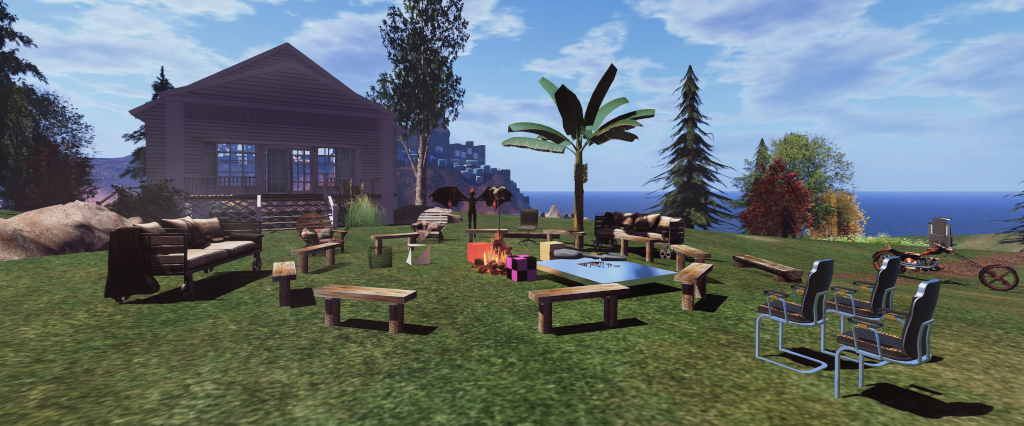
Hippotropolis Campsite: venue for CCUG meetings
The following notes were taken from my audio recording and chat log of the Content Creation User Group (CCUG) meeting of Thursday, December 4th, 2025 and my chat log of that meeting.
Table of Contents

Please note that this is not a full transcript of the meeting but a summary of key topics.

Meeting Purpose

  • The CCUG meeting is for discussion of work related to content creation in Second Life, including current and upcoming LL projects, and encompasses requests or comments from the community, together with related viewer development work.
  • This meeting is generally held on alternate Thursdays at Hippotropolis and is held in a mix of Voice and text chat.
  • Dates and times of meetings are recorded in the SL Public Calendar.

Official Viewer Status

  • Default viewer 2025.08 – 7.2.3.19375695301 – maintenance update with bug fixes and quality of life improvements – December 2 – New.
  • Second Life Project Lua Editor Alpha (Aditi only), version 7.1.12.14888088240, May 13 –  No Change.

General Viewer Update

  • 2025.08 is largely a maintenance release. However:
    • For Apple Silicon it includes a new VHACD-based convex decomposition library for mesh uploads, so creators on Apple Silicon should be able to upload meshes using it. If this library proves useful on Apple, then it will be implemented for Linux and Windows viewers, allowing the current Havok sub-library to be deprecated.
  • The first planned viewer for 2026 (2026.01) is being referred to as First Impressions. As the name suggests, the focus will be on refining the user experience for those who are coming into Second Life for the first time. Details to follow in the new year.

SLua Update

  • As per the official blog post, the SLua beta on Agni (the Main grid) has been officially announced.
  • The viewer is still a beta RC version, and an updated version is due out “soon”.
  • Official VSCode Plug-in (Recommended).
  • Official scripting documentation.
  • Third-party transpiler (LSL to SLua). Note that whilst viewed as workable, the use of this transpiler might not be as efficient as writing SLua code.
  • The nine beta test regions are centred on SLua Beta Void (mind the water or just search “slua” in the viewer’s World Map)..

WebRTC Voice Update: Speech to Text

  • There has been an LL-internal demonstration of Voice-to-text using WebRTC (transcribing Roxie Linden’s speaking into local chat in the viewer).
  • When used, the generated text is shown in local chat using a different colour to typed text.
  • Transcriptions are currently to English only (although Philip Linden indicated this will be from multiple languages).
  • The demonstration was described by Kyle Linden as “a little rough around the edges, but working.”
  • The process is direct – from voice to text, currently without any need for user intervention.
    • However, given the need for voice to be passed to the WebRTC server, then passed for transcription into text and then passed to the chat service for injection into local chat, there might be a degree of latency between someone speaking and seeing their words appear as text (around 1 second).
    • Going via the WebRTC server rather than using any form of plug-in with the viewer means that anyone using voice will have their words transcribed to text only once, rather than multiple plug-ins receiving the voice and then pushing it to a transcription service before receiving it back (which would be a non-trivial cost – e.g. 100+ plug-ins requesting the transcription of someone speaking at a Linden Community Round Table as opposed to the WebRTC server requesting the transcription once and broadcasting it to local chat).
  • One of the things LL are cognizant of is the tension between providing a fully automated service, which may tread on exiting solutions which meet specific needs, and potentially working to open the capability to allow it to work alongside of existing solutions / assist them.
  • As the transcribed text is pushed to local chat, then it is likely than worn translations tools will pick-up on the text and translate it as well; this many be both beneficial and annoying (beneficial, a non-English speaker can read the translated text just like anything else typed into local chat; annoying as it could result in someone using a worn translation tool constantly receiving walls of text (the spoken word transcribed to English text and then the translated text). As such, it was acknowledged some additional controls might be required.
  • A key point with this functionality is that it is a work-in-progress and not yet ready for formally release (WebRTC has yet to be fully deployed anyway), and once it is available, it will continue to be refined and enhanced (e.g. one enhancement might be to translate voice rather than just transcribe to English) .

In Brief

  • Default viewer chat bar. The independent chat bar was removed with the implementation of the the CHUI (communication hub user interface – the integrated chat and IMs floater) in around 2013 for the official viewer, although some TPVs re-implemented it not long after.
    • Requests have long been made for LL to return the chat bar functionality to the official viewer – and this is now being done, starting with Project Zero (the viewer in a browser).
    • However, if a TPV with the chat bar functionality were to submit a pull request to LL, then consideration would be given to taking the code as-is and implementing it into the 2026.01 viewer.
  • The bug relating to scale / offsets, etc., not being persistent on PBR when switching materials has now been addressed.

Next Meeting

2025 week #47: SL CCUG and Open Source (TPVD) meetings summary

Hippotropolis Campsite: venue for CCUG meetings
The following notes were taken from:

  • My chat log of the Content Creation User Group (CCUG) meeting of Thursday, November 20th, 2025 and my chat log of that meeting
  • Pantera’s video (embedded at the end of this article) and my chat log of the Open-Source Developer meeting held on Friday, November 21st, 2025.
Table of Contents

Please note that this is not a full transcript of either meeting but a summary of key topics.

Meeting Purpose

  • The CCUG meeting is for discussion of work related to content creation in Second Life, including current and upcoming LL projects, and encompasses requests or comments from the community, together with related viewer development work.
    • This meeting is generally held on alternate Thursdays at Hippotropolis and is held in a mix of Voice and text chat.
  • The OSUG meeting is a combining of the former Third Party Viewer Developer meeting and the Open Source Development meetings. It is open discussion of Second Life development, including but not limited to open source contributions, third-party viewer development and policy, and current open source programs.
    • This meeting is generally held twice a month on a Friday, at 13:00 SLT at the Hippotropolis Theatre and is generally text chat only.
  • Dates and times of meetings are recorded in the SL Public Calendar.

Official Viewer Status

General Viewer Updates

  • 2025.08 is to be the last viewer release for 2025. This is likely to be promoted to de facto release status after the US Thanksgiving holiday.
  • At the time of writing, 2025.08:
    • The crash rate is improving.
    • This viewer includes the VHACD convex decomposition library.
    • Mesh content creators are encouraged to try the current beta of the the viewer to make sure physics hulls are working in-world, etc., given that many settings with the library are different to those used by Havok, the longer-term plan being to eliminate Havok sub-libraries from the viewer.
  • The next viewer version will by 2026.01 – details of which will be made available once its likely contents have been initially settled on by the Lab.
    • However, it looks like 2026.01 will include the new code for faster log-in loading of inventory for those with very large inventories, and a dedicated Linux build of the viewer.
    • During the OSUG meeting, Geenz Linden indicated that another project he hopes to start moving forward with in 2026 is the Current Outfit Folder (COF) updates contributed by Kitty Burnett (Catznip), and the current plan is to get this into 2026.01.

You Tube Embedding Issue

  • As a reminder:
    • You Tube recently updated elements of their video embedding code such that non i-frame youtube.com/embed/NNNNN style links will not work within Second Life (whilst youtube.com/watch/NNNNN style links will still function correctly – although this latter format does expose all the You Tube on-screen video controls, etc).
    • This is an issue liable to impact a variety of in-world television and similar systems utilising You Tube.
    • It is very much a You Tube issue, so there is no guarantee they would remain valid / useful for any length of time.
  • For further detail please refer to the official blog post: YouTube Embeds in Second Life: What Happened and How to Keep Your Media Working.
  • Those finding further information on issues arising from this You Tube change should report them via the SL Feedback Portal.

SLua Update

  • Back-end support for SLua is now available in Beta on Agni, the main grid.
  • The SLua beta viewer, available from the official Alternate Viewers page, must be used for writing SLua code, but no specialised viewer to view SLua scripts running in-world.
  • The latest SLua viewer includes the websocket to Visual Studio.

SLua Resources

CCUG Discussion – In Brief

  • glTF animation upload support: this is “on the radar” for development, but is not currently an active project, and needs to be added to the current viewer roadmap.
    • A request to review animation priorities was also requested, and it was suggested this might be something that could possibly be looked at within the current animation support framework.
    • A general discussion on animations and priorities continued through the early part of the meeting, but no-one from the Lab with sufficient up-to-date knowledge of the animation system to provide meaningful input to the discussion.
    • This discussion included the following animation feature requests: user-definable animation priorities and allow starting an animation with a specific priority, together with this proposal for animation network reworking from user Coyote Enthusiast.
  • A request was made for an independent alpha channel (i.e. not linked to Diffuse/Colour channel) and available to both both Blinn-Phong and PBR that could help reduce the number of unique textures required for things like terrain, and without having to atlas huge sheets of layered details. The short answer was that this is unlikely until there is (at the very least) an opportunity to revisit texture streaming at the very least, with Geenz noting:
We’re already on some razor thin memory margins on some of our potato machines – so if we did that we’d need to find a way to make some stuff more scalable in our texture streaming tech. This isn’t a no – we need that for other things. But it’s not a 30/60/90 days thing I’m sorry to say.

Bakes on Mesh (BoM) Layering

  • Better layer ordering has been put to the UI/UX team with not promises as to when it might be worked upon, although there are “other projects” the Lab is planning which would also benefit from this.
  • A feature request for allowing sets / containers for/of BOM layers has been submitted, and is defined by Geenz as “interesting” and “TBD”.
  • The above led to a discussion on BoM improvements (e.g. PBR materials support; blend modes of different layers; etc).
    • In response to this, Geenz noted he would like to get PBR specular support, if only as a migration path from Blinn-Phong (and with the noted, “if you do this expect things to not quite look right if you mix these two”).
  • This discussion involved the potential complexities / straightforward aspects of PBR specular support, providing BoM support to alpha channels, before circling back to the benefits of having better texture streaming in general and prioritising the latter to different texture slots, etc.
  • This discussion touched upon BoM support for Animesh and a request for a universal alpha.

OSUG Discussion – In Brief

  • Signal Linden revealed that Friday, November 21st, 2025 was his last day at Linden Lab after 10 years with the company, rising to the position of Director of Engineering.
    • Signal has been the major driver in overhauling and improving the Lab / third-party/open-source relationship, which is to continue along the path Signal has set for it, improving and refining things where appropriate.
  • Roxie Linden noted that there has been a WebRTC voice server update. This provides HRTF (better spatialization) as well as server crash fixes. It’s still regarded as “beta”, but the WebRTC team is looking for feedback on its usability.
    • Further work on WebRTC is in progress, including spatial moderation.
    • Thought is still being given to replacing Echo Canyon (Vivox Voice testing region) with a WebRTC equivalent, with Roxie Linden indicating this is now a matter of scheduling and implementation.
    • Roxie’s preferred approach would be to have an ‘echo’ option with Preferences which, when used, does a full round trip to the server and back, allowing both device verification on the WebRTC service and network quality. If adopted, this will require both a server update and some viewer UI work.
  • A brief discussion on potentially replacing Chrome Embedded Framework (CEF) in the viewer (e.g. to something like Servo – as this matures). The response was that CEF is unlikely to be replaced in the foreseeable future, which does not mean there will not be fixes, etc., for identified issues.
  • Request for LL to provide SGV support, including for text on prims / test rendering in-world, including the following two requests:
    • SVG Canvas: A way to generate dynamics graphics on prim faces (without MoaP).
    • Add a Text Rendering Method.
    • In response, and specifically in terms of in-world text rendering, Geenz Linden suggested that something like MSDF might be more appropriate for SL, as it allows pre-rasterizing a large collection of fonts into some really tiny textures, and get some pretty sharp text rendering that scales “pretty easily”.
    • This led to a discussion on potential uses of SVG, and the advantages of SVG over MSDF, and vice-versa, and other options for in-world text rendering (and the use-cased thereof – such as notice boards, etc.).
    • Geenz requested tat if there are SVG-specific use-cases before text rendering, these be recorded in a feature request Canny.
  • A request was put forward to have TPV stats (usage per OS, crash rates and crash types) on a more frequent basis once more (they were at one time monthly, then switched to weekly before becoming more sporadic once more). This will be looked into.

Next Meetings

2025 week #45: SL CCUG and Open Source (TPVD) meetings summary

Hippotropolis Campsite: venue for CCUG meetings
The following notes were taken from my audio recording and chat log of the Content Creation User Group (CCUG) meeting of Thursday, November 6th, 2025 and my chat log of that meeting, together with Pantera’s video (embedded at the end of this article) and my chat log of the Open-Source Developer meeting on Friday, November 7th, 2025.
Table of Contents

Please note that this is not a full transcript of either meeting but a summary of key topics.

Meeting Purpose

  • The CCUG meeting is for discussion of work related to content creation in Second Life, including current and upcoming LL projects, and encompasses requests or comments from the community, together with related viewer development work.
    • This meeting is generally held on alternate Thursdays at Hippotropolis and is held in a mix of Voice and text chat.
  • The OSUG meeting is a combining of the former Third Party Viewer Developer meeting and the Open Source Development meetings. It is open discussion of Second Life development, including but not limited to open source contributions, third-party viewer development and policy, and current open source programs.
    • This meeting is generally held twice a month on a Friday, at 13:00 SLT at the Hippotropolis Theatre and is generally text chat only.
  • Dates and times of meetings are recorded in the SL Public Calendar.

Official Viewer Status

General Viewer Updates

  • 2025.08 is liable to be the last viewer release for the year, with development work as a whole (including server-side) liable to slowing down due to end-of-year holidays and company breaks.
    • That said, Geenz Linden is hoping to get the go-ahead to try and get “a few things” out for the door before year-end. These include fixes/improvements to PBR water , and also clearing some technical debt.
    • The fixes/improvements to PBR water sparked a brief conversation on the PBR water issues and solutions (e.g. tweaks to SSR and whether or not these will “fix” things – although it was made clear that the “old” water reflections code will not be coming back to the official viewer codebase).
  • Work is progressing on getting a Linux flavour of the official viewer back into shape. Those interested in the work can find it in this viewer repository, and the Lab is actively looking for feedback.
    • Note that this build is WebRTC only, Vivox Voice is not supported.
    • Depending on progress / feedback there is a potential for this viewer to surface as a Release Candidate / beta viewer before the end of the year – Geenz is hoping to achieve this as a part of the technical debt clean-up work.
  • Open Source meeting: Geenz is attempting to move forward with replacing the viewer Contributor License Agreement with digital certificates of origin for code contributions to the official viewer.
    • In short, instead of contributors having to read through and accept LL’s code license, and assign rights accordingly, when a code contribution is made, the originator  just adds a sign-off as a part of the code contribution commit.
    • There will be new documentation on this revised process that will be made available ahead of it being implemented.

You Tube Embedding Issue

  • You Tube recently updated elements of their video embedding code such that non i-frame youtube.com/embed/NNNNN style links will not work within Second Life (whilst youtube.com/watch/NNNNN style links will still function correctly – although this latter format does expose all the You Tube on-screen video controls, etc).
  • This is an issue liable to impact a variety of in-world television and similar systems utilising You Tube.
  • The is very much a You Tube issue, so while the Lab could investigate options for workarounds there is no guarantee they would remain valid / useful for any length of time.
  • Note that (obviously) Vemeo (and other services) video embedding is unaffected by this issue, as does hosting from a personal server.

CCUG Discussion – In Brief

  • Brief discussion on the following PBR bugs:
  • A request was made for an official viewer specific user group “to discuss the UI”.
    • As pointed out at other meetings where this has been raised, there are already two user groups wherein the official viewer and TPVs are discussed: the Content Creation User Group, and the Open-Source Development User Group (formerly the TPV Developer UG). Adding a third really doesn’t add anything significant.
    • In terms of UI “discussions”, it was suggested these are rarely fruitful with in a large group, as opinions tend to be subjective / biased according to which viewer people prefer to use, and which UI style (viewer 1.2X style or viewer 2.0+ style or variations thereof) they like. Ergo, a meeting specifically focused on the viewer UI isn’t potentially going to be that beneficial in terms of generating actual UI improvements.
  • A discussion on SL enhancements and prioritisations: A general note on the complexities of making enhancements to SL and determining what should / can be done and when.
    • In terms of graphical enhancements, it was noted that often, these tend to work best with dedicated / more recent GPU cards, with the problem being that stats show the majority of SL users tend to run medium or lower specification hardware, often with more limited GPUs and / or integrated graphics which may or may not be able to adequately run newer rendering options. Thus, the implementation of such capabilities can become a complex balancing act of determining what the “average” SL system can manage, how well it can do so without dramatically changing how SL appears to the user (changes to SL’s in-world appearance often causing widespread backlash when changes are made), determining what the general defaults for new capabilities should be in order to best address end-user hardware capabilities, etc.
    • Then there are enhancements to the platform which may not have a performance impact, but which do have questions around them in terms of overall benefit to users (e.g. quality of life improvements for the majority of users, content creation improvements, etc.), and also around resources required to bring them to fruition, etc., all of which need to be balanced against one another and with things like graphics improvements, et al, in order for the Lab to determine prioritisations.
  • The above extended to offering hardware cut-off points for SL, with the Lab preferring to keep this more towards operating systems (and associated hardware drivers, etc.) reached a manufacturer’s end-of-life, rather than arbitrarily setting cut-off points.
    • An example of this could be taken with older versions of the Mac OS (e.g. OS 12 or older). LL would like to cease support for these versions of the OS and focus on more recent releases offering support for more up-to-date libraries, etc., offering better functionality, but the number of Mac users still running systems only capable of running older versions of the OS currently prevents LL from setting a cut-off for Mac support.
    • The flipside to this is when OS vendors present an end-of-life for a given operating system, it can actually benefit SL and users who do upgrade (e.g. the ending of official support for Windows 10 bringing many older versions of Intel’s integrated HD graphics to an end of life state).
  • The above expanded into a conversation on communications, keeping users informed of SL’s capabilities and changes, what can be done within SL with the right viewer settings, informing users of the potential impact on their systems of enabling  / increasing various settings (based on stats, etc., the viewer is dynamically gathering on in-world scenes and the hardware running the viewer), etc
  • Geenz indicated that a longer-term hope is that more work can be done in making the viewer more multi-threaded in CPU use and cutting down on the reliance on co-routines within the viewer code as a result. However, no time frames on this.

OSUG Discussion – In Brief

  • It is likely that the current alpha-blend Blinn-Phong issues are likely to be fixed prior to year-end, as these require server-side work as well, and the server team is already very busy with WebRTC and SLua.
  • The first part of the meeting involved a discussion on Linden water reflection, Screen Space Reflections, lighting probes (all as summarised above) and a potted history of invisiprims and their “return” as water exclusion surfaces.
    • Elements of work Geenz is looking to try to get moved forward with the viewer include:
    • Re-introducing legacy search.
    • Discord integration with the viewer.
    • Making the viewer updater “more open source friendly”.
    • “Killing” Autobuild in the viewer build process.
  • Geenz offered a PSA to TPVs:
 If you are receiving increased reports about the latest AMD drivers causing problems with shadows enabled, I can confirm that a rollback to the previous version fixes that. I’m already digging around to see who I can report a driver bug to.
  • A request was put forward to have TPV stats (usage per OS, crash rates and crash types) on a more frequent basis once more (they were at one time monthly, then switched to weekly before becoming more sporadic once more). This will be looked into.

Next Meetings

2025 week #40: SL CCUG meeting summary

Hippotropolis Campsite: venue for CCUG meetings
The following notes were taken from my audio recording and chat log of the Content Creation User Group (CCUG) meeting of Thursday, October 2nd, 2025. Please note that this is not a full transcript, but a summary of key topics.
Table of Contents

Meeting Purpose

  • The CCUG meeting is for discussion of work related to content creation in Second Life, including current and upcoming LL projects, and encompasses requests or comments from the community, together with related viewer development work.
  • This meeting is generally held on alternate Thursdays at Hippotropolis.
  • Dates and times of meetings are recorded in the SL Public Calendar, and they are conducted in a mix of Voice and text chat.

Official Viewer Status

  • Default viewer 2025.06 7.2.1.17108480561 – August 29 – No Change.
  • Second Life Beta viewer 2025.07 7.2.2.17774206511 – Apple Silicon Support – September 26 –  NEW.
    • This viewer now ships as a “Universal Binary” that contains both the Intel and Apple Silicon versions of the viewer. It should give performance gains on the Apple Silicon version in particular.
    • Also includes various WebRTC improvements and bug and crash fixes.
    • Known issues:
      • This version does not support convex decomposition for physics meshes with Apple Silicon. This will be hopefully be corrected in a future update or release, possibly with the help of a code contribution.
      • Navigation buttons in the in-viewer browser are no longer present for marketplace and search – these will be restored in a future update.
      • Apple Silicon does not support pathfinding tools.
      • Subtle rendering differences might be noticed on certain configurations and EEP environments.
  • Second Life Project Lua Editor Alpha (Aditi only), version 7.1.12.14888088240, May 13 –  No Change.

Viewer 2025.07

  • LL are working on implementing some bug fixes prior to offering a further beta version of this viewer.
  • One change with the next version will be the return of Havok convex decomposition for Mac Intel systems to enable mesh uploads under emulation Requires the enabling of Rosetta in the universal build for Mac) until such time as a an alternative can be implemented.
  • Work on an alternative solution is in progress via code contributions. This is likely to be included in viewer 2025.08.

General Discussion – In Brief

  • The confusingly-worded Create “System Body Shape v2.0” came up for discussion.
    • In short: LL unlikely to implement any form of new / updated system avatar, preferring to focus on implementing more modern technology and capabilities that allow creators to develop more capable (and less complicated to users?) avatars.
    • This included a brief discussion on “open souring” the avatar system body so creators could take it and modify / improve it for themselves, with the note that technically it is, but as it misses some critical elements which tend to render doing this moot.
  • A potential bug with touching scripted objects was demonstrated with attachments designed to be touched (in short: a object could miss initial touches and thus fail to trigger touch_start() ). This was demonstrated at the meeting, and a Canny report was requested on the problem, together with the demo item.
    • This discussion also encompassed issues with fast clicking on object in-world and cursor positioning, and unexpected results (e.g. rapidly clicking on a touchable object with the mouse moving, so that a subsequent click “misses” the item, causing the server to register that in favour of the the expected return  – like a dialogue box or something – from the initial click).
  • A discussion on setting materials / overrides on PBR vs. Blinn-Phong. In short, with Blinn-Phong, a change in texture / material can be carried out with a reset of overrides; within PBR, changing the material resets overrides. In the case of scripted items, unless the material change and new overrides are sent as a single packet, changing the material can result in the object appearing to “flash” as the material is displayed prior to the new overrides being applied.
    • The prompt for the question arose out of how a scripted bottle held by an avatar could change to a selected texture (to presumably represent the drink in the bottle), and how this might be better coded rather than relaying purely on texture caching, which appeared to be the root of this particular problem.
    • Possible solutions for this became somewhat convoluted (outside of finding a mean by which required textures could be pre-loaded), and frankly zapped right over my head. However, the conversation took up the the last part of the meeting.
  • A question was asked as to why sometimes trying to rez mesh items (or items onto mesh objects)  results in a “Failed to place object at specified location” error message.
    • This can often come down to the physics shape of the surface on which an item is being rezzed, as Beq Janus explained in one of her videos.
    • Another cause can be a mismatch between where the viewer thinks an object is trying to be placed and where the simulator views it as being placed – which has been a long-standing problem.
  • A misunderstanding has apparently led to some concerns that support for sculpties is being deprecated / sculpties are being “eliminated”. Neither of these are correct; there are no plans to either deprecate or eliminate sculpties. 

Next Meeting

2025 week #38: SL CCUG meeting summary

Hippotropolis Campsite: venue for CCUG meetings
The following notes were taken from my audio recording and chat log of the Content Creation User Group (CCUG) meeting of Thursday, September 18th, 2025. Please note that this is not a full transcript, but a summary of key topics.
Table of Contents

Meeting Purpose

  • The CCUG meeting is for discussion of work related to content creation in Second Life, including current and upcoming LL projects, and encompasses requests or comments from the community, together with related viewer development work.
  • This meeting is generally held on alternate Thursdays at Hippotropolis.
  • Dates and times of meetings are recorded in the SL Public Calendar, and they are conducted in a mix of Voice and text chat.

Official Viewer Status

  • Default viewer 2025.06 7.2.1.17108480561 – August 29.
    • Inventory Favourites System, plus assorted new features.
    • Improvements to avatar system; camera and movement; chat; voice; content creation tools.
    • Mesh uploader updates.
    • Text & UI polish.
    • Fixes for Environment and Rendering; stability and crashes; UI.
    • System improvements.
  • Second Life Project Lua Editor Alpha (Aditi only), version 7.1.12.14888088240, May 13.

Viewer 2025.07

  • This is now in QA and making its way towards release candidate status (or “beta” as RC viewers seem to now be referenced).
  • The added native Apple Silicon support is said to deliver “pretty impressive” performance improvements for those running on that OS.
    • A caveat here is that for this release only, it may not be possible to upload meshes on Apple Silicon. This is due to some Havok issues and “some licensing limitations”.
    • These issues will likely be resolved when the open source replacement for Havok for convex hull decomposition is integrated into the viewer. This update is anticipated as being available in the upcoming 2025.08 viewer.
    • The above limitation is only for Apple Silicon, it should not apply to Windows or Mac systems running x86 chipsets.
  • For other updates likely to be included in this release, please refer to my summary of the previous CCUG meeting.

Viewers 2025.08 and 2025.09

  • These are liable to be the last two viewer updates from the Lab for 2025, and both are in the planning stage.
  • Updates under consideration for either of them include potential updates to screen space reflections (SSR), building on work carried out earlier in 2025 but which have yet to reach the viewer.
  • However, precise details as to what will be in either  / both viewers is still subject to internal discussions and decisions within the Lab.

General Discussion – In Brief

  • Mesh import support – general direction:
    • COLLADA.DAE support will always remain and be available, even if only for legacy content that may never be updated to glTF.
    • .gltf /.glb is now an officially supported mesh format or both static and rigged mesh, but with some limitations (e.g. no blend shapes) – with a request that an bugs that may be discovered are reported.
    • It is acknowledged that currently, importing .gltf meshes is a two step process ( .gltf materials and the .gltf mesh) which have to be imported separately to one another.
    • There have been discussion on supporting other mesh formats – but these are only discussions at this point in time, with absolutely no guarantee or time frame that/when other formats will be supported, as the work would require further and extensive modification to the mesh import workflow and internal SL mesh support.
  • A request was made for Inventory Thumbnails to support aspect ratios other than just 1:1, or to include a means for images to be cropped within the viewer post-upload.
    • This came hand-in-hand with a reference to Unpacker scripts; Assign image thumbnail UUID to an unpacked folder – which is currently being tracked, but has no specific implementation time frame.
    • Making changes to the the image aspect ratio for Inventory thumbnails was seen as “unlikely” in the near-term, but it was suggested the idea be raised at the next Open Source User Group meeting to see if a code contribution might be made.
  • A general discussion on the new Inventory Favourites capability in the official viewer, including comparisons with using the Favourite Wearables option seen in some TPVs.
    • Whilst the latter is not necessarily as flexible in its use as the Lab’s implementation, it was seen as scoring over the latter due to a) having a dedicated floater; and b) having that floater accessible from a toolbar button.
  • A request was made for some form of Inventory “cold storage”, where items can be archived without having to be boxed, and which is excluded from Inventory searches.
    • It was suggested that the easiest way to solve for this would be to a system folder to Inventory which is pre-set so that anything placed within it does not show up during searches.
    • Another suggestion was to strengthen Inventory filters to allow certain exclusions or to allow filtering by new inventory capabilities (e.g. to directly filter for all folders / items tagged as a Favourite).
    • The above could be combined with some UX redesign to better surface filters and make their functionality clearer, and potentially allowing filters to be set as easy-to-access inventory presets to quickly allow different views of a person’s Inventory to be accessed.
    • This broader discussion on inventory wound through a good portion of the meeting in terms of comments from users.
  • The subject of allowing region-wide reflection probes was raised – and was responded to as unlikely to happen, with a not that regions already have a “void probe” which – whilst primitive in nature – already does much of what a region-wide probe would do, using some of the data from the region. This can be visualised by going to Preferences → Graphics, locating Max Reflection Probes and setting it to None.
  • A question was asked as to whether LL staff and contractor work full-time on their specific areas, or if some work shorter hours / get moved around projects, thus limiting the amount of time they can spend working on certain things, leading to a lengthening of time frames, etc.
    • The broad response was that the (approx. 30-strong) dev staff work a standard working week, and some do get moved between projects, depending on priorities.
    • Further, planning, complexity and prioritisation do play a role in determining what gets worked on and how resources are used, all in accordance with management, etc., focus on platform direction and development.
    • Also, given the overall complexity and age of SL, the need for backward compatibility, etc., a large amount of effort has to go into simply “keeping the lights on” (to use Philip Rosedale’s term), and this also impacts available resources and determining what projects and taken up and worked on at any given time.
  • A general discussion on versioned sky assets, weather, the old 768-metre system clouds, etc. In terms of versioning EEP assets, this is something still under discussion at the Lab, but is not something currently being targeted for implementation.

Next Meeting

2025 week #36: SL CCUG meeting summary

Hippotropolis Campsite: venue for CCUG meetings
The following notes were taken from my audio recording and chat log of the Content Creation User Group (CCUG) meeting of Thursday, September 4th, 2025, and the official video is embedded at the end of this article. Please note that this is not a full transcript, but a summary of key topics.
Table of Contents

Meeting Purpose

  • The CCUG meeting is for discussion of work related to content creation in Second Life, including current and upcoming LL projects, and encompasses requests or comments from the community, together with related viewer development work.
  • This meeting is generally held on alternate Thursdays at Hippotropolis.
  • Dates and times of meetings are recorded in the SL Public Calendar, and they are conducted in a mix of Voice and text chat.

Official Viewer Status

  • Default viewer 2025.06 7.2.1.17108480561 – August 29.
    • Inventory Favourites System, plus assorted new features.
    • Improvements to avatar system; camera and movement; chat; voice; content creation tools.
    • Mesh uploader updates.
    • Text & UI polish.
    • Fixes for Environment and Rendering; stability and crashes; UI.
    • System improvements.
  • Second Life Project Lua Editor Alpha (Aditi only), version 7.1.12.14888088240, May 13.

Viewer 2025.07

  • This is now in development.
  • Will likely include (although the list is subject to possible change as the viewer develops):
    • “Proper Discord support” for those with a Discord account  – further clarification to follow as the viewer is developed.
    • Native Apple Silicon support, which should see a performance boost for those running Apple Silicon.
    • A Chrome Embedded Framework (CEF) update (used to power the in-viewer browser, media on a prim (MOAP), etc.), which should bring some performance and security improvements – although the former will not necessarily be observed in regions / parcels making heavy use of MOAP (e.g. in arcades, and similar).
      • This also might include a code contribution which enables  PRIM_MEDIA_FIRST_CLICK_INTERACT within the viewer, allowing the user to interact with a media without an initial “focus” click, as well as passes hover to the media.
      • As a side note: a code contribution included in 2025.05 7.2.0.16729091892 (current release at the time of writing) allows media Autoplay turned off, whilst still allowing it to work on HUDs using MOAP.
    • New performance metrics which should allow the Lab to gather data on the likely performance impact new features might have on the viewer. This should benefit updates such as the improvements to screen space reflections (SSR), which have been parked in a viewer branch pending the ability to better assess how these updates might impact the average user’s experience in terms of frame rate (speed, smoothness, etc.).
  • It was indicated that 2025.07 could act as a baseline for updates to SLua support in the viewer.

General Discussion – In Brief

  • Alpha / Gamma issues (linear alpha blending):
    • In order for PBR lighting to render anywhere close to correctly, alpha blending had to be switched from SRGB to linear colour space. This can cause some older content using Blinn-Phong, to look either more opaque or more transparent than in did pre-PBR.
    • A suggested fix for this would be to give people the ability to adjust the alpha/gamma on per texture entry for the object (including no mod items), and this had been scheduled in 2024 for release “after the  ExtraFPS viewer”.
    • However, as this was essentially a “permission hack”, the update got held-up. It has now been decided to default all old content to gamma space blending, to bring back some of the “old” alpha blending functionality
  • Extracting Sky and Water Settings assets from a Day Cycle was filed a year ago and noted as tracked (also: https://github.com/secondlife/viewer/issues/2887), but progress may have stalled. As such, a effort will be make to raise its priority, although it still likely will not surface in a viewer until at least the 2025.09 release.
  • Issues with updating alphas on PBR materials was raised (currently, it is not possible to change the alpha without also changing the colour/tint. llSetLinkGLTFOverrides can be of some help with certain issues, and Brad Linden indicated that a Canny on the matter is working through the system, which should also help.
  • Custom Skeleton support: Geenz noted that the move to glTF mesh import was primarily to address the fact that COLLADA .DAE is increasingly unsupported by content creation apps, and thus SL needed to update to a “newer” format.
    • However, the manner in which the work has been done could support the use of custom skeletons in the future.
    • But, in order for this to be possible, several other hurdles would have to be cleared first (such as updating the internal SL mesh file format to support custom skeletons and without breaking existing content).
    • As such, any such support would need further consideration and prioritisation against other updates / projects before getting on the roadmap.
  • Vulkan support: this was referred to as still being “some way off” and requiring some extensive work, including cleaning-up how the view handles OpenGL.

General Questions

  • Questions were asked about both segmenting regions / parcels into vertical zones; the status of further work on Combat 2. and on Land impact calculations. These were questions more specific to Rider Linden (who was unfortunately unable to attend the meeting) / the Simulator User Group, and as such were redirected to the latter.
  • The question was raised if the developing Lobby capability for SL Mobile (which will eventually allow people to use some aspects of the Mobile app such as chat without them appearing as on-line to others) could be implemented within the viewer.  It was indicated that this might be possible in the future, although there is no current work in this direction at present.
  • This above encompassed a conversation on where conversation logs are currently stored (on the local device, be it computer or Mobile) vs. being stored in a manner that makes it accessible to all devices a user might employ to access Second Life. This is something the Lab is looking at, allowing for the privacy / data protection concerns of storing logs on third-party services, and would likely be an opt-in service
  • Additional questions on cashing-out, lifetime memberships, etc., were similarly pointed towards the relevant user group meetings, as no-one from the Lab at the CCUG in involved in these areas.

Next Meeting