I recently reviewed Bryn Oh’s Daughter of Gears / Rabbicorn trilogy (see A Daughter of Gears and a Rabbicorn in Second Life), and while it may be only a brief two article break before returning to Bryn’s work again, there is a reason for this. It comes in the form of an exhibition of Bryn’s 2D and 3D art currently open at the Surreal Art Gallery, curated by JulietteSurrealDreaming.
The Standby Sketches offers a unique insight into Bryn’s creative process, specifically in reference to the three parts of the The Standby Trilogy.
Often when planning a new virtual artwork I still step back to the traditional art, from where I began, to sketch ideas and help myself understand what I want to convey in my artwork. This exhibit shows some of the various bits taken from my sketchbooks, the pen and ink drawing, the oil paintings, and even the bronze sculpture that materialise during the creative process.
– Bryn Oh, describing The Standby Sketches
The Standby Sketches
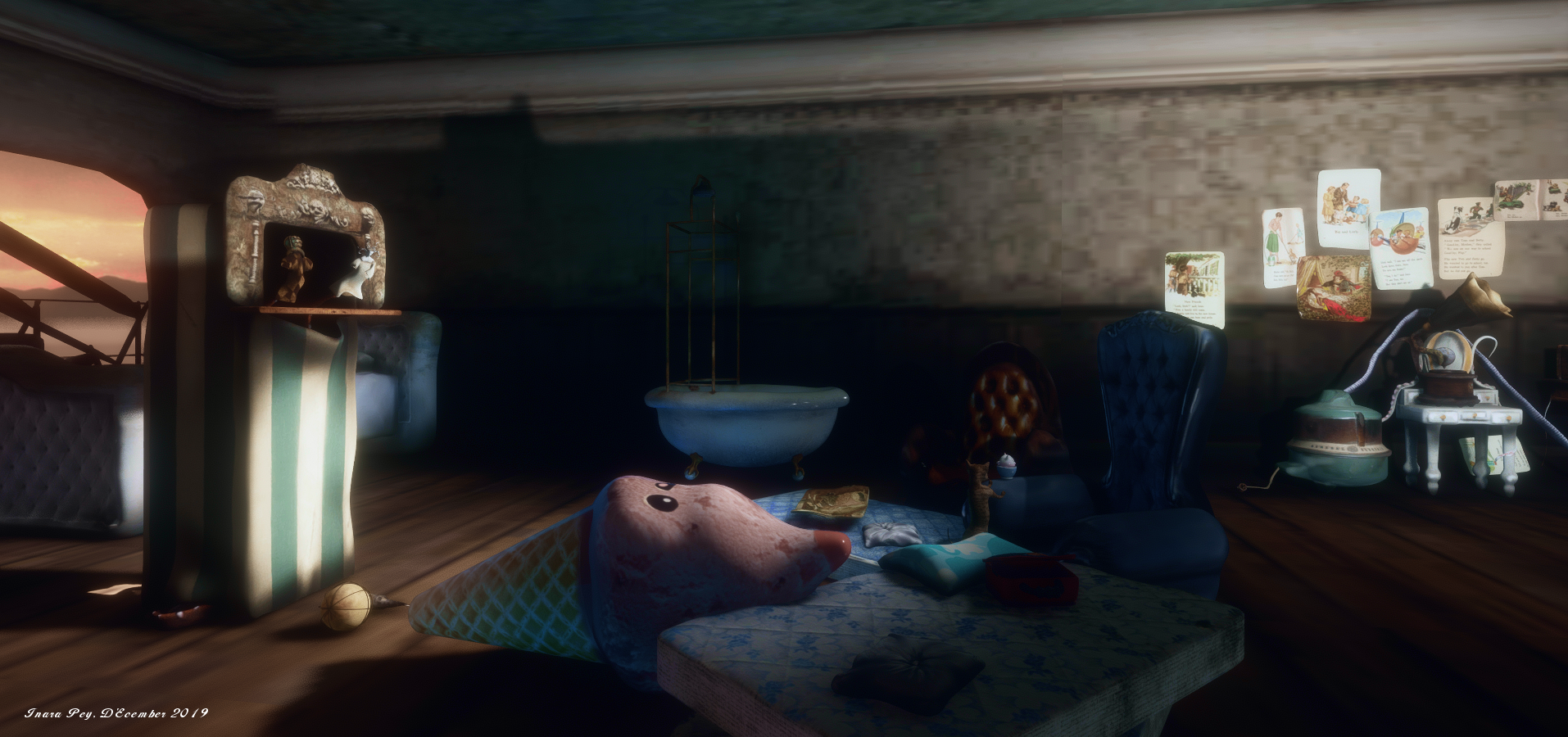
Spread over two level of the gallery (accessed via the teleport point in the foyer area), the exhibition presents a series of sketches showing the evolution of The Daughter of Gears, mesh models from various scenes from the trilogy (including some that do not appear to have been used in the final installations), and drawings that appear to show the evolution of the rabbicorn as well asstory scene ideas.
This is a small display, but one that is fascinating nonetheless, providing insight into Bryn’s creative process. While it might have been enhanced with some additional textual information to accompany the sketches and sets of images, one cannot find fault with none appearing; for one thing, Bryn tends to keep busy with preparing art, whether intended for SL or elsewhere. For another, these pieces on offer speak eloquently in and of themselves, particularly for those who have visited the trilogy whilst it is at Immersiva, while the sketches and drawings are more than capable of standing up in their own right as works of art.
With individual pieces available for sale, and an opportunity to obtain limited edition bronze pieces cast of The Daughter of Gears and the Rabbicorn, The Standby Sketches will be open through the rest of January and February. Given the pairing of the exhibition with the Standby Trilogy, I’d recommend a visit to this ahead of The Standby Sketches so that the fullest appreciation of both can be gained.
Currently open – for a while longer at least – within her home region of Immersiva, is Bryn Oh’s three-part tale of a mechanical girl and a rabbicorn (part rabbit, part unicorn, all mechanical). It’s a complex, multi-faceted story rich in detail and themes that requires time – and not a little patience – to be witnessed and followed in full.
The three parts of the story stand as individual installations that should be visited in order. One sits at the ground level of the region, the remaining two up in the sky. They commence with The Daughter of Gears, and then progress through The Rabbicorn Story and conclude with Standby. Within them, they enfold matters of love, lost, fear, life, death, longing, companionship, human nature, feature of technology / progress, and sacrifice, as well as demonstrating how all of Bryn’s pieces share a relationship with one another, being set within the same universe – or perhaps “Ohverse” might be a better term.
Bryn Oh: The Daughter of Gears
The three installations between them also have a long history, as Bryn points out in discussing their origins.
Daughter of Gears story was originally created years ago when I was commissioned by a company called Rezzable to make something for an existing region called Black Swan … The second and third parts were hosted by IBM when they were actively within Second Life.
Originally when the stories were created in prims they each were close to 20,000 prims for a grand total of around 60k. Far more than a sim can hold. But yay! for mesh which has allowed me to reduce the footprint down to 19683.
Bryn, commenting on The Daughter of Gears and The Rabbicorn Story
Bryn Oh: Standby
Bryn covers the unfolding story at length through her blog, so I’ll restrict myself to just outlining things here. All three installations are framed around a series of three poems, the stanzas of which are spread through each of the installations and presented in such a way we can only visit them in the correct order.
For The Daughters of Gears, this involves climbing a high tower to uncover a story that might be said to have, as a seed, within Mary Shelley’s Frankenstein; or, The Modern Prometheus – although the two are very different in content. Here, a mother faces the death of her one daughter by building a mechanical body into which she can transfer her child’s soul. Unfortunately, the locals, scared by what she has done and regarding her work as an abomination, come to her high tower to put a stop to things. Ultimately, they fail – but at the cost of the mother’s life, leaving the Daughter of Gears alone.
Bryn Oh: The Rabbicorn Story
The story is told by climbing the tower itself – individual stanzas set on different levels. Now, to be honest, climbing the tower isn’t easy – to the extent that some might find it frustrating – it is easy to mis-step / jump and find yourself back at the bottom of the tower (and I’d recommend using Mouselook in places, as the camera angles can be tight); however the scenes the climb reveal are more than worth the effort.
In The Rabbicorn Story, we follow the tale of a mechanical rabbicorn, it’s relationship with the boy form whom it is built, and what happens when others come to covet the uniqueness of a mechanical intelligence and how it might be used – for good or ill. The initial part of the story might be said to have a seed in a modern-day “classic”, this one Peter. Paul and Mary’s Puff The Magic Dragon (notably the lyrics dealing with dragons (or in this case Rabbicorns) living forever, but no so little boys). Forced on the run from, but tracked by, the scientists that covet it, the Rabbicorn eventually finds its way to the tower of The Daughter of Gears, and in the third part of the tale, Standby, we follow the attempts by the two of them to find a new home together, little realising they are being tracked.
Bryn Oh: The Rabbicorn Story
These latter two parts of the tale are navigated by teleport rather than climbing – although for obvious reasons, a section of The Daughter of Gears’ tower does appear. There is also something of a Transhumanist / The Matrix-like reference in The Rabbicorn Story, as revealed in Bryn’s notes on the installation: the merging of human consciousness with machines to make the latter operable.
It is also within The Rabbicorn Story and Standby that we particularly see how this tale is interwoven with other aspects of Bryn’s universe. This is most clearly seen by the the Rabbicorn being created within the same facility as featured in 26 Tines, while in searching for a place to live, The Daughter of Gears and the Rabbicorn come across Lady Carmagnolle, still standing alone on her broken stage (you can read more about Lady Carmagnolle and 26 Tines in A Lady and 26 Tines in Second Life).
Bryn oh: The Daughter of Gears and the Rabbicorn
Richly visual, deeply set in terms of themes and interpretation, these three installations offer an expressive visit in which it is possible to become thoroughly enmeshed within the unfolding tale. The outcome may not be what might be entirely expected – but again, it follows a tradition within storytelling and myth building.
Standby also has a link with another exhibition of Bryn’s art in Second Life, and I’ll be offering a few notes on that in an upcoming piece.
Three years ago, in December 2016, Bryn Oh unveiled Hand, a full-region installation offering visitors an immersive experience mixing art and storytelling with a touch of mystery and discovery. I visited that installation on the occasion of its opening – see Bryn’s Hand in Second Life – so I was delighted to learn via a Tweet from fellow traveller Wurfi that Bryn has opened Hand within Sansar.
The original Hand was an interactive experience, utilising many of Second Life’s capabilities, notably the use of a HUD as a guide tool and storytelling device. Sansar currently lacks any real ability to provide an HUD-like capability, but this doesn’t lessen the impact of Hand in Sansar. Instead of the HUD, this installation make use of dynamic objects within the installation to tell the story, notably in the form of the principal character in the story, Flit – or Flutter, as she is also known.
Bryn Oh, Hand – Sansar
I won’t dwell on the story in great depth, given I did so in my original piece on Hand, but I will repeat something I noted in that article:
This journey takes us through a strange, broken urban setting with decaying, collapsing buildings; a place where adults are almost (but not entirely) absent, apparently leaving their children to fend for themselves … Walking through the streets and buildings I seemed to come across nods to dystopian sci-fi: a hint of Soyent Green here, a reference to rampant consumerism there. While Flit and the other children brought to mind shades of And The Children Shall Lead, minus the space alien angle.
– Bryn Oh’s Hand in Second Life, December 2016
Bryn On, Hand – Sansar
What is particularly impressive with this build – which Bryn has specifically built around the use of VR headsets to gain a full sense of immersion that the original in Second Life perhaps couldn’t achieve – is the richness of colour, sound and sense of presence, the latter being fully appreciable even when visiting in Desktop mode as I did.
This edition of Hand, as Bryn notes in her blog, has been made possible through the support of the Ontario Arts Council, an organisation that has – to the benefit of us all – long supported Bryn’s work. In that post, Bryn also muses on art within virtual spaces, and how the capabilities of VR headsets coupled with creative environments like Sansar can help to bring a new artistic movement to the attention of a wider audience:
We had the Cubists, Impressionists, Surrealists, Modernists and I see our movement as the Immersivists. I have believed in this idea a long time but now with virtual reality headsets such as Vive or Oculus, the immersion is less fragile. You don’t look at a computer screen and beyond its borders see a bill that needs to be paid or your cell phone rings… instead you are in the world I have created and firmly there. Unlike painting where you stand from a distance and look at a static scene or cinema where you are told a story as a passive observer, virtual reality artwork can offer the ability to be an active participant in the art.
– Bryn Oh
Bryn Oh, Hand – Sansar
Hand is proof of this. Within it, we can not only follow Flutter’s story, but we can look elsewhere. Spaces that can only be hinted at in a painting or seen as a passing background in a film can be turned to and explored. Of course, this has always been the case with Second Life, but the personal immediacy of VR does take this personal involvement within a an installation like this adds a further layer to the narrative within it.
As captivating as the original – Desktop users note that some free-camming might be advised – Hand remains as an engrossing story in Sansar as it did in Second Life.
Bryn Oh is currently working on a new immersive installation to succeed Hand, which closed in late 2017, and about which you can read more here. While the new installation is under development, she has opened two single-scene poems, Lady Carmagnolle and 26 Tines, both of which can be found on Bryn’s home region of Immersiva.
“A carmagnolle is one of the very earliest full metal diving suits,” Bryn says in explaining the first of these scene poems. “Monstrosities of protection that allowed people to explore the depths.” In fact, it was the first properly anthropomorphic design for an atmospheric diving suit (ADS), designed in 1882 by the Carmagnolle brothers. It features a distinctive metal helmet with multiple small glass ports to provide a view outside for the wearer.
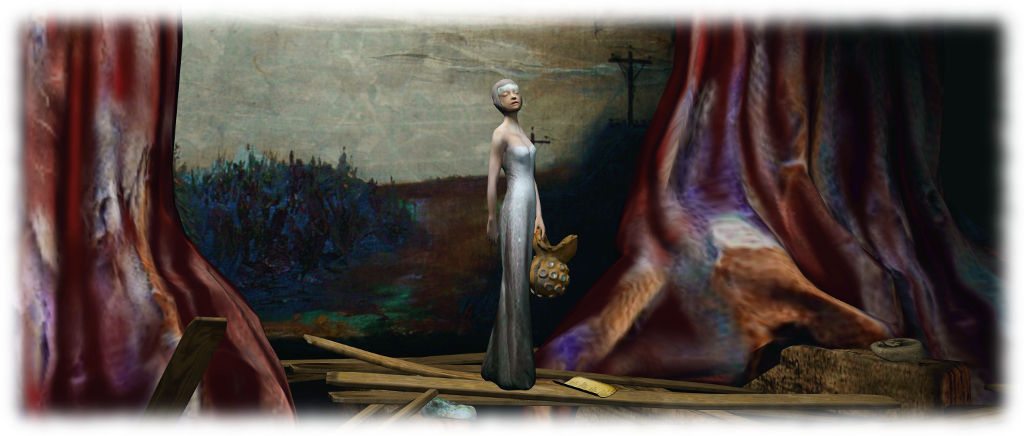
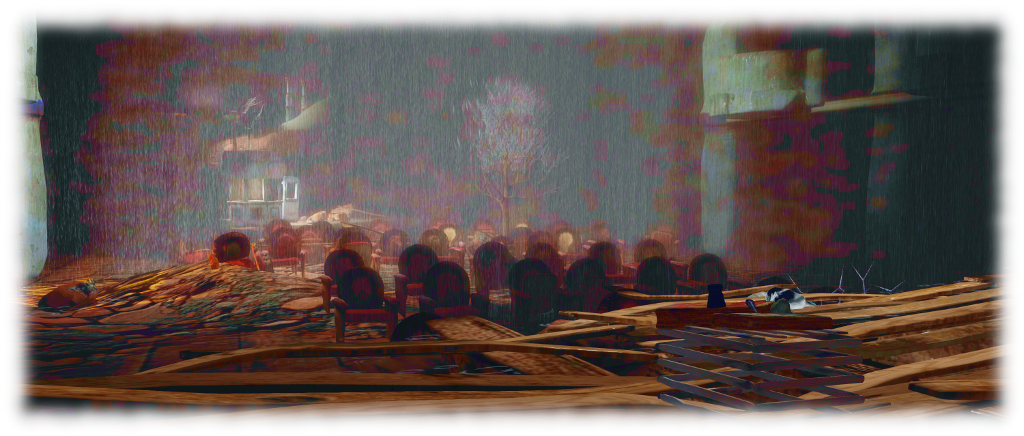
In Lady Carmagnolle, the titular lady of the piece stands alone on a deserted stage in a broken-down theatre, the helmet of the carmagnolle suit in one hand, a rock in the other, a face drawn upon it. “She imagines the rocks to be injured birds who she cares for,” Bryn states, “When it rains the ink washes away leaving a simple stone. When Lady Carmagnolle looks to find these rocks and instead finds them gone, she wistfully imagines that they have grown back their wings and returned to the sky, finding others to fly with. In her loneliness this is her most beautiful dream.”
It’s a sad tale, accompanied by a sad poem and sent within the haunting setting of the tumble-down theatre, where the rain falls as Lady Carmagnolle’s only audience.
26 Tines, on the other hand, is something of a love story, again accompanied by a poem. “The laboratory is silent, the scientists gone, we have seven hours, before the dawn,” so reads the first stanza of the poem. It directly refers to the emotional bond between two robots within a research facility, a bond where – even were they both human – words would be inadequate to express their feelings.
So instead, when the working day has come to an end, and the humans have left this secretive, underground bunker of a laboratory, the maintenance robot pauses in its tasks of cleaning up. Instead, it sits down with its tiny kindred, and the two connect via cable. In this way, they bypass clumsy language and exchange their feelings and emotions directly one to another via the 26 tines of wire contained within the cable connecting them.
Thus it is, the two robots pass the time until morning comes and the daily routine intrudes, scientists returning to their lair to resume their work. Separated, the robots are left with the intimate memories of dancing together through the nights, the sublime delight of sharing their time, their feelings, so intimately for seven short hours each day – and the knowledge that in the night to come, they can be together once more.
Like Lady Carmagnolle, Bryn’s 26 Tines is haunting in theme, but with a slightly dark, science fiction turn. Both are easy to visit, but offer layered meaning and a richness of pathos, loneliness and devotion.
Floating is an accident, pure and simple. It was never intended to be a collaboration between Bryn Oh and Cica Ghost – but that is what it is. Which is not to say that it is anything unfortunate – far from it; it’s an installation that mixes fun with something of a slight social message.
As Bryn explains, the installation was originally intended to be her design, but built to display the 2D art of another person. But for some reason (shyness?), having secured a grant to use the region, the other artist did not follow through on their commitment and no 2D art was supplied – leaving Bryn holding the lease on a region and in need of an idea. Enter Cica Ghost. She and Bryn put their heads together and in a week, Floating had emerged, with the assistance of Desdemona Enfield and Serenity Mercier.
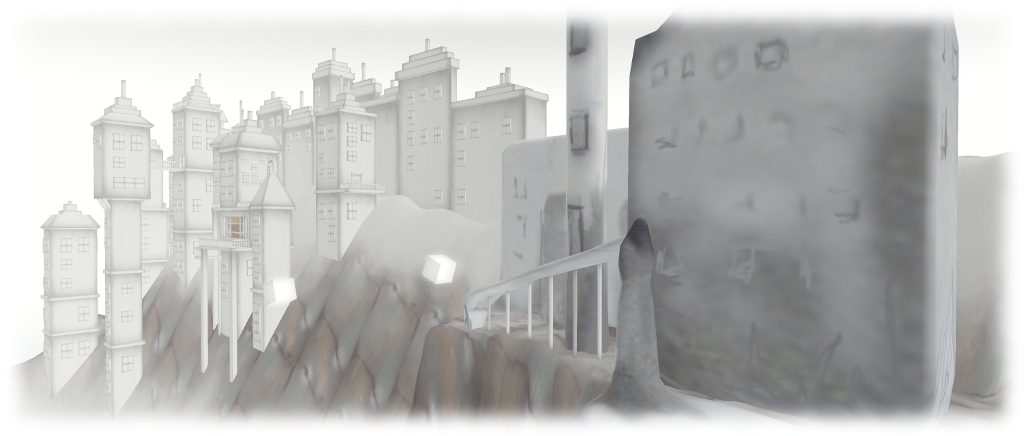
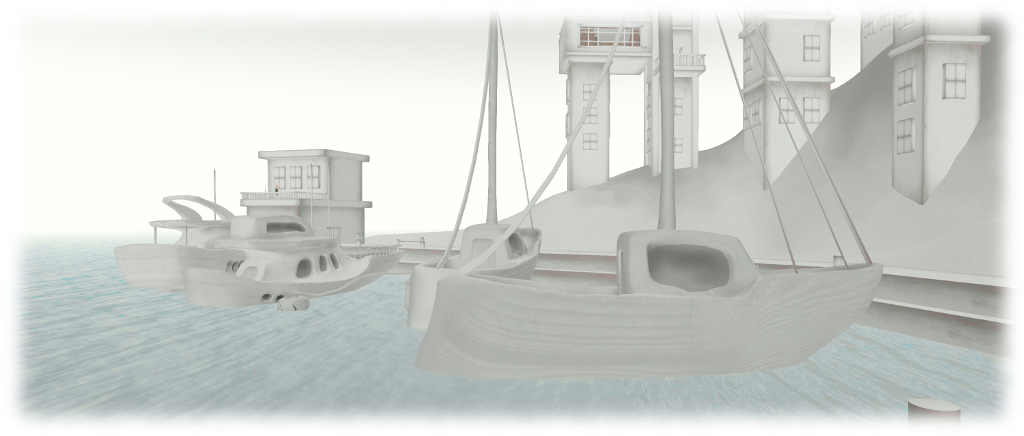
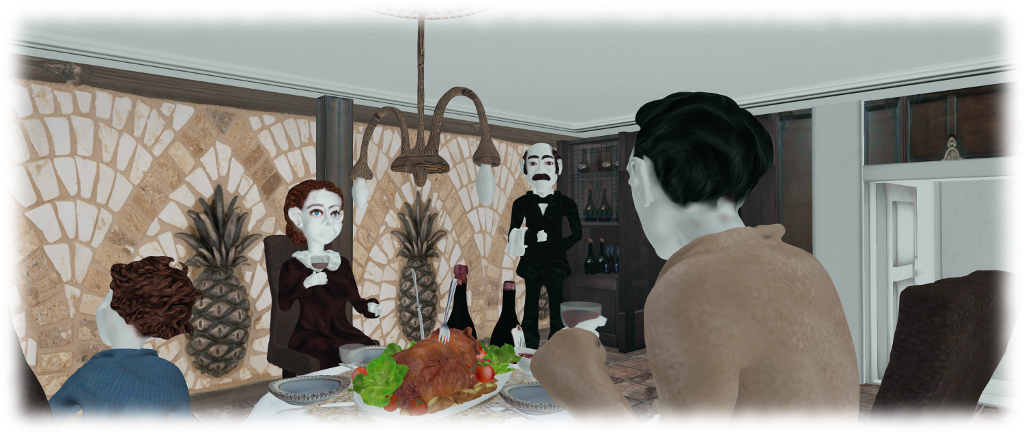
The core of the build is a city hugging a shoreline; at one end are high-rise apartments overlooking a marina with motor cruisers and boats. The people in the apartments are clearly wealthy or well-off; through the windows of one we can see a family sitting down for a sumptuous meal, a butler in attendance, in another, a family sits in coloured warmth. With the marina and the high-rise buildings, the evidence of wealth, it is hard not to be put in mind of somewhere like Monaco.
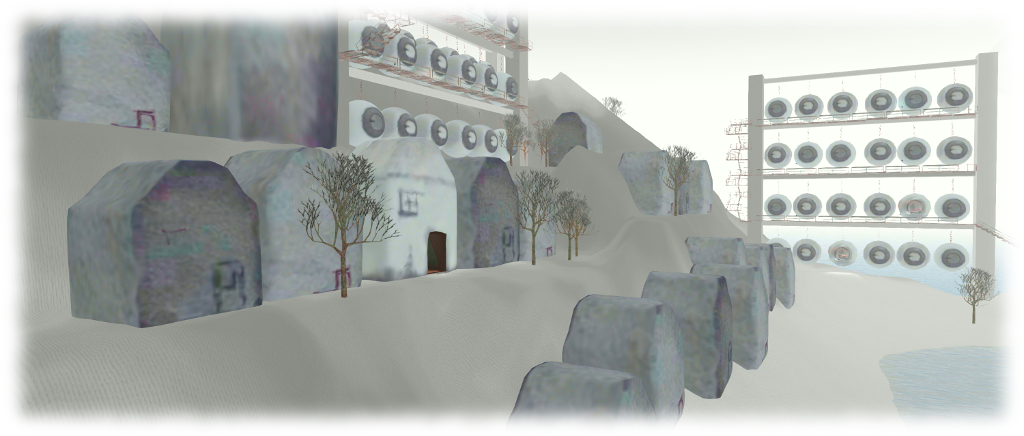
At the other end of the curving shoreline it is a different story. Here there are no glittering high-rises, only older buildings, grubbier in appearance, which in turn give way to humble, racked living pods. The beach here is also far from the pristine marina, with piles of detritus, while the absence of colour underlines the lack of affluence. Thus, a comment on the divide between those who have, and those who have less (and who serve?), is made.
However, this isn’t just a build with a message on society’s disparities; there is also a sense of fun yo be found. At the arrival point, visitors can take an umbrella and float around the build, while free-floating balloons also offer a means to float through the air. But be warned – care needs to be taken as there are blocks that periodically fall from the sky.
Also to be found at the landing point is a zap gun. This can be purchased for L$0, and allows people to hunt and shoot one another. Just make sure you join the experience in the region if you intend to place – otherwise, should you be shot by someone else, you’ll be teleported home, rather than just back to the landing point.
Floating is a curious, electric mix of art, message and fun (if visiting with others and the guns are being used). Instructions on obtaining the zap gun and on getting around can be found at the landing point.
Hand, Bryn Oh’s latest full region installation officially opens in Second Life on Saturday, December 10th at 12:00 noon SLT. It offers visitors an immersive experience which mixes art and storytelling with a touch of mystery and discovery.
On arrival, visitors are asked to accept the experience HUD (which will initially be blank) , and which can be minimised by clicking the dancing figure icon. As there is a lot of text to be read as one progresses through the experience, the HUD can also be further enlarged by clicking the Extra Large Text button on the HUD.
Instructions for viewer settings are also provided at the landing point. These are geared towards Firestorm and specifically the use of Phototools. Those on other v4-style viewers will find the settings under Preferences > Graphics and the Advanced Settings… button (Advanced Graphics Preferences floater). Bryn also uses Firestorm’s client-side windlight by altitude capability, so those on other viewers may need to manually change windlights (listed in About Land) as they move up through the installation.
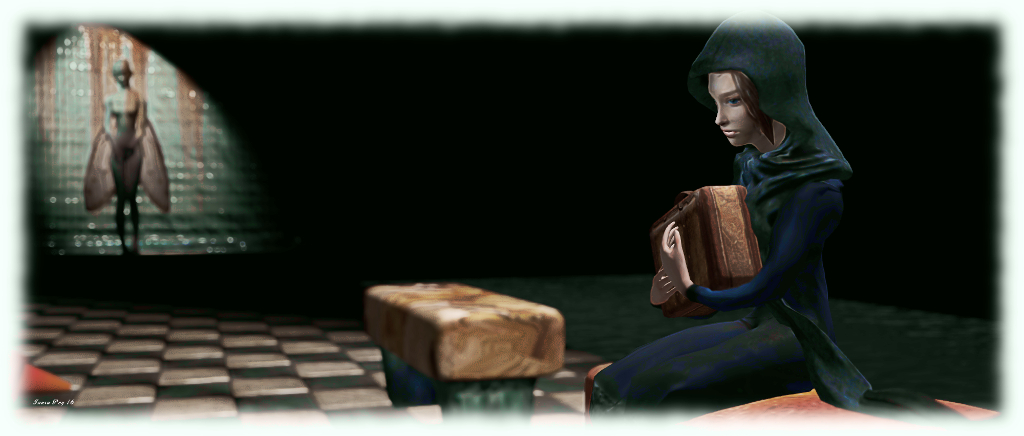
From the landing point and instructions, a teleport sphere carries visitors to an underground tram station, and their first encounter with the principal character of the piece, Flit – or as she is sometimes known – Flutter. It is her story we are invited to follow, the narrative (and the way through it) indicated by Flit herself, as she stands within certain scenes or points the way along the route we should follow – such as walking a collapsed aerial mast like a tightrope walker, or standing on a stairway as if waiting for us to join her and continue up them.
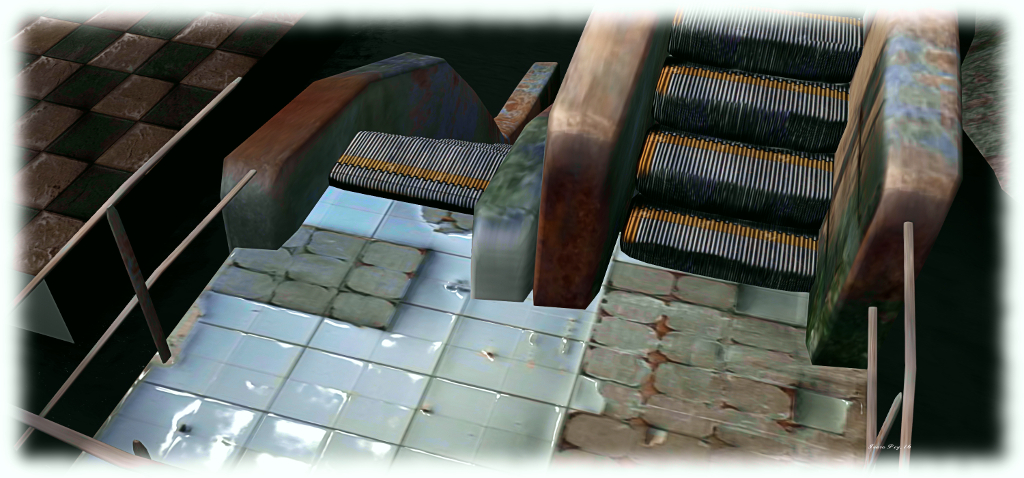
This journey takes us through a strange, broken urban setting with decaying, collapsing buildings; a place where adults are almost (but not entirely) absent, apparently leaving their children to fend for themselves. Technology is still active – drones buzz around and project adverts on walls and floors for whoever might watch them – presumably as a form of currency / earning, and lights flicker and play. Walking through the streets and buildings there appears to be nods to dystopian sci-fi: a hint of Soyent Green here, a reference to rampant consumerism there. While Flit and the other children brought to mind shades of And The Children Shall Lead, minus the space alien angle.
Whether any of this was Bryn’s design or simply my over-active imagination, I’ve no idea – but Hand’s narrative naturally invites you to fill in the blanks: what has happened here? Why have the adult withdrawn? Why is the city so ruined? Lack of maintenance because there are no adults – or something else (there are hints to be found pointing to a fear of nuclear war). Thus, in experiencing Hand, we also extend it, by exploring carefully and letting the hints – posters, objects, etc. – suggest things to us.
There are also links and hooks into Bryn’s other work to be found here as well. Some are present within the story, others may be harder to find. As Bryn states, don’t be afraid to touch things as you explore. Take the lacewing beetle, for example; touching it will introduce you to Scissors a machinima by Bryn. Elsewhere, a broken cellphone lying on the kerb might lead you skyward to poignant piece of art based on an equally poignant image; and so careful exploration is required.
Byrn produced a trailer machinima for the installation (below), featuring music specially composed by Phemie Alcott. Phemie was due to perform at the opening of Hand, but Bryn reports that as Phemie’s mixer decided to commit suicide, the performance will now not take place until 14:00 SLT on Sunday, December 18th. Bryn isn’t sure how long Hand will remain in place – so be sure to visitor sooner rather than later, and please consider a donation towards Immersiva’s continued existence.






 Inara Pey: Living in a Modemworld