 On Saturday September 20th, Avatar Social Network (ASN) celebrates its first birthday and is holding a party in Second Life. It comes pretty close to marking my first month of involvement in ASN, so what better time to take another look, and also chat to Arkad Baxton, ASN’s founder about the past year and what may lie ahead?
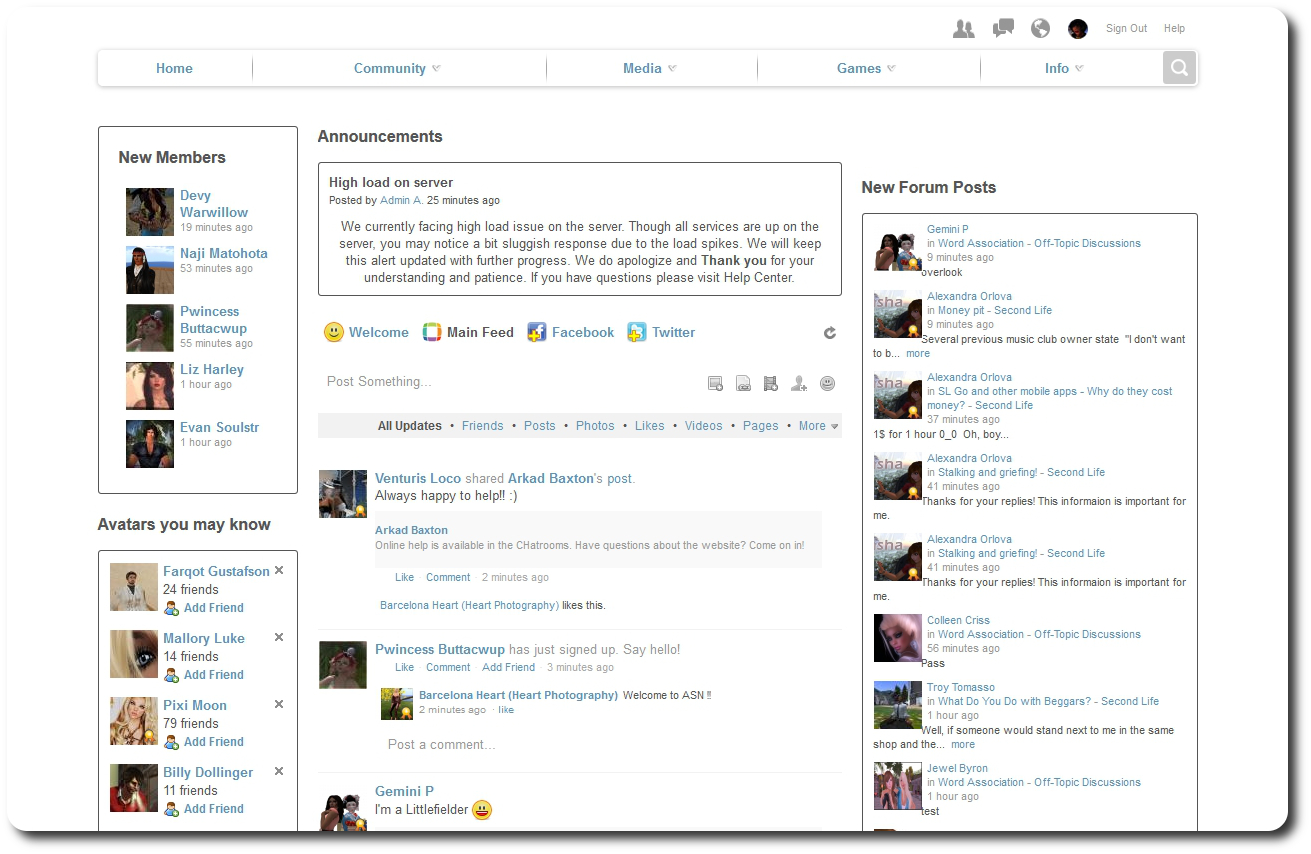
As I noted in my first piece about it, ASN was established to provide a social hub where users of virtual worlds and games – not just SL – can interact with one another in a wide variety of ways: post comments and pictures to a common feed, write blog articles, discuss topics on the forums, post videos and photos to their own walls and to albums, create their own pages and feeds, create groups to promote and share creativity, in-world activities and so on – and generally have fun.

Since starting up in September 2013, ASN has enjoyed steady growth as people have discovered it, although over the past few months the growth in sign-ups has increased somewhat dramatically, passing quickly through both the 2,000 and the 3,000 mark and continuing to rise. But why set-up a social network in the first place? Second Life, World of Warcraft, many OpenSim virtual worlds, and so on, have forums where users can interact, and some have supporting social networks (SL for example has the SL feeds, Moolto, SL Friends…), so why start another?
“I get that question a lot actually,” Arkad says in reply. “People using virtual worlds and games like World of Warcraft and so on did not have a social network environment where they could freely interact with one another as their preferred avatar or character. Nor did they have a place where they could discuss their various interests in different worlds and games. The social networks and forums they did have were focused just on individual platforms. So I decided to try to make a place where people can freely make friends and share content no matter what their main interest in games or virtual worlds.”
Given the current rate of sign-up, ASN has certainly garnered a lot of interest among a widespread audience, which has in turn generated a core of active users who use the service daily, blogging, interacting through the feeds, groups and pages, and sharing their content. Indeed, such was the popularity of the site at the time of my joining (when membership was just touching 2,000), the service was actually showing signs of strain, and I wondered how it would handle future loads. I needn’t have worried.

ASN has a development roadmap in place, which is constantly being refined, updated and acted upon. Proof of this came a few days after my original article, when ASN’s ISP moved the service to bigger, faster and more robust servers. At the same time additional back-end services were introduced, including the use of SSL / HTTPS for more secure connections between users’ computers and the ASN servers.
An interesting aspect of ASN’s roadmap is that it is not being defined solely by the ASN team and their service provider. Feedback, ideas and input is openly sought from ASN members, both through the website’s feedback page, and through direct discussions with Arkad himself.
“Feedback has had a huge impact on the changes we make,” he notes during our chat. “Our feedback page lets people add their ideas and thoughts. Others can vote on them to show us how strong the demand is for specific ideas or suggestions, and our team is reviewing and evaluating them as we go. Obviously, we can’t please everyone, but we always listen to the members.”
Nor is the roadmap and listening to feedback confined to the core website; in my first article on ASN, I made an entirely personal aside about the level of access the Android app requests of a device. This was not a direct critique of the application or any suggestion that the app is doing anything untoward; merely that as a non-technical person, i felt the app exceeded the level of access to my device I was comfortable in giving.
On reading the article, Arkad contacted me to enquire what could be done to redress this, his view being that if I felt this way, others may as well, so it would be good to try to amend things if possible. As a result, and alongside the development of an iOS version of the app, a possible revisit to the Android app could be on the cards (the app is already undergoing an overhaul so it works more smoothly with the more secure servers).
Of course, the development of the service requires funding, so I asked Arkad how that is managed. “The primary revenue for the site is coming from advertising at the moment,” he replied. “That being said, there are various investors involved, so the finances are somewhat diversified, and we are hoping to add to the revenue stream by offering additional paid services down the road.”

One of the criticisms from outside of ASN is that there is so much anonymity involved – not so much where users are concerned, but in how the site is operated. ASN is owned by a virtual company, AP Holdings; while this may well be a Second Life company traded on SL Capital Exchange, it is still virtual and the only name associated with it is that of an avatar.
“ASN is a website structured to give people the freedom to be known purely as their preferred avatar or game character, and we promote the fact that no real-life information need be given or shared in order to use the service,” Arkad says in addressing this criticism. “We’ve simply tried to demonstrate this in a ‘show by doing’ approach. However, I do recognise that trust in a service is important, and we will soon be providing information on the actual company behind ASN and we will then continue to publish information related to it as the growth of the website demands.”
Continue reading “Celebrating one year, 3,000 members, 70,000 posts, 12,000 friendships”
 Inara Pey: Living in a Modemworld