Art and idioms in Second Life

Vegetal Planet: State of Mind

Currently open at Vegetal Planet is an impressive 2D / 3D interactive installation led by Cherry Manga, made with the support of JadeYu Flang, that makes for a fun, and also thought provoking visit.

State of Mind is a journey through 20 popular idioms and expressions, taken without the need to move that far. It’s a journey that requires visitors to enable Advanced Lighting Model (Preferences → Graphics), although you do not require shadows to be enabled as well, if you’re concerned about viewer performance.  With ALM set, touch the sculpture at the landing point to deliver you to the main exhibition space.

Vegetal Planet: State of Mind

Located in a skybox, this is an environment that is in a state of flux, the scene within it changing periodically, gently paging through the 20 idioms. Visitors can either stand and watch the show or, by touching the east wall, can become a part of it, floating serenely as the scenes change around and below them.

Each idiom  / expression is presented as a complete scene, with the expression written in French or English and French against the wall that can set you floating. While is it easy to look at this and translate what is written, it’s more intriguing to observe the scenes as they appear and decrypt what is being illustrated. Sometimes this is easy – as with Head in the CloudsWalking on EggshellsStars in (Your) Eyes, others may take a little time to figure out, and some may not have an literal translation from French / English, so may not always be familiar to everyone.

Vegetal Planet: State of Mind

All of the pieces are, however, cleverly presented, often inviting the observer not just to try to identify the idiom being presented, but also consider how it came about – particularly with those that border on cliché. Take Thinking Outside the Box as an example – where did it originate, and how did it descend into a management consultancy cliché? Turns out it may well have originated with management consultants in the 1970s as a result of the “nine dots” puzzle, only to circle back to them through wider use to become a common training cliché.

Consideration of the derivation each saying is encouraged by the lack of any explanation for each setting beyond the expression appearing on the wall. Thus, in looking at the passing scenes, the grey matter is naturally stirred into questioning just why such expressions have become so recognised, that nine times out of ten we’ll happily use any one of them without otherwise considering where and how it might have be born and then enter into common usage.

Vegetal Planet: State of Mind

Fascinating, intricate and engaging, State of Mind will, I believe, be open for at least the next month.

SLurl Details

A return of Bryn’s Hand in Second Life

Bryn Oh: Hand

Bryn Oh first created Hand is Second Life in 2016. An immersive experience, it mixed art and storytelling with a touch of mystery and discovery.

Originally an installation that used Second Life Experience Keys, Hand recently transitioned to Sansar with the assistance of a grant from the Ontario Arts Council, and which I recently wrote about in Bryn Oh’s Hand in Sansar. That grant has also allowed Hand to once again be resurrected in Second Life.

In writing about Hand in 2016, I noted of the installation:

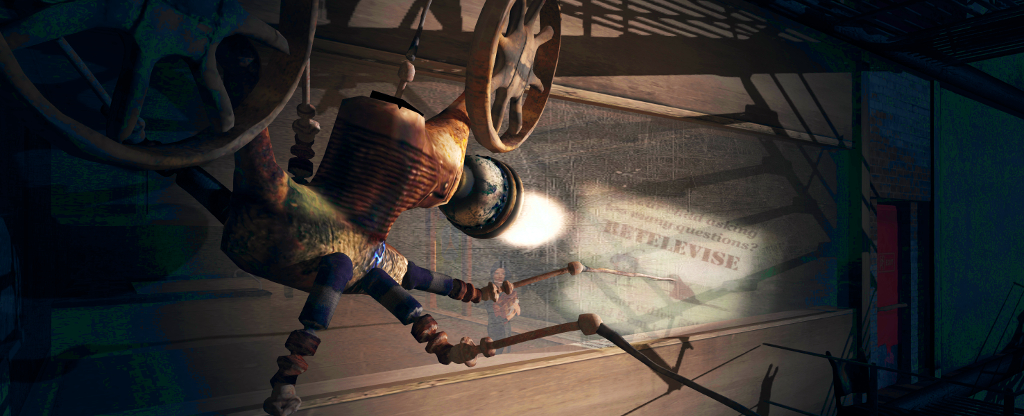
This [is a] journey takes us through a strange, broken urban setting with decaying, collapsing buildings; a place where adults are almost (but not entirely) absent, apparently leaving their children to fend for themselves. Technology is still active – drones  buzz around and project adverts on walls and floors for whoever might watch them – presumably as a form of currency / earning, and lights flicker and play. Walking through the streets and buildings there appears to be nods to dystopian sci-fi: a hint of Soyent Green here, a reference to rampant consumerism there. While Flit [the principal character] and the other children brought to mind shades of And The Children Shall Lead, minus the space alien angle.

Bryn’s Hand in Second Life, December 2016

Bryn Oh: Hand

This is still true, as is the use of Experience Keys to assist visitors, instructions for which are provided at the landing point. What is different with this iteration is that rather than using a teleport to reach the actual starting point of the story – Flit sitting in an underground station – visitors must find their way through a tunnel from one station to the next, where Flit is waiting.

From here visitors once again travel up the escalator and out into the the run-down setting of a city well past its prime. Here the story will unfold by finding, and following Flit as she appears at various points in the installation, either pointing the way through the story or ready for a chapter of it to be told. As you approach the latter, you should hear the narration (assuming you have local sounds enabled). However, if no audio is obvious, make sure local sounds are on, and touch the microphone alongside Flit.

Bryn Oh: Hand

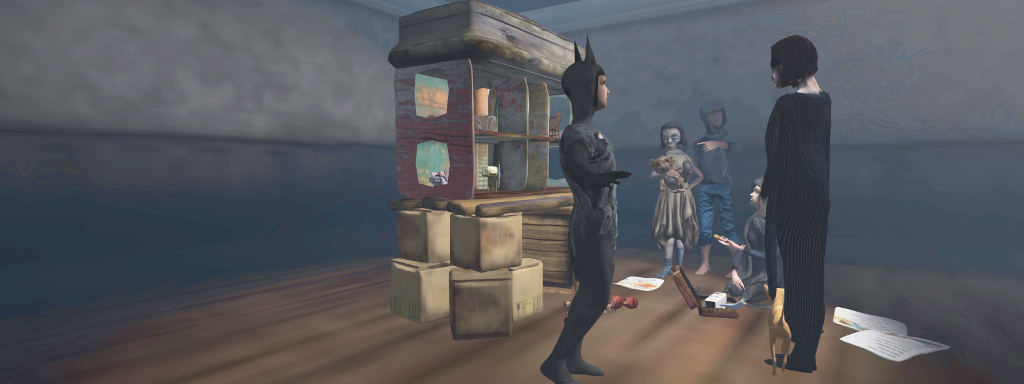
Aspects of the path through the story do require some care – making your way over tightrope-like planks and fallen towers for example, or climbing up piles of the detritus of humanity. Also, cleverly woven into the story are hooks to several other elements of  Bryn’s work – so don’t be afraid to touch things as you explore. Take the scene of the girl with the golden crown and her little entourage waiting to be found whilst exploring the rooms of the main building in the installation: touching the girl or the insects and creatures will offer you the chance to watch a video about The Girl with the Paper Crown.

Hand, whether visited in SL or Sansar – and a visit to both shows some of the core differences between the two – remains a captivating story, one that encourages us to fill-in the blanks through our own imaginations, adding to the richness of the tale Bryn tells through character, setting and the words of her narrator.

Bryn Oh: Hand

SLurl Details

  • Hand (Immersiva, rated: Moderate)

A man of many faces in Second Life

The Lost Unicorn: Razor Cure

Open through until Sunday, March 22nd at the Lost Unicorn Gallery is Razor Cure: Man of Many Faces, an exhibition of art by Razor Cure.

A Second Life photographer with a lean towards self portraiture, Razor doesn’t so much present characters and settings in eye-catching images, but actually inhabits the character he creates. some of these are born entirely of his imagination, others inspired by film or legend, while all of them reveal a man in love with stories, as he notes in writing about himself:

I go by Razor Cure, the name itself semi-borrowed from a book I was reading when I made my SL account … I came to SL for naughtiness, after my favour game, City of Heroes, died (and its back now, woo!) and ended up getting into picture taking. Now most of my time here is spent hunting for cool new outfits and attachments, exploring sims, tweaking poses…

The Lost Unicorn Gallery: Razor Gallery

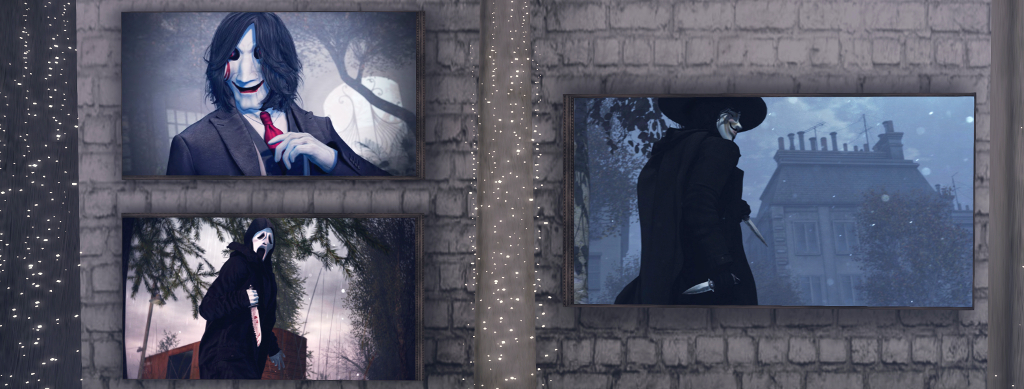
This love of inhabiting characters and telling stories is very much in evidence in the pictures selected for this exhibition. Within it, we can join with Harry Potter at Hogwarts, ride a magic carpet with a Prince of Persia, watch as a Baby Groot borrows a certain stone-laden gauntlet, confront a Joker-esque villain or a masked anarchist; all of whom are framed in in a manner that sets them within a story our imaginations can unfold.

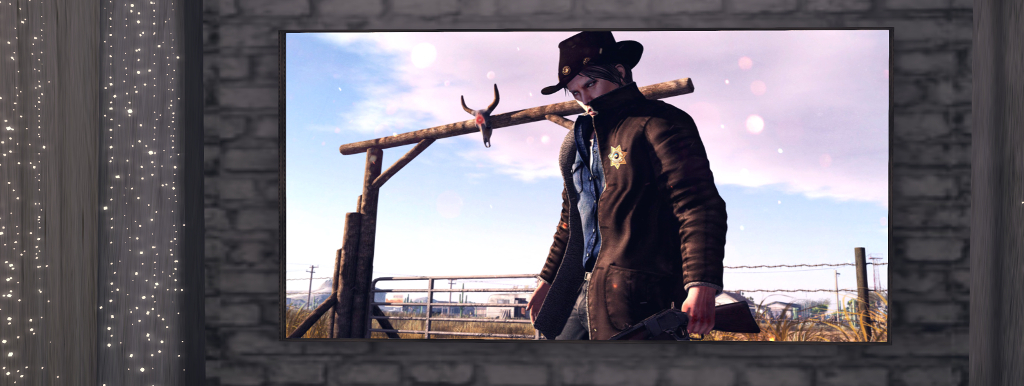
Alongside of these are pieces that might be regarded as more “traditional” avatar studies: the ring master, the cowboy, the hunter, and characters from fantasy. But again, Razor makes them characters he can inhabit, rather than just offer them as static studies, again making them stories in art.

The Lost Unicorn Gallery: Razor Cure

Man of Many Faces sits within the main hall of the Lost Unicorn and several of the surrounding halls. This both provides plenty of space for Razor’s art without overwhelming the visitor whilst also offering gentle encouragement to explore the other gallery spaces and the art and artists they have to offer.

SLurl Details

Strand Starsider’s art and stories in Second Life

Raging Graphix Gallery: Strand

Currently open at Raging Graphix Gallery, curated by artist RagingBellls, is an exhibition by digital artist and storyteller Strand Starsider.

The exhibition is split into two chapters: Magic, Angels and Demons, which ran from February 1st through 14th, and Fantasy and Scifi, launched on February 15th, and which runs through until the end of the month, which features the images seen in this article and includes a special celebration of art and music that will take place on Saturday, February 22nd from 11:00 to 13:00 SLT.

Strand’s work covers multiple genres: fantasy, science-fiction, noir, erotica, romance, avatar portraiture, abstract, whimsical, and more, enfoldling his imagination, Second Life and the physical world (catch his renderings of Christopher Walken, Clint Eastwood and Heath Ledger as The Joker available on his Flickr stream, for examples of the latter) . Rich in compositing, his are more than just digital art, they are genuine tales, each one with a narrative reaching far beyond the frame in which it sits, many often with subtle details that only reveal themselves through considered examination, adding to the tale they have to offer.

Raging Graphix Gallery: Strand

The pieces selected for this exhibition all offer a reflection of this gift for embodying narrative through art, and his exceptional ability to  create entire worlds within each piece. To fully appreciate them, I would strongly recommend using the viewer’s camera control to focus in on individual pieces rather than trying to view them from a distance. In this way, the details of each piece in turn are brought to the eye, rather than multiple images in the frame of view each competing for attention.

As a master artist, Strand is comfortable enough in his medium to not only present his work for public exhibition in-world and through his Flickr stream, but also take us into his creative world, producing videos that reveal his compositing process from end-to-end. Take Moon Princess, for example, shown below as it appears on Flickr and at the exhibition; it is accompanied by a time-lapse video showing how the image progressed from initial idea to finished piece, including the flow of change and experimentation that form part of the real-time creative process.

Strand: Moon Princess

I confess to wishing to be able to see Strand’s work displayed in a larger format than offered  – and I say that with no disrespect to RagingBellls; we all work within the space we can make available. It’s just that a larger format for the images would allow one to more easily focus on individual pieces.

However, and make no mistake, this is a stunning display of Strand’s art, and should not be missed, particularly if you’re unfamiliar with his work. Full kudos to RagingBellls for hosting it.

SLurl Details

Art and quantum states in Second Life

Milena Carbone: Agape in Pace

Having opened at the Itakos Project, curated by Akim Alonzo, on Sunday, February 16th, Milena Carbone’s Agape in Pace is a fascinating exploration of art, love, hate, religion, politics  – all of which might be summed up as the human condition; together with reflections on quantum field theory – specifically the quantum vacuum state and the Casimir effect.

Spread over two floors of the gallery space, the exhibit presents a mix of images and text panels, which together present a layered, nuanced story.

Initially, the exhibition was inspired by the strangeness of the quantum vacuum: a vacuum that was the result of interactions of matter, antimatter and quantum fields that cancel each other out. The image of the Agape and Lilith twins represented the course of matter and antimatter that arises and rejoins almost simultaneously to disappear in the peace of emptiness.

As my work progressed, I drifted towards the two parallel stories: of Agape, oriented towards love and the search for peace; and of Lilith, oriented towards hatred of the other and the search for destruction. These are two postures towards the world. Not just the world of humans, but of all forms of life and the mystery of our existence. The two stories inevitably unite in death and forgiveness.

– Milena Carbone, describing Agape in Pace

Milena Carbone: Agape in Pace

The stories of Agape and Lilith are told on the lower floor of the exhibition, Agape to the left and Lilith to the right as you face the hall. Each can be followed individually, while each acts as a reflection of the other. Neither can actually exist without the other, yet should they ever meet, they will mutually annihilate one another violently and completely. But while they stay apart each might continue indefinitely, as symbolised by the mirror-like triptych at the end of the hall.

Further nuance is added through the examination quantum field theory. The popular idiom life doesn’t exist in a vacuum tells us that everything is in relation to it’s context; thus, neither Agape nor Lilith exist alone; they are intertwined – love and hate, light and dark – each giving life to the other; neither occupies a vacuum, and together, whilst never touching, they operate as an example of the Casimir Effect: their very existence as individuals means that between them, they generate a non-zero energy that effects the space (or others) around them.

Milena Carbone: Agape in Pace

On the upper level, the exhibition, Milena both continues her examination of the human condition whilst offering her own examination of Agape in Pace. In doing so, she offers insight into her creative process and her use of layering in her art as a part of her storytelling. Here as well, there are nuances and reflections on the nature of life and existence, religion, and an understanding of our place in the universe – indeed, the idea that life itself is a reflection of the physical forces at work throughout the cosmos.

Provocative in stimulating the grey matter, attractive in its art presentation, and ending on a pointed commentary on both the small-mindedness we are all too often witnessing in modern politics, and the reality of our tiny presence in a cosmos that small-mindedness presumes we own, Agape in Pace is a captivating exhibition.

Milena Carbone: Agape in Pace

SLurl Details


A journey through CybeleMoon’s Dark Wood

CybeleMoon: Dark Wood and Other Destinations

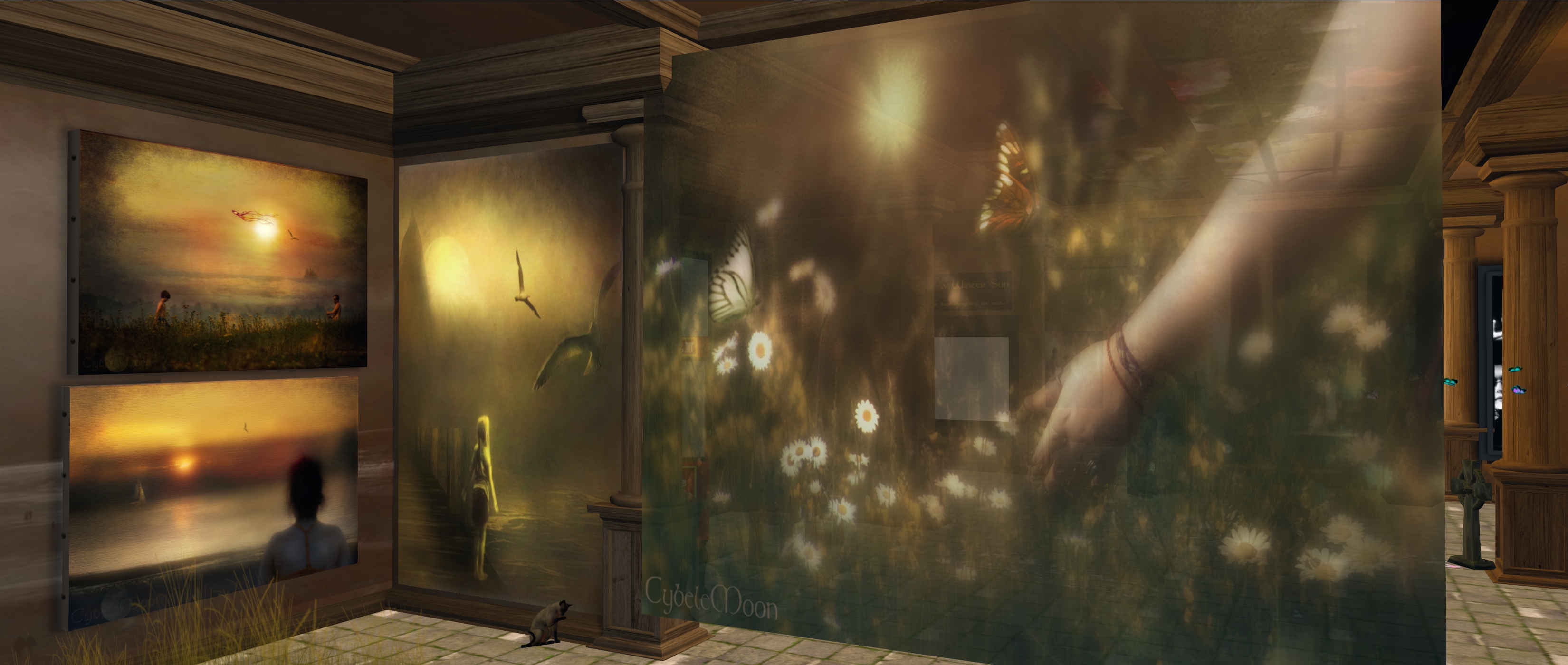
Now open at Savor Serenity is Dark Wood and Other Destinations, an exhibition of CybeleMoon’s always enchanting art. It offers a journey through her world, from woodland to coast, taking us past ethereal settings inhabited by children and creatures.

Cybele’s art ranges from portraits to landscapes, encompassing magical totems, hidden groves, wild glens, fairie circles, haunted woods, lonely shores and gardens of colour, light and shadow. Her palette offers us mixes of digital and real, gently mixed with tales and stories, children at play, picnic teas and enchanted children. All of which are offered within Dark Wood – and more besides.

CybeleMoon: Dark Woods and Other Destinations

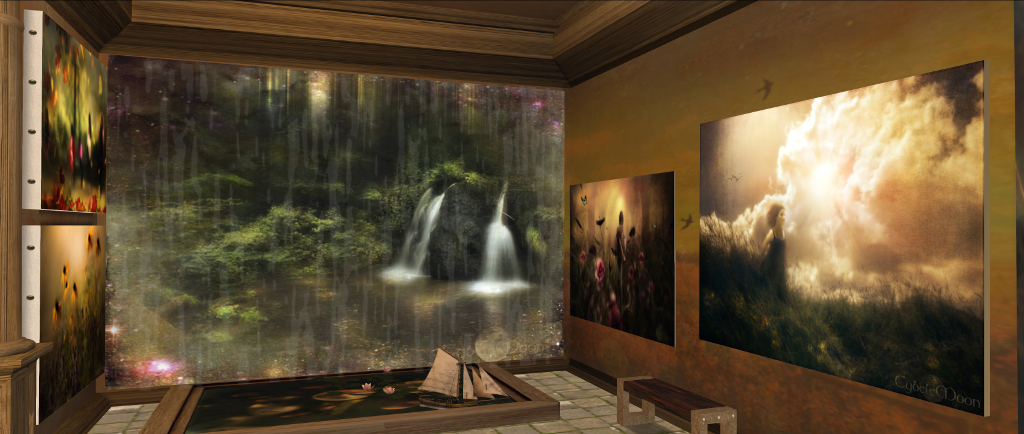
Splitting the gallery into three spaces through the considered placement of wall hangings that carry images of their own, Cybele presents us with a gentle tour of her work. Within the centre area we are introduced to her waifs, a wonderful set of largely monochrome portraits of children, together with one of her marvellously layered digital pieces that comes landscape and child’s face to present a haunting story within, and video presentations of her work.

Bordering the central area are images of her woodlands and coastal scenes, her glades and more of her children – the latter often infusing several of her images with a sense of fae magic. For me, one of the attractive aspects of this exhibition is Cybele’s use of 3D elements with two of her pictures; these lead us into the art with which they are placed, making a part of their narrative. In this, it is exceptionally hard not to want to climb the wooden bridge in from of The Winter Path and attempt to follow the trail to see what lies beyond the distant bend that sees it pass behind shadowed trees.

CybeleMoon: Dark Wood and Other Destinations

Similarly, the use of a pool with small boat and lilies sitting upon the water that adjoins The Fairy Glen at Rosemarkie, adds a depth of narrative to the idea of fae folk the art presents, the face below the water suggesting a water nymph at play in the waters spreading outward from the glen and “into” the pool.

Evocative, rich in image, colour, tone and story, Cybele’s art is always a delight, and for those familiar with it or have yet to experience her work, Dark Wood and Other Destinations should not be missed.

SLurl Details