Life through Xia’s Diary in Second Life

Diotima Art Gallery: Xia’s Diary

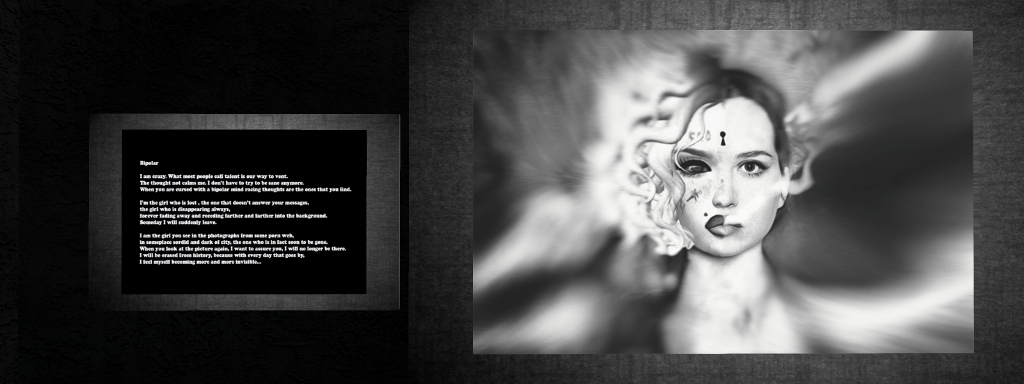
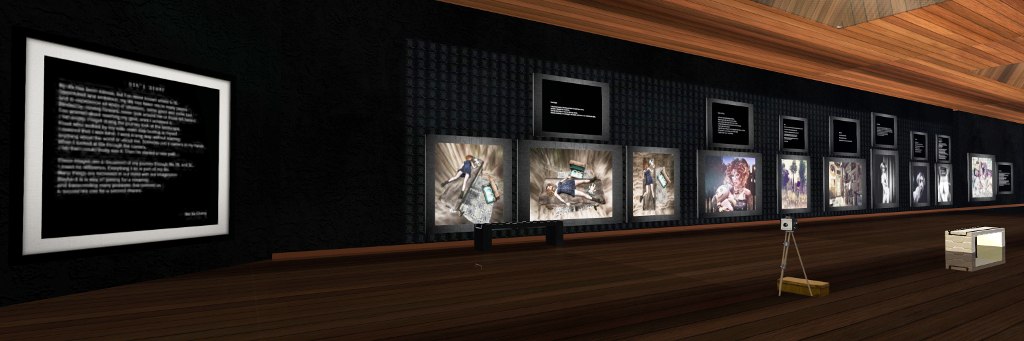
Xia’s Diary, currently open (for a little while longer, at least!) at Diotima Art Gallery curated by Red Bikcin, is an exhibition in images and words that offers reflections on life – both real and virtual – by Xia Chieng.

This is a thought-provoking installation in which Xia offers something of in introspection on her own life – how it has played out in Second Life, and how matters from her physical world life have informed her time in in the virtual and how the latter has caused her to more generally reflect on life as a whole.

My life has been intense, but I’ve never known where to fit. Opportunist and ambitious, my life has taken me to many places and to experience all kinds of situations, some good and some bad. Blinded by moving forward, never look around me or those left behind … When I looked at life through the camera, I felt that I could finally see it. Then he started a new path.

– Xia Chieng, defining Xia’s Diary
Diotima Art Gallery: Xia’s Diary

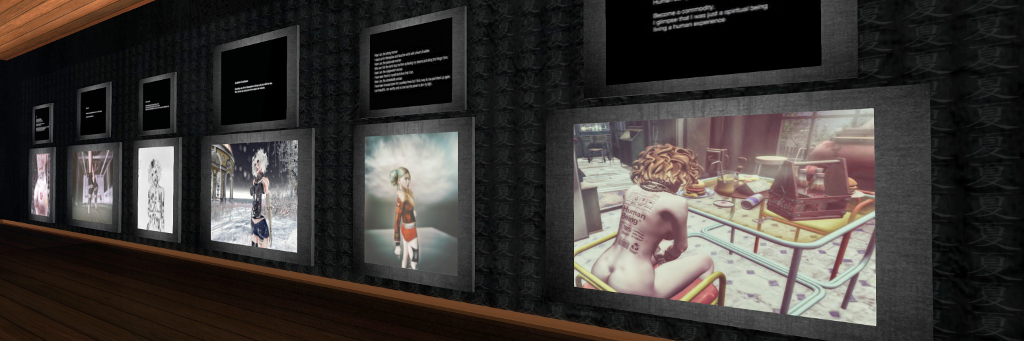
Twenty-one images – all of them avatar studies (although one has an aspect to it suggesting it might have originated in the physical world) – are presented in the exhibition. Most sit as individual pieces, although there are three that clearly form a single group, and three more are presented in such a way as to suggest they could form a set.

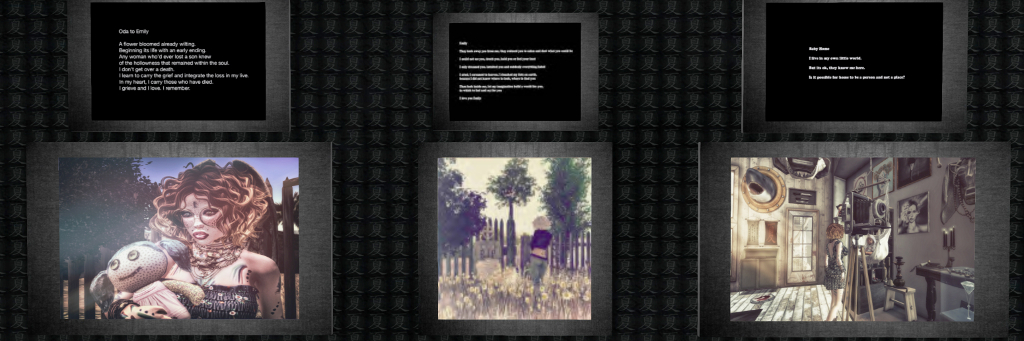
All are accompanied by Xia’s thoughts, the words provided with evocative titles such as Lost HopeOde to Emily, Broken Doll, and so on. They offer frames to the images over which they sit – and a windows into Xia’s thoughts and feelings.

These images are a document of my journey through life, RL and SL, I make no difference. Everything I do is part of my life. Many things are recreated in our mind with our imagination. Maybe it is a way of looking for a meaning and transcending many problems that torment us. A second life can be a second chance. 

– Xia Chieng, defining Xia’s Diary
Diotima Art Gallery: Xia’s Diary

The words, offered white-on-black are as clear-cut and unequivocal as their presentation. Evocative, provocative (as are some of the images), brutally honest, they offer the kind of introspection most of us probably prefer to carry out within our own heads (and most likely in a darkened room) well away from public display.

Thus, Xia’s Diary becomes something of a tour de force of feelings and responses in which we are cast into multiple roles. We are the voyeur and the emotional vampire, illicitly peeping in on the sometimes salacious, often poignantly deep, confessions from the heart and drawing from them. And given these are confessions – honest, down-to-Earth examinations of self, of hopes, of fears, of confusion of need – so too are we cast as the confessional-made-flesh, bearing witness to the opening of a soul. And because these are deeply personal reflections, so too are we given pause to hold up a mirror to ourselves and review who and what we are in life, both physical and virtual.
Diotima Art Gallery: Xia’s Diary

Intense, sometimes dark, expressive, and captivating, one of the more richly narrative and personal exhibitions I’ve recently seen.

SLurl Details

The Man Who Lived in the Future, in Second Life

The Edge Art Gallery, July / August 2019: The Man Who Lived in the Future

Currently open at The Edge Art Gallery operated and curated by Ladmilla, is an exhibition marking the 500th anniversary of the death of Leonardo da Vinci. The exhibition, entitled The Man Who Lived in the Future, features a new look for The Edge Art Gallery and displays are by sadi8 and JurisJo, jessamine2108, Larisalyn, PatrickofIreland, Kapaan and Ladmilla herself.

The new look for the gallery space is very much Tuscan in nature – as befitting da Vinci, a son of Florence (Vinci being a città of Florence). Exhibition spaces take the form of individual Tuscan-style houses all space around three sides of open lawns and a garden area, with the main reception area and a further gallery space rounding-out the building on the three sides of the lawns.

The Edge Art Gallery, July / August 2019: The Man Who Lived in the Future – Larisayln

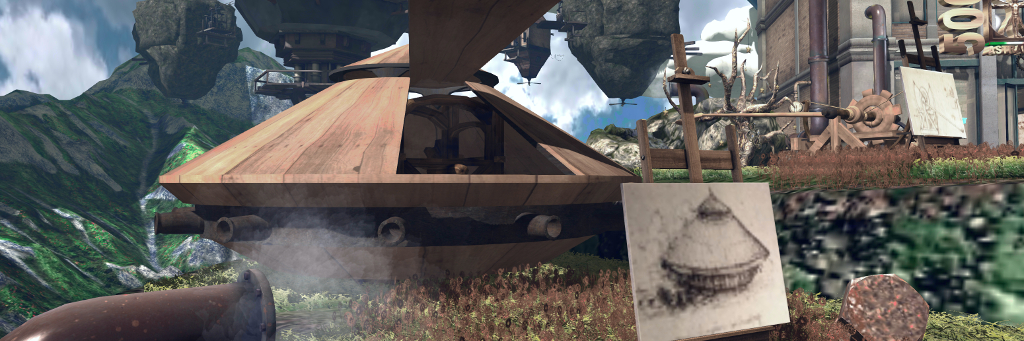
Within this garden is a model of da Vinci’s aerial screw by Sergio Delacruz, together with an airship and Bach’s Spine (the latter by Eupalinos Ugajin) to give reminders of both de Vinci’s own vision and the ideas of motion and flight, which both fascinated him. However, this is very much an exhibition of 2D art, and the manner in which the artist have chosen to interpret the life and times of da Vinci is what makes it attractive.

For example, Larisalyn takes as her muse, Cecilia Gallerani. A mistress of Ludovico Maria Sforza, Duke of Milan, she was da Vinci’s subject for his 1489 painting The Lady with an Ermine. She was also responsible for inviting da Vinci to her chamber discussions on philosophy and other subjects with members of the local intellectual set over which she presided. With the images presented here, Larisalyn notes she has tried to represent da Vinci’s style of painting.

The Edge Art Gallery, July / August 2019: The Man Who Lived in the Future – Kapaan

Kapaan, meanwhile focuses on both da Vinci’s inventiveness and his art. His gallery space includes representations of da Vinci’s parachute,  together with monochrome images of the parachute in use. These are displayed with imaginative takes on a couple of da Vinci’s most famous works, The Vitruvian Man and Mona Lisa.

Styles reminiscent of da Vinci’s studies of people and nature, as well as representations of his flying machine can also be found within the displays by PatrickofIreland, sadi8 and JurisJo, and Ladmilla – and I admit to finding PatrickofIreland’s The Study, featuring da Vinci himself, to be particularly evocative, as is the small model of da Vinci’s flying machine.

The Edge Art Gallery, July / August 2019: The Man Who lived in the Future – PatrickofIreland

I confess to being a little confused by jessamine2108’s images, which appear to be closer to more “traditional” avatar and SL nature studies, rather than being intrinsic to a celebration of da Vinci. Which is not to say they are not in themselves attractive.

Those who venture into the gallery space enclosing two sides of the landing point terrace will find a further selection of Ladmilla’s own art, including a series of images partnered with words by Eli Medier, which make for an evocative display in their own right.

The Edge Art Gallery, July / August 2019: The Man Who Lived in the Future – Ladmilla

Two musical events are planned alongside The Man Who Lived in the Future. On Saturday, July 27th, DJ Avalon Boa will be spinning music from 12:00 noon SLT through 14:00, with DJ le Ouf doing the same at the same time, on Saturday, August 3rd.

SLurl Details

LEA: more on the closure, and a move to save it

Linden Endowment for the Arts: Another World, May 2017

Following my post on the forthcoming closure of the Linden Endowments for the Art (see: Linden Endowment for the Arts to officially close), committee member JMB (Jo) Balogh posted a personal statement on the closure to Facebook.

As I’m not active in any capacity on that platform, Jo subsequently sent me a copy of her comments via note card, and since I have received numerous questions both in IM and via Twitter, etc., on why the LEA might be closing, I sought Jo’s permission to reprint her thoughts below.

At the same time, and for interested parties, there is a new in-world group for those would would like to see the LEA’s work continue into the future in some manner.

Jo’s Comments on the LEA’s Closure

Again, please note, as Jo states, these are her views on the LEA closure, rather than any form of official statement on the matter; nor do they represent the views of other committee memebers. Nevertheless, they may help shed some light on things.

This is a personal statement, not on behalf of the committee, just my point of view.

For quite a while it was obvious to the Committee that the LEA program as such was slowly dying. Applications for grants were way down and there were complaints that LEA had become boring and predictable. The committee had shrunk in numbers and giving up the right to apply for a grant made becoming a member a non starter for many good people. We spend months discussing it amongst ourselves and in meetings with LL. We concluded that it was not fixable within the current framework and that the only way forward was to step down and let a new group of people with new innovative ideas take it forward. Basically for LEA version II to be started from scratch again, just as it was in 2010. So that’s what we did. We stepped down and left it with LL.

So this is where it stands. I’m sure that LL would be happy to provide the regions again if some of you can come up with a solid proposal for promoting the Arts in Second Life and be willing to run it because it is takes work, a lot of work, trust me on that. It’s a labour of love because it is not paid work. In those years since 2010 Art in SL has changed dramatically and will continue to do so. Go for it! Make it happen.

JMB Balogh (Jo Balogh)

Linden Endowment for the Arts: Serotonin Reuptake Inhibitor, April 2016

The New In-World Group Seeking a Continuance of the LEA’s Work

Potentially (but not necessarily) as a result of Jo’s comments, a new in-world group has started, called LEA 2.0 The New Future~ SAVE LEA! Which can be joined by visiting the group join boxes at LEA 5 (up until the end of August 2019, at least).

Founded by artists Tansee Resident and Riannah Avora, the function of the group is described as:

Join Group to SAVE The LEA Sandbox, AIR grants, Core grants and the future of SL Virtual Art and Creativity. Be Proactive. This is an opportunity for “Positive” voices to be heard and be a part of the continuing growth and innovation of virtual art and creativity at LEA with dignified and equal respect to all concerned artists.

Please Be specific with your suggestions. Offer reasonable solutions.

Suggestions can be sent to either Tansee or Riannah in-world or dropped into the green boxes placed on LEA 5 (again, at least until the end of August 2019). In an introductory note card, Tansee adds:

Be Proactive & Positive. Avoid Negativity. Write your suggestions and observations on a note card. Be specific. Be respectful. Offer realistic solutions and explanations why you think something will work and how you envision it working. We have 2 weeks to compile input & present to LL. The plan then is to have a meeting at LEA Theatre.

So, if you wish to contribute ideas of a realistic and positive nature for the future of the LEA – or some next generation LEA – now is the chance to do so.

Linden Endowment for the Arts – Love, Henry, July 2015

For my part, I would simply suggest the following regarding an future organisation akin to the LEA:

  • Keep things simple, keep them open. One of the long-running critiques concerning the LEA was its star-chamber like nature. Meetings were largely closed-door affairs, the by-laws tended to discourage guests  rather than welcome them (with some understandable reasons for doing so); the grant selection process came to be seen (and not entirely fairly) as biased in favouritism; the blog / website never really reported on committee activities, furthering perceptions that it was all somehow secretive, etc.
  • Revisit the AIR grants: these were set-up at a time when arts installations had to be largely built and scripted by hand, making them intensive builds. Times have changed, and as more recent years have shown, installations can be developed using prefabricated mesh elements that can be used in a transformational manner, rather than being built from scratch. So, are 6-month grants actually still required? Could they be reduced somewhat to allow a greater range of expression through a year? Need they all aligned, starting and finishing on the same dates twice a year, or could they be set to operate on a more rolling-style basis with smaller groups of them overlapping with start / end dates? Is 20 AIR regions actually too much to be properly managed, and would a smaller number be preferable?
  • Utilise outreach and engagement. This loops back to the first bullet point in some respects. For assorted reasons, it is not unfair to say the LEA often tended to be regarded as being “apart from”, rather than “a part of” the broader diversity of arts and expressionism in Second Life. Better engagement with the broader arts information groups (e.g. SL Art, Cercle Fafner, to name two of the more prominent groups) would therefore perhaps be beneficial.

There is a lot more on specifics that will likely need to be looked into – up to, and including, I would suggest – the Lab’s own involvement in any LEA-like organisation (and their willingness to be perhaps be more involved than has in the past been the case; but then, this is the Linden Endowment for the Arts – at least for the time being). However, I offer these points as more generic points for possible discussion, if deemed relevant.

Should you have ideas of your own, then please – as noted – contact Tansee and Riannah, or drop your feedback into the green boxes on LEA 5 while they are available; and if you’re interested in keeping track of what might come of this move, join the in-world group.

Cica’s Dogwood in Second Life

Cica Ghost: Dogwood – July 2019

An arid land surrounded by the sea, conical hills sprouting from its back to rise above both the nude ground and denuded briar-like trees – this is the strange landscape that greets visitors to Dogwood, Cica Ghost’s latest installation in Second Life.

Within this landscape is an equally curious mix. Two slightly porcine dogs, the kind you might expect to see romping through an animated film, appear to stand guard either side of a ramshackle pair of fences that  themselves appear to be protecting a group of strange structures.

Looking like a mix of gourds, pearl drops and long-necked vases, these structures sprout valve-like arms from  necks rising up to open mouths. Combined with their sometimes bent shapes, these “arms” and open mouths give these forms a comically anthropomorphic look about them, little little odd women and men waving little arms at one another or to visitors, and exchanging conversation.

Cica Ghost: Dogwood – July 2019

Two more dogs stand among these structures, again appearing to have dropped in from an animated film. One is a toothy and slightly worried-looking bulldog, the other an almost Chihuahua-like companion. Together they have an air of a Laurel and Hardy pairing about them.

Also scattered across the island are black birds, standing some in groups some on their own. With their colouring, long legs and beaks, they resemble a cross between a stork and a crow; but like the dogs and the strange structures, they have a strong sense of individual personalities.

Both dogs and birds are nicely animated – the eyes of the dogs dart around, while the birds move their eyes, turn their heads and raise the occasional leg as if about to take a step, then lowering it again in an change of mind.  These animations, together with the multiple avatar sit points with their share of dances waiting to be found throughout the region, add a subtle dynamic to this setting.

Cica Ghost: Dogwood – July 2019

But sitting under a hazy sky, even with its oddly comical-cum-fairytale look, it’s hard to completely understand Dogwood – until that is, you reach the south-west corner of the region. It is here, with a narrow channel of water acting like a moat to separate it from the rest of the land, that a another hill rises. It is topped by a tall tower, reached by precarious-looking flights of steps stacked together without support. The tower is itself enfolded by the scaly tail of a great, wingless wyvern, who rests his bulk on the crown of the tower, eyes roving over the landscape before him.

Tower and wyvern add a further fairytale feel to Dogwood – but it is what lies within the tower, at the end of that precarious stairway that offers a key to Dogwood. A lone flower stands here, the brightness of its colours and the redness of its pot standing in strong contrast to the rest of the landscape. Put them with the quote Cica has selected to frame the installation, and the poetry of Dogwood falls into place:

Just living is not enough… one must have sunshine, freedom, and a little flower.

– Hans Christian Andersen

Cica Ghost: Dogwood – July 2019

Perhaps initially hard to grasp but equally quirky and cheekily humorous, Dogwood is genuinely poetic in its presentation, carrying a rich vein of fairytale under the banner of the Andersen quote.

SLurl Details

  • Dogwood (Dueville, rated Moderate)

Pixtoria: the art of Davenwolf Dagger in Second Life

Davenwolf Dagger – Pixtoria Galleries

I recently gained an introduction to the photography of artist, photographer, and Second Life resident, Davenwolf Dagger as a result of his participation in the July exhibition at Kultivate’s The Edge gallery (see: Kultivate: The Edge Gallery – July 2019), where his presented an eye-catching collection of black-and-white photos entitled The Blacksmith Series, that particularly caught my eye, both for the richness of their narrative and for the fact they indirectly reminded me to recall the time I was lucky enough to spend in Tasmania.

Coincident to my review of that exhibition, Davenwolf also sent me an invitation to visit his in-world gallery, Pixtoria Galleries – an invitation I was happy to accept.

Davenwolf Dagger – Pixtoria Galleries

Split between two levels, one on the ground and the other in a skybox, Pixtoria is a veritable tour de force of Davenwolf’s art  – and quite engagingly so. The ground floor provides an introduction to his digital images, running from the abstract through to fractal-like pieces to those suggestive of exotic, alien landscapes to a – for me – fascinating piece entitled DNA, with is marvellous suggestion of constructs and building-blocks and hint of architectural constructs.

The ground level gallery space is small, offering a social area on its upper floor rather than more images, but it is enough the whet the appetite and encourage the visitor to click the teleport disk to reach the sky gallery.

I’m a bit of a creator and perfectionist so I’m always making something. Whether it be in SL or the real world I like to keep myself entertained by creating artworks, photography, drums, videos, sculptures etc., you name it and I’ve done it over the years. Some projects I’ve had with better success than others but I eventually get there in the end.

– Davenwolf, describing his life and art

Davenwolf Dagger – Pixtoria Galleries

The sky gallery is a much larger affair, split into two levels of two halls apiece, the upper levels connected to the lower by elevators. The lower level is home to more of Davenwolf’s digital art, one hall devoted to pieces that continue the themes evident in some of the ground level pcitures, with experiments in line, colour, form and tone. Some of these offer a clear fractal influence (Trident, the triptych like Connections and Spiral), while others present more “organic” forms.

Across the floor, in the other lower level hall are some utterly wonderful images expressing the beauty of geometry as a model for art. Spheres, rings, cones and more sit on chequerboard patterns and under expressive skies, their colours and reflective surfaces offers wonderful depth, so much so you feel like the reflections should move in response to your own camera / avatar movements. Tucked into one corner of this hall are two pieces – Urban Decay and Stranded – that each contain an especially powerful narrative.

Davenwolf Dagger – Pixtoria Galleries: The Blacksmith Series

The upper levels of the gallery featured, at the time of my visit, two exhibitions of Davenwolf’s photography. The first focuses on The Blacksmith Series, his marvellous black-and-white series noted above, captured in an old working environment in Launceston, Tasmania, and, across the intervening atrium, Ward 21 Morisset Asylum.

The latter is an utterly evocative series, taken (I assume) in a disused wing of the psychiatric hospital that opened in 1908 either within, or very close to, the town of Morisset, New South Wales, Australia. Reaching its peak in the 1960, when it houses up to 1600 patients, today it still tends to dominate the town’s reputation, despite now having a patient population roughly one-tenth the number from the 1960s.

Davenwolf Dagger – Pixtoria Galleries: Ward 21 Morriset Asylum

Davenwolf’s pictures capture halls and rooms now broken and decaying, but which are now the home of graffiti. Utilising light and shadow, camera angle and choice of lens, and the occasional image of a man, Davenwolf uses the condition of the ward and the presence of the graffiti to give  – and pardon the term, no pun intended whatsoever – graphic interpretation of a mind in turmoil.

When viewed as complete sets, The Blacksmith Series and the Ward 21 Series are striking in their storytelling. However, the individual pieces within each also stand as collectable images in their own right.  Similarly, the digital images offered through the gallery will natural grace any art collection, making any visit to Pixtoria Galleries doubly worthwhile.

SLurl Details

Linden Endowment for the Arts to officially close

Linden Endowment for the Arts: Eidola, 2019

The Linden Endowment for the Arts (LEA) is to officially close on August 31st, 2019. The announcement came via a notice came via a note card circulated via the Linden Endowment for the Arts Info group, and follows on from a contraction of the scale of the LEA’s operations in Second Life and an announcement made in November 2018 stating the organisation would be going through a restructuring.

The Committee of the Linden Endowment for the Arts regrets to inform residents of Second Life that the LEA regions will be closing at the end of August 2019…

The Linden Endowment for the Arts (LEA) was established to help create a centre of arts activity in Second Life. It was founded in 2010 and launched its first events in 2011. For the last eight years, it has been a collaborative venture between Linden Lab and the arts community. Guided initially by a board of renowned Second Life artists and more latterly also bringing in people with a strong interest in promoting the Arts in Second Life, the LEA has been committed to providing access to engaging experiences in the arts for the Second Life community. Over the last eight years, through its exhibitions, programs, and events, the LEA has fostered awareness of artists’ contributions to our virtual world and encouraged others to get involved and be inspired.

– from the announcement of the LEA’s forthcoming closure

Linden Endowment for the Arts: Exodus: A Trip for Life, 2017

Sponsored by Linden Lab, and with 29 regions at its disposal, the LEA was initiated under Mark Kingdon’s tenure as CEO at Linden Lab to function as something of a “arts council” in Second Life, run directly by a committee of residents. The core ideals behind the LEA – as expressed on the official website were to:

  • Provide a starting point for artists in Second Life, and for those interested in art to make connections and display their work.
  • Encourage and cultivate art and artists within Second Life.
  • Foster community, creativity, and innovation among artists and all residents interested in art.
  • Provide a way for artists to promote their art.
  • Collaborate with existing art regions, galleries, exhibits, and performance spaces to help nurture their valuable participation in SL arts.
Linden Endowment for the Arts: City Inside Out, 2015

The regions were split into two primary programmes: the “core” regions (nine in all) which could be used by artists from across Second Life for relatively short-term projects, and 20 Artist in Residence (AIR) regions that could be “booked” for six months at a time. Following the announcement of the restructuring in November 2018, the 20 AIR regions were wound down as the last batch of installations for 2018 came to an end. With the formal closure at the end of August 2019, the remaining nine core regions will be shut down.

The LEA was a brave attempt to try to help promote arts within Second Life, although its very nature was bound to be somewhat controversial. Indeed, following its formation, there was a certain degree of hostility directed towards it, a lot of which was unfair.

Linden Endowment for the Arts: Speculum, 2015

As was pointed out to me after I wrote the article on the 2018 restructuring announcement, running any organisation like the LEA is going to be a thankless task; there is no remuneration for time given, there is always going to be hostility over actions taken and the grants awarded, and so on; it really can be a thankless task. Nevertheless, there were times when the committee really didn’t help itself, such as failing to adequately act in accordance with its own by-laws after a committee member openly griefed a privately-held arts region in 2015 (other than hiding those by-laws when challenged under them following said incident).

However, there can be no doubting then when all is said and done, the LEA did a tremendous amount of good for the artists who participated in its programmes, offering many the means to express themselves and reach audiences in a manner that might never otherwise been able to achieve.

Linden Endowment for the Arts: Astral Dream Project – Leonardo 500, 2019. One of the last LEA core region exhibitions

For example, there have been collaborative projects too numerous to mention; there have been individual installations offered for use by a wider community (take Chic Aeon’s MOSP installations for example); there have been works embracing political and social issues (such as the 2LEI installations); investigations into matter of health (which through their construction and presentation may well have offered catharsis to the artists behind them). There have been installation that have allowed the many faces of art of be examined, explored and enjoyed music, song, dance, storytelling, the visual interpretation of classic works. And there have been those that have simply offered the opportunity for us to express joy and laughter – and so much more.

As such, and while the LEA many have had its warts and at times had to face undue criticism, it has through its nine years of existence been a force for good for those arts who have been able to make use of its facilities and it has certainly helped enriched art within Second Life and allow many to appreciate work and installations they might otherwise never get to see. So, it’s not unfair to say its passing will be missed.

Related Links