The CCUG meeting is for discussion of work related to content creation in Second Life, including current and upcoming LL projects, and encompasses requests or comments from the community, together with related viewer development work.
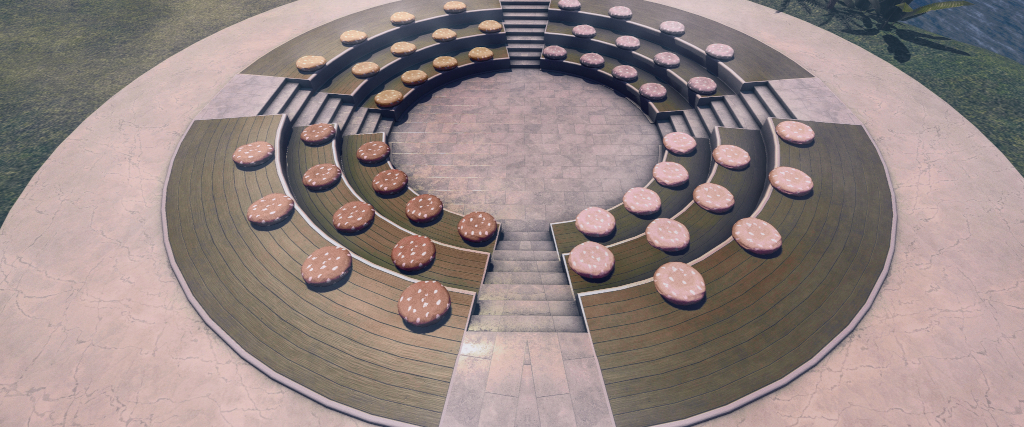
This meeting is generally held on alternate Thursdays at Hippotropolis and is held in a mix of Voice and text chat.
The 26.3 RC/ Beta was updated at the start of the week, and looks set for promotion to release status in week #34 (commencing Monday, August 1, 2026). As a maintenance / bug fix update, this includes a number of WebRTC fixes.
Linux support: LL is currently merging Linux “across the board”, and this should see Linux support in the Develop branch, so that it is a part of all future viewer builds.
This has meant the the resumption of work on the Graphics Care Package (GCP) viewer with the fixes and improvements around PBR and correcting issues within it as far as possible was slightly delayed – but it will now include a Linux build.
There are still a number of bugs to be addressed prior to GCP reaching a project / Alpha release, and once it is listed on the Alternate Viewer page as such, it will remain in soak for an extended period to allow feedback to be gathered.
The issuing of the GCP viewer will mark the first step in the graphics pipeline modernisation work which has been raised at both CCUG and Open Source Development meetings, but as a first step, the changes should be transparent to most people.
There will be a further project / Alpha update to the Lua Editor viewer, prior to that progressing to RC / Beta, most likely as viewer 26.4.
Mesh and LODs
Level of detail (LOD) is a technique used in computer graphics to optimize rendering by reducing the complexity of 3D models as they move further away from the camera so as to improve overall performance while maintaining visual quality. As a very basic description, this is achieved by “swapping” highly detailed (high polygon) models for models with a lower level of detail (fewer polygons) as the viewing position (camera) moves away.
For various reasons (cost, complexity, land impact, ease of defeat, etc.), LOD optimisation within Second Life has been something of a contentious issue – with a core part of this being the automatic LOD generation capability within the viewer can easily be defeated / even when used, produces generally bad results.
With a focus now turning towards improving the use of mesh in Second Life, Geenz noted that the issues of LODs is one that could perhaps be addressed. He suggested one of three particular approaches:
A drag-and-drop capability that allows a model sans LODs to be dropped into it, and without further prompting, the LODs are automatically generated.
A similar capability, but where the model and its associated LODs are dropped into it – but if the LODs do not achieve certain metrics, new LODs are automatically generated in place of them; or
The current approach is continued, with all of its issues (including creators including n/cards telling users to ramp-up rendering in their viewer to “see a product at its best” because no LODs are supplied / to defeat camera distance decimation (and hurt viewer performance).
Given the emergence of greatly improved LOD generation tools such as Mesh Optimiser, Geenz is currently leaning towards the middle of these three options, as it a) allows creators to generate their own LODs; b) ensures that everything is metrics based: if the generated LODs meet the required metric, they are used; if not auto LODs are generated to meet the criteria and are used instead.
IF such an approach were to be taken, it was acknowledged that consideration would have to be given to potential impact, including whether or not the new LOD system would retroactively apply to content already uploaded or not; the risk of new LODs causing higher Land Impact, resulting in objects being returned, etc.
The use of an auto LOD generation tool did receive some positive feedback.
This is however, just an initial discussion, not a statement of intent – feedback is being sought and content creators are encouraged to offer such through the usual channels (e.g. Discord) and via future CCUG meetings.
General Discussions
Script toggle for Animesh:
A request was made for a scripted capability for toggling the state of an Animesh object “on/off” automatically or manually.
A number of reasons for this were put forward from simplifying the update process for Animesh objects through to reducing simulator resource use.
The above re-opened the topic of enabling wearables / attachments on Animesh objects; this had been something that might be developed under “Animesh 2.0”, after the original release of Animesh in Second Life.
However, that project largely got put on hold due to other priorities taking precedent – such as the announced, then much delayed and ultimately stalled and shelved project(s) to re-visit land impact costs, avatar rendering costs, etc.
Geenz has suggested he’ll look internally for information on “Animesh 2.0” and the reasons why it was held over and then then left.
Also suggested was the idea that rather than trying to address specific Animesh updates, it might be better to pursue a more structured approach to attachment hierarchies and the support of custom skeletons, as doing so would allow for a more broader set of use-cases to be met – although achieve a full system of hierarchal support on the server-side would not be straightforward.
A general discussion on the reasons behind working towards custom skeletons / rigs, attachment hierarchies etc., and the potential benefits of supporting custom skeletons / rigs and the complexities of maintaining a given level of continued support for older capabilities under the expectation that any changes made will not prevent older approaches (in this case the current avatar skeletal rig) from working.
In terms of mesh improvements, Geenz broke down what is being considered into three project areas:
Building-out the foundations in terms of glTF 2.0 specification support – with controls to ensure a consistent approach to data, etc.
Support for blend shapes, building off of the current under-the-hood blend shape support. Feedback was requested on what content creators would like to see with blend shape support (e.g. having blend shapes addressable via LSL / Lua). Again, feedback welcomed via meetings and channels such as Discord.
Support for custom rigs.
Note: at this point, my recording software decided to disconnect from SL, as as I was AFK, I failed to notice it had, and so have no contextual audio for the last 20 minutes of the meeting, hence ending this summary here.
Summer continues at Mysterious Isle, Cica Ghost’s Homestead region, as she opened her installation for August 2026 on the 13th of the month.
Called Summer Dream it’s another charming setting blending whimsy with fun in which we’re asked to frolic over hill and dale and under the boughs of tall trees, spot the local wildlife and perhaps lie among the daisies and flowers.
Cica Ghost, August 2026: Summer Dream
However, this isn’t any ordinary landscape; almost everything we can see appears to have been knitted or perhaps formed from pipe cleaners and wads of foam that have been twisted and glued together, cut and shaped and painted to become knobbly bushes, tall trees and mushrooms wearing their caps like wizard’s hats.
The result is a magical setting reminding us of childhood summers, when the days stretched away before us, bright with opportunity and adventure and without the clouds of school to cast a shadow over us.
Cica Ghost, August 2026: Summer Dream
Here is a world without a care within it; a place where a bear can enjoy time fishing from the end of a pier; ducks can paddle waters rippled by sunshine and a rowing boat offers the chance to just dip one’s feet in the water and keep them cool. It’s a place where even the tree houses are precisely that – houses perched in trees!
Summer Dream is not a place you want to walk through – it’s a place where you want to start skipping and running, filling the air with laughter and shouts of joy; where the houses and fir trees suggest a game of hid-and-seek might be in order.
Cica Ghost, August 2026: Summer Dream
It’s always summer somewhere, a quote from Lilly Pulitzer, the fashion entrepreneur famous for her colourful, summery clothing, reminds us.
With Cica, it’s fair to say a good part of summer resides in her heart, and we’re all fortunate to have it shine on us through Second Life.
Frog’s Garden, August 2026 – click any image for full size
I was led to Frog’s Garden by the redoubtable Sam Rougefeu (Dodderi Haifisch), after he pointed to the setting recently on Twitter. Sam is, like me, an avid explorer of Second Life and he records his explorations and discoveries via his blog Exploring Second Life – and if it’s not on your reading list, then I suggest it should be 🙂 .
Frog’s Garden is the work of Kaoru Darkstone and occupies roughly one sixth of a Full private region exercising the additional Land Capacity bonus offered to such regions by Linden Lab.
Frog’s Garden, August 2026
Although occupying the south-eastern corner of the region, and so open to the sea on two sides, the setting keeps just its eastern end open, drawing a curtain of vertical cliffs around the other three.
Doing so is actually to the setting’s advantage, allowing it to come across as a tranquil setting far from the pressures of the world; a place where travels can rest and recharge their batteries.
Frog’s Garden, August 2026
This is place of gentle contrasts, from the rough, shingle shoreline to the cliffs with their tumbling screens of water and the streams and pools to which they give rise, all of which shelters groves of tree, blankets of flowers and grasses and meandering paths.
Within it, as well, are three physical places to spend time, each of which gently contrasts with its two neighbours.
Frog’s Garden, August 2026
The first of these is the large, modern café. Such is its prominence, I’ve opted to use it as the Slurl Landing Point for this article, as none appears to be set or enforced within the parcel.
The other two are, by turn of the footpath leading away from the café, a Shinto shrine sitting within its own grounds and tucked back into a corner of the setting. Close by, but sitting behind its own dry stone wall in a little need of repair, sits a small vegetable garden, most likely growing fresh produce for the café.
Frog’s Garden, August 2026
Of the three, the café offers the most comfortable place to relax, with both indoor and outdoor seating. The temple forms a nice retreat, although it might be a little disappointingly empty for some. However, in his piece, Sam does point out it is a memento from a now-closed location in SL, so its currently condition perhaps shouldn’t be critiqued too much.
Which is not to say the café is left as the only place to sit – there is a table and chairs out at the little open-sided barn at the vegetable garden, and some other little spots are to be found through the simple act of wandering.
Frog’s Garden, August 2026
This is a place for careful exploration, as there are a lot of details which might be missed – I’ll leave to find the tiny waterside shrine and the deer tucked away among the trees for example.
The shoreline here is not one for sunbathing or paddling; whilst there is a path running down to it, the shingle and rocks are all fairly rough and liable to be indifferent to the comfort of bare feet. However, this actually adds to the attractiveness of Frog’s Garden, as nature can be indifferent to our needs, and not very stretch of coastline is necessarily sandy.
Frog’s Garden, August 2026
That said there are perhaps a couple of rough edges to things here and there: the base on which the café sits could be a little tidier and one of the bridges is perhaps a little oddly placed. But these are very minor grumbles.
The one thing the parcel could benefit from, however, is a Shared Environment which brings out more of its natural colour and depth. After initially taken some shots using the default environment, I did find myself switching to one of my personal EPP Day skies; should you visit Frog’s Garden, you might want experiment with your own EEP settings.
Frog’s Garden, August 2026
Frog’s Garden is a charming corner of Second Life rich in detail and ideal for those who love café hopping around the grid. My thanks to Sam once again for pointing me towards it!
It’s been a while since I’ve directly written about the work of Sisi Biedermann, an artist working in multiple mediums to present captivating art from Second Life and the physical world and presenting them in-world.
Given this, it was a delight to be able to take an opportunity to drop into an exhibition by Sisi which is currently being hosted by Owl Dragonash at her excellent boutique gallery, Maison de la Chouette, and also to visit Sisi’s new personal gallery space, Magic Art.
Maison de la Chouette, August 2026: Sisi Biedermann – Magic Art
Sisi has worked in multiple mediums over the years – watercolours, oils, digital, acrylics – presenting pieces covering landscape art, still life, portraiture, digital mosaics and more.
I joined Second Life in 2007, and back then I never realised how much this would mean to me. Back then I had just started painting with acrylics after a very long break where I raised my children and looked after my family and my work. I started taking photos in Second Life in 2008, and have developed my style ever since.
– Sisi Biedermann on her art, 2017
Sisi Biedermann – Magic Art, August 2026
Since first introduced to her art almost a decade ago, I’ve been a confirmed fan; all of her work is utterly unique and inspirational – and frankly, I at times feel I haven’t covered it as much as perhaps I should. With her most recent exhibition at Maison de la Chouette, Sisi has chosen the same title as her new personal gallery space: Magic Art, neatly linking both gallery and exhibition together in both name and theme.
Both present Sisi’s still life art with a focus – I believe I’m correct in saying – on watercolour pieces. At Maison, the theme is largely that of beautiful pieces of plants and flowers, whilst at Sisi’s personal gallery space this also broadens into studies of cats – whether her own or not, I’ve no idea, but given she does appear to be a cat lover (something we have in common!), I would not be surprised if they were.
Maison de la Chouette, August 2026: Sisi Biedermann – Magic Art
What is clear is that all of these pieces have been beautifully executed as paintings, and then framed and uploaded to Second Life as outstanding pieces of art fit to grace any SL home.
The move to the new gallery space seems to reflect the start of a new chapter in Sisi Second Life in which she has scaled back on the overall size of her gallery – which she also used to host exhibitions by other artists – which, after almost 20 years of activity in Second life is perfectly understandable! The important thing here is that Sisi has not withdrawn from SL as a medium for artistic expression and its ability to help promote physical world art; she’s simply refocused.
Sisi Biedermann – Magic Art, August 2026
On an entirely personal note, I will admit to missing elements of Sisi’s digital art within her new gallery space; perhaps this will come with a changing of exhibition theme. I say this not because Sisi’s paintings are lacking in any way, but simply because her digital art and collages are very much a part of her artistic expressiveness and also a joy to behold, so I hope there is an opportunity to see some of them in the future.
In the meantime, Magic Art, whether seen at Sisi’s own space or at Owl’s Maison de la Chouette, is a magical exploration of paintings from the physical world, offered for appreciation in the digital and not to be missed!
On Wednesday, August 12, 2026, under the title Improving Marketplace Search and Product Discovery, Linden Lab new new Second Life Marketplace maintenance policies designed to help improve the shopping experience. The approach builds on operations carried out in the past on a periodic manual basis, but will not be carried out on a monthly basis using automated tools.
The new policy comprises two parts:
Unlisting products:
If a Merchant has not logged in for one year AND a specific product has not generated a sale in one year, that individual product listing will be automatically unlisted from Marketplace.
Disabling stores:
If a Merchant has not logged in for two years AND their store has not sold anything in one year, the entire store will be automatically disabled.
Important notes for context:
In Both of the above policies, products and stores will only be acted upon if both elements of the criteria are met during a review.
Neither policy option will result in anything being physically deleted from the Marketplace; affected products and/or stores will simply cease to be visible when browsing the Marketplace and in things like search returns.
Merchants will be able to reactivate unlisted products / disabled stores by logging into the Marketplace and updating them.
Active merchants and actively maintained products will not be affected by these changes.
These new policies for products and stores will come into effect on Monday, August 17, 2026.
In order to avoid accidental / incorrect unlisting of products / stores, the blog post suggests merchants periodically:
Review older or lower-performing listings.
Refresh product listings, images, descriptions, or pricing to help improve visibility and sales activity.
As noted, there have been manual operations to clean-up the Marketplace in a similar manner to this is the past, and requests for the de-listing of inactive products has been frequently requested during Web User Group (WUG) meetings, so these new policies appear to be aimed at making making the process easier to handle via automaton whilst also addressing the requests made at the WUG meetings.
Those with any concerns / feedback on these polices can raise them through the forums or via the WUG meetings, the next one of which will take place as follows:
14;00 SLT, Wednesday, September 2, 2026 at this location. Note that meetings are held in a mix of Voice and text chat.
The PALM, August 2026 – click any image for full size
The start of the week saw an invitation arrive from Nomore (Manoji Yachvili) to visit her homestead region and latest art exhibition, Cellophane.
Whilst I was unable to make the opening due to pressures elsewhere, I was extremely pleased and surprised to receive it; earlier in 2026 Nomore had closed her Homestead region to public access, and had also offered what looked like being a final exhibition of her art, hosted by Dido Haas at Nitroglobus Roof Gallery (see: Of Inventory, art and the artist in Second Life). I was therefore keen to hop along and see both the region and the exhibition.
The PALM, August 2026
I’ve covered past iterations of Fading Shadows numerous times in this blog, and have always enjoyed how Nomore has blended natural setting, architecture and art to create a flowing sense of space and environment.
This is very much in evidence with this iteration for mid- 2026. Entitled The PALM, it presents a minimalist, windswept coastal area of sand and dunes into which the rolling tide has sculpted inlets and bays, and the slopes of the dunes and hills have been smoothed and rounded by the passage of the wind.
The PALM, August 2026
There is a sense of age to the setting, both in the way the sands have been so shaped, and in the fact that that an old stone watchtower guards one corner of the setting, the wreck of sailing ship caught on the shoals below it, guarded by an orca.
Across the region, to the north-east, the land becomes rockier, the sands rising to cleave to a table of rock on which sits Nomore’s private home, and the only part of the region off-limits to visitors.
The PALM, August 2026
These are not the only structures present within the region; Nomore has a captivating means of incorporating various architectural styles into her region designs which both perfectly fit the aesthetic and which can serve as a home to her art exhibitions. The PALM is no exception.
Scattered across the landscape are four modern building designs, each home to a themed exhibition of Nomore’s Second Life and physical world art. As with many of her past region designs, these have been blended into the setting through the use of texturing and materials – something perhaps most apparent here within the cliff house gallery on the north side of the setting.
The PALM, August 2026
Cellophane, Nomore’s latest exhibition is housed with Cory Edo’s Jura Cottage, a building I’ve oft considered playing with myself (still might!), which here again Nomore has superbly blended into the setting through careful retexturing of the base and some of the outer walls
The exhibition is – like many for Nomore – something of a reflection of personal feelings and outlook and accessible commentary designed to prod us into thinking about life and the planet around us. For me, this always makes Nomore’s exhibitions especially attractive; they are both visually and mentally engaging and multi-layered.
The PALM, August 2026
Cellophane offers food for thought on modern society and its outlook on a range of matters from global warming through to questioning the purpose of art, whilst gently reminding us that we are all stewards of this planet, and we all have a responsibility for actively caring for it.
In this the use of cellophane / plastic particularly layered; its convenience makes it both ideal for simple preservation, whilst at the same time it is one of the most ecologically damaging materials we can use and which we often so carelessly dispose. It is also a perfect metaphor for our willingness to be inactive participants (if you will) in expressing concern for the directions the world around us seems to be taking.
The PALM, August 2026
These thoughts and ideas have helped shape The PALM as a whole; reading the artist’s reflection on the exhibition sheds light on the nature of the region’s form and the idea of slow erosion. Thus landscape and art further come together.
In this, there is perhaps a wider contrast hidden without the quiet beauty of the region; particularly in the contrast between the flotsam and jetsam of human vacationing scattered over the sands and the quiet reminders of the beauty of life in all its forms in our oceans, and which can be glimpsed as we explore the landscape.
The PALM, August 2026
Which is not to say the PALM is all about Deep Thinking. Its minimalist beauty is captivating and photogenic; there are multiple places to sit and simply chat or enjoy the passing time; there are opportunities for padding out on the waters via little boats or have a little fun on a springboard.
Nor is the art within the region confined to the gallery spaces or even the ground. Elements of art have been carefully folded into the setting in the form of sculptures, whilst an active Experience operating within the region can be used to hop between the ground-level galleries and those up in the air over the region, which house Nomore’s personal collections of art.
The PALM, August 2026
In short, there are multiple reasons for visiting The PALM – and I very much hope that after reading this, you will hop over and see for yourself. My thanks to Nomore for the invitation, and apologies for no making the opening event!