Catznip migrates to the V3 FUI with release of version 3.2.0, which comes in two flavours: R3 (without the LL OpenGL fixes) and R4 (with the fixes). Unlike the recent Dolphin and Niran’s releases, the release doesn’t add any new button positions or button options to the FUI, but instead offers some very nice features elsewhere.
The 3.2.0 R4 release installed without a hitch, and on launching displayed the now-familiar FUI, with almost all the buttons active by default, occupying the left and bottom sides of the window (only ABOUT LAND, BUILD, MAP, PICKS, PREFERENCES and SNAPSHOT are excluded).
New Features
The most obvious new feature added to Catznip is that rather natty “collapse” button on the majority of panels / floaters. If you are using several panels and simply want them out of the way, but not actually closed (as you’re still using them), this button causes the selected panel / floater to collapse into a single line, allowing you to “stack” a number of panels and quickly swtch back and forth between them.Collapsed panels can be aligned to the top side of the screen (e.g. under the Navigation / Favourites Bar, if you use it), allowing you to present yourself with an alternative means of accessing those panels / floaters you routinely use.
The “collapse” button in the Inventory panel (top); the Inventory panel collapsed (centre); several panels collapsed (bottom)
Other key changes comprise:
“ChatTimestampSeconds” setting has been included to show seconds in chat timestamps (for nearby chat and instant messages)
An active group title drop-down to the group side panel tab, with the “” entry keeping the group active, but hiding the group title from your nametag
“Wear on Current Outfit” option has been added to the inventory category context menu; (replace) wears all items in the folder similarly to selecting all items and right-click “Wear”
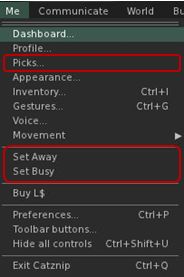
The Me menu has been revised to include a new option to open profile Picks directly, and to include the SET AWAY and SET BUSY options (no longer in a submenu as with V3) – see right
An “Expiration” and a “Clear History” option have been added to the recent people history gear menu
Optional skins have been removed from the installation folder
As well as making your own Picks directly accessible from the Me menu, the panel can now be displayed from your avatar context menu by right-clicking on your avatar and selecting MY PICKS from the context menu.
Preferences UI Updates
The PREFERENCES->CATZNIP–>UI tab has been extended to include a range of options, including:
Whether or not the “collapse” button described above should be displayed in floaters and panels
The ability to have the chiclet bar and / or notifications displayed at the top or bottom right of the screen
Whether item properties open in a separate floater or the inventory panel
The ability to set display lifetimes (seconds) for script permissions and notification
Catznip new custom UI options
Elsewhere Catznip sports the new translation options in PREFERENCES->CHAT (no surprises there) and gains the new snapshot floater that includes the option to upload snaps directly to your web profile feed.
Performance
On my PC, pretty much in line with the most recent V3 release and the likes of Dolphin 3.2. Frame rates on a sim with 5 other avatars hovered in the mid-teens, dropping sharply to single figures with shadows enabled. I have encountered a few problems in terms of settings not persisting between relogs (graphics would default back to HIGH and 128m Draw distance, while the Destination Guide insists it is open on my screen with each log-in). Other preferences (spell check language, button changes, etc), all persisted without incident.
Opinion
Yet another great Viewer from Kitty, with some very nice touches – did you know for example, that you can teleport directly from a landmark contained in a notecard in Catznip? Just open the notecard and right-click on the LM. Touches like this make Catznip fun to use (although I don’t use it nearly enough to discover all of them), and the move to the FUI, coupled with both popular TPV options (such as radar and Kitty’s own spell check) and the enhancements described here (as well as a number of bug fixes), continue to ensure Catznip presents a viable and well-considered alternative to the official viewer.
I’ve been asked to pass on the following – and while only too happy to do so, I’m closing the item to comments as it is important anyone who has questions and who can’t attend the event, post their question to the official Phoenix Firestorm blog.
The Phoenix / Firestorm team are holding a public Q&A session this coming Saturday to answer questions and concerns relating to both the Phoenix and Firestorm Viewers.
The meeting will take place at 13:00 SLT at the 4-region auditorium at Rockcliffe University and will be hosted by Nigma Sterling of Rockcliffe University.
Those wishing to attend are advised to arrive early, and using the following SLurls according to the first initial of your FIRST name:
The event will be recorded and made available online after the fact (no live streaming planned at this point).
Note that the focus of the event is to discuss genuine concerns relating to either Viewer and their future development, and to answer questions and address specific critiques.
So far, some £6,150 ($9663) has been put into the project, representing 25% of the required total of £25,000 ($39279). Whichever way one looks at this, it is a remarkable achievement. However, the fact remains that in order for Kirsten’s Viewer to survive, it’s not enough.
Kirsten, and her rl “avatar” Lee Quick, together with partner Dawny Daviau have been caught-up in moving from Europe back to the UK, and so haven’t been able to maintain full internet access. Nevertheless, I did manage to catch up with Dawny this evening, and asked her if there were any chances of the fundraising effort being rolled forward another 60 days (assuming Crowdfunder allows this – it is something sites like Indiegogo support). Her reply was very clear and very understandable:
Hey Inara, No we won’t. If the target isn’t met the viewer will not return.
So if the Viewer is to be saved, there’s a lot to be done.
Participating in the project can bring with it certain benefits, as defined on the right, making it even more worthwhile for people to get involved.
Over the years, Kirsten’s Viewer has been leading-edge in terms of capabilities and usability, renowned for its ground-breaking support for photographers and machinema makers throughout SL. Many of the innovations found in the official Viewer(s) owe their heritage to Kirsten’s Viewer.
In its more recent developments, the Viewer was the first TPV to offer full mesh upload capability within Second Life (and other grids) and also introduced 3D Viewing to the grid.
For KirstenLee, the Viewer has been a labour of love for more than three years of his life, and only recent and unavoidable changes to his and Dawny’s personal circumstances forced them into shelving the Viewer – while a huge response to the news that development work on the viewer would be indefinitely suspended, coupled with the response to an idea put to the community by Hamlet Au, encouraged them to try the crowdsourcing route.
We’re entering the season of miracles and giving, so if you are a Kirsten’s Viewer user, and you’ve not contributed to the project and are in a position to do so – why not visit the project page (click the image above right, or click here). £18,000 sounds a lot to raise in just 10 days, but if people do pull together, who knows what might be achieved.
And if there is anyone out there with especially deep pockets, a love for virtual environments and who enjoys technology – KirstenLee and Dawny would love to hear from you as well!
Note: thie version reviewed here is 3.2.2.24336 with the openGL fixes. If you continue to have issues with Firestorm, try 3.2.1.24179.
It’s here, and it has the OpenGL fixes. And it is quite simply superb.
Firestorm 3 is everything a Second Life Viewer should be – and so much more. So much, in fact, that putting together a review has been something of a headache for me – where do I start, how do I order things?
One thing I will say right off the bat – and that is to give a very personal thank you to Jessica Lyon in particular for giving me the means to get started on this review ahead of the official release.
The Log-in Screen
The first of the big changes hit you right from the start: the log-in / splash screen has been significantly revised, incorporating much of the Viewer 3 log-in screen capabilities and, in some areas, extending them.
Making a Splash: the Firestorm log-in screen
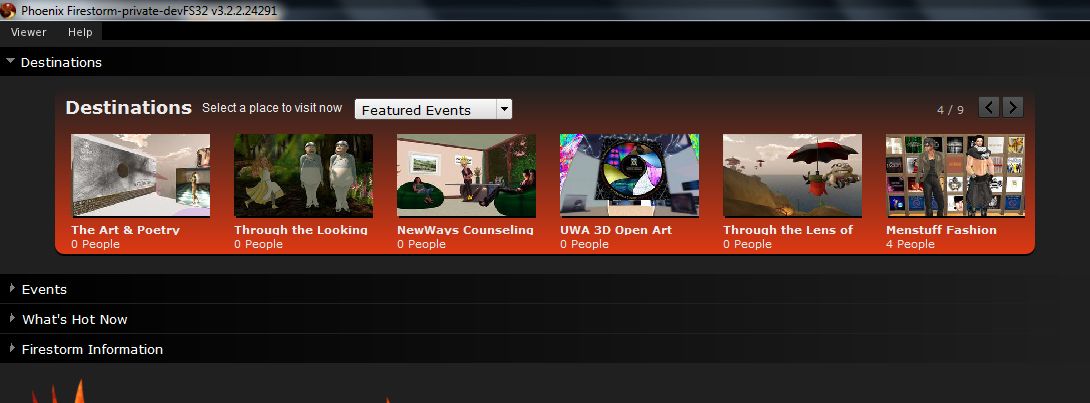
At the top of the screen are four headers. The first three of these, Destinations, Events and What’s Hot Now, pull information directly from the Viewer 3 log-in screen I reviewed back in August 2011. For those who have not encountered this up until now:
Clicking on any of the drop-downs will display a sliding panel of Destinations, Upcoming Events, and “hot” places to visit (the latter determined by the number of people currently visiting it)
Finding a place to go has never been so easy
Opening any one of those drop-down will, very tidily, close the previously-open drop-down
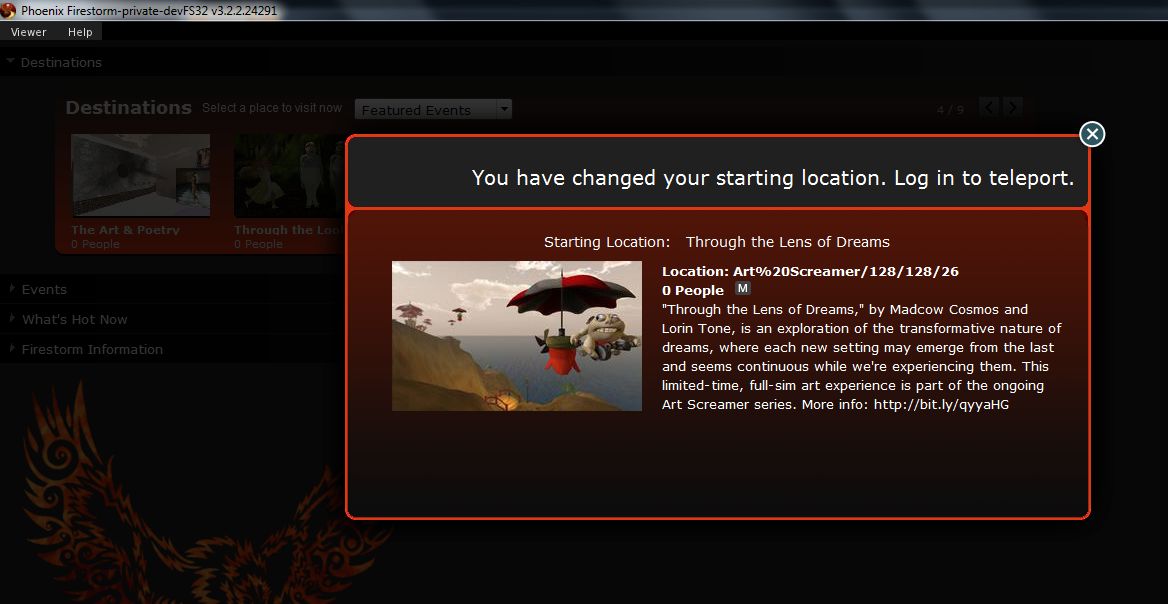
Hovering the mouse over the middle of any of the images in a panel will display a SELECT button; clicking on this will open a pop-up of further information, together with a notice that your start location on logging-in has been set to the selected location
You can still switch back to your Home or Last Location via the START AT option at the bottom of the log-in screen.
The last option is that of Firestorm Information, which is open by default. This provides links to the Firestorm download page, the wiki pages and the JIRA; the Firestorm Blog; and information on the Viewer version currently under development. most significantly of all, it includes links to the SL Grid Status Page, allowing users to immediately see if there are any known problems of which they need to be aware.
I am an unabashed fan of the Viewer 3 log-in screen; that Firestorm has adopted it is a major plus in my book. That they are further willing to go where Linden Lab apparently refuse, despite repeated cajoling through the likes of Twitter by a lot of people, gains it another huge tick in the Pey Book of Viewer Satisfaction. Would that LL understood the need to put this information front-and-centre, especially given that with the best will in the world, the grid dows tend to go Swedish Chef every so often and bork, bork, bork. But then, the Firestorm developers are all regular users of the platform…
At the bottom of the log-in screen are the familiar log-in credentials boxes. As is common for TPVs (and previous versions of Firestorm), the Viewer can store log-in information for different accounts, making logging-in with an Alt, etc, a matter of simply selecting a name (or indeed, name / grid combination) from a drop-down list. A DELETE THIS ENTRY button allows for the removal of any selected account from the Viewer’s records.
Default Settings (Viewer Modes)
Choose your desired mode
The log-in area also includes a DEFAULT SETTINGS drop-down. This allows you to chose from one of three operating modes for the Viewer. These are: Phoenix, Hybrid, and V3.
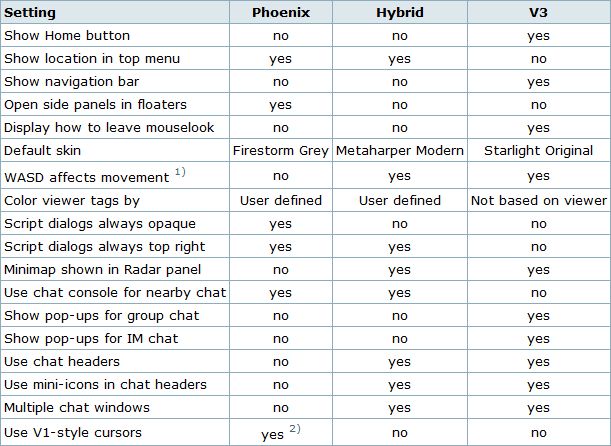
I’ve already outlined the three UI looks, and this version doesn’t change them that much, so I won’t spend time on them here per se; however, for the curious of mind, the default settings for each mode can be found in the table below (from the Firestorm wiki).
Defaults for the three Viewer modes
Note: Phoenix does not mean the Viewer will present a Phoenix / Viewer 1.x-style interface.
Preferences
Firestorm’s preferences have had a major overhaul, with many options being more pragmatically grouped and thus hopefully easier to find. I’ve tried out outline the key changes below. You can also find a quick reference table to the changes in the Firestorm wiki.
General
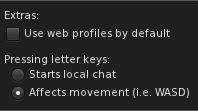
Move or type: you choose
The general tab now includes and EXTRAS panel that allows you to:
Select whether the Viewer display your own or other people’s in-world profile or your / their web profile
Whether the WASD keys will move your avatar or focus the cursor on the chat bar (also found in the Chat tab).
Note: By default, Pressing Letter Keys is set to START LOCAL CHAT for the Phoenix mode, but set to AFFECTS MOVEMENT for the Hybrid / V3 modes.
Chat
The Chat tab rationalises the majority of options associated with setting chat preferences. As well as presenting the expected Chat options, the tabs originally located in Preferences->Firestorm->Chat (General (renamed “Firestorm”), Radar and Keyword Alerts). This tab also includes:
Popular chat log options also found in Preferences->Privacy
A Notifications tab, allowing you to define how IM and Group Chat notifications are handled using either the Viewer 3 pop-ups an/or in the chat console (i.e. lower left-hand corner of your screen, as per Phoenix / Viewer 1.x)
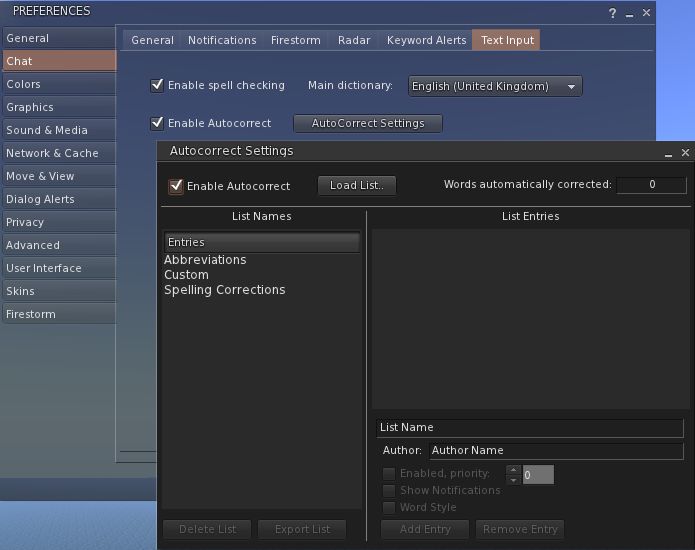
A Text Input tab comprising the Spell Check and AutoCorrect functions
AutoCorrect and Spell Check – together under Preferences->Chat
Graphics
The graphics tab see the arrival of a FULLSCREEN mode for Firestorm. The option requires a restart to take effect, but renders the Viewer beautifully on screen without the usual application window.
Sound & Media
The Sound & Media tab has been refreshed, splitting media and Voice functions into two sub-tabs: General and Voice Settings. The General tab now includes the Media Audio Rolloff Distance settings originally located in Preferences->Advanced.
Sound & Media: new Voice tab and the Media Audio Rolloff sliders
Move & View
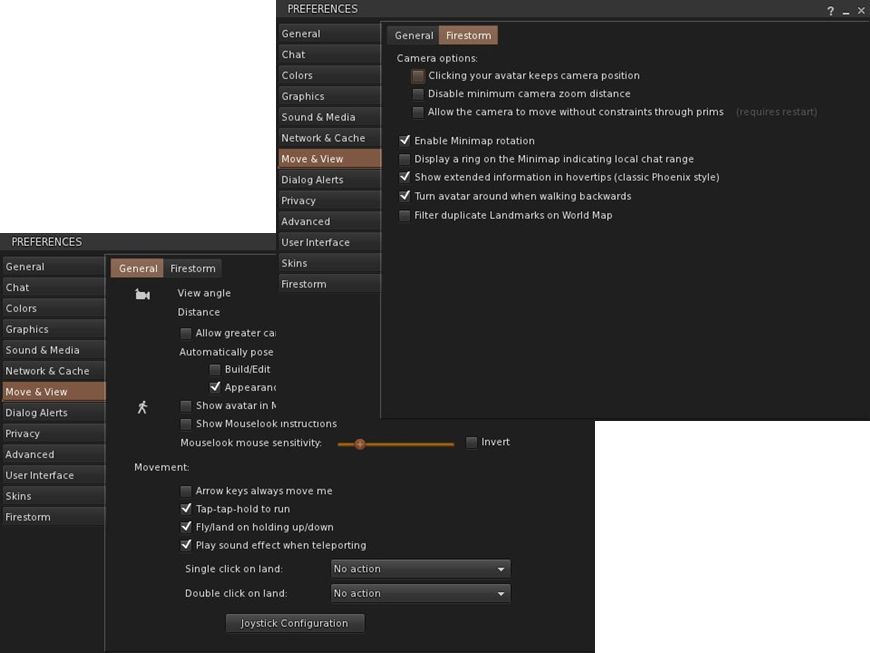
The Move & View tab includes the Viewer 3.2 “click-to-move” functionality (which will reverse avatar mouse steering if you use it!), and moves the Firestorm Camera options originally found under PREFERENCES->FIRSTORM->VIEW to a new sub-tab called Firestorm.
Move & View: incorporate click-to-move and Firestorm’s camera options
Privacy and Advanced
The Privacy tab is rationalised so that LookAt options are now located on their own sub-tab, including the LookAt Target option originally found in Preferences->Firestorm-General.
The Advanced tab has been reduced to the Viewer / grid / Advance / Developer Menu options.
User Interface
Originally called UI Extras, this tab now:
Includes the UI Scaling slider (originally in Preferences->Advanced)
Includes the lag meter check box (originally in Preferences->Firestorm->General)
Includes the Avatar Head movement options ( originally in Preferences->Firestorm–>Avatar)
Allows both script dialogue and Group notices to be displayed in the top right of the screen a-la Phoenix / Viewer 1.x.
The Font tab has been expanded to include options to adjust chat line spacing and folder item height.
Firestorm
The Firestorm tab has undergone significant changes
The General sub-tab has been rationalised as a result of options being either moved elsewhere or dropped
The Protection tab now include the Phoenix Spam Protection options
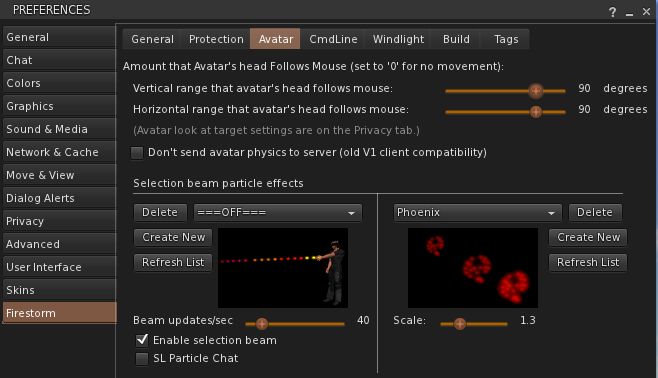
The Avatar tab replaces the View tab and combines the Avatar Head movement options with Selection Beam Particle options
Preferences->Firestorm->Avatar
The Windlight tab includes additional options for accepting region settings and cross-fading changes.
Chat Bar and Chat
The Chat Bar now includes two buttons: the first opens / closes the Nearby Chat floater, while the second opens the Conversations floater. However:
If the Nearby Chat floater is docked with Conversations (as it is by default), then both will appear to perform the same function.
With Nearby Chat undocked, Conversations opens to display your Contacts.
New Feature: Hiding the Chat Bar
Like Phoenix, the Firestorm Chat Bar can now be hidden:
Go to Avatar->Preferences->Chat->Firestorm and check AUTOHIDE MAIN CHAT BAR
The Chat Bar is now hidden.
To access it, tap ENTER – the Chat Bar will open at full window width
Type your text and press ENTER – the text is sent and displayed in the chat console or Nearby Chat (if open)
If you open the Chat in error, simply tap ENTER or ESC to close it without typing anything.
If you prefer, you can set the Chat Bar to open as soon as you start typing:
Go to Preferences->General->Extras or Preferences->Chat->General and make sure PRESSING LETTER KEYS is set to STARTS LOCAL CHAT
Pressing any letter, number or character key will now open the Chat Bar and capture your typing
As above, pressing ENTER will both display the test and close the Chat Bar
Note: setting this behaviour will disable the WASD keys as avatar movement keys.
To disable Chat Bar hide, the feature, go to Go to Avatar->Preferences->Chat->Firestorm and uncheck AUTOHIDE MAIN CHAT BAR. Remember to reset your the WASD functions, if required.
Additional New Chat Features
There are two further new chat options in this release:
Visible hint for when someone is typing: go to Preferences->Chat-> and check SHOW TYPING INDICATOR IN BUBBLES… tags will update to show if someone is typing, even if they have the typing animation turned off
You can display an optional channel selection box in Nearby Chat. Go to: Preferences->Chat-> and check SHOW CHANNEL SELECTION IN CHAT BAR
Channel display in chat
Chat Echo Fix
In previous versions of Firestorm, both the chat bar and Nearby Chat would echo whatever was typed into the other. This has been fixed so that text can be typed separately into each.
Camera Floater
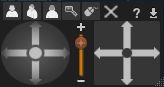
The Camera floater used within the Phoenix /Hybrid modes has been refined, with the view buttons (rear, front, 3/4s, zoom & Mouselook) now along the top of the floater. This makes the floater more compact, by some may find it harder to reposition once undocked from the toolbar as a result.
Quick Preferences
The Quick Preferences button now includes options to turn name tags over avatars off / on, and a time-of day slider for altering the region daylight in your own Viewer.
Mesh Uploads
One of the most eagerly-awaited capabilities within both Firestorm and Phoenix is that of mesh object uploads.
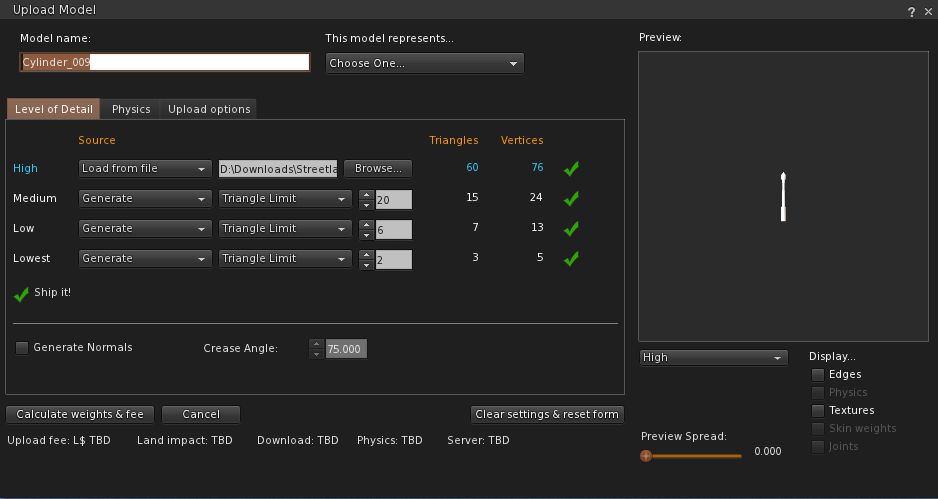
This release sees Firestorm gain the capability, thanks to Nicky Dasmijn. The upload process uses the latest Viewer 3 upload window, and while I am no mesh expert, it appears to match the official Viewer in terms of smoothness of operation.
Note that the upload feature includes the fix for CTS-627 (Mesh upload crashes Linux).
Spelling checkers are something TPV users tend to take for granted; or if you’re a Guardian reader, quite possibly for grunted (sorry, a little English humour….). We’ve been able to bask in the glory of having our misspellings highlighted ready for us to correct (or in some instances, had them auto-corrected, depending on the sophistication of the checker code itself). Those using the official Viewer, however, haven’t been so lucky.
But that is about to change. Enter Storm 83. A year plus old, barely watched or voted upon, and now a coming soon feature. So as Oz comments on the JIRA, “Everyone thank Kitty for volunteering to contribute this feature!” Kitty being Kitty Barnett, who is the assignee for the project, and who has been a prolific contributor to TPV code, including RLV/a.
It’s not clear exactly how the feature will be integrated – different TPVs have added it in various tabs within Preferences. However, if we take Kitty’s own Catznip Viewer as a lead (given it is based on Viewer 3), one might hazard a guess and say that rather than being hidden away inside Preferences, as is the case with come TPVs, the Spell Check option will get a tab of its own.
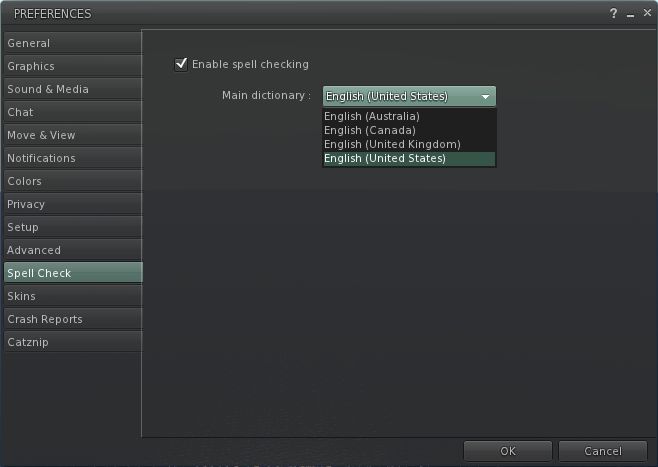
With Catznip the spelling checker is very straightforward: simply tick the check box to enable. American English is the default, but other options are available from a drop-down menu. Spelling errors are then underlined in red in chat, and right-clicking on them will display a nice little menu listing alternatives as well as an option to add the word to a custom dictionary, should you prefer. One suspects the Viewer 3 functionality will be similar.
I’ve no idea whether the dictionary will include the ability to download other language dictionaries, a-la the likes of Phoenix and (shortly) Firestorm. I’ll hopefully take a closer look once the code reaches a Development Viewer or enters the Beta code base.
Viewer 3.2 continues with almost weekly releases. The 3.2.1 (244864) release went public of the 15th November brings the release viewer almost up-to-par with things recently seen in the Beta and Development Viewers, namely:
Chat translation options – in time for the Google free API end-of-line, although the debate over Bing fees is liable to continue
The Viewer also includes a number of crash and performance fixes, together with a bag full of minor bug fixes and corrections.
In the Development branch, the Viewer reaches 3.2.4 (245302). There are no obvious release notes with the Development version (empty wiki page), and no obvious UI updates. I assume the release carries more in the way of bug fixes, etc.
Performance-wise, the new releases (3.2.1 & 3.2.4) offer something of a performance boost on my usual hardware set-up: Viewer frame rates are constant in the mid-30s when on sims with a handful of others but still falls on its bum when shadows, etc., are enabled (to roughly 1/2 the frame rates of Firestorm, and roughly 1/3 those of Exodus). This gives rise to noticeable “stutter” when panning the camera particularly.
Both the new release and the latest Development versions continue to run significantly better in Linden Home regions than Firestorm (again on my set-up). I’ve yet to encounter a single disconnect in these regions when using the official Viewer, whereas, as I’ve mentioned, disconnects and crashes are a fact-of-life when running Firestorm in many of these regions. Frame rates for the 3.2.1 while in Linden Home regions were also significantly better than with the 3.2.0 release of the viewer – 18-20 fps, rather than single digits sitting around the 3-5 fps mark.
I’m not sure where the OpenGL fixes stand – it is hard to get along to Viewer meetings; there is a “dedicated” development stream for fixes to this issue, but I have no idea if these fixes are making their way back to the main Development -> Beta -> Release flow.
The Viewer installer and executable still have yet to be corrected: as far they are concerned, people are still installing and running “Viewer 2”. Tateru Nino raised this point recently (and tbh, I hadn’t actually noticed until she did). I don’t find it an irritant myself, but it is mildly amusing.
The mouse movement / click-to-move reversal is still there however. For those unfamiliar with the problem: up until now (unless using the Basic Viewer mode), you could steer your avatar using the forward / back keys and by pressing and holding the left mouse button with the pointer over your avatar; moving the mouse left / right would move your avatar in the appropriate direction.
With SINGLE CLICK ON LAND set to MOVE TO CLICKED POINT sees this reversed – move the mouse to the right, and your avatar moves left. There’s a JIRA out to request a fix to issue.
Beta-wise, no changes have been made, and the release number remains as per last week.
Overall, 3.2.4 (Development) looks pretty stable, fast and comfortable to use. As I’m not affected by the OpenGL issue, I’m completely unable to comment on how it fairs on impacted graphics cards, and will have to leave that up to someone else. Otherwise, and pending the official release of the OpenGL fixes, these releases may indicate the “radical” element of the Viewer UI change is coming to an end, and it’ll be more a case of polishing things in terms of small enhancements and bug fixes.
And on that subject, if anyone from LL is still reading this blog – there are a few JIRAs on the new UI besides the one linked to above. You might want to point your colleagues towards :).
 Catznip migrates to the V3 FUI with release of version 3.2.0, which comes in two flavours: R3 (without the LL OpenGL fixes) and R4 (with the fixes). Unlike the recent Dolphin and Niran’s releases, the release doesn’t add any new button positions or button options to the FUI, but instead offers some very nice features elsewhere.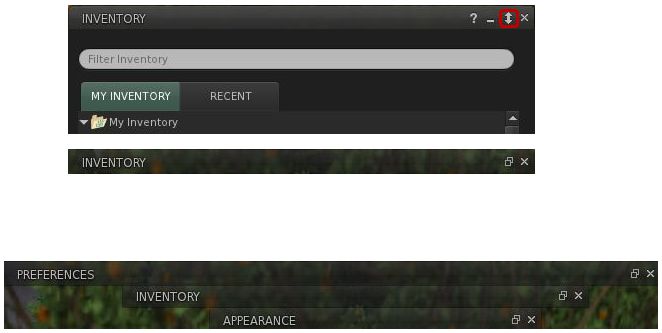
 Other key changes comprise:
 Today, the attempt to get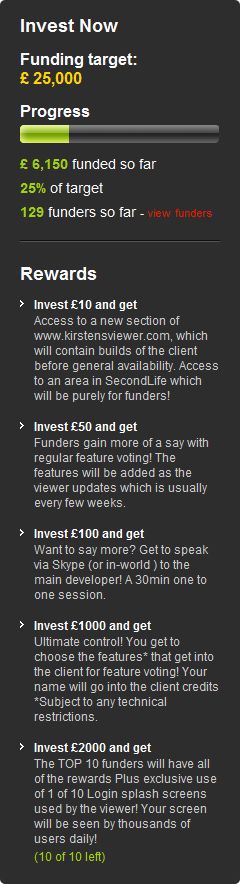






 Inara Pey: Living in a Modemworld