2025 week #40: SL CCUG meeting summary

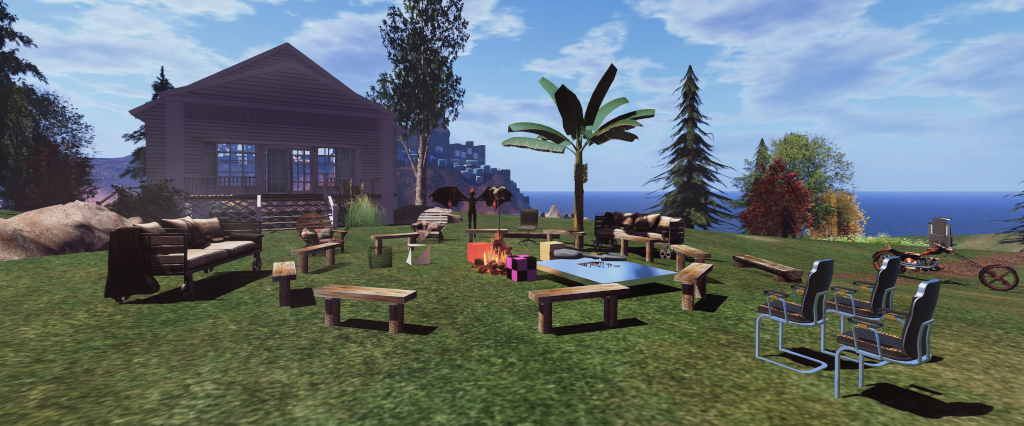
Hippotropolis Campsite: venue for CCUG meetings
The following notes were taken from my audio recording and chat log of the Content Creation User Group (CCUG) meeting of Thursday, October 2nd, 2025. Please note that this is not a full transcript, but a summary of key topics.
Table of Contents

Meeting Purpose

  • The CCUG meeting is for discussion of work related to content creation in Second Life, including current and upcoming LL projects, and encompasses requests or comments from the community, together with related viewer development work.
  • This meeting is generally held on alternate Thursdays at Hippotropolis.
  • Dates and times of meetings are recorded in the SL Public Calendar, and they are conducted in a mix of Voice and text chat.

Official Viewer Status

  • Default viewer 2025.06 7.2.1.17108480561 – August 29 – No Change.
  • Second Life Beta viewer 2025.07 7.2.2.17774206511 – Apple Silicon Support – September 26 –  NEW.
    • This viewer now ships as a “Universal Binary” that contains both the Intel and Apple Silicon versions of the viewer. It should give performance gains on the Apple Silicon version in particular.
    • Also includes various WebRTC improvements and bug and crash fixes.
    • Known issues:
      • This version does not support convex decomposition for physics meshes with Apple Silicon. This will be hopefully be corrected in a future update or release, possibly with the help of a code contribution.
      • Navigation buttons in the in-viewer browser are no longer present for marketplace and search – these will be restored in a future update.
      • Apple Silicon does not support pathfinding tools.
      • Subtle rendering differences might be noticed on certain configurations and EEP environments.
  • Second Life Project Lua Editor Alpha (Aditi only), version 7.1.12.14888088240, May 13 –  No Change.

Viewer 2025.07

  • LL are working on implementing some bug fixes prior to offering a further beta version of this viewer.
  • One change with the next version will be the return of Havok convex decomposition for Mac Intel systems to enable mesh uploads under emulation Requires the enabling of Rosetta in the universal build for Mac) until such time as a an alternative can be implemented.
  • Work on an alternative solution is in progress via code contributions. This is likely to be included in viewer 2025.08.

General Discussion – In Brief

  • The confusingly-worded Create “System Body Shape v2.0” came up for discussion.
    • In short: LL unlikely to implement any form of new / updated system avatar, preferring to focus on implementing more modern technology and capabilities that allow creators to develop more capable (and less complicated to users?) avatars.
    • This included a brief discussion on “open souring” the avatar system body so creators could take it and modify / improve it for themselves, with the note that technically it is, but as it misses some critical elements which tend to render doing this moot.
  • A potential bug with touching scripted objects was demonstrated with attachments designed to be touched (in short: a object could miss initial touches and thus fail to trigger touch_start() ). This was demonstrated at the meeting, and a Canny report was requested on the problem, together with the demo item.
    • This discussion also encompassed issues with fast clicking on object in-world and cursor positioning, and unexpected results (e.g. rapidly clicking on a touchable object with the mouse moving, so that a subsequent click “misses” the item, causing the server to register that in favour of the the expected return  – like a dialogue box or something – from the initial click).
  • A discussion on setting materials / overrides on PBR vs. Blinn-Phong. In short, with Blinn-Phong, a change in texture / material can be carried out with a reset of overrides; within PBR, changing the material resets overrides. In the case of scripted items, unless the material change and new overrides are sent as a single packet, changing the material can result in the object appearing to “flash” as the material is displayed prior to the new overrides being applied.
    • The prompt for the question arose out of how a scripted bottle held by an avatar could change to a selected texture (to presumably represent the drink in the bottle), and how this might be better coded rather than relaying purely on texture caching, which appeared to be the root of this particular problem.
    • Possible solutions for this became somewhat convoluted (outside of finding a mean by which required textures could be pre-loaded), and frankly zapped right over my head. However, the conversation took up the the last part of the meeting.
  • A question was asked as to why sometimes trying to rez mesh items (or items onto mesh objects)  results in a “Failed to place object at specified location” error message.
    • This can often come down to the physics shape of the surface on which an item is being rezzed, as Beq Janus explained in one of her videos.
    • Another cause can be a mismatch between where the viewer thinks an object is trying to be placed and where the simulator views it as being placed – which has been a long-standing problem.
  • A misunderstanding has apparently led to some concerns that support for sculpties is being deprecated / sculpties are being “eliminated”. Neither of these are correct; there are no plans to either deprecate or eliminate sculpties. 

Next Meeting

2025 week #38: SL CCUG meeting summary

Hippotropolis Campsite: venue for CCUG meetings
The following notes were taken from my audio recording and chat log of the Content Creation User Group (CCUG) meeting of Thursday, September 18th, 2025. Please note that this is not a full transcript, but a summary of key topics.
Table of Contents

Meeting Purpose

  • The CCUG meeting is for discussion of work related to content creation in Second Life, including current and upcoming LL projects, and encompasses requests or comments from the community, together with related viewer development work.
  • This meeting is generally held on alternate Thursdays at Hippotropolis.
  • Dates and times of meetings are recorded in the SL Public Calendar, and they are conducted in a mix of Voice and text chat.

Official Viewer Status

  • Default viewer 2025.06 7.2.1.17108480561 – August 29.
    • Inventory Favourites System, plus assorted new features.
    • Improvements to avatar system; camera and movement; chat; voice; content creation tools.
    • Mesh uploader updates.
    • Text & UI polish.
    • Fixes for Environment and Rendering; stability and crashes; UI.
    • System improvements.
  • Second Life Project Lua Editor Alpha (Aditi only), version 7.1.12.14888088240, May 13.

Viewer 2025.07

  • This is now in QA and making its way towards release candidate status (or “beta” as RC viewers seem to now be referenced).
  • The added native Apple Silicon support is said to deliver “pretty impressive” performance improvements for those running on that OS.
    • A caveat here is that for this release only, it may not be possible to upload meshes on Apple Silicon. This is due to some Havok issues and “some licensing limitations”.
    • These issues will likely be resolved when the open source replacement for Havok for convex hull decomposition is integrated into the viewer. This update is anticipated as being available in the upcoming 2025.08 viewer.
    • The above limitation is only for Apple Silicon, it should not apply to Windows or Mac systems running x86 chipsets.
  • For other updates likely to be included in this release, please refer to my summary of the previous CCUG meeting.

Viewers 2025.08 and 2025.09

  • These are liable to be the last two viewer updates from the Lab for 2025, and both are in the planning stage.
  • Updates under consideration for either of them include potential updates to screen space reflections (SSR), building on work carried out earlier in 2025 but which have yet to reach the viewer.
  • However, precise details as to what will be in either  / both viewers is still subject to internal discussions and decisions within the Lab.

General Discussion – In Brief

  • Mesh import support – general direction:
    • COLLADA.DAE support will always remain and be available, even if only for legacy content that may never be updated to glTF.
    • .gltf /.glb is now an officially supported mesh format or both static and rigged mesh, but with some limitations (e.g. no blend shapes) – with a request that an bugs that may be discovered are reported.
    • It is acknowledged that currently, importing .gltf meshes is a two step process ( .gltf materials and the .gltf mesh) which have to be imported separately to one another.
    • There have been discussion on supporting other mesh formats – but these are only discussions at this point in time, with absolutely no guarantee or time frame that/when other formats will be supported, as the work would require further and extensive modification to the mesh import workflow and internal SL mesh support.
  • A request was made for Inventory Thumbnails to support aspect ratios other than just 1:1, or to include a means for images to be cropped within the viewer post-upload.
    • This came hand-in-hand with a reference to Unpacker scripts; Assign image thumbnail UUID to an unpacked folder – which is currently being tracked, but has no specific implementation time frame.
    • Making changes to the the image aspect ratio for Inventory thumbnails was seen as “unlikely” in the near-term, but it was suggested the idea be raised at the next Open Source User Group meeting to see if a code contribution might be made.
  • A general discussion on the new Inventory Favourites capability in the official viewer, including comparisons with using the Favourite Wearables option seen in some TPVs.
    • Whilst the latter is not necessarily as flexible in its use as the Lab’s implementation, it was seen as scoring over the latter due to a) having a dedicated floater; and b) having that floater accessible from a toolbar button.
  • A request was made for some form of Inventory “cold storage”, where items can be archived without having to be boxed, and which is excluded from Inventory searches.
    • It was suggested that the easiest way to solve for this would be to a system folder to Inventory which is pre-set so that anything placed within it does not show up during searches.
    • Another suggestion was to strengthen Inventory filters to allow certain exclusions or to allow filtering by new inventory capabilities (e.g. to directly filter for all folders / items tagged as a Favourite).
    • The above could be combined with some UX redesign to better surface filters and make their functionality clearer, and potentially allowing filters to be set as easy-to-access inventory presets to quickly allow different views of a person’s Inventory to be accessed.
    • This broader discussion on inventory wound through a good portion of the meeting in terms of comments from users.
  • The subject of allowing region-wide reflection probes was raised – and was responded to as unlikely to happen, with a not that regions already have a “void probe” which – whilst primitive in nature – already does much of what a region-wide probe would do, using some of the data from the region. This can be visualised by going to Preferences → Graphics, locating Max Reflection Probes and setting it to None.
  • A question was asked as to whether LL staff and contractor work full-time on their specific areas, or if some work shorter hours / get moved around projects, thus limiting the amount of time they can spend working on certain things, leading to a lengthening of time frames, etc.
    • The broad response was that the (approx. 30-strong) dev staff work a standard working week, and some do get moved between projects, depending on priorities.
    • Further, planning, complexity and prioritisation do play a role in determining what gets worked on and how resources are used, all in accordance with management, etc., focus on platform direction and development.
    • Also, given the overall complexity and age of SL, the need for backward compatibility, etc., a large amount of effort has to go into simply “keeping the lights on” (to use Philip Rosedale’s term), and this also impacts available resources and determining what projects and taken up and worked on at any given time.
  • A general discussion on versioned sky assets, weather, the old 768-metre system clouds, etc. In terms of versioning EEP assets, this is something still under discussion at the Lab, but is not something currently being targeted for implementation.

Next Meeting

2025 week #36: SL CCUG meeting summary

Hippotropolis Campsite: venue for CCUG meetings
The following notes were taken from my audio recording and chat log of the Content Creation User Group (CCUG) meeting of Thursday, September 4th, 2025, and the official video is embedded at the end of this article. Please note that this is not a full transcript, but a summary of key topics.
Table of Contents

Meeting Purpose

  • The CCUG meeting is for discussion of work related to content creation in Second Life, including current and upcoming LL projects, and encompasses requests or comments from the community, together with related viewer development work.
  • This meeting is generally held on alternate Thursdays at Hippotropolis.
  • Dates and times of meetings are recorded in the SL Public Calendar, and they are conducted in a mix of Voice and text chat.

Official Viewer Status

  • Default viewer 2025.06 7.2.1.17108480561 – August 29.
    • Inventory Favourites System, plus assorted new features.
    • Improvements to avatar system; camera and movement; chat; voice; content creation tools.
    • Mesh uploader updates.
    • Text & UI polish.
    • Fixes for Environment and Rendering; stability and crashes; UI.
    • System improvements.
  • Second Life Project Lua Editor Alpha (Aditi only), version 7.1.12.14888088240, May 13.

Viewer 2025.07

  • This is now in development.
  • Will likely include (although the list is subject to possible change as the viewer develops):
    • “Proper Discord support” for those with a Discord account  – further clarification to follow as the viewer is developed.
    • Native Apple Silicon support, which should see a performance boost for those running Apple Silicon.
    • A Chrome Embedded Framework (CEF) update (used to power the in-viewer browser, media on a prim (MOAP), etc.), which should bring some performance and security improvements – although the former will not necessarily be observed in regions / parcels making heavy use of MOAP (e.g. in arcades, and similar).
      • This also might include a code contribution which enables  PRIM_MEDIA_FIRST_CLICK_INTERACT within the viewer, allowing the user to interact with a media without an initial “focus” click, as well as passes hover to the media.
      • As a side note: a code contribution included in 2025.05 7.2.0.16729091892 (current release at the time of writing) allows media Autoplay turned off, whilst still allowing it to work on HUDs using MOAP.
    • New performance metrics which should allow the Lab to gather data on the likely performance impact new features might have on the viewer. This should benefit updates such as the improvements to screen space reflections (SSR), which have been parked in a viewer branch pending the ability to better assess how these updates might impact the average user’s experience in terms of frame rate (speed, smoothness, etc.).
  • It was indicated that 2025.07 could act as a baseline for updates to SLua support in the viewer.

General Discussion – In Brief

  • Alpha / Gamma issues (linear alpha blending):
    • In order for PBR lighting to render anywhere close to correctly, alpha blending had to be switched from SRGB to linear colour space. This can cause some older content using Blinn-Phong, to look either more opaque or more transparent than in did pre-PBR.
    • A suggested fix for this would be to give people the ability to adjust the alpha/gamma on per texture entry for the object (including no mod items), and this had been scheduled in 2024 for release “after the  ExtraFPS viewer”.
    • However, as this was essentially a “permission hack”, the update got held-up. It has now been decided to default all old content to gamma space blending, to bring back some of the “old” alpha blending functionality
  • Extracting Sky and Water Settings assets from a Day Cycle was filed a year ago and noted as tracked (also: https://github.com/secondlife/viewer/issues/2887), but progress may have stalled. As such, a effort will be make to raise its priority, although it still likely will not surface in a viewer until at least the 2025.09 release.
  • Issues with updating alphas on PBR materials was raised (currently, it is not possible to change the alpha without also changing the colour/tint. llSetLinkGLTFOverrides can be of some help with certain issues, and Brad Linden indicated that a Canny on the matter is working through the system, which should also help.
  • Custom Skeleton support: Geenz noted that the move to glTF mesh import was primarily to address the fact that COLLADA .DAE is increasingly unsupported by content creation apps, and thus SL needed to update to a “newer” format.
    • However, the manner in which the work has been done could support the use of custom skeletons in the future.
    • But, in order for this to be possible, several other hurdles would have to be cleared first (such as updating the internal SL mesh file format to support custom skeletons and without breaking existing content).
    • As such, any such support would need further consideration and prioritisation against other updates / projects before getting on the roadmap.
  • Vulkan support: this was referred to as still being “some way off” and requiring some extensive work, including cleaning-up how the view handles OpenGL.

General Questions

  • Questions were asked about both segmenting regions / parcels into vertical zones; the status of further work on Combat 2. and on Land impact calculations. These were questions more specific to Rider Linden (who was unfortunately unable to attend the meeting) / the Simulator User Group, and as such were redirected to the latter.
  • The question was raised if the developing Lobby capability for SL Mobile (which will eventually allow people to use some aspects of the Mobile app such as chat without them appearing as on-line to others) could be implemented within the viewer.  It was indicated that this might be possible in the future, although there is no current work in this direction at present.
  • This above encompassed a conversation on where conversation logs are currently stored (on the local device, be it computer or Mobile) vs. being stored in a manner that makes it accessible to all devices a user might employ to access Second Life. This is something the Lab is looking at, allowing for the privacy / data protection concerns of storing logs on third-party services, and would likely be an opt-in service
  • Additional questions on cashing-out, lifetime memberships, etc., were similarly pointed towards the relevant user group meetings, as no-one from the Lab at the CCUG in involved in these areas.

Next Meeting

2025 week #32: SL CCUG meeting summary

Hippotropolis Campsite: venue for CCUG meetings
The following notes were taken from my audio recording and chat log of the Content Creation User Group (CCUG) meeting of Thursday, August 7th, 2025. Please note that this is not a full transcript, but a summary of key topics.
Table of Contents

Meeting Purpose

  • The CCUG meeting is for discussion of work related to content creation in Second Life, including current and upcoming LL projects, and encompasses requests or comments from the community, together with related viewer development work.
  • This meeting is generally held on alternate Thursdays at Hippotropolis.
  • Dates and times of meetings are recorded in the SL Public Calendar, and they are conducted in a mix of Voice and text chat.

Official Viewer Status

  • Default viewer 7.2.0.16729091892, issued August 5, promoted August 8 – New.
    • glTF mesh import (should have similar constraints to COLLADA upload, but does not support a unified material upload solution).
    • Media changes including support for PRIM_MEDIA_FIRST_CLICK_INTERACT and HUD autoplay (see https://wiki.secondlife.com/wiki/LlGetPrimMediaParams).
    • Fixes related to memory allocation, inventory floater, world map and Picks performance.
    • Fixes for OpenJPG, PBR Texture Panel Repeats per meter improvements and sky ambient colour not blending during day cycle among others.
    • Fixes for image rendering.
  • Second Life Project Lua Editor Alpha (Aditi only), version 7.1.12.14888088240, May 13 –  No Change.

2025  glTF Mesh Uploader

  • There were multiple requests for the behaviours within the glTF mesh uploader that do not much the COLLADA .DAE uploader to be revised so that they do conform with the latter.
  • These had to be shut down, largely due to technically limitations within SL’s internal mesh formats.
  • The hope is that over time, these limitations can be “peeled” back, and mesh import as a whole improved, most likely by using a new internal mesh format.
  • No details on what the new internal format will be, as this is still subject to internal discussions at the Lab, but the aim is to make things easier for both content creators and content consumers.

2025.06 Viewer

  • The next viewer in development is 2025.06, which is described as “not very ground breaking”.
  • It contains a lot of work and bug fixes original intended for the Maintenance C viewer from 2024, and prior to the viewer release process being revised.
  • The key feature in this viewer will be Inventory Favourites.
  • Currently, the viewer is going through a stabilisation process with the aim of releasing an RC Beta as soon as possible.
  • The aim of the 2025.06 release is to raise the cadence of official viewer releases. This is seen as beneficial on a number of counts:
    • It allows individual releases to become more iterative in nature, building capabilities and allowing better response to feedback from users.
    • It breaks the cycle of long delays between viewer releases while the Lab tries to deliver an entire project in a single viewer drop.
    • It will hopefully allow the Lab to be more nimble with releases, allowing them to come back to major updates and adjust them / add to them based on longer-term feedback, rather than appearing to simply drop a project into a viewer release and then never come back to it with significant updates / improvements.

In Brief

  • Removing Scale From LI Calculations (Recap/Update):
    • Signal Linden highlighted a Feedback Ticket he has raised, proposing the removal of scale from Land Impact calculations, which has been touched upon at the last couple of SUG meetings.
    • However, numerous caveats / issues with the proposal arose as it was further investigated, including potential impacts on physics, issues for streaming calculations, etc., all of which caused a slow-down in the idea.
    • Rider Linden provided an update, noting that scale land impact is so closely tied into an object’s triangle count that there is no easy way to extricate the two, leading to the risk of small items with a high tri count suddenly exploring in their LI is scale was removed from the equation.
  • Support for Vertex Animation Textures (VAT) – a means to create complex and non-traditional animations in real time using textures and shaders to achieve the visuals on the GPU, thus having a much lighter performance impact on the CPU when compared to traditional skeletal mesh animations.
    • Allowing for the complexities of SL, concern was raised over use of VAT “overloading other systems”, with the view that providing support for blend shapes could actually be preferable.
    • However, given the age and complexity of the SL internal mesh format, adding things like blend shape support (and / or) vertex support, is seen as a “pretty involved effort” with a number of potential complications.
  • The above led to a more general discussions on animations for things like plants, the LI cost of Animesh and how it precludes it from widespread use; the balance between having lots of animated elements in-world versus potential performance cost; options for baking animations into meshes, etc.
  • Make Scale/Offset/Rotation PERSIST when switching PBR Materials (e.g. not having any scale, offset and / or rotation set for a surface cleared why swapping one material on that surface for another, as is currently the case):
    • The reason this happens is that (unlike Blinn-Phong, where the offset, scale and rotation are set against the object surface) with glTF materials, that are set against the material itself (as per the relevant glTF specification extension); ergo, changing the material reset them.
    • This behaviour could potentially be changed through the addition of an override to give more consistency in behaviour between PBR materials and Blinn-Phong; however, any such update comes down to a matter of prioritisation. This prompted an invitation to any interested open source developer to submit a suitable update.
    • One concern over a possible solution is the need for additional UI elements in what is already regarded as a complicated Build / Edit floater.
  • Support 16-bit grayscale terrain import: this has been acknowledged by the Lab as a problem that needs to be addressed, but as yet, there has not been the opportunity to take a deep look into possible causes of issues with the RAW terrain file import, and what the correct solution(s) might be.
  • Nothing on the cards for further .glTF extensions at this time, however, with the glTF importer now in the release viewer “the door is open to a lot more possibilities for what we could do” (e.g. removing the “old” .glTF importer used purely for materials and allowing the “new” importer to handle them, making it much easier to add further .glTF extensions in the future).
  • A general discussion on scripted animation, inverse kinematics (IK), puppetry, and similar. In short:
    • Puppetry remains frozen.
    • It is recognised the proper IK would allow for a range of capabilities (e.g. animation retargeting)
  • A general discussion on controls and the game_control work. As the latter is Leviathan Linden’s project, and he was not at this meeting, I’ll leave updates on this to the Server User Group summaries.

Next Meeting

2025 week #29: SL CCUG meeting summary

Hippotropolis Campsite: venue for CCUG meetings
The following notes were taken from my audio recording and chat log of the Content Creation User Group (CCUG) meeting of Thursday, July 17th, 2025. Please note that this is not a full transcript, but a summary of key topics, and timestamps are to the official video, embedded at the end of this report.
Table of Contents

Meeting Purpose

  • The CCUG meeting is for discussion of work related to content creation in Second Life, including current and upcoming LL projects, and encompasses requests or comments from the community, together with related viewer development work.
  • This meeting is generally held on alternate Thursdays at Hippotropolis.
  • Dates and times of meetings are recorded in the SL Public Calendar, and they are conducted in a mix of Voice and text chat.

Official Viewer Status

  • Official Viewer: 2025.04 – 7.1.14.15192634334, issued May 25, promoted May 28 – No Change.
  • Second Life Project glTF Mesh Import, version 7.1.14.15976006598 July 2 – No Change.
    • This is an early Alpha release with some of the rough edges and already resolved many bugs and crashes, although more are to be found, together with general feedback from the community. Please read the release notes if you intend to test this viewer.
  • Second Life Project Lua Editor Alpha (Aditi only), version 7.1.12.14888088240, May 13 –  No Change.

 glTF Mesh Uploader

[Video: 1:41-3:03 – and as noted below]

  • This project is moving into beta testing, and the updated viewer for beta testing is currently with QA, and should appear on the Alternate Viewers page “pretty soon”.
  • Again, as a reminder this project is providing the overall functionality available for uploading COLLADA .DAE files to the upload of glTF mesh files. As such all current constraints will continue to exist within this work.
  • Enhancements will be coming (and Feature Requests have been received for things like increased tri counts and vertex limits), but are regarded as a separate tranche of work.
  • [Video 4:50-6:00] A request was made for enhancements to the convex physic hull limits (e.g. number and complexity). This would require simulator-side changes, as some of the constraints are enforced server-side, and are “fundamental” to how Second Life works.
    • There is no work currently being planned around this.
    • In general it was considered something that might be better tackled if / when the Lab gets to “re-doing” SL’s internal mesh format.

Lighting Discussion

  • [Video 6:05-7:40] Light and particle exclusion volumes – the question was asked that as SL now has water exclusions “volumes”, how hard would it be to do the same for lighting and particles (e.g. to prevent lighting in one room bleeding into another).
    • In actual fact, SL does not currently support water exclusion volumes – it only supports water exclusion surfaces, which operate more-or-less in 2 dimensions to “hide” water”, rather than excluding it from a volume area.
    • Geenz noted that water exclusion and light / particle exclusions are “very different” in nature, with water exclusions surfaces being handled by a dedicated rendering pipe, and both light and particles requiring their own specific solutions.
    • He further noted that for lighting, other engines typically support linking a light source to a volume, constraining the light to it. SL does not have that capability, and while it would not be impossible to enable it, the work would be non-trivial, and is not something being looked at. His preferred approach would be to get shadows working more efficiently and at a larger scale.
  • [Video: 10:39-11:25] Related to the above, it was noted that non-shadow punctual lighting could help with lighting / darkness / shadow issues. These had been something Runitai Linden had started to look at prior to departing the Lab; in Geenz’s view, a means to determine which lights should / should not cast shadows might offer a partial solution.
  • [Video: 12:17-13:43] Geenz also noted there are been several requests on Canny for lighting improvements, and he would like to get some work on lighting prioritised. However, there is a large amount of work already identified for the viewer, and so prioritising and further work has the be done “carefully”.
    • He also noted issues with point lights were noted (fall-off being incorrect; the light radius tends to exceed the value set; point light penetrate objects far too much, etc), and suggested they could potentially benefit from a revisit at some point.
  • [Video: 24:36-25:30] Would it be possible to create a reflection probe-like if volume and assign an EEP setting to it?
    • There is no means to do this directly, but in theory could be done via LSL.
    • Rider Linden noted that by using an Experience, it is possible to trigger EEP settings for individual agents, which might achieve something similar.
    • A Feature Request on the idea was requested.

Viewer-side Havok Sub-Library and Pathfinding

[Video: 25:39-32:38]

  • Pathfinding’s future is still up in the air, with no final decision taken as yet. Currently all that is being looked at is the removal of the Havok sub-library from the viewer, which impacts Pathfinding.
  • This sub-library is used for two purposes:
    • For convex decomposition in mesh uploads.
    • Visualising / managing the Pathfinding Navmesh.
  • In terms of mesh uploads, there are alternative open-source libraries which could be used in place of Havok. Some of these alternatives are already being used by TPVs in preference to having to obtain a Havok sub-library licence from LL, and Geenz noted that a Pull Request from any viewer using such an alternative would be “welcome”.
  • Using Havok in the viewer purely for visualising the Navmesh is seen as overkill, again considering there are potential alternatives which could be used.
  • Philip Linden noted the need to reduce the amount of technical debt in the codebase, and removing Havok from the viewer would assist in this.
  • As far as Pathfinding as a whole is concerned, Geenz reiterated that currently, the Lab is not looking to completely deprecate it (both within the viewer and on the server-side); all that is being discussed at present is the need to remove Havok from the viewer.
  • An ancillary question asked by Rider linden was how many people at the meeting actually used Pathfinding characters, as opposed to NPCs using llGetStaticPath (which appears more popular, given the 15LI penalty and overall complexity of build Pathfinding characters).

In Brief

Please refer to the video as well.

  • [Video: 3:14-4:10] There is some work going into “beefing up some frame time metrics” – this will mean the viewer’s Statistics Floater (CTRL-SHIFT-1) will be updated with “a lot more” statistics going forward.
    • Some of this work will be surfaced in the next update to the glTF Mesh Upload RC viewer.
    • How many of the new stats are to be tracked in real-time is still TBD within the Lab.
  • [Video: 8:05-8:40] In terms of water exclusion volumes, this work has not yet bee prioritised and would required co-ordination between the simulator and viewer teams as it would require the passing of new object flags in order to work properly.
  • [Video: 20:41-24:08] General Linden Water update:
    • Improvements to Screen Space Reflections (SSR) on water are currently on hold pending the work on gathering better frame time metrics to be sent to the logs (how often is a user’s frame rate significantly dipping, for example), rather than just logging a user’s frame rate at the time they log-off.
    • The work that has been done on water SSR also still needs some further polish.
    • Overall the aim is to offer real-time reflections on any surface without it being a “gigantic frame rate killer”.
    • Other things that Geenz would like to bring back include shoreline fading, which had to be disabled due to alpha rendering issues – but this kind of work may have to wait for expanded EEP settings for water.
  • [Video: 33:40-36:02] PBR texture stretches when “stretch textures” is unchecked was raised over a year ago, and is marked as “complete”. It is not clear if a fix was actually deployed (and it does keep occurring), so Geenz and Atlas linden are going to take this back for a further review.
  • [Video: 37:04-48:24] A discussion on “lag”, and the (still common) assumption that most of it is simulator-side, and thus LL’s problem, rather than the viewer becoming overloaded thanks to people’s proclivity to jam-pack their avatar with complex meshes, multiple attachments, high-resolution textures, etc., thus impacting their own system’s performance (and potentially that of the people around them).
    • Geenz acknowledged that there is more LL could do to allow people to better quantify the impact they are having on themselves and others, vis à vis their avatar outside of the (inaccurate) avatar complexity system.
    • A problem here is that whether provided via options in the viewer, documentation, etc., people will ignore recommendations, warnings, reminders, etc.
    • Potential approaches to helping people understand the impact of the avatar include: indicating how much of their VRAM their Avatar is absorbing; having a meter display over their avatar’s head indicating the level of impact on general performance their avatar is having (both of which would only be visible to the user viewing them – and not to everyone else).
    • Technical solutions which might also help and under potential consideration for future implementation include texture streaming.
    • This discussion also encompassed the deficiencies with the ARC (Avatar Render Cost calculations & figures, and regulating the tension between people dressing their avatars so that they are resource-intensive to render, then going to a club or social venue and then dragging down the performance experienced by other users vs. allowing the venue owners to have the ability to set an “upper limit” on how resource-intensive avatars entering their club can be in order to preserve an experience that can be enjoyed by everyone.
  • The first 10 minutes of the meeting included a largely text-based discussion on the physics engine and viewer freezes. In short, there are no planes to change the physics engine, and the kind of viewer freezes experienced by SL as physics calculations are carried out are not uncommon within platforms using user-generated content (UGC), so trying to replace the current Havok engine (or even updating it) would not necessarily solve these issues.
  • A discussion between a user and Geenz concerning an EEP setting setting and use of an RGB cloud map, and whether this is supported. No definitive answer, other than Geenz would need to investigate.
  • The end of the meeting touched on SL Mobile issues and Project Zero – these are covered in other user group meetings.

Next Meeting

2025 week #20: SL CCUG meeting summary

Hippotropolis Campsite: venue for CCUG meetings
The following notes were taken from my audio recording and chat log of the Content Creation User Group (CCUG) meeting of Thursday, May 15th, 2025. Please note that this is not a full transcript, but a summary of key topics, and timestamps are to the official video, embedded at the end of this report. .
Table of Contents

Meeting Purpose

  • The CCUG meeting is for discussion of work related to content creation in Second Life, including current and upcoming LL projects, and encompasses requests or comments from the community, together with related viewer development work.
  • This meeting is generally held on alternate Thursdays at Hippotropolis.
  • Dates and times of meetings are recorded in the SL Public Calendar, and they are conducted in a mix of Voice and text chat.

Official Viewer Status and Updates

Viewer Status

2025.04 and Upcoming 2025.25 RC Viewers

[Video: 5:55-7:01]

  • The feature set for the 2024.04 RC viewer remains as per the currently available version:
    • Chat Mentions (Early Support): Type @ then pick a name. To follow: audible alerts and highlight colour pickers.  This does not support generic mentions such as @everyone or @here.
    • My Outfits subfolders: now supports the use of subfolders.
    • Hover height: the minimum/maximum is now +/- 3 meters.
    • UI Quality of life improvements.
    • Use the release notes link, above, for full details.
  • The upcoming 2025.05 RC looks set to include:
    • A “catch-up merge” of fixes and updates from the old Develop / Maintenance C branches.
    • Inventory Favourites (described at the meeting as “a little bit buggy”). As per [Video: 11:41-13:30], this is  a capability originally designed in 2024, and will see the addition of an Inventory tab where selected favourite items can be listed.

 glTF Mesh Uploader

[Video: 3:51-5:54 + as noted below]

  • The decision has been made to move this out of the upcoming 2025.05 RC viewer.
  • This decision also means that the Lab is evaluating what will be required to get PBR material imports working as part of the mesh upload process at the same time (rather than just having only the Base Colour uploaded).
    • Under previous plans, it had been stated that direct import of a full set of glTF materials as a part of a glTF mesh requires an large refactoring of code; so the initial release of the uploader would only support Base Colour, with other maps to be added in the future.
    • It also marks a switching away from discussions at the last CCUG, where creators expressed a preference to upload meshes with all materials and just have blank faces to which they could they apply their materials post upload. This is because the Lab would rather provide a complete drag-and drop solution, if this can be done.
    • The unspoken element of this update suggests that if direct upload of materials with meshes does prove to be complex, providing uploads with blank faces will likely be the fallback approach.
    • Either way, the ability for people to apply their own materials to objects that are Modify will remain unchanged.
  • [Video: 7:02-8:31] As to when an in which viewer the mesh uploader will surface is TBA, and subject to further internal discussions at the Lab.
    • There is currently a issue in getting rigged meshes (full avatars, as provided for testing by content creators, rather than individual items) to upload correctly.
    • LL is not opposed to shipping the uploader as a Project viewer once suitable for testing. This is liable to occur “sooner rather than later”, subject to the above mentioned issue.
  • [Video: 8:55-9:55] Will the glTF uploader support large meshes / those with more than 8 faces, rather than breaking them up?
    • The 8-face constraint a current system constraint and requires potentially significant simulator codes changes. As such, it is liable to remain “for now”
  • Implementation of a glTF mesh uploader will not mean the end of COLLADA (.DAE) upload support for SL – this will remain available. However, as modelling tools, etc., are deprecating COLLADA support, there is a recommendation that if creators wish to continue supporting their old mesh content, then they convert it to glTF .

In Brief

  • [Video: 13:32-15:00] Feature Request Add Custom Tags to Inventory Items – was raised at the end of 2024, and is currently marked as Tracked.  It was raised again at this meeting. Kyle Linden confirmed that a design for such tagging in on the viewer roadmap.
  • Terrain:
    • [Video: 15:15-16:12] Potential for better terraforming tools: Described as something LL would like to get to, including higher resolution texture support; the (currently on-hold) Terrain Painting work, etc. However, nothing is currently being worked on, and suggestions for terrain improvements request through the Feedback Portal.
    • [18:04-20:26] New terrain textures for Mainland: seen as a “nice to have”. However, given issues around enabling HDR skies to make PBR look good on Mainland (and the resultant “dim/dark” look to the skies) + the number of people still not using PBR-capable viewers (although this number is falling), LL is cautious about making widespread changes to Mainland. Nevertheless, updating terrain textures is something (per the above) LL “would like to do” in time.
    • [Video 44:41-46:26] WRT terrain and texturing a question was asked on whether it would be possible to have a “grass” functionality at so point, allowing land holder spawn grass on their land, rather than just having a texture. This does (to a point) exist in the viewer through the Build floater → plant rez option, although this is admittedly old and can be LI intensive, so likely needs revisiting in the future to update. Canny requests on what people would like to see with this were requested.
  • [Video: 17:10-17:45] It was asked if there was any further news on feature request: Make Appearances Height = Prim Height, noted at the last meeting as “something that could be looked at”.
    • Short answer: no.
    • The discrepancies in height are something LL would like to address, but involves where they are and what needs to be done (even different viewers can report different heights for the same avatar). But is it not something currently in progress.
  • [Video: 20:33-24:39] A discussion on being able to “share” attachments (e.g. one person being able to have a pizza box attached to them, and others being able to “take” a slice of pizza from the box a) without any complex means of taking an attachment to inventory and adding it (or similar) and b) having the corresponding slice of the pizza “vanish” from the box.
    • Rider Linden confirmed two approaches (to meet different use-cases) are “on the drawing board” to address this. One involves the use of Experience capabilities; the other enabling attachments to be made directly from an object’s inventory. However, neither option is currently being worked on.
  • [Video: 24:51-29:21] A request was made for further attachment points.
    • Providing additional attachment points is seen as sub-optimal, simply because of the additional rendering load / script processing requirements doing so will bring.
    • Rather, and while not currently on the roadmap, LL might look towards allowing customs skeletons (when supported) to have their own attachment structures, with a proxy system to offer back compatibility with the existing attachment point system.
    • This discussion touched on the Permissions system (e.g. allowing no modify items to be linked to others), which is really a no-no among many (although subject to debate within and without LL), as so unlikely to change in the foreseeable future, if at all.
  • [Video: 29:50-31:20] The above flowed into a discussion on the proposed permissions “bypass” that had been put forward by Geenz Linden for resolving issues of alpha/gamma issues causing some hairstyles to look “wrong” under PBR lighting.
    • This would have enabled uses to make a change through the viewer to enable “legacy” blending on the hair, even if it was No Modify. However, this was not seen as an optimal route to take by some at LL.
    • As such, the fix remains on hold until either those at LL can be persuaded that allowing such a bypass of permissions is not so bad, or an alternative solution can be determined, which could be used to detect all instances where legacy alpha blending is required.
  • [Video 33:22-34:55] Imposters and mesh proxies:
    • It is acknowledged that the current avatar imposter system is looking increasingly outdated.
    • The idea of providing some form of proxies (e.g. “visible triangle only” when seen from a distance) has been discussed internally at LL, however, this is not something being actively worked upon, nor is it part of any scheduled future work.
  • There were also general discussions around Gacha (more policy than content creation) and this Canny report; new user on-boarding; content being ripped from SL (or other platforms) and (re)uploaded to SL for sale (file a DMCA Take-Down request); LL addressing quality of life issues (usability) – being addressed, file Cannys!; items awaiting better prioritisation (e.g. dynamic Landmarks). Please refer to the last 20 minutes of the video for more on these.

Next Meeting