Linden Lab have issued a further mesh update, detailing the Mesh Upload status page is now available on Main grid user dashboards.
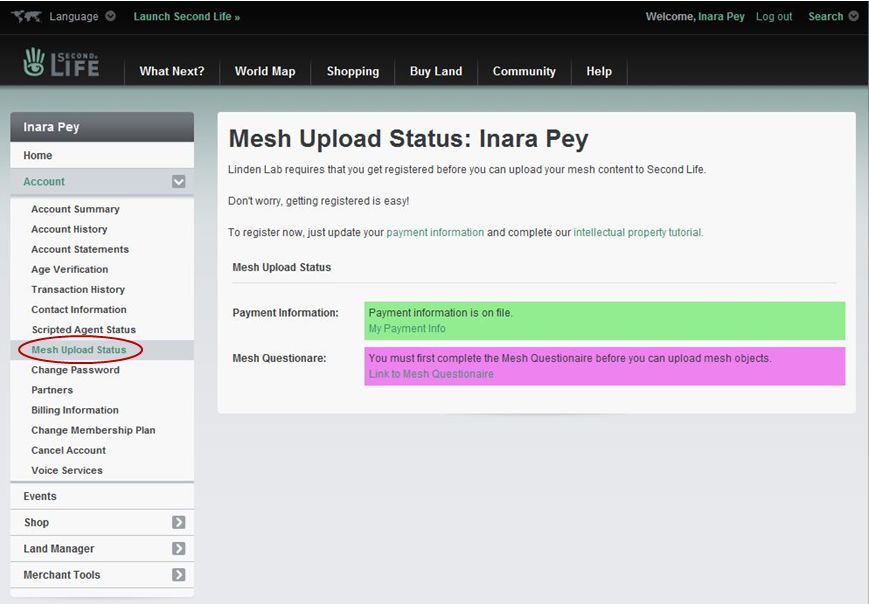
As I reported a week ago, the new status page can be located by logging-in to your dashboard at www.secondlife.com. When your dashboard is displayed, click on ACCOUNT in the menu at the top left and then Mesh Upload Status.
Back at the start of June, we learned that the ability to upload Mesh to SL is to be gated. You can currently take a peek at how this works by going to your Beta (aditi) Gridstatus page.
Click on the right-pointing arrow next to Account to display your account options, then click on MESH UPLOAD STATUS (located between SCRIPTED AGENT STATUS and CHANGE PASSWORD, as circled below).
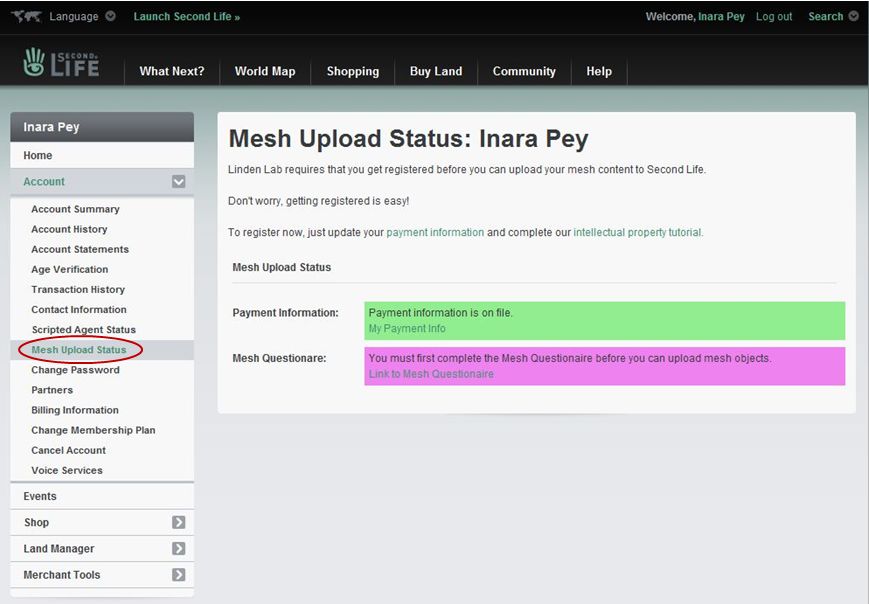
Mesh Upload Status page
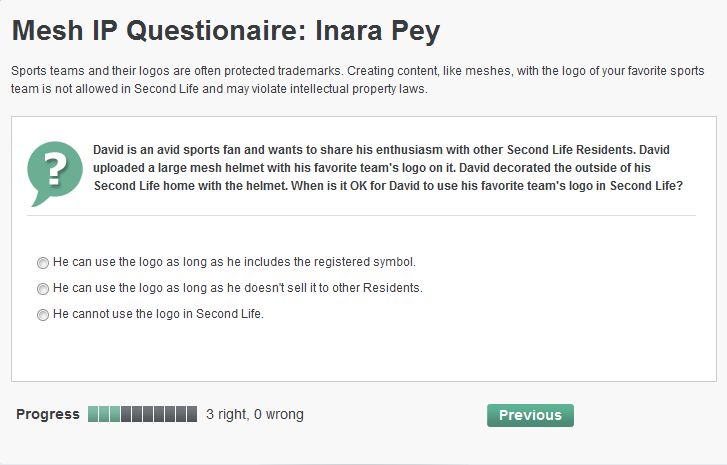
To qualify for Mesh uploads, you must provide payment information to Linden Lab, and complete a Mesh Intellectual Property Right tutorial / questionnaire, which comprises a series of multiple-choice questions, as shown below.
Questionnaire
The questionnaire is not mind-bogglingly difficult – and it shouldn’t be, the idea is to make people aware of what will not be tolerated and can lead to their ability to upload meshes being revoked; not to try and catch them out before they even get started. As such, it is possible to go back a step should you get any question wrong and then take the question again.
Completing the questionnaire results in you being informed that you are now cleared to upload meshes, and provides a link to some additional information related to trademarks and copyright under US law. I was actually surprised that there are (currently, at least) no links to Linden Lab’s own policies around mesh and IP.
You won’t currently see the option if you are using your main Grid dashboard page (at https://secondlife.com/my/).
It is possible what completing the questionnaire at this point in time may only apply to the Beta grid – you might have to complete the questionnaire again once the link is available from main Grid dashboard pages.
The Firestorm development team report that Linden Lab has confirmed Firestorm is now the third most popular viewer by number of distinct users and in terms of hours spent using SL. This moves it into third place in terms of popularity, ahead of the old official 1.23 Viewer.
According to the Viewer Directory (last updated 12th July), Firestorm sits in sixth place overall in terms of crash rates, putting it directly behind the official 2.7.2 release, and up on the official 2.7.5 release. Interestingly, the current full release of the official Viewer (2.7.4) isn’t listed.
To aid people making the transition from the Viewer 1.x environment, Phoenix have produced a new video tutorial, which is well worth a look-in:
(with thanks to CS Pfeffer for the nod on the video)
One of my first experiences with V1 TPVs was via the Windows Cool Viewer compiled by Boy Lane, and which became the Rainbow Viewer. For a long time, this was simply my Viewer of choice. I was therefore intrigued to see that after over a year, Rainbow has been overhauled and made available once again.
Based on the 1.22 release of Viewer 1, Rainbow has a core of die-hard fans, and the new release does much to bring it up to par with the likes of Phoenix and Imprudence 1.3/1.4, given it now includes:
Client-side AO
Media filtering
TP history
Display Names
Multiple attachments (but like other V1 TPVs, no multiple wear for the same layer of clothing)
Tattoo and Alpha layers
Outfits creation
Prim alignment tool
Multiple grid support
Using Rainbow is like a blast from the past. At installation, you’re informed that you need to obtain several files from either the “official” Viewer 1 or from Snowglobe. This is something I haven’t had to do in ages, and while I can understand why Boy has gone this route (better performance where the Kakadu system is concerned), I nevertheless wonder as to how vulnerable this leaves Rainbow: Viewer 1 is no longer available and there is no guarantee LL might not at some point simply remove snowglobe access, given it is now a dead project.
Once in the Viewer – and my use of Firestorm of late notwithstanding – there was something nostalgic in using Rainbow; the interface, the Preferences options – all hark back to the “good old days” in many respects when things were indeed, “fast, fun and easy”. However, the nostalgia is actually very short-lived. There is much that Rainbow lacks that I find hard to do without: there is no vertical tabbing for IM windows, for example, and no Quick Preferences option (although granted, both may come). Even the inclusion of avatar physics is – to be honest – now dated. The Viewer 2 system (already adopted by Firestorm) is far superior for those willing to give it a go.
Where Rainbow is likely to score is in being aimed at other OS Grids. I tested it with InWorldz and Avination, both with few issues other than getting the “you have been logged out” message, complete with options to review chat / IMs each time I logged out of InWorldz, rather than getting s “clean” exit. Other than that, performance was easily as smooth at Imprudence 1.3, and a lot better than the likes of Phoenix. As such, it is a welcome addition to the list of Viewers that can access other grids.
In terms of SL, however, I do wonder about the Viewer’s longevity. As I’ve already commented, the reality is that V1-based TPVs for Second Life are likely coming to their End of Days, what with the Search issues, mesh, and so on.
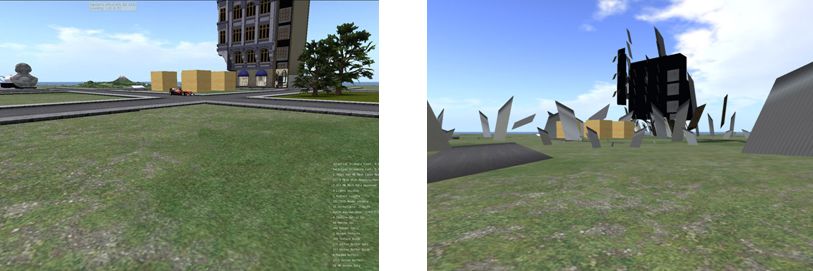
One of the problems facing Rainbow: Mesh as seen in the V2 Mesh Viewer (left) and in Viewer 1 (right) – with thanks to Linden Lab
To be fair to Boy Lane, the Viewer has been released with a clear statement of intent:
“Rainbow does not intend to be a competitor of viewer 2 or any other of the 3rd party viewers around. All of them are based on either V2 or Snowglobe code. Rainbow is based on 1.22, and playing in a league of it’s own. To support legacy hardware, and to support all my friends in Opensims.”
The last part of this statement is a worthy goal in itself – and again, full kudos to Boy for providing OS grid users with a greater choice. However, where Second Life is concerned, and even with a loyal following, given all that is coming down the road in the next few weeks and months, it’s hard to see this latest Rainbow release as having a decent shelf life.
Some may count this post as premature, but given we’re now into July, and what is coming down the road, I’m getting my goodbyes in early.
Viewer 1 has been with us since Second Life opened its doors. Over the years, it has seen features added, tools moved around, the capability for API elements to be introduced (perhaps the most widely-used being Marine Kelley’s Restrained Love Viewer); the code has been open-sourced, allowing a raft of famous (and not a few infamous) Viewers to come into use: the OnRez Viewer, Cool Viewer, Rainbow Viewer, Meerkat, Imprudence, Phoenix and of course the “Devil incarnate” itself: Emerald (and that’s without mentioning the various “blackhat” Viewers).
Many changes to the Viewer were welcome (remember the introduction of the first skin option? of Windlight?), many were being decried and striking fear in the hearts of some even before they rolled out (remember the hoo-haw in some camps over the arrival of Voice?); others were met with much facepalming and LL’s apparent failure to grasp how people used their viewer (remember the consternation when the chat windows all changed and “communicate” turned up?). Some of the criticism aimed at the Viewer and LL was justified; a lot of it wasn’t. But through it all, Viewer 1.x, in all its many guises has remained a perennial favourite among Second Life users. Not even the demise of the official 1.x series of Viewer did much to put a dent in this: people simply switched over to V1-based TPVs in preference to going over the Viewer 2.
Viewer 1.18 at the Windlight launch (with thanks to Eckhard Jager)
Now all of that is about to change. In truth, the writing has been on the wall for V1-based Viewers for the last 12 months or so: ever since Linden Lab depreciated all versions of their Viewer prior to 1.23.5 and then turned off Snowglobe work in favour of Snowstorm for Viewer 2.x.
Snowglobe showing the silver skin (thanks to SamanthaS Nightfire)
From this month, however, even those using V1 TPVs are going to have to consider where they are going to move to next. As LL remind us (via retweets of this announcement, at least through @SecondLife), mesh commences its roll-out this month, starting with, I understand, the Blue Steel Release Channel prior to the remaining Release Channels & the rest of the main grid being mesh-enabled by the end of August.
Ergo, if people want to see mesh objects, they are going to have to move to a V2-based viewer. What’s more, unless the TPV developers have persuaded LL otherwise, it is possible those wanting to upload mesh imports will be forced to use Viewer 2 for this purpose, given LL were looking to ring-fence this capability (whether this is still the case is unclear – like much else around mesh).
Mesh: heralding the end of the road for Viewer 1 TPVs (model by Timmi Allen)
Nor does the bad news for Viewer 1 end there; Oz Linden is on record as saying that developers of such Viewers are facing an uphill battle: “[A]ny Viewer that isn’t being actively maintained is going to start having fairly serious problems over the next months. We’re making a lot of changes… if viewers don’t keep up, things will break.”
The fact is, it will become harder and harder for TPV devs to try and maintain Viewer 1 code. Kirstenlee Cinquetti saw the writing on the wall over a year ago, and has moved over entirely to the development of the outstanding S21 Viewer. Announcements made at the end of last year concerning the future of the Viewer 1 Search prompted Phoenix and Imprudence to start down the road to developing a V2-based Viewer each. While Imprudence are still putting effort into their V1-based 1.4 Viewer, it is evident that their longer-term aim is not merge this work into their V2 Kokua Viewer, while Phoenix already have the outstanding Firestorm available. Individual TPV developers are also transitioning: Lance Corrimal hasn’t done anything significant with his V1-based Viewer since the end of April, while his V2-based Viewer comes on in leaps and bounds.
It is going to take a while for mesh to really make its presence felt – assuming, again, that the roll-out goes smoothly and without any major updates; it’s also possible that some TPV developers will look to try and backport the Search 2 functionality into their offerings in the hope of keeping things alive. So it’s possible that some may try to cling to Viewer 1 for a little longer; but while it may be seen as an unpopular statement in some quarters, the era of Viewer 1 really is now drawing to a close.
I don’t say that with any sense of superiority (I am an unabashed V2-based Viewer convert – Firestorm and Kirstenlee’s S21); I started out with Viewer 1 (version 1.14 or 1.15), and personally have no problems with it. But, sad to say, we all come to a time where, for better or worse (depending on one’s own feelings), we must move with the tide.
And the tide is now assuredly flowing to Viewer 2’s shore.
Firestorm today released a second public beta version of the viewer. The 2.5.2.16922 release came somewhat unexpectedly and added a slew of new features and bug fixes which do much to move the viewer very much closer to a prime-time release status.
Note: the following comments apply to the Windows version of Firestorm. Other OS versions may differ.
Build Tools
Chief among the new features is a full port of the Phoenix build tools, so that Firestorm now includes:
Clickable group name on build floater
Object highlight toggle on build floater
Pivot point controls
Default size and material controls
Link number of build floater (with same bugs as Phoenix)
Build options pref panel Prefs> Firestorm> Build
Copy/paste object position, size, rotation, parameters and textures
Alt, control and shift keys modify increment on spinners (Alt: x10. Control: x1/10. Shift: x1/100)
Higher precision on position, size and rotation (4 decimal places)
Phoenix’s additional path profiles and transforms types
Added button for copy keys (UUID) to clipboard
Added requirement to confirm before setting object for sale (prevents sale sniping)
Expand/Collapse button
Added always show last owner.
Other notable changes include:
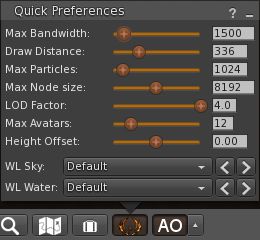
Quick Preferences Button
Quick Preferences options
The inclusion of “Quick Preferences button” in the bottom tool bar that provides quick and convenient access to a host of options that can often require frequent adjustment (see right), including the ability to rapidly step through windlight sky and water defaults or select them from a drop-down menu in much the same way as can be found within Phoenix via the arrow option at the extreme right-hand end of the tool bar.
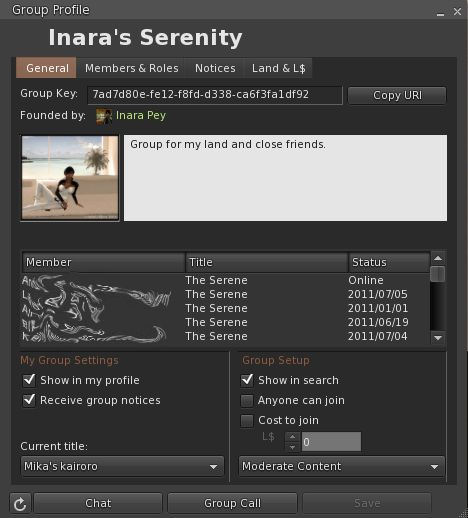
Group Pop-up Window
New Group pop-up window
It’s pretty well known that I’m not a fan of the Sidebar, which tends to be little more than a disruptive waste of space where I’m concerned – so anything that Firestorm adds that prevents me having to be tossed around the Viewer and into the Sidebar is going to get a big thumbs up from me.
So it’ll come as no surprise that the new Group pop-up window is a big hit with me. As with Viewer 1.x, it allows you to pull-up information on a Group and peruse it quickly and conveniently in a simply pop-up.
It even includes a couple of new buttons – although one of them could perhaps do with a clearer title. CHAT opens up a Group Chat window – very handy when you want to make an announcement; GROUP CALL also opens up a Group Chat window, although the function of the button is actually to initiate a VOICE call between group members. As such, the latter button might be better off labelled “Voice Call”.
Movement Controls
I’ve rarely used them, but many do like Viewer 1’s movement controls. Until now, these haven’t been offered within Firestorm as a discrete option.
This latest Beta changes that by presenting them with a toolbar button of their own, and the palette fully repositionable. This will doubtless be seen as a very welcome addition by those who prefer to use the palette.
Land Details
Another small, but to me significant, improvement is that with this release, the land name displayed at the very top of the Viewer window is once again clickable and will bring up the ABOUT LAND window. This has been one of my hang-ups with Viewer 2.x; despite having the LAND button sitting in the navigation bar (which I rarely turn off), I must admit that I’ve been unable to break the habit of pointing to the land name and clicking on it, a-la Viewer 1.x, in order to bring up ABOUT LAND. Kudos to the Firestorm team for rescuing me from the need to consciously break myself out of this habit!
Bits of the rest
Other changes I particularly like with this release are:
“Restore to last position” added to inventory right click menu
Contacts tab in Conversations is now closable
World map search results are now alphabetical
Copy outfit your wearing to text option in the worn tab on appearance panel. From gear menu, copy to clipboard.
Performance-wise, this represents, on my hardware at least, the best results to date with Firestorm. When on a sim with one or two others and draw set to 360m, I can achieve 60-65fps, easily putting Firestorm on a par with Viewer 2.6. On more crowded sims, this falls to between 45-50fps, which is still superior to the last release. What really stuns me however, is that on a sim with 5 other people and with shadows enabled, Firestom can manage 20-25fps on my machine, making it easily the best when it comes to rendering shadows for me.
Opinion
Firestom simply goes from strength to strength and this release potentially marks it as ready to move to a “final” release status.
If you’ve held-off downloading Firestorm or making the move to a Viewer 2.x-based TPV, now is really the time to start re-thinking your position, especially with Viewer 1.x search about to lose effectiveness in some areas and mesh due to be rolled out over the next 6-7 weeks. And if you’re not impressed with Viewer 2 either from direct experience or through the reports of others, Firestorm is liable to suit you right down to the ground.