Apparently, as a result of Labor Day in the USA and the threat of hurricane Dorrian, there was no SLS (Main) channel deployment on Tuesday, September 2nd.
As a result, on Wednesday, September 4th, there will be deployments across the entire grid – the SLS (Main) and the primary RC channels. The order of deployments will be the SLS (Main) channel, starting 30 minutes ahead of the usual time. Once completed, and providing there are no issues, it will be followed by the RC deployments.
The SLS (Main) channel is to be updated with server maintenance package 19#19.08.23.530380, comprising maintenance fixes and Log improvements, and previously deployed to the Magnum and LeTigre RC channels.
The three main RC channels (Magnum, LeTigre and BlueSteel) will all be updated with the same server maintenance package – 2019-08-29T20:20:39.530516 – comprising “simulator component of deploy tooling and process improvements”. This update sees the introduction of the new Simulator release notes pages (see below).
There will also be a small move of more regions (around 100) to the Cake RC channel on Thursday, September 5th. This will be a further expansion for the script usage improvements. People wishing to test these updates can put in a ticket to have their region moved to Cake – but should note that updates to that channel do not necessarily follow the same weekly schedule as the main RCs.
Release Notes
In May 2019, the viewer release notes moved to a new series of web pages (see: New SL viewer release notes pages: an overview). The RC deployments scheduled for Wednesday, September 4th will see the all release notes for the RC channels move to these pages as well. This means:
The there is a new link for simulator release notes on the main About Release Notes page.
The release notes themselves have a new “more specific” version number system – as witnessed with the simulator release for the RC channels noted above.
It has been promised that these pages will be “more informative” with release information. This appears to take the form of Jira report reference numbers.
The link to the simulator release notes is now live on the About Release Notes page – click for full size, if required
SL Viewer
At the time of writing, there have been no updates to the current list of existing official viewers, leaving the pipelines as follows:
Current Release version 6.3.0.530115, formerly the Bakes on Mesh RC viewer, promoted August 26th – NEW.
Project Muscadine (Animesh follow-on) project viewer, version 6.4.0.530100, August 19.
360 Snapshot project viewer, version 6.2.4.529111, July 16.
Legacy Profiles viewer, version 6.2.3.527749, June 5. Covers the re-integration of Viewer Profiles.
Linux Spur viewer, version 5.0.9.329906, dated November 17, 2017 and promoted to release status 29 November 2017 – offered pending a Linux version of the Alex Ivy viewer code.
Obsolete platform viewer, version 3.7.28.300847, May 8, 2015 – provided for users on Windows XP and OS X versions below 10.7.
In Brief
“[Second Life: Failed to grant capabilities”] – this is an error people have been seeing recently. It generally occurs as a result of a general failure to set up communication between your viewer and a region when moving into that region.
When first connecting to a region, the viewer asks for – and should receive – a set of “capabilities” – URLs where the viewer can connect and get or send info.
If this fails, it’s unlikely the viewer will be able to work with the region. The most effective way to deal with this is have the region restarted – so if you’re not the region holder, please drop them a line to let them know the region needs restarting or file a support ticket. If you are the region holder and you cannot restart the region or the issue is not resolved following a restart, please file a support ticket.
LL continues to investigate the issue whereby any scripts compiled to an experience prior to simulator version 19.08.06.529800 will not recompile on 19.08.06.529800 or later. In fact, Simon Linden was working on the issue while attending the meeting). The root cause does not appear to be within the updated server code, and for now, the only solution appears to be recompiling everything in the experience – which is acknowledged as being less than optimal.
Logos representative only and should not be seen as an endorsement / preference / recommendation
Updates for the week ending Sunday, September 1st
This summary is generally published every Monday, and is a list of SL viewer / client releases (official and TPV) made during the previous week. When reading it, please note:
It is based on my Current Viewer Releases Page, a list of all Second Life viewers and clients that are in popular use (and of which I am aware), and which are recognised as adhering to the TPV Policy. This page includes comprehensive links to download pages, blog notes, release notes, etc., as well as links to any / all reviews of specific viewers / clients made within this blog.
By its nature, this summary presented here will always be in arrears, please refer to the Current Viewer Release Page for more up-to-date information.
Note that for purposes of length, TPV test viewers, preview / beta viewers / nightly builds are generally not recorded in these summaries.
Official LL Viewers
Current Release version 6.3.0.530115, formerly the Bakes on Mesh RC viewer, promoted August 26th – NEW.
Release channel cohorts:
UmeshuMaintenance RC viewer updated to version 6.3.1.530411, on August 27th.
The following notes are taken from the Content Creation User Group (CCUG) meeting, held on Thursday, August 29th 2019 at 13:00 SLT. These meetings are chaired by Vir Linden, and agenda notes, meeting SLurl, etc, are usually available on the Content Creation User Group wiki page.
Bakes on Mesh
Project Summary
Extending the current avatar baking service to allow wearable textures (skins, tattoos, clothing) to be applied directly to mesh bodies and heads. This involves viewer and server-side changes, including updating the Bake Service to support 1024×1024 textures, but does not include normal or specular map support, as these are not part of the existing Bake Service, nor are they recognised as system wearables. Adding materials support may be considered in the future.
There are some local edit issues – some already noted in the viewer release notes – that can produce odd results when using the appearance editor which correct themselves on exiting the appearance editor and when baked via the Baking Service.
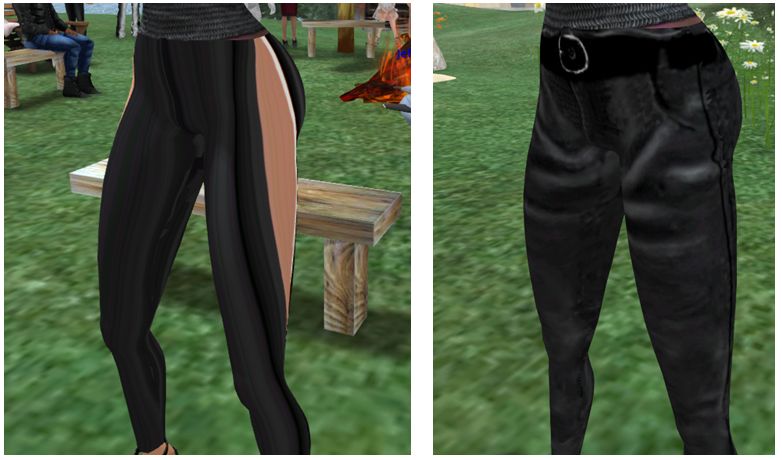
Cathy Foil has noted this glitch than can occur with Baked_Lower wearables on BOM: when editing locally in the appearance editor, the leg does not appear to be masked correctly by the wearable (which is also incomplete at the waist). Once baked, however, the wearable appears correctly applied and in full (r). Credit: Cathy Foil.
Some of these local edit issues may not be specific to Bakes on Mesh, but may be more noticeable as a result of BoM, and the Lab is looking to resolve them.
Animesh Follow-On – Project Muscadine
Project Summary
Currently: offer the means to change an Animesh size parameters via LSL.
Current Status
The simulator support on Aditi (the beta grid) – DRTSIM-421 (region Bakes on Mesh) has been updated, but there are no feature changes within it.
The project viewer has been merged with Bakes on Mesh (as the release viewer) and is passing through the Lab’s QA, and so should be appearing soon.
ARCTan
Project Summary
An attempt to re-evaluate object and avatar rendering costs to make them more reflective of the actual impact of rendering both. The overall aim is to try to correct some inherent negative incentives for creating optimised content (e.g. with regards to generating LOD models with mesh), and to update the calculations to reflect current resource constraints, rather than basing them on outdated constraints (e.g. graphics systems, network capabilities, etc).
Current Status
Work has now resumed.
First part of this is to continue data-gathering and look at re-aligning some figures based on the changes made for Animesh.
Thus far, the project primarily comprises enhanced logging to assist the Lab in data collection, allowing information on the overall cost of a specific avatar or in-world object to be gathered.
Once enough data has been gathered across a broader enough spectrum of content to give the Lab confidence they have a good understanding of things, then work can start on adjusting the cost calculations for rendering, etc.
It’s important to note that any user-viewable changes as a result of ARCTan are still some way off, and the Lab will be staging things to let users know what is happening when, and what it is likely to impact.
There was a lot of general conversation towards the end of the meeting on what people hope ARCTan will do (e.g. forcing creators to make proper use of avatar LODs, etc.).
Environment Enhancement Project
Project Summary
A set of environmental enhancements (e.g. the sky, sun, moon, clouds, and water settings) to be set region or parcel level, with support for up to 7 days per cycle and sky environments set by altitude. It uses a new set of inventory assets (Sky, Water, Day), and includes the ability to use custom Sun, Moon and cloud textures. The assets can be stored in inventory and traded through the Marketplace / exchanged with others, and can additionally be used in experiences.
Due to performance issues, the initial implementation of EEP will now likely not include certain atmospherics such as crepuscular rays (“God rays”).
The number of remaining issues is “trending downwards”.
Misc. Items
The upcoming Voice RC (or project) viewer mentioned at the last TPVD meeting still has a couple of issues preventing it from surfacing in the Alternative Viewers page.
The Umeshu Maintenance viewer (currently version 6.3.1.530411, merged with Bakes on Mesh) could be promoted to de facto release status as early as week #36 (commencing Monday, September 2nd), in a break from the Lab’s preferred 2-week gap between release promotions.
Date of next meeting: Thursday, September 12th, 2019.
There was no deployment to the SLS (Main) channel on Tuesday, August 27th, leaving it on server maintenance package 19#19.08.06.529800, containing internal fixes.
On Wednesday, August 28th, the core RC channels should be updated as follows:
Among other things, this update will see the RC channel name be removed from Help > About in the viewer (it will simply be recorded as “Second Life Server”), and the channel name will no longer be returned for LSL enquiries.
Note this is the RC channel name that will be changing – both the simhost name and the simulator version will still be visible, contrary to comments in the forums. Also, simulator version number will remain available to LSL; it is again, just the channel (sim_channel) that will always return “Second Life Server”
Magnum ad LeTigre should receive server maintenance package 19#19.08.23.530380, very helpfully referred to as “Maintenance fixes” and “Maint Train woo woo chuga chuga chuga chuga”
There will be a further small-scale RC deployment that will (if I understand things correctly) comprising the script usage improvements – the smaller deployment being cautionary after things went sideways when an attempt was made to deploy these updates to an RC channel in week #34.
SL Viewer
The Bakes on Mesh viewer was promoted to de facto release status on Monday, August 26th, with the release of version 6.3.0.530115. You can find out more here:
As a result of this promotion, the Umeshu Maintenance RC viewer updated to version 6.3.1.530411 on Tuesday, August, 27th, bringing it to parity with Bakes on Mesh. This will likely be the next viewer to be promoted to release status in around 2 weeks time.
The rest of the viewer pipelines see no change at the start of the week and remain as follows:
Project Muscadine viewer (Animesh enhancements), version 6.4.0.530100, August 19th
360 Snapshot project viewer, version 6.2.4.529111, July 16th.
Legacy Profiles viewer, version 6.2.3.527749, June 5. Covers the re-integration of Viewer Profiles.
Linux Spur viewer, version 5.0.9.329906, promoted to release status 29th November 2017 – offered pending a Linux version of the Alex Ivy viewer code.
Obsolete platform viewer, version 3.7.28.300847, May 8th, 2015 – provided for users on Windows XP and OS X versions below 10.7.
In Brief
The planned changes to RC deployments (see the blog post links above) has caused some drama, partially due to people misunderstanding that the RC channel names will be less obvious, as noted above – but not the simulator / simhost names.
However, it is true that the downgrading of ready access to RC channel names will make it harder for users to recognise which channel they are on – which could made testing capabilities and features harder, given that people are not so familiar with simulator versions and simhost names.
The flip side to this is that in some respects, the Lab doesn’t want people to know which channel they are on to stop preconceptions about issues, etc., they may encounter (e.g. “I was on Magnum, which has X release on it, and I have this issue – so it MUST be X that is at fault!”) – and according to Oz Linden, they would like to see more testing of new features on Aditi ahead of any main grid RC deployment.
To help people understand what is being released, the simulator version release notes are promised to be “more informative” in future and where relevant. That said, “Maint Train woo woo chuga chuga chuga chuga” isn’t exactly setting the bar that high in terms of informative release notes.
There is a reported issue with experiences whereby any scripts compiled to an experience prior to simulator version 19.08.06.529800 will not recompile on 19.08.06.529800 or later. The issue is further described thus, following any attempt to recompile:
Checking Properties for the recompiled scripts will show no compiled experience. Plus shift-copying or using the edit menu to copy or dropping an experience script in a host, will all result in the experience being completely lost from the script compile. However, llResetScript() doesn’t trigger the loss.
A bug report has been raised on group chat lag (BUG-227477). The Lab is aware of this and has left the report open for further input from those experiencing issues. Constructive and informative feedback is clearly being sought, along the lines of the comments thus far left.
Updated with an overview of “Bakes on Mesh appliers” for Mesh bodies and head yet to be updated to support BoM.
Monday, August 26th, 2019 saw the formal release of Bakes on Mesh (BoM) for Second Life, and with it, an attempt to make system wearables (skins, tattoo and clothing layers) usable on modern mesh avatar bodies, utilising the avatar Bake Service and without the need for a dedicated applier system.
While Bakes on Mesh has been in development for over years, and much of it is known to many users, this article has been written to provide something of an introduction / overview of BoM, covering things like system wearables, the Bake Service, that changes that have been made, where to find information on using BoM, and what it may mean for Second Life users in the future, depending upon how well the capability is received by creators.
Some Basics
System Wearables and the Bake Service
System wearables as they appear in inventory
Without going too deeply into specifics for those unfamiliar with them, system wearables are a special kind of inventory asset (some of which are shown on the right) that can be directly worn / added to the system avatar to produce a “dressed” look.
These wearables come in a number of “layers”- skin (which must always be worn on the system avatar), tattoo, undershirt, shirt, and jacket.
The naming of the layers isn’t that important – a creator could be assign a bra or a shirt or a pair of pants to any one of the tattoo, undershirt, shirt and jacket layers, depending on how flexible they want their clothing to be. What is important is that the always follow an hierarchy: skin is always at the bottom and so “covered” by the other layers, which are in turn “covered” by the next (so undershirt wearables always apply “over” tattoo wearables; “shirt layers “over” undershirt wearables, etc), with the avatar able to wear up to 62 wearables in any combination of layers at one time.
This might sound very complex, but for those familiar with the system, it is very easy to grasp; however, what is important is what comes next. When an avatar’s look is complete, the information about all these wearables are sent to the simulator and then to a back-end set of servers called the Bake Service over a series of channels called the “bake channels”, which define where the layers appear on the avatar. These channels are:
BAKE_HEAD, which defines all the wearable elements that have been applied to the head (e.g. skin, and tattoo layers used for make-up)
BAKE_UPPER, which defines all the wearable elements – skin plus any tattoo, undershirt, shirt and / or jacket layer(s) that have been applied to the avatar body above the waist and below the neck (with the left arm mirrored from the right).
BAKE_LOWER, which defines all the wearable elements – skin plus any tattoo, undershirt, shirt and / or jacket layer(s) that have been applied to the avatar body from the waist to the feet (with the left leg mirrored from the right).
BAKE_EYES and BAKE_HAIR (both pretty self-explanatory).
BAKE_SKIRT, which defines skirt / dress style wearables.
The Bake Service then composites (bakes) the layers received on each of these bake channels into a single texture, and sends the results out to every viewer able to “see” the avatar. So, for example, facial / head skin and any make-up tattoo(s) received via the BAKE_HEAD channel are baked to become a texture seen on the avatar’s head, while the layers received over the Bake_Upper channel are baked into a texture seen on the avatar’s upper body, and so on, ensuring the avatar consistently appears to everyone dressed at the user intended, while also removing the need for individual viewers to manage the complex layering and rendering of all the individual wearable layers on other people’s avatars.
Mesh Bodies and Complexity
Since their introduction, mesh bodies have not been able to leverage this approach. Instead, they require a dedicated “applier” mechanism to achieve the same ends, together with the use of an alpha layer to hide the system avatar.
Further, to enable clothing items to be layered – so you can have an applied shirt / blouse appearing to be “under” a jacket, for a example, mesh bodies have had to be constructed in a complex manner, with several layers closely packed together (colloquially called “onion layers”) that effectively mimic the system wearable layers. This actually makes the avatar a lot more complex than they otherwise might be, resulting in their relatively high rendering costs.
Enter Bakes on Mesh
So, Bakes on Mesh has been developed to allow system wearable to be applied directly from inventory to worn mesh faces (e.g. avatar bodies and wearables) that have been correctly flagged by the creator to support Bakes on Mesh. Through Bakes on Mesh, Linden Lab hopes:
Users can avoid the need to use appliers, but can add wearables to their mesh avatar directly from inventory.
Creators will be able to simplify avatar mesh bodies and heads by removing the need for some of the “onion” layers. This should – if done – reduce the rendering complexity for bodies and heads, thus hopefully improving people’s SL experience (as avatars won’t be quite so resource intensive or require quite so much “assembly time” when encountering them on logging-on or after teleporting somewhere).
Notes:
As with all new features, use of Bakes on Mesh will only be apparent to those actually using viewers running the Bakes on Mesh code; anyone not on such a viewer will likely see something of a mess.And as with new features, it will take time for the Bakes on Mesh code to be implemented by all TPVs.
Bakes on Mesh does not mean user “have” to go back to using system wearables nor does it mean that applier systems can no longer be used. It is simply a means of making system wearables work with mesh bodies and heads, hopefully with the benefits given above. Those who wish to can continue to use applier-based clothing as they always have.
Bakes on Mesh adds new options for applying suitable textures to the baking channels for application on a mesh body by the Bake Service
An introduction to using BoM can be found in the Bakes on Mesh Knowledge Base article. This includes information on trying BOM using a test mesh body – the best way to do this is to use Aditi, the beta grid. I’m not going to go into specifics here, simply because there are multiple resources available to assist users and creators – some of which are noted at the end of this article, and I want to keep this as a more general, easy-to-understand primer.
When considering Bakes on Mesh it is important to remember it is not necessarily intended as an outright replacement for appliers and current mesh bodies from the get-go. Rather, it is initially an alternative – although if the popularity / take-up among creators and users are sufficient, then over time it could obviously become the system of choice over appliers and more complex mesh bodies. However, existing mesh bodies / heads and applier systems will continue to work as they always have.
Key Points of Bakes on Mesh
This list is not exhaustive, but is intended to give a feel for Bakes on Mesh and its use:
System skin layers, tattoo layers, clothing layers and alpha layers all work – the mesh just needs to be flagged by its creator as supporting Bakes on Mesh and correctly set-up for alpha layers to work as intended.
As an alternative, there are assorted “BoM appliers” designed to work with mesh bodies / heads that have not (yet) been updated with Bakes on Mesh support – see below for more.
You do not need a full body alpha to wear a Bakes on Mesh flagged mesh. If the flag is present when you wear the mesh, the body section it is flagged for disappears. So, if you wear a lower body “Bakes on Mesh ready” avatar part, then entire lower body of the system avatar will disappear.
The Bake Service has been updated to support 1024×1024 resolution textures, so it offers the same texture resolution for wearables as offered through applier systems (prior to Bakes on Mesh the maximum resolution for wearables was 512×512).
Obviously, the wearable must be made at this resolution in order to utilise it; a 512×512 wearable will not magically appear to be 1024×1024 resolution when applied.
In order to be fully effective, mesh bodies using BoM and BoM wearables should match the system avatar UV map as closely as possible.
Fortunately, most of the current range of avatar bodies sold under brands such as Maitreya, Slink etc., do tend to stay close to the system avatar UV map. So any new BoM-specific versions / updates should continue to do so.
Alpha support means that layers means that mesh bodies should no longer need to be split into multiple pieces for individual alpha-masking to prevent a body clipping through clothes. Alpha requirements are back in the hands of the clothing creator, and should be made alongside the clothing, so that when used and providing the body is correctly set-up they should just “work”. In addition, clothing makers may not longer need to include auto alpha scripts.
Changing mesh body parts should be easier, providing both bodies are flagged to use Bakes on Mesh. The body takes whatever is worn on the system body – skin and make-up instantly appear on each change of head, for example.
Skin makers will be able to offer more options by including tattoos with their skins, allowing for a variety of make-up options, whilst there will no longer be any limitation on the use of tattoos (one per zone).
Applier support will still be required for the following: nails; eyelashes; standalone ears, hands, feet, lips, bust implants, etc.; lip gloss; materials finishes (see Some Possible Points of Contention, below); neck blenders, anything not intended to look “painted” on.
New with Bakes On Mesh
To provide full “wearables” support, Bakes on Mesh introduces some new elements that will be of key import to creators:
The introduction of 5 new bake channels – LEFT_ARM_BAKED, LEFT_LEG_BAKED, AUX1_BAKED, AUX2_BAKED, AUX3_BAKED:
These can only be used with Bakes on Mesh, and are not available to the system avatar.
LEFT_ARM_BAKED and LEFT_LEG_BAKED are intended to help with making mesh avatars where the left and right limbs have different textures (and so can be asymmetric, as can currently be achieved with applier systems).
The AUX channels are general purpose, and could be used for body regions not possessed by system avatars (such as wings) or for other purposes.
This means BoM has 11 possible channels for wearables to use for textures, and for the baking service to produce.
However, the new channels listed above do not have alpha support like the other channels, and so cannot have “holes” cutting through the mesh face they are worn against.
BOM also adds a new wearable type called Universal.
While specifically added to allow the wearing items that use the new channels described above, the Universal wearable has slots corresponding to all 11 of the bake channels, offering extensive flexibility of use. In layering order, universal wearables go between the tattoo and body layers.
Note that for others to see your avatar correctly when you are using Bakes on Mesh they must also be using a Bakes on Mesh viewer. If they are not, they will see your avatar as a mesh of red, blue and yellow colours showing through your mesh parts.
Left: Bakes on Mesh when seen via a non Bakes on Mesh viewer: the system avatar will show through the mesh body parts, covered by default system-supplied BoM marker textures. Centre and Right: using a “Bakes on Mesh applier” on a non-BoM body and head and via a Bakes on Mesh capable viewer. The centre image shows the “before” avatar state: the system layer skin and clothing are worn, but do not conform to the mesh body and head (which must be worn without their corresponding alphas for this type of applier to work), and so “poke through” (highlighted in places by the red circles). The right image shows how things look after the”Bakes on Mesh” appliers have been used – the system layer clothing and skin now mostly conform to the mesh head / body, with the exception of fingers and toes (highlighted) which will generally require an additional “glove” or “mask” fix.
“Bakes on Mesh Appliers”
During the testing of Bakes on Mesh, at least two experimental applier systems were produced to allow BoM to be tested on non-BoM flagged bodies and heads. For example, Omega produced an experimental BoM applier system, with instructions here.
Since then, and given that several mesh body and head creators have yet to produce BoM flagged updates to their bodies / heads, several more such “BoM appliers” have been produced, some of which are available for free, some are provided by the mesh head / body creator, and others are available at a nominal cost, and may be for specific purposes (e.g. the Bakes on Mesh skin applier (Omega) by Conor Shostakovich at L$125).
These essentially work by allowing you to dress your system avatar with the required system wearables, then wearing your mesh body / head without their alpha masks, and then using the applier to apply the system layers to the mesh body / head in a similar manner to “traditional” appliers – but again, as a single composite layer when baked.
How effective these systems are can be variable.
Due to differences in the way skin skin textures / UV maps work and the way mesh bodies tend to be put together, such appliers may not work particularly well around feet and hands.
Note: links to products does not constitute endorsement. Always check the Marketplace for products and reviews.
Such appliers are intended as an interim “fix” for using Bakes on Mesh until such time as the major head and body creators provided full Bakes on Mesh support.
Some Possible Points of Contention
However, there are what might be regarded by some as “negatives” around Bakes on Mesh, a couple of the more prominent ones being:
The Bakes Service – and thus Bakes on Mesh – does not support materials (normal and specular maps). How much this impacts people’s acceptance of BoM is open to debate. However, when needed, materials still can be added manually (if the mesh / mesh face in question is editable) or via a suitable applier.
Appliers are convenient, as they are an all-in-one solution requiring only one or two items in inventory – the outfit applier HUD and possibly an intermediary relay tool like Omega.
With Bakes on mesh, wearables are all individual inventory assets, which could lead to inventory growth, some of which might be quite extensive as a result of creators providing multiple options / layers (although in fairness, some applier systems can be like this – I have seen a Hugo’s Design outfit with no fewer the 40 individual items, both system layer clothing and multiple applier options).
Some of the inventory “bloat” BoM might cause can potentially be managed via the use of the viewer’s Outfits capability (although this obviously also adds to bloat with inventory links) or via a new form of applier system that utilises system wearables created at 1024×1024 resolution.
How much these may impinge on consumer’s willingness to adopt BoM remains to be seen.
Closing Remarks
Like all new capabilities, Bakes on Mesh will take time to gain understanding and traction. Also like all new features, it has its outright fans, and those who have – even before really getting to work with it in earnest – decided its is bad / wrong / pointless / a step back, etc.
I’m personally sitting in the middle. If it does what is claimed on the tin, and if it gains traction among mesh body and head creators (and several have been working on BoM for the 12+ months its been in development) and clothing creators, then it could do its own little bit towards a better “optimisation” (quotes used intentionally, as there is still a lot more than can be done in terms of optimisations cross SL), and make things a little better for everyone.
But it will take time for Bakes on Mesh to mature in terms of general use – creators need to update their heads / bodies (although Slink is apparently ahead of the curve, and their new bodies are said to work with existing appliers, and other creators may also be providing products / updates, I’ve just not encountered any as yet). Those making system wearables are going to need time to update to the 1024×1024 where preferred (if they haven’t already, and so on. And, most obviously, it will take a little time for the Bakes on Mesh code to percolate out to all TPVs.
It has long been a tradition in Second Life that the main grid simulators and the regions they support are split between a number of channels:
The main channel, called Second Life Server, or SLS, which has the majority of simulators / regions running on it (roughly about 70%).
Three core release candidate (RC) channels, code-named BlueSteel, Magnum and LeTigre – each of which may account for roughly 10% of the simulators / regions.
Assorted smaller RC channels (such as Snack and Cake), that come and go according to needs – they may draw their simulators / regions from the SLS channel or the main RCs or a combination thereof.
This division is designed to allow a flexibility of approach to deploying updates, particularly those that may contain new features or have specialist updates such a new throttles or security changes, as these can be deployment to one or two of the RC channels first to test how they work under fully 2live” conditions (which the Lab, with the best will in the world cannot possibly fully test prior to deployment), and then removed with minimal grid disruption should anything untoward happen.
These RC deployments generally take place every Wednesday. If all goes well, and depending on how many different simulator updates are on the larger RCs, one will generally be “promoted” to the SLS channel the following Tuesday, having spent a week on one or more RCs. there are some variances in this, depending on what is going on (significant changes or new feature might be gradually deployed from one to two to all three RCs over a period of time, and then to the SLS channel, for example), but you should get the general idea from this, if you weren’t previously aware of how things work.
These (generally) weekly deployments are reflected in my Simulator User Group updates, where I list the deployments in terms of the SLS channel and the three core RC channels (the Lab doesn’t always acknowledge when a very small RC is being used).
However, on Monday, August 26th, Linden Lab announced upcoming changes to how simulator changes are going to be handled, and while the deployment methodology will remain the same (SLS channel deployments on Tuesdays, RC deployments on Wednesdays), there will be some differences, notably:
Starting with a deployment to one of the RC channels, the channel name will no longer be visible through the viewer (Help > About) nor will it be open to LEL query – the channel name will simply be listed as “Second Life Server”, the same as the “main” channel. Over the next couple of weeks this will be true for all RC channels.
This means that when reporting simulator issues, just referencing the channel name will no longer be sufficient – users must use the simulator version number. This is displayed in Help > About, alongside the channel name:
Going forward from week =35, simulator issues should be reported using the simulator code version number, not the channel name (“SLS”, “BlueSteel”, etc.).
The reasons for making these changes are defined as being twofold:
To provide the Lab with better data on the performance and reliability of the server updates, and allow for better monitoring (presumably via the additional tools and internal changes the Lab has been making to the simulator code for the last few months).
To avoid spurious associations between the RC channels and capabilities. For example, the idea that one RC channel runs on better (or worse) hardware than another or the SLS channel; or that issues being experienced *must* be the result of an RC deployment, purely on the basis that that was either the last deployment made, or the user happened to be on an RC channel when they encountered an issue (regardless of whether the code may actually have caused the problem or not).
It is also noted in the official blog post that while simulator code version numbers will be the preferred means of reporting issues, channel names will continue to be recognised by Support for matters of testing:
Future improvements will make each RC channel a better model of the Grid as a whole. Support will continue to be able to accommodate Region owners’ requests that a Region be in the RC for a particular feature or fix they want as soon as possible, or that it be excluded from any RC.
It’s currently not clear if these changes will also impact the channel reporting capabilities in TPVs like Firestorm (which can pop-up the name of the simulator channel when moving from one to another) or not.
A final note in the official blog indicates that simulator release notes will be moving to the same system as is now used for viewer release notes. When this happens, I can only hope it is managed better than is currently the case for viewer release notes, where updates viewers may be references on the Release Notes page OR the Alternate Viewers page OR the Available Viewers Index on what seems to be the flip of a coin.
Please refer to the official blog post for full details of the changes.
 Carolina, July 2019 – blog post


![][Octopussy][ goes Cuba; Inara Pey, July 2019, on Flickr](https://live.staticflickr.com/65535/48250373461_9467c8ce90_o.jpg)


