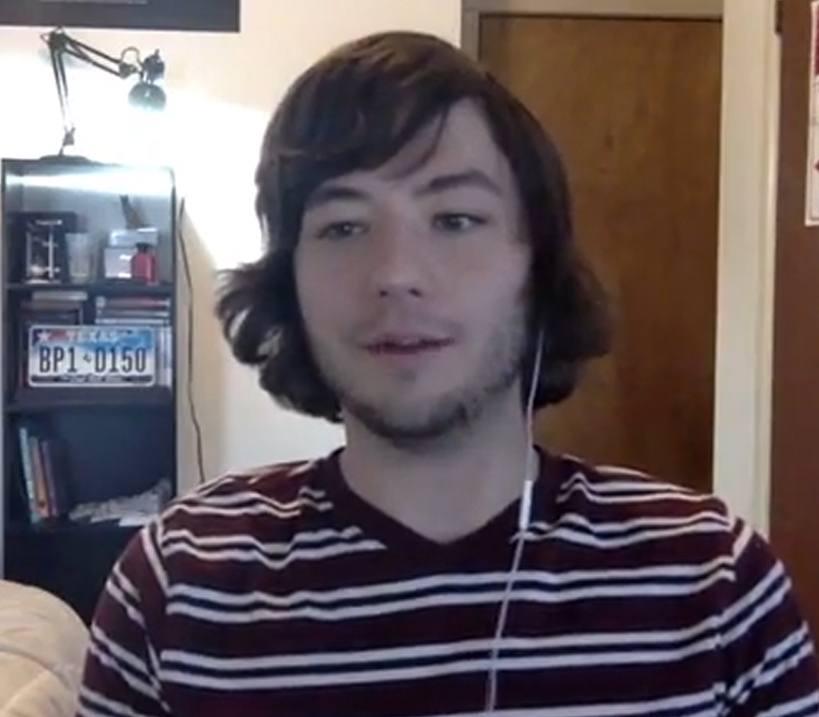
Zachh Barkley is the Master of Magic in SL, as revealed in the 17th instalment of The Drax Files. While it’s not clear from the video, he appears to have joined SL as a teen, and has since built up a successful brand within the virtual world specialising in the thing that most fascinates him: magic.
Spells, incantations and more are Zachh’s stock in trade, and LSL, particles, prims and more are his hallmark. It’s the extension of a childhood love which (I’m guessing from his chat with Drax) grew out of a love of Harry Potter and early experiments with build-you-own game environments and tools.
Zachh Barkley
Which should not be taken to mean Zachh is the archetypal Second Life user beloved of certain elements of the media (i.e. someone lacking a life). It’s clear from the video that not only does he have a life outside of Second Life, he has shown friends and family that the virtual can give rise to real world benefits, such as an income.
Those who do tend to dismiss Second Life as a crutch for the less socially capable would do well to listen to Zachh’s disarming explanation of his time with the platform – building revenue-generating business, learning skills (such as coding) which are transferrable elsewhere, mastering digital content creation (another transferrable skill) … it all adds up to something rather unique and which offers potential for development and employment (as well as fun) well beyond the platform.
There are a lot of great moments in this segment, and Zachh’s disarming openness and honesty again demonstrate that those engaged in the platform really are the best ambassadors for it. This is something I really do wish the Lab would more fully appreciate: the opportunities for strong narrative marketing which are available to them for promoting the platform to a broad cross-section of different audiences. The stories don’t have to be constructed – they’re already here, waiting to be told.
All they lack is the reach of a constructive, progressive marketing campaign. And with all the improvement and updates made to the platform over the last two years, perhaps we’re approaching the time when such a campaign can enter the planning stages – so how about it, Ebbe? Are your marketing team ready to construct a narrative around the stories we have to tell?
And with that said, there can only be one … way to sign-off this article, and that’s with another video, not a million miles removed from this segment of The Drax Files or the essence of Second Life itself.
The 16th episode of the Drax Files has premiered, showcasing the work of Brique Topaz (Brique Zeiner, RL) and her organisation Live and Learn in Kenya (LLK). They are engaged in work to feed and educate poor children in Kenya, including covering fees, uniform, shoes, textbook and school supplies and now, even building a school of their own.
Brique Topaz (Brique Zeiner RL) and Kenyan children in the Feed a Smile programme
Feed A Smile is a programme run by LLK to provide nutritious warm lunches for over 400 children every day, paid for entirely from donations to the project. Over a third of the money directed at the programme comes from donations received through Feed a Smile in Second Life – and that’s a remarkable figure.
The money is raised through live music played at the Lavender Fields club, which stages around 5 or 6 events weekly and to which musicians donate their tips and visitors are asked to donate just L$100 ($0.30), which is enough to purchase a filling meal for a child in Kenya, a fact that within itself is quite mind-boggling.
“I keep waiting for the mainstream media to realise that Relay in Second Life is the greatest human interest story,” Zander Greene commented when discussing Fantasy Faire and RFL with Drax in 2013. “I just don’t understand why CNN and forty other media outlets aren’t beating down our door to try to tell this story.”
Those words apply equally here; who would have thought that people creating digital avatars and logging-in to a virtual environment and sharing time listening to one another’s music, could have such a profound effect on the lives of young children in Africa?
This is very much a story which should be highlighted and pushed out before the mainstream media; not because it is “feel good”, but because it is a clear demonstration of the positive and lasting influence virtual words can have on the real world, and more than an antidote to the hoary old view the media has that those involved in such spaces do so because they “lack” a life elsewhere.
“There are a lot of people out there who really want to do good things,” Brique observes, “but they don’t know how … in Second Life, it’s all there. It’s all possible.” Indeed. Where else has such an immersive, engaging and free-flowing environment become the conduit for so many from around the world to help support others?
The latest episode of The Drax Files turns to the prolific and ingenious Scottius Polke, aka artist Scott Rolfe.
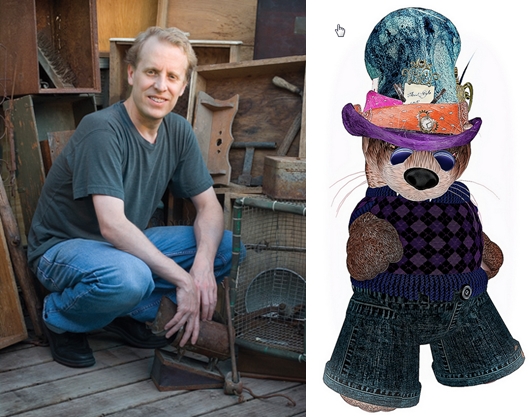
Tall and blond in real life, Scott presents himself as a two-foot-tall gregarious, sunglass wearing, fedora-hatted otter in Second Life, where he is known – as in real life – for producing incredible works of art.
Joining SL in early 2008, he was also quick to release the potential of the platform not only as a means of artistic expression, collaboration and social engagement, but also as a means of counterpointing elements of his own real life personality and giving creative freedom to aspects of himself which might otherwise not always be so obvious to those meeting him.
A man and his inner otter: Scott Rofle (courtesy of srofle.com) and Scottius Polke (courtesy of Cat Boccaccio)
“I am a Tiny otter,” he says of his SL persona. “Well, otters have kind of carefree spirit, they enjoy fun and I was hoping it would balance-off some of my more rigid personality; I’m more introverted in person and the otter is bombastic and out of control!”
He also notes that while a digital creation, Scottius nevertheless has an energy of his own, one which Scott likes to associate with, and which appears to feed into and connect with his more conscious creativity, allowing his real and virtual lives to complement one another, adding depth to his work in both.
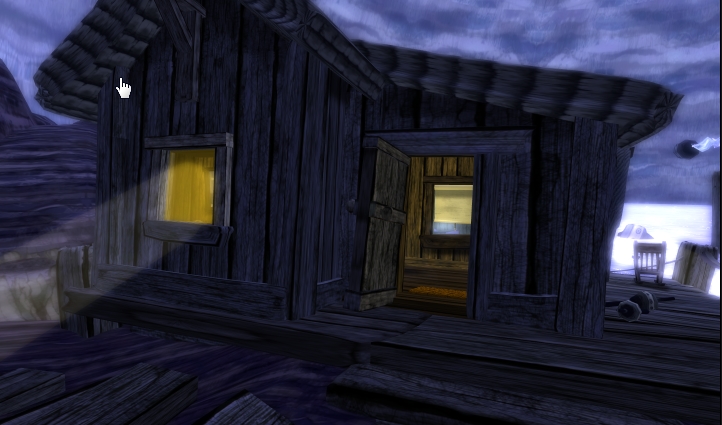
The fisherman’s hut from The Docks, referred to in episode 15 of the Drax Files (image courtesy of Dividni Shostakovich)
He’s also a first-rate ambassador, as the film reveals, quick to engage others on the subject of Second Life, demonstrate it, and draw them into the world which has captivated him and show them that it is a place of enormous potential – and fun. In this, he’s very quick to turn the widespread perception many people have about Second Life being a place for those “without a life” completely on its head.
“It seems that … there is very much a detachment from everyone else in the public sphere,” he says in reference to real life while discussing things for the episode, “[In] coffee shops here, you don’t go and suddenly there’s a big gathering of people. No. You go to your table and you might be with one other person, or with your laptop, and it’s almost completely quiet. Second Life is the opposite of the perceptions that a lot of the public hold. It’s not a place where lonely people ignore each other; it’s a place where minds connect!”
Real life can be isolating in other ways as well, and often and not Second Life really can counter it and open the doors to many rich and diverse means of genuine and positive interaction, as Scott again points out during the pre-production conversation.
“There are issues [as an artist] of putting your work out there and not getting any feedback or knowing what people are thinking about it,” he says of real life. “And you know, we don’t live in a vacuum. and an essential part of art is sharing it with other people; and for the longest time, all it seemed I was doing was storing my art in my house and in my closet, and that’s killing the purpose of art.”
With Second Life, the interaction and feedback is there and it is immediate, from peers and friends alike, and it fuels the creative and collaborative processes, something with Scott likens it directly to the vibrant and positive atmosphere he was immersed in when studying art in college which served to further fuel his creative desires; something that he admits he’d never really felt in the time between leaving college and discovering SL.
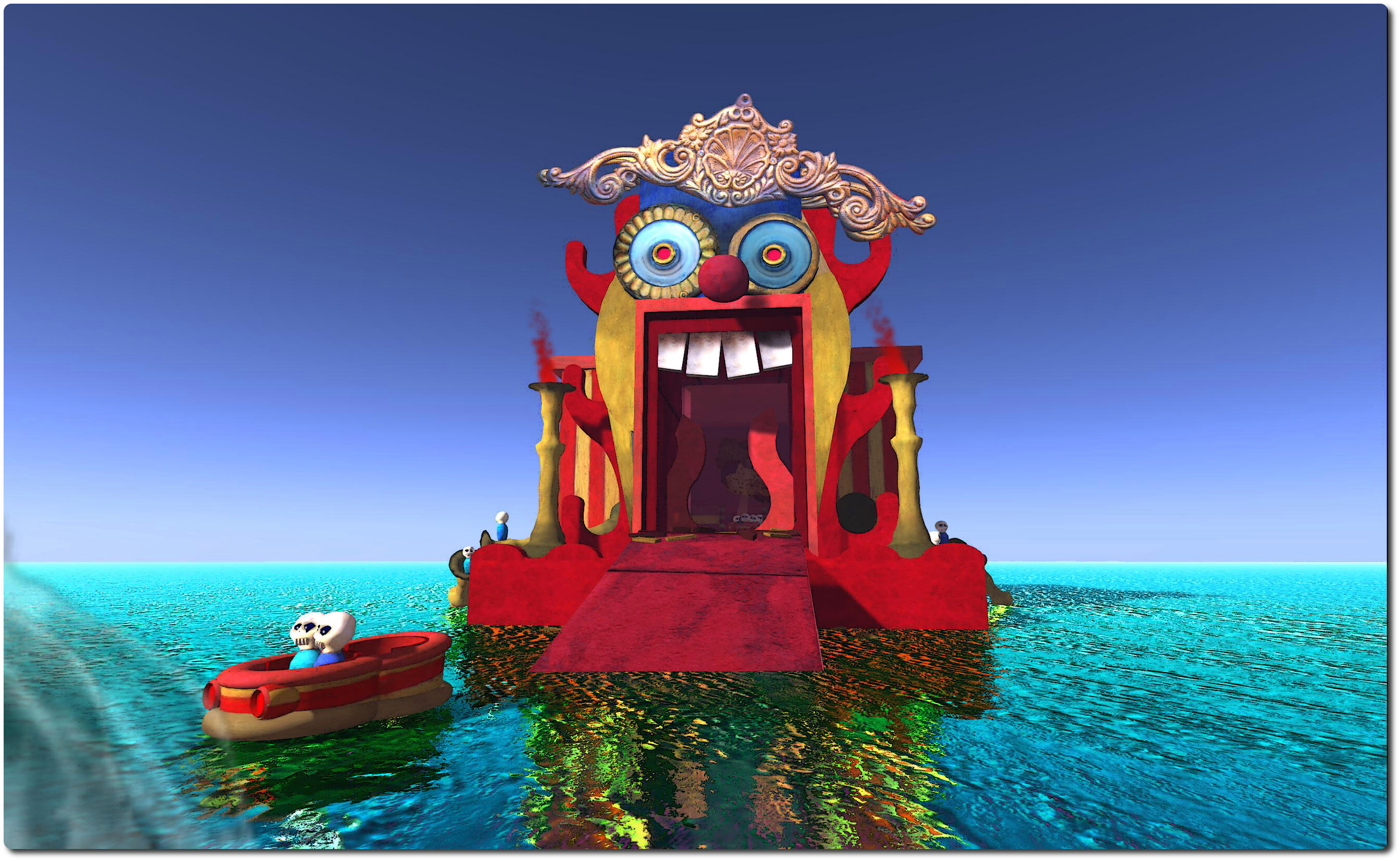
Carnival Discardia fun house, recreated in SL for the collaborative LEA installation “Rafts“
This is another fascinating insight into the way in which Second Life have captivated someone and enabled them to find further means of expression and creativity and release. Scott’s experiences and his sheer enthusiasm for the platform offer another visual and positive means of presenting Second Life to those who have not experienced it for themselves. The breadth and depth of topics covered here once again raise the bar in terms of the reach of this series. This is not an episode to miss.
Second Life has always been a powerful medium for artistic expression, whether it be 2D (through the creation of photographs and machinima taken in-world, or the use of SL as a means to display paintings and drawings, and so on), 3D (in the form of sculptures, models, etc.), or immersive (such as partial or full region builds).
Such is the platform’s versatility, that it has always attracted amateur and professional artists, who have formed one of Second Life’s strongest and most vibrant communities of users who have created some of the most stunning pieces demonstrating the creative power inherent within the platform.
Rose Borchovski an artist in both RL and Second Life is renowned for both her immersive works in the latter and for her multimedia music theatre performances and multimedia art installations in real life, of which perhaps the more internationally recognised being The Blue Planet, produced in collaboration with her RL spouse, director Peter Greenaway (with whom she is also collaborating for a new installation in Rotterdam entitled Sex and the Sea).
Within Second Life Rose is perhaps best-known for her Susa Bubble creations. Susa, is child-like character who “went to bed single and woke up double”, came into being in Second Life when Rose’s own daughter was ill, and Rose created the first story for her.
Rose Borchovski: The Arrival
Since then, of course, the Susa Bubble story has become famous across Second Life, and Rose sees the platform as the means by which she can carry forward the developing story of these small, fragile-looking but nigh-on indestructible characters as then go about their own explorations and mischief.
Rose sees SL as a means of expression on many levels; not just in what we might regard as “art” in the usual sense, as demonstrated by her one pieces in-world, but also in how we chose to present ourselves through the medium of our avatar, it’s appearance and what we bring to it from the real world in terms of our own thoughts, desires, ideals and physical attributes, such as our own voice, touching on all this combines to affect how other react to us and identify with us.
“I still would like to convince you that you’re going to film Rose, my avatar, and not me. Because Rose is handsome and she’s slim and I have a charming accent, so Rose is much more sympathetic as an image,” she tells Drax at one point. In many respects, the creation of our avatar presents a level of freedom in how we express and present ourselves which simply isn’t possible in real life for a variety of factors, external and internal. As such, the artistic and emotional involvement we have in the process of creating and refining our avatar is a means by which each of us can artistically express ourselves, if we so wish.
And of course, how we opt to behave when using our avatars might also be seen to be reflected in some of the tales Rose tells through her Susa Bubbles stories …
Second Life is also very much as practical tool for Rose. While she has stated elsewhere that as a means of artistic creation, SL can be a slow and time-consuming medium in which to work, it is one that nevertheless greatly assists her real world art; allowing her to visualise and model her real life installations and walk through how she wants to stage them and have them appear to the visitor.
In this she touches upon two other aspects of Second Life which lift it above the “mere” definition of it being a game or simply an open sandbox: it can have both a practical feedback into our real lives, much as it helps her visualise and build real life installations, objects and models, and it can form an even greater channel for emotional and creative release because it can feedback equally into our real lives as much as we feed into it from our real lives; something I believe I’ve been experiencing in my own small way through SL photography, which has started to feed back into my real life activities.
For the artist, Second Life has always, and in so many ways, been at the cutting edge of expression and development. That is as true today as it was back when SL burst into the public consciousness. Almost every visual development and enhancement to the platform adds yet another opportunity to the visual artist. As Rose herself says, more fool those outside of the platform who could benefit from it in their refusal to accept it as a means of expression; given its global reach, they are only denying themselves a new, and potentially huge, audience.
In September, I covered the story of Fran Swenson, an 86-year-old suffering from Parkinson’s Disease, her daughter Barbara, and their experiences and times within Second Life.
I wasn’t the first to come to Fran’s story, which is remarkable in the way Second Life has had a positive and uplifting impact on her life; Hamlet Au did that way back in February. But such is her story, it does deserve to be heard and re-told, be it through blogs like Hamlet’s or this one, or through media coverage such as in the San Diego Union-Tribune.
Barbara and Fran
Now, both Fran and Barbara – Fran Seranade and Barbi Alchemi respectively in Second Life – get to share their story and their insight and wisdom in the latest edition of The Drax Files. And I’m not exaggerating when I say that, in what has already been a truly outstanding series, this is the most powerful segment to yet come to our screens.
Having lost her husband to Parkinson’s in 2003, Fran found herself diagnosed with the illness the following year. Over time, she relocated from the east coast of the United States to the west, and as a result, her son Ken, still living on the other side of the country in Florida, proposed the idea of using Second Life as a means of bringing the family together more easily, offering to build a home for them in-world.
Barbara, also residing on the west coast, admits that, initially, she wasn’t that keen on the idea. Like many people, she considered SL as little more that a sexual playground, coupled with a steep learning-curve for those not particularly well-versed in the nuances of virtual worlds and / or computer games and environments. It was easier to point a derisive finger at Second Life users than to become one. But once encouraged to give it a go, Barbara soon found herself converted. What’s more, she was amazed when she started witnessing Fran’s response to the platform, both physically and mentally.
Fran’s experiences with Second Life have resulted in Barbara establishing Creations for Parkinson’s, and Creations Park in SL – both of which are designed to bring sufferers of the disease and their friends together in an environment where they can meet and share and enjoy themselves pursuing a wide range of activities.
Fran’s story is also one which has come to the attention of academic researchers such as Tom Boellstorff, an anthropology professor at UC Irvine, and Donna Davis, a strategic communications professor at the University of Oregon and who now leads the Thursday group sessions at Creations.
Fran’s experiences have been a focus of study for Tom Boellstorff
It was Boellstorff who pointed to the possibility of Second Life triggering “mirror neurons” in Fran’s mind. These are, as Barbara explains in the video, the neurons which allow us to pattern and mirror what we see in others. While there is some controversy as to their classification and origin, their effect on assisting the learning capabilities of young children is fairly widely recognised, and the theory is that in Fran’s case, her mirror neurons are reacting to her time in Second Life and are forging new pathways to connect her mind and body, offsetting some of the impact Parkinson’s is having on her.
While Fran’s own case is still the subject of study and so precludes definitive conclusions being drawn from a medical standpoint, the fact remains that the therapeutic value of Second Life on her own real life – allowing for the fact she is active in other areas of her life as well – is very genuine. In this, she is not alone; several research studies have shown that while our avatars can be highly stylised and all tend to be youthful in appearance, our identification with them can have lasting and positive benefits on our lives in so many ways.
“The avatar represents who I really feel inside,” Fran tells us, “When I look at my avatar, I feel like I’m looking at myself.” This reaction is not unusal; and it does act as a kind of positive affirmation that may well – perhaps thanks to mirror neurons again – offer something of a fountain of youth for the mind which can manifest itself as real physical improvements in health, vitality and happiness and in our self-identification.
Creations Park, founded by Barbara and a centre where people with Parkinson’s Disease from around the world and their friends can share, relax, and enjoy themselves in a stress-free environment offering a broad range of activities
However, to think this is a story about the potential impact Second Life may have on health issues is to only pick-up on half the story. This segment of The Drax Files is much deeper than previous episodes because it very much expresses the reality that far from being something that sets us apart from “real life”, Second Life is something which both enriches our real world experiences, and allows us the freedom to be who we really are in ways that are all too frequently denied us elsewhere in life.
Oscar Wilde once said, “Man is least himself when he talks in his own person. Give him a mask, and he will tell you the truth.” But was he necessarily right? Modern life requires we wear so many masks: the mask we wear to work, the mask we wear to church, the mask we wear when among strangers, the social mask, the stern-mum-and-dad mask we sometimes have to present to the kids, the mask we wear when joining-in with “the crowd”, or “the lads”, or “the girls” when on a night on the tiles, and so on. All of them allow us to express aspects of ourselves, but those aspects are always constrained to what we believe we should be projecting to those around us, rather than necessarily actually being who we are as a whole person.
Of course, Second Life also allows us to wear a huge range of masks in-world, and allows us to do so free of the constraints society would otherwise demand of us. We can be truer to different facets of our personality, to our hopes, our wants, and our desires. But the greatest gift Second Life perhaps gives us is that it actually allows us, if we’re willing to do so, to create and foster environments where we can all safely lay all our masks aside and simply be ourselves without fear of recrimination or judgement.
This is something not lost on Barbara, “We’re free to be who we really are,” she points out. “Sometimes people can be terribly shy, but in here, they open up for some reason. Meeting here with our avatar is a totally freeing experience, there is a deeper level of connection. We really let down our mask, and we are authentically ourselves; who we are will get expressed in our avatar. We’re out of the box.”
Fran and Fran and friends
We often talk about overcoming the perceptions of all those who would see Second life as a den of digital iniquity and a haven for basement dwellers unable to “get a life.” Perhaps this is the way to do so. Not by attempting to challenge such ideas head-on or argue against them, but to show that Second Life and environments like it are not only capable of allowing completely free rein to our imaginations and creative abilities, but that they are a very valid social extension to people’s lives; that rather than being a means to escape the world, they offer a means to more fully engage with the world at large, and can actively expand our understanding and appreciation of the world through our interactions with the people behind the avatars.
When you combine this aspect of outreach and connection with the free-ranging creative opportunities within Second Life, you have a medium which, as we have all recognised in our time in-world, exceptionally powerful on so many levels for each and every one of us, regardless of age, social standing, background and so on. It’s not about hiding away or needing to escape from the tribulations of life or being unable to express ourselves in real life. It’s about extending and expanding and enriching our lives.
“This is about all people,” Barbara says towards the end of the piece, “Using their creativity in a positive way to make a new world.”
Ole Etzel is someone who knows exactly how to measure success. “My definition of success is that I can do what I want,” he states in the opening minute of the latest segment of The Drax Files.
Ole
This doesn’t mean that Ole is wealthy enough to do whatever he wants, or anything like that. It means that he has created an environment in which he can enjoy a huge amount of creative freedom in his work as a machinima maker, and is in a position where he enjoys complete creative control over all of his work.
This success has been largely due to Second Life, a platform Ole immediately saw as an incredible medium for a brand of artistic expression. In this, his story is, on the surface, little different to that of many others who have come into Second Life and found a niche in which to excel, be it art, photography, physical content creation, game-building, or as an actor or voice artist or singer, and so on. It’s also a further demonstration that someone can actually be involved in a platform like Second Life and have a life, and isn’t actually using it as some form of escapism to slip free of real world pressures.
“I don’t think working at the computer is escapism,” he says of his work during the extended interview. “Perhaps it was escapism when my grandfather went down into the basement where he had a little miniature train and he built his world there. It’s really not very different. But it’s not escapism. It’s creativity.”
Ole’s machinima is a skilled mix of animation, music, storytelling and a very eclectic selection of themes and ideas all presented in something of an avant-garde style focused on his two principal characters of Mr. and Mrs. Bones. His creations, which together with his RL work can be found on his YouTube channel, demonstrate a painstaking level of creation which really does mark out machinima as being more – to borrow from Drax – than “hour-long Call Of Duty gameplay uploaded in unedited form”, which is sometimes how machinima can be perceived by those who have heard the term without actually studying it (or have engaged in an hour-long recording of their latest blast on Call of Duty…).
Art can often be a powerful means of political expression, and Ole’s pieces are no exception to this; several of his films do carry a political message. In fact he sees Second Life as an ideal platform for art as political commentary, noting that many people involved in Second Life are political, “They use the tools to build little artworks with a political message; things that matter in the so-called real world.”
Given his desire to at times to produce works which touch upon the real world and / or which stir the cognitive processes, freedom – creative and expressive – is something Ole sees as essential to his work. So much so, that he has consciously striven to keep his real-life identity completely off of the Internet and to adopt what he refers to the “eastern” approach to presenting oneself online, whatever medium he is using.
“There are these two attempts of how to deal with the Internet,” he says, “The more western, the more American attempt of putting your name and a lot of photos on Facebook, then there’s the more eastern, the more Japanese attempt of the avatar.”
Ole’s position is not unique; there are a number of artists involved in SL who only do so through their avatar alter-egos because of the freedom they gain for themselves, and because it allows their work to stand on its own without potentially being overshadowed by perceptions gleaned as a result of people being able to connect the digital with the “real”.
This segment offers a fascinating insight into the machinima maker’s art, from storyboarding an initial idea through to the final product. Yes, it can be a lonely process – as Ole points out in the extended interview, he has a day job as well as his family, so his machinima is something which is restricted to evenings and weekends, when he has the opportunity to spend a couple of hours producing around 10 seconds or so of completed material. But the flip side to this is that the entire process is liberating and empowering.
“I used to run around with a big VHS camera on my shoulder … I needed a second person already for the sound, and then the cutting afterwards – it was terrible! I have a lot of footage, but I never finished a movie,” he notes.
Second Life and machinima have freed him from all that. Together they provide a means by which he he can steer his work through from beginning to end, and can do so unencumbered but either the cultural weight of more traditional, studio-driven film faire, or by the need to compromise on subject, technique, approach, etc., which can arise as a result of the collborative needs of more traditional independent film-making. In machinima, every aspect of the product can be creatively controlled and presented exactly as the machinima maker envisions, limited only by the technical constraints inherent within the platform.
And even the technical constraints needn’t be as limiting as we might think; particularly when it comes to getting started with Second Life – a subject Ole also has some very clear views on.
A common critique levelled at the platform is that it is “too hard” for people to get to grips with, and the learning curve is too steep. That critique, more often than not, is levelled by people from within the platform. But is it really? As Ole points out, “Try using Blender. THAT’s a hard learning curve.”
His view is liable to be controversial in this regard, but I admit I actually understand where he is coming from and what he means. It’s easy to forget that the knowledge which allows us to use SL in the ways we want didn’t come to us all at once. Why, then, do we often look at newcomers to the platform and believe that they immediately need to be encumbered with the vast majority of knowledge which we only accumulated with the passage of time?
True to his word, with this episode, Drax is building on the foundations he’s laid throughout the series to date, offering another piece which invites those outside of SL to reconsider any preconceptions they may have with the platform and re-evaluate it as a valid medium of creative expression and endeavour. In Ole, we have the perfect spokesperson who can address both the world beyond SL and perhaps challenge the perceptions and bias those of us engaged in the platform may ourselves carry.




 Inara Pey: Living in a Modemworld