HeArt and Soul Gallery, February 2024: Scylla Rhiadra – Presence
In January 2024, Scylla Rhiadra presented an exhibition entitled Containers at Mareea Farrasco’s IMAGOLand Art Galleries (see: Containers: an artistic voyage of expression and constraint in Second Life). It offered an examination of how spaces – be they at home or at work or somewhere between, whether public or private – can both help organise and protect us as individuals whilst also giving us the freedom to fully express who we are, whilst at the same time they can also inform, contain, and constrain us in how we reveal ourselves to the world at large – and perhaps actually to ourselves as well.
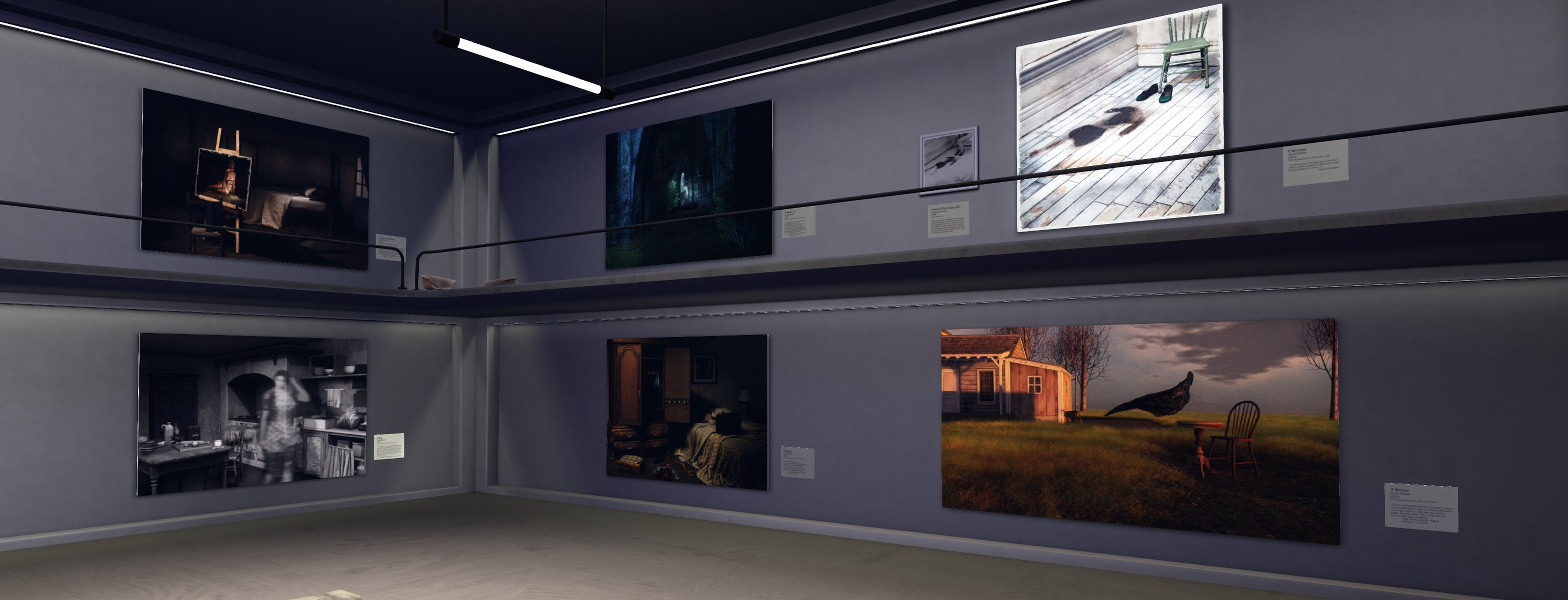
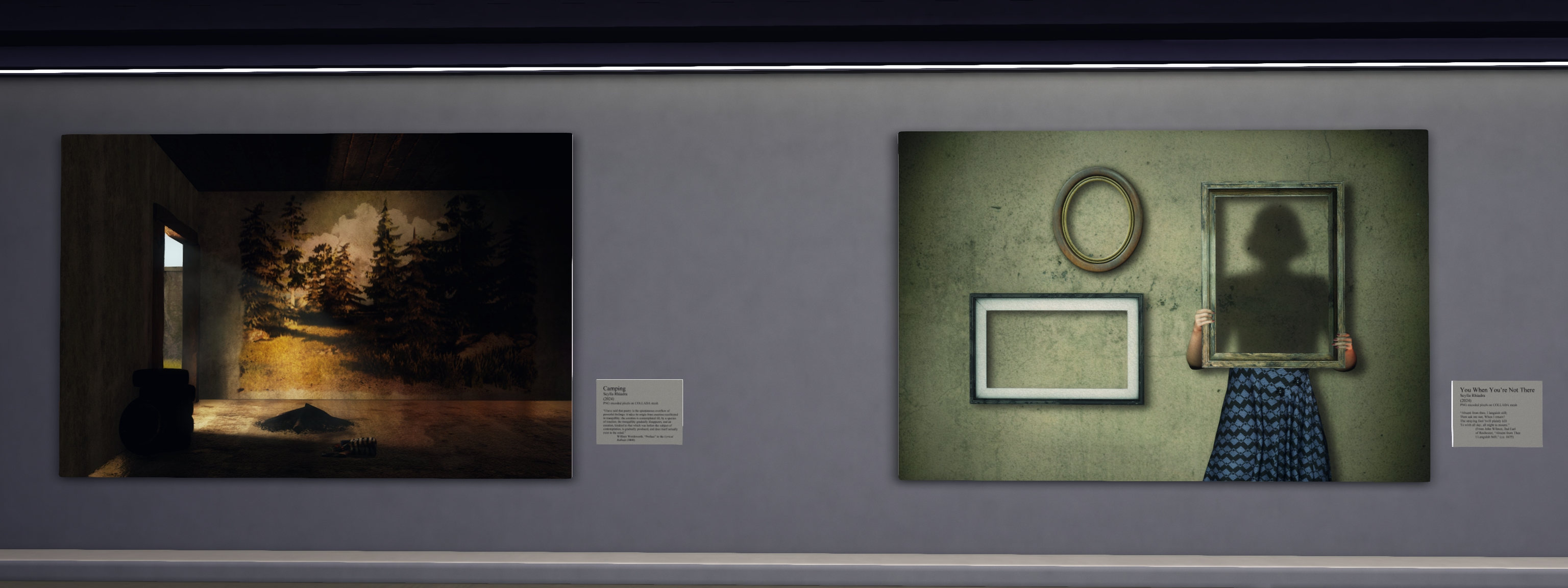
Now, at HeArt and Soul Gallery, operated by Tom Willis and Lizzy Swordthain, she offers an exhibition of work which can be considered a further chapter on the theme, offering an alternative perspective. In Presence Scylla does not look and the manner in which the spaces we occupy and move through affect us – but how we impact the spaces and places through which we move, oftentimes long after we have departed.
HeArt and Soul Gallery, February 2024: Scylla Rhiadra – Presence
We all leave a mark on the places we move through, and on life as a whole. The size of that mark obviously varies from the celebrated statesperson or global celebrity down through the favourite uncle or teacher from school; but our mark is undeniable:
We are presences even in those places where we are not, by virtue of our actual absence: we leave a trace embedded in what did not happen: the somethings we might have said that remain unspoken, or the somethings that might have been done that we were not present to do.
– Scylla Rhiandra, Presence, February 2024
As with Containers, the images Scylla supplies are studies in composition and narrative. Each holds a story, or at least a vignette which is clearly discernible. In addition, each image is again accompanied by a board containing a considered quotes from a piece of literature designed to further illustrate the image itself; and like those found in Containers, it is hard not to feel these selections offer insight into Scylla – and allow her to leave a further little “her shaped” hole in use which accompanies the one created by each picture. Certainly, I again felt that distant kinship with her purely through the pieces and authors she has selected.
HeArt and Soul Gallery, February 2024: Scylla Rhiadra – Presence
Also like Containers, the collection making up Presence are layer in potential meaning and subtext. There is the meaning offer through the title of each piece, the reflection of that title and meaning through the selected text, the framing of the theme used to express the ide; all of which are expected. But then there are the more subtle aspects: those which lie in the way in which each piece chimes with us personally, the memories and thoughts conjured – perhaps most of all by the people who have touched our lives but who have now moved on in one way or another, only to leave one of those small holes in our thoughts and memories.
Another beautifully poignant and expressive series of Scylla.
Burnt Toast Café and Tavern, February 2024 – click any image for full size
My Second Life café hopping continued recently when I bounced into the Burnt Toast Café and Tavern, occupying some 20,400 sq metres of the Full private region leveraging the land capacity bonus (although at the time of my visit, a portion of the land appeared to be either undeveloped or undergoing redevelopment by the holders and so closed to general access).
Those land holders are Emilly Jaynesford and Lee (lisa5791), and together have created a most pleasing little corner of Second Life, packing a lot into the setting without ever allowing it to feel overcrowded. Rather the reverse, in fact and the trails and paths winding through it between the various locations give a sense of space and openness.
Burnt Toast Café and Tavern, February 2024
A friendly welcome awaits all at the Burnt Toast Café and Pub! Bring friends or make new ones. Drink coffee in the gazebo or have a pint in the pub!
– Burnt Toast Café and Tavern About Land description
The landing point delivers visitors to the top of a stone stairway leading down and away from the broad terrace on which the tavern stands. This terrace extends outwards from one of the curtail walls of rock separating the setting from the neighbouring parcel and helping to prevent structure, etc., from these intruding into the landscape or skyline. The pub faces out over open waters from which it is separated by two wide wooden decks, the lowermost of which extends out over the shingle shoreline, the pair of the decks offering comfortable seating under parasols and warmed by wrought-iron log-burning fires.
Burnt Toast Café and Tavern, February 2024
The stone steps descending from the tavern’s terrace to split, one arm reaching down to where a carousel turns on a ground-level terrace also overlooking the shoreline, whilst the second stretches down under a stone arch to grasp the tail of a path which teases the way onwards.
Passing an old clock tower sheltering wooden benches under its eves, the path can be used to reach the café itself as it sits within a wildling garden complete with (wishing?) well and a broad, bed-like platform slung beneath a balloon and ready for chats, cuddles or a taking a short ride. On the far side of this garden, a small cabin sits beside a pond to offer an cosy annex to the café, its porch offering a vantage point for observing the ducks on the quiet waters of the pond and the carp swimming beneath its surface – although closer views of both might be had from the leaf-shaped raft also floating on the water. Those with a keen eye will also likely spot the gazebo hiding under boughs and amidst bushes to one side of the garden as well.
Burnt Toast Café and Tavern, February 2024
Running in the opposite direction to the café, a remaining branch of the path runs through a stone pergola providing access to the west end of the setting and the large wooden pavilion raised within the walls and gardens of an ancient structure – perhaps the land remnants of an old abbey or castle – the pavilion offering itself as a larger dance and events space.
Then there is the orangery, tucked alongside the western edge of the café’s garden and separated from the pavilion in its ruins by hefty nub of mossy rock. With wisteria dripping from its rafters and cosy sofas and armchairs occupying its floor, the orangery presents another place into which visitors can retreat and spend time.
Burnt Toast Café and Tavern, February 2024
Between all of these points, considerable care has gone into shaping a setting rich in the colours of nature as flowers bloom and shrubs blossom, giving the sense that what might have once been a barren, rocky landscape has been tamed by the growth of plants, shrubs and trees, becoming a more welcoming location than it might once have been; a place with the vegetation have in turn become subject to gentle husbandry to encourage their growth without allowing them to run totally wild.
Care has also been taken to try to blend the vegetation with the curtains of rock forming the borders to the land, such that the artificial nature of the latter is at least softened, if not completely obscured, making them far less intrusive than might otherwise be the case, and the setting even more natural in look and feel as a result.
Burnt Toast Café and Tavern, February 2024
For those who don’t like walking, or wish to quickly hop to a particular point within the grounds, a network of teleport disks is supplied. Again, care has been taken to try to avoid having these stick out too much, but they are easy to find – and they will be needed to reach a further location: the local beach.
Located over on the west side of the region, this presents a cosy beach house raised above soft sands and with a pool and deck to one side. At the time of my visit, the beach was isolated from the rest of the café’s ground by the intervening parcel which may be awaiting (re-)development as mentioned above, thus making the teleport disks the only easy means of reaching it.
Burnt Toast Café and Tavern, February 2024
All told, Burnt Toast Café and Tavern is an expressive and charming setting with a sense of welcome and an allure that encourages tarrying.
Nitroglobus Roof Gallery, February 2024: Mihailsk – Lost
‘Tis better to have loved and lost
Than never to have loved at all.
– In Memoriam A.H.H (1850) Alfred, Lord Tennyson
The above words, written in the 27th Cantos of Tennyson’s elegy to his friend (and lover?) Arthur Henry Hallam- who died at the tender age of 22 -, have become something of a modern proverb since they first appeared in that poem. They are often offered in consolation to someone who has lost – through death or other departure – a person who has meant so much to them.
Nitroglobus Roof Gallery, February 2024: Mihailsk – Lost
The words, whilst generally sincerely meant, likely don’t come as much comfort for anyone in the throes of loss; rather they likely sound like a hollow consolation, such is the hurt, the loneliness, the sense of desolation which tend to overwhelm us at such times. However, the poem is more than a trite 2-liner; through its cantos, Tennyson expresses a range of feelings and reflections on the passing of his friend and a poetic essay on the cruelty of nature.
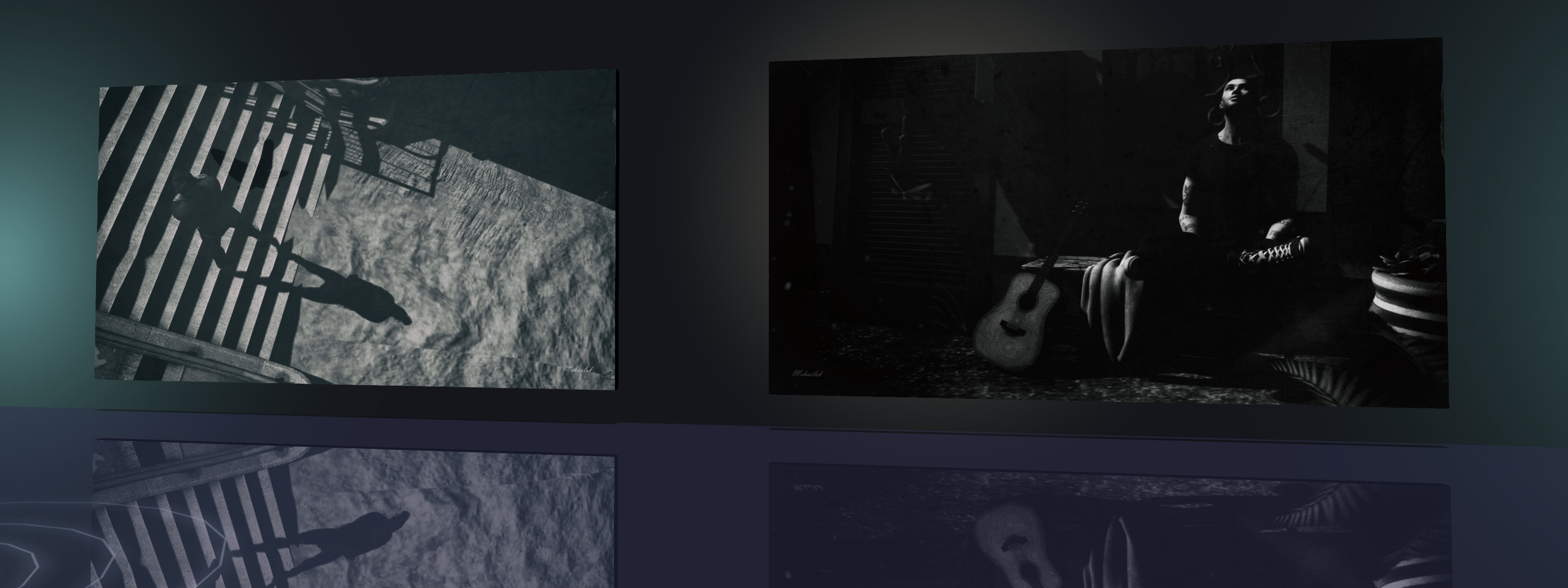
As such, it has much in common with Mihailsk’s latest exhibition, which opened within the Nitroglobus Roof Gallery operated and curated by Dido Haas (and which served to introduce Mihailsk’s art to the world of SL art exhibitions back in 2021 – see: Mihailsk’s Baptism of Fire in Second Life). Like that exhibition, this latest, entitled Lost is a highly personal selection of art, dealing as it does with his coming to terms with the lost – or rather, disappearance – of his Second Life partner.
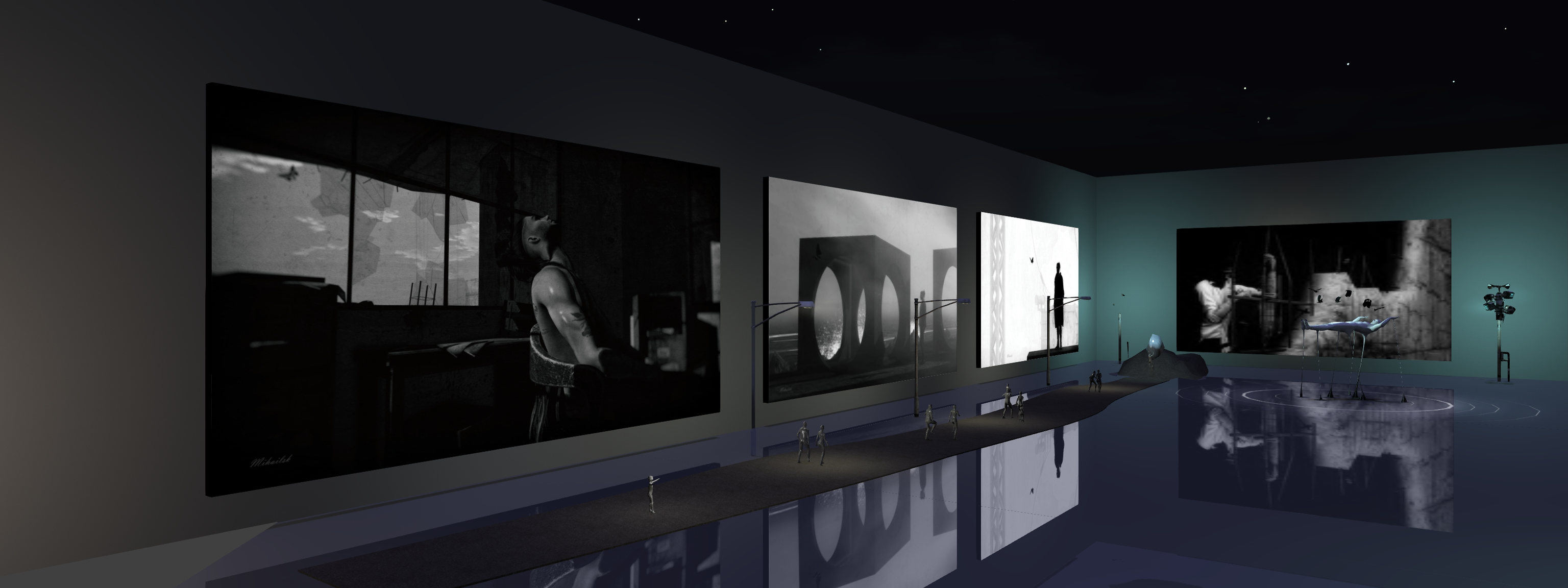
Within it, and like Tennyson’s poem, Mihailsk explores the rawness of emotions as the loss is felt and the resilience of the heart which allows us to (perhaps) eventually accept and move forward in life. However, where Tennyson used 2,916 lines of iambic tetrametre, Mihailsk uses his marvellous, minimalist monochrome style (his lingua franca, if you will) across a dozen images to convey a similar depth of emotions, feelings, prayers and wandering thoughts as found in Tennyson’s poem. Each image is a poignant canto in its own right, elegantly conveying its feeling and sentiment even without recourse to skilling out its name via the Edit floater.
Nitroglobus Roof Gallery, February 2024: Mihailsk – Lost
These are pieces which, so artfully created as they are, in places enfold a heartfelt sense of the artist’s inner emotions and sense of self whilst also reflecting his outward feelings and sentiments. Elsewhere, they reveal the wellspring of hurt and loss only one who has loved deeply can perhaps feel – and the resilience born of that love which can, in time, allow that person to look back on what has been lost and accept the proverb of Tennyson’s words as true.
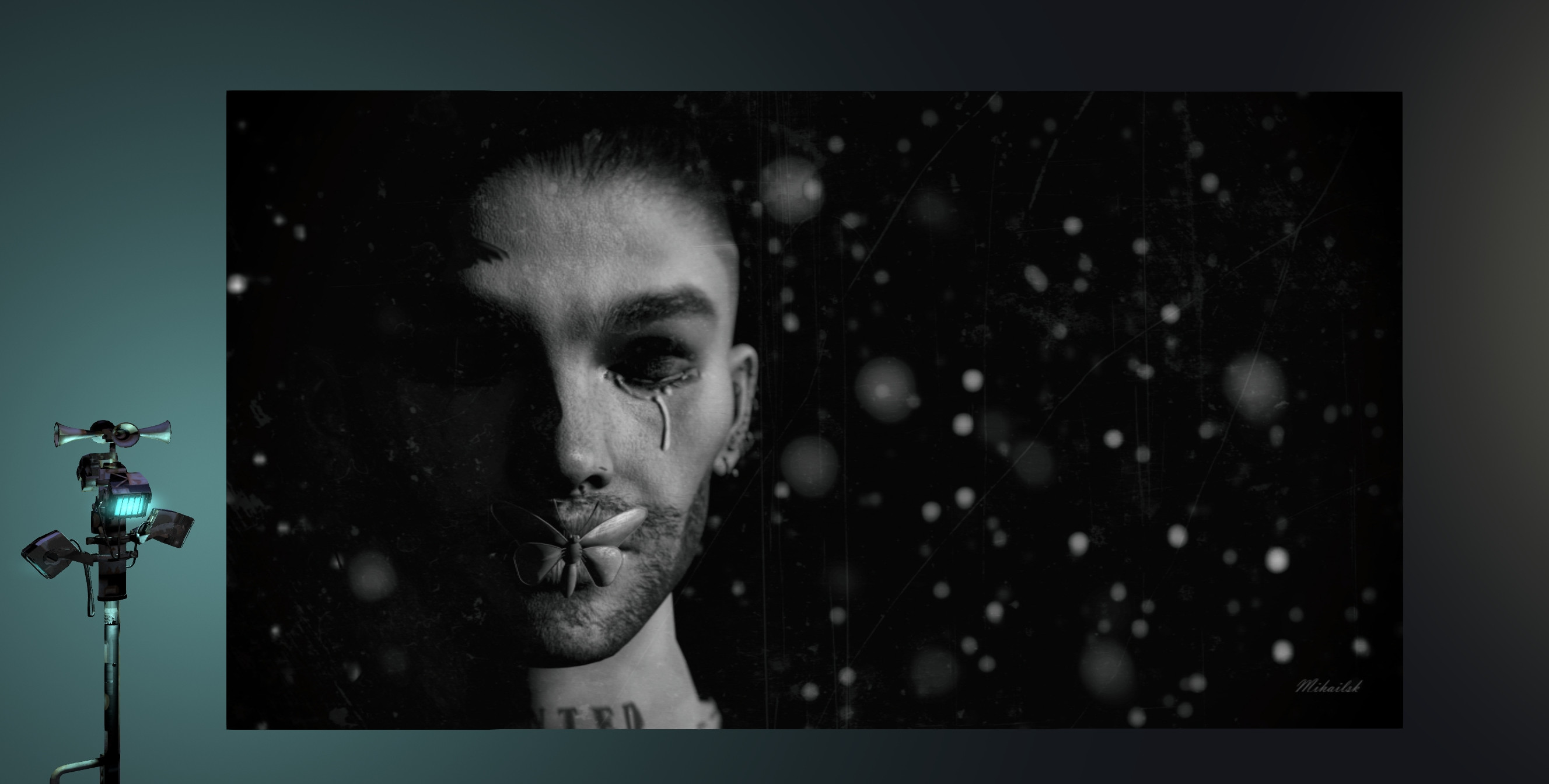
Just take, for example, Take Care, and Be Well. Both offer kind sentiments to the one who has vanished, each with its butterfly symbolising taking flight to a new life / escape; at the same time, they both evoke a sense of loneliness and loss through the shadowed figure, standing either with hands thrust dejectedly into pockets or leaning against a bicycle with its promise of travels – but with nowhere to go. Then there is Wish, evocatively capturing those shadowed moments of hurt and want; when the one wish is to have all back as it was – whilst knowing it can never be so; or Mute Pain, perhaps the rawest of the images in terms of its emotional tone and impact.
And just as Tennyson’s In Memoriam A.H.H carries broader themes within it, so too does Lost bear witness to the wider truth that whilst Second Life might well be a fleeting realm of digital “make believe”, the emotions and feelings we bring to it, or which are stirred within us as a result of our interaction here are as genuine, lasting and impactful as any we might experience within the physical world. Indeed, they may well be worse, in that this world is unique in the way people can simply vanish, leaving those who remain without any knowledge of why or where they went – or how they might be, physically and mentally. Thus loss here can be shrouded in the additional hurt of just not knowing.
Nitroglobus Roof Gallery, February 2024: Mihailsk – Lost
Powerful, emotive and with a beating heart of love, strength and resilience, Lost is a stunning collection of images wrapped within very personal feelings which should not only be seen, but absorbed like the words of an elegy. When visiting, do be sure to view Adwehe’s sculpture Revival of Psyche, made especially for this exhibition and which helps underscore its emotional content.
Soulstone, February 2024 – click any image for full size
I’m going to start by saying that by the time some read this, Soulstone will have taken on a new guise compared to what is seen here. The fault for this is mine entirely; this Full private region – held and designed by Valayra Asher (Valayra) – has been in its winter guise for some time, but things being what they are with life in general at the moment, it has taken me a while to get from taking photos and jotting down notes to actually getting something half-way decent written up.
So, my apologies for that!
Soulstone, February 2024
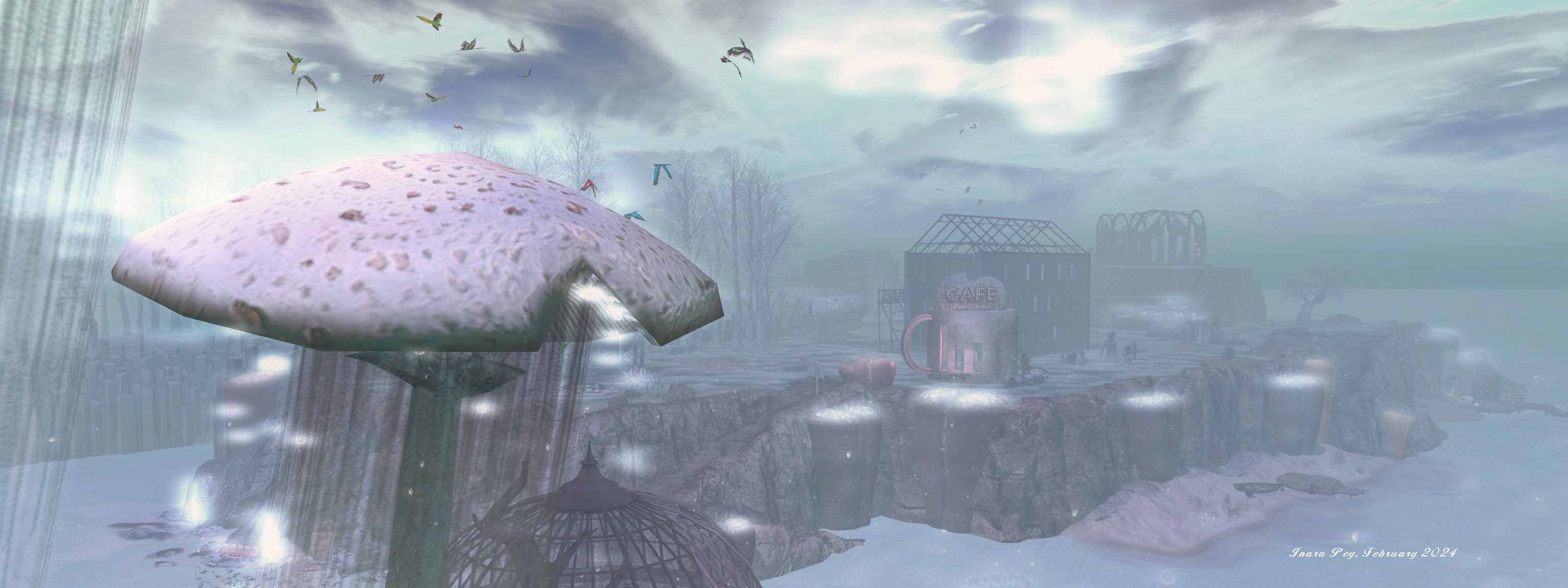
In its winter cloak, the region has presented an engaging mix of art, fantasy and a soupçon of science fiction. The landscape is split in two, thanks to a dogleg channel running through it, the sides of which suggest it may be artificial in nature, the walls formed by parallel lines of great basalt columns, one arm of which marches resolutely out to sea, leaving the land behind, to form a kind of breakwater.
Both of the islands are flat-topped, their remaining sides forms by natural rocky cliffs and slopes falling to the sea, with water flowing outwards from fissures here and there to cascade of the rocks below. Each island is home to a number of structures, but be aware that the small island with its well-appointed house and older lighthouse, appears to be a private residence, so please restrict explorations to the larger, L-shaped landscape.
Soulstone, February 2024
The landing point is located in a gazebo of cathedral-like proportions; and like a cathedral, it sits head and shoulders above the rest of the landscape thanks to the shoulder of rock on which it has been built. Within it might be found a cosy hideaway and a series of teleport boards which can carry visitors to the major points of interest around the island. However, I’d recommend to those who read this article and make it to Soulstone before it temporarily closes on February 15th for redressing in readiness for spring, that initial explorations are carried out on foot.
The landing point shares the island with a warehouse-like building either still under construction or lacking in repair (you decide!) and a number of other structures which should pique curiosity. The incomplete warehouse helps to set the artistic elements to be found within the setting, being home to sculptures by Bryn Oh and Rogue Falconer, with further statues outside by DRD with other by Mistero Hifeng awaiting discovery.
Soulstone, February 2024
The twists of sci-fi are humorously offered – H.R. Giger alien is collecting its order of cookies and hot chocolate from the café, pot-bellied “greys” have turned their flying saucer into a DJ hangout or are heading the local (and novel) swimming pool for a dip. There’s also a slight Orwellian slant in places as well, thanks to piles of television screens here and there keeping what seems to be a Big Brotherish watch on things.
There are several waterfront locations to be discovered as well. Some might require exclusive use of the teleport boards to reach, whilst others might be reached by stairways or paths hewn or worn into the rocky outer flanks of the island. One of the former passes through a most unique gorge: natural rock cliffs rising above the flat top of the island, the inner walls of side either bearing the façades of buildings as they escort the path down to the beach
Soulstone, February 2024
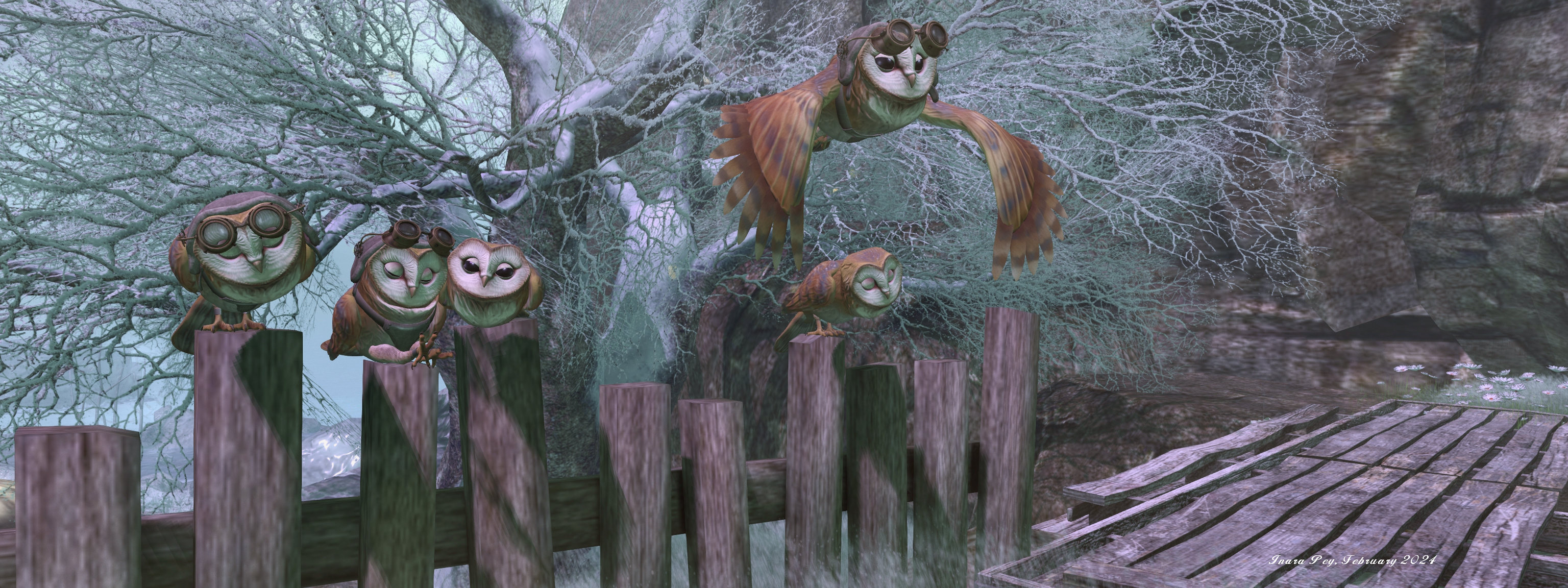
Throughout all of this are multiple places to sit – and also the remaining locations to be discovered by the teleport boards (which you should return to and try after an initial exploration of the large island, in order to ensure you get to see everything). There are also numerous little touches of detail scattered throughout, some quite unexpected – such as the owls or the bicycles neatly parked in their rack; others add to the mysterious air of the setting – but I’ll leave you to hope across and find them for yourselves.
Quietly unique and eminently artistic and photogenic, this iteration of Soulstone will be vanishing from Second Life come February 15th, as noted – so do please again accept my apologies for the lateness of this article and, of you are a keen SL explorer and have not see it already, be sure to make the most of the remaining 36-ish house before Valayra and her partner close it for the aforementioned redressing.
IMAGOLand Galleries, February 2024: Mareea Farrasco: Les Colchiques
Wilhelm Albert Włodzimierz Apolinary Kostrowicki is unlikely to be a name familiar to many. Born in Rome in August 1880, he was of mixed Polish-Lithuanian and (it is thought, as his father was never positively identified) Italian heritage. However, he is exceptionally well-known under the name he adopted following his emigration to France whilst a teenager: Guillaume Apollinaire.
Regarded as one of the foremost poets of the early 20th century, Apollinaire was an impassioned defender of the emerging art movements of the first decades of the 20th, century – particularly cubism and surrealism, both of which he is responsible for naming as such (the latter in the preface to his play The Breasts of Tiresias, itself regarded as one of the first pieces of surrealist literature.
As a poet, Apollinaire was influenced by the Symbolist movement, and it was from this that he developed a style of poetry which eschewed punctuation and sought to reflect modern times and life in form. In doing so, he would express the view that art – visual or written – should not be rooted in any particular theory, but should be born of intuition and imagination, so as to be as close as possible to life, nature and the world around us.
IMAGOLand Galleries, February 2024: Mareea Farrasco: Les Colchiques
Both the influence of the symbolist movement and his own emerging style are perhaps best reflected in his 1913 volume of poems, Alcools. Within that volume is what is regarded as one of the most poignant poems written in his too-short life (Apollinaire died at the age of 38 due to complications from a wound received in 1916 whilst he was serving in the French infantry, and which left him weakened and vulnerable to the ravages of the 1918 Great Influenza Epidemic – aka the “Spanish flu” pandemic). That poem is Les Colchiques, which is the subject of an exhibition of digital art by Mareea Farrasco, which opened in February at her IMAGOLand Galleries in Second Life.
The poem presents a bucolic setting: cows grazing within a field as children come to play, before the cowherds come to take the cows home. It sounds idyllic – and can be taken as such. However, the overall framing of this three-stanza poem is also deeply layered, exploring ideas of the cyclic nature of life, mortality, beauty, and the passage of time. The opening stanza starts by referencing the fact that in their grazing, the cows are poisoning themselves as they are eating colchiques – aka Colchicum autumnale, the very toxic autumn crocus (although not a true crocus) – growing wild in the meadow. It then goes on to compare the colour of the flowers within the field with the eyes of the poet’s love, enfolding the idea that just as the poisonous nature of the plants lay hidden in their rich and lovely lilac colour, so too has the captivating beauty of the poet’s love come to poison his life by captivating and enthralling him.
IMAGOLand Galleries, February 2024: Mareea Farrasco: Les Colchiques
In the second and third stanzas we have the children coming to play in the field, and within the poet’s observations of them lie the idea that the girls within the group will one day be mothers, and their daughters will one day come to play in the fields, just as their mothers did before them, thus introducing the idea of life’s cyclical nature and the passage of time; at the same time, the fleeting nature of beauty is folded into the comparison of fluttering eyelids with flower petals being lost on the wind. Finally, the cows are drawn from the field by the singing of the herdsmen, the children having also departed, leaving only the deadly flowers – a subtle commentary on mortality and the transient nature of life.
Within her exhibition, Mareea presents images that travel through the literal forms present within the poem, perhaps emphasising the themes of love and childhood innocence within the stanzas a little more than their deeper interpretations. However, the richness of the poem’s metaphors are present within many of the pictures for those who seek them . Note how, for example, Les enfants de l’ecole viennent avec fracas focuses on young girls, thus reflecting the poem’s second stanza’s observation concerning mothers and daughters; similarly, whilst Et ma vie pour tes yeux lentement s’empoisonne might be drawn from the final line of the first stanza, the lowered eyelids of the parasol-carrying young woman perhaps reflects the second stanza’s views on time and the fleeting nature of beauty.
IMAGOLand Galleries, February 2024: Mareea Farrasco: Les Colchiques
Thus, and like the poem itself, these images, set within an environment designed to further reflect the more innocent and pastoral nature of the poem’s beauty, offer a simplicity and complexity of interpretation Apollinaire himself would have both recognised and appreciated.
Monkey Island, February 2024 – click any image for full size
Gian (GiaArt Clip) is an artist, photographer and region designer whose work – in the form of Buddha Garden – I’ve covered twice within this blog (in February and December 2022, so is itself overdue for a return visit on my part!) and who has now presented us with a new setting to explore and enjoy in the form of Monkey Island, which I was recently able to visit.
Described as “an island in the Caribbean”, Monkey Island offers opportunities for exploration – including a treasure hunt -, photography, relaxing, and simply enjoying the setting with its mix of major and minor islands as they edge towards a theme of pirates whilst also offer a number of potential twists which take the mind in other directions.
Monkey Island, February 2024
The Landing Point is located on the largest of the islands, upon which sit a little village presenting an interesting mix of themes and places to visit. There is a small house, for example, which is neatly kept and carries with it a sense of refinement one might not usually associate with piratical leanings; paintings apparently from the European Renaissance period adorn the walls along with framed wooden fretwork; the kitchen area is well-cared for and the bed made with comfortable sheets, while behind a screen and offering a further twist, sits a bath complete with plumbing and shower head!
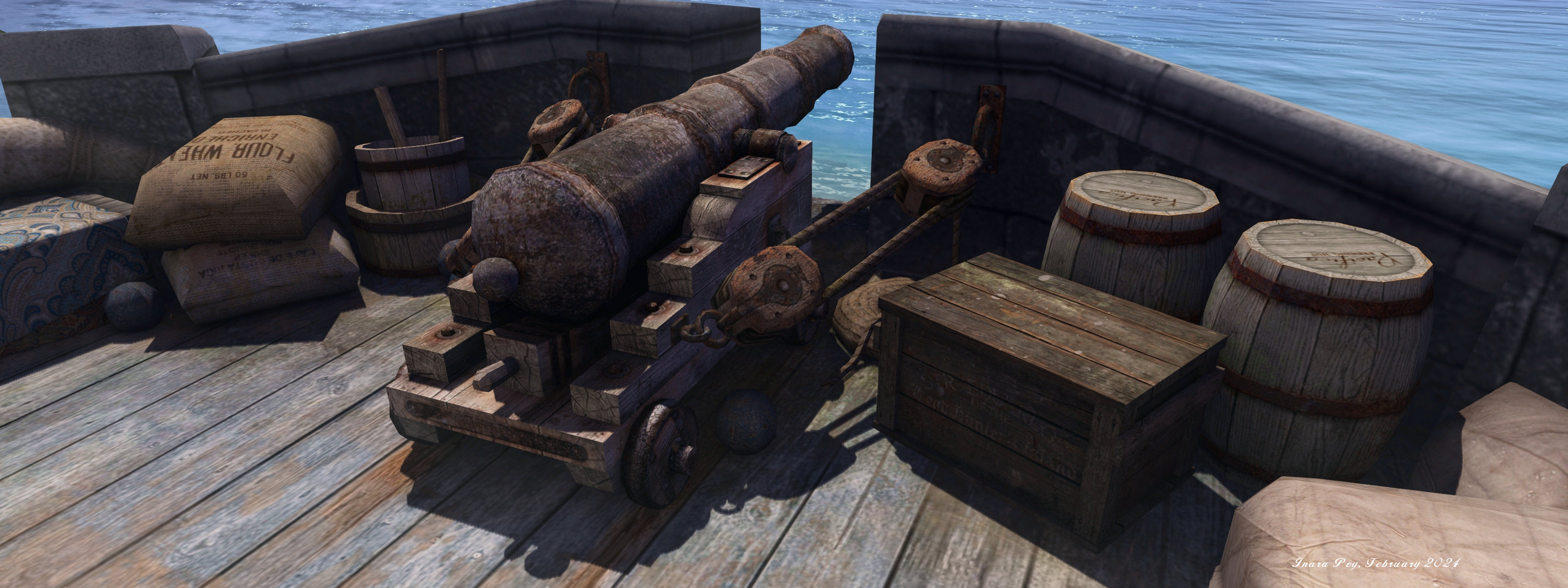
Meanwhile, the smithy next door harkens back more towards medieval times in terms of the majority of the weaponry and protection being made (although admittedly, there are canon and shot on the upper floor); and while the tavern has a look suited to almost any period, medieval, renaissance or the “golden age” of piracy (mid-17th through early 18th centuries), the meals being served would not necessarily look out-of-place in a modern gastro-pub.
Monkey Island, February 2024
This is not to criticise in any way; the mixing of themes and ideas works very well, serving to give the setting a sense of history and mystery. This continues up to the rocky nub forming the highest point on this island, where sits a little art gallery selling pieces by Gian, several of which offer a glimpse of the pirate era and one of its most famous sons – Edward Teach.
More direct hints that this is an enclave for pirates can also be found scattered around the place, both indoors and out, whilst those interested in the treasure hunt can obtain their first clue from the proprietress of the tavern (be sure to give the chimp playing outside a little pet). She’ll set hunters on a route of exploration through the village and elsewhere – but to succeed, patience and a code will be required – I will say no more!
Monkey Island, February 2024
A sandbar curls out from the village island, pointing towards the second of the setting’s large islands; a place which is probably going to attract the eye anyway. given its most obvious feature. Apparently carved our of the peak’s rock, this feature might will put some in mind of an island with another name; a place if not associated with monkeys, then certainly known for being the home of one titan of an ape.
The sandbar doesn’t actually connect to this second island, but it does offer protection for a small bay and wharves where a boat might be found to carry you across the water. But don’t be in a hurry to find the boat rezzer and set off over the water – there is much to find around and below the village; and a walk out along the sandbar (where many of the monkey that presumably give the islands their name also roam) is worth it, if only to better appreciate what lay its its far end.
Monkey Island, February 2024 – “Alas, Poor Yorrick! I knew him, Horatio…”
Sitting on the rocks which mark the end of the sandy finger at the end of the sand sits an oversized chimp atop of a pile of books. He appears to have been cast from bronze or similar, rather than being carved from the rock and is quite a striking figure as he holds in one hand a human skull he appears to be thoughtfully pondering. Looking at him, I was instantly put in mind of two things: the famous speech from Act 5, Scene 1 of Shakespeare’s The Tragedy of Hamlet, Prince of Denmark, and the infinite monkey theorem – and I’m sure I’ve not been alone in reacting this way!
Whether the placement of the chimp is intended to set thoughts wandering along such paths or not, I’ve no idea; but certainly the Hamlet-esque element is not entirely out-of-place, with its themes of death and burial: the pirate’s life tended to have violent ways and ends whilst including the idea of buried treasures; and it is fair to say that Edward Teach saw he head and body part ways following his death, so perhaps the chimp is contemplating the skull of a pirate more than a court jester…
Monkey Island, February 2024
As to the tall island itself, this offers much to explore and discover, with paths, wooden stairways, climbing ropes and zip lines presenting the means of getting around. One of the latter in fact crosses the water to one of the smaller islands as it sits in the lee of the mountain, a pirate ship anchored in its shallows, and if you seek the hidden treasure, you’ll need to take the ride down it to the little island as it holds the key (figuratively speaking) to the final part of the hunt – but again, I’ll leave you to find that out for yourself. All I will say here is that even if you’re not interested in unlocking the treasure, you will still most likely want to visit this little island and take the plunge to find its secrets.
One other thing I would note as a well in talking about the smaller islands, is that there is one is home to a small stone cottage with a round tower at one end. This might well look inviting to the curious, but it is in fact a private residence and not open to uninvited guests or wanderers, so do please keep that in mind when visiting.
Monkey Island, February 2024
Richly detailed, fun to explore and finished with a subtle, natural sound scape, Monkey Island is a fun place to visit with much to discover (I’ve not even mentioned the hidden grotto with its upright piano within until now, for example!). Recommended.








 Inara Pey: Living in a Modemworld