September 7th saw the debut of this month’s Month of Machinima selecton by the LEA and showing at the LEA Theatre (SLurl). With the theme of “Seasons”, which can refer to the four seasons of the year, the seasons of your life, and so on, this month sees a range of imaginative and emotive films on offer.
This month’s entries comprise:
Unknowable Alien Isles:Chaffro Schoonmaker – a farewell to, and lament for, the Alien Isles installation at Unknowable
Duran Duran All You Need is Now by Ian Pahute an homage to the 80s, Duran, Duran and, particularly, their fans – and the passing years!
Curves by Hunk Huasner described as “Second Life machinima remixed with Akon’s Nosy Neighbour and other video clips”, a slightly risque mix of in-world machinima and live action film which is voyeuristically humourous.
A Pesto for all Seasons by Bleu Oleander, a lighthearted look at the making of the perfect pesto, complete with dancing basil…
Nature of Elements by Chic Aeon, which is described as “a video ‘coffee table book’ – there is a message of course, but mostly it is about the pretty pictures”. The message is clear – and one we should all consider
Why Now? by Pooky Amsterdam – a moving question and answer session with Holocaust Survivor Fanny Starr demonstrating the power of Second Life and a world-wide educational and historical forum
Love Me Tender Rafale Kamachi, a whimsical tale of attempted murder, longing, magic and transformation in a steampunk setting
Visualizing Theorem at UTSA by lono Allen: “The creative forces of art, music and science collide in this new sim wide art exhibit at University of Texas at San Antonio (UTSA).” Combining imagery from Second Life and music collaboratively produced in a social media album called “Theorem” by ten musicians , the film celebrates sixteen installations in SL curated by UTSA, which are based on the science and math theories explored in the album.
The series will run for six months from October 1st, 2011
All artists in SL will be able to apply to have a full sim on which to host an art show of their own for a period of 1 month through the series
Each artist will receive access to a sim on the 1st of the month
They will have full use of the sim in order to mount their
When their show actually launches, and how long it runs for within the month is up to the artist
The sim will be cleared on the last day of the month and passed to the next applicant on the 1st of the following month
Each artist will receive a blog write-up in the LEA Blog, UWA Blog and the Virtual Outworlding Blog (and others, if coverage confirmed)
The closing dates for applications is Saturday 10th September 2011
Artists wishing to participate should send a NC to both Jayjay Zifanwe and Bryn Oh describing what the sim artwork will be in no more than 100 words, and:
Provide the names of anyone who might be working with you in creating the sim / show
Give your 1st, 2nd, and 3rd preference for the month in which you’d like to present your show (October 2011 through March 2012).
An impressive build: Duché de Coeur, languedoc Coeur
Every once in a while as one travels around Second Life, one comes across a place that is so utterly unexpected, that one cannot help responding to it by thinking, “This is what Second Life is about!”
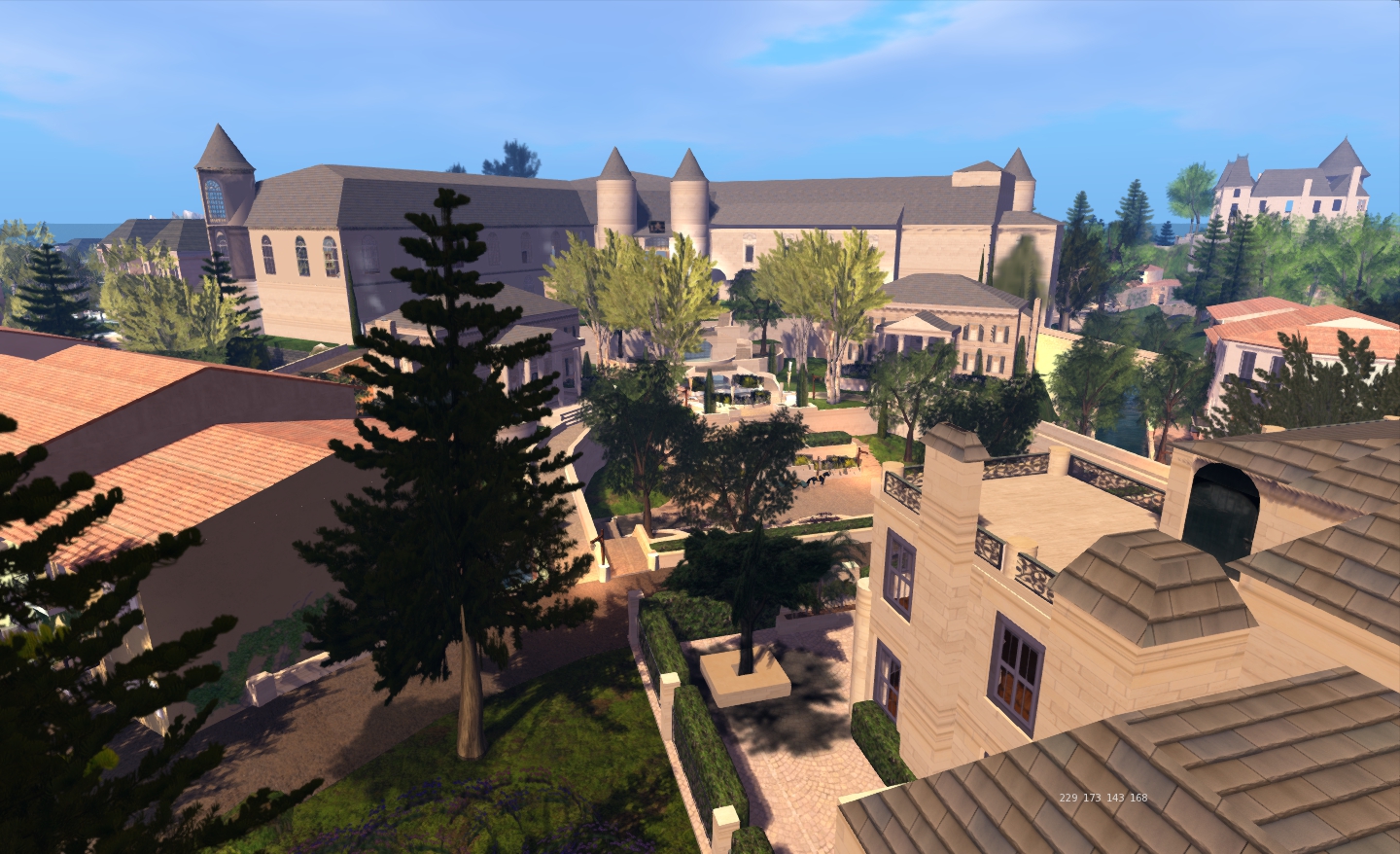
Duché de Coeur is just such a place. To my shame, I’d never come across it in nigh-on five years of SL wanderings until Pete Linden passed me information on a festival being held there in July. That the festival was a mix of arts and music was intriguing enough; that it was in its second year, even more so. I had to investigate; and I’m glad I did.
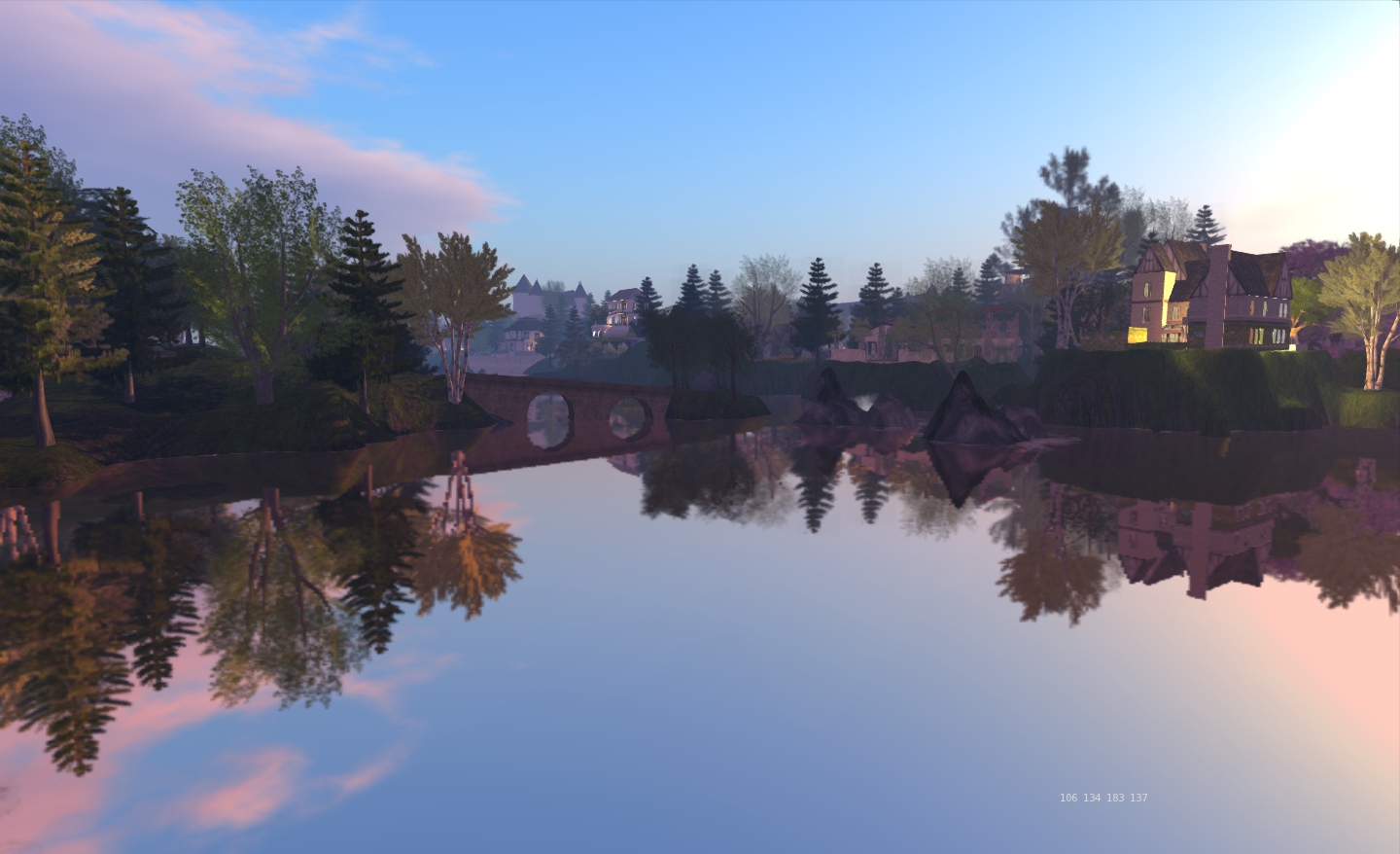
Morning reflections
Centred on the Languedoc Coeur region in-world, Duché de Coeur is a Second Life community in the truest sense of the word: a gathering of like-minded people from around the world who have come together to create and develop something in-world that is both reflective of, and an extension to, their real-life interests and passions.
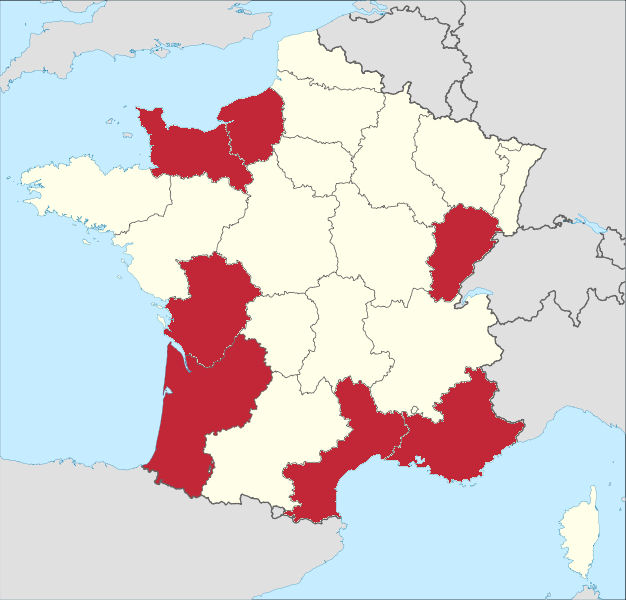
The regions of France that inspire the sims of Duché de Coeur
Comprising 14 sims, The Duchy represents a fictitious area of France that comprises the real life regions of Provence, Languedoc, Aquitaine, Poitou, Normandie, Touraine, and Franche-Comté as they were in the 18th Century – the Age of Enlightenment. It is an openly idealistic take on the Age, combining the period’s advancement of knowledge and value system with romance and chivalry; although that’s not exactly how it started out. When first established, the Duchy was far more focused on romanticism, as founder Bedrich Panacek explained, when I met him and fellow community leaders SkyRider Varriale (his partner) and Baharat Atlas, recently.
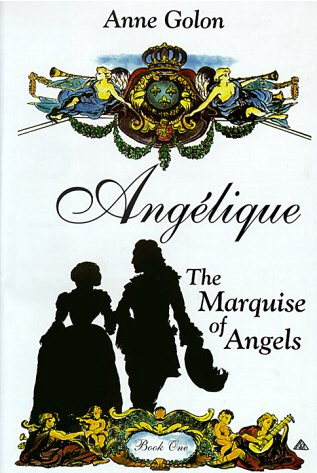
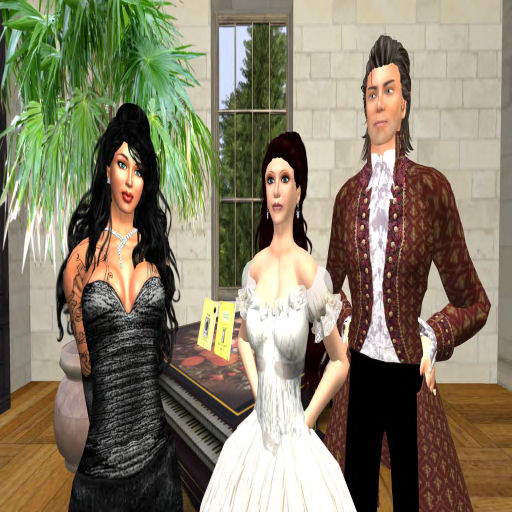
“The Duchy was originally inspired by the book Angélique,” Bedrich said as we sat together in the Green Room at the Duchy’s Opera House. “Gradually it moved forward 100 years with Tatiana and Skye,” he adds, smiling at SkyeRyder Varriale, seated beside him, who takes up the story.
“Bedrich and I met and formed a partnership, both personal and business. We were both interested in France in the 1700’s 1800’s, and I had experience building and landscaping for another game company, while Bedrich is the IT guy, the scripter. Our ideas works together. We also have a third partner, TatianaDokuchic Varriale who has contributed lovely works to the Duchy.”
Angélique, the Marquise of the Angels
The ‘Angélique’ Bedrich refers to is Angélique, the Marquise of the Angels,the first is a series of novels set in the 17th Century written by French author Anne Golon and her husband (responsible for researching the story), Serge Golon. Published in English under the pseudonym Sergeanne Golon, the book was itself inspired by the life of Suzanne de Rougé du Plessis-Bellière, and grew to a series of 13 novels published between 1956 and 1985, with a fourteenth, Angélique et le Royaume de France, due to be published in November this year, and an as-yet untitled fifteenth volume set to conclude the series.
But why this period in particular?
Bedrich takes the question, “Much of western government and ideals are based on concepts that were discussed by some of the greatest thinkers in England and France in the Age of Enlightenment. Centres of thought including L’Académie Francaise, L’Academie Royale des Sciences, and L’Academie Royale de Musique were some of the most important public institutions that caused people to question established thought. We wanted to try and capture that, bring it to life.”
Education and the arts both play important roles in the Duchy, which hosts an annual Arts and Music Festival, together with a season of events that commences in September; all of which are co-ordinated by Baharat Atlas and Pekel Panacek (no relation to Bedrich). And while there is a degree of role-play among the community members (something I’ll return to in a moment), the more organised quarterly role-play events are primarily aimed at providing insight into the history of France over a 400-year period spanning the 15th to 19th Centuries.
When it comes to the matter of events in the Duchy, both Bedrich and Skye are full of praise for the contirbution Baharat has made, and continues to make, “She understood our desire to make this an open, sophisticated, environment,” Bedrich explains.
“She organised our music program, which has taken off,” Skye agrees, “She has really brought events alive here.”
So what is it that attracted Baharat to the Duchy? “I was first attracted to the beauty [of Languedoc, the original sim],” she explains, “That it had an interesting movement and energy unlike any other sim.”
Walking through the avenues and along the footpaths of the Languedoc, it is easy to see what Baharat means; not only are the buildings correct to the period, there is a certain harmony and balance that is clearly apparent. This has been continued throughout the additional sims in the Duchy as they have been added over the years, a subtle mixing of nature and architecture and blending of movement through the use of rivers and canals, that breathe a romantic life into the sims that one rarely comes across elsewhere.
There is also an historical subtlety to the Duchy; all of the builds are either modelled on real life buildings from the period, or they have been carefully crafted to be representative of the the various regions of France included in the Duchy.
The lighthouse
To take the lighthouse overlooking the habour as an example. This is a reproduction of the 75m-tall Phare de Barfleur-Gatteville, built in 1774, and still stands as a museum to lighthouse-keeping today. The Queen’s Hamlet, meanwhile is a reproduction of The Petit Trianon, originally intended for Madame de Pompadour, who died four years prior to its completion. Following her passing, Louis V awarded it to his last Mistress, Madame du Barry, prior to it becoming a country escape for young Queen Marie Antoinette when she need to escape the court of her husband, Louis XVI.
Morning reflections II
Nor does the historical element end with the buildings.
As I mentioned earlier, while role-play is not the primary aim of the Duchy, many of the residents engage in the period life on sim: they adopt roles suited to the age, as well as the style of dress, mannerism and courtesies. Most joining this broader role-play element (which is not a pre-requisite for living in the Duchy) also outfit their houses (all of which are designed and built by Skye) with period furnishings where possible. There are also efforts to establish an economy within the Duchy reflective of the period in order to give added depth and authenticity to living on the sims.
The authenticity extends to transportation as well. While teleporting is permitted, residents often prefer to travel on foot or by one of the scripted means available to them: by boat or by horse-drawn carriage. Both systems are the brainchild of Bedrich, and demonstrate considerable flexibility of use. Resident can, for example, use the carriages to travel between one another’s homes across the Duchy or to reach the notable centres of activity, such as the Académie Royale de Musique. In addition, visitors can also use them to reach public destinations within the Duchy; carriages can be summoned as required by clicking the signs located around the sims. Boats on the canals and waterways perform a similar function, again allowing residents and visitors a natural freedom of movement.
Your carriage awaits….
Nor are you restricted to horse and carriage or boat; given the Duchy presides over the period of the Montgolfier brothers, balloons are also available for people to float serenely over the sims,enjoying the sights and this innovative (for the time!) mode of transportation.
Given the historical context of the Duchy, the focal point for activity is very much centred on the four Academies which have been established. These are:
L’Académie Royale des Sciences, which is being developed to help people become familiar with the huge impact of French science on the world. Those with a passion for science and its history are encouraged to become involved with the Academy by recreating experiments and ideas (“laboratories” are available for rent where diagrams, models, etc., can be displayed)
L’Académie Royale de Musique at the Versailles Opera House inspired Duché de Coeur Opera House, is the focal point for all music and threatre-related events in the Duchy, supported by a number of other venues across the sims
L’Académie Royale de Peinture et de Sculpture is one of the focal points for the visual arts in the Duchy, supported by a second area at the village docks
L’Académie Francaise is intended to host literature readings, ettiquete lessons, French lessons, art exhibits, etc., and offers a venue suitable for discussions and presentations suitable and related to the Age of Enlightenment.
The magnificent entrance to the Opera House at the Duché de Coeur by night
As a venue for events, the Duchy offers many opportunities for artists across Second Life. This year’s Arts and Music Festival saw no fewer than 28 performances across two days, covering a range of musical styles and which also included a dance presentation. September will see the commencement of the new arts and music programmes which I’ll be endeavouring to cover.
As mentioned above, education is an important aspect of the Duchy’s activities. “We have had several different types of groups use the Duchy for their events,” Skye said, “And we would like to do more. We recently conducted a tour for an educational group.”
“The Virtual Pioneers,” Bedrich continued from her with a nod, “We showed them some of the issues that resulted in the French Revolution. [As a result] they are going to host their annual historical society meeting here in January.”
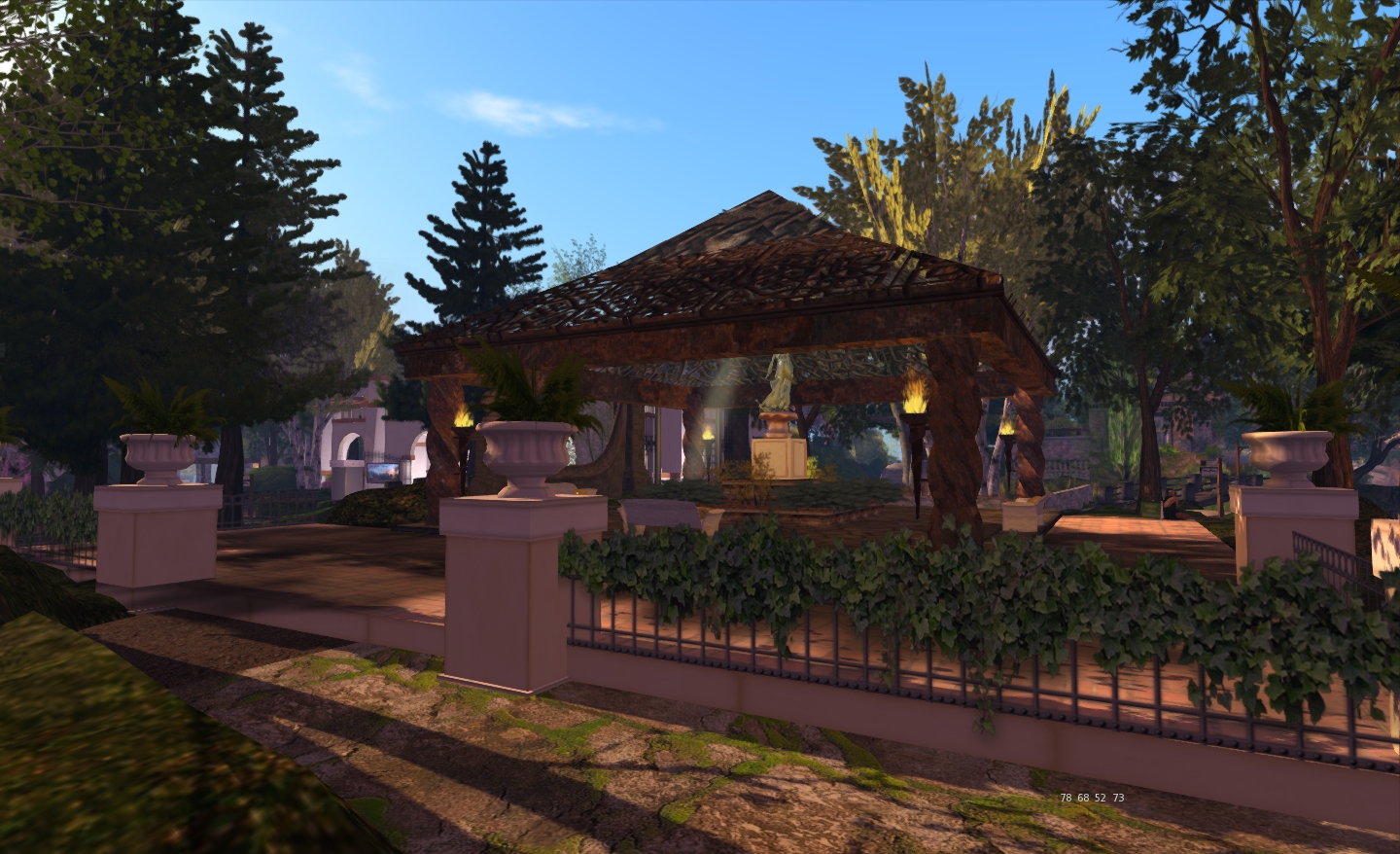
One of the estate’s parks
Given the immense amount of work that has gone into the sims of the Duchy – including seasonal changes to the land and trees, one can understand why; it represents a truly unique window on history, one that is fully embraced by both those who manage it and those who choose to settle there. Indeed, it is a mark of the success of the Duchy that it has grown in response to demand, the sims being added to meet both the needs of those wishing to live there and the growing success of its events calendar. What is equally remarkable is that none of the original charm and romance of the Duchy has been lost over the four years of its development; while the focus of the sims may have broadened from the original setting and embodiment of Angélique, it has gained depth and breadth as a result – and offers residents and visitors alike a lot to share and take-in.
Even with the amount of work that goes into a piece like this, with copy passing back and forth to ensure accuracy of content, it is inevitable errors still slip through on the part of the writer.
As per the comments below, I should have indicated Bedrich Panacek was the co-founder of the Duchy (alongside Skye and Tatiana). As can also be seen from Tatiana’s and Skye’s comments, the division of labour within the Duchy is more complex than the article indicates.
The August Month of Machinima kicked-off on Wednesday 3rd August, but way too late for me to get to the LEA theatre – 7:00pm SLT, so here’s a belated look.
Eleven entries are on offer this month, with the theme being: “Design and Architecture”.
The entrants cover a broad range of topics within the over theme, encompassing an examination of an international project encompassing students in the USA and Egypt, The Kansas to Ciaro Project #2; through homages to some of SL’s most innovative, quirky and/or thought-provoking builders and artists, AM Radio, Alambra, Off the Wall, Two Ways of Looking at You, What isn’t Underneath, presented in various forms from musical tours, to history-within-a-tale to storytelling; through to questions on the nature of perception, The House that Self Built. Along the way we pass the more esoteric with Relevant Search and Democracia Virtual Ya, and encounter the story of a wandering robot, Copy Design.
After my slight disappointment last month, the August collection makes for interesting viewing, although I admit to being somewhat lost with Demoncracia is concerned; I’m probably a little too literal.
As per usual, the films are all available for viewing at the LEA Theatre (Surl), or can be seen on the Month of Machinima YouTube channel. I’m also including my personal favourites for the month below, each of which demonstrate, in different ways, the power of Second Life.
The theme for July’s Month of Machinima is “Games in SL”.
Or at least, that’s the theory; and tbh I’d been looking forward to seeing a set of films showcasing the magic of games and role play in Second Life, and perhaps even learning about elements of rp or other games in SL I’ve not previously encountered. As the very least, I was anticipating seeing glimpses of stories involving fantasy, science-fiction and the rest. Sadly, this was not to be.
Don’t get me wrong, the entries on show this month at the LEA Theatre are visually impressive, and demonstrate skill and artistry I probably couldn’t hope to master; it just that – well, almost none of the have anything to do with Games in SL.
In The Red Shoes we have a superb demonstration of Second Life as an outstanding medium for storytelling, as we do with Someone Called – but to my mind, storytelling isn’t really related to games in SL. Similarly, Travelling presents an excellent travelogue to Second Life – but travelling through SL, seeing the sights and the means of transport isn’t directly related to games in SL. I’m honestly not at all sure what to make of bRaiNwasHer, but it’s hard to frame it in the conext of games. The Wavey Sea is a great music video, but – well, you can guess where I’m going.
Dedication gets somewhat nearer the mark, insamuch as it tells a story that might be said to be framed in a role-play environment, and again, it is a fabulous piece of work in itself, but I still cannot help but feel something is missing…
To me, games in SL offers up an opportunity to highlight the deep, immersive richness of game playing within SL: role-play, steampunk, combat – dare I say, even Gorean. There are many other forms of games in SL – Tiny Empires and the like – which could, with a little imagination, form the foundations for revealing and entertaining films. Arcade Boy and When Warriors Gather go some way towards this, but there still seems to be something missing.
Again, I’m not blaming the film-makers for this lack of game-related depth: as I’ve stated, every film in this month’s entrants is skillfully executed and worth watching. I’m also not necessarily pointing the finger at the LEA judges; MoM is an excellent idea and worth pursuing; and truth be told, it’s hard to guarantee that what will work theme-wise. Even so, it’s a little disappointing that more did not rise to the challenge and present films more directly related to this month’s theme – I’ve certainly seen a fair few films on subjects such as combat games and RP in SL elsewhere, so it’s not for lack of potential content.
In the meantime, here’s Dedication, by CadenceDVE, which I really like as a story and which comes close to the ideal of the theme in a visually impressive manner. You can see all the entries above on the MOM YouTube channel.
Given I’ve written about my very tenuous link to the space shuttle Endeavour, I thought that for this instalment of Destination: I’d take a look at the International Spaceflight Museum (ISM).
ISM is perhaps one of the most famous destinations in Second Life and a fabulous example of what can be achieved through dedication and hard work on the part of a group of enthusiasts. Starting modestly on the sim of Spaceport Alpha, the ISM now covers two sims – Alpha and Bravo, and forms the hub of a group of (non-affiliated) sims dedicated to science, the environment, technology and space – including NASA’s own CoLab sim. The museum and its sims are overseen by the ISM Corporation, a Kansas, USA, non-profit organisation currently seeking 501c3 tax exemption with the US IRS.
ISM arrival: LEO
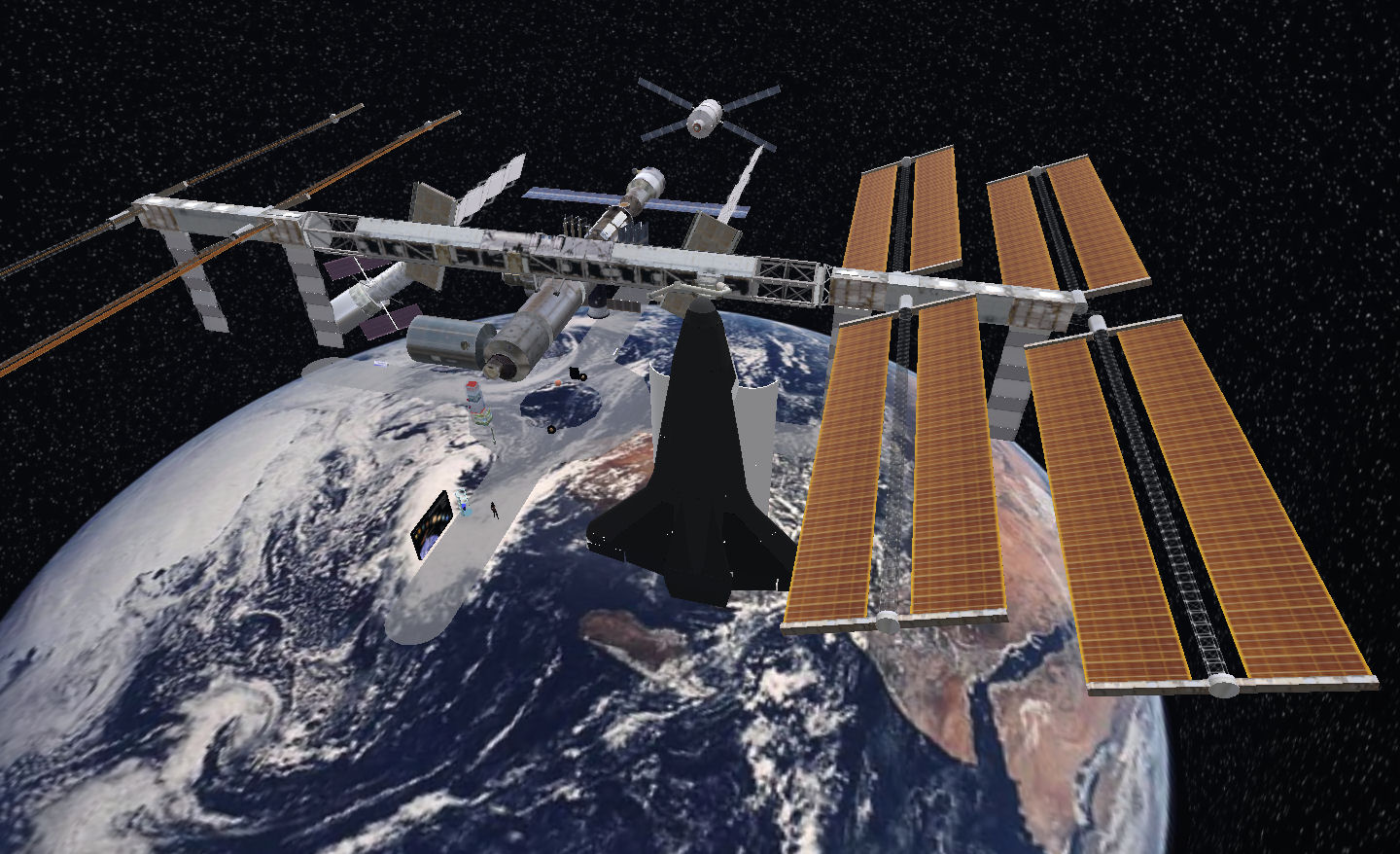
As one would expect from a long-established SL facility that tackles such an engaging and absorbing subject as the exploration of space, ISM is exceptionally well-thought out. Use the main LM (from Search), and you’ll find yourself in low Earth orbit, standing on a platform with the glorious arc of the Earth below you and the magnificent and somehow delicate form of the International Space Station overhead, complete with space shuttle (the Endeavour!) and two Soyuz craft docked with it, while a European Automated Transfer Vehicle makes its final approach to dock. Also hanging in space beside the station, a little incongruously, is the Hubble Space Telescope.
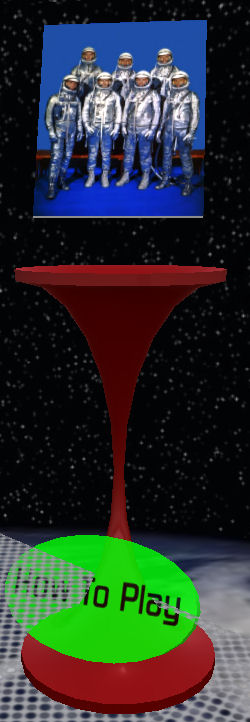
Trivia quiz plinth
The first thing that strikes you on arriving – after the magnificence of the display around you, is the sheer care that has been put into things. Around the walkway are hovertext icons, carefully positioned so they don’t intrude on your wanderings, but which provide a wealth of information. Additionally, each of the models in the exhibit is accompanied by a clickable plaque that will take you to a dedicated, multi-lingual wiki page that provides detailed information on the exhibit.
Also located on the platform is the main teleport unit / ISM map, and the first station in the museum’s Trivia Quiz. In this, you collect game cards by answering questions on space and space exploration. Cards can be redeemed at the ISM gift shop (or that’s the theory; to be honest, I’ve never found the object used to redeem the cards – but the quiz is still fun).
Travel to the Planets
The teleporter will carry you to any of the planets in the solar system, where you can find out more out our celestial neighbours and any space missions that have visited them. It’s actually while on the solar system tour that things get very slightly irritating.
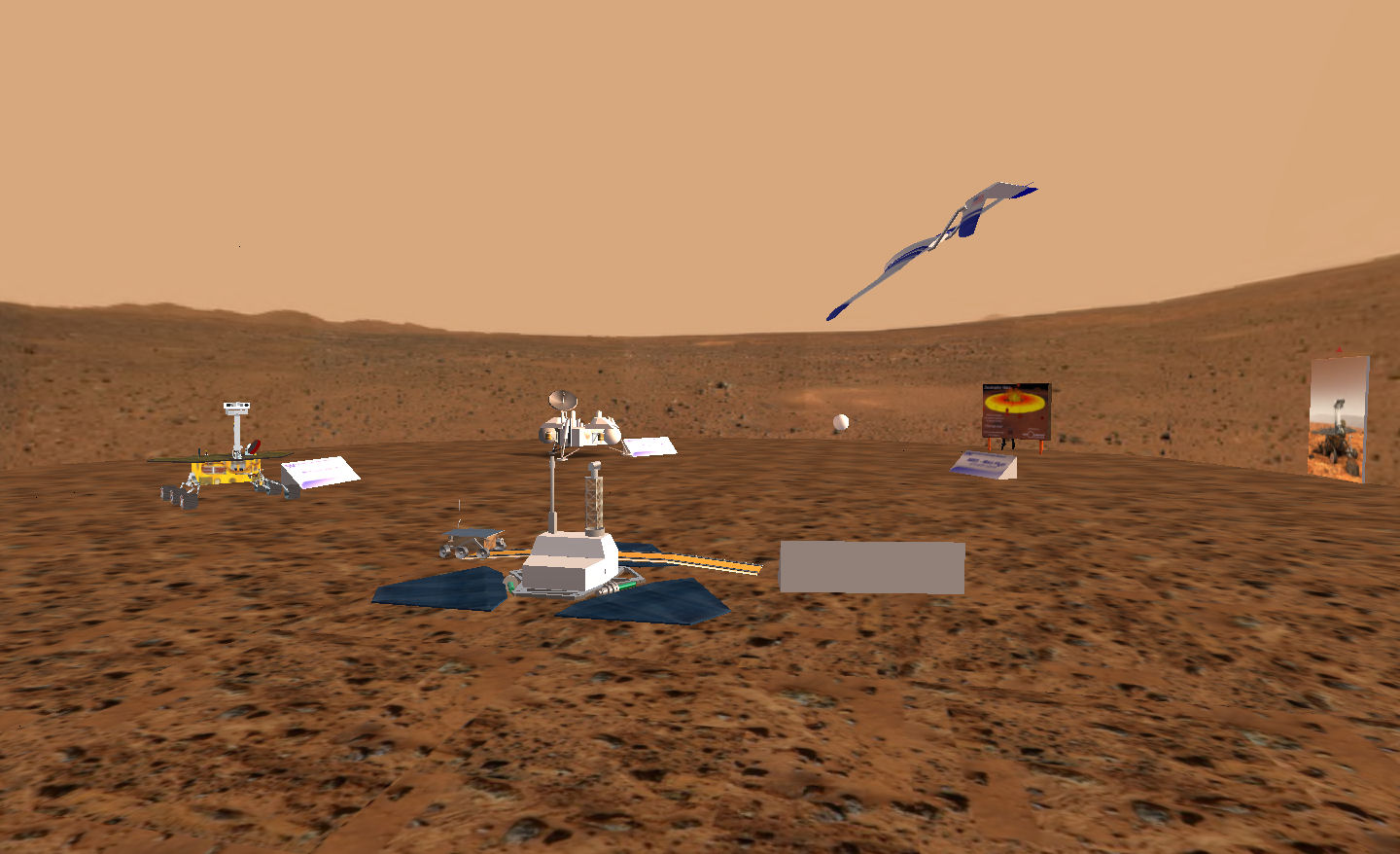
On the surface of Mars
While the exhibits are informative and well laid-out, the fact is that once you’re away from the arrival area, it’s pretty hard to get off the tour – there are no “return” teleport points. So if you opt to hop directly to, say, Mars, finding your way back to Earth, Venus or Mercury is a tad difficult.
Each of the displays exists in its own sphere or cube, with (again), plenty of information to absorb as you admire them. Were I to pick a favourite, it would be Mars – but then that planet has always held a mystical fascination for me – simply because you can pay a visit to the surface of our oft-visited neighbour in space.
The Pluto / Charon display, ostensibly marking the “end” of the solar system, allows you to take a peek at some of our nearest interstellar neighbours as it includes a three-dimensional model of our corner of the galaxy, complete with clickable stars!
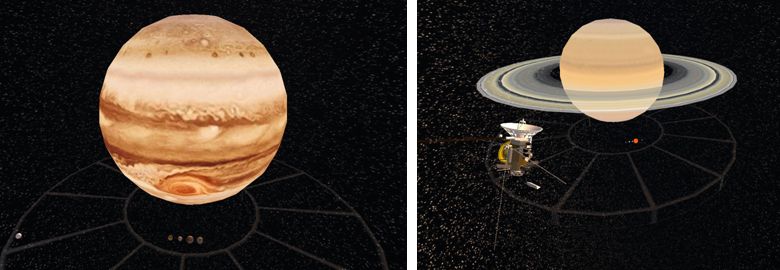
Jupiter (left) and the Galilean moons; Saturn (right) and the Cassini / Huygens mission
The Pluto / Charon display also appears to offer a novel way of moving on in your explorations: a parachute to get you down to the ground! This is something of a novel approach, to be sure, but as I have my own chute, I strapped it on and stepped off the edge of the catwalk only to splat myself on the ground as the lag prevented my chute from opening in time. Ah, well.
Feet on the ground – head in the clouds
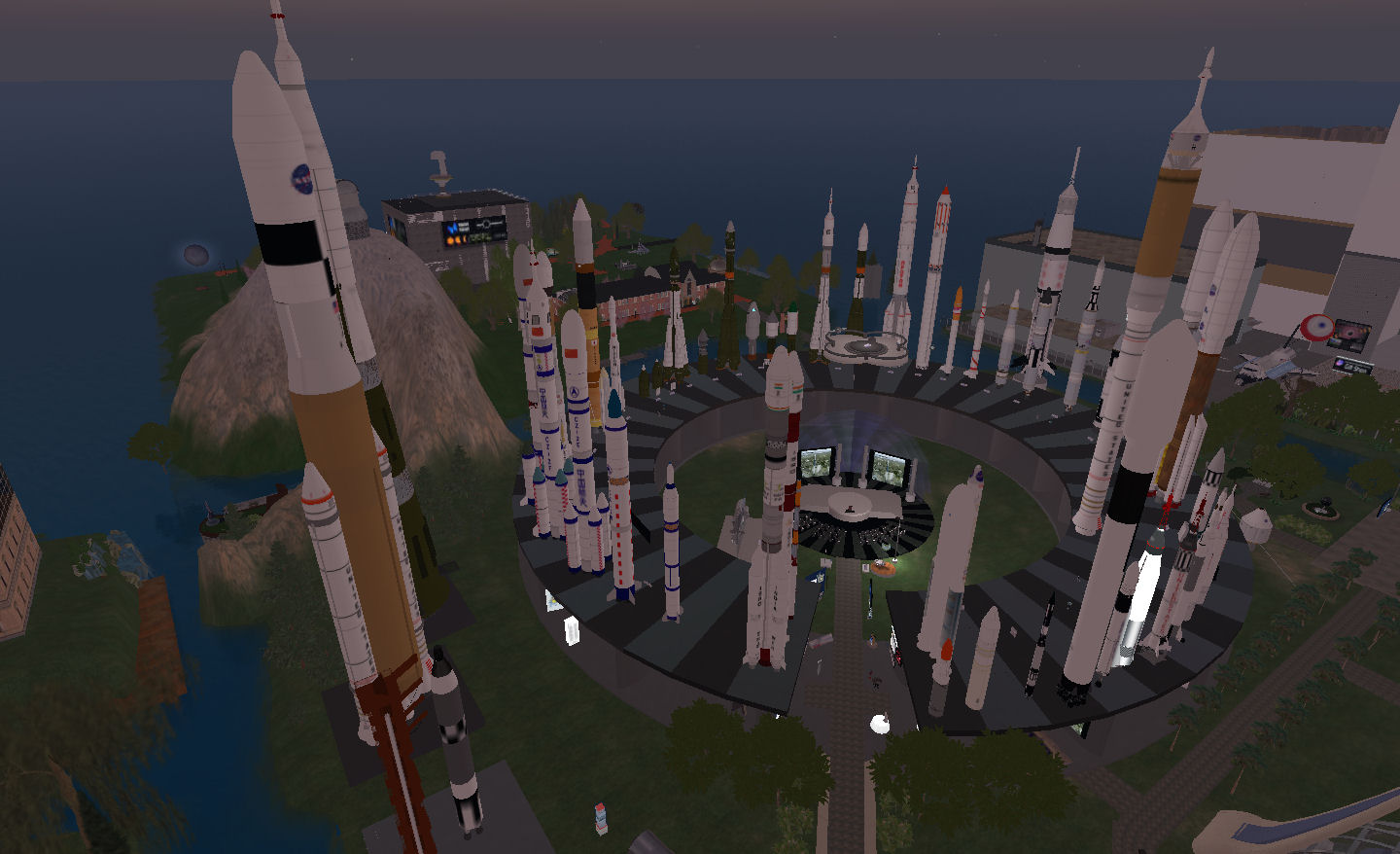
Fortunately, no-one ever dies in SL, so after picking myself up and dusting myself down in the hope that no-one noticed, I found myself in the middle of the Rocket Ring. Here you can learn about all the rockets ever flown – and some that never did or have yet to take to the skies. In the centre of the garden is the ISM theatre, which frequently hosts talks on space flight, space exploration, astronomy and the like, and which broadcasts a NASA TV fee during space missions. Under the Rocket Ring you can find a wealth of other information – some of which may help you with questions from the 2nd Trivia Quiz plinth, which also can be found here as well.
Not all the displays are static, either – you can, for example you can ride atop a Titan II rocket in a Gemini capsule into outer space, our climb aboard a space shuttle and have a look around. You can also visit the Planetarium and take in a show. And if you don’t fancy trudging around the sims, try taking the tour ride – just make sure you can get seated before the vehicle moves off!
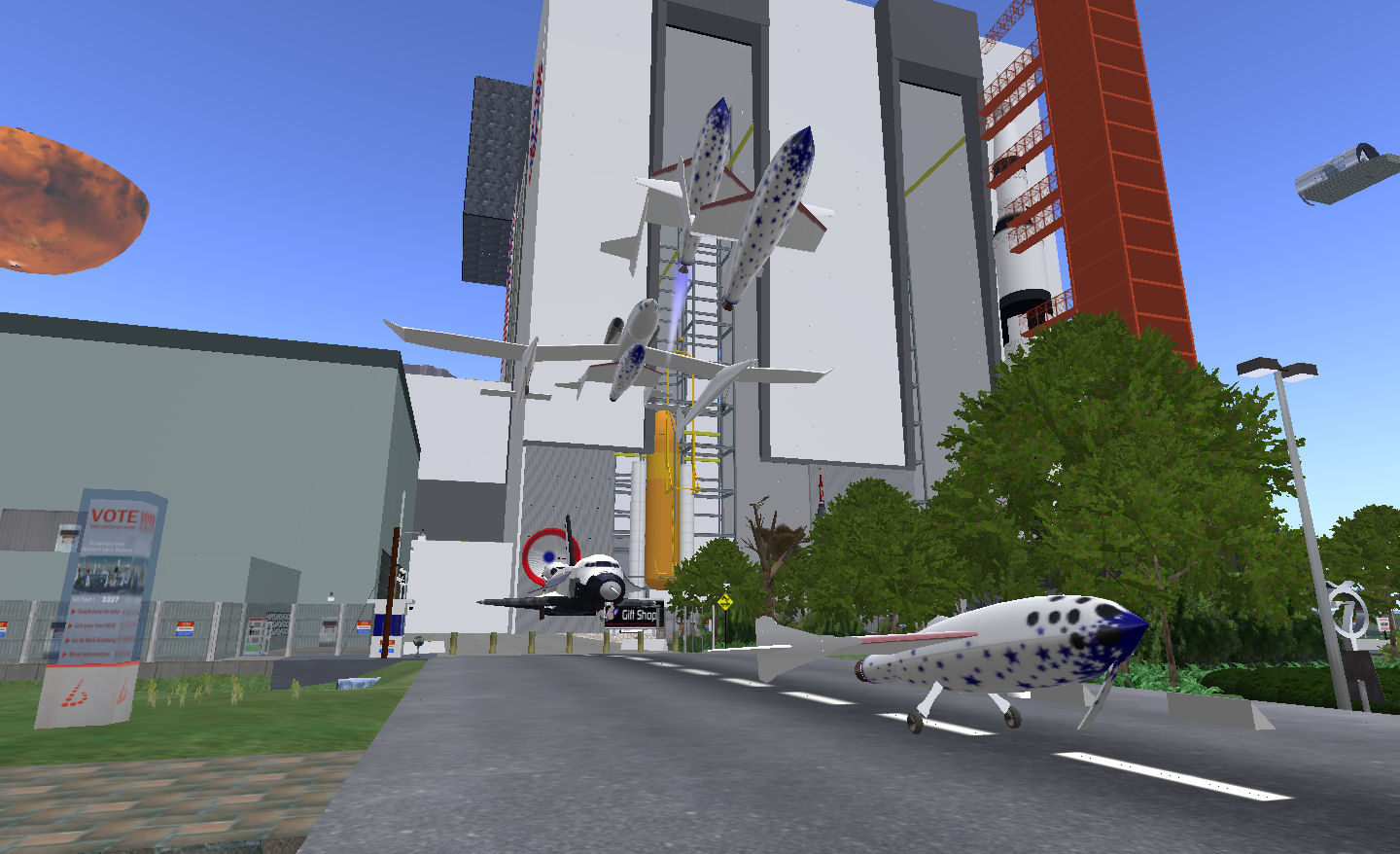
Spaceship 1, The Shuttle and Spaceport Bravo
Across the water, in Spaceport Bravo (be a little careful around the sim boundary, the crossing can be rough) sit replicas of some of the more famous buildings from America’s Kennedy Space Centre – including the imposing bulk of the Vehicle Assembly Building. Here you can see the huge Saturn V rocket, used to launch men to the Moon, find out about other hardware, past and present…and complete another part of the Trivia Quiz. Atop the Vehicle Assembly Building is the observation deck; turn your draw distance up and enjoy the view (just be sure to notch it back down again to reduce the lag when you leave).
While the ISM is not officially linked to or affiliated with NASA, it is bounded on two sides by NASA sims: NASA CoLab and the Explorer sim, operated by NASA / JPL. Both of these are well worth a look around as a part of your visit.
There are some problems with the museum, lag being perhaps the biggest. There are 14,229 prims scattered around the sim in dozens of exhibits and buildings – that’s a lot of drawing for your Viewer to handle. There are also information givers, web page redirectors, scripted vehicles and displays, all of which contribute to the server-side load. Given this, lag is understandable, and because of it – while it is tempting to pump up Draw as far as possible to see everything – I’d recommend that, unless you have a super high-end system, you keep draw turned down while moving around, and slide it back up while looking at individual exhibits on the ground. I’d also advise you limit your flying; the lag can make this a questionable activity – you can easily hit a sim boundary without warning as the lag grabs you, and end up rubber-banding hither and thither or getting unceremoniously dumped on another sim.
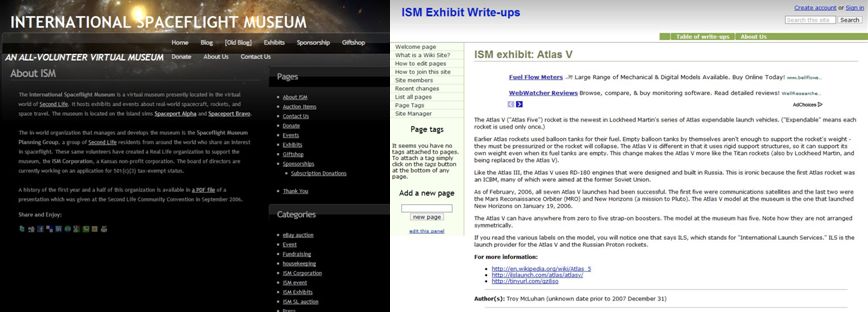
Away from the in-world experience, the ISM website offers a wealth of information on the museum, those responsible for it, what is going on in terms of upcoming events and a whole host of other information and news. The site is extremely well presented with excellent navigation. Of equal use is the ISM Wiki – reached via any of the in-world exhibit plaques. While this can interrupt the immersive experience while actually touring the ISM, it contains masses of information that is well-worth a look-in – and it does so in multiple languages, providing everyone with a chance to delve into it.
ISM website and wiki
Overall, ISM is one of the best attractions put together within Second Life. Whether you are a space enthusiast or just casually interested in taking a look, it has a lot to offer and represents an immersive and educational experience. The “wow!” factor tends to be high, and the exhibits are stunning both for the care and detail that has gone into their construction, and because of what they represent; the exploration of space and our understanding of the universe around us are truly awe-inspiring. And the ISM delivers much of that awe directly to your monitor screen.
But don’t just take my word for it – go pay a visit yourself!