So, Direct Delivery launched yesterday. I’ve been playing with it since then, and here’s some feedback and updates on what is being reported via the Merchant’s forum.
My Experience
Moving Goods to Folders
This was the most time-consuming task, mainly as I used it to re-order my business folders so that they can now be directly dragged-and dropped with each update. Inventory did get somewhat inflated, as I opted to move the originals of folders uploaded to SLM to my inventory and keep them as “master” copies into which I could drop updates, etc., ready for future uploads.
Uploading via the Merchant’s Outbox
Uploading a folder via Niran’s Viewer
Worked a treat using the SL Viewer, Firestorm and Niran’s Viewer.
Folders dropped into the Merchant Outbox folder would be duly processed and sent without incident, the only slight delay being the time required for the Outbox to initialise itself.
Once uploaded, those items set with the same original name as items in my listings auto-updated as anticipated, and those requiring a manual update (I took the opportunity to do some updating!) required around 4-5 seconds apiece to re-associate (although such was the demand on the Marketplace yesterday, this did at times take longer, prompting me to leave cutting-over much of my stock until this morning, UK time).
I will confess to keeping the old Magic Box items on file at the SLM end, under unassociated items, just in case! (I’m lucky, my total stock is just under 50 items.) I also started cautiously, a folder at a time, but confidence quickly grew that the system wasn’t about to do anything nasty and bumped over around 6 folders at a time.
Concerns with Direct Delivery
A number of concerns / issues have been raised via the Merchant’s forum.
Changes Mean Manual Association
An irritant with the new system is that if changes are made to the contents of a folder – such as the addition of new items, changes to a notecard, etc., – the folder, when uploaded to SLM is not automatically associated with an existing listing even if it retains the same name as an existing folder.
This means every time a change is made to the contents of a folder already listed on SLM, the merchant must manually associate the folder with the required listing and delete the older version of the folder when it appears in Unassociated Items – something that could add considerable time to the process when making multiple updates.
Deleting Unassociated Items
Some people have been reporting problems when deleting unassociated items. This can actually be time-consuming if done on an individual basis – and some merchants may find they need to remove some as they go, as there appears to be a limit of 100 unassociated items per merchant, it could get a little tedious. Sera Lok therefore suggests a solution in the forum.
The ANS Issue
At the time of launch, the Automated Notification System has not been enabled for Direct Delivery, and Linden Lab have only committed to turning this feature on in the “next couple of weeks”. Given the number of merchants who depend on ANS for records-keeping, and the fact the LL were repeatedly asked not to roll-out Direct Delivery whouth ANS being enabled for it, this is causing understandable reluctance with some in converting to Direct Delivery.
Destination Folder not Reported
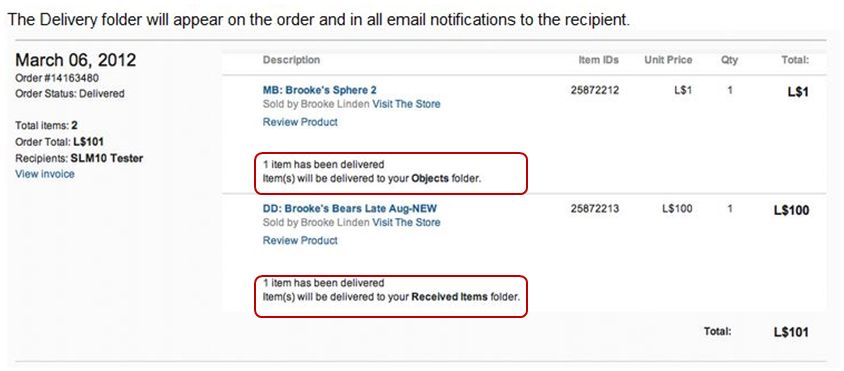
As part of the launch documentation for Direct Delivery, it was stated that: “The Delivery folder will appear on the order and in all email notifications to the recipient.”
The promised format for deliveries recorded on people’s Marketplace account histories
However, the functionality does not appear to have been rolled-out with Direct Delivery. Neither merchants nor recipients are informed of the purchase destination either in their account histories or in any associated e-mails relating to the transaction.
As deliveries are currently displayed in a person’s Marketplace account history (Marketplace->MyMarketplace->My Account->Order History
While this is not a show-stopper, a JIRA has been raised on the matter.
Recipients do, however, get an in-world notification that goods have been delivered to their Received Items panel / folder if they are logged-in to SL / when they log-in to SL (assuming they review all stored notifications!).
Viewer Support
At the time of my original report on Direct Delivery, all Viewers on my Viewer Round-up list supported Received Items, as did much older (pre-mesh) versions of Viewers I tested (Imprudence, Singularity, Astra).
The Merchant Outbox situation is slightly different. As it stands at the time of writing this piece, this is the situation with the Viewers I’ve checked:
Viewers supporting Merchant Outbox functionality: the SL Viewer, Firestorm 4.0.1, Nirans (currently 1.30, but has supported it for a while)
Catznip is working on an update to be released shortly (RL interrupted the schedule)
Cool Viewer, Dolphin, Exodus, Phoenix, RLV, Singularity and Zen all appear to require updates in order to display the Outbox.
If your preferred Viewer does not currently support Outbox functionality, the best thing is to keep an eye on the Viewer’s blog pages for word of any update.
Overall Response
The overall response has been muted. While concern over ANS may be holding merchants back from any migration and the manual association requirement notwithstanding, this has been one of SL’s quieter roll-outs. Certainly, there do not seem to have been any major SNAFUs or problems – but then, many merchants may still be holding off on conversions.
Personal Feedback
I resisted giving feedback in my main piece on Direct Delivery, as I wanted to keep it as factual as possible (and am still updating it to reflect the current situation). However, my core feedback after using the system is:
The Good
The migration process via a suitable Viewer is pretty seamless for the most part. Automated association worked fine where folder names were the same as item names; manual association was a couple of additional steps, but not overly time-consuming if updates are taken in batches
Delivery works to any Viewer, regardless of base code (V3 or V1 style) – Received Items appears either as a panel in your Inventory floater (V3-based Viewers) or as a folder (V1-style Viewers)
No hiccups were encountered in sending goods as gifts or with permissions ending up mangled
The Bad
No ANS. Given the manner in which merchants repeatedly campaigned for ANS to be active for Direct Delivery, the decision to roll-out without it is somewhat surprising. Should ANS support be delayed, one hopes LL will also delay the turning-off of Magic Box functionality to allow merchants time to migrate to DD without having to face an artificial time limit
Failure to auto-associate updated folders as a result of content changes. One can understand folders remaining unassociated following an actual change to the folder’s name, but leaving folders unassociated simply because contents have changed adds unnecessary overheads to the process of updating items.
Dranopia, the breedable dragons system developed by Timmi Allen, Leni Galli and Ciaran Maktoum, has added a new chapter to the ongoing saga of Dranopia: The Quest.
In Revolt of the Forgotten, the story is picked-up shortly after the groms have been defeated and the lost souls of the Dranopia ancestors rescued. But a new cataclysm has engulfed the resting-place of the ancestors’ souls: a great flood has occurred, sweeping away everything before it, leaving only a vortex of swirling water, and the openings to long-forgotten tunnels leading deep into the walls of the gorge, tunnels revealed as earth and stone collapsed under the force of the swirling water below…
Dranopia after the great flood
Revolt takes the mechanics of the original Quest and moves them into a labyrinth of underground tunnels which must be explored while once again flying upon a dragon (either your own or one obtained from the start-point for the quest), and attempting to obtain a range of items along the way.
The essential game system remains the same, but presents significantly more to do. From the start point / rezzing area, you take your dragon (and a game HUD available from the free vendors) and fly through the arch and out over the water. Your goal is to collect as many coins and keys as you can in the game time. Along the way, you can also obtain additional game-play time and restore the health and vitality of your dragon – and you must also avoid various threats and obstacles.
The start area
Moving the game into a tunnel systems adds a new dimension in flying your dragon; the confines of the tunnels mean that camera angles and views are much tighter. Those familiar with operating in the first person (Mouselook) in SL might be at something of an advantage here; as the tunnels twist and turn, rise and fall, seeing what lies ahead is not always easy in third person; adjusting your camera offsets might also help.
Speed is also something to watch, as it is easy to find yourself hitting walls and floors, costing you time and possibly points, or missing branches and turns where the tunnels split and twist.
Down in the depths
The labyrinth comprises a number of distinct forms, each separated from the other via a door. Each contains a key to be found as well as coins, green health hearts and red hearts for bonus time. Both of the latter are of equal importance: the green hearts help restore your dragon’s vitality and handling – if the dragon’s strength drops to zero, then your game is over; you’ll be dropped to the ground and your dragon will vanish. Red hearts help extend you game time, allowing you to collect more coins and keys; you can gain up to 600 seconds at any one time.
Points are awarded for coins, etc., obtained – but are also deducted should you have an encounter with whatever lurks in the passages and tunnels – of which I cannot say more here, you’ll have to discover things for yourself 🙂 – but that fact the points can be lost is another reason for watching your speed. Coins start at 5 points for the blue glass coins, rising to 100 points for the gold coins. Treasure chests can be opened by obtaining the required keys (each of which will gain you 50 additional points).
Game HUD
Given all these elements – coins, keys, treasure, bonus time, health – the game HUD is somewhat more complex that the original, but well-presented and easy to understand. By default it attaches to the top centre of your screen – and that’s probably the best place for it, as it is easy to reference it without blocking your in-world view.
High scores are recorded on scoreboards located at the start area – but you’ll need to have media-on-a-prim (MOAP) running in order to see the scoreboard displays.
I would advise playing the game without running anything else that might be processor-intensive on your computer; I had my anti-virus software start a scan during my time in the tunnels and my ability to fly my dragon in the confines of the passageways completely fell through the floor…
All-in-all, Revolt of the Forgotten builds nicely on the game-play from the original Quest, adding additional elements that should help attract those who played the original game, while providing a nice gaming experience for those who haven’t yet tried the system. There are seven dragons available at the start-point for those that don’t have a Dranopia dragon of their own to rez, and each again has its own characteristics.
Why not hop over to Dranopia and give things a try for yourself?
Dranopia: Revolt of the Forgotten is available on the Virtual Services Sculptie Experiments region.
In January I visited Wendy Xeno’s Humanoid, which I found to be an evocative and photogenic experience. So when I heard she’s been commissioned by Dirk Talamasca to produce another piece, I knew I’d have to pay it a visit.
Hazardous, the result of the commission, is located on Misali, a Homestead sim owned by Mandingo Quan, who was also involved in the design process. The byline for the installation is Dream infinitely….. remain fearless…..seek Hazardous adventures, and for those familiar with Wendy’s work, it carries many of her trademark touches.
Your arrival receives a musical greeting, this time from a piano which features covers of Linkin Park’s “Numb” and “Beth” by Kiss, a rather eclectic mix of instrument and music that works very well within the theme and tone of the installation.
The eclectic piano
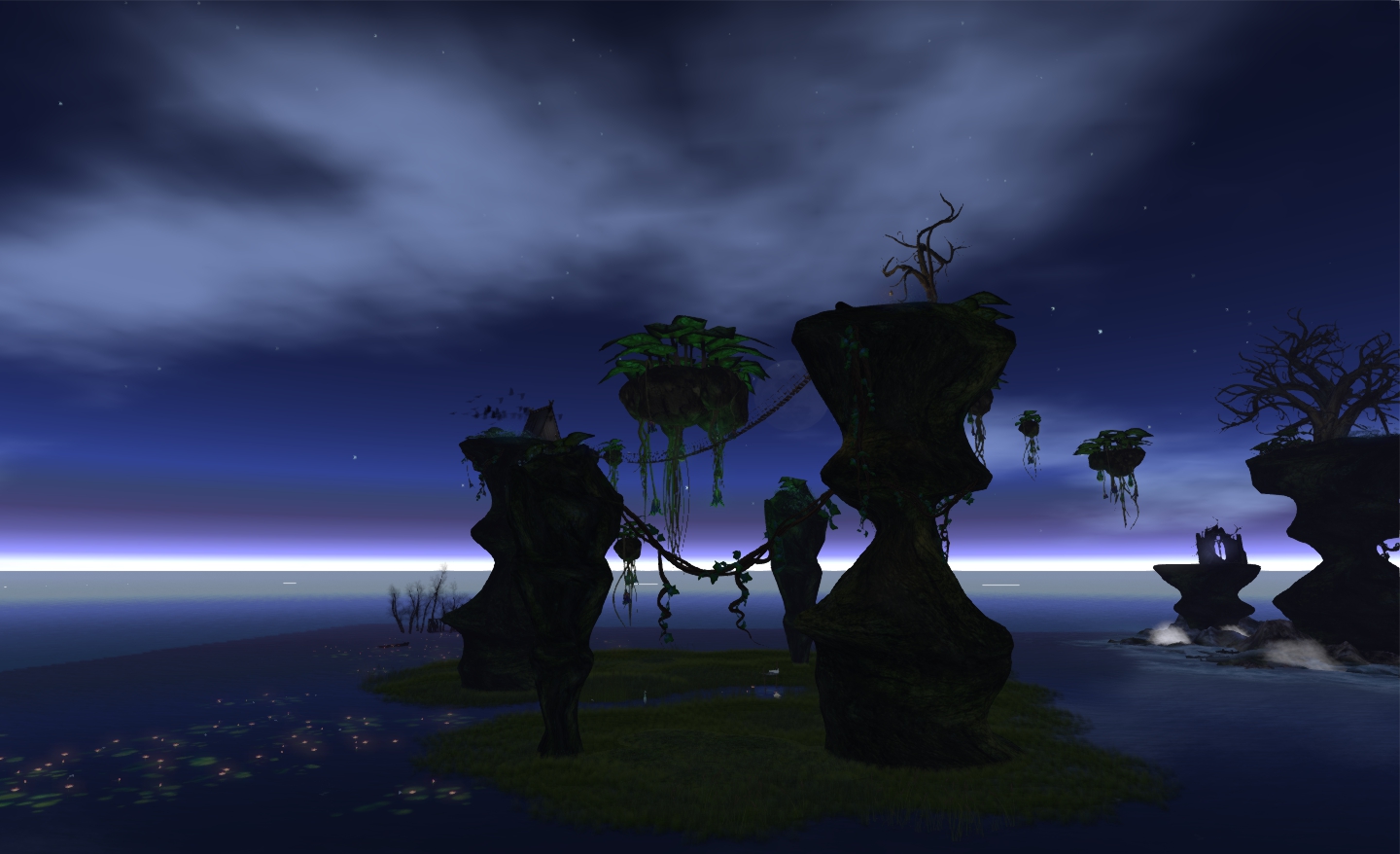
Around you lies a muted landscape with dark, dusk-laden skies (assuming you accept the local Windlight settings – and I recommend you do!). For those visiting with a partner / loved one and who have a romantic inclination, a bottle floating in the water alongside the guest book pedestal offers dances. For the adventurous, the silhouettes of a nearby landmass beckon – but be careful you don’t mess the balloons tethered closer to hand, which offer a fun way to see the sim…
The balloons allow you to ride around the installation, guiding yourself via the arrow keys and PAGE UP and PAGE DOWN, and make reaching various part of the piece a lot more fun than simply flying. If you decided to stop off anywhere, then your balloon doesn’t instantly vanish, giving you the option of grabbing hold and floating onwards if your visit to a particular spot isn’t too long.
Towards the centre of the sim lay a number of tor-like outcrops, the larger two of which are linked by a rope walk and offer visitors places to simply sit and observe or enjoy one another’s company.
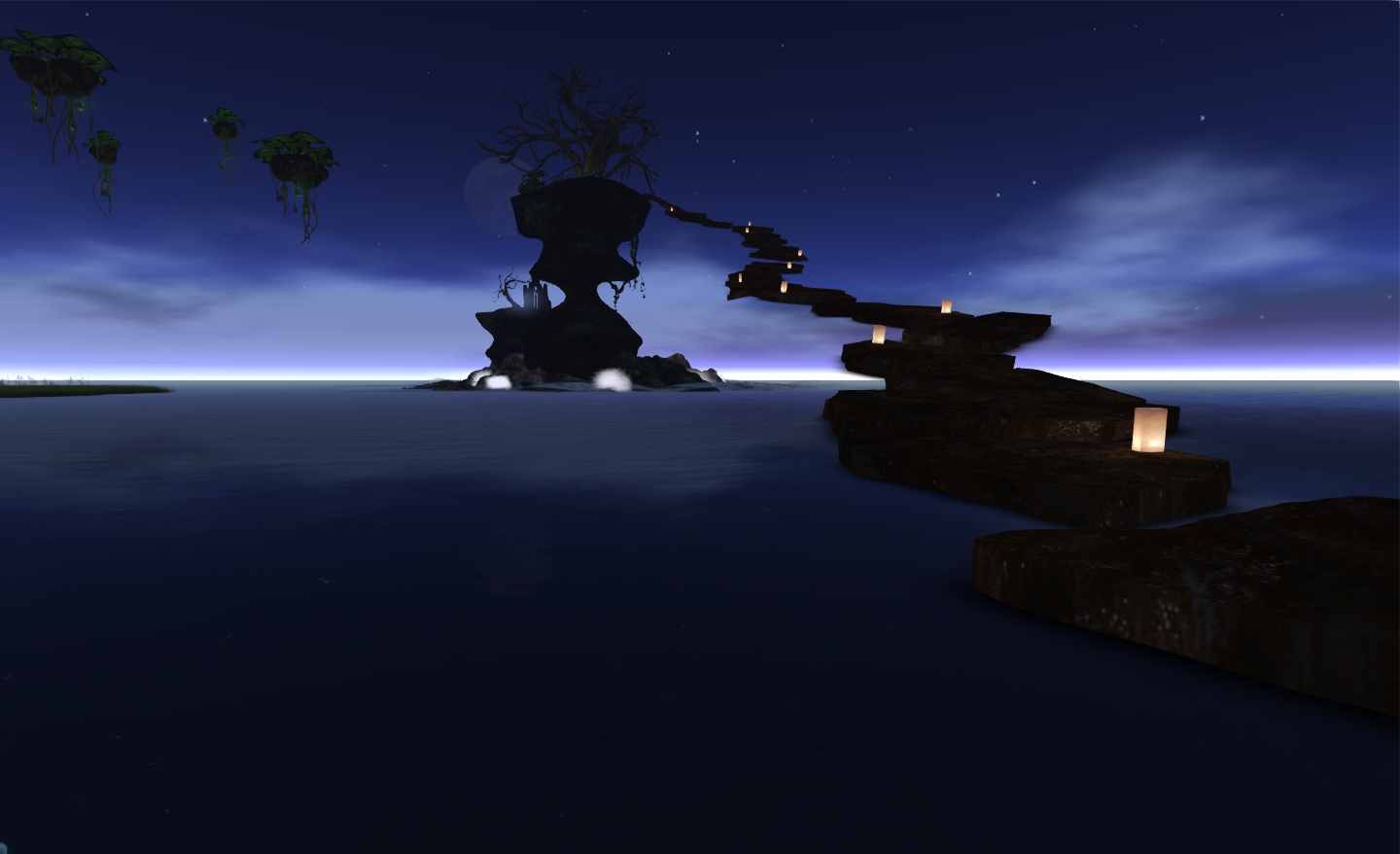
To the north-east of the region sits a tangle of trees, denuded of leaves, and from which a stone path rises, angling gently upwards and inviting you to walk it, following the trail of lanterns to the top. As you climb, so the wind blows, carrying the sound of surf, as waves sweep against the tall tor you are approaching. At the top sits another symbol familiar to Wendy’s work: a birdcage, this one containing a music box. Dances are available nearby, but I’ll leave you to find the giver :).
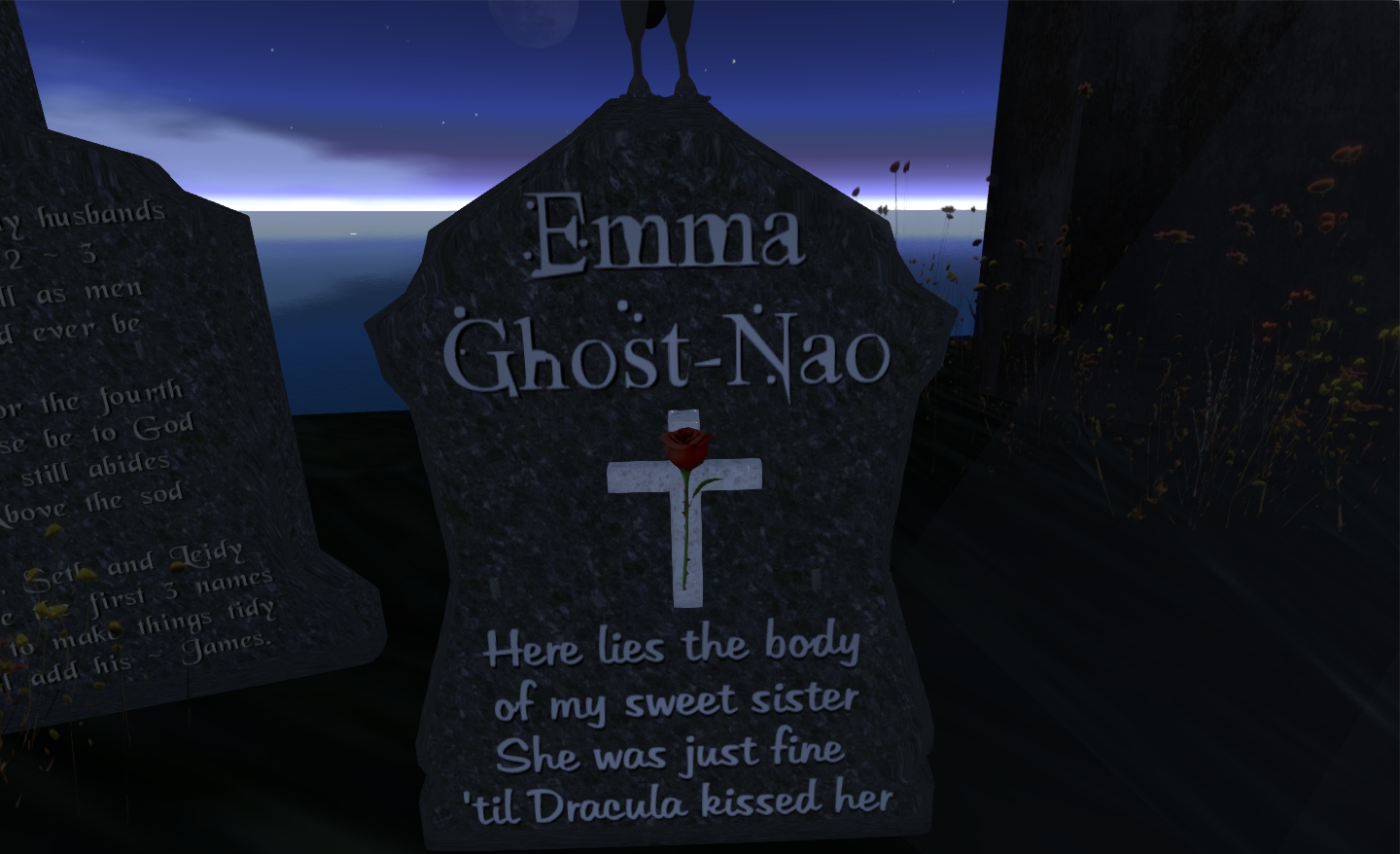
Make sure you drop down to the graveyard below…the tombstones are a delightful read…
Like Humanoid, Hazardous extends its reach into the sky via three teleports located near the arrival point. These lead to various scenes contained within spheres high overhead, of which my favourite is the “ghost ship”.
Overall, Hazardous has much in common with Humanoid, but is also very different; together they complement one another and form pieces that work both individually and together. Both are evocative, but in very different ways. While Humanoid caused me to the think very much of Eliot’s The Four Quartets, Hazardous resonated with me in terms of fantasy, the colours and forms lending themselves naturally to images of strange and distant worlds, or perhaps other versions of this world where the fantastic is possible.
Like Humanoid, Hazardous offers SL photographers a great environment in which to work – both the Windlight settings and colour tones work very well whether or not you have deferred rendering active, making it possible to play around a lot with images and effects when using a Viewer such as Exodus or Niran’s.
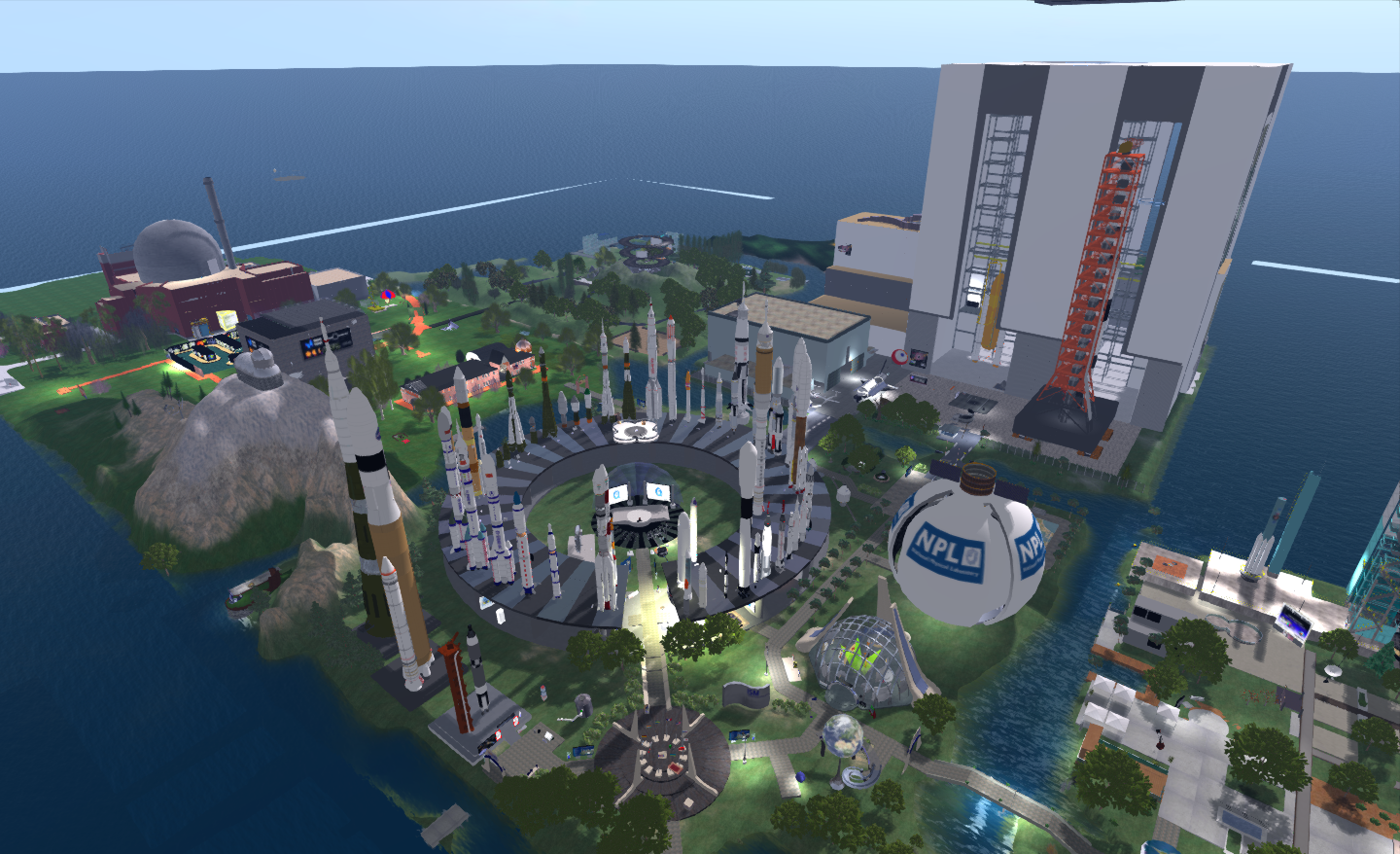
I reported recently on the status of the International Spaceflight Museum and the issues it has suffered of late – some of which are internal, others not so. However, tier due was raised, and the ISM team were planning on making a return with Spaceport Alpha and Spaceport Bravo.
At the weekend, Kat Lemieux received a message from Linden Lab stating that the account had been delinquent for so long, the ISM group would have to purchase new sims from Linden Lab.
The sims themselves went off-line in mid-January, with unpaid tier amounted to around $1180 (two sims at $295 for two months, presumably December and January). Since then, the ISM team have been working to get payments made following donations – and have experienced around two weeks in delays due to issues related to Paypal / LL.
The initial reaction to the news when made public was one of stunned disbelief, and for Kat and the team, a concern that the regions may have in fact been deleted with a loss of content.
While the tier had been in arrears for two months – the sims themselves had only been offline for a little over a month, so had the content been lost, this would have been a cruel blow.
BUT: during an e-mail exchange with Kat, I received this message:
The islands are back, with content!!!
Now we have to find out what are the conditions — is this a temporary restoration just to let us get the content, or are they back in the same terms as before? We’ll find out, and I’ll let you know when we do.
So – well done, Linden Lab!
As Kat’s e-mail states, there is still work to be done, but following a rapid-fire visit to Spaceport Alpha, things do appear to be back and in good condition.
It’s fair to say that, since their arrival on the grid, I’ve not been a great fan of breedable animals in SL. There’s no particular logic to my position, it’s simply that the idea hasn’t appealed to me.
At least until now. You see, my viewpoint might just be changing, because there’s a new game in town when it comes to breedables – and I use that word both figuratively and literally.
BattleBeast Breedables have been hitting the news of late with announcements appearing on several blogs earlier in the month. They are an interesting concept that combines three popular elements in SL – the aforementioned breedable creatures, combat and role-play.
The breedables in question are dragons – which is why I was initially drawn to the project; I’m a dragon junkie, and have been ever since my father first introduced me to Smaug by way of bedtime stories when I was about seven, through to my discovery of Anne McCaffrey’s wonderful books and beyond..
The BattleBeast website gives a wealth of information on the concept, as well as a well-written backstory. The dragons themselves follow a path that will be familiar to those who have owned breedables before: they are hatched, grow, eat, mate, and so on. They also look pretty cool as well.
Standing with dragons: posing between two full-grown adults (click to enlarge images, as always)
But it is the added dimensions of combat and role-play that set BattleBeast Breedables apart from other systems. Not only can dragon owners breed and nurture their own dragons, they can challenge one another to duels and engage in tournaments that feature much that is familiar to the world of the dedicated combat gamer: experience points, stamina, health – and their dragons will gain experience and additional capabilities along the way. Just like real combatants, dragons will also need time to recover from their physical activities – and as an extension of the breedable element, dragons can be mated or paired to produce offspring that may demonstrate enhanced fighting characteristics.
A young dragon
Both combat and breeding also lead to further elements in the concept: those of role-play and affiliated activities. A lot of thought has gone into this, and it’s clear that the creative team behind the project very much hope that as it grows in popularity, the system will give rise to new and interesting communities, with people focusing on different aspects, be they breeding and selling dragons, developing affiliated products, or providing tournament venues, as well as seeing people own dragons themselves expressly for the purposes of combat.
With the public beta for the system now under way, I was fortunate enough to receive an invitation to meet with the team behind the project – Andi Canare, Wynter Sommer and BattleBeast Resident to talk a little more about the concept, the beta and dragons in general. I kicked things off by asking after progress with the beta itself.
Beta Battlers and Breeders
“It’s going great!” Andi said in reply to my question, “The response has been fun and enthusiastic [and] our group has experienced steady growth – so they are telling their friends! It’s been smooth sailing so far; we’ve been real happy with it.”
“Anyone in the main group can beta – which is about 200 people, I think,” BattleBeast – Battle to his friends – agreed. “People are setting up breeding areas and mating them, doing battles – we get a record of all the matings and battles on our server, so we can track how it’s coming along. Like any new project, there is a core group of the ‘hardcore’ beta testers, and we talk to them every day, and get suggestions, hear about bugs, etc. So far, I’d say we’re very pleased with beta, and very encouraged by the community response we’ve gotten.
“There are many aspects to the dragons,” he continued, “So beta is about confirming stability and adding features in all of them: the HUD, the animations, the flying controls, the mating and birthing, traits…” I asked if there had been any major problems arising from testing to date. “None that I’ve seen, no,” Battle replied, “We’re cautious but very optimistic. We’re in a very good place, in terms of lag, prim-count and manageability of them as breedables.”
When it comes to an end-date, the team are working to a schedule, and are eager to launch – but they’re also aware that it’s important to make sure capabilities and usability as they stand are nailed-down, and that users aren’t going to encounter anything that might upset their experience. As such, while they have earmarked an end-date for the beta, they’re taking the cautious route and not announcing it publicly for the time being – which is a wise path to tread.
Considering Combat
Combat sits very much at the heart of the system, and is something the team plan to evolve. Currently, combat is controlled from the sidelines, so to speak – there is no requirement for people to be mounted on their dragons, although they can if they wish. However, there are plans to add a riding element to the combat in the future should there be a demand to do so. Fights are very strategic in nature, with each player selecting an attack or defence move, and the dragons acting and reacting to these, with scores being kept over a series of rounds – what some gamers might call the “rock-paper-scissors” model. The approach has some advantages in SL – such as reducing lag. It also allows the team to code the dragons with optional attack animations that combatants may choose to use.
Meeting with BattleBeast (l), Andi (c) and Wynter (r) at the BattleBeast Breedables main store
However, more direct interaction, together with more tactical elements are already being considered by the team. “This is a foundation,” Battle explained, “And we’re listening carefully, and we’ll evolve it. We don’t pretend to know all about how people will use the dragons, but we want to be able to help them have choices to do so.”
A key aspect with tournaments is that they can be held anywhere where there is room and where basic rezzing permissions have been set – there is no need for any additional equipment or purchases, although the team are looking at producing a scoreboard, and one of the attractions with the dragons is the ability for others to produce additional equipment and other items through the system’s Affiliate Programme.
This freedom of venues means that users can establish themselves where they please – at home, on friends’ sims, and so on. It also helps open more of the role-play aspects of the system: rather than owning dragons themselves or running the more traditional breedable “farm/stores”, people can provide venues and facilities for owners to meet and trade, where auctions might be held and additional equipment and food purchased or dragons trained – and where tournaments can be held and/or challenges met. “We’re adding a tab on the HUD to let people find other combatants who are on-line to challenge,” Battle added as we talked, “[And] we have a capability in the dragons for a “team” association; so at some point we’ll publicise that, and help people organise teams, guilds, clans, and so on.”
As with other combat systems, levelling-up in BattleBeasts means unlocking new capabilities and traits in a dragon, enhancing its abilities. This also links back to the breedable aspect of the dragons – mating between dragons with enhanced fighting abilities will in turn produce offspring that have greater abilities. Thus, the breeding / combat elements can be seen as a cycle of nature and nurture, with an element of genetics mixed in as well – as the BattleBeast byline puts it: Better Breeding means Better Battle. Better Battle means Better Breeding.
Riding into Role-play
Role-play is seen as an equally important part of the system’s development as both combat and breeding and, as with those elements of the system, the team to receive feedback from their testers when it comes to role-play, as Battle explained, “Role-play is interesting, and an area where we expect our customers to nudge us into where they want the dragons to be. As we grow and our beasts evolve, our dragon owners will play a role in helping us.”
“’What do you need from us?’ will be heard within our group,” Andi added. “It’s all about the BattleBeast Experience.” As such, the team see the role-play opportunities not only linked directly with the combat and breeding elements, as with the examples mentioned above, but also something that might attract role-play groups quite unconnected, initially, with combat or breedable animals in the usual sense. “We’ve had some good pirate and Gorean inquiries already,” Battle informed me, underlining the point.
“We have lots of suggestions about interacting with the dragons, and most of those come from a role-play perspective,” Wynter adds, bringing quick agreement from Battle. “They will follow their owners in flight now… that seemed pretty common, across all RP visions, and we’ve determined that giving a dragon owner the ability to order a dragon to ‘go fly and perch at X’ is a good thing to have, or ‘walk this path’. These are very doable, and we’ll be building on them.” In fact, the team are already involved in LL’s pathfinding project, which may well offer significant additional capabilities for their dragons – or any other animals that may be added to the range in the future; as Battle hinted at as we chatted, “That’s why we’re BattleBeasts, not Battle Dragons!”
Collaborative
In talking to the team, one cannot escape the fact that they view BattleBeasts as very much a collaborative effort with their growing community as much as they view it as a personal project: they’ll take practical suggestions from the community and see what can be done to facilitate them.
“Very much so!” Battle agrees. “We are open to taking this where they [the users / dragon owners] want it to be.”
“We are having a lot of fun getting input and suggestions from our Beta group! Everything is logged and prioritised,” Wynter adds. “Nothing is just thrown out as silly or crazy!”
“And we have a principle of doing this, to enable people to participate in secondary market items,” Battle continues, elaborating on something we’d so far only touched upon. “So if someone wants to make an accessory and it makes sense, we’ll work with them to have the dragon interaction work with their items. We’ve had a great response to our Affiliate Program. From a functionality perspective, it’s hard to see what those things might be. This one here, the Purple Fancy,” he indicates the dragon standing next to us, “We let it out into beta, and people were so excited to see it! We’re eager to see all of the other things already done as hidden traits!”
Purple Fancy
Purple Fancy brings us to back to the dragons themselves. Currently developed using sculpts, an adult weighs-in with a Land Impact of 21 – which is not at all bad, considering the complexity of the models; plans are under way to introduce mesh into the equation as well. In terms of growth, it takes six days for a dragon to develop from a hatchling to adolescent, at which point it can start fighting, and it will reach its full adult size in around 15 days of hatching. Adults can fight for 250 days, and can breed for 180 days. Another additional element in the system that’s not available as a part of beta testing is an “auto-combat” mode, which essentially places a dragon under automated control, allowing it to be used to help train other dragons for combat and tournaments, enabling them to level-up and gain enhanced capabilities prior to entering the arena.
The BBB HUD
Dragons can be managed through a variety of means: they are fully scripted, so menus can be used to control them and enable various capabilities, etc; when being ridden, they respond to the normal WASD / keyboard movement/flight controls. Then there is the BattleBeast HUD. This has two primary modes – MANAGE and BATTLE, with buttons to switch between the two – and is, if I’m honest, somewhat on the large size when opened-out. However, clicking on the BattleBeast shield will tuck it neatly away into the top left corner of the screen.
One of the things I personally like in the HUD is the FOLLOW option – by which a dragon will follow you in flight – which can make for some dramatic looking-shots!
Dragons at sunset
The care and attention paid to the project isn’t restricted to the in-world elements: the BattleBeast Breedables website is packed with information and very professionally presented. Like the rest of the project, it is also in a state of evolution; plans are currently in-hand to add a forum for users, as well as to provide front-desk support software and information updates on tournament results, trait discoveries and so on – all under Andi’s guiding hands.
Overall, BattleBeasts is a fascinating project; between them, Andi, Wynter and Battle have considerable exposure to, and experience in, the SL breedable markets, and it is clear this experience has been used to its fullest in developing BattleBeasts. Even so, bringing together breedable animals, combat and role-play in this way is a daring endeavour, the team’s clear and infectious enthusiasm notwithstanding. However, they’re not alone in such enthusiasm – it’s clear from the Group chats that all those involved in the current beta are similarly enthusiastic – dare I say enthralled – by the dragons, and I’ve little doubt that the system will have very wide appeal once officially launched. Plans for this are already in-hand, with a two-day celebration in the works that will feature battles, hunts, live music and festivities.
For my part, I have to say that after spending time flying around with my beta dragons and generally having fun with them, I’m close to being pretty hooked. I’ve wanted to be a Dragonrider since I was about 12 or 13. With BattleBeasts I may yet get the opportunity to be one – all I need to do is find a sim called “Pern” – after all, have dragon, will travel, as they say!
If you wish to try out the BattleBeast dragons for yourself and assist with the beta programme, sign-up to the BattleBeast Beedables group in-world. Beta packages are available via the Group Notices.
On Friday February 10th, the University of Western Australia (UWA) kicked-off their fifth MachinimUWA Challenge under the title Seek Wisdom.
On offer are prizes totalling L$700,000 (approx. $3,000 US), including a top prize of L$130,000 and a UWA special prize of L$100,000, with eleven prizes in total on offer. The challenge is being co-sponsored by UWA, AviewTV, Philip Vought & The Tornado Gallery.
The Major Rule and Other Requirements
To quote from the press release on the Challenge:
Your machinima can be about whatever you choose, but there is one rule all entries must follow. The only requirement is that at least ONE of the 100 Treasures from UWA must form part of your story. These are actual treasures, however at least 17 of them exist on UWA land in Second Life. You may choose to include as many of the treasures as you like so long as there is at least ONE. Apart from this, feel free to film anything, anywhere. You may use props at the location, or maybe want to change the footage later during the post process, this is up to you… as long as the treasure or treasures you choose to be part of your Machinima can be recognised and form part of your storyline.
The recommended running time for entries is around 4 minutes 30 seconds in length. This isn’t a hard rule, but entries aiming for the UWA L$100,000 special prize, which will be awarded to the machinima that best captures the essence or spirit of 100 years of seeking wisdom at UWA, must fit within the recommended length.
Additionally, entrants are asked that they acknowledge the works featured in their submission and the lands in which the submission was filmed.
Completed entries should be uploaded to a suitable broadcast medium (e.g. Vimeo, YouTube, etc.), and links to the film sent to the UWA’s Jayjay Zifanwe and LaPiscean Liberty.
Closing Date for Entries
Midnight SLT, June 30th, 2012.
About the Theme
“Seek Wisdom” is the UWA’s own motto, found in its coat of arms, and was selected as the theme of the challenge to honour the new way education is delivered at UWA, “New Courses 2012.” The requirement to include at least one of the 100 treasures from the UWA in entries is to mark the university’s upcoming centenary in 2013.