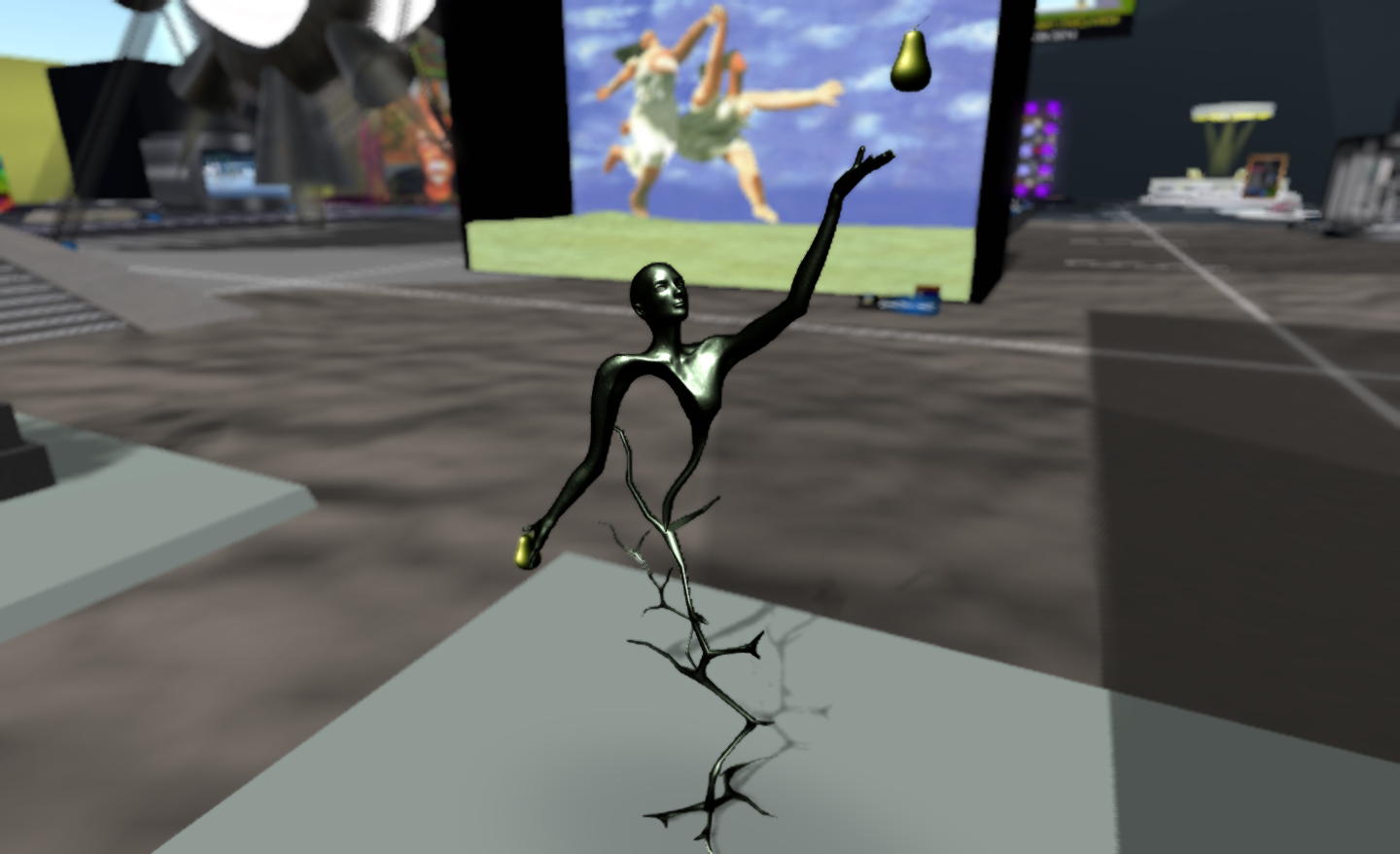
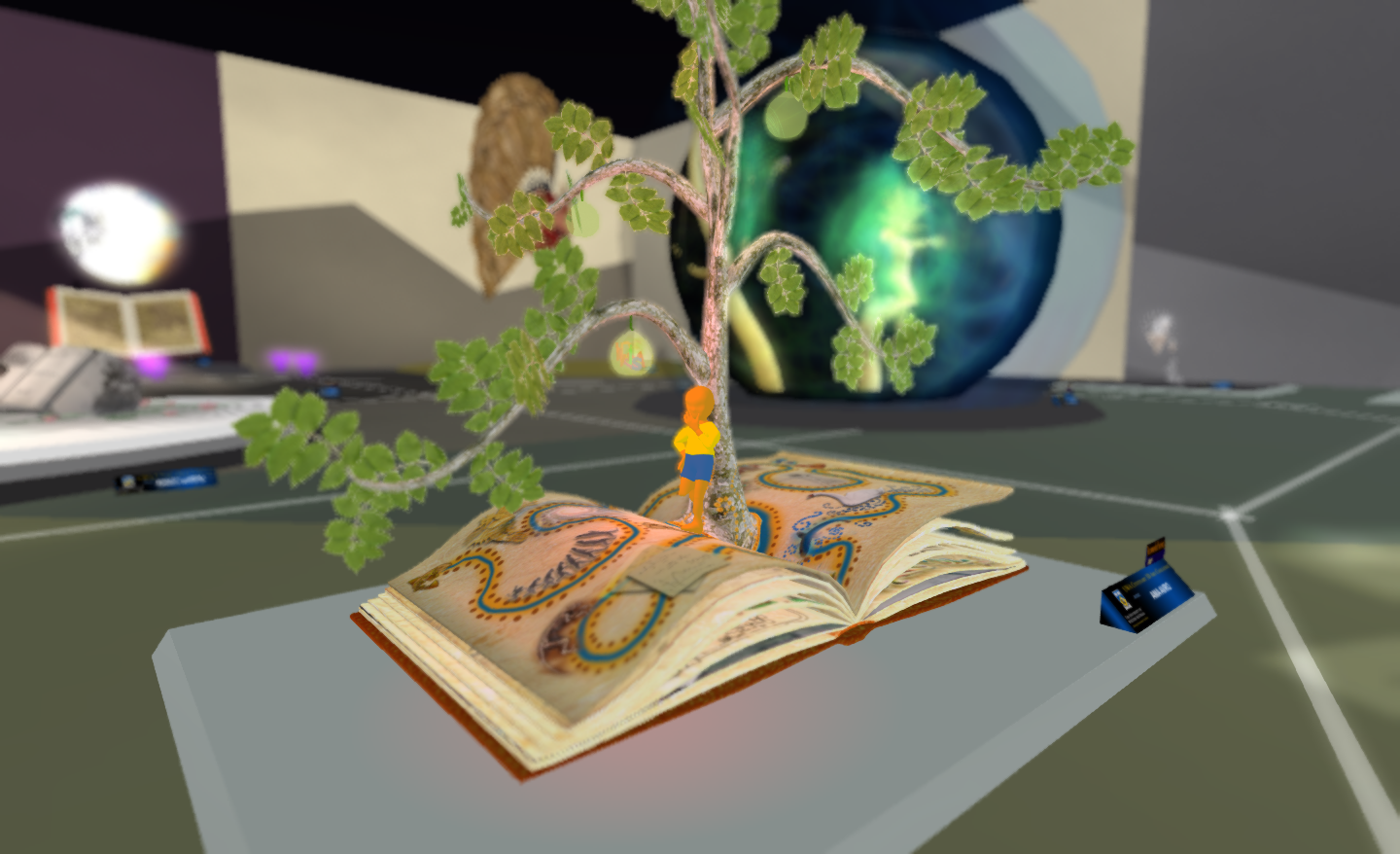
Entries recently closed for the University of Western Australia’s (UWA) 3D Art Challenge, which was open to artists from February 1st through May 30th 2013.
Entitled “Reflections”, the Art Challenge was run in tribute to the 2013 Centenary of the University of Western Australia, as UWA reflects on its 100 years of existence and ponders the question of what the next 100 years will bring. The 2012 Art Challenge was also run in tribute to the Centenary. 2012 is 100 years since the first staff were hired at UWA and 2013 is 100 years since the first students started studying at UWA.
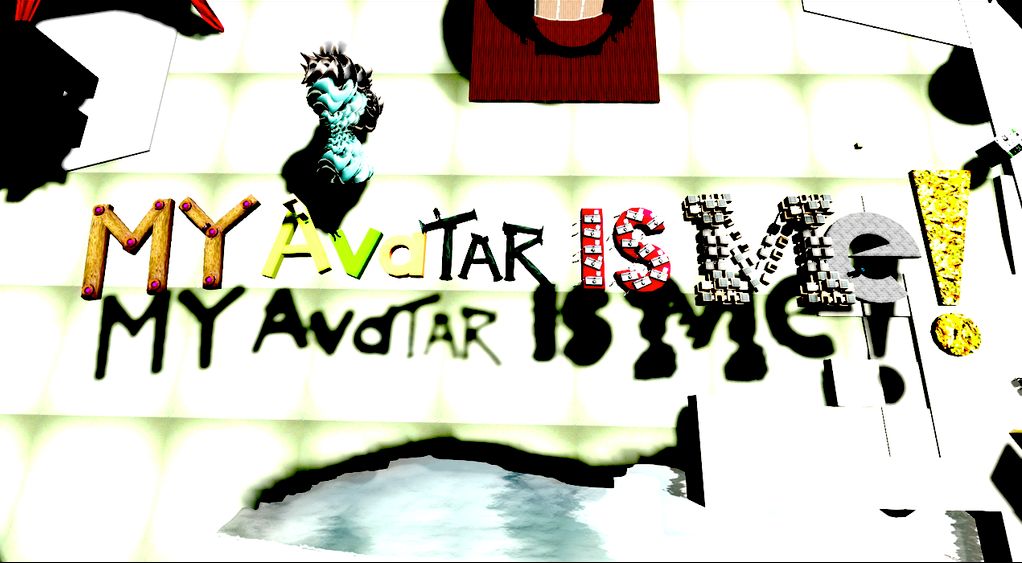
Artists were challenged to come up with a piece of 3D art which fits the theme of the challenge, and to do so using no more than 150 prims (LI 150). In all 64 artists from around the world accepted the challenge, and their works are now on display for all to see on one of the UWA’s regions.
Judging is underway by a panel of invited judges, and the winners will be announced in August 2013, at a special event which will include the winners of the 2013 UWA Machinima Challenge, which is also being held on the same theme.
However, between now and midnight SLT on July 10th, SL residents have a chance to vote on the 64 entries – and in doing so, win a share of L$20,000 and some real-life rewards in the process!
All you have to do to participate, is visit the UWA exhibition of the 64 pieces, and a select your personal top 10 in order of preference. Send your entries either by e-mail (jayjayaustralia@hotmail.com) or list them on a notecard and send it in-world to Jayjay Zifanwe (please make sure you put your name on the title of the notecard with the words REFLECTIONS UWA Centenary 3D Audience Event).
The five entries which most closely match the juried top ten will each receive the following L$ prizes:
1st Prize (mostly closely matching the judges’ top 10): L$ 7,000 and an invitation to be on the judging panel for the next UWA grand art challenge.
2nd Prize: L$ 5,000
3rd Prize: L$ 4,000
4th Prize: L$ 2,500
5th Prize: L$1,500
In addition, aLL five winners will receive in the mail a special pack that includes a copy of the book, ‘100 Treasures of UWA’ which was produced for UWA’s Centenary.
For full details on the audience participation judging, please make sure you read the UWA blog article, which includes links to both the start of the exhibition tour, and directly to each of the 64 entries in the competition.
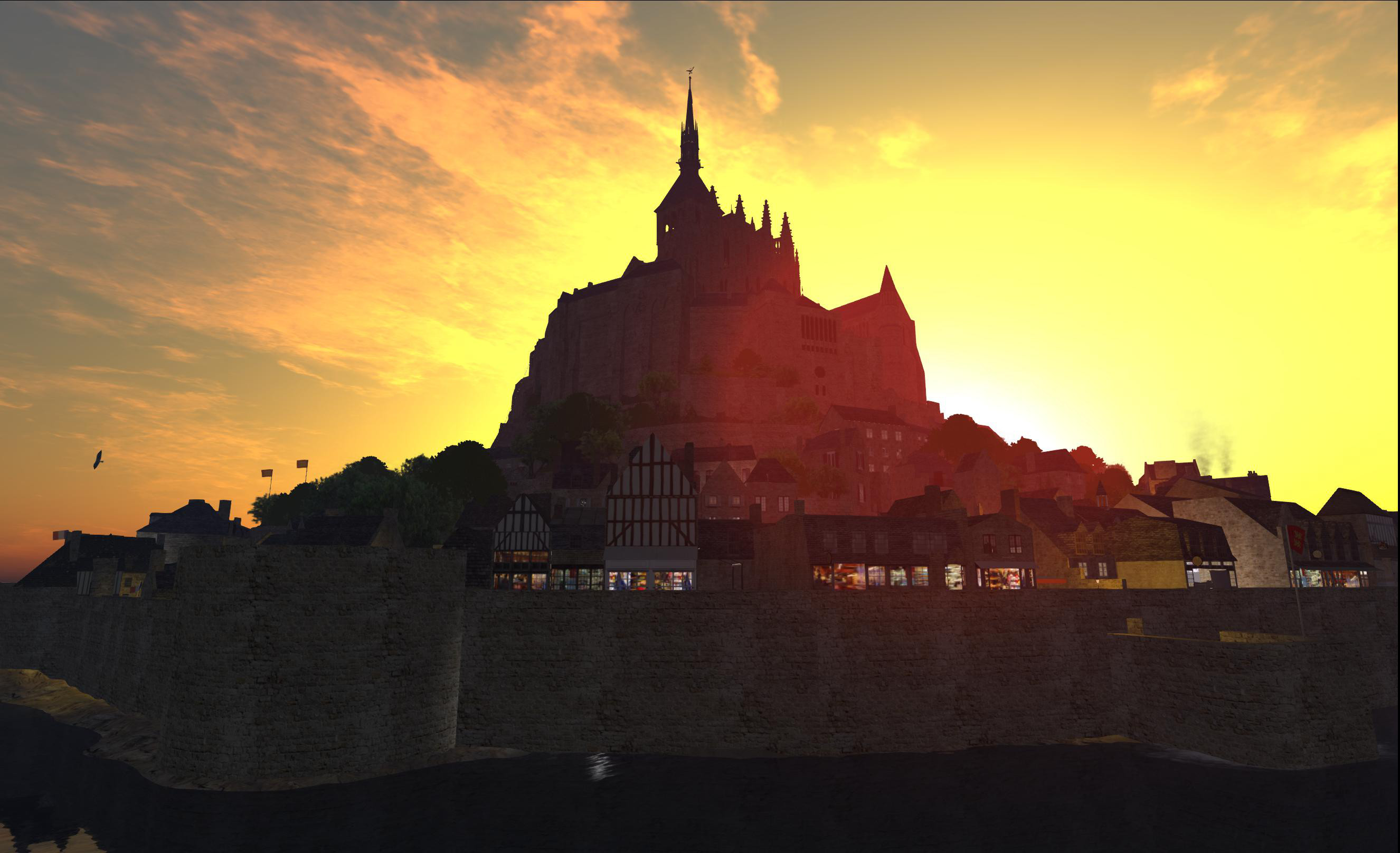
It’s been two years since I first blogged about Mont Saint Michel in Second Life. As I’ve been having a few issues with my GPU when logged-in the Second Life – particularly when taking snapshots with the various bells and whistles active – I stopped by the Mont in order to try things out after having fiddled with drivers and such-like, and grabbed a couple of snaps.
There have been a few changes over the years since my first review, with the “car park” region having long since vanished and a few more cars now on the island itself.
This is a great place to explore, with shops and parks to wander through en route up to the abbey itself and – for those willing to find it, a hidden secret which I actually missed during my original visit, but had to go back and find after several friend nudged me in the right direction.
If you’ve not paid a visit in the past, I cannot help but recommend you do.
As regulars here will know, I’m kind-of into SL sailing and flying, have written about both rather a lot since tumbling into both quite by chance, with my most recent acquisition for the former being the E-Tech Sparrow, which is leaning me dangerously close to seeing if I can rent some water-front land somewhere (I have modest needs; nothing larger than 2048 sq metre & room enough for a cottage, a bit of landscaping and a dock…).
However, it occurred to me that while I have been out on (and over) the water rather a lot over the past few months, particularly on Blake Sea, I’ve never actually blogged about places there – and there is rather a lot to see and do, beside sailing / flying.
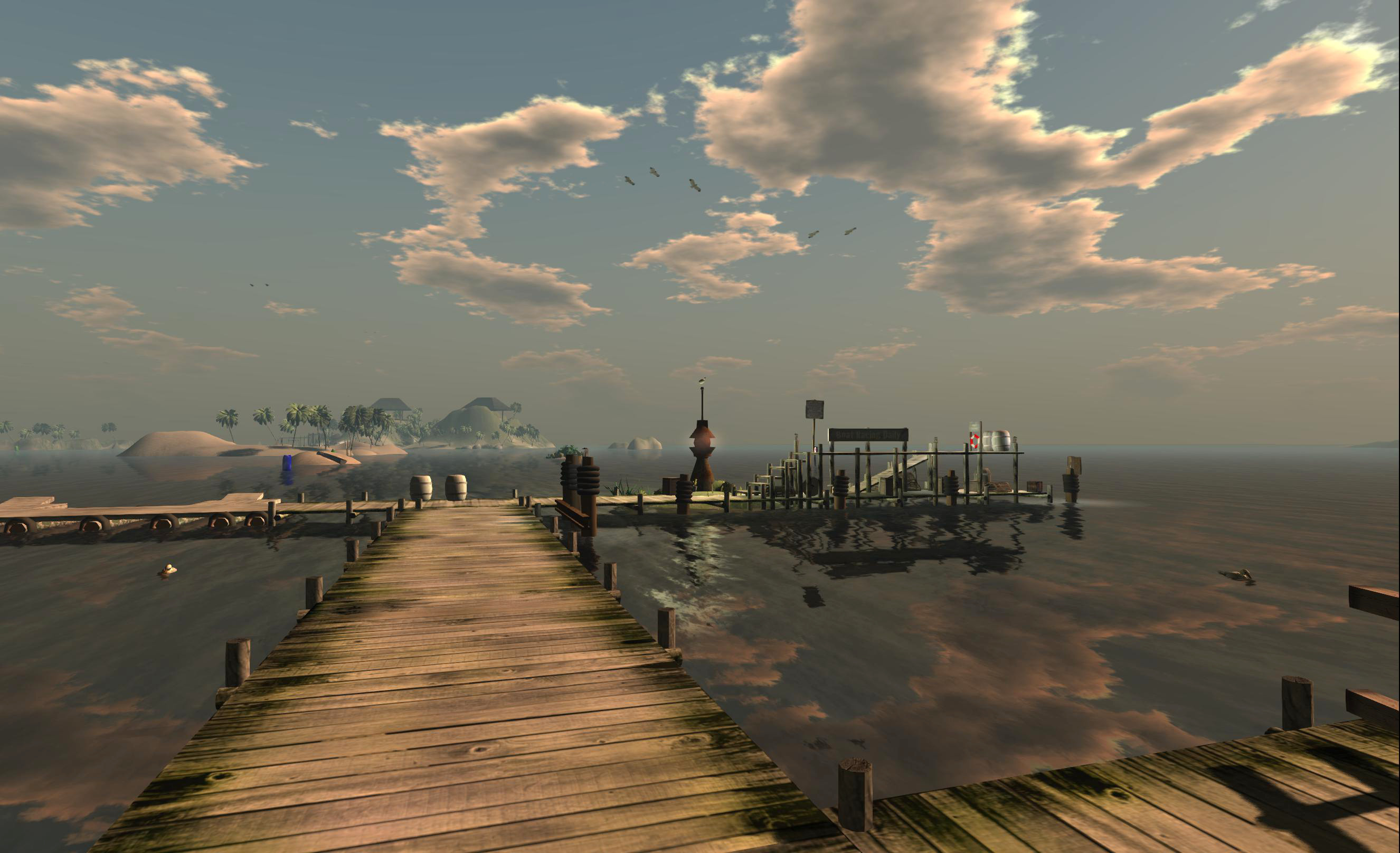
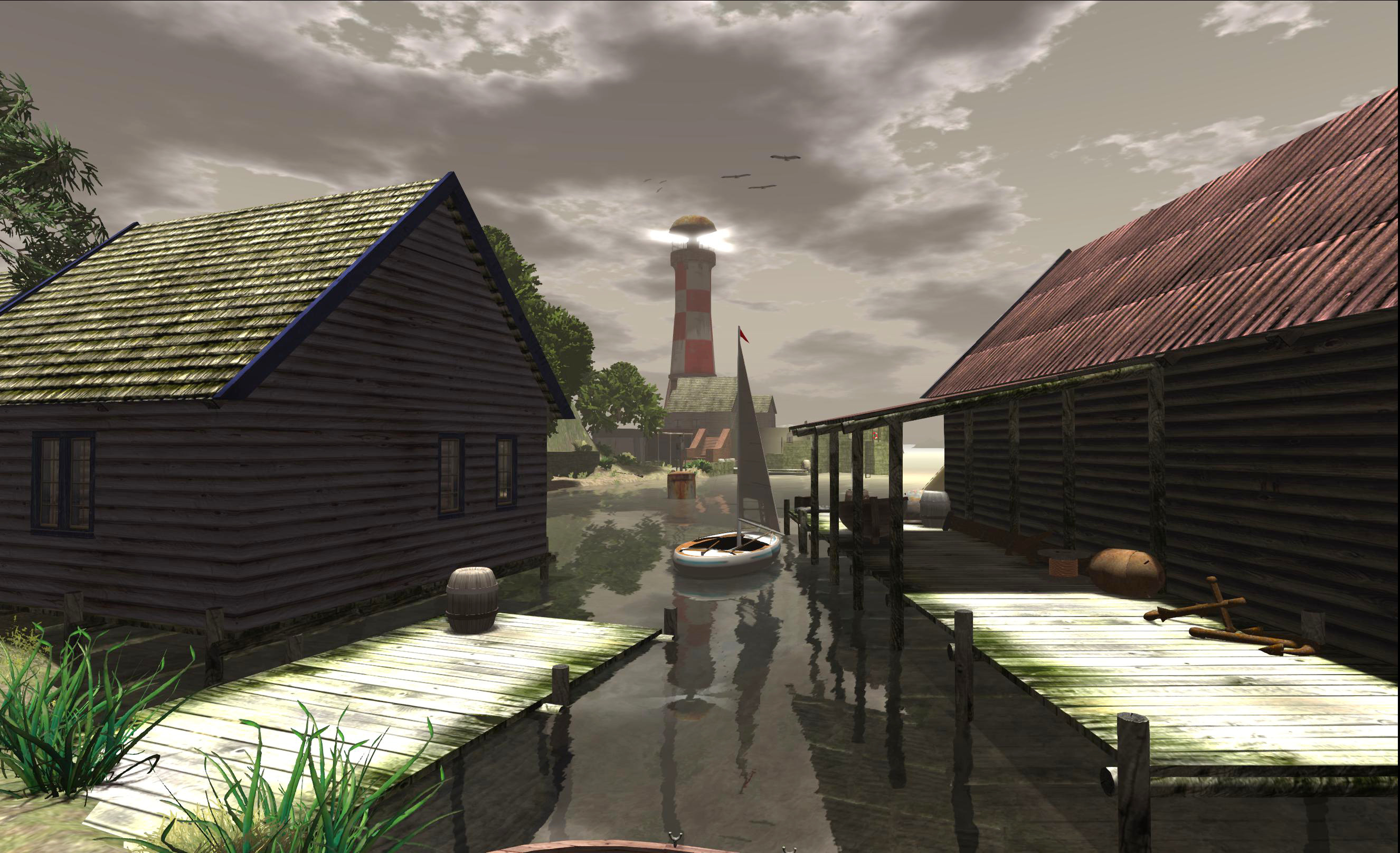
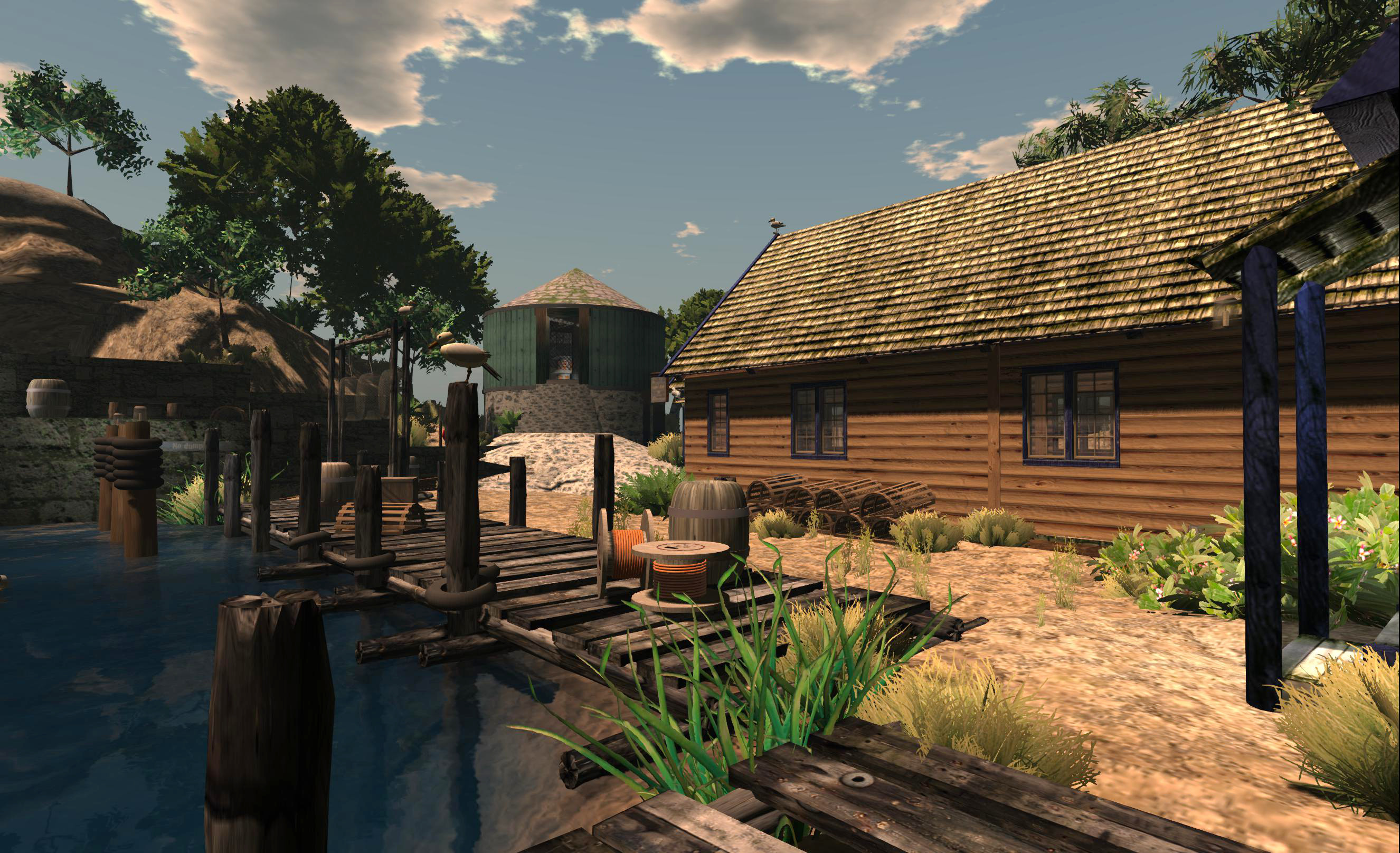
Take Half Hitch, for example. This is one of the areas in Blake Sea where you can rez your own boat (or seaplane or submarine – whatever takes you), and set out to explore the ocean blue. It’s like that many people arriving there never get beyond the quayside landing point and rez zone, which is a shame, as there is a lot to poke about at on the island – just take a wander through the cave at the landward end of the quay.
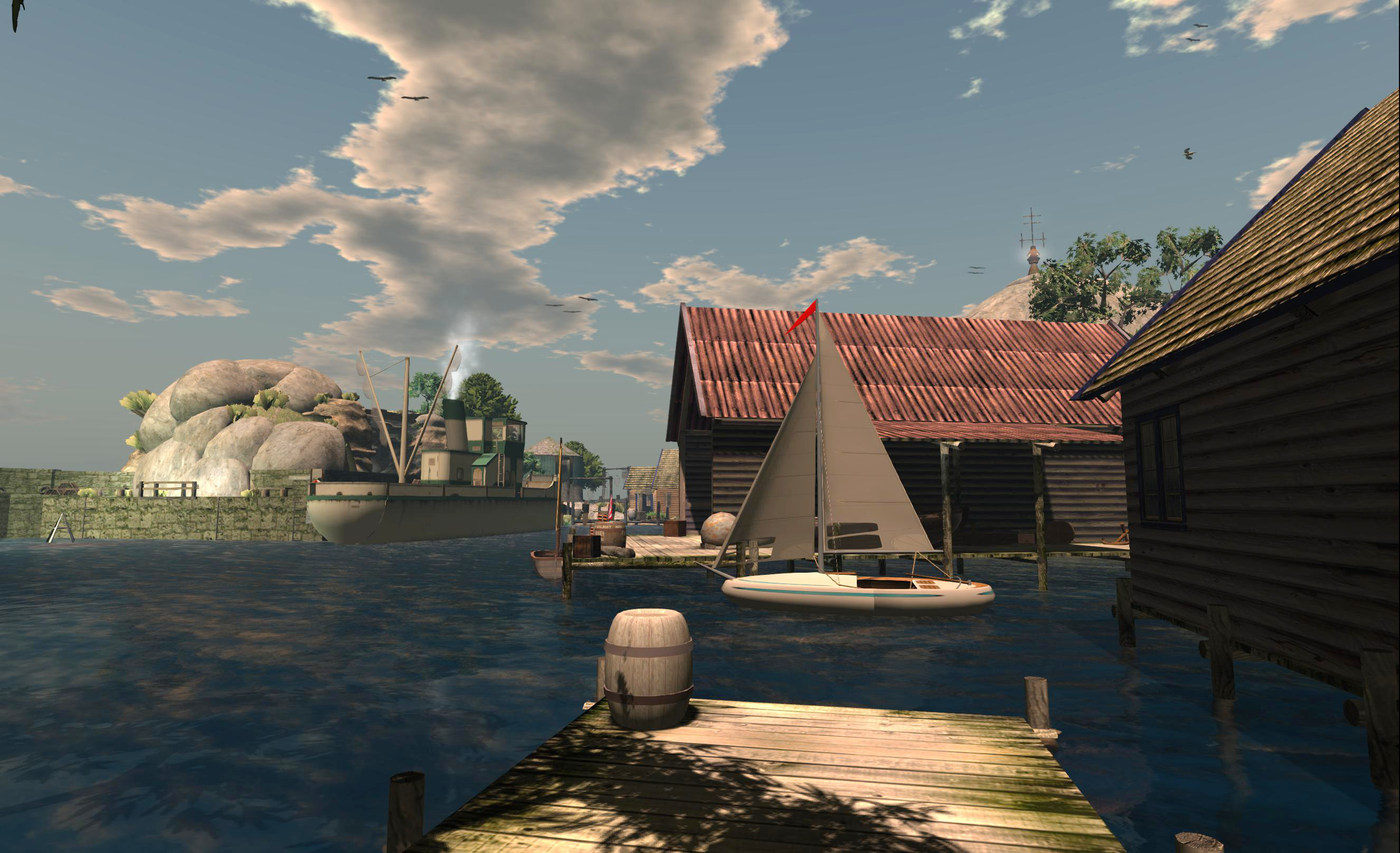
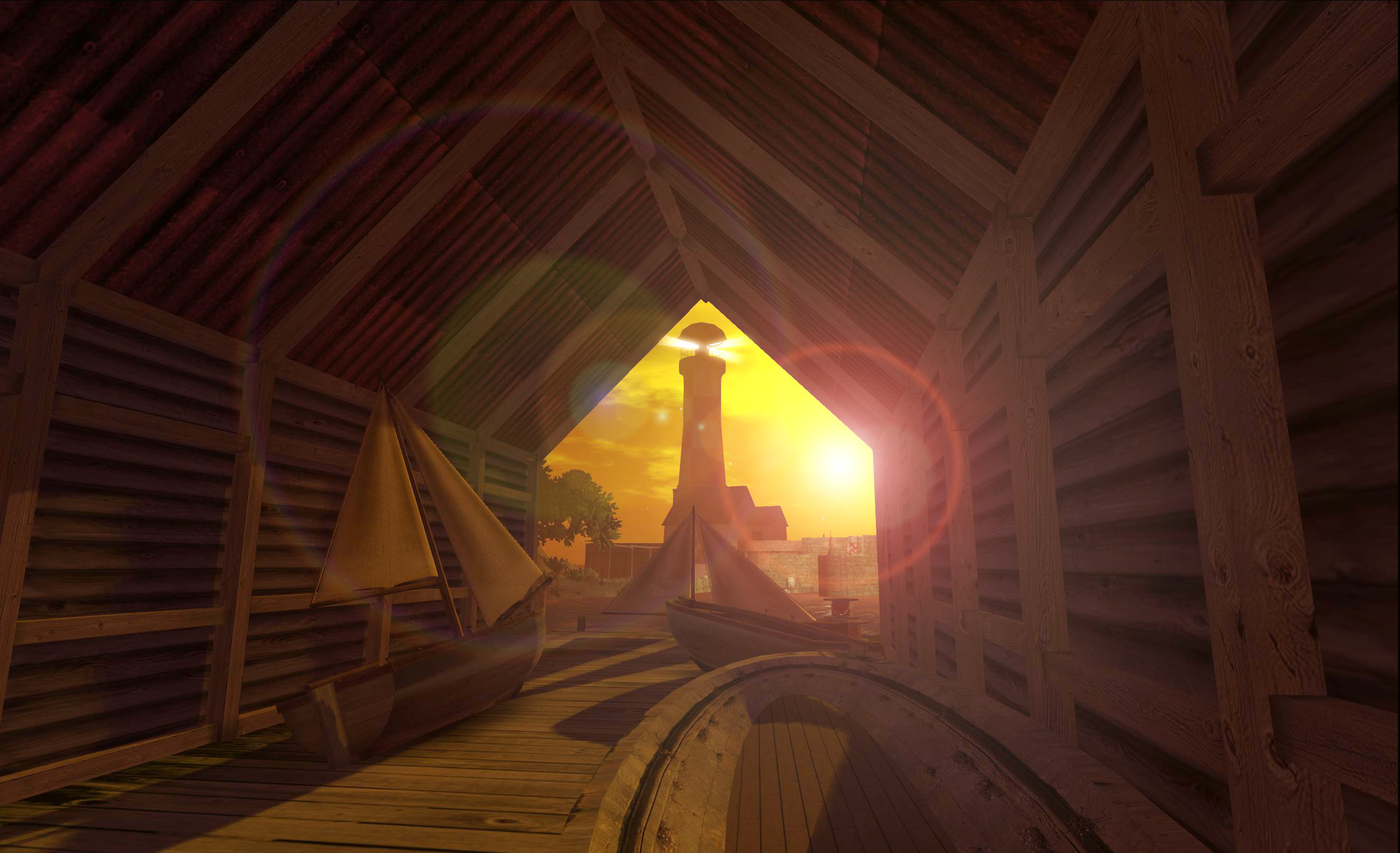
On the other side of the cave tunnel is a sheltered port, complete with breakwater, a lighthouse and warning buoys to guide boats in, and quays and buildings which form a part of a small fishing “community” – there’s even a trawler sitting dockside, either getting up steam to sail on the morning tide or which may have recently returned to port after a day’s fishing.
Now, the build is admitted not state-of-the-art. Some of the rock formations on the north side of the island are decidedly spherical, some of the textures are a tad low-res – but remember, everything around Blake Sea is designed to be low-lag to aid the flying and sailing and – in particular – to assist with any racing which may be going on. And anyway, “dated” doesn’t necessarily mean “not worth exploring”.
There are lots of little corners to poke and pry at here, and even more opportunities for the SL photographer. Those who want to try their hands with sailing can also find a demo boat rezzer which will help them take to the water and skim around a bit, and there are some nice little look-out points to watch the world go by or where you can watch any racing taking place.
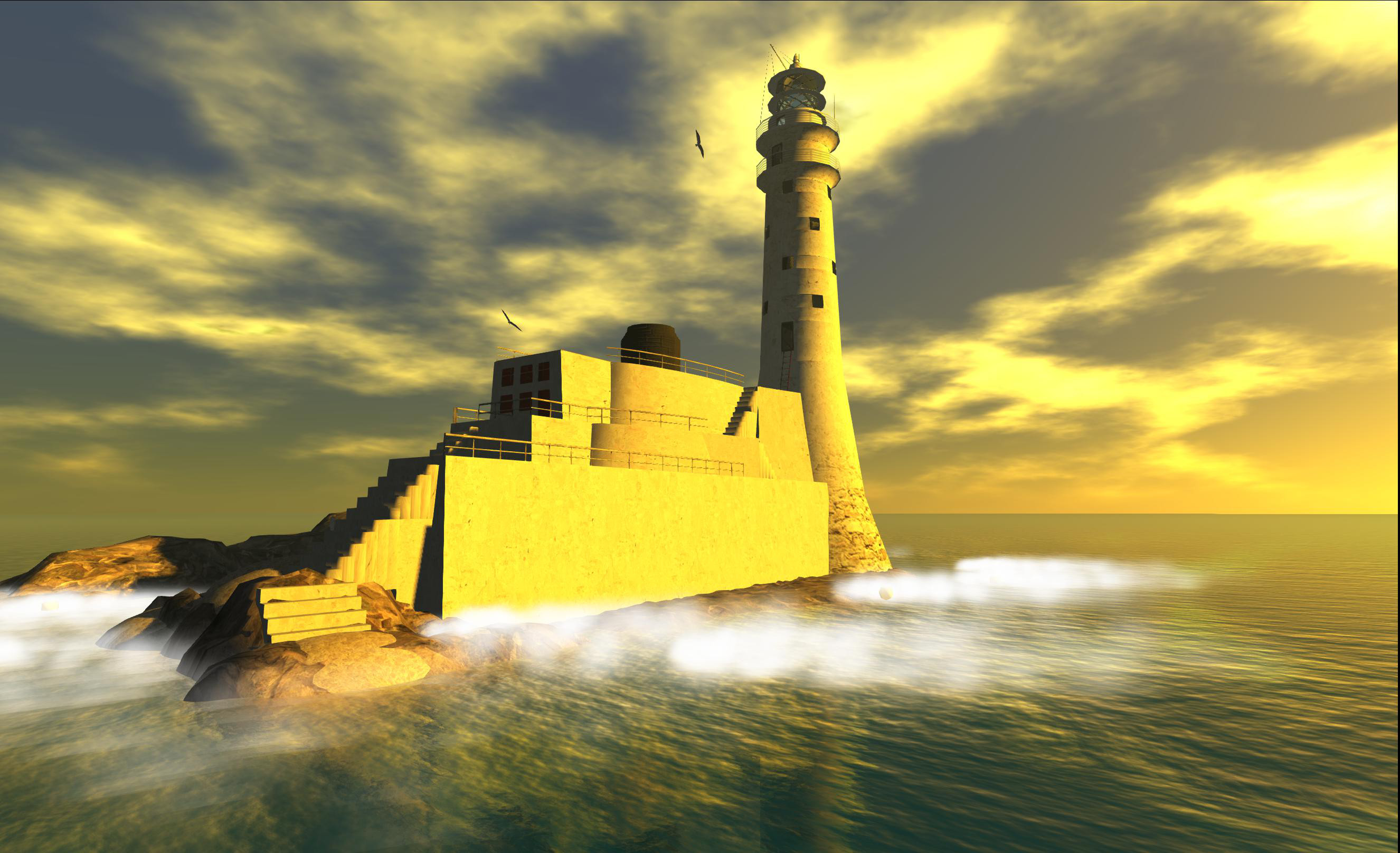
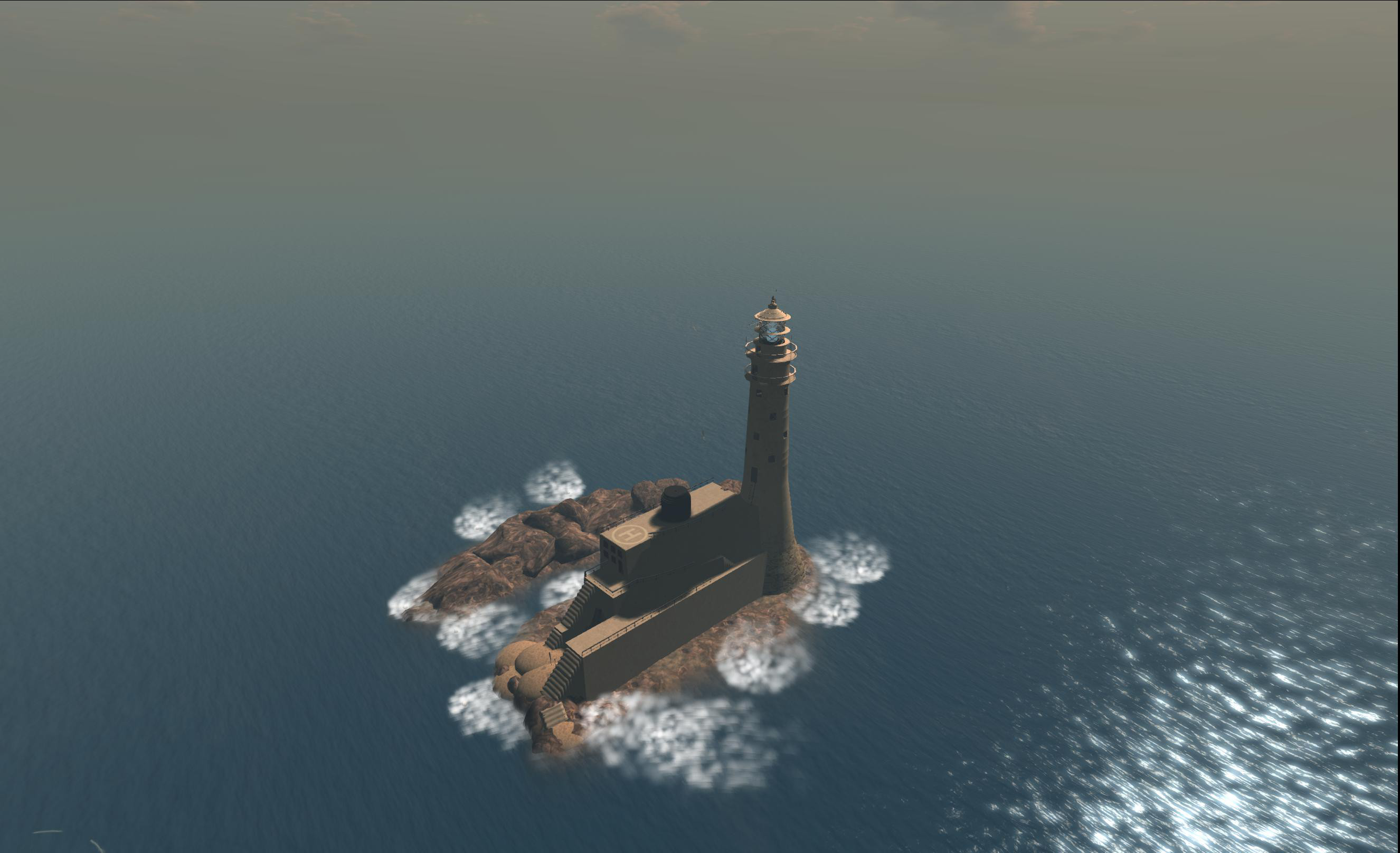
Those who do take to the water and sail west may well encounter the Crow’s Nest Lighthouse, which has again featured in some pictures in this blog. This is actually a build based on a real life lighthouse (Fastnet Rock), and, if you have your draw distance down somewhat (something of a good idea when sailing / flying), appears as a reminded of what a lonely and isolated lives lighthouse keepers once had to lead.
I managed to grab one shot in particular of the lighthouse while flying east out of Hollywood Airport a couple of months ago, which I think really demonstrates this last point, even if it’s not necessarily the most artistic of shots.
Should you opt to land at the lighthouse, there’s not a lot to actually see inside the lighthouse – although if you look hard enough, you’ll find a picture of the real life original. – but that’s not the point, it’s a great little build in its own right which does much to enhance Blake Sea, as well as providing a useful way-point for sailors. Outside of the lighthouse tower, however – and as pointed out by Lance Corrimal in the comment below – there is a memorial for all members of the SL Sailing community who have passed away.
There’s a lot else to see out on the Sea – so if you haven’t given it a try, why not have a mooch around the waters?
The David Rumsey Map Collection is just about everything any cartographer with an interest in the history of the subject and a particular focus on the Americas could ever want. Over 39,000 maps are on file – although these also include various maps of Africa, Asia and Europe. The maps can be accessed through a number of online viewers and services – including Second Life!
The SL exhibit covers four adjoining regions and presents a number of displays, information boards and links to the main website which, taken together, form an interactive means of study and offers the opportunity to learn about cartography.
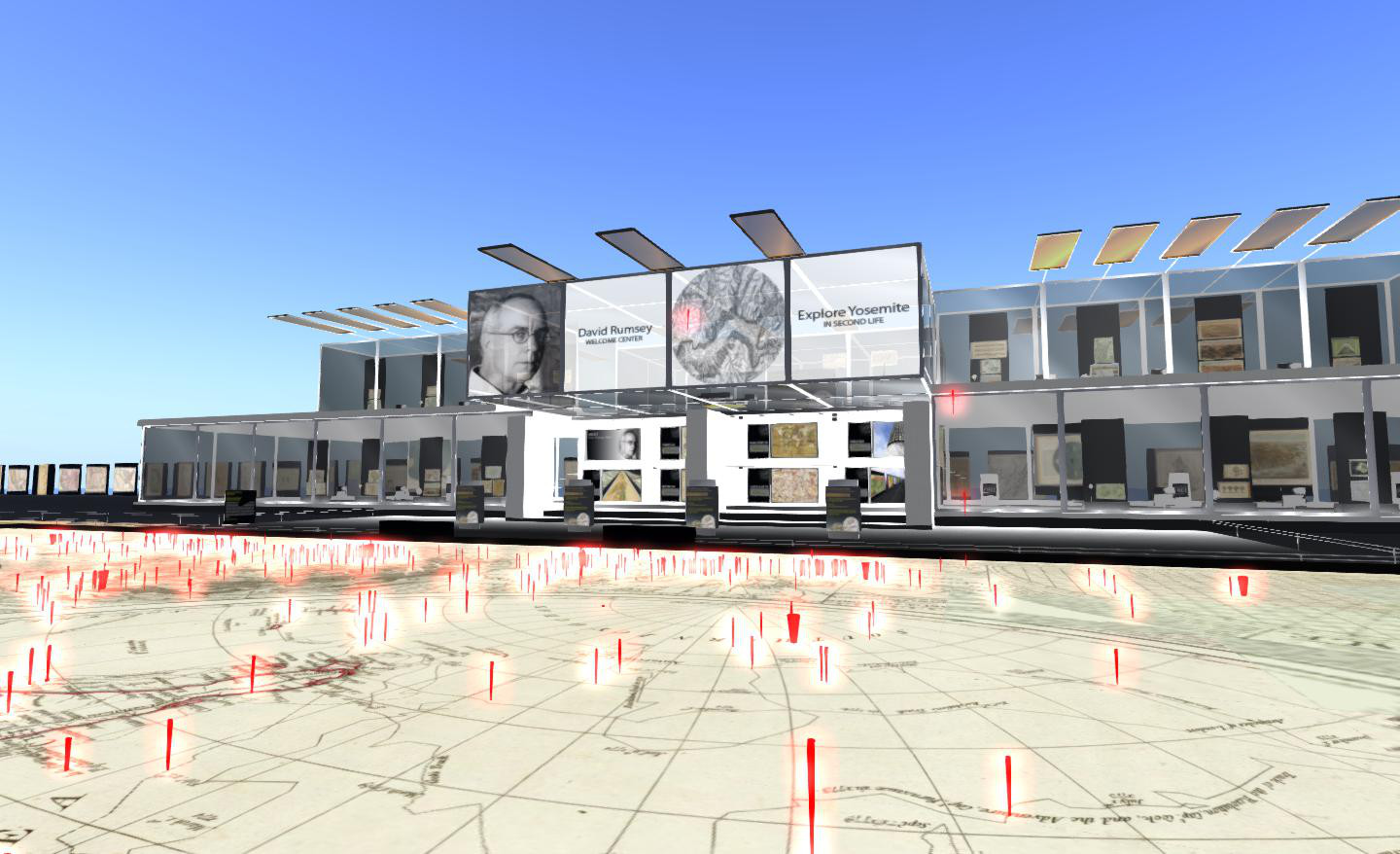
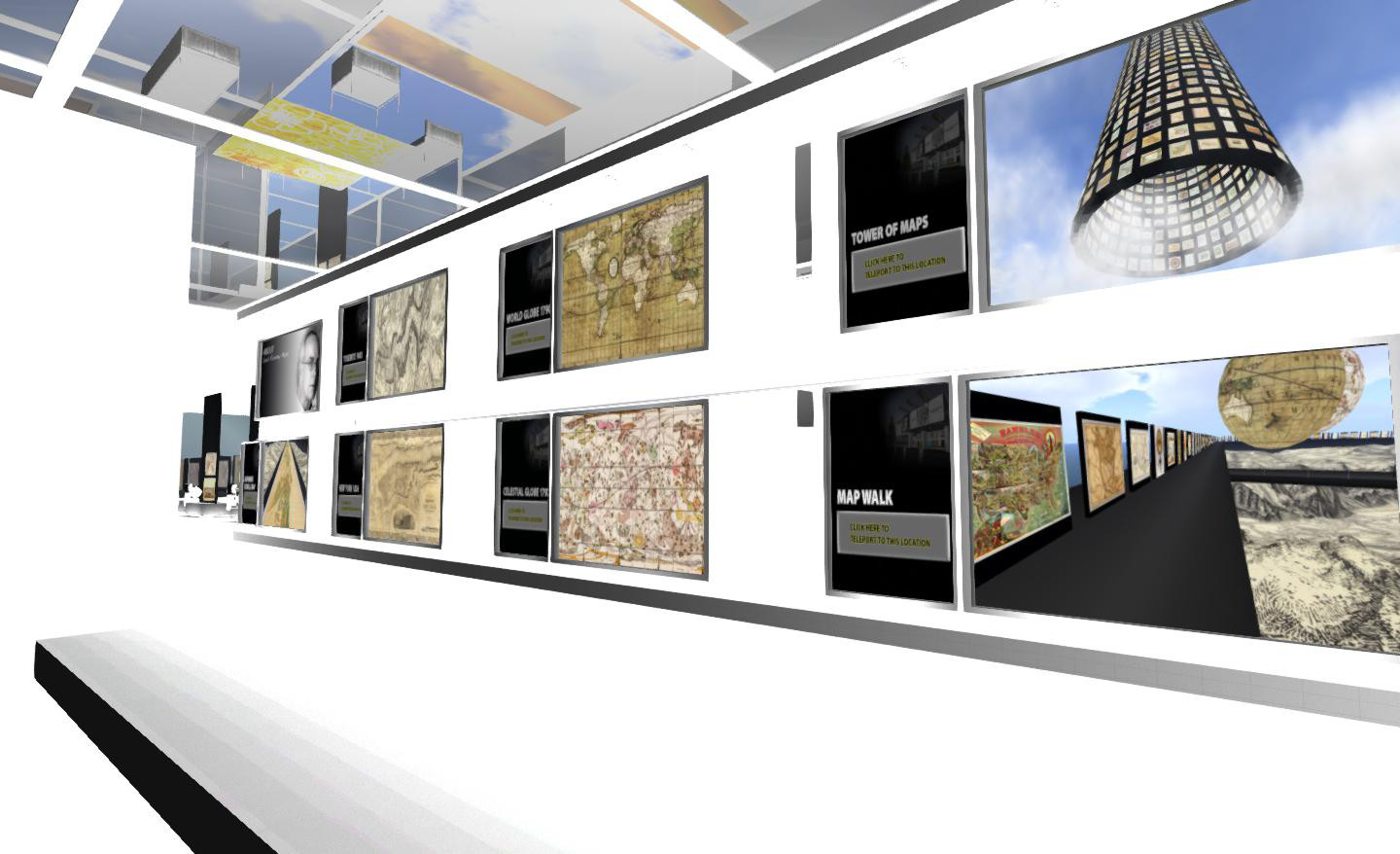
The arrival point comprises an information centre where you can learn about David Rumsey Maps, the SL exhibit and access teleports to the various displays. Directly outside of this is a push-pin map of the world, with the invitation for visitors to move one of several push-pin “givers” over their home location, add a pin and leave a message of up to 140 characters in length.
Below this, and covering all four regions is a gigantic topographical map of Yosemite Park and its surrounding areas, circa 1883, complete with a floating observation deck. Control options allow you to view the map with full bright on or off, and as a 3D relief display (using sculpts) or a conventional 2D map.
Above the 4-region map is a small orientation centre for those new to SL, and above that is a reproduction of J.H Colton’s 1836 map of New York. complete with models of some well-known landmarks (such as the Empire State Building, Brooklyn Bridge and City Hall) which help give the map context to modern eyes.
Elsewhere in the build are touch-boards on the Map walk which surrounds all four regions and the gigantic Tower of Maps, which provide direct access to various maps and pages on the website. You can also hop inside two globe maps or admire a Japanese scroll map.
All-in-all this is an extensive and excellent use of Second Life, with the information centre also providing audio / video presentations as well as a range of collectibles (40 in all), which you can pick-up as you explore. There is also a skyborne auditorium, but I’m not sure if that is still running the advertised programme (I’ve managed to miss hopping over there at noon SLT to find out the last few times it has crossed my mind to check…).
David Rumsey Maps makes for a worthwhile visit for anyone interested in cartography, and an engrossing use of Second Life. One word of advice should you visit – turn up your drawn distance to at least 512m to get the fullest benefit.
August 2013: Flocke, asdescribed here, has gone & the region is under redevelopment.
The world seen through a child’s eye, is a world full of wonders. A world where imagination reveals many paths. The world seen within the eye of an adult can sometimes be scary and make us want to hide and close the eyes. Still we are, even if grown in age, children of this world … A journey about ‘Reality and Illusions’. A visual discussion where you might explore sometimes beauty and sometimes the strange and odd.
This is the description Joanna Corith gives to her new collaborative project at Flocke, which she has developed with Pale Illusion. It’s a region that is bound to grab my attention, as it features water, so I was pleased to get the nudge from Baz D. to go take a look.
Flocke is a place which can be explored as an art installation and simply as a place to visit. As an art installation, the introductory notecard for the region (tucked neatly aware in a little signboard .. somewhere … :)) reads, “We’d like to invite you to a little visual journey of a discussion we have about ‘REALITY’ and ‘ILLUSION’ and hope you’ll have fun to explore our thoughts, questions and perhaps conclusions we will make.”
As a place to visit, Flocke offers places to dance with a friend, or to sit and contemplate things (or one another) and a little open-air movie theatre.
Given recent world events, with tornadoes and floods making the headlines, the region’s design is also somewhat evocative and thought-provoking, with shattered houses suspended in the air, flooded ruins on the ground and even a ravaged houseboat. As such, I admit I found my mind wandering in directions other than the nature of reality and illusion, despite the region’s designed being framed by Albert Einstein’s famous quote, “Reality is merely an illusion, albeit a very persistent one”. I also found the inclusion of the little rafts with floating candles on one side of the region particularly poignant as a result.
That I was reminded of recent real life tragedies is not to condemn the build in any way. Far from it; that Flocke is so evocative on a number of different levels is to me a demonstration of the visual power of this open, almost minimal design. So I look at my own thoughts while visiting as reflective of the fact that we cannot avoid carrying matters from the real world into our second lives, and can thus find those matters resonating with us in the most unexpected of ways.
Often, when I visit a region, I tend to tweak my windlight settings, even if the region owner has set a complementary setting of their own. It’s not necessarily that I don’t like the selected windlight; it’s more a case that I like to have a twiddle and a play and present things in a (hopefully) interesting way in my snaps which still allowing anyone who may visit off the back of these pieces the broadest measure of discovery & the opportunity to perhaps tweak and place with their own windlight options.
Flocke, however, is one of the exceptions to this approach. The use of the Bristol pre-set with the region is simply perfect, and gives the region all the atmosphere it needs, so all the pictures here are presented “as-is”, so to speak, although I admit to twiddling with GIMP a little with a couple to get the desired monochrome results on the Flickr slideshow.
This may be an open and minimalist region in terms of landscaping, but you should keep your eyes peeled; there are some very interesting, subtle, charming and whimsical touches to be found as your wander around. For those wishing simply to relax, try the little movie theatre in the corner of the region or perhaps spend a little time sitting on the raft.
I spent a good two hours in Flocke with a roaming camera, poking, nosing and snapping – and the truth is, I could happily have spent another two doing exactly the same. Sadly, the needs of a rumbly tummy and the matter of sustenance proved to be increasingly distracting, despite my attempts to convince myself otherwise by repeating another famous quote on the matter of illusions: “Time is an illusion, lunchtime doubly so.”
Rest assured, however, I’ll be returning to Flocke. It’s that kind of place. Hopefully, I might see you there …
Second Life is ahead of its generation, but very traditional in the fact that it enables creativity, and I believe that that is the most powerful form of entertainment.
So speaks Rod Humble in the seventh segment of The Drax Files. which aired on Monday June 3rd.
The plan had been to keep the guest a surprise for as long as possible (I was sworn to secrecy back before the segment had even been filmed), but word started leaking out after Rod made several in-world appearances using both his primary account and some of his alts.
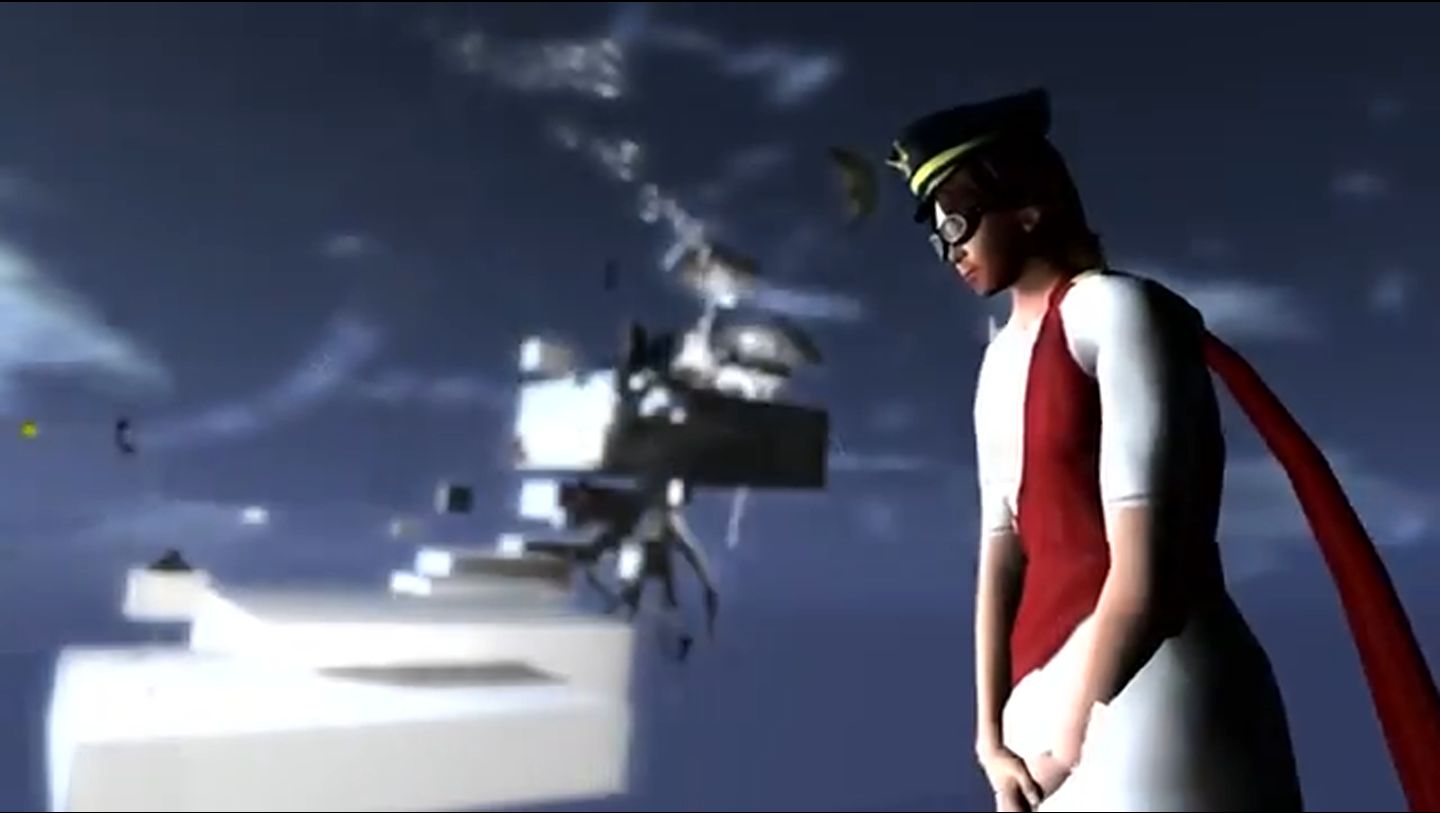
Through his alter-ego, Rodvik Linden, Rod Humble contemplates echoes of the future
Featuring footage shot both in-world and at the Lab’s main offices in Battery Street, San Francisco, the segment is a rapid-fire overview of Second Life, its impact on the world and how senior management at the Lab view what is happening to the platform and how they think it is fairing. As such, it is possible that some of Rod Humble’s comments may come across as superficial and be critiqued as such. However, this is only a five-minute piece, and the established format of the show isn’t suited to any in-depth analysis or reporter-led interrogative, and to expect it to be so would be unfair.
What does emerge from the segment is a picture of a man who has both the responsibility for ensuring Second Life maintains a comfortable level of success which at the same time and who – contrary to popular belief in some quarters – does actually “get” Second life in many fundamental ways, even if he may not have a complete understanding of its appeal.
There is admittedly a juxtaposition here; on the one hand, Rod Humble has spent more than two years of hard grind at the helm of Linden Lab, and has steered the company into new waters of unknown depth while at the same time pushing for very real investment in their flagship product and driving forward a range of new technical initiatives for Second Life. All of this does speak of someone who has an eye on the future for the platform and who recognises its many technical weaknesses.
Yet, on the other hand, he talks with disarming honesty about the bemusement he feels towards SL’s continued success and longevity and the fact that why it is successful remains something of a mystery – and something which appears to be completely missed by the tech industry and media as a whole.
Avatar identity and pseudonymity (and the individuals’ right to the latter) are matters of import to Rod Humble (images courtesy of Draxtor Despres)
There are some familiar themes in the piece which anyone who is reasonably familiar with Rod Humble and his past commentaries is likely to instantly recognise. His comments on matters of privacy and anonymity, for example, are pretty much echo what he said at the last of the Second Life Community Conventions in 2011. Similarly, the numbers quoted are pretty much the same as we’ve been hearing for the last couple of years. But repetition alone doesn’t invalidate what is being said.
Things like avatar identity and pseudonymity / personas are matters which concern many SL users, so the fact that Rod Humble hasn’t shifted his stance of the matter in the course of his tenure at the helm of Linden Research should be taken as a positive sign.
Similarly, while many of us within SL would like to see more visible moves towards getting more of the 400,000 monthly sign-ups to stick, we also need to remember that this video isn’t about dissecting Second Life this way or that: it is about presenting the world with a better understanding of the platform and why people enjoy it so much – and hopefully encourage people to come and give things a try. As such, Rod’s message is very much on topic and in keeping with past segments of the show.
Rod Humble roams SL in one of his many alts (image courtesy of Draxtor Despres)
Another aspect of the anonymity element in the segment is the way in which it serves as a reminder that just because we don’t people moving around and through Second Life wearing “Linden” tags doesn’t mean actually mean Lab don’t spend time in-world and among users. As Rod comments:
I love flying around with my alts. Sometimes I’m dressed as a Greek philosopher, sometimes I’m a spaceship, sometimes I’m dressed as an animal! I mean, it’s great! And [in] each one of those personas you can fully engage in a way community in a way that you can’t when everybody knows it’s Rod Humble.
Obviously, this doesn’t mean Lab staff are in-world every minute of the day – but it is a comment which should be born in mind when critiquing the Lab with claims that staff are “never” in-world.
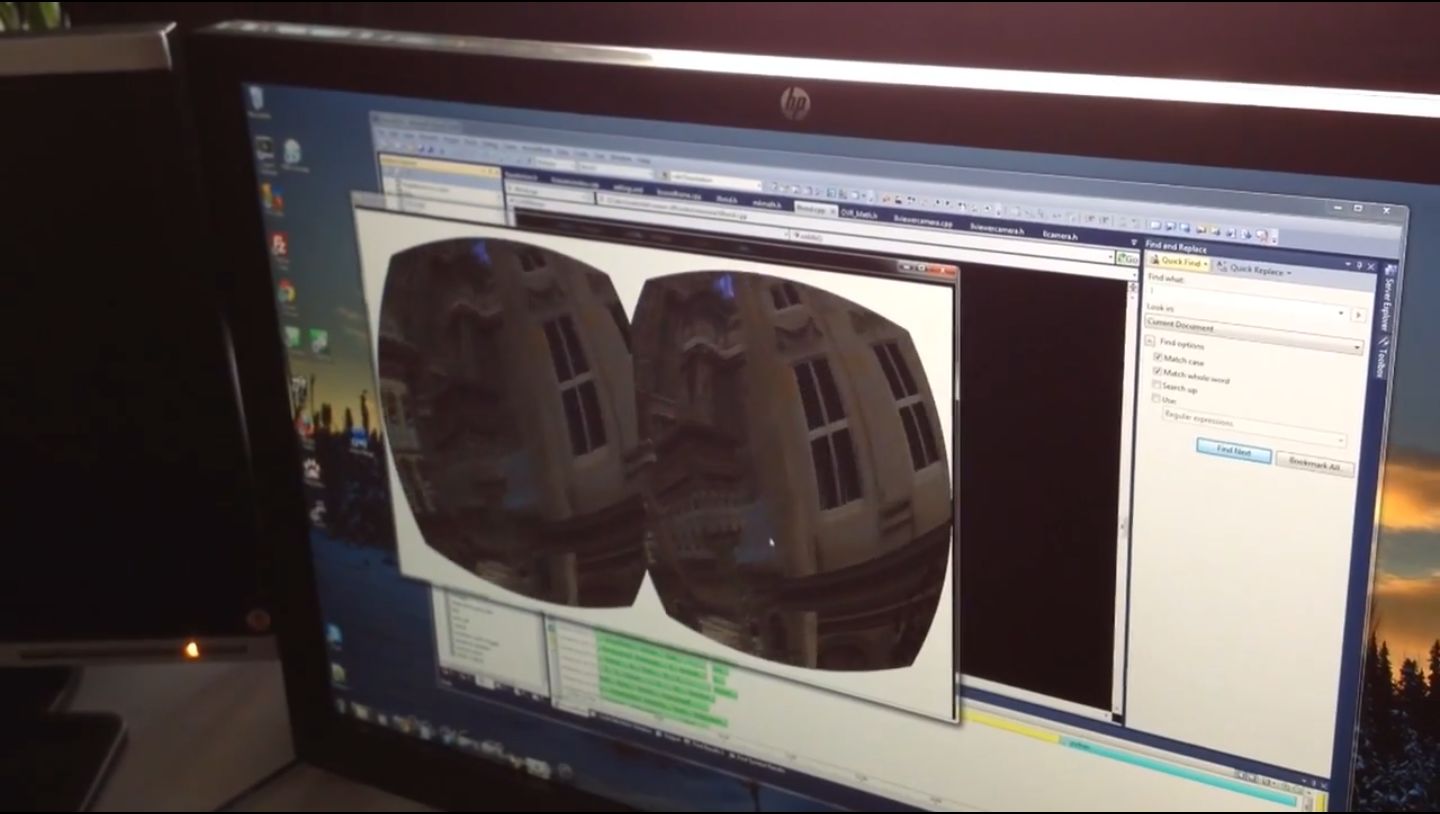
“we have the Oculus Rift working within Second Life, and we are working to make it a triple-A experience, particularly around the user interface…”
As noted at the top of this piece, the show also demonstrates that Rod Humble still intuitively “gets” the power of Second Life, even if he doesn’t by his own admission fully understand why the appeal is the way it is (something I think true of a lot people, even if we each have our own ideas and theories). Not only does he “get” it, he is actually leading the charge to make SL a better, more enjoyable experience for all of us, old and new.
The fact that LL have invested considerable time and effort into SL over the course of the last year or more should stand as a reminder that the company still believes the platform is viable – and that is good news for the platform and its future, even if the projects concerned aren’t that visible or what people might view as being “sexy” (which has been used at times as a reason to bash this work and the Lab). While such efforts may not solve all of SL’s woes, they do at least demonstrate that the Lab’s commitment to the platform is still there.
And as we approach SL’s 10th birthday celebrations, that really is worth while remembering.
 Entries recently closed for the University of Western Australia’s (UWA) 3D Art Challenge, which was open to artists from February 1st through May 30th 2013.