UWA announces Freedom Project books available

The Freedom Project FINAL 26 Aug, 2013

Launched on Sunday September 1st, 2013, the Freedom Project was a joint undertaking by the University of Western Australia,  Virtual Ability Inc., and the Centre for ME/CFS and Other Invisible Illnesses.

A 2D and 3D art and film event, the project extended an open invitation to artists suffering from a disability or chronic illness, or associated with those suffering from either, to demonstrate how virtual life has enabled them to engage in activities and interact with others in ways which may not be possible in the real world.

I covered the launch of the project at the time, and subsequently reported on the opening of the Freedom Project art exhibition in the UWA’s gallery spaces in March of 2014 (the exhibition is still open for viewing at the time of writing for those who would like to visit, although the exhibition will be taken down in the next two or three weeks to provide the UWA’s Transcending Borders project additional display space.

At the time the challenge was announced, it was indicated that art pieces submitted to the Freedom Project would feature in a commemorative book – both digital and orinted – in the hope that both the book and the exhibited pieces and films will inspire others, and will demonstrate how virtual worlds can be used to help some people who may have had difficulties finding other means of expression to believe in themselves more, or to connect with others.

The Freddom Project book is now available in in or electronically as a part of the UWA's Studies in Virtual Arts (SiVA) series of e-journals
The Freedom Project book is now available in print or electronically as a part of the UWA’s Studies in Virtual Arts (SiVA) series of e-journals

On Friday September 5th, FreeWee Ling, curator of the UWA’s gallery spaces and co-ordinator of the UWA’s virtual world art projects, announced that the Freedom Project book is now available.

Lavishly produced and illustrated, the book tells of the origins of the project and provides an overview of the global nature of the project and the events which took place within Second Life where it was represented; information on the project’s partner and sponsor organisations is also provided.

Central to the book is the art itself and the artists. The illustrations throughout are beautiful, with many of the pieces being given wonderful two-page spreads. The artists’ stories, told in their own words, are equally as moving, making this a powerful piece of reading.

The Freedom Project book is lavishly compiled and presents both the artists and their work beautifully

The electronic version is available on-line as a part of the UWA Studies in Virtual Arts e-journals series. The printed version can be obtained for L$5000 (around $20.00 US), shipped anywhere in the world. Those wishing to purchase a copy should contact JayJay Zifanwee of the UWA for ordering information.

Artists and groups who participated in the challenge can also claim a free copy of the printed book – again, please contact JayJay Zifanwee for ordering details.
Related Links

Journey through a lost paradise

Bastet's Paradise, Aphrodite; Inara Pey, Sept 2014, on FlickrBastet’s Paradise, Aphrodite (Flickr) – click any image for full size

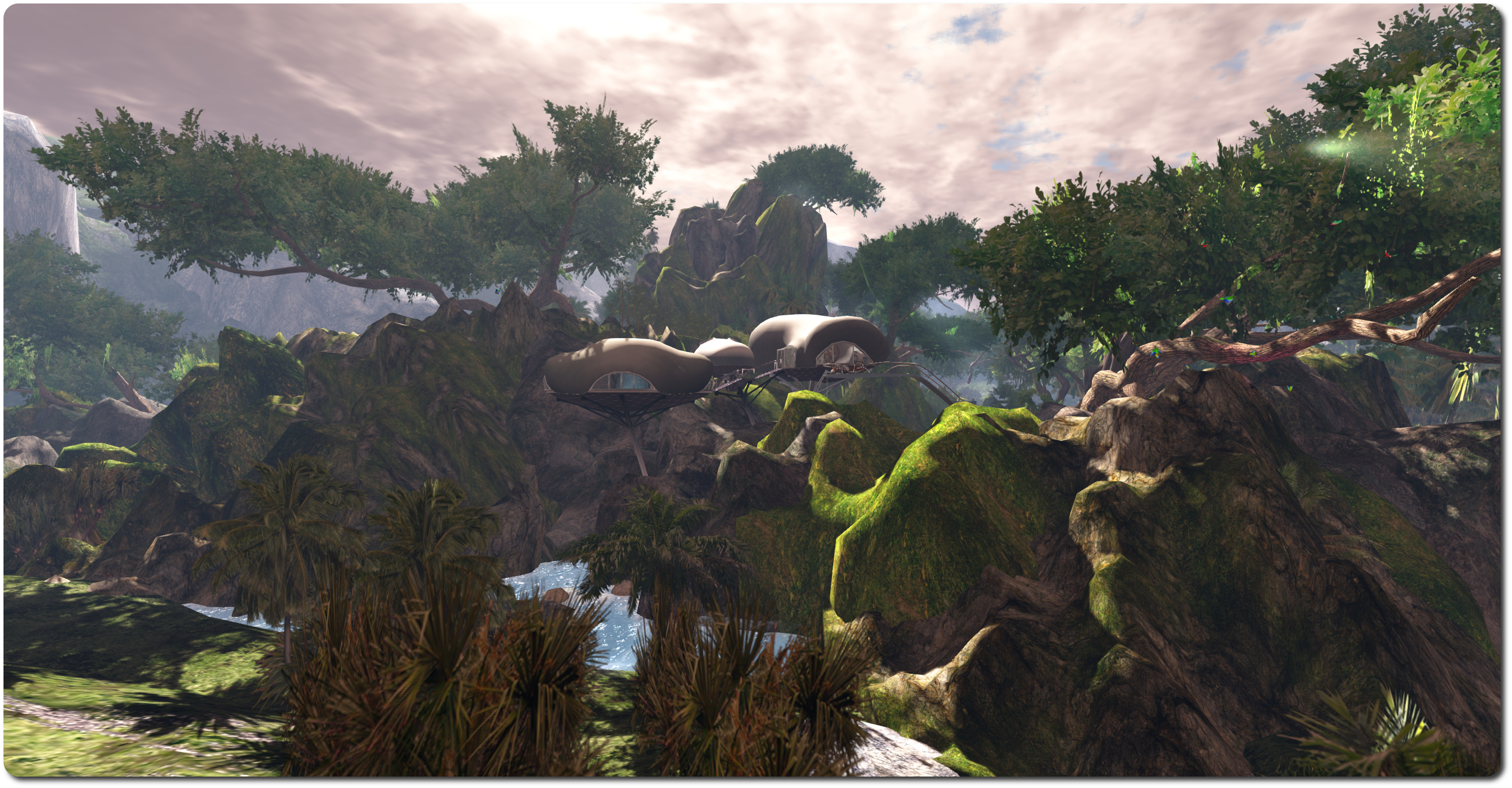
Bastet’s Paradise, referred to in the Destination Guide as The Lost Island, is a beautiful enigma inviting exploration. Designed by Tek Scientist, the region is a curious blend, offering a rich landscape for people to enjoy and explore, places to sit, or share or to dance, mixed with curious shades of adventure, fantasy and science-fiction.

The Landing point sits alongside a garden conservatory, complete a barbecue and outdoor kitchen, and offering a place for people to sit and, if they wish, enjoy a meal. All of which sounds nicely suburban; except the conservatory and patio appears to be sitting in a jungle clearing overlooking a river and with elephants standing close by…

Bastet's Paradise, Aphrodite; Inara Pey, Sept 2014, on FlickrBastet’s Paradise, Aphrodite (Flickr)

So, are we in Africa? Well, not entirely; the ruins a short walk away suggest we might be in South America, while beyond them a rounded tree house suggests something one might find hidden in Middle Earth, while the tiger roaming beneath the trees perhaps points towards the Indian sub-continent.  Elsewhere things have a distinctly sci-fi edge to them, suggesting we are in fact on another world, far removed from Earth; so perhaps this place is a far-flung colony deep in space, an Eden created by human hands, where the animals of old Earth wander amidst the broad trees and ancient stones of a long vanished civilisation, and surrounded by tall mountains.

Careful exploration is required here, and if you’re into SL photography, you may find you’re spending a lot of time cycling through windlight settings, as so much of the region offers itself to photography and a range of lighting conditions. Do be a little careful in you explorations, however, as the sim surrounds do encroach on the region in places, which can lead to a few problems such as bouncing against the region boundary while roaming. Be aware as well, that if you take to the air, not all the trees are set to phantom, which can also lead to unexpected collisions.

Bastet's Paradise, Aphrodite; Inara Pey, Sept 2014, on FlickrBastet’s Paradise, Aphrodite (Flickr)

But don’t let that put you off; Bastet’s Paradise really is worth taking time to explore. I loved the otherworldly feel to part of the region – the play of glow and light across surfaces which gave the upward flowing water an entirely “alien” look and feel as it moved across rocky surfaces as if they were shimmering in their own right. Elsewhere, catching sight of distant mountain tops through the trees gave me a feeling of being in Lothlorien or perhaps Greenwood the Great before darkness crept into it, and looking out towards the distant Misty Mountains.

For those who simply want a place to chill, Bastet’s Paradise offers plenty of scope – there are places to sit to be found under trees, on the shoreline, inside the assorted buildings  – and even floating out of the water in a giant soap-bubble! Intan dance systems can be found throughout the region as well, and for those wanting a more romantic / intimate space, there’s a teleport system which will carry those who find it up to a skybox overhead.

All told, an interesting place to visit.

Bastet's Paradise, Aphrodite; Inara Pey, Sept 2014, on FlickrBastet’s Paradise, Aphrodite (Flickr)

 Related Links

Ferrisquito: the early works of Bryn Oh

Ferrisquito (l) displays one of the pieces of Bryn's art
Ferrisquito (l) displays one of the pieces of Bryn’s art

Opening in Second Life at the Rift Horizon Gallery on Wednesday September 3rd at 08:00 SLT is an exhibit by Chance Acoustic entitled A Room for Ferrisquito, featuring elements of  Bryn Oh’s work from the period 2008 through 2011, and which will be marked by a special presentation by Art Blue.

The room is situated over the gallery, so if you arrive at ground level, use the teleport sign to reach it. The oval room offers an intimate display space, with images of Bryn’s work, as photographed by Chance, framed around the curved walls, and The Consumerist Sherpa sitting on one side of the floor. Overhead, the Beetlebot presides from a high perch, watching everything.

Ferrisquito: image by Chance Acustic
A Room for Ferrisquito

However, the focal-point for the exhibit is Ferrisquito, an angelic-appearing character, who can be summoned via a wall panel close to the “door” into the room. When summoned, he’ll acknowledge in chat, then duly arrive and stand on a pose ball. Once there, he’ll rez elements of Bryn’s work, displaying them on the floor space around him and sometimes overhead in the upper gallery area which can be reached via the staircase, allowing them to be viewed and examined by visitors.

In all, there are 25 3D pieces of Bryn’s work to be seen, comprising: Under the Poumbrella [poembrella], Mayfly machinima, Downloading …, The Violinist, Run like a fawn, Run Rabbit Run, Mother, Feed me, Steamdragon, Wee little Steamclock, Standby, Carriage, Consume, Poumbrella, Pouncing Fox, Confused eyes, Bryn Oh´s bicycle, The Rabbicorn, 26 Tines, Cerulean, Willow, Angler Girl, The Violinist and Nightmare. Ferrisquito himself is a reference to the icon representing the robot theme park featured in Immersiva, while the room in which the pieces are displayed is seen by the Art Blue and Chance as a time capsule, designed to keep the pieces forever safe and available for display for as along as Second Life exists.

Ferrisquito
A Room for Ferrisquito

In keeping with this idea of time, the exhibit’s opening will feature a short play by Art Blue entitled Knowing. Lasting 20 minutes, it involves a story of time travel, an attempt to uncover the secrets of life, and the discovery of Bryn’s work; all of which is narrated by an owl, Nervual.  Following this, visitors will be invited to enjoy Chance’s images of Bryn’s work, and witness the arrival of Ferrisquito, ready to reveal the 3D pieces he carries with him. Visitors will also be invited to collect a special book of images and text from the exhibition as a keepsake of their visit.

Following the opening of Ferrisquito in Second Life, Art Blue will also be hosting an exhibition on Metropolis grid featuring the room, together with two of Bryn’s 3D pieces – the Beetlebot and the The Consumerist Sherpa, – for which he has had special permission to transfer to Metropolis grid. The exhibit will form part of his Vulcanicus OpenSim art time capsule.

This opening on Metropolis grid will be marked by a special event in which Art Blue will call the room and its surroundings into existence before his audience, the artist giving form to a new “world”. Those wishing to attend the event should contact Thirza Ember via the HG Safari Facebook group, as sitting is limited for the performance.

Ferrisquito
A Room for Ferrisquito

Related Links

Drax Files 22: adventures in virtual health

Sandy Winkler is  an assistant professor at NOVA Southeastern University College of Healthcare Sciences in Florida, teaching occupational therapy, and she has brought a unique 3-year study to Second Life: how a virtual world might better serve as a learning environment for amputees when compared to a traditional website.

Dr. Sandra Winkler (via Nova Southeastern University)

The study, entitled Dissemination of Amputation and Prosthetic Evidenced-based Medicine, is funded by the United States Agency for Healthcare Research and Quality, and Sandy is half-way through the allotted 3-year study period. Enough time to have started gathering and assessing data based on patient studies, and to provide general feedback – although as Sandy herself states towards the end of the piece, it is still too early to draw definitive conclusions.

A core focus of the study is to increase the acceptance of living with an amputation and the use of prosthetics. Both aspects of this work involve overcoming psychological and physiological issues an amputee faces. Physiological in terms of adjusting to life without a limb or limbs, and also in physically learning to use a prosthetic; psychological in terms of mentally adjusting to the loss of a limb pr limbs, dealing with a range of potential emotional issues which inevitably arise from the loss of a limb or limbs, together with the joint psychological / physiological aspect of learning to adopt their lifestyle, activities and mobility to suit the use of a prosthetic or wheelchair.

The work has involved the use of both traditional 2D-based websites and Second Life to assess how amputees respond to information relating to loss of limbs and the use of prosthetics.

The main building at Virtual Health Adventures

The in-world side of the study offers the same information, history and so on, to patients via the Virtual Health Adventures island (VHA), which is supported both by a website of the same name and developmentally by Virtual Ability Inc.

Here amputees can not only read about exercises, learn about mobility using a prosthetic or wheelchair (such as getting the latter in and out of their car), they can experience them via their avatar, the actions and movements of the latter being sufficiently life-like that they can be replicated in the physical world, encouraging patients to repeat the exercises, etc. Such is the sense of identification subjects feel with their avatar, that Sandy notes those who have balance problems with a prosthetic leg in the physical world make a marked improvement in their sense of balance as a result of seeing their avatar get around within Second Life.

Alongside this, VHA offer a range of in-world activities and opportunities for social engagement, with windsurfing, jet skiing, and more on offer by way of activities, together with opportunities to sit and chat with others and / or participate in the aforementioned exercises. These have been shown to offer what might be called a two-step benefit. On the first, there is the obvious social interactive element and the benefits arising therefrom, together with the sheer enjoyment of kicking back and doing things which are fun. In addition, the activities have been shown to assist in dealing with phantom limb syndrome.

The museum in the upper floor of the VHA building

Occupational therapy obviously plays a huge role in adjusting to living with an amputation and learning to operate with a prosthetic limb. The VHA has a special role to play here as well, which is directly focused on therapists and students, allowing them to spend time in-world as an amputee, experiencing first-hand what it is like to have more limited mobility or limited vision, allowing them to better understand situations and circumstances face by amputees and to  directly integrate the prosthetic into their own body image, helping them to develop a more empathic bonding with those whom they treat.

While, as noted above, it is still too early to draw definitive conclusions and the VHA’s work, Sandy has a positive view of the potential of virtual worlds. “It’s pretty clear that the virtual world environment is a significant next step in tele-healthcare,” she says. “We live in such exciting times, technology is making huge leaps, and interactions and digital worlds are becoming more and more immersive. If we let our imagination fly, there’s no limit to what can happen.”

So very true.

Continue reading “Drax Files 22: adventures in virtual health” →

Of windmills, men of the imagination and questing through SL

Dox Quixote
Don Quixote

I recently wrote about Gem Preiz’s new exhibition Geometry and Genesis , which forms one of the exhibits in this year’s Fine Arts Tour (FIAT) on display at the Galeria Mexico during the month of September.

Also participating in this year’s Tour is another artist friend of mine, Derry McMahon. As the founder (now retired) of the Seanchai Library in SL, Derry has taken as the theme for her exhibit none other than Miguel de Cervantes’ much-loved literary hero, the Ingenious Gentleman of La Mancha himself, Don Quixote.

We’re all familiar with the tale of this stranger in a strange land, on his quest to make the world a better place, and who sees the world not as it is, but as it should be. A tale which, as Derry noted to me in discussing her exhibit, a perfect foil to explore Second Life from the perspective of both imagination and the many ways in which we create and show our own visions of this strange and beautiful digital land.

Dox Quixote
Don Quixote

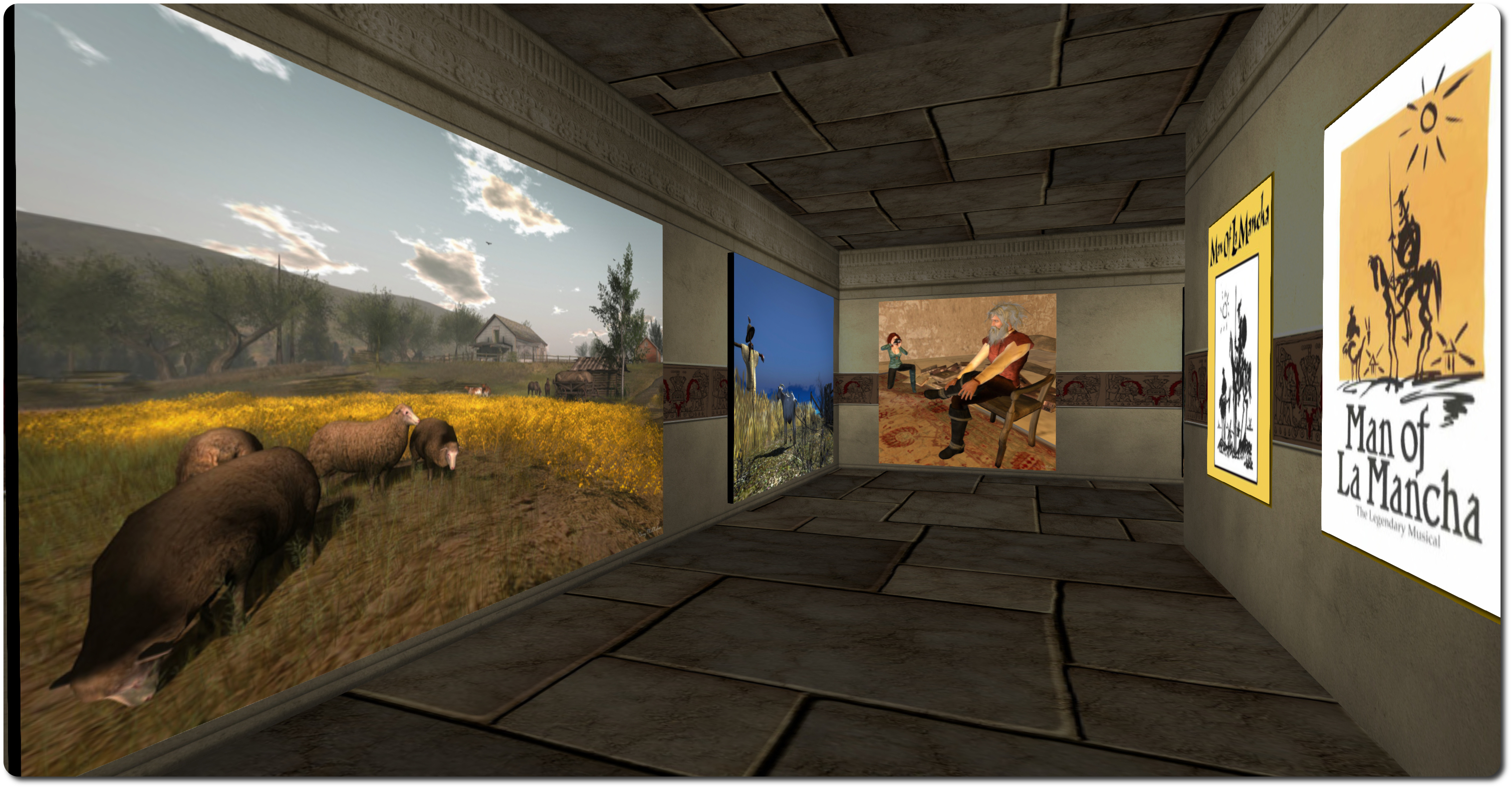
In presenting Don Quixote, Derry effectively takes on the role of  visual chronicler to Alonso Quijano’s explorations through Second Life. She presents this idea very cleverly through one of the images in the exhibition, where she can be seen kneeling to photograph the Don, who appears none too certain about having his image captured.

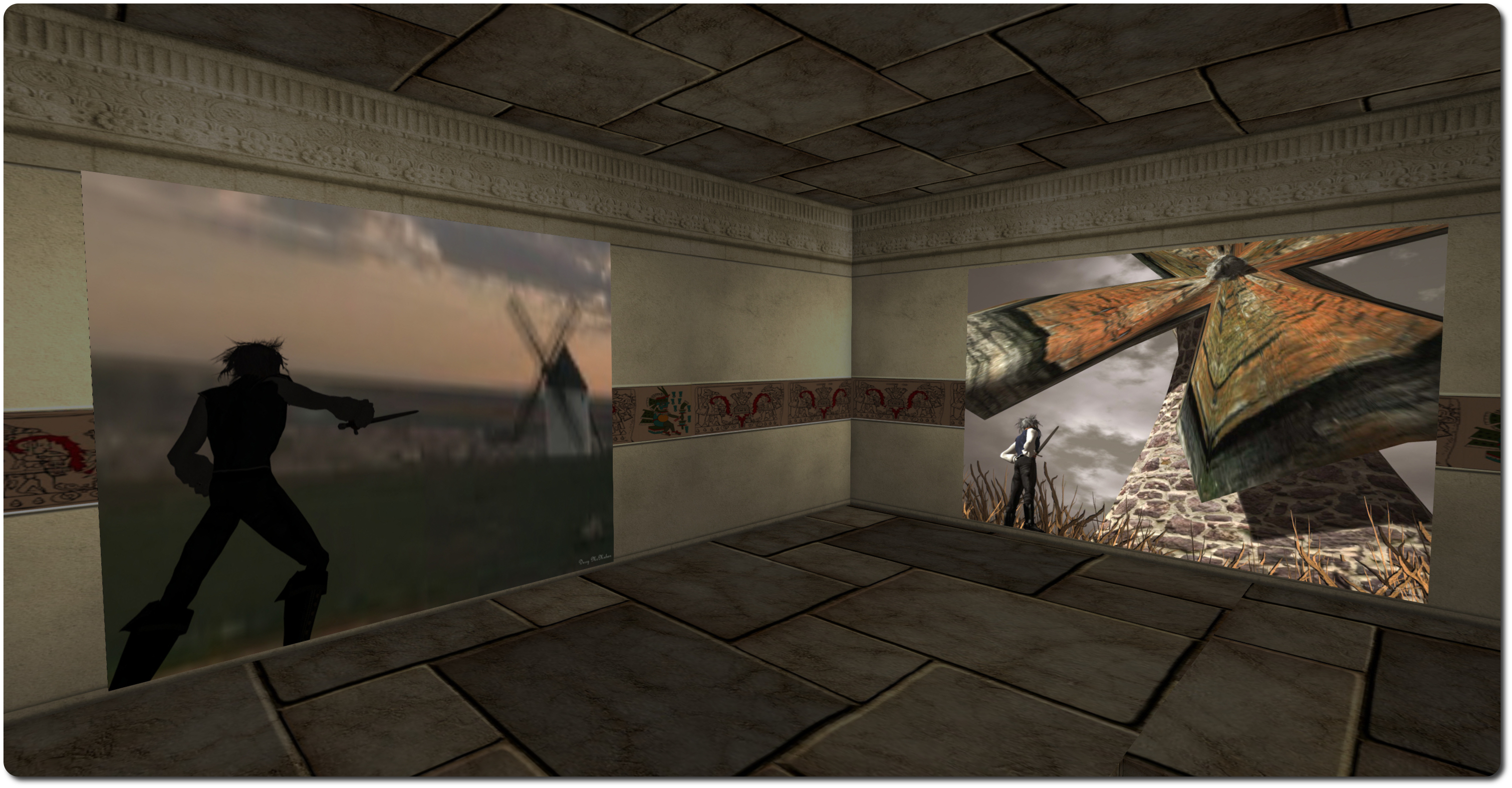
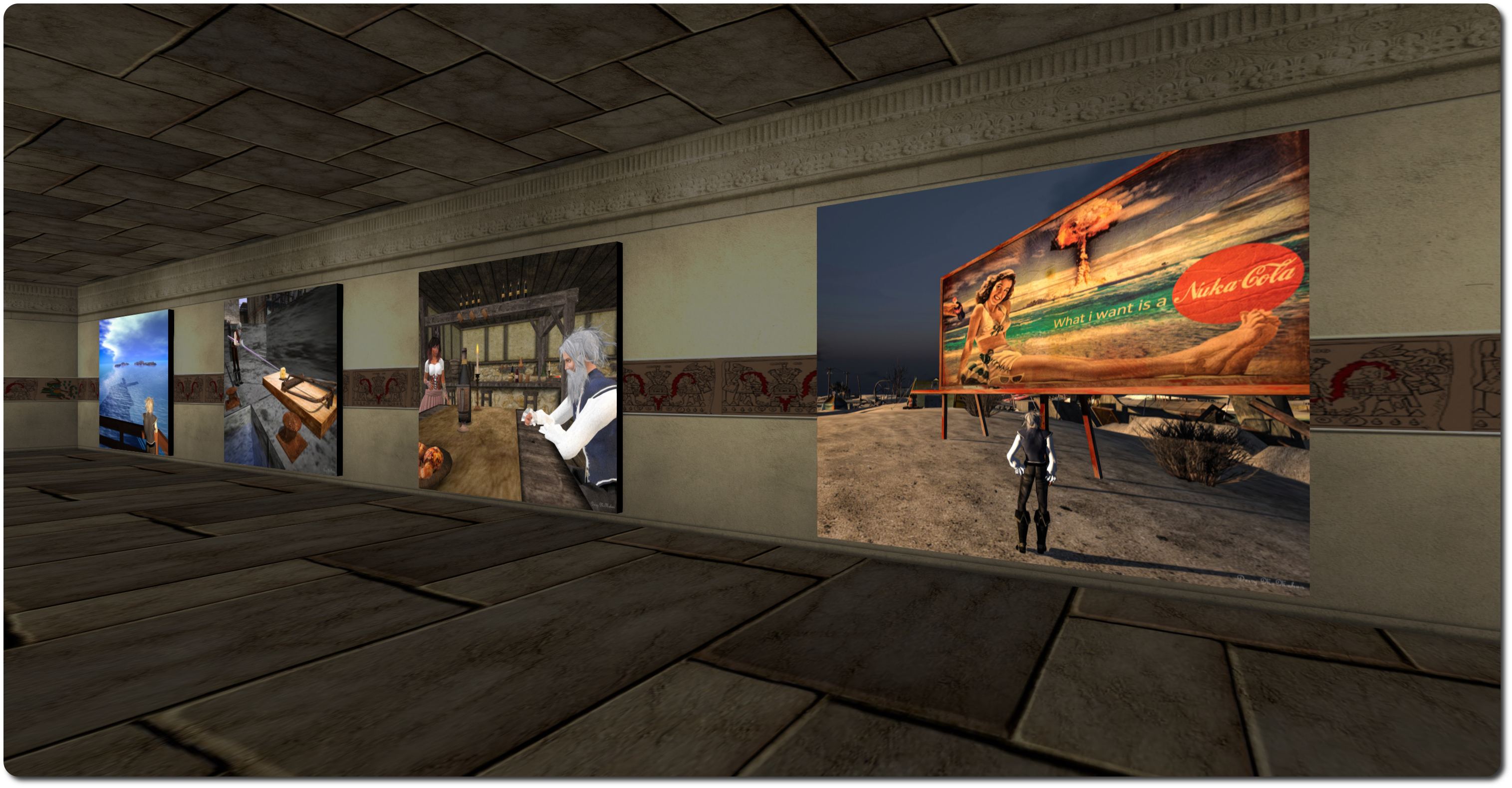
This is a charming and whimsical display of some 28 images captured from around SL and spread over two floors of exhibition space. Some of them feature motifs drawn from Don Quixote’s adventures – there are a few windmills to be found, together with a tavern scene, horses and jousting lances. Others are far more reflective of the stranger in a strange land element, and will likely raise a bemused eyebrow – as they probably did for the Don himself!

Dox Quixote
Don Quixote

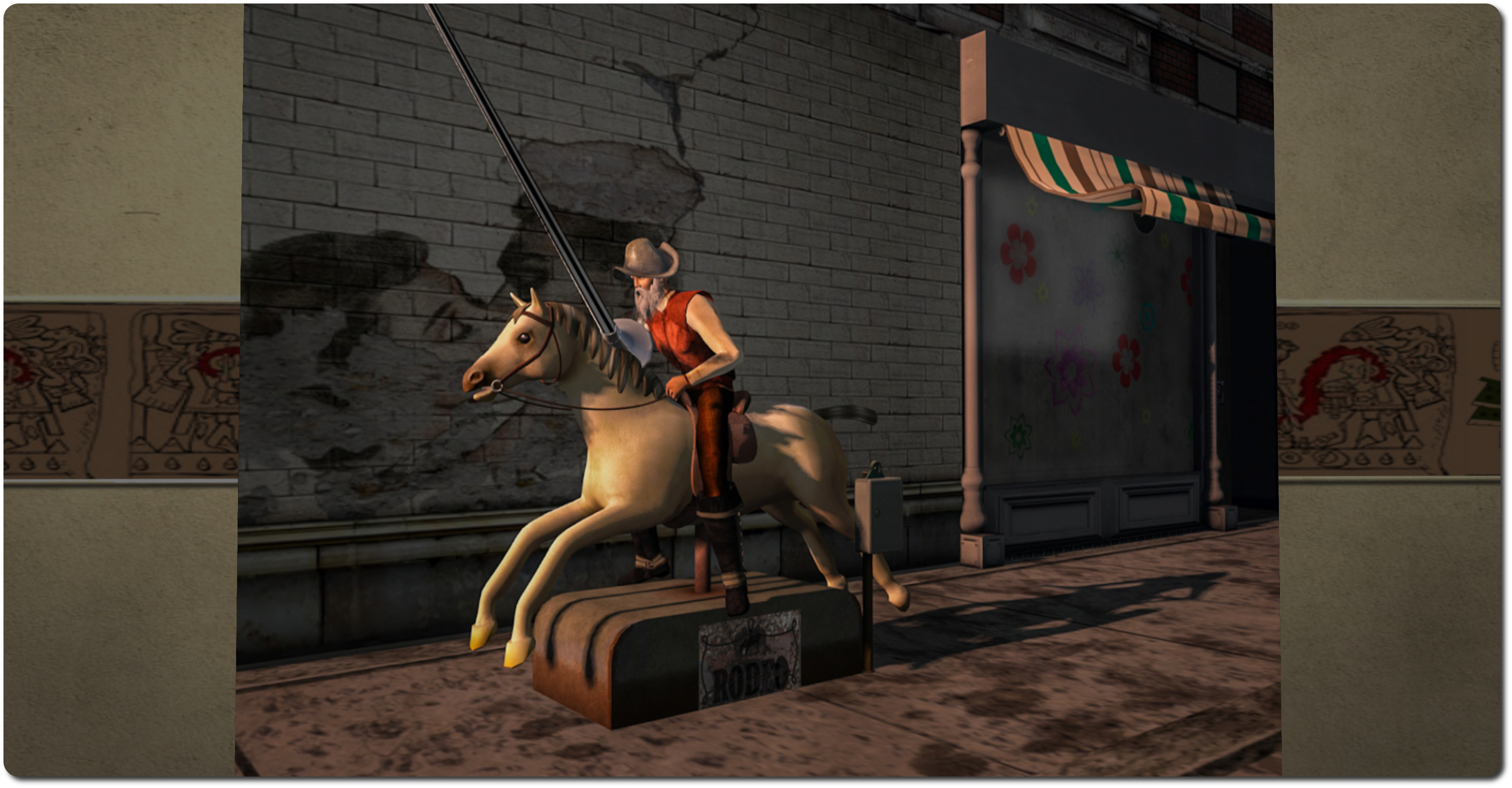
The whimsy is evident in images of the Don sitting outside on a caravan, guitar by his side as if awaiting to be called up to a stage and perform – itself perhaps a subtle reference to The Man of LaMancha musical. Then there is the wonderful image of the Don astride a mechanical rodeo horse – a tilting of an entirely different kind!

Derry mixes her art with images of posters from the Wasserman / Darion musical The Man of La Mancha (itself an adaptation of a teleplay by Wasserman) and which was in turn adapted into the 1972 Arthur Miller film starring Peter O’Toole and Sophia Loren, which also appears in poster form.  Excerpts from the sheet music give further ambience to the exhibit.

Don Quixote
Dox Quixote

All told, Don Quixote is a delightful display, the images fresh and imaginative and which easily put one in mind of some of the memorable songs from the musical. When touring FIAT, be sure not to miss it.

And on the subject of songs from the musical, there really is only one way to close this piece – and that’s with the marvellous Scott Bakula performing a medley from the musical.

Related links


M*A*S*H remembered


4077th MASH - LEA2
4077th MASH – LEA2 – click any image for full size

Open now at LEA2, is a homage to what remains both one of the most highest rated shows in US television history, and one of the most internationally popular and instantly recognisable: M*A*S*H.

Created by Tahiti Rae, the build lovingly recreates the 4077th Mobile Army Surgical Hospital from the era of seasons 6 through 8. Within it are all the familiar sets and locations. The Swamp, the Nurses’ Quarters, the tents of Colonel Sherman Potter, Father Mulcahy and Major Margaret “Hot Lips” Houlihan, the OR and offices – right out to the motor pool (remember Staff Sergeant Luther Rizzo?) and Rosie’s, the off-camp bar; all have their places here.

“I chose to build my representation based on this television series because so many people all over the world personally relate to how the human spirit, humour, diversity, skill and love can bring people together, regardless of War,” Tahiti said of the piece, “Does War send us apart?  Or actually bring us together?”

4077th MASH - LEA2
4077th MASH – LEA2

She continues, “To me, war has never changed. It’s always been either self-defence or defending the freedom of a friend. Otherwise, it is intolerant aggression.  Regardless, the human spirit always prevails.  And this particular portrait of those who went through the Korean War, based on real surgeons on the front lines, brought into our living rooms what they suffered, laughed about and loved in such a profound way, that it touched us all.”

You might wonder how I can pin-down the period of the show represented by the build. Well, such is the care with which Tahiti has put this all together, the clues are all there to be seen, both indoors and outside. One only has to explore to find them. And exploration is very much the key to this installation.

You start at an arrival point high overhead – a triage or pre-op station, if you will – where you can find information on the build and on M*A*S*H itself. From here you can teleport down to the region, arriving at the 4077th, as so many personnel did, at the helipad located on a mound to one side of the camp.

4077th MASH - LEA2
4077th MASH – LEA2

Walk down the worn track from the pad, and you’re free to explore the camp as you will. Do make sure you have local sounds enabled to full appreciate things, and keep an eye out for the clipboards located in places like quarters, the OR and so on – they contain information and video links related to both popular moments in the show and the experiences of actual Korean War veterans.

Within these clips is one from one of the most poignant moments from the show, which in its own way, underlines the complete futility and indiscriminate nature of war: Radar’s announcement that Colonel Henry Blake’s plane, transporting him home after having completed his tour of duty, had been shot down over the Sea of Japan with no survivors.

The level of detail in the build really is wonderful – as noted above, there are enough clues to pin down the approximate point in the series the camp represents. There may even be individual clues which allow the time to be pinned down even closer than I’ve managed; but the key thing is, it’s all here – from Colonel Potter’s beloved Sophie, to the small memorial to Colonel Blake, through to Hawkeye’s trademark red bathrobe and signature Groucho Marx nose / glasses and on to … well, visit and see for yourself!

4077th MASH - LEA2
4077th MASH – LEA2

Around the periphery of the build are what appear to be some incongruities, such as a “tiny” military encampment and a sniper’s position, uniformed soldiers, all from eras much later than that of Korea – perhaps a reminder of conflicts which exist to this day.

As well as leading you to those, exploration of the region is important as it will bring you eventually to the story’s end – a music video and then a final teleport (reached via a bus; your only clue!

Those who know and love the series will understand the symbolism presented at the “The End”, as they follow Tahiti’s directions and explore each of the rooms. The reference to the show’s final episode and the experiences within it of the linchpin of the series: Dr. Benjamin “Hawkeye” Pierce, as portrayed by the brilliant Alan Alda.  Work your way up through the rooms to Hawkeye’s and then step out onto the fire escape. This will take you to a final goodbye – M*A*S*H style (although there are teleports back to the start point and back down to the 4077th).

I’ll leave the final word on the build to Tahiti, “In a time of great conflict on this planet, I wanted to recreate MASH because I think it’s important that we remember how war separates us, and yet also how it brings us together.  I am humbled and honored to bring back the full gamut of emotion that the writers and actors burned into our memories with this television series.  We use the past as part of our foundation for the future.”

Related Links