Empowering embodiment: Our Digital Selves

We all have blood. We all feel. We all matter. We are all different.

– Shyla the Super Gecko (KriJon)

Our Digital Selves: My Avatar is Me  is a new video documentary by Draxtor Despres, which officially unveiled on Thursday, May 17th, to coincide with Global Accessibility Awareness Day.

It’s a powerful 74-minute piece which, as Draxtor himself notes, “Was supposed to be a slightly extended episode of The Drax Files World Makers,” but which, “ballooned into a dense investigation into the power of living vicariously through an avatar in Second Life and next generation virtual worlds like High Fidelity and Sansar.”

The documentary grew out of a desire to follow the work of Tom Boellstorff and Donna Z Davis (respectively Tom Bukowski  and Tredi Felisimo in Second Life). For the last three years, Tom and Donna have been engaged in a National Science Foundation funded study formally entitled Virtual Worlds, Disability, and New Cultures of the Embodied Selfand more informally referred to as Our Digital Selves.

I first covered this study in Exploring disability, new cultures and self in a virtual realm, back in 2016, when I outlined Donna and Tom’s examination of the experiences of people with disabilities – visible and invisible – who are using Second Life to represent themselves, possibly free of the shadow of any disability, engage with others and do things they may not be able to do in the physical world.

How is the internet changing the ways people think of themselves as individuals and interact as members of communities? Many are currently investigating this important question: for this project, the researchers are focusing on the experiences of people with disabilities in “virtual worlds,” three-dimensional, immersive on-line spaces where people with disabilities can appear any way they choose and do things they may not be able to do in the physical world.

– Donna Davis and Tom Boellstorff introducing Virtual Worlds,
Disability and New Cultures of the Embodied Self

Using in-world meetings and discussion groups, Donna – a strategic communications professor at the University of Oregon specialising in mass media & society, public relations, strategic communication, virtual environments and digital ethnography, and Tom –  a professor of anthropology at the University of California, Irvine – set about engaging with Second Life users. Through these sessions they explored the many facets in living with a disability, people’s reactions to those with disabilities, and the experiences those with a wide range of physical and other disabilities – the ability diverse, as Donna notes – find within virtual spaces.

Donna Z Davis and Tom Boellstorff (Tredi Felisimo and Tom Bukowski in Second Life), co-researchers in Virtual Worlds, Disability, and New Cultures of the Embodied Self, supported by the University of California, Irvine; the University of Oregon; and the National Science Foundation.

Covering enormous ground over the three years – including providing participants with virtual space in-world at Ethnographia Island where they might express themselves and their relationship with their condition – Virtual Worlds, Disability and New Cultures of the Embodied Self is perhaps best described as a voyage of discovery and revelation for all those involved – researchers, participants and observers alike. And it is this voyage that the documentary Our Digital Selves: My Avatar is Me encapsulates.

The documentary focuses on thirteen participants in the study who, along with their avatars  transcend their various disabilities through artistic expression and making a home for themselves in the digital realm.

Starting with the idea of freedom through embodiment that environments like Second Life offers as a result of the almost entirely free-form way in which we can express ourselves through our avatars visually free from the disabilities or imperfections that might otherwise define us, the film moves onto the concept of being rooted to a place, and the idea that having that space allows us to further define and extend who we are. This idea of “emplacement”, as Tom calls it leads to an initial exploration of the places the study participants built on Ethnographia Island.

Jadyn Firehawk, one of the original participants in the study – and who first notified me about it in January 2016 – before her installation ” Reconstructing Identity After Disability”, Ethnographia Island, 2016

It is here that the personal stories begin to unfold, with Jadyn Firehawk describing what those of us blessed with sound minds and bodies might take for granted in ourselves those around us:  performing every day tasks when living with an invisible disability. It’s easy enough to show understanding and compassion – and make allowances for – those with physical disabilities. Yet how often do we (if only silently) question or shy away from those with mental / emotional disabilities when they raise the subject of their health, simply because we don’t see physical evidence of their disability?

These stories are fascinating, moving, and deeply revealing studies; not only in terms of those relating them, but also in what they say about the sheer power of a platform like Second Life to imbue creativity, to form relationships, to encourage our desire to push past barriers – physical, mental, personal and societal – and even to re-grant the authority for us to control our identity and how much of it we choose to reveal to others.

In this, the video not only covers matters of personal representation of self when living with a disability, but covers wider issues of identity, revealing who we are, have the right of control over what is revealed to others about ourselves. In the age of Facebook, Google, data gathering, Cambridge Analytica style activities, this is an issue that reaches far beyond what might be seen as the “core” subject matter of the study – be which nevertheless is part and parcel of the idea of embodiment; one which does affect us all.

The stories revealed through the film are moving, insightful – and revelatory; not “just” because of what they reveal about the participants, but in the way it can cause measures of self-reflection and encourages thoughts on our own virtual embodiment: what it means to us, how it exercises our desire for growth, etc.

Continue reading “Empowering embodiment: Our Digital Selves”

A village called Ahiru in Second Life

Village of Ahiru; Inara Pey, May 2018, on FlickrVillage of Ahiru – click any image for full size

Village of Ahiru is a full region themed along Japanese  / Edo period lines (although the time frame for the region isn’t specifically the Edo period, as evidenced by things like the bicycles to be found scattered along the extensive paths and walks within the region).

The main landing point, located in the sky above the region offers an introduction to the setting, noting it is a mixed public / private location with a number of rental properties to be found within it. However, providing the privacy of those renting is respected, visitors and photography are both welcome, and for those wanting to get a little more in character, two vendors at the landing point offer free female and male kimonos.

Village of Ahiru; Inara Pey, May 2018, on FlickrVillage of Ahiru

Ground level is reached via a map teleport board. This lists all of the public areas, and denotes the rental properties – the majority of which are located to the east of the region, with a few more located on the southern coastline. The large rentals are surrounded by walls guarding their inner gardens / courtyards, and smaller properties can be identified by the “mailbox” rent boxes on their walls.

At ground level, the region is split into two land masses by a narrow river. Public areas straddle both of these islands, so decided on where to start a visit is open to choice. However, having spent time wandering through the village, I’d recommend the shrine on the south island or the Onsen or theatre on the north island as being good starting points; they are all public places, and offer good map reference points when making your way around the region.

Village of Ahiru; Inara Pey, May 2018, on FlickrVillage of Ahiru

Richly wooded, Village of Ahiru also has a veritable web of paths and trails running around and through it.  Climbing and descending over stairs and steps, winding around hills, passing under the arched canopies of trees, some of these paths are paved, some form grass tracks and others are marked by stepping-stones or look like cinder tracks. The thing that the have most in common is that they form a complete network which, as you follow it as paths cross and divide, serves to make Village of Ahiru feel a lot larger than the usual 256 metres on a side region.

From the grand bulk of the Theatre, visitors can head south along an arrow-straight avenue to one of the bridges spanning the river. Branching from this to the right (west) and east (left) are paths leading to other points of interest: a wild garden with standing stones, a more formal garden area with pavilions, a little waterfall spanned by another little bridge and opportunities to relax.

Village of Ahiru; Inara Pey, May 2018, on FlickrVillage of Ahiru

To the left from the theatre avenue, stone steps offers a way to the ochaya (tea house) located on one of the region’s two high points. Or if you prefer, you can follow the path around the hill on which the tea house sits and find your way to the impressive Osen, with heated and cold water pools for bathing. With waters following past its entrance from water falls, this is perhaps the centrepiece of the region, and another point at which a teleport map board can be found for those wishing to hop between locations. The second high point for the region is located on the southern island. It is home to the region’s shrine and overlooks the rental properties to the east and south, the base of the hill again surrounded by paths.

Other highlights within the region include a small commercial shopping area, a children’s playground nestled under the trees, and several lookout points such as the waterside hangout – and perhaps one or more places to discover. “As usual, my areas have a couple places hidden away,” principal designer Hatsumomo (Yasyn Azemus) informed me during our visit. I’m not going to give these all away, but I did enjoy discovering the Café Grotto.

Village of Ahiru; Inara Pey, May 2018, on FlickrVillage of Ahiru

Surrounded by mountains, rich in flora and trees, and laid out in such a way to give the impression of far more space than the region might otherwise suggest, Village of Ahiru makes for an engaging visit with plenty to see and discover while exploring.

SLurl Details

A Mediterranean Soul2Soul in Second Life

Soul2Soul Med; Inara Pey, May 2018, on FlickrSoul2Soul Med – click any image for full size

In February 2018, I wrote about a visit we made to two Homestead regions designed by Minnie Blanco (Minnie Atlass): Soul2Soul River and Soul2Soul Bay (see here for more). While I’m somewhat hesitant about blogging regions that are intended for rental purposes, but both Soul2Soul River and Soul2Soul Bay were so beautifully designed and offered sufficient public spaces, I felt comfortable in writing about them.

Since then, Minnie has added a third region to her group, Soul2Soul Med. As the name implies, this homestead region has something of a Mediterranean theme to it. Once again, the region in part offers properties for rent to those looking for a home; although at the time of our visit there were only three such properties on the region, leaving the greater part of it open to public exploration.

Soul2Soul Med; Inara Pey, May 2018, on FlickrSoul2Soul Med – click any image for full size

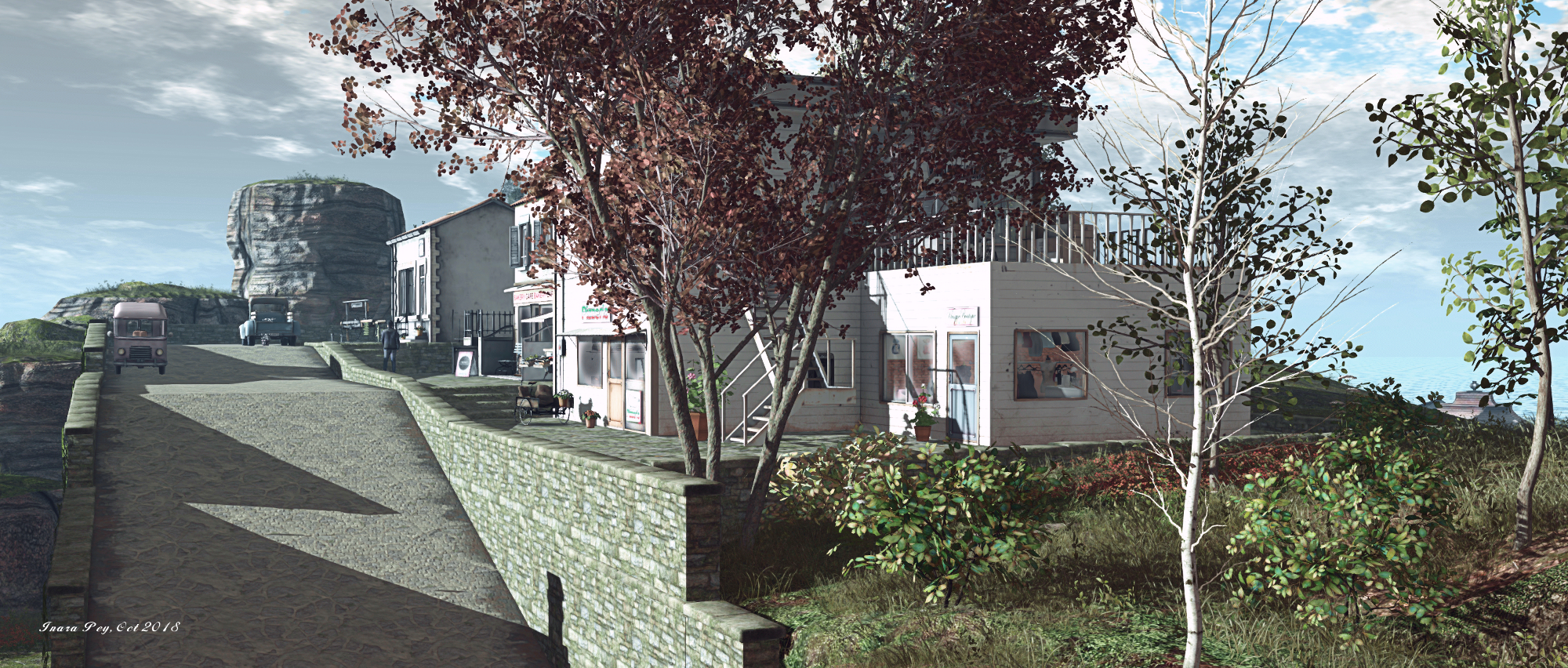
Visitors arrive on the southern most of the two island the regions has been split into. This points roughly south-west to north-east, a rocky shoulder of land on which is perched a little hamlet sitting above a beach and pier for boat moorings. Gaily painted houses run along the upper street, although the paint on some of them is showing signs of fading under the bright Sun. Cars are parked along the little street, flowers are in full bloom, while the café half-way down the slope to the beach presents a welcome rest-stop from explorations.

A second rocky island crosses the first to the north, forming a “t” to its base. A narrow channel separates the two islands, turning south to run between them to the east, a single bridge spanning it.

Soul2Soul Med; Inara Pey, May 2018, on FlickrSoul2Soul Med – click any image for full size

This northern island is given over to the rental properties.  All three are spread far enough apart to offer those renting them a fair amount of privacy, while roads leading from each of them come together before the bridge, offering a direct connection with the little hamlet on the southern island.

There’s a feeling of life that has been added to the region: boats are moored down on the water; bicycles and vehicles are scattered around, and a couple of maintenance chaps are performing repairs here and there. Meanwhile, and on the edge of town is the ruin of a house where a group of mannequins appear to have set-up home, complete with a bed on the upper floor and a broken-down truck parked out back. It’s a further quirky addition that gives the region additional atmosphere and depth.

Soul2Soul Med; Inara Pey, May 2018, on FlickrSoul2Soul Med – click any image for full size

With its rugged, coastal look, mixed flora, hilltop hamlet and surrounding hills, Soul2Soul Med is delightfully picturesque, and matches both Soul2Soul River and Soul2Soul Bay in the level of detail and styling put into the region. For those looking for somewhere to live, the rental parcels are well placed and offer a lot of room. For those looking for a place to explore – remembering that there are private residences on one of the islands – and take photographs, Soul2Soul Med offers an ideal destination.

SLurl Details

Silas Merlin at LEA 14

Silas Merlin LEA 14

“There are experiments and exhibits inside buildings,” Artist and sculptor Silas Merlin says of his installation at LEA 14. “It’s a collection of the things I happen to be building this semester, so there’s no specific theme; but I do have LEA in mind whatever I do, so I think everything is in theme in that respect.”

It’s certainly an intriguing environment, bringing together Silas’ gift for 3D sculpture and his pastel artwork in a place where exploration is encouraged – indeed required, if one is to see everything. It is also a place which includes certain nods to others here and there, be they intentional or otherwise; with the intentional ones offered a little tongue-in-cheek and without rancour.

Silas Merlin LEA 14

The landing point to the installation is located in a tall tower sitting just offshore to the rest of the build. This tower contains the first of Silas’ experiments: the use of a cubemap and a 360-degree image to create a reflective hemisphere on the stone floor (you’ll need to have you viewer’s Advanced Lighting Model (ALM) enabled via Preferences > Graphics in order to see the reflection, otherwise the hemisphere will simply appear to be a black object).

Getting to the rest of the installation is perhaps best done by flying from the landing point. A rugged landscape, with a ground pattern and plants which are in places mindful of Cica Ghost’s designs, this is a place littered with buildings and ruins, many of which look to have been extruded from living rock rther than constructed. Some rise like the towers of a castle, others seem to have echoes of Hindu or Aztec architecture, and others are far more free-form.

Silas Merlin LEA 14

Many of these structures have elements inside or on them. These range from experiments with projectors and projected lights  – so again, keep ALM enabled during your visit – to little vignettes of characters from J.M. Barrie’s Peter Pan (as seen through the 1953 lens of Walt Disney Pictures) to places to sit down and relax, and so on.

The Peter Pan elements can be found in a little scene featuring the Darling family, and  a charming little diorama featuring some of the principal characters – Pan himself, Hook, Tiger Lily, the crocodile, the alarm clock, etc. Larger versions of some of the characters can also be found dotted about the landscape, with Hook’s ship sitting in a small bay.

Silas Merlin LEA 14

Two of the larger structures within the landscape are particularly engaging, albeit for different reasons. The first takes form of a temple with a somewhat Hindu styling to it. It has been raised in recognition of a certain – controversial, shall we say – artist who has not had the best of relationships with the LEA, being s known for her … disruptive … influence.

“She seems to target LEA artists,” Silas playfully said of the artist concerned, “So I thought it would be fun to have a temple with offerings to appease the angry goddess!”

Silas Merlin LEA 14

The second building offers a selection of pastel drawings by Silas. However, these are very different to his usual studies. Predominantly black-and-white, they have something of a dark, haunting tone to them, with even the colour paintings hinting at spirits and the supernatural.

A part of the installation that may not be obvious to visitors sits at 3021 metres in the air. Here, on a platform sits a small ghost town of buildings – some of which reminded me of some of the structures in Silas’ Felsenmeer experience in Sansar.  It sits among a number of platforms containing unfinished elements, and offer another point for exploration, even if you do need to map teleport your way up to it.

Silas Merlin LEA 14

A curious but engaging mix of Silas’ work, LEA 14 will remain open to visitors through until the end of June.

SLurl Details

A Little Bit of Soul in Second Life

A Little Bit of Soul; Inara Pey, May 2018, on FlickrA Little Bit of Soul – click any image for full size

Update: A Little Bit of Soul is now closed, and SLurl links have been removed from this article.

Occupying one half of a Full region, A Little Bit of Soul is group design offering a huge amount to see and explore.  Running from west to east across the region, it presents what might be seen as a build in three parts, all of which flow together to offer a unifies setting.

At the western end is a built-up area which encloses the landing point. Split into two parts, it encloses the landing point within a plaza-like square surrounded by boutique-style businesses, some of which have town style houses built above them. Footpaths run around the shops on two sides, one of which forms a small road lined with more shop fronts with living spaces over them, while the other offers a way to a waterfront area.

A Little Bit of Soul; Inara Pey, May 2018, on FlickrA Little Bit of Soul

This small precinct offers a pristine setting: shop fronts are freshly painted, balconies are lined with potted plants, and trees and hedges are neatly trimmed. A small metal gazebo sits towards the middle of the square, a harpsichord, guitar and drum set forming a curious setting for a trio of musicians. All-in-all, there is a strong European cosmopolitan air within this part of the parcel.

Walk westward across the plaza from the landing point, and you’ll find a narrow set of steps lead up to the second half of this built-up area. This is altogether more run-down in tone – and becomes progressively more so as you explore. It is reached via two pairs of doors at the top of the steps leading up from plaza, which open onto another square surrounded on three sides by what might at first glance appear to be small apartments or perhaps hotel rooms, windows lit. With its hanging ivy, open verandahs in cast iron, and open courtyard, this area has something of an old New Orleans feel to it.

A Little Bit of Soul; Inara Pey, May 2018, on FlickrA Little Bit of Soul

With the exception of a first floor room sitting over an arched entrance leading out of the square, the “rooms” of this hotel / apartment setting are actually false, and demonstrate a clever use of space on the part of the designer here, Megan Prumier. Pass through the archway and take the ramp or steps on its other side, and you’ll find the “rooms” of the hotel / apartment house have become the frontage for run-down stores facing out onto little streets.

This raised area offers a collection of footpaths and open spaces set with tables and chairs, market stalls and other bric-a-brac and general detritus, all set amidst the shells of ruined buildings. The entire area exuding an aged feel, with more shells of ruined buildings sitting off-shore, rising above tall walls to give the parcel an added sense of depth.

A Little Bit of Soul; Inara Pey, May 2018, on FlickrA Little Bit of Soul

Travel east from the landing point, under an archway between two stores, and you’ll come to the second element in the parcel’s design. The first part of this area is a small chapel and churchyard, again put together by Megan, caught under a steady downfall of rain. Beyond this, under a further archway, sits a much smaller group of shops, bordered on both sides by woodlands, the southern of which has paths and trails running through it, as well as places to sit – or bathe.

Designed by Xange Madrigal, this area flows seamlessly into the surrounding woodlands and the surrounding rugged countryside. A small body of water can be found here, together with a raised terrace with seating while more paths lead the way to hidden gems of areas, simple wooden bridges crossing the water where necessary to encourage explorers onwards.

A Little Bit of Soul; Inara Pey, May 2018, on FlickrA Little Bit of Soul

And still there is more: the eastern end of the region offers more woodland, copses, trails, an outdoor space for weddings or other celebrations, a waterfront  a sauna deck and gazebo looking out over offshore islands which again add further depth to the parcel, and a cabin-style home. These have all been brought together by several more contributors to the region – although I’m not entirely sure if the cabin is intended to be open to the public at large, so please keep this in mind when visiting.

Throughout my visits, A Little Bit of Soul was caught under a twilight sky, and while this works, I would suggest it limits the appreciation of the beauty of the parcel, which far more comes to life under a daylight setting. However, I strongly recommend seeing the setting under both its intended windlight (Bryn Oh’s Mayfly) and a good daylight setting: A Little Bit of Soul is a marvellous setting, well deserving of a visit.

A Little Bit of Soul; Inara Pey, May 2018, on FlickrA Little Bit of Soul

With thanks toy Shakespeare (SkinnyNilla).

Touring the Raglan Shire Artwalk 2018

Raglan Shire Artwalk 2018

Raglan Shire, Second Life’s Tiny community once again throws open its doors to people from across the grid as participating artists and visitors to the annual Raglan Shire Artwalk.

This year marks the 13th Artwalk, which opened on Sunday, May 13th, and runs through until Sunday, June 17th. 2018. The event offers an opportunity not just to appreciate a huge range of art from both the physical and digital worlds, but to also tour the Shire regions and enjoy the hospitality of the Raglan Shire community.

Raglan Shire Artwalk: CybeleMoon (Hana Hoobinoo)

A non-juried exhibition, the Artwalk is open to any artist wishing to enter, and has minimal restrictions on the type of art displayed (one of the most important being all art is in keeping with the Shire’s maturity rating). All of this means that it offers one of the richest mixes of SL art displayed within a single location in Second Life, with 2D art is displayed along the hedgerows of the Shire’s pathways and tree platforms overhead and 3D art among the community’s parks.

Each year attracts over a hundred SL artist – and this year is not exception. The depth and range of art on display is guaranteed to keep visitors exploring the paths and walks around the through the hedgerows –  and if walking proves a little much, there are always the caterpillar rides to ease the load on the feet.

Raglan Shire Artwalk: John B (John Bleriot)

Also, teleport boards are provided to help people find their way around the exhibition spaces, while balloons which offer rides around the region and through the art displays. However, given this is an opportunity to visit and appreciate Raglan Shire, I do recommend exercising your pedal extremities and doing at least some of your exploration on foot – just keep in mind people do have their homes in the regions as well.

Given the number of artists involved, there isn’t a published list of participants, but anyone interested in the world of SL art is bound to recognise some of the names of the artists here. I personally couldn’t help but notice CybeleMoon’s (Hana Hoobinoo’s) hauntingly beautiful art along, John B’s (John Bleroit’s) marvellous macro photography, Bear Silvershade’s marvellous black and white photography and Relenne’s (Rey Vlodovic’s) nautical-themed photo-paintings.

Raglan Shire Artwalk: Bear Silvershade

This is also my second year of exhibiting at Raglan Shire, and my thanks go to the organisers of the Artwalk and the folk of the Shire community to be a part of this event.

With five weeks to enjoy the Artwalk, there’s no need to try to cram everything into a single visit, so why not plan to pay Raglan Shire a number of visits over the coming weeks and take the time to enjoy the art rather than risk being overwhelmed with the sheer volume of images on display? It’s more than worth the time to do so.

Raglan Shaire Artwalk: Yours Truly

SLurl Details