The Boathouse Café, July 2026 – click any image for full size
Update: both Outpost Bay and The Boathouse Café have closed, and Sorcha now has opened Stillwater Coast – read more here. SLurls have therefore been removed from this article.
I’ve always enjoyed Sorcha Tyles’ region and parcel builds over the years, so back in June I was happy to drop into her latest (at the time of writing) endeavour: The Boathouse Café as I resumed my occasional visits to various cafes and coffee houses in Second Life.
Occupying a waterfront parcel (hence the name) just over 3,000 square metres in size, The Boathouse is presented by Sorcha under her Dutch Pavilion banner and offers a setting which, unsurprisingly and very cosily has much in common with other designs under that banner and which I’ve covered in these pages (notably Wild Silence, which I visited in late 2025 and June 2025’s iteration of Dutch Pavilion itself) – although leaning perhaps a little more into a Nordic theme in keeping with elements of the estate within which it resides.
The Boathouse Café, July 2026
A rustic Nordic hangout by the sea. Grab fresh fish & chips on the shipyard side, or escape into the wild, wind-swept garden with a cosy coffee. Unwind to the sounds of gulls and waves.
– The Boathouse About Land description
The café itself takes the form of a converted smokehouse with some limited moorings available – the surrounding rocks tend to dissuade attempts to come alongside at least at low tide, as does what’s left of one boat which apparently tried! Most of the high-set wharf is therefore given to outdoor setting to the front of the café, with fish & chips being offered outside as a treat.
The Boathouse Café, July 2026
Inside, the café has something of that Boho, informal look where whatever might have been available / obtained from local markets has been used for furnishings. This results in chairs and tables with a decidedly vintage 1970s or 1980s style to them mixing with more modern bar-style high chairs, together with a rustic-style food and beverage kitchen / counter space. Eclectic it might be, but it is also very relaxed and cosy.
To the rear of the building is a garden space which very much offers memories of Wild Silence, etc., in its informality and wildling growths of grass and plants.
The Boathouse Café, July 2026
The deck here has, admittedly, seen better days and could result in some stern words from a passing health and safety executive, but this doesn’t detract from the pies and other scoffables available nor does it prevent the cafe’s cats and dogs appreciating it as a place to catch some Sun.
A gravel path runs around the garden from the wharf and back, presenting the opportunity to walk off any extra weight that might have been felt to have been gained whilst eating, together with some swings for adults or kids to enjoy. There are numerous places to sit throughout the garden, including one on the water and another over it in the form of another deck.
The Boathouse Café, July 2026
A jet ski also sits on the water by the garden, but fortunately, it is not open to general use so it won’t end up causing interruptions for those trying to relax as it is buzzed around the island.
Those with a romantic inclination or who simply enjoy dancing can avail themselves of a dance system tucked into a corner – although the best place to dance is possible in the garden rather than around where the system has been placed J . If fishing is more your style, that is also available!
The Boathouse Café, July 2026
In all, a delightful and easy-going visit; however, one point of note: do not remain in one place for too long, as you might be teleported home if you don’t reply to a pop-up dialogue requesting you confirm you are still at your keyboard.
Concrete Shadows is an exploration of urban life captured through the interplay of light and shadow in contemporary artwork. This city life exhibition illustrates how the silhouettes of people merge with their surroundings, creating a dialogue between the individual and the urban landscape.
– Miles Cantelou
Thus reads the artist’s introduction of a series of acrylic canvases adapted for upload to Second Life for the exhibition Concrete Shadows, which opened in mid-June at ArtCare Gallery, curated by Carelyna.
Those familiar with Miles’ work will know that his range encompasses street and studio photography, painting in acrylics and oils, working within 3D environments and more. Utilising genres from abstract through surrealism to abstracted expressionism, his art is a constant study of light and light forms often with a strong lean into using light and light forms. Much of his work is colour-rich and boldly stated. Here, however, and as his introduction notes, he large eschews colour (although some is present in places to give an added subtle context to the urban environments featured) in favour of a more monochromatic look.
Comprising 20 individual pieces, Concrete Shadows could be a record captured from within a city anywhere in the world. But precisely where their inspiration comes from doesn’t actually matter; what does is the manner in which they resonate with us as we view them and their the subtext of line, shape, shadow and block serve to suggest; so that in some it is possible to perceive the bustling and disorderly order of somewhere like Tokyo or Shanghai whilst others might suggest a kinship with London, Paris or New York – or wherever your imagination takes you.
All of them offer narratives of life, be this used as a collective nouns for the bustle of people passing along busy streets, cojoined by matters of business, tourism, need – whatever; or be it a reflection of the individual caught in a moment of introspection, transition or perhaps loneliness within the midst of that bustle. More broadly, they tell a story about the places we have created in which we go about our business and lives; the ebb and flow of the relationship between conurbation and self. Cities are places we have built out of our own necessity; yet at the same time we are mere elements of their necessity, serving their growth, their wealth, their power. They cannot exists without us and nor can we, as a society, function without them; the one gives purpose to the other.
Is there balance in this? Perhaps; perhaps not – but there is a blurring. Our relationships with the cities in which we live is one of adversarial symbiosis; it constantly shifts and changes as we move through the concrete and steel canyons or pause for breath in the small haven of green park spaces. We move as one, currents and eddies of humanity coursing through streets and avenues, flowing into and from buildings, an underscoring of our need for them – and their reliance upon us. At the same time we seek to remain individuals, operating within and yet apart from the rush of City Life and all it brings.
Le Monde Perdu, July 2026 – click any image for full size
It was back to Luane’s World for a summer visit for me – it’s nice to drop in at least twice a year to see what LuaneMeo has cooked up for her public region of Le Monde Perdu, although I admit it’s been a couple of years since my last summer visit!
For 2026, Luane, with the assistance of Gorba McMahon, presents visitors with an island wrapping a Mediterranean feel about it, the two major buildings sitting upon it hinting at places such as Tuscany and the South of France. The island sits with its back towards the residential regions of Luane’s World, its northern side marked by rocky walls sitting above a shingle and grass coastline.
Le Monde Perdu, July 2026
These modest cliffs mark the raise spine of the island, a flat top comprising a pair of flat plateaux of grass and trees on which the houses are located, one to the east and the other to the west, the land sloping down from them to the south to join the golden sands of a beach. The latter forms two south-pointing headlands which give the island an overall C-shape, an inlet cutting into it to form an almost heart-shaped bay, the entrance to which is marked by an offshore lighthouse.
The Landing Point is located on the flagstone terrace of the house to the east side of the island and which in part forms the rental office for the residential aspects of the estate as well as a little café with seating on the terrace outside.
Le Monde Perdu, July 2026
A small barn with fence meadow sits at the end of the elevated land sufficiently clear of the house so as not to crowd it, and a horse rezzer is available there for those who might not wish to walk around the island – the landscape does make for comfortable riding.
A path runs from the back of the house to a set of steps leading down to Luane’s usual bridge across the waters to the rest of the estate. This does contain public paths explorers are free to follow – but do please keep in mind the houses found along the paths are private residences 🙂 .
Le Monde Perdu, July 2026
A second path runs westwards from the house, crossing the grounds to reach a fence guarding against any risk of falling into the gorge cutting but the two plateaux from north to south, connecting the lowlands on either side. A gently humped bridge spans the gorge, allowing the path to continue onwards to the west, where it skirts around the second house.
Sitting in its own wall garden, the latter commands a view out over the beaches and the bay and is charmingly furnished. Across the track from it, the rest of the plateau offers a grassy retreat with the ruins of a cottage and places to sit. A little summer house sits in the lee of the plateau on its north side, just past the point where the sands of the beaches give way to the shingle of the north coast.
Le Monde Perdu, July 2026
These sands can be reached via steps descending the hill from a point just past the house with its walled garden. However, do not expect your passage past the house to go unnoticed – feline eyes keep a careful watch on all comings and goings! And keep an eye out for the rabbits ready to announce “You’ve got mail!” to whomever lives inside 🙂 .
The western arc of the beach provides the broadest expanse of sands, although this is somewhat broken up by a rising mound of gassy land and rock crowned with young trees and where a small pool house has been built on a shoulder of rock, and the (tide-formed?) cave beneath it turned into a cosy and no doubt cool hideaway.
Le Monde Perdu, July 2026
That the sea has worked on the island can be seen from around the foot of the hills and the back of the beaches, where the sand had been compacted by decades of water and then cut into stratified blocks which become quite tall on the eastern arc of the bay.
The headland to the east also has a rise of grassy land sitting within the cure of the beach, and this is home to a little hut sitting with its back towards the bay so that its small deck offers a view out across more open waters.
Le Monde Perdu, July 2026
The bay is obviously a popular place, with opportunities for sunbathing on the sands or splashing about on the water courtesy of floats and the like. A small wooden jetty offers and inflatable boat rezzer for a pootle on the water (mind any swimmers!), whilst a sign offers the same but using a kayak, and a handful of rowing boats scattered around the shallows of the island offer places to sit and relax as well.
The beach and boats are not the only places to sit outdoors, there are benches, seats, blankets, daybeds, gazebos, and swings all awaiting use to be found right across the island, each of them offering a view and /or a place to retreat.
Le Monde Perdu, July 2026
I’ve been covering Le Monde Perdu and Luane’s work for a decade now, and have always appreciated the sense of life she brings to her region designs through her sculpting of the landscape, the flora she puts out across it and her use of animals and wildlife. They are all perfectly blended to present a setting entirely natural in scope and content, never feeling forced or laboured in achieving its goal to encourage people to feel at home, relax, explore and perhaps have a little fun.
In short, Le Monde Perdu Summer 2026 continues the region’s reputation as an absolute delight.
Pour Up Winery & Vineyard, July 2026 – click any image for full size
Established in 2021, Pour-Up Winery & Vineyard is the vision of Mach K. Disick (BhampagnePapi) and has been a popular destination within Second Life in the years since.
With 2026 marking Pour Up’s 5th anniversary, Mach has marked the year with a refreshed look for the setting, opening what will hopefully be a new chapter of its time in Second Life.
Pour Up Winery & Vineyard, July 2026
Occupying roughly one half of a Full private region leveraging the available Land Capacity Bonus, the setting has been landscaped on Mach’s behalf by Sevnn Rowley-Sinclair (Svenn007) with décor added by Mach. And it is, quite simply, a gorgeous location dedicated to the appreciation of wine whilst offering opportunities for exploration, photography, horse riding and other activities.
The Landing Point (not enforced) sits towards the middle of the setting, within the vineyard, which occupies the more elevated aspect of the landscape.
Pour Up Winery & Vineyard, July 2026
A converted water mill (with the wheel turning rather conspicuously against the flow of water beneath it – such are the quirks of SL!) sits as the main grape press, although those so minded can their hands – err, feet – at some traditional grape stomping. Just do please remove shoes, etc., before ding so! 🙂 For those who prefer to simply taste the wine, outdoor seating is also provided.
Apple trees border the vines with their rich crop of grapes awaiting picking, the apples perhaps suggesting a nice side-line in cider might be added to Pour Up’s offerings. Along the path running past the fields is the Maison du Vin, where an impressive stock of wines is to be found, whilst under an open-sided summer house visitors can try their hands at pottery.
Pour Up Winery & Vineyard, July 2026
Westward from the winery, an old cart track winds its way along the uplands, edging around a broad plateau before descending past more vines watched over by apple and orange trees as they step their way down towards the coast.
A paved shoulder of rock is to be found at the start of the track’s main descent to the lower lands, and this is home to the rather appealing Paint and Sip – try your hand at landscape painting while enjoying the wine; although do be careful with the amount imbibed, lest your painting become less landscape and more modernistic abstract! Careworn stone steps descend from the main track close by, offering access to a small shingle beach.
Pour Up Winery & Vineyard, July 2026
Reaching the lowlands on the south side of the setting, the track provides access to Pour Up’s stables where a horse can be rezzed for those wishing to gently ride around the location (saddle stands might be found elsewhere as well, allowing horses to be rezzed from them).
Beyond this, the path reaches the biggest single element of the setting: a large waterfront terrace where music events might be enjoyed (Mach being a DJ himself), a stage being set to one side of the terrace.
Pour Up Winery & Vineyard, July 2026
Bordered on two further sides by vine-draped trellis with outdoor seating under their shade, the terrace is guarded on its remaining side by a large barn now converted to the main winery.
Both the winery and the terrace are somewhat separated from the rest of the setting by a slender channel of water flowing outwards from waterfalls located alongside the landing Point. This gives a nice sense of separation from the hustle of any music events from the calm of the rest of the setting, whilst a little retreat can be found across the water from the falls, reached via a path from the terrace area.
Pour Up Winery & Vineyard, July 2026
Eastward from the vineyard and Maison du Vin, another path winds its way to the coast, offering a way to visit the open spaces of a south-eastern headland marked by a lighthouse with wooden moorings a little further around the shoreline. A path winds on from behind the moorings to the small public garden and a personal memorial set-up by Mach.
And if all of this weren’t enough, the plateau mentioned earlier is the home of the winery lake, a tranquil setting fed by the same waters as pass the winery mill, and where quiet times may be had solo or with someone special.
Pour Up Winery & Vineyard, July 2026
The path up to the lake also passes by a small promontory where the top end of a zip line waits to carry visitors down the line of the channel partially dividing the stables, terrace and winery from the rest of the setting. It arrives at a platform joining the eastern path down from the winery and the Maison du Vin.
Throughout all of this are multiple places to sit and pass the time, from benches to blankets to tree houses and, of course, the various locations where wine might be enjoyed. And, needless to say (again!), the entire setting is highly photogenic and rich in detail.
Pour Up Winery & Vineyard, July 2026
Congratulations to Mach and Pour Up Winery and Vineyard on reaching five years – and I raise my glass to many more years to come!
The Mobile Learning Centre: general information boards
As a part of a wider effort involving creators from across Second Life, Linden Lab has, since later 2025, been developing and deploying experiences optimised for SL Mobile and geared to helping (primarily) those new to Second Life who come in via Mobile to gain familiarity with using the application.
One such experience in the Mobile Learning Centre, aimed at helping brand new users to Second Life understand some of the basics of the application – although it could just as easily help existing users who have never used SL Mobile to do the same as well. As such, it is something I’ve been meaning to cover for a while.
Like tutorial experiences current and past, the Learning Centre takes a familiar route of taking users through a series of lessons. However, and unlike many past tutorials of this nature it avoids trying to teach someone everything they might need to know – how to move, how to communicate, how to teleport, how to use L$, and so on. Part of this may well because some capabilities are not available to SL Mobile = building, inventory, etc., – but there is also the fact that by keeping things to a minimum and not including things like chat (which is possible in SL, mobile, obviously), the Learning Centre avoids overwhelming a new user with a large volume of things to learn and remember all at once; although it does provide the means to demonstrate some additional capabilities, which I’ll come to.
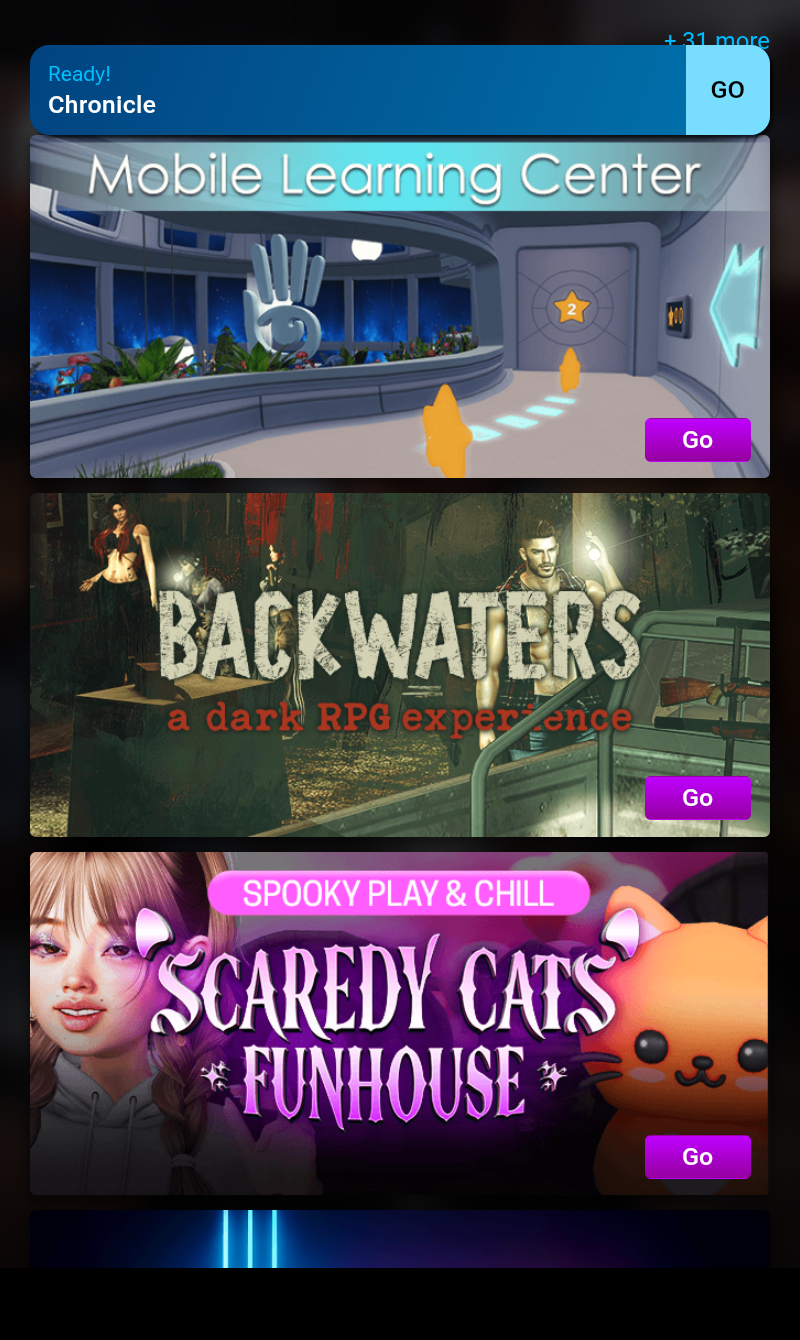
The Mobile Learning Centre is one of the SL Mobile Experiences seen when logging-in to the App, and accessed by tapping the GO button.
Available from the selection of experiences displayed when logging-in to SL Mobile, The Mobile Learning Centre is the work of the SL Studios team, and developed in consultation with the Marketing and Growth team.
The aim was to take what had been used in past in-world tutorial environments and offer something that would be usable, informative and carries an element of fun. The entire experience is set aboard a space vessel of some description and involves moving through various rooms where learning activities are to be found.
Everything is based around the collection of large stars along the way. These both open intervening doors between corridors and rooms and also form a “side quest”: collect enough stars and you’ll help the commander of the space ship, one Captain Rilo, regain control of his vessel, which he and his diminutive crew have apparently lost (perhaps not the most encouraging thing to hear when you’re aboard said vessel!).
After tapping the GO button for the experience in the App, users are delivered to a start point where the above mechanics are broadly explained, and the first directions on movement are presented. It is here that, obviously, one of the most important elements of a tutorial like this is to first be encountered: the signage.
Outside of the informational signs at the Landing Point (seen at the top of this article), the majority of the signage is graphics only – no words, and presented in a manner that is easy to understand. Panels are also limited in number at each station along the way which also helps avoid a sense of information overload.
A lot of the learning effort is given over to gaining familiarity with using SL Mobile’s joystick for movement – and this is worthwhile; the joystick can be small for stubby fingers and, depending on the device being used highly responsive (on my 8-inch tablet sliding the joystick can result in my avatar zooming around), so practice makes perfect.
The Mobile Learning Centre: instructional signage
Part of this practice involves some climbing and walking along elevated walkways, encouraging patience and care in using the joystick. Within another, aquarium-like room, there is a lesson in learning to fly.
Along the way there is a showcase of one-world locations (although no teleports to them), a trip through the space ship’s bridge area to earn the thanks of Captain Rilo (if you’ve collected the required stars), and a final sort-of social space / teleport room where people can relax or use the teleport portal to continue their explorations or access the Mobile Showcase and / or Destination Guide (and, in the case of established users, their Landmarks) within the Mobile App, or play something of a game.
The stars needed to access the various rooms and to help Captain Rilo can be found along the corridors and walkways and within the rooms themselves. They are gathered by passing through them. Each room requires the collection of a set number of the correctly coloured stars, and care has been taken to make sure there are more stars of a given colour available than are needed to open a specific door, so if one proves to be difficult for someone to obtain, there are alternatives.
In terms of helping Captain Rilo, this is optional and pretty basic. It can be skipped by only focusing on getting the stars to the various learning rooms, but the trip to the bridge to earn his thanks is a bit of an interesting side bar to getting around. It also potentially helps new users gain their first SL Mobile achievement – walking 250 metres (in fact, walk around enough, and you’ll get the 1 km achievement!).
The Mobile Learning Centre: elevated walkway
There is also more of a game to be found at the end of the main “learning loop” (so to speak) and within the portal room: collect enough red stars and a trap door in the floor will open up allowing users to drop through into a series of stacked chambers, each one containing both stars of all colours and floors of hexagonal floor segments.
The idea here is to move around each chamber as quickly as possible, collecting the stars by colliding with them and avoiding floor panels which may vanish from under you. A failure with the latter means falling down to the next chamber, where the process repeats. Falling through to a final chamber presents a “star path” winding back up to the gallery overlooking the portal room.
The Learning Centre: portal to the Welcome Hub and instructions on accessing experiences and the Destination Guide
Within the portal room and the galleried level above it, are chairs and tables. The former are actually interactive and can be sat on (and under updates made mid-2026, will display the pose dialogue box, allowing users to adjust their sit position). Signage to one side of the space indicates this – but I couldn’t help but feel placing it closer to the lower floor seating might be better.
The Welcome Hub teleport portal will drop those using it into the Community Exhibition, which should allow new starters learn more about Second Life, and close to one of the Hub’s teleport boards. Here again is an opportunity for possible confusion, given the Hub is more geared to using the Desktop viewer. Given this, setting the Landing Point from the Learning Centre is a good move, but some indication that elements of the Hub do reference capabilities more suited to the viewer might be a little helpful.
In this regard, perhaps a dedicated landing area for those teleporting from the Mobile Learning Centre? This could even include a teleport back there for those who may have access the portal from there prematurely. Of course, there are helpers with the Hub who can provide assistance, but a little pointer wouldn’t go amiss overall.
The Mobile Learning Centre: finding Rilo
It is possible that some might feel the Mobile Learning Centre doesn’t cover enough essentials – what about communication, for example? Not a single lesson on using chat or Voice. However, SL Mobile’s UI is somewhat intuitive in this regard, and there are sufficient on-screen icons to encourage tapping and trying, so I don’t see this as much of a shortfall in things.
There’s also the problem of where exactly do you draw the line of direct exposition? If you include chat, what about IMs? If you include chat and IMs, what about Group chat? If you include Group chat, what about… – and so on. This is often where learning systems for SL fall down; yes it is complex, yes there is a lot to learn – but it doesn’t necessarily have to all be learned in a single pass, even with something as basic as SL Mobile. Simply put, piling everything and the kitchen sink into a tutorial system can end up being as off-putting as not having any learning experience at all and simply expecting users to get on with it.
The Mobile Learning Centre – destinations showcase (albeit without location names or teleports)
In this latter regard, I understand from those at the Lab discussing the Mobile Learning Centre, that this is borne out from the feedback gathering by the data team: the experience is the strongest performing of those thus far set-up, gaining largely positive feedback from users passing through it who are subsequently surveyed.
For my part, I found the experience pleasant and easy to follow. The niggle noted above vis-à-vis the Welcome Hub is just that: a niggle; it doesn’t detract from the Mobile Learning Centre in any way (well, the Hub isn’t part of the Centre, so…). Yes, the “side quest” with Captain Rilo is a tad twee, but that’s nothing to really rail against, and as noted already, it can be avoided.
Mobile Learning Centre: approaching the teleport room
If you do opt to pay a visit, I strongly recommend you only so so using SL Mobile rather than the Desktop viewer – hence no SLurls in this article!
Two years ago, in July 2024, Dido Haas hosted the first public exhibition of Second Life photography by Miu (MiuMira) within The Annex of her Nitroglobus Roof Gallery. Called Connections, that exhibition garnered over 350 unique visits, people drawn to its wealth of expression and focus – and I was one of those 350 to be some engaged, as I noted in Miu’s Connections at Nitroglobus in Second Life.
It is therefore fitting that Mui is back at The Annex for the months of July and August 2026, in what might be considered an informal second anniversary celebration of her first ever public exhibition of art. Whether seen as such or not by those visiting it over the next several weeks, it is certainly an underscoring of her ability to produce imagines that are both personal and approachable, and which express so much whilst remaining so perfectly minimal.
Nitroglobus Roof Gallery Annex – Miu: Unspoken
Entitled Unspoken, this small but highly impactful collection of pieces is very much a continuation of Connections in terms of presentation, style and focus, whilst also taking us deeper into moments of intimacy and tenderness, and of shared experiences where words are, simply, superfluous, unwanted, unnecessary.
Unspoken explores the feelings that defy verbal translation—moments of profound vulnerability, quiet resilience, and complex inner truths. For many, silence is the safest space to exist, process, and protect one’s truest self. By stripping away the noise of explanation, Unspoken invites viewers to sit with these quiet moments. It challenges us to look beyond the surface, connect through shared human experience, and listen to the powerful stories told strictly through the eyes, gestures, and stillness of the human form.
– From the artist
Nitroglobus Roof Gallery Annex – Miu: Unspoken
Through these pieces we can witness a story that is never forced, never overtly stated, but which instead exists in the nuance of pose and focus. A story of quiet moments of intimacy and vulnerability, of love and being, which are expressed both through studies of the individual and those shared with another.
Within each piece is a flow of those moments existing in the brief, transient space this exists between longer, deeper moments of intimacy and expression, but are also within their brief flourish, rich in emotion and feeling, only needing a flash of recognition in order for them to indelibly imprint themselves on our consciousness.
Nitroglobus Roof Gallery Annex – Miu: Unspoken
We hear much about the power of non-verbal communication and the inability of our current digitally-driven realm to transmit these wordless aspects of communication. All that is said on the subject is true; there is so much about Second Life that does communicate – but there is so much of communication that is absent from it.
However, that absence is not absolute; through the pieces presented within Unspoken, Mui both offers us the connection to the unspoken wealth of mood, feelings and expressive which can be found through our avatars and which, if brought to the point of practical expressiveness could so readily transform our digital world into one of intense meaning and contented sharing.