I recently received an invitation to view an exhibition of art at St. Elizabeth’s Gallery, featuring the work of Cayla (YumiYukimura). Whilst untitled, the exhibition focuses on avatar portraits primarily, but not exclusively, featuring her own avatar.
To be honest, I don’t remember having encountered Cayla’s work previously, so rather than having me drone on about her work, I’ll offer her own statement that accompanies the exhibition:
St Elizabeth Gallery: Cayla
I have been a photographer since 16, working for my high school chronicling high school events. Always with an interest in art and an education in photography, I have done several exhibitions of my work. Recently I have been concentrating on Second Life avatar portraits.
I input details, of what I am trying to achieve, into an AI program to create unique, one of a kind, backdrops. The avatars are posed in front of these backdrops with the intent of blending the avatar into the backdrop to produce a painterly portrait with sensitive handling of light that evokes a sense of magic and wonder. The avi is meant to mesh with the backdrop to present a more realistic looking environmental portrait using light and shadows, depth of field, colour, outfit, and pose.
– Cayla (YumiYukimura)
St Elizabeth Gallery: Cayla
The result is a collection of more than 30 piece spread across the ground and mezzanine levels of the gallery, all of which tell a story within a portrait (although not some might be considered as NSFW). While most of the images feature Cayla’s avatar, there are a number featuring friends, but all of them – as Cayla notes – have been addressed and posed in a manner to work with the backdrops Cayla has generated and imported into Second Life.
For me, the attractiveness of these pieces is the manner in which they evoke a story and / or a period, although I’d perhaps have liked to see some of the images in a slightly larger format just to be able to fully appreciate the detailing of the backdrops and gain a greater sense of presence with the characters Cayla offers.
St Elizabeth Gallery: Cayla
Captivating and rich in content, these are images that, for me, came as an engaging introduction to Cayla’s art, and I look forward to seeing more.
Furillen, March 2022 – click any image for full size
In 2015 I had the pleasure of visiting the first region-wide build by Serene Footman. Entitled Furillen, it was modelled on the Swedish island of the same name that sits just off the coast of Gotland. It marked the start of string of engaging and photogenic builds by Serene modelled after the more unusual places to be found in the physical world, the majority of which I have attempted to cover in these pages.
In 2020, Serene decided to take a break from designing public regions in Second Life – which while a loss to us all, was entirely understandable given the amount of effort required to bring his designs into being, from initial idea through research, design and construction through to opening. However, he is now back, at least for a time, and has opted to return to his roots (so to speak) once more, offering a further look at Furillen through the lens of his imagination.
Furillen, March 2022
For those unfamiliar with it, the four square kilometre island of Furillen is connected to Gotland via a bridge and a narrow isthmus wide enough for a road, and for most of the 20th century it was home a limestone quarrying before becoming restricted to military personnel when a radar installation on the island started operations in the 1970s.
Radar stations still operate on the island, but the restrictions on public access were lifted in the 1990s, and parts of the island were declared a European Union Natura 2000 area and nature reserve, affording them protected status. Two thirds of the reserve is covered with pine forest intersected by some marshlands.
Furillen, March 2022
Since 2000, the island has been the location for a minimalist hotel and conference centre owned by photographer and entrepreneur Jonas Hellström. A project headed by Björn Ulvaeus of ABBA fame planned to build a recording studio close to one of the island’s beaches as the first part of a broader intent to make Furillen into a centre for art and design. However, permission for this work was ultimately denied in 2010 due to the environmental impact the project would ultimately have on the beach and the island as a whole.
In his original Furillen build (see The beauty of a bleak midwinter in Second Life), Serene celebrated much of this – the old quarry, the hotel, and so on. For this iteration, he again presents these elements, but – in taking a look at the photographs of Furillen that can be found in places like the café house and the hotel, are much more closely modelled on their physical world counterparts. Also to be found is a nod towards the radar installation, thanks to the tall tower and squat station building sitting within the north-east corner of the setting.
Furillen, March 2022
However, this is no mere re-tread of the 2015 Furillen build; instead we are presented with a new take on the island, with a focus on the hotel and the quarry, the ambient sound scape offering a feel for the island’s nature reserve status. As with the previous iterations of Furillen, this is an atmospheric build with a marvellous minimalist feel to it.
This is not to say there is not a lot to see, but rather that Serene uses a measured eye for space, landscaping and placement of elements to present a place that looks and feels like a minimalist painting whilst actually offering a lot to see and photograph.
Furillen, March 2022
I really don’t want to say to much more – not because I don’t appreciate the region (the reverse, in fact: I’ve long admired Serene’s work and am hoping this will make the first of a new season of his region builds, as I’ve genuine missed his artistry in Second Life). Rather, I’d like people to see the build first-hand for themselves – but to keep in mind, Serene’s builds can be short-lived, so dropping in sooner rather than later might be worthwhile just in case. My thanks to Shawn (again!) for the LM and pointer!
Ribong Gallery Artspace – Quadrapop Lane: Art is What You Make It
I’m starting this article with an apology for San (Santoshima), curator / owner of Ribong Gallery. In mid-February, she sent me an invite to attend Art is What You Make It, the (at the time) new exhibition by Quadrapop Lane … and I managed to mis-file it in inventory. As a result, I am late getting to it and writing about it – but the exhibition is currently still open and well worth viewing.
The easiest way – to a point – of explaining this installation is to use Quadrapop’s own words:
Art is What You Make It is an installation of art made from other art, starting with textures used on prims, mesh and particles from quad’s RL photos, designs created in photoshop, digital drawings, and quad’s physical drawings and paintings. These images are often recycled through SL screen shots that may further be manipulated and uploaded as textures.
The images have been altered and recycled repeatedly so that their source is often unrecognizable to the maker: Art is built of layers of experience, personal and cultural, built on an artist’s response to the world. The results may bear no resemblance to the initial motivation or concept.
– Quadrapop Lane
Ribong Gallery Artspace – Quadrapop Lane: Art is What You Make It
The result is a walk through 2D and 3D art that is genuinely and stunningly visual. There are elements of animation, abstraction , particle and physical art. To see it at its best, you’ll need a reasonable Draw Distance (96m recommended) and have Advanced Lighting Model (ALM – Preference → Graphics → make sure the option is checked). The installation is divided into six areas – four on the same level, which can be visited in a counter-clockwise direction and end with a surprise (take the angled tunnel).
These four areas include 2D, 3D and animated art pieces by Quadrapop (with the latter including particle emitters). ALM is required as projectors are used throughout, so without the option being enabled, you’ll miss a lot. A spiral ramp rising from the centre on the four rooms, rising to a mezzanine level with further art, including a walk-through element which can be intense in terms of the lighting, and a marvellous 3D animated fresco hanging in space.
Ribong Gallery Artspace – Quadrapop Lane: Art is What You Make It
The remaining level is reached via teleport from the lowest level (look for the TP disk on the four of one of the rooms), and takes the form of a maze-like walk through light to the centre and the TP back to the low level.
Describing all that is here is a little wasted, as this is an entirely visual installation, one fully deserving to to be seen and enjoyed. So I’m going to shut up now and encourage you to visit while there is time enough to enjoy Quadra’s work for yourself.
Ribong Gallery Artspace – Quadrapop Lane: Art is What You Make It
Shangdu, March 2022 – click any image for full size
On Sunday, March 6th, Hera (Zee9) opened a new setting for people to visit and appreciate. Called Shangdu, its name might for some call forth thoughts of the original northern capital of the Yuan dynasty, the successor to the Mongolian Empire as founded by Kublai Khan; a place we in the west perhaps more familiarly know as Xanadu.
However, this build is not in any way reflective of, or inspired by, the words penned by Samuel Taylor Coleridge in his poem Kubla Khan, itself the result of an opium-fuelled dream, or anything to do with the city. Whilst fantastical in nature, the poem is nonetheless rooted in descriptions that, passing by way of Samuel Purchas (from whom Coleridge might be said to have gained his opening line for the poem, Purchas having written In Xandu did Cublai Can build a stately Pallace) all the way to Marco Polo, who did visit the fabled city some time in the late 1270s.
Shangdu, March 2022
Instead, Hera uses the name Shangdu to evoke a sense of the Yuan period, and to evoke a feeling of natural beauty, rather than the artificial opulence born of Coleridge’s poem or Purchas’ words. In fact, what we have here is a painting in 3D, a watercolour we can walk through.
The difference here being the opulence is in natural beauty. I first did this about 20 years back in Unreal Tournament; I was looking for something completely different to create and I found these beautiful paintings of a Chinese water Village. [However,] this is a complete fantasy, I have not tried for any particular accuracy in the buildings, although the textures are all taken directly from photos of the village.
Hera (Zee9)
Shangdu, March 2022
The setting presents a walled village through which narrow canals run to both feed and be fed by a moat that encompasses around two-thirds of the village as its sits beyond the high walls and which is it turn directly fed from falls dropping from the northern-western uplands that cup the remaining corner of the village.
The landing point sits as the exit of a tunnel, a rutted track running from it to curve gently to the only landward gate into the village, presided over by an imposing gatehouse ready to defend the wooden bridge below. The tunnel offers the sense that visitors are travellers – perhaps on the Silk Road and following Marco Polo, even if this is not the Shangdu – coming to this place after a long journey.
Shangdu, March 2022
With watch towers sitting notably on the north and east walls of the settlement, it’s clear where the greatest threat to its security might originate – not that this is a particularly a place of war; far from it in fact: the overall impression is that this is a place that might be linked to fishing for sustenance, given the eastward lake sitting beyond the walls, and where at least one silk trader has established a presence, whilst in another resides an artist. However, outside of these and the local temple and a house, the majority of the building here are façades rather than furnished places.
But having so few interiors to explore in no way detracts from the setting; rather, it helps spur the imagination as to might otherwise lie behind the doors to the houses and other buildings, allowing us to add to Hera’s 3D painting with the colours of our own imaginations. As we wander along the narrow streets, cross the wooden and stone bridges, passing under blossoming trees and by stone seats and wooden benches, it is hard not to imagine the local denizens also passing along the same cobbled ways, the smells and sounds of cooking coming from within different abodes, mixed with the sounds of animals in the little yards and the shouts of merchants and other echoing down the alleyways.
Shangdu, March 2022
For those prepared to look for them – but within the village walls and beyond – lay places to sit and / or mediate. Signalled by the presence of small pillows, some of these are relatively easy to find, but one might require some care spying to locate 🙂 .
Set within its own EEP Day Cycle, as used in the images in this article, and including both an ambient sound scape and an appropriate music streams for those who would care to listen as they explore, Shangdu is another superb design and gift to all of us from Hera. Should you drop in, do please consider making a donation to the heron at the landing point to help Hera with the costs involved in building her creations (again, note that is common for Hera, the buildings to be found within the village are all of her own creation).
There is another world, but it is inside this one.
– Paul Eluard
This is the quote Cica Ghost has selected for the description of her March 2022 installation, Green Planet, which opened on Saturday March 5th. Whilst most quotations give Eluard as saying “in”, rather than “inside”, it is nevertheless an entirely appropriate quote for the installation, and for at least two reasons – which I’ll come to in a moment, and promise not to offer an entire treatise on them!
Follow the SLurl (or the LM, if you have that!), and you’ll be delivered to the bowl of what might be an ancient impact crater, almost completely ringed by green-covered hills. The only way out – worryingly – is a gaping maw overseen by a single large, roving eye, and from within which rise or hang green stalagmites and stalactites – or might they be teeth?!
Cica Ghost: Green Planet
However, the maw is not that deep and is not waiting to chomp down on you when you attempt to pass; rather it is a gateway to a curved gorge-like canyon, its walls and floor again almost slimed in green and from which green flowers point their trumpet-like blooms at the strange orange-green sky.
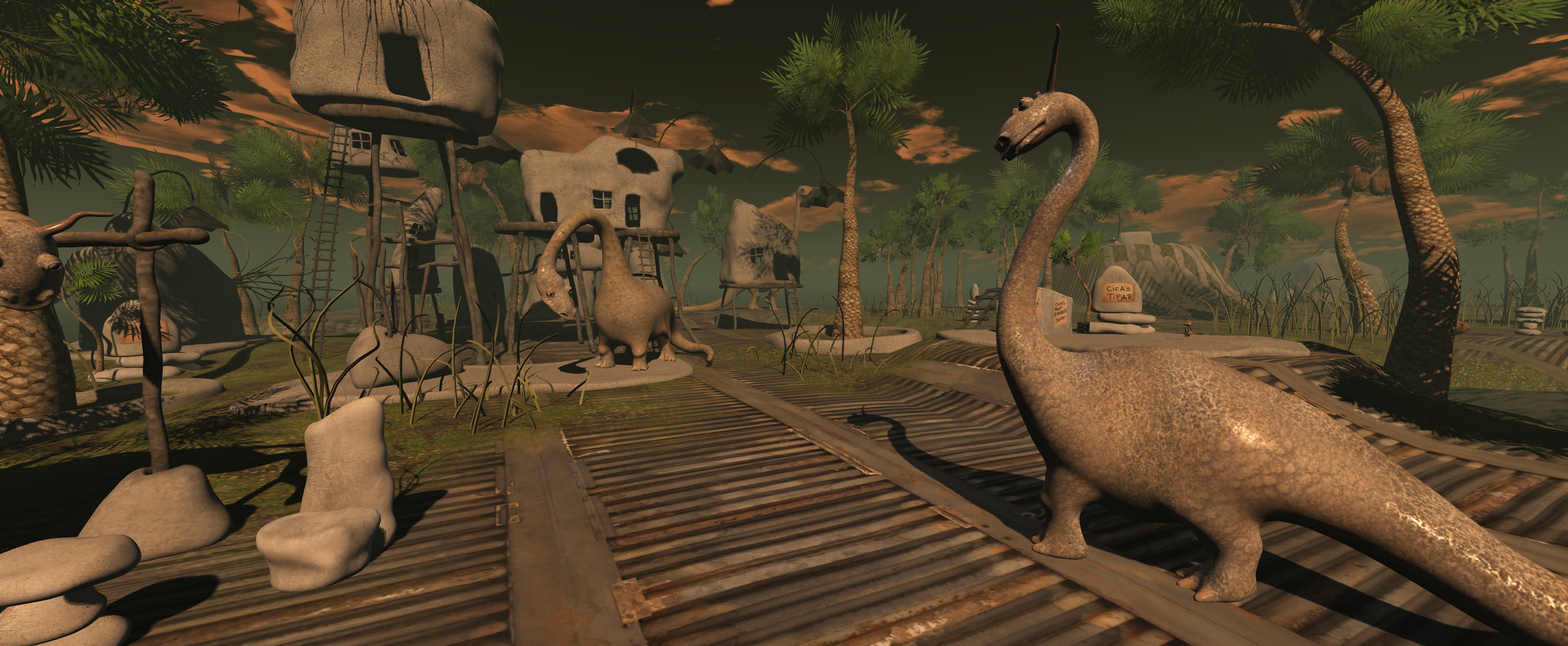
The far end of this valley opens out into an even more alien landscape, a place inhabited by strange slug-like creatures as green as the their surroundings, some with what we would regard as the normal complement of eyes, others with decidedly monocular vision and still some with no real indication of any form of eye or eyes. Fat-lipped and bulbous-headed, they are clearly not of Earthly origin, and the mix with more of the strange maw-like creatures and one or two that have legs.
Cica Ghost: Green Planet
Throughout this landscape, more of the trumpet-like flowers point to the sky, and many of the undulating features have the feel of having been extruded rather than formed, while green globs drool from fronds and rocks as if someone has thrown green paint across this place – or perhaps it is the gunk thrown out by whatever caused the impact crater that is home to the landing point! Also to be found here are little fumeroles that periodically burp forth green bubbles that drift upwards, while grass-like fronds that have escaped any smothering by the green goop curl gently.
Sitting pristine within the setting is a silvered metal rocket, panels heavily riveted and a single viewport looking out over the scene – but the creature with its face pressed to the thick beaded glass does not appear to be human. The presence of the rocket and its traveller, together with a glass-domed very Earthly-looking flower, add perfectly to the overall surrealism of the setting.
Cica Ghost: Green Planet
And surrealism is one of the reasons the quote Cica has chosen for the setting is so apt: Eluard was one of the founders of the Surrealist movement, dedicated to opening channels in the mind as a means for the unconscious mind to express itself. In this respect, there is much to be said about Second Life and the manner in which we can use it to express ideas of our own and unlock our imaginations in a way that somewhat parallels surrealism’s attempts to unlock the subconscious.
The second element in the fitting choice of Eluard’s quote is that just as there is a myriad of worlds out amongst the stars of our galaxy, some of which – perhaps many – might will harbour strange and exotic life that might be celebrated through the bizarre creatures Cica has given us here; we have only to look inwards to find equally fabulous “other worlds” as they sit within our imaginations. Worlds like Cica’s Green Planet – wonderfully bizarre and captivating, unusual, engaging and fun (be sure to mouse over things – there are hidden dances awaiting discovery and a number of fun poses to be had – although you might have to look up at what is drifting around overhead to find the latter!).
Cica Ghost: Green Planet
As always, another great installation from Cica, who never fails to offer something fresh and eye-catching each month, so do please consider making a donation to her on-going work when visiting! And don’t forget the gift at the landing point!
Bella’s Lullaby, March 2022 – click any image for full size
It was back to Bella’s Lullaby for me recently, after Shawn Shakespeare let me know the setting has a springtime rebuild by holder Bella (BellaSwan Blackheart) – and given its been around 6 months since my last visit and the fact that it has since moved to a new region – it was actually about time I dropped by again!
Bella’s Lullaby has always offered something of an easy, tranquil visit for those dropping in, and this remains the case with the current design. Set beneath a spring sky in which the Sun’s light is enough to wash the off-region islands in a bright haze, yet overcast enough to suggest spring showers might be on the way, the region again offers a pleasing mix of land and water – in this case, two long islands split by an off-centre channel running north-to-south between them, and plenty of open spaces, together with a sprinkling of buildings and structures across both islands.
Bella’s Lullaby, March 2022
With the channel splitting the islands guarded at each end by a tall windmill sitting on its own small island and a squat lighthouse rising from the waters on four sturdy legs respectively, the two large isles are connected by a single low bridge that effectively presents passage along the entire channel by the little boats dotted along its length. Not, given the rocky, shoal-like nature of parts of the channel, that this would necessarily be possible even were it sans a bridge.
The landing point sits within the courtyard of a small café sitting upon the larger island. This is actually one of three brick-built structures on this island; to the south stand a pair of linked shops which some visitors may recognise as also having made an appearance in the previous iteration of Bella’s Lullaby, and which now rise shoulder-to-shoulder from a paved square. Between these shops and café lies the remaining brickwork, a long, tall wall that divides the land between them even whilst it starts and finishes without apparent purpose, a single door set within it.
Bella’s Lullaby, March 2022
A low, capped stone wall runs parallel to the waterway to also help connect shop to café, whilst something of an overgrown garden sitting between the latter and the brick wall also acts to draw café, wall and shops together to complete a vignette awaiting exploration. Surrounding the shops is a degree of urban detritus – a telephone box, vehicles, an aging bus stop and tram sans tracks – that help to give them a further unique sense of presence in this place.
However, these are not the only buildings to be found within the setting. Sitting over the waters of the channel is a wood-built artist’s studio, whilst on the other island sit a wooden barn and a small brick-built cottage with but a single room offering a cosy observation point – although the sign hanging above the door seems to suggest it was going to be something else. Barn and cottage sit at opposite end of their island, a scattering of birch trees and the hints of a once-cobbled path connecting them.
Bella’s Lullaby, March 2022
Throughout the entire sitting there is much attention to detail – such as a robin helping himself to a meal outside the café, the carving of a heron watching the narrow waterway, the cats lazing in the Sun, and so on. There are also multiple places to sit to be found across the landscape, indoors, and out on the water and within some of the vehicles, whilst photographers will doubtless find much to capture and frame as well.
Bella’s region designs never fail to offer something fresh and uplifting to see and appreciate, and this latest iteration of Bella’s Lullaby is no exception. The open landscape that runs over the two main islands gives one a sense of space and peace, the trees and shrubs also presenting a sense of privacy in the way they break-up the low-lying lands, whilst the generally overgrown / unkempt nature of the spaces around the buildings hints at a sense of age / the passing of time.
Bella’s Lullaby, March 2022
This is very much a setting where one can gain a sense of being able to breathe and leave worries and concerns behind, whether one opts to sit quietly or explore and spend time spotting the local birds and the other fowl that make up the majority of the inhabitants.