Autumn at Mousehole in Second Life

Mousehole, September 2022 – click any image for full size

It’s been over a year since my first (and until now, only) visit to Mousehole, the second of Tolla Crisp’s regions to carry her Cornish theme (mixed with broader flavours from Europe). That visit, in June 2021 (see:  A corner of Cornwall in Second Life), was made notlong after the region had opened,  and saw it feature elements inspired by the ancient Cornish fishing village of Mousehole (pronounced maʊzəl, or Porthenys in Cornish) – at one time one of the busiest fishing ports, far down towards the very tip of England’s “toe”, on the southern coast of Cornwall.

At  the time of that visit,  Mousehole directly abutted Tolla’s Frogmore (now in its 5th iteration); however, time has passed and now Frogmore Cottage – a region given over mostly to rentals but with public paths winding through it – sits between the two.

Mousehole, September 2022

Now sitting within a Homestead region, Mousehole has perhaps lost its more recognisable links to its physical world namesake – but in doing so it has lost none of its charm or beauty. Built by Dandy Warhlol (Terry Fotherington), in keeping with past builds for both Mousehole and Frogmore – and doubtless with a lot of input from Tolla – the region now presents itself as mix of small, rugged islands of the kind that might be found around the Cornish and Devonshire coasts, and flooded lowlands.

The landing point sits on the main landmass for the region, a squat island marked by a shale shoreline to the south from which rises an impressive rock formation which, from some angles at least, is perhaps mindful of a seal or sea lion sitting on the shore, head raised to the sky. The rest of the island points north from here, taking first the form of a flat-topped shoulder of cliffs before dropping down to lowlands where sits a tiny hamlet.  Far smaller than Mousehole, this  nevertheless recalls both the village and the June 2021 build thanks to the sign from the old pub hanging on the wall of what might have once been a fisherman’s house, but which now looks deserted.

Mousehole, September 2022

This little hamlet, with its mix of houses that suggests both English and European influences, sits with a small harbour facing north and east towards the two Frogrmore regions.However, it is separated from them be a low-lying island which both shelters its moorings and is home to one of the region’s two large sandy beaches – the other sitting under the “sea lion rock” and the table-top cliffs of the main island.

Three further isles help complete this little archipelago.  Two sit side-by-side astride a narrow channel to the north of the main island. Linked be a wooden bridge spanning the separating gorge, they are repectively the home of a smattering of further houses and buildings, and a single little pavilion.

Mousehole, September 2022

Westwards sits a rugged blob of an island, its flat top home to ancient ruins  whilst carrying a hint of Cornish moorlands even whilst a tall white lighthouse rises from their southern extent. Little bridges connect these latter isles to the hamlet, presetting the means for visitors to explore all of them on foot, despite the swirling waters churning the channels between them.

Throughout all of this there is, as one would expect, a wealth of detail both on land and on the water. In the case of the latter and despite the visible turbulence of white-capped foam suggesting shallows and rocks beneath, it is clear that the channels separating the islands are an important part of life here. Rowing boats are moored throughout, and Dandy has made clever use of a farmhouse design to incorporate water and moorings neatly into its layout, the overall design of the house offering that twist of European influence mentioned earlier without making with house feel out-of-place in this setting.

Mousehole, September 2022

Those wishing to reach the Frogmore regions – or get to Mousehole from them – can do so via low wooden bridges which connect with a rocky spine rising from between Mousehole and Frogmore Cottage (and indeed, straddling the two regions). When coming from Frogmore Cottage, this slender island, windswept and battered by the tide, offers a warm greeting, a small cafe and a familiar sight across Cornwall in the form of hardy little ponies.

As always with Mousehole / Frogmore there are many opportunities for photography here, and the default EEP setting does much to help reinforce the idea that this is a part of Cornwall which is saying “goodbye” to summer skies and sunny days, and preparing itself for the arrival of the harsher days of winter. Well worth a visit.

Mousehole, September 2022

SLurl Details

Art and a walk in Southern Corsica in Second Life

Corsica Tourist Centre and Tea Garde – start of the CSC Art Trail

A while back, and via Owl Dragonash, I received an invitation to explore (and possibly participate in) the Art Trail at Corsica South Coasters. While I have not directly participated, I did finally manage to get my bum and feet over to Corsica and take a walk along the Art Trail – and enjoyed doing so.

As the name suggests, the Art Trail is an open-air walk along the southern coast of Corsica, winding its way between the Corsica Tourist Centre and Tea Garden and Port Emyniad, with the former noted at the starting point; although there is no reason why trail-walkers can start from the Port and follow the signs backwards – there is no order into how the path is followed and the order in which the art is viewed.

CSC Art Trail, Corsica – just follow the signs!

It’s a route that takes in a number of sights along the south coast of Corsica, including gallery spaces at Port Emynaid and Ceakay Ballyhoo’s gallery (Ceakay is one of those – along with Owl, Catori Mistalker and Bijoux Barr – responsible for the trail) and others, as well as the trail itself marked both by trailside signs and mounted art from participating artists, either just for exhibition purposes or for sale.

The walk takes about 5-6 minutes when going directly from point-to-point. However, such is the nature of the walk, coupled with the opportunities to witness the art on display both along the trail and within the many studio galleries, and well as catching other points of interest along the way.  Doing so can draw a walk out into a very pleasant stroll, with the route itself home to a number of teleport station that provide access to additional points of interest within Corsica.

CSC Art Trail – Isle Biedermann and MJ Biedermann (MarjorieBrickard)

The Art Trail is intended to be an “eternal” art display (although pieces and galleries might naturally change over time), and artists from across Second Life are invited to participate along the trail-side art frames. Artists wishing to have work displayed along the walk can do so by:

  • Select one piece of their art as both a texture an a framed / on canvas piece of part – both to be set to Full permissions.
  • Send the art and texture in a folder to Ceakay Ballyhoo, together with the following:
    • If the art is to be sold – the permissions to be set against the art if it is to be sold & the price at which it is to be offered.
    • A copy of your biography as an artist and / or information on the art you would like to share.
  • Ceakay will then set the art up on one of the available art frames along the trail.
The galleries at Port Emyniad

Any question about the Art Trail should be directed to one of Ceakay Ballyhoo, Bijoux Barr (bijouxbarr) or Catori Mistalker.

SLurl Details

The romance of Cap Thunderbird in Second Life

Cap Thunderbird, September 2022 – click any image for full size

Occupying a Full private region utilising the LI bonus, Cap Thunderbird is held by Buzz Thunderbird (BuzzFlashMcQueen) and offered as a public setting for all who wish to visit. It is a location of two distinct halves, separated by a high curtain of cliffs cutting almost completely across the region from west to east, but each half nevertheless equally accessible to the other, and both fully open to visitors to appreciate and explore.

The main landing point sits within the southern half of the region, which has been designed by Buzz as a wedding venue and parklands. Whlist the wedding setting offers plenty to see, it is northern part of the region on which I wish to focus. This can be reached by teleporting over the cliffs – there is no hard-and-fast landing point – or by crossing the bridge from the main landing point and then heading west, past the wedding pavilion before re-crossing the stream and following the path under the stone arches and around the western feet of the cliffs.

Cap Thunderbird, September 2022

This northern part of the region is presented as a romantic park with something of a water theme. It is rich in detail and – for me at least – somewhat mindful in part of places such as Yorkshire’s Fountains Abbey (even though there is no direct similarity), thanks to the large ruins sitting along the west side of the region. Built using elements from The Chapel Ruins from The Looking Glass (and a personal favourite of mine, having frequently adorned my island home).

Buzz’s build makes good use of elements from the Chapel, allowing an extensive structure to be put togethe without any sense of repetition. It sits before a body of water cutting into the landscape, the drowned pillar and walls of more ruins (also re-uses of the TLG Chapel Ruins) rising above the waves as if gasping for air.

Cap Thunderbird, September 2022

Nor is the abbey the only gathering of ruins; across the waters of the inlet and over the grasslands to the east sits a further ruin. Its thick walls suggest it may have once served a defensive purpose – although the wide window bays say otherwise, as do the buttresses that still support parts of its remaining walls, both speaking to this having also been a religious building. These ruins are abutted by the remnants of a water mill. Of wooden construction, it stands roofless but with wheel intact and steadfastly turning in opposition to the waters of the stream passing below.

Offering a step-by-step description of what to see / where to go isn’t really useful here, given teleports within the region are so open – but there are various points of interest that should be noted. The first is that the main landing point can furbish visitors with a teleport HUD.

Cap Thunderbird, September 2022 – wedding venue

Whilst somewhat on the large size, given its functionality, the latter allows visitors to hop to a number of points of interest in the region, including the Hidden Gardens and the Underwater setting, located beneath the waters of the inlet. A further location available via the HUD and also directly via a board at the region’s main landing point, is Desolation, a small diorama sitting in the sky.

Birds and waterfowl have clearly made this park their home and can be found throughout, whilst deer roam the grasslands. Across the landscape lie pools and lakes of flowers adding broad swathes of colour to the setting, some of them caught in the shimmering fall of beams of light.

Cap Thunderbird, September 2022

The latter fall from a sky which (together with some of the wildlife) betray this place as not being a part of England’s northern counties, but somewhere otherworldly. Cloud-like in form, this sky is cut by an arc of brilliant white, whilst beneath the cloudly backdrop hang sparking points of light, perhaps stars set againts the cloudy grey of a nebula, whilst as the time passes, so the arcs of Moons (or other planets) can at time be seen.

Those wishing to explore this land via other means than using their pedal extremities can do so using the teleport HUD already mentioned, or by using the little motorboat to putter around the waters, or partake of a flying bubble available from the rezzer hidden amongst the trees, or via a sedate ride in a hot air balloon. The latter two offer the means to hop up and over the cliffs separating the two sides of the region, thus offering an alternate means of exploring both.

Cap Thunderbird, September 2022

With multiple places to sit and relax, and finished with a suitable soundscape, Cap Thunderbird offers a relaxed and romantic setting with multiple opportunities for photography and – of course- an engaging wedding venue. My thanks (as ever!) to Shawn Shakespeare for the landmark!

SLurl Details

Serena Riviera is rated Moderate

An Art Walk + 3 in Second Life

UASL, September 2022: Roxksie Logan

It was back to the ever-evolving United Artists of Second Life (UASL), the community “for artists … by artists”, for me at the start of the week to catch-up on a couple of art exhibitions there, both of which opened this month: the Art Walk and the respective work of a trio of artists who are being exhibited together at the UASL’s Galerie Principale.

Presented by Michiel Bechir, Art Walk offers the work of Blip Mumfuzz, Elfwym, Georgie Iceghost, Harlow Isabelle Stoop, Jamison, Karly Kas, Mara Telling, Owl Dragonash, Susietea, and Violette Rembrandt (Myra Wildmist is listed on the invite note card, although I didn’t find any of here work along the walk), all of whom present four images apiece located in a open-air lawn sitting between the futuristic building of UASL’s galleries and supporting buildings.

UASL, September 2022: Art Walk

Ranging from landscape images captured within Second Life to animal studies from the physical world, to digital paintings, Art Walk is an easy-on-the-eyes exhibition that brings together a wealth of photographic, painting, and post-processing styles and techniques, with visitors able to wander around the lawn and viewer each artist’s quartets of images at their leisure, with bio givers alongside the works present the chance to learn more about each of the artists.

Occupying three of the floors within UASL’s Galerie Principale are a trio of exhibitions by BijouxBarr (ground floor), Nodome (second floor) and Roxksie Logan (third floor): three very different artists brought together in a trio of exhibits which are individually and collectively engaging to the eye.

UASl, September 2022: BijouxBarr

Within her section, Bijou presents a selection of art in two parts. To one side is a set of landscape paintings. Bright, their colours in places almost over-saturated, these are pieces that breathe life through their colour. Across the hall, are eight images of an altogether different nature – portraits, both human and animal, and fantasy pieces. Containing their own tonal quality that is completely distinct from the landscapes, these are marvellous walks through the imagination.

Nodome is an artist whose work I don’t think I’ve encountered before – more is the pity – as she has much to say, both through her art and in words. These are pieces ranging from the sexual (if not conventionally so), through the abstract to the expressionist. Each has a richness of narrative rippling through it.

UASL, September 2022: Nodome

Roxksie Logan is an artist whose work I’m very familiar with, and whom I’ve always enjoyed for her ability to offer images and installations that challenge perceptions and thinking. Here, on the third level of the gallery she presents the most captivating of digital images (as per the image at the top of this article). Rich in colour, enfolding elements of fantasy, cyberpunk, science-fiction, and with a look and tone that is fanciful, alien and familiar – all by the same measure, these are a tour de force of digital artistry at its finest.

Both Art Walk and the display at Galerie Principle sit as just two among the gathering of galleries and art spaces that being UASL to life. As such, when visiting, do take the time to explore and visit the other exhibitions awaiting discovery – or better yet, take the time to make several visits to explore UASL properly, if you’ve not previously done so.

SLurl Details

Note that Karpov is rated Moderate.

The caves and caverns of Rosehaven in Second Life

Clair View Ruins and caves, The Realm of Rosehaven, September 2022 – click any image for full size

The Realm of Rosehaven  (operated by SelenaAnansi and Serra Anansi) is one of the oldest fantasy / medieval themed residential and role-play communities in Second Life. Totalling 15 regions, it offers a rich mix of private and public spaces, it is a place with much to see and discover; a place that can be called home by those with a focus on fantasy.

We offer you a place to hang your hat, rest your feet, and let the stress of the outside world fade away in a fantasy British Isles styled setting.  Architecture and themes are inspired by fairy tales, lore, myths, and possibly your dreams.  Medieval and fantasy clothing is welcomed and encouraged; however, there is no set dress code.
Rosehaven is a land of magic and dreams – the living embodiment of imagination and creativity, where humans, elves, fae, shapeshifters, and other creatures can peacefully coexist among the mist-covered lands.

– From the Realm of Rosehaven website

Clair View Ruins and caves, The Realm of Rosehaven, September 2022

I was drawn to the estate after learning about the extensive network of caves, caverns, tunnels and places of mystery and magic which offer the Second Life explorer much to see and – well, explore.

This is a network with many points of entry (and exit!), which exists underground, under the sea and in the air, the various elements linked by an experience which allows for relatively seamless teleport movement between locales. Given the multiple points of entry, how and where a traveller may come by the system is a part of the fun of discovery; it might be a case of noticing a shadowed archway between houses and then walking through it, or finding a ladder leading down into the bowels of the earth from the basement of a public building, or even the ornate doors at the foot of a cliff which open at the touch of a hand rather than the utterance of “Mellon!”

Clair View Ruins and caves, The Realm of Rosehaven

For the purposes of my explorations, I opted to go the easy way – via the entrance below the Temple of the Oracle at Clair View Ruins (designed by designed by Snow Kelley). Step through the stained glass of the portal, and your voyage begins at the Cavern of Inner Wisdom; pay attention to local chat for a clue on how to proceed – but before you do move onwards, take the time to explore the halls built within the cavern. And when you are ready to travel onwards, don’t be fooled when confronted by an apparent blank face of rock after following the Cavern’s whispered instructions.

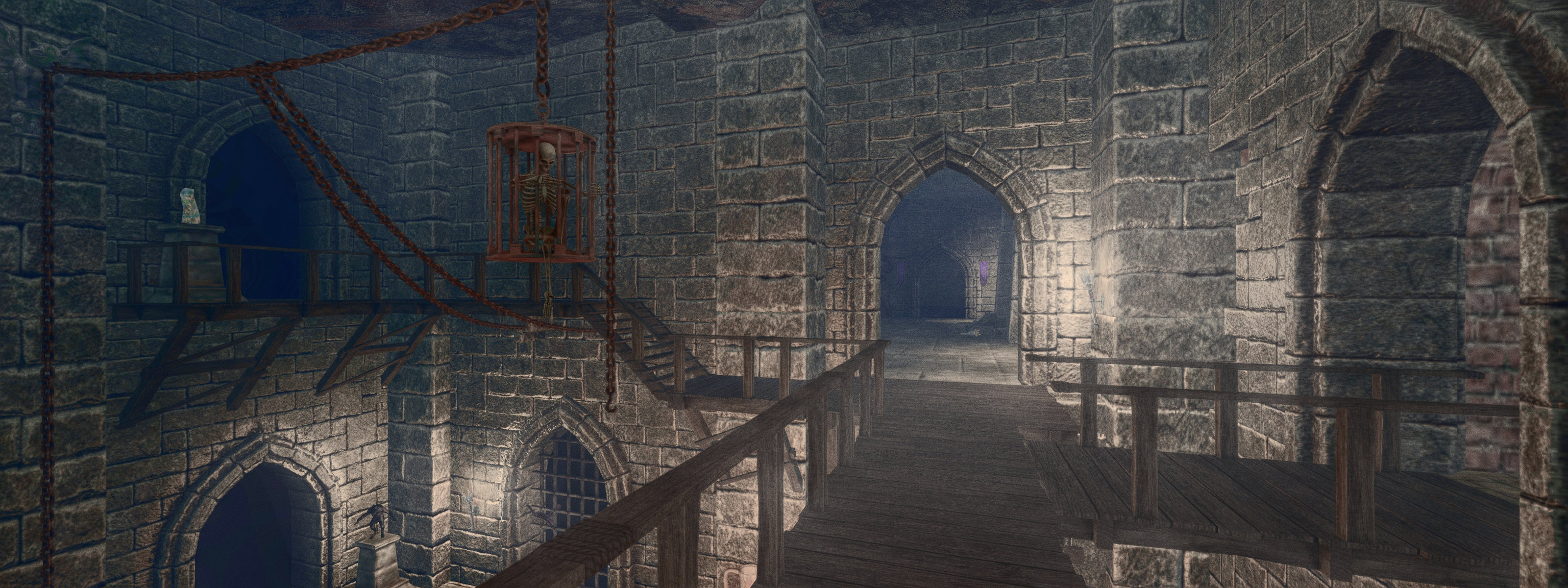
Beyond this first cavern lies an underground fortification, a place of hewn and shaped stone walls, where broad stairways of wood and stone connect different levels and long halls and shadowed arches hint at further destinations. Designed and built by Talus Ravenheart, it sits as a kind of hub with multiple opportunities of onwards exploration. But again, before stepping through any of the archways, take a moment to explore the passages also offered, because again there are places here to be discovered: catacombs with the memory of one passed, a broken wall leading to natural caves beyond which in turn lead to further secrets and spaces awaiting discovery.

Clair View Ruins and caves, The Realm of Rosehaven, September 2022

Such is the nature of this “hub” (for want of a better term), that describing what might come next is impossible, thanks to the multiplicity of options for onward travel available. And even if there were a proscribed route, providing a blow-by blow description of what might be found would spoil the experience of exploring the cave and caverns for yourself. Suffice it to say that as you select arches and routes and shaded tunnels, so might you find yourself in the abode of a practitioner of magic or the hideaway of pirates or tunnels adorned with crystals, leading the way to elven halls – or more besides; each one designed by one or more of the residents of Rosehaven, and thus given an individual flavour.

Along the way it is possible to come across interactive elements in various places and rooms as well – so should you find yourself in, say, a cellar where grapes are pressed into wine (to name but one) – be sure to mouse-over anything that looks like it might not actually fit with the rest of the room / cavern. Also, given that any route might lead you to an alley or dungeon or gateway or stairs leading to the world beyond the caves, the tunnels offer a unique means for discovering and exploring public spaces within the broader Realm; just remember that teleports into the network may not always be a portal or hidden in shadow; some might lie behind an innocent-looking door…

Clair View Ruins and caves, The Realm of Rosehaven, September 2022

Whether used for exploration or for role-lay, the caves of Rosehaven add a further dimension to this engaging community, and are more than worth a visit.

SLurl Details and Links

Art and allegories in Second Life

The Vordun: Allegories of Artemisia, September 2022

Recently opened at The Vordun Museum and Gallery, operated and curated by Jake Vordun, is a stunning exhibition of art from the physical world offering a celebration and exploration of the life and work of Artemisia Gentileschi (1593-1656) also known as Artemisia Lomi), one of the most accomplished artists of the Baroque period, (c. 1625-1740).

Born in Rome on the 8th July, 1593, the eldest child Prudenzia di Ottaviano Montoni and noted Tuscan artist Orazio Gentileschi, Artemisia took up art at an early age, and was producing professional works by the age of fifteen. Like her father, she followed the innovations set by Caravaggio – such as the use of real models – whilst also developing a natural eye for the use of the brush and in the mixing of paint and use of colour to depict the female figure with a naturalism which extended beyond the more idealistic approach of her male peers.

Artemisia Gentileschi: Self-Portrait as the Allegory of Painting, 1638–39. Via: wikipedia

Initially regarded more out of curiosity than in recognition of her skills – she came to wider public knolwedge as a result of the trial of artist Agostino Tassi, who raped her when she was 18 – by the time she was in her early twenties, she had become the first woman accepted into the  Academy of the Arts of Drawing in Florence.  As her work gained a broader audience, so to did her career flourish through patronage and hard work, her art carrying her from Florence back to Rome, thence to Naples – and even to England and the court of King Charles I.

As well as its depth of realism, her work is notable for its focus on women from myths, allegories, and the Bible, with many featuring herself as one of – if not the – protagonists. Her art eschews the more accepted view of the female form – that of a gentle, sensitive, vulnerable creature – to instead present women as figures of power, strength, and the equal of men.

The exhibition at The Vordun – entitled Allegories of Artemisia – is an extensive look at Artemisia’s work offering one of the most unique gatherings of reproductions of her art to been seen outside of the printed page.  A collaborative display by Jake Vordun (producer), Marina Münter (vivresavie) – curator; Paul Gils (ObertonX) – research assistant; and Cibele Cibernética (profetadigital) – graphics designer, it is a multi-room exhibit made all the more abosrbing by its non-linear approach to Artemisia’s life and art, one which – in the words of those responsible for the exhibition:

[Traces] a parallel between the the characters she depicted in her paintings and her own life, the visitor gets the chance to experience real scale works by her and artists from the same period, given the chance to analyse visually the aspect of her work.

From the introduction of Allegories of Artemisia

The Vordun: Allegories of Artemisia, September 2022: Judith Beheading Holofernes (left: Caravaggio, c.1599; centre: Artemisia Gentileschi, c. 1614-20; right: Artemisia Gentileschi, c.  1612-13)

On accessing the exhibition from the gallery’s main hall, vistors should follow the route through the opening to the right. This takes a route through a series of rooms, starting with a general introduction to Artemisia Gentileschi, followed by a series of self-portraits that help into introduce both the artist and the artistic tradition of a painter focusing on a subject more than once during their career.

From here, further rooms offer reproductions of some of Artemisia’s more noted works drawn from biblical stories (including from deuterocanonical books of the Old Testament), together with reproductions of the same subject by her male contemporaries – thus providing that opportunity to directly compare the work of Artemisia with her contemporaries, and appreciate both the uniqueness of her depiction of female characters and the depth of naturalism found within her work.

Wall text in each room help contextualise the subjects of the paintings and also to provide historical / biographical information (such as on Artemisia herself or her father) where relevant. This set of rooms culminate in a three-part section dealing with the deuterocanonical character of Judith which include both Judith Beheading Holofernes and Judith and Her Maidservant. This in itself is an exquisitely framed and presented series of images – some of them the most famous of the Baroque period – forming an exhibition-within-an-exhibition.

The Vordun: Allegories of Artemisia, September 2022

Beyond these initial rooms lies a large hall that brings together further pairings and small groups of paintings by Artemisia and other artists of her period (one of which includes a piece by one of her few female contemporaries – Elizabetta Sirani), and well as individual pieces by Artemisia. This is bracketed to one side by two further “themed” sub-sections entitled Church Commissions and Mary Magdalene.

Throughout the exhibition there is a wealth of information carefully brought together by the organisers. Each painting is presented with a plaque supplying the title of the piece, the name of the artist, the approximate time in which it was painted, and where it resides today. In  typical Vordun style, these plaques can be clicked to display their information in local chat. Meanwhile, the main hall includes a timeline of Artemisia’s life, defined in terms of the recognised periods of her work as an artist, and the notable events within them, together with a small display of works by other artists and inspired by her work and life.

The Vordun: Allegories of Artemisia, September 2022

Since its inception, the Vordun has presented a series of long-duration, richly immersive exhibitions that seek to replicate the experience gained within a physical world museum, whilst presenting exhibits which either cannot be reproduced in the physical world or, if they do have something of a  physical world analogue, are far more accessible than their counterpart might be. All of this makes The Vordun an engaging visit, and Allegories of Artemisia adds to this enormously.

When visiting The Vordun, do be sure to accept the local experience and specifically for Allegories of Artemisia, make sure your viewer is set to Used Shared Environment.

SLurl Details