A return to Kekeland – Bardeco in Second Life

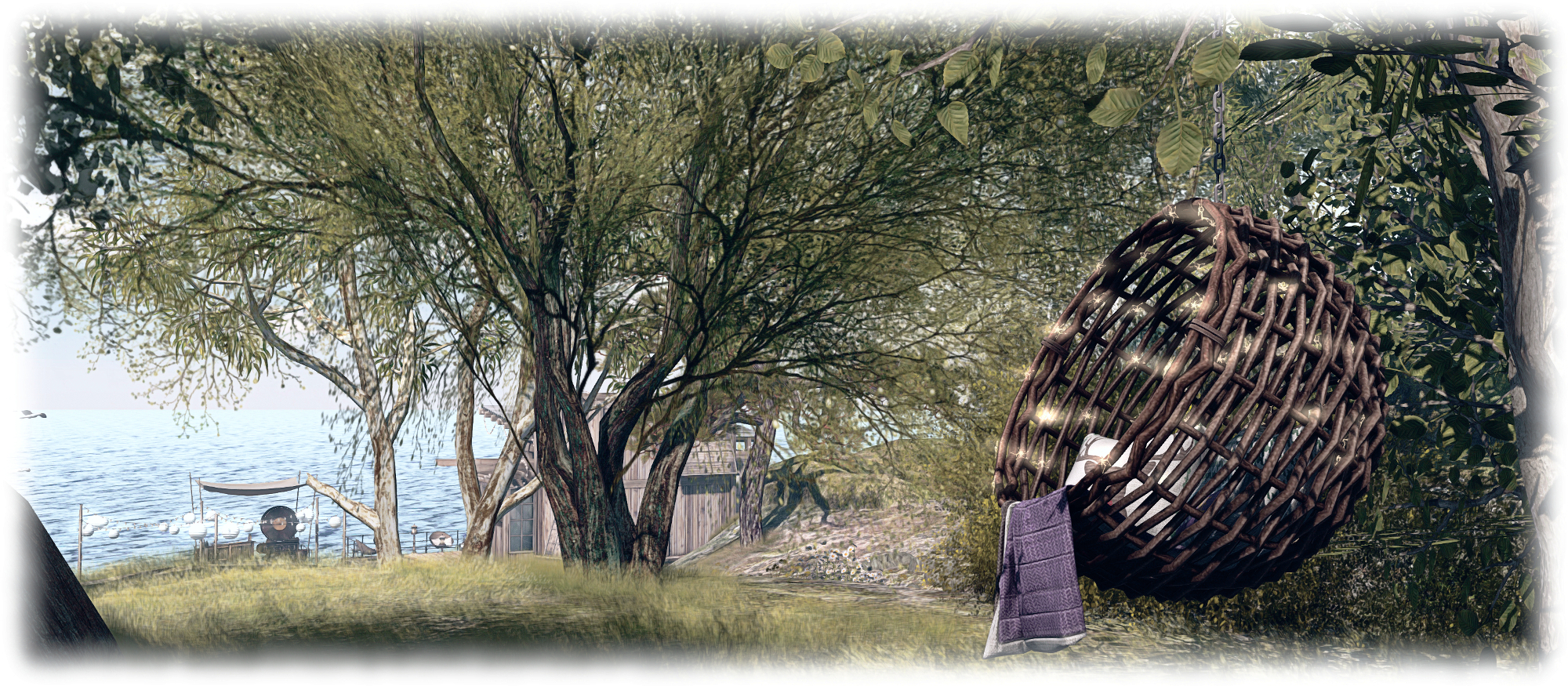
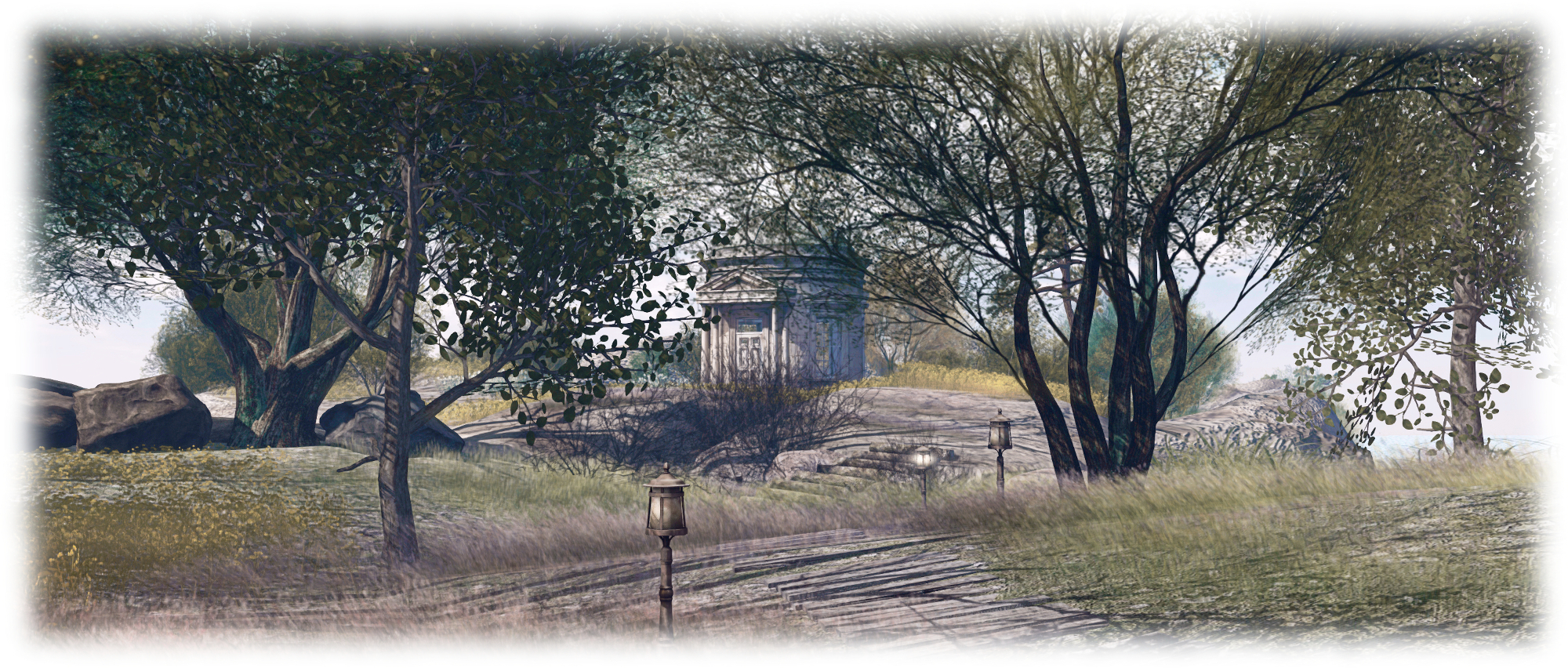
Kekeland - Bardeco; Inara Pey, August 2018, on FlickrKekeland – Bardeco – click any image for full size

Update: Kekeland – Bardeco has closed. SLurls have therefore been removed from this article.

It’s been nigh-on a year since our first visit to Kekeland – Bardeco, and while the titular bar served as an inspiration of me to remodel Caitinara Bar, after we visited the in the latter half of 2017,  we hadn’t been aware of any move or make-over in the design – until, that is, Shakespeare dropped a new LM on me. Intrigued, we hopped over to have a look, to discover Kekeland – Bardeco has moved from a Homestead to Full region, and undergone a make-over in the process.

We tried to recreate a quiet, sunny and peaceful fishermen place, inspired by an Italian village. You will find a little harbour and a coloured village, and hillsides of vines, with camping and mountains.

– Dandy Warhlol (terry Fotherington) and Belle des Champs (Bridget Genna)
Kekeland - Bardeco; Inara Pey, August 2018, on FlickrKekeland – Bardeco

As recreations go, the “new” design for Kekeland is impressive, and succeeds in imparting the feeling of being within the kind of setting that inspired it; but the success might come at s slight cost to some visitors: this is a place where there is a lot going on, particularly with textures, so some adjustment to viewer settings might be required to compensate.But this should put you off visiting; after all, that’s what graphic presets are for!

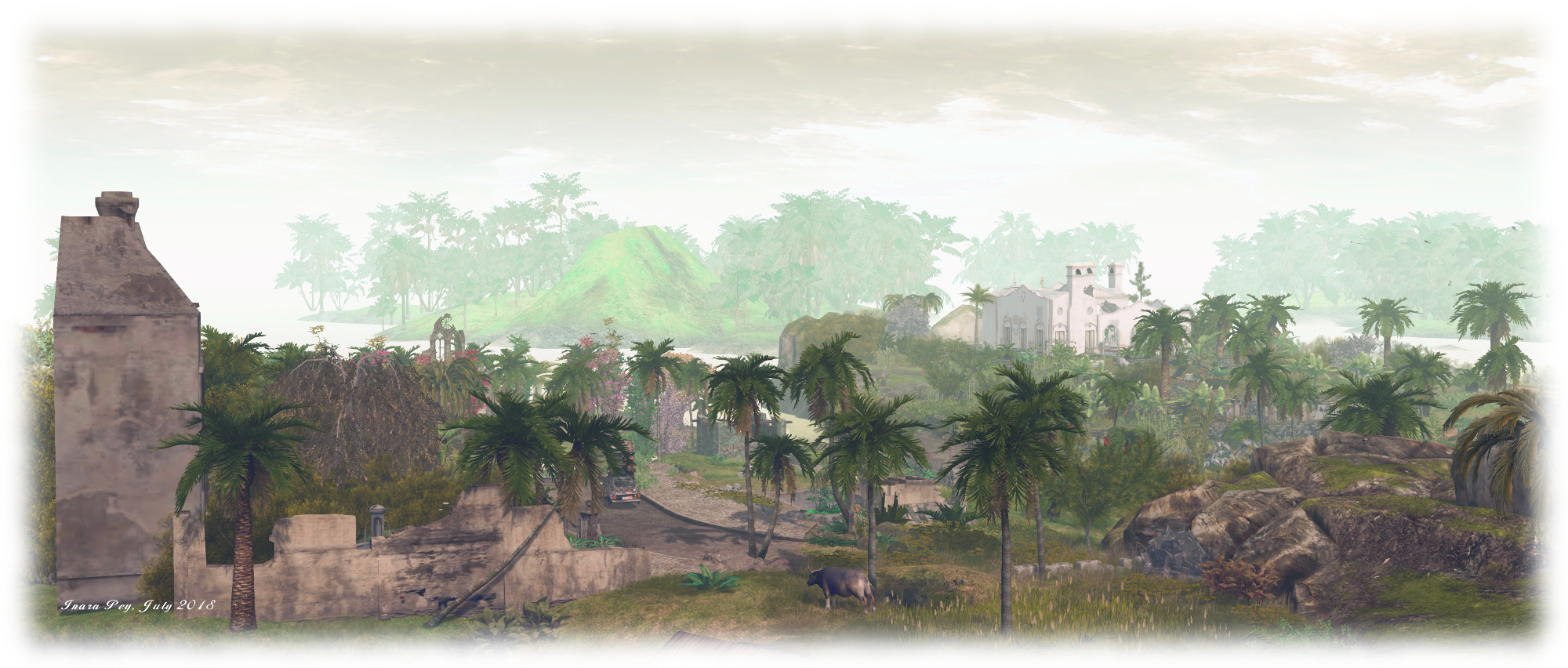
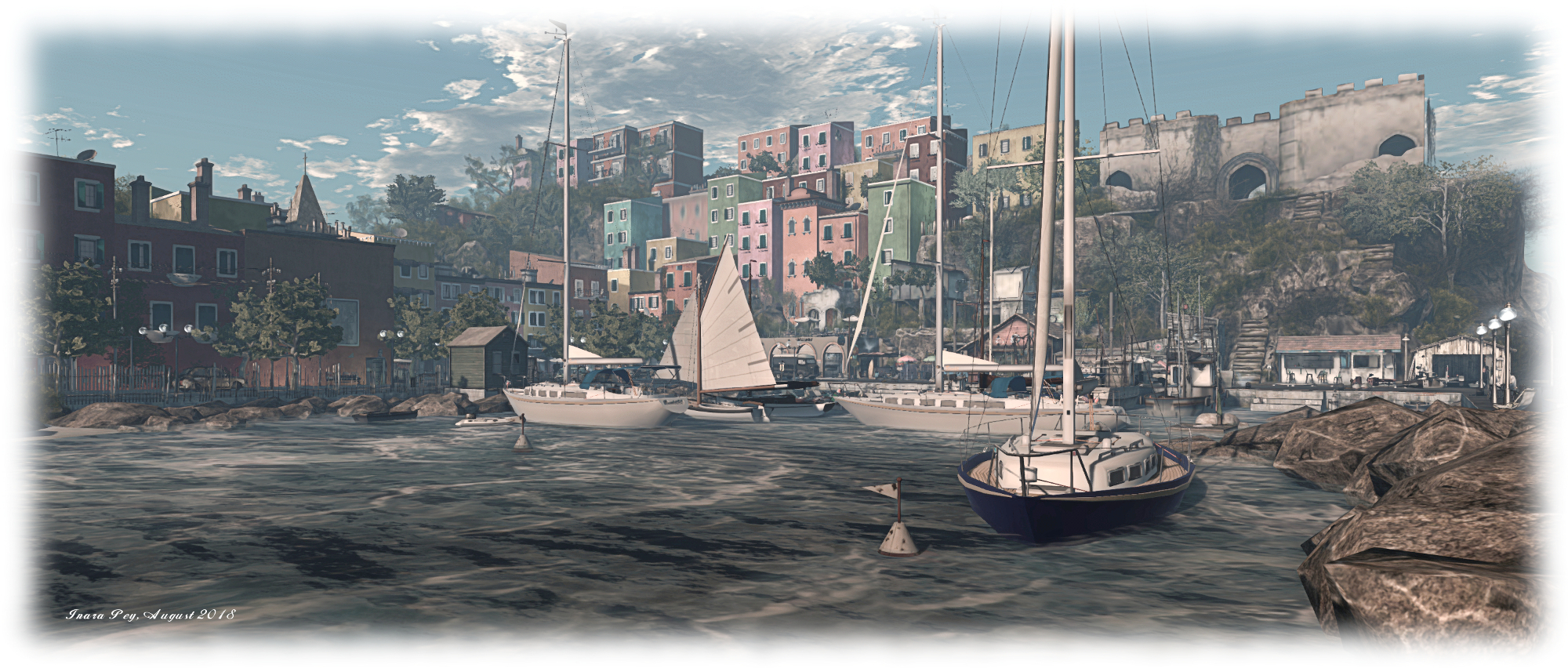
The harbour described in the land description sits on the south side of the region, a walk down through the streets of the town surrounding it on two sides. Protected from the sea by a breakwater and watched over by a lighthouse, it is fairly bustling with boats: sailing boats, yachts, motorboats, RHIBs – so much so that the fishing boats tied-up at the wharves must have to fight their way out to the freedom of the sea in order to ply their trade each morning!
Kekeland - Bardeco; Inara Pey, August 2018, on FlickrKekeland – Bardeco

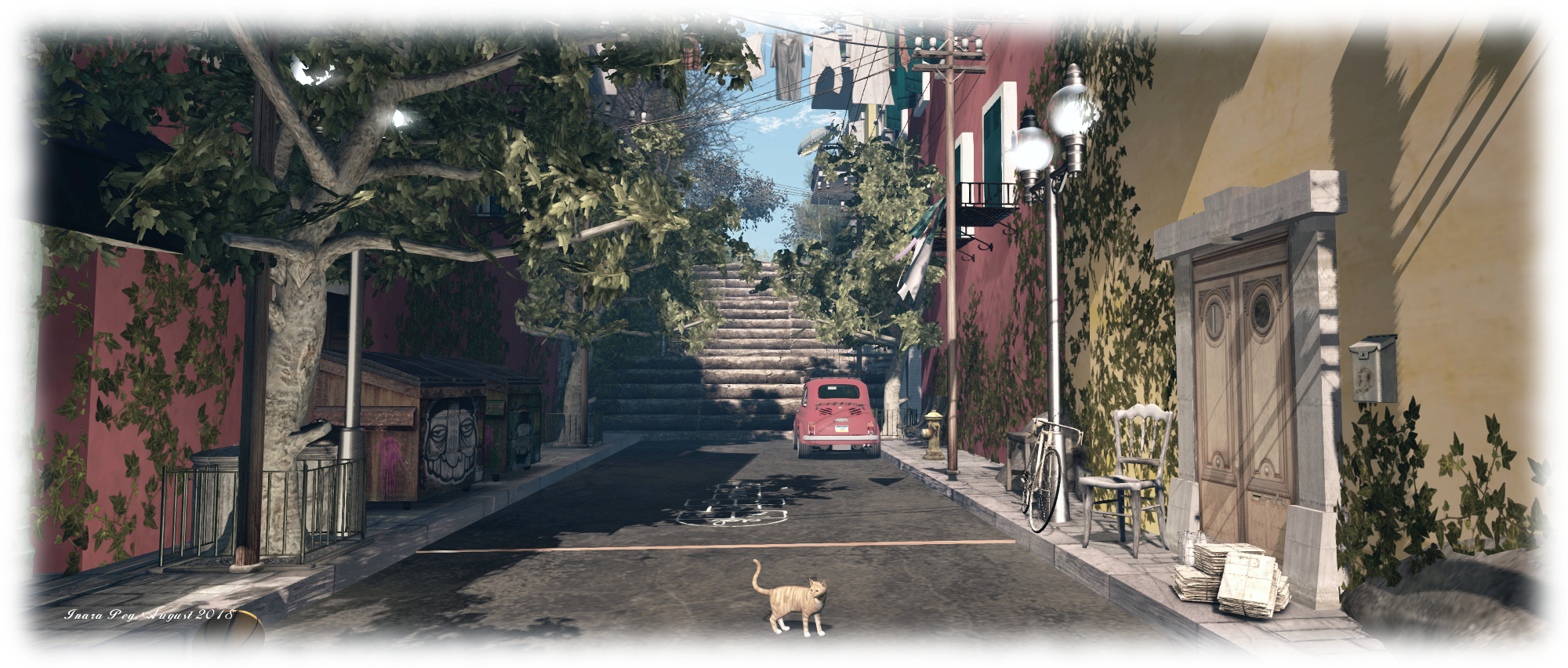
These fishing boats are tied-up on the east side of the harbour, which is clearly the “working” side: a busy waterfront road where a lot is going on. Behind it, and climbing the stepped cliffs, tall, modern-looking apartment blocks vie with  an ancient fort that once commanded a strategic view over the bay, to claim the skyline as theirs.

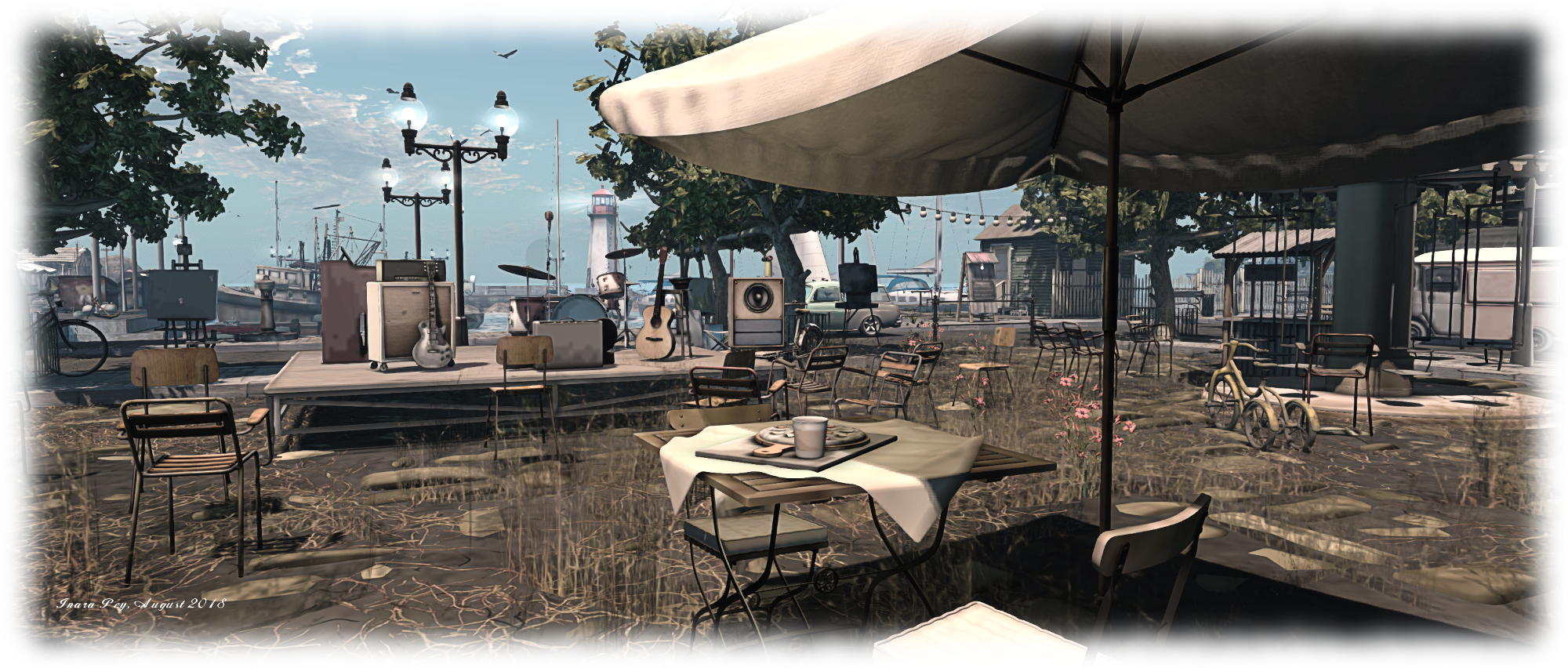
The town continues round to the north where, set back from the harbour is a plaza – surprisingly overgrown and with more tower blocks and houses climbing up the inland slope behind it. Along the plaza the predominant business appears to be entertainment and refreshment. The coffee houses, bars, boutiques and open-air music area, together with the more modern apartment houses up on the cliff-top, suggest why the harbour is so chock-full of boats: once a working coastal village, this place has now become a holiday destination.
Kekeland - Bardeco; Inara Pey, August 2018, on FlickrKekeland – Bardeco

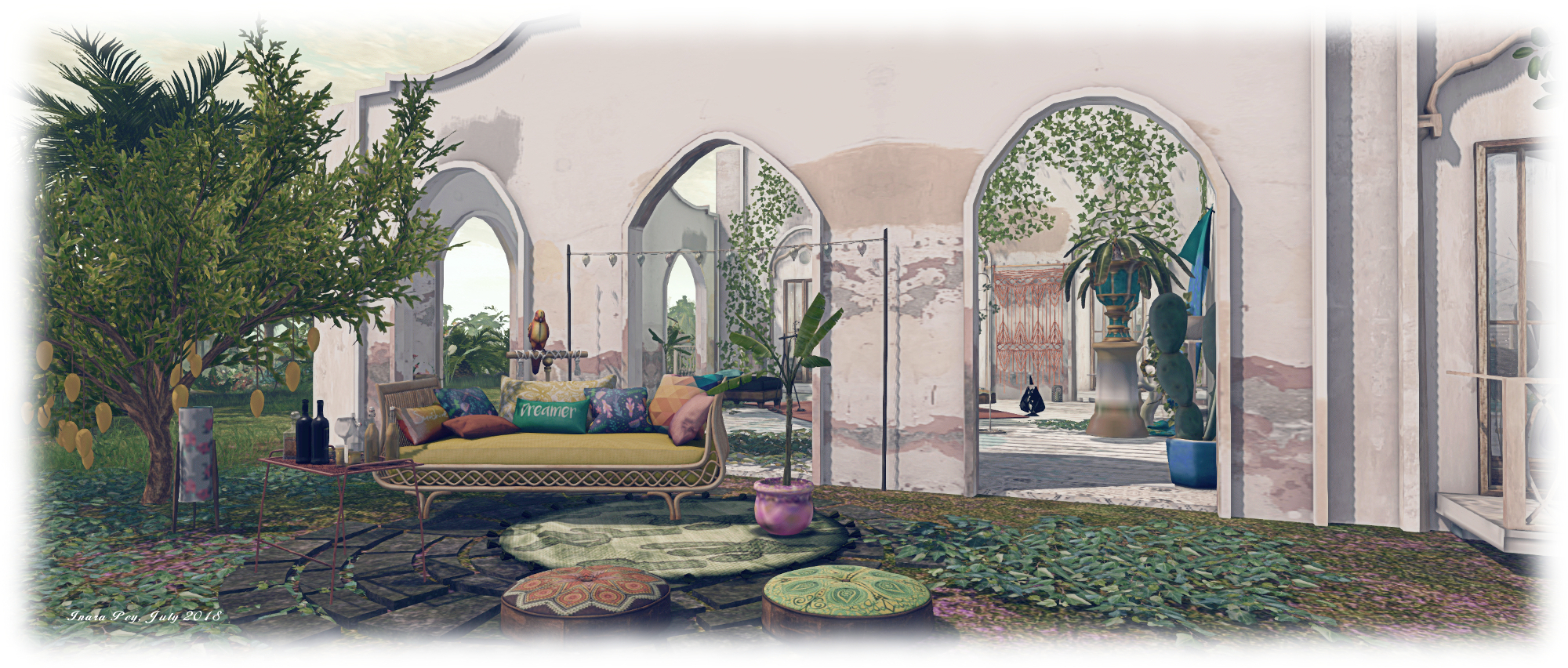
A further attraction lies on the west of the harbour. Here, sitting atop a rough table of rock, sits Bardeco. The last time we saw this (also the occasion of our first visit to a region design by Belle and Dandy), it was imaginatively placed at the foot of of the region’s cliffs and built back into them, offering an entirely “covert”, so to speak, setting that was both part of yet separate from the rural setting above. Seeing it out in the open in this “new” location did take a little getting used to, I admit, but it has not lost any of its shabby-chic appeal.

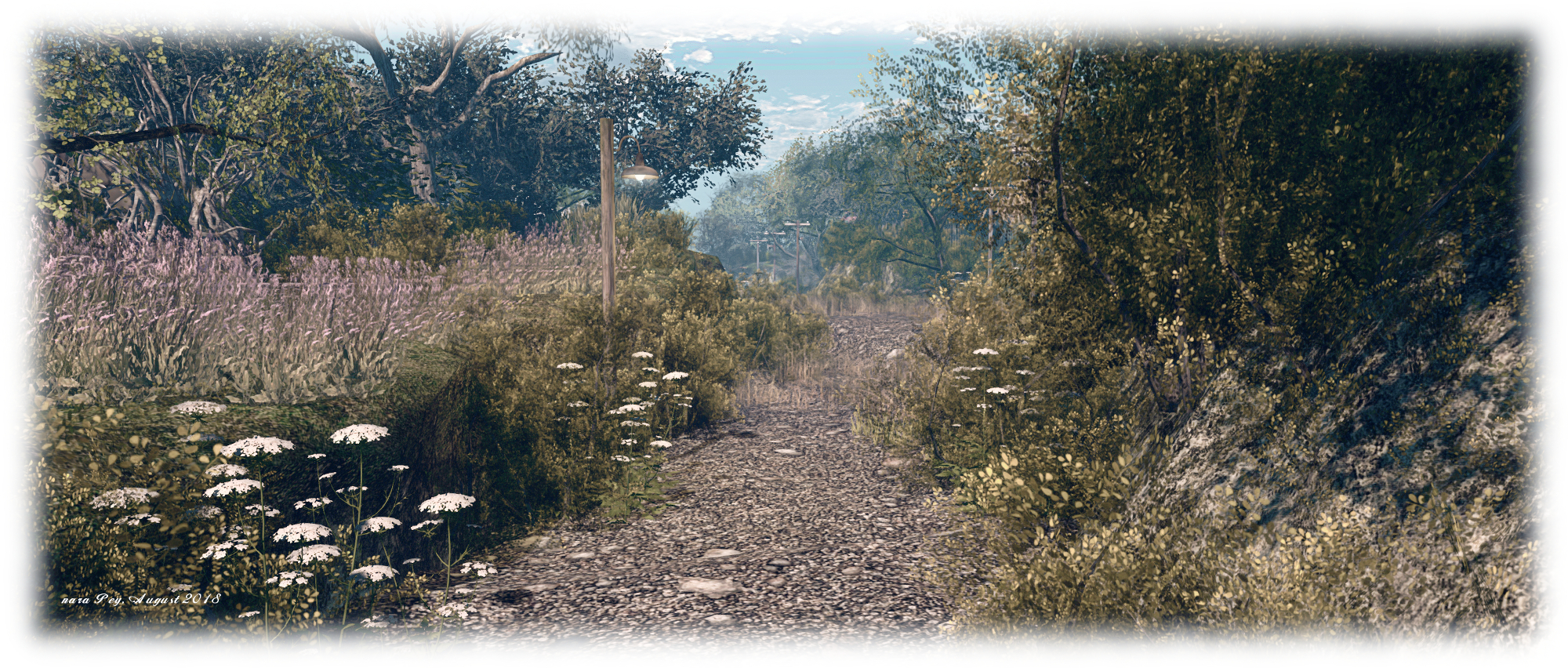
North of Bardeco, beyond the slip of water and beach dividing it from the town, the buildings quickly give way to open, rugged land. Here can be found trails, old ruins and signs that not all the locals have been driven away by the maddening crowd on the waterfront. Goats are being reared and grape vines cultivated on some of the lower northern steps of the island, while old farmhouses hide among the trees or sit aloof from the trails on their own shoulders of rock. There’s also the ruins of a much grander property sitting forlorn and alone, whatever story of times past lying within its broken walls fading slowly as nature takes up a greater and greater residence.

Kekeland - Bardeco; Inara Pey, August 2018, on FlickrKekeland – Bardeco

In its Homestead iteration, Kekeland – Bardeco offered a wonderful sense of rural living, complete with its discrete and neatly tucked away bar. With its move to a Full region simulator, it presents a more urban setting, and marries these with some of the feeling on open spaces that made the “original” so appealing. It is very different to the “old” design, but sports a unique look and charm nevertheless.
A return to Summers Wind in Second Life

Summers Wind; Inara Pey, August 2018, on FlickrSummers Wind – click any image for full size

I’ve recently been drawn back to travelling to places in Second Life I’ve not visited for a while, and one of the places that sprang to mind – even though it has only been a couple of years since I was last there – is Summers Wind. The hub of Mexi Lane’s three “Wind” regions, the others two being Winters Wind and Autumns Wind, both of which adjoin it, but are given to private residential properties.

The major thing that drew me to Summers Wind the first time around was the extraordinary manner in which landscape designer Rumegusc Altamura has blended landscape and architecture in the public regions of the region to create something truly memorable: a great plateau of rock rises from the middle of the island. And I’m delighted to say that, but for a few changes, it is still very much the centrepiece of the design, with the region as a whole still a marvellous and eye-catching visit.

Summers Wind; Inara Pey, August 2018, on FlickrSummers Wind

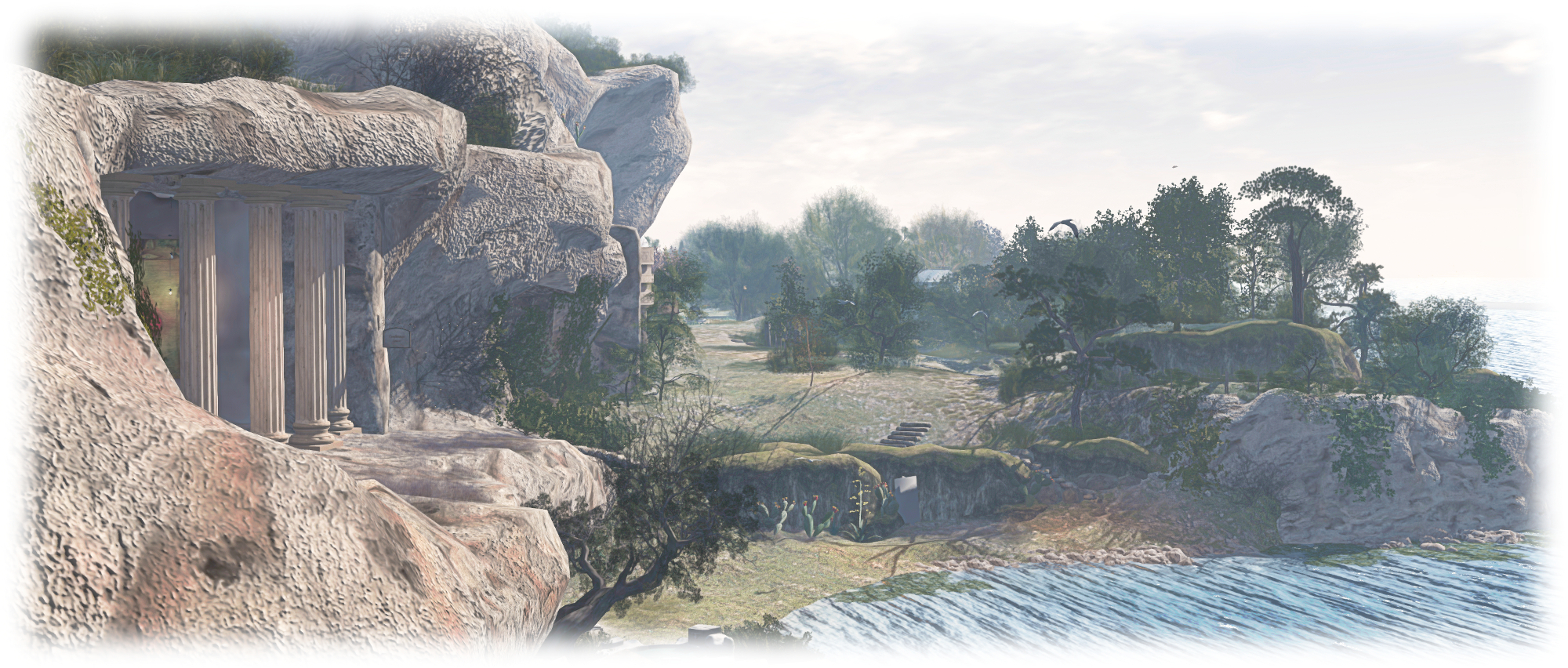
Pitted and sculpted into to great sweeps and curves as if by wind and water, the plateau is worlds away from the usual tables of rock seen in Second Life. At the foot of that massive upthrust of land is a series of deep caverns, each fronted by marvellous Graeco-Roman architecture: ornate lintels supported by great Doric style columns. All bar one of the caverns is home to a small store, the exception being offered as a conference space.

Running northwards from the southern coast of the region, the plateau splits Summers Wind roughly in two. On its west side are private rental properties – so please keep this in mind when visiting. To the east (and atop the plateau) are the public areas, albeit it with a couple of private residences.

Summers Wind; Inara Pey, August 2018, on FlickrSummers Wind

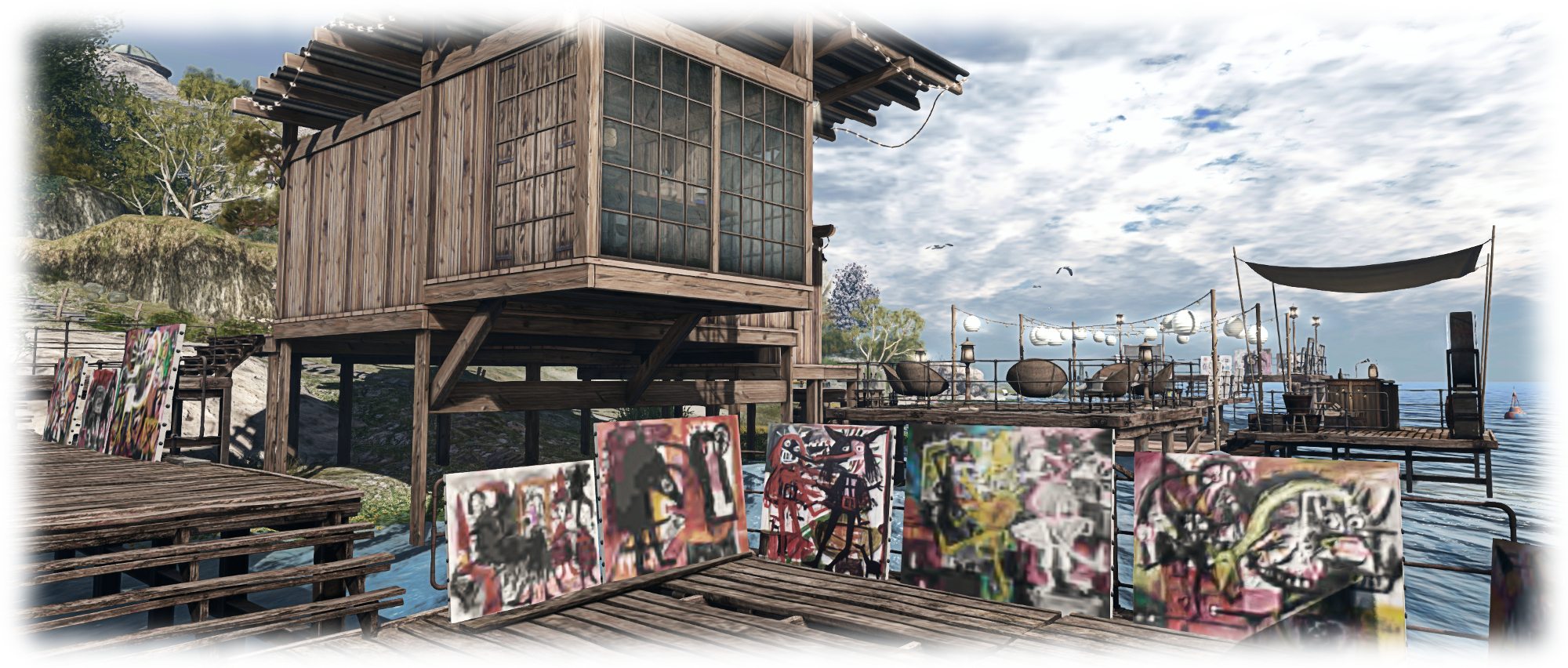
Nestled against the eastern coast sits the Café des Arts. Maintaining Mexi’s patronage of the arts in Second Life – she has supported the arts in SL for most of her in-world time, most notably through her former arts region, MIC- Imagin@rium – the café regularly hosts informal exhibitions set out along its wooden decks, and at the time of my return, it featured a display of physical world art by Italian artist Giancarlo Petrini.

Just to the north of the café are little bumper boats that can be use to explore the waterways around and through all three of the Wind isles – but again, do please remember Winters Wind and autumn’s Wind are primarily residential in nature. These can be accessed overland via a stone footbridge in the north-east corner of Summers Wind, which links it to Winters Wind, with more private residences scattered long the north shore of Summers Wind to face Winters Wind across the intervening water.

Summers Wind; Inara Pey, August 2018, on FlickrSummers Wind

When we first came to Summers Wind, there was a glorious underground club space beneath the north reach of the great plateau. While the entrance remains, the club has now gone (sadly, as the design was exceptionally well done), a spa now replacing it. There was also a way up to the top of the plateau – a winding trail and steps, which also seems to have been removed at some point. Now, so far as I can tell, the way up to the top of the plateau is via the signpost near the landing point. Clicking on the various boards on it indicating the various public locations – including the cliff-top conservatory – will deliver a landmark to the destination, allowing visitors to teleport to their desired destination.

In writing about Summers Wind back in 2016, I used a stanza from Summer Wind, the 1965 classic by Johnny Mercer and made famous by Frank Sinatra. I did so both because the name of the region put me in mind of the song, and because the song’s source, the German Der Sommerwind (Bradtke and Meier) uses the Sirocco wind of the Mediterranean as a metaphor, which fits with the wind-sculpted look of Summers Wind’s great plateau. Given how little has changed with the region, I still find the song as applicable today as I did back then.

Summers Wind; Inara Pey, August 2018, on FlickrSummers Wind

Which is another way of saying Summers Wind remains a stunning and beautiful design that is a delight to visit, explore and spend time within, containing its own unique look and a special sense of romance.

SLurl Details

In the forest of Chakryn in Second Life

Chakryn Forest

In my last couple of Exploring Second Life articles I’ve referenced re-visiting regions that have existed in-world without necessarily changing much over time. These posts prompted Miro Collas, another seasoned SLexplorer to remind me about Chakryn Forest, a place that has been in existence for getting on towards a decade.

A collaborative design between region holder Bettina Tizzy, landscape artist Andrek Lowell and Eshi Otawara, Chakryn Forest is a place that has changed little over the years since my last visit, back in 2013, and it was pretty well established even then. As such, it sits as something of a time capsule in SL; claimed in 2008, it has little in the way of mesh within it, retaining instead, and “old world”, so to speak, charm.

Chakryn Forest

As the name suggests, this is a forest realm, a place where gigantic redwood trees tower into the sky, spawned from megaprims spun by Zwagoth Klaar at a time when prims were limited to a humbling 10x10x10 metres. Their presence alone will set the bells of memory ringing for those of us who remember working in prims back before mesh arrived and we saw the size limit leap to 64m on a side…

There are no real paths here – it’s a forest after all – and so explorers need to find their own way from the landing point through the trees to discover what lay within, be it the exotic plants, the swooping, dancing sprites or the little camp sites and the more hidden places to sit. The supplied windlight is a little basic, so I do suggest photographers experiment – the images here were taken with a variety of settings, rather than using the default.

Chakryn Forest

For those in the mood, there are a number of quests to be found scattered through the forest and initiated by the likes of Elementals, Fae folk and Hobbits. All require finding objects and returning them to the start point of each quest in order to receive a reward. I confess to not having tried any this time around, so I assume all are in working order. When exploring, beaware that there is a secret place hidden away, lit by candles and offering another glimpse back into the history of SL; hanging decorative nets “woven” from textured cylindrical prims.

With the right windlight, Chakryn Forest has an ethereal feel to it; there is a sense of mystery between the trunks of the great trees, while the exotic flowers scattered about and the floating (in the air and on the water) Elementals give the forest an other-worldly feel. Animals are not in evidence, which is a good thing, given any wanderers would likely not handle the terrain with its slopes and folds while static animals probably wouldn’t look right. However, there is a rich sound scape to go with the setting, so have local sounds enabled when visiting.

Chakryn Forest

Like the tress within it, Chakryn Forest is enduring; old it may well be in terms of component elements, but it is still an engaging visit. More particularly, its age makes it very much a part of SL’s growing history; so when you visit, do please consider making a donation towards its continuance through one of the red flowers scattered across the forest floor.

SL Details

Meditations on a Black Kite in Second Life

Black Kite; Inara Pey, August 2018, on FlickrBlack Kite – click any image for full size

In writing about the closure of Namaste and Kamigama recently (see here for more), I made mention of the fact that with all the “new” regions and ever-changing region designs in Second Life, it is sometimes easy to forget the more long-lived locations in-world that are open to public visit.

Those comments put me in mind of a region I first visited nigh-on six years ago, and to which I haven’t written about in the last four. So, I decided to heed my own suggestion and hop over to it and spend a little time there.

Black Kite; Inara Pey, August 2018, on FlickrBlack Kite

Black Kite is the home of Cloudy (Theblackcloud Oh), and it has been open to the public for as long as I can remember it being in Second Life. Over the years it has undergone changes here and there, but by-and-large it has always remained a tranquil, water-focused setting, and this remains true today.

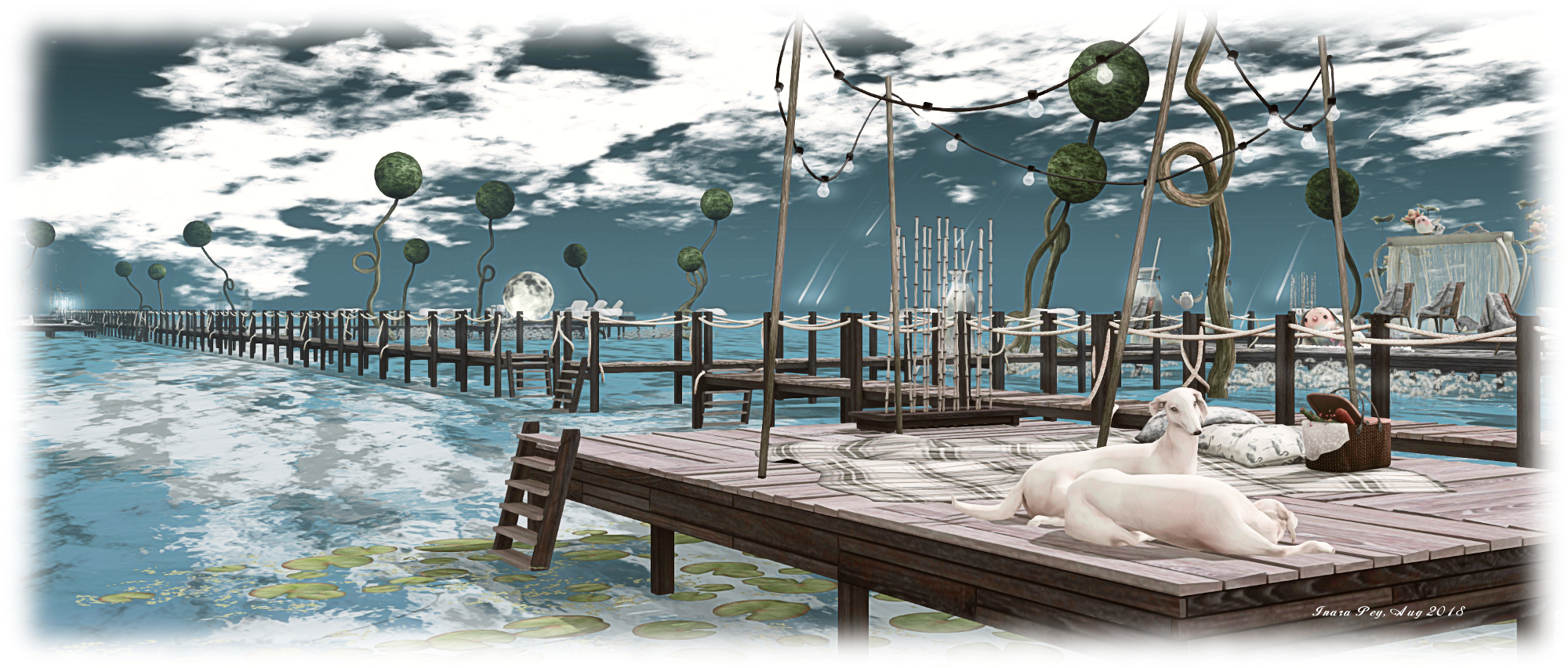
This is a place where azure waters gently flow under a matching sky broken by lazily drifting clouds of white. The ankle-deep water is dotted with wooden decks and board walks, some connected one to another, others sitting as isolated islands to be reached by gentle wading, short steps offering a way up onto them.

Black Kite; Inara Pey, August 2018, on FlickrBlack Kite

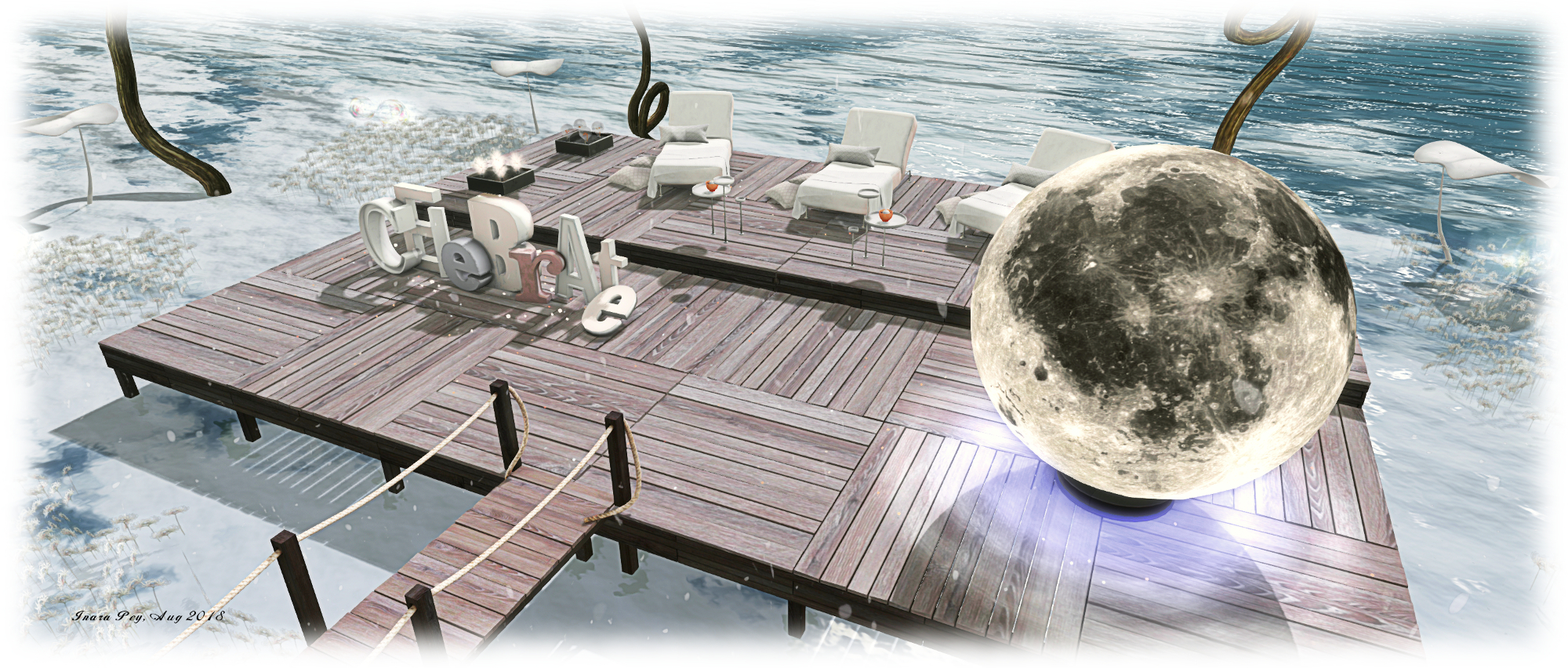
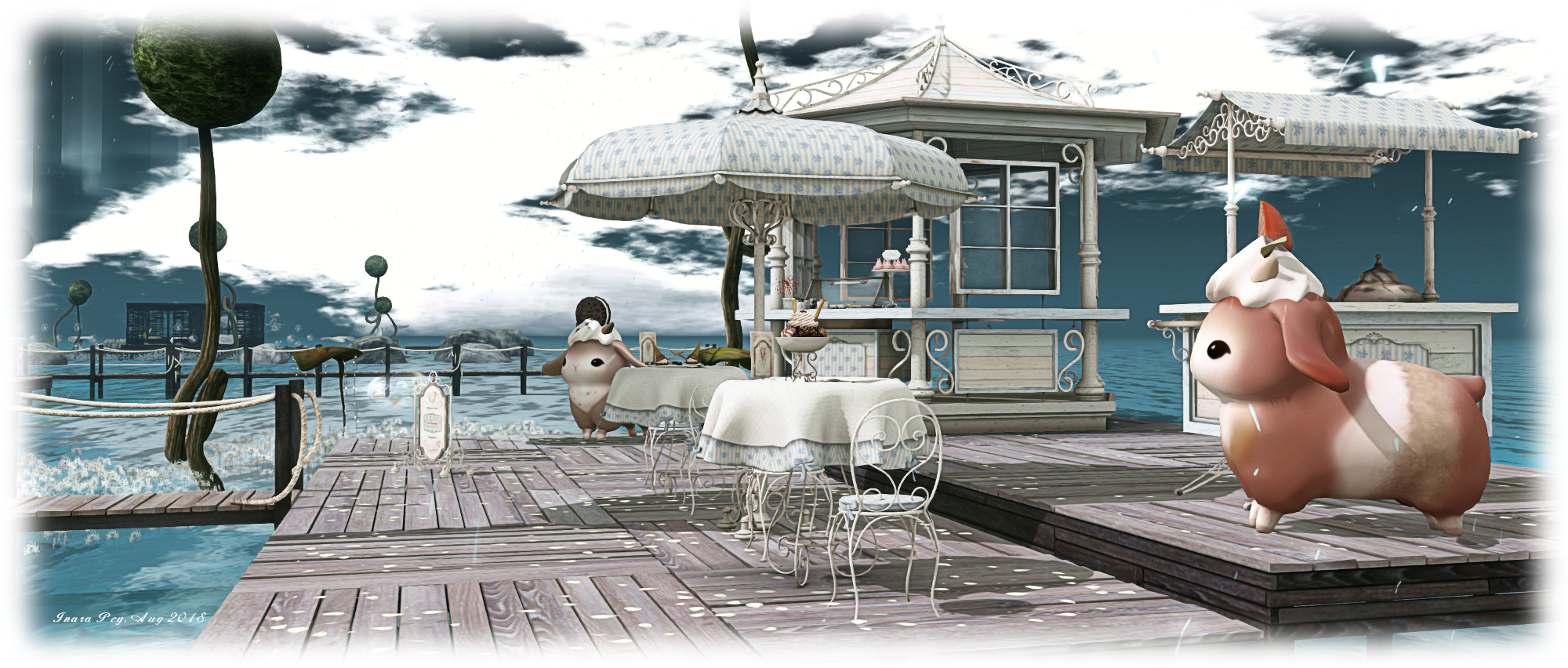
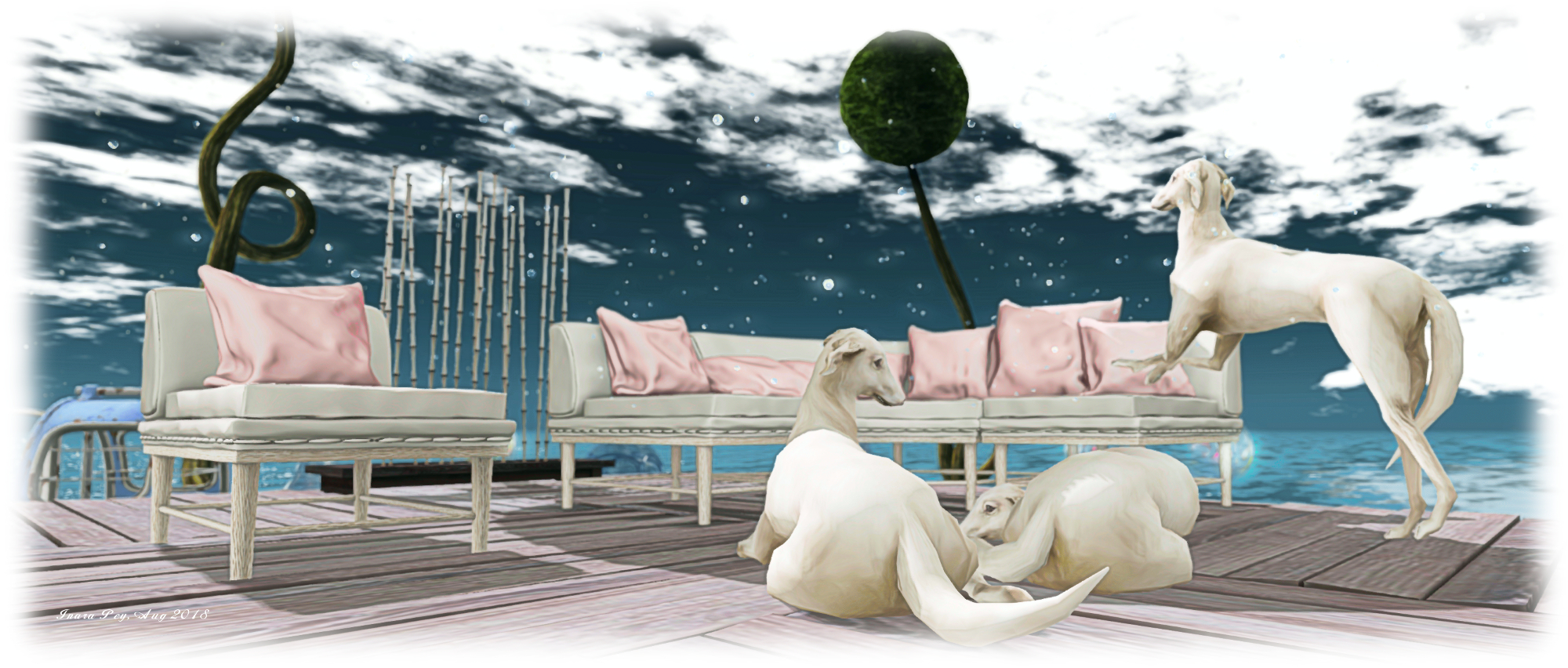
The decks are home to assorted points of interest – a couple are the location of the 8f8 store, another offers the chance to rest alongside the Moon, a third features a little open-air café (one of the elements of Black Kite that tends to remain as other elements come and go), while others offer places to simply sit and while away the time.

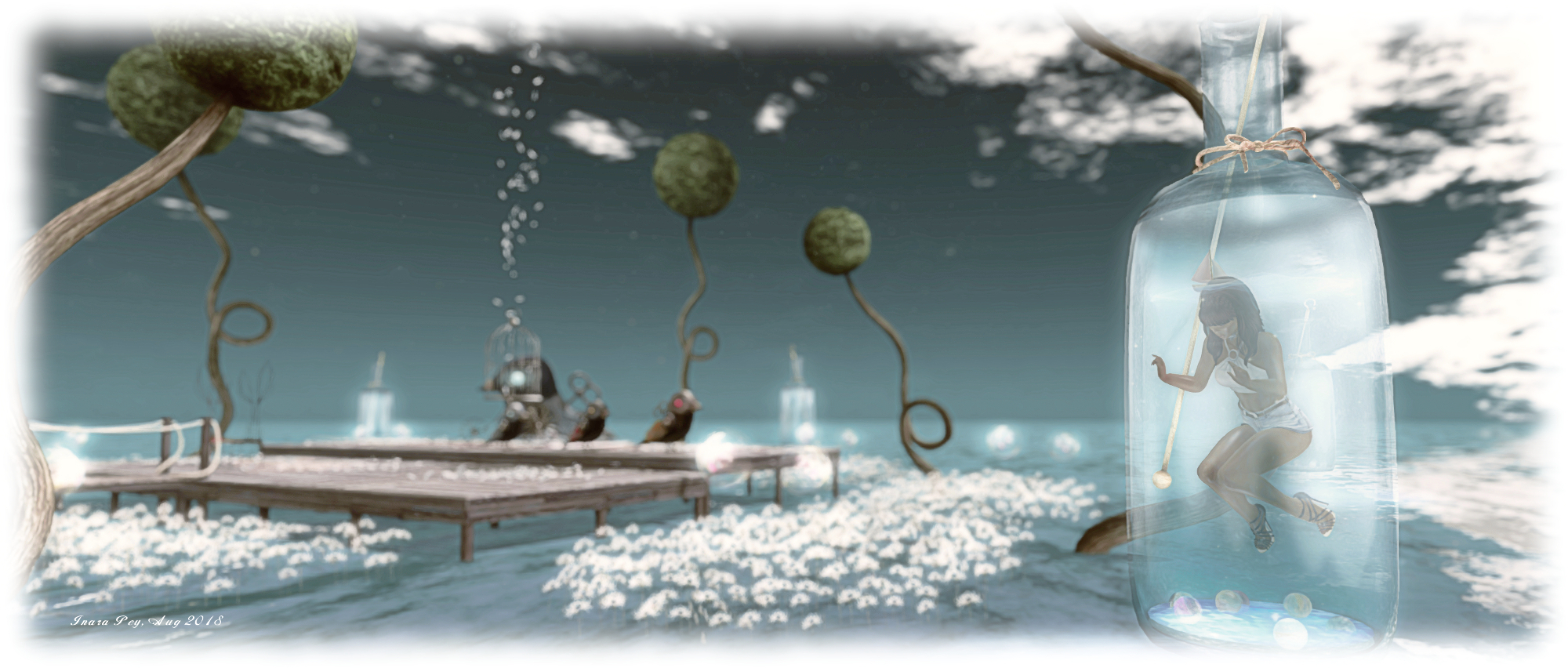
Watching over this is the region’s signature kite, caught on a mystical wind and aided in its oversight by the strange bobble-topped trees that rise from the waters alongside platforms and around the landing point. Throughout all of this are invitations to throw aside worries and care and just be: “Do what you want”, Celebrate”, “Nothing really matters”, “Dream” … Even “Go fly a kite”, painted on the water beneath the floating kite, reads more as an invitation than it’s more usual sentiment.

Black Kite; Inara Pey, August 2018, on FlickrBlack Kite

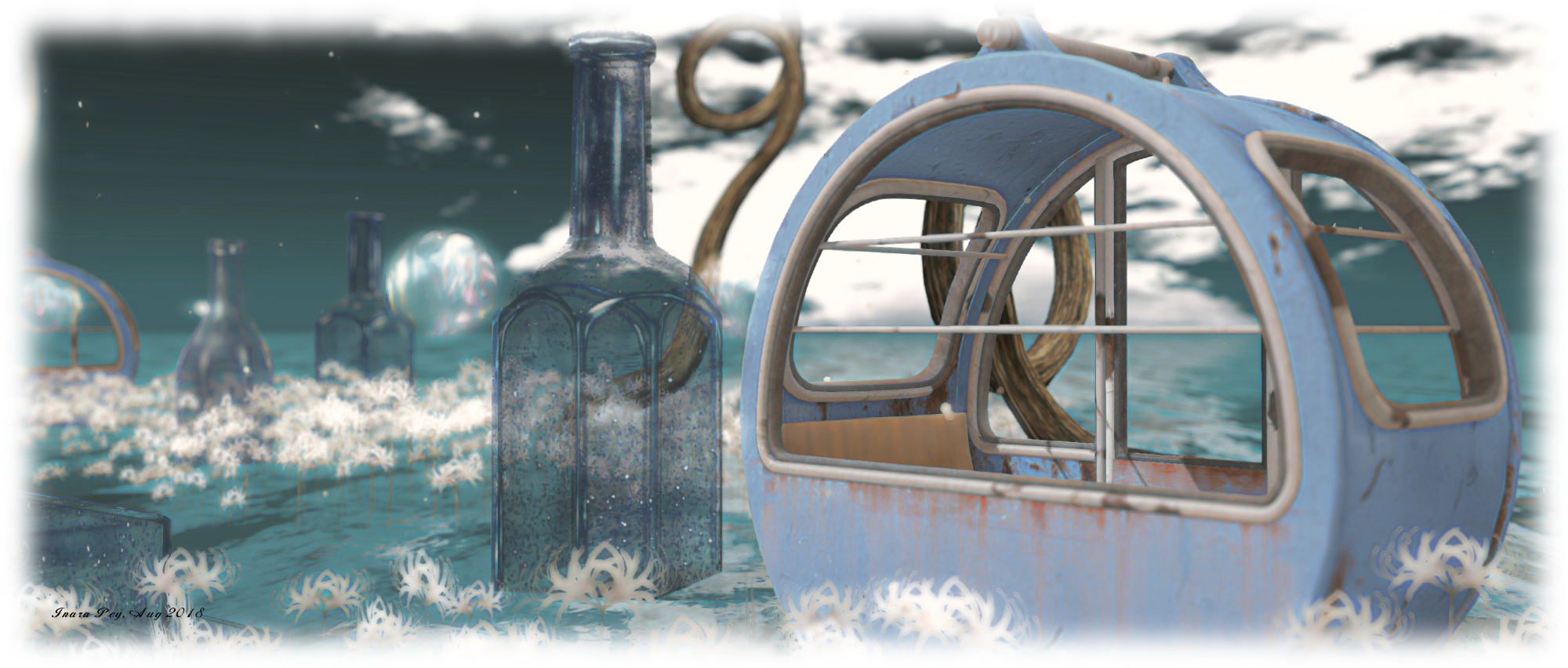
For those who have previously visited, the 8f8 store, the kite, the trees, the café and the water tower will all be reminders of Black Kite’s endurance in Second Life. So to are the bottles and jars scattered around, offering those who want to meditate in peace and quiet – and behind glass – the ability to do so. But so too are the subtle changes to be found on repeat visits spaced a little time apart from one another.

In my case, and on this trip, these changes took the form of a tower of shipping containers I can’t recall having seen before, and the arrival of assorted “cuteness” around the region – the “ice cream bunnies” at the café, for example, or the plushie birds. Small changes, perhaps, but enough to keep the camera and eyes roving, and the feet wandering through the region to discover what else might be.

Black Kite; Inara Pey, August 2018, on FlickrBlack Kite

Cloudy does still keep a private residence in the north-east corner of the region, and this is barred to public entry – but the rest of the region remains as open and as free to wander as ever. In fact, one of the joys of Black Kite always has been the fact it is uncluttered. Board walk, decks, platforms – all are scattered across the region with sufficient water between them as to engender among those using them a sense of being apart from others, free to relax in your own little space on one of the decks even when others may be a-visiting or enjoying a break for themselves.

Given that so many places occupying private islands come and go with (sometimes alarming) frequency, that Black Kite remains in-world, open to the public and asking so little in return, for more than six years now, having originally been claimed in March 2012, and remains under its original “ownership” is pretty remarkable. As such, I’m glad I’ve made the time to not only revisit for the first time in several years, but also to write about it once more.  And as with my two previous posts, I’ll again suggest that if you’ve never visited Black Kite before, and wish to see somewhere just that little bit different, you jump over and take a look for yourselves.

Black Kite; Inara Pey, August 2018, on FlickrBlack Kite

SLurl Details

Black Kite (Black Kite, rated: Moderate)

A Farewell to a Pandora Box of magical Dreams

Pandora Resort; Inara Pey, October 2017, on FlickrNamaste – click any image for full size

I’ve written about the region designs of Lokhe Angel Verlack (Jackson Verlack) since April 2015, when I first discovered one of his first iterations of Pandora Box of Dreams – the name he has largely used to denote the regions he has designed and run with his SL partner, Miza Cupcake Verlack (Mizaki).

Over the years, these designs have grown in complexity and vision, he and Miza have also moved from the Pandora Box of Dreams approach to design role-play regions inspired by the World of Darkness universe (see here and here) before returning once more to the Pandora Box of Dreams “brand” with region designs that have mixed rental accommodation with stunning places for visit and spend time, such as the former Pandora Resort, and more recently Namaste and Kamigami, both of which I visited in 2017 (see here and here).

Pandora Resort; Inara Pey, October 2017, on FlickrNamaste

Sadly, word came from Miza that Namaste and Kamigami will be closing on August 1st, 2018. In fact, Jackson has already started dismantling Kamigami. What’s more, it’s likely to be the last public region design we might be seeing from Jackson for a while.

The reason for the closure isn’t the hoary old devil of tier per-se – whilst offering rentals for people, Jackson and Miza have largely covered the cost of the region out of their own pocket. Rather, its a lack of footfall through the region. Despite frequent events, the opportunity to enjoy two very well-designed and captivating locales, the region has seen a steady decline in traffic which, sadly, has reached a point where Jackson and Miza feel they’d rather focus on more personal projects and things that give them enjoyment.

Pandora Resort; Inara Pey, October 2017, on FlickrNamaste

In this, they are far from alone: the truth is that such is the vastness of Second life and the constant popping-up of new regions and new places to visit, those places that offer a sense of longevity and comforting familiarity, unless located on the mainland, do become harder and harder to maintain when it comes to drawing a steady flow of traffic. Even with things like tier reduction (and depending on how that is passed on through land companies when it comes to rented regions), a point can so easily be reached  where the effort in trying to maintain that flow and meeting the cost of keeping a region has to be put into perspective and a decision sometimes made.

I admit, I feel a little guilt here; as a Second Life travel blogger, I’m all too keen to hop to the “new” places and write about them, or hop back to those that are given a make-over every few months. It becomes all too easy to forget about those that are there, month-on-month and never overly changing, but offering a consistent beauty for all to enjoy. Perhaps this is something all of us who write about Second Life need to keep in mind, and consider looking back at some of the regions we’ve visited in the previous year that might not have changed in the intervening time, and just dropping a “reminder” note about them for readers who may not have had the chance to visit, or might be unaware of their presence.

Kamigami, Pandora Resort Town; Inara Pey, February 2018, on Flickr Kamigami, Pandora Resort

In the meantime, the gradually disappearing Kamigami notwithstanding, there is still a little time before the region closes on August 1st, 2018, to visit Namaste and say farewell, and perhaps drop a note of thanks via IM or notecard to Lokhe and Miza for sharing their vision with us.

For my part, I hope this is not the last we’ve seen of Lokhe’s designs; he has amazing vision in creating special places, and my thanks to him and Miza for allowing us to share in them.

Pandora Resort; Inara Pey, October 2017, on FlickrNamaste

SLurl Details

Ponto Cabana, Lemon Beach, in Second Life

Ponto Cabana; Inara Pey, July 2018, on FlickrPonto Cabana – click any image for full size

Lemon Beach is a place we’ve frequently visited in Second Life. From at least 2015 through until early 2017, it was held by Silvermoon Fairey under the name It’s A New Dawn (see here and here for more). More recently, it has been held by Iska (sablina), who initially gave it the name La Virevolte (The Twirl), occasioning us to visit on two occasions in the winter of 2017 and the spring of 2018.

Iska, working with working with Chimkama, and Toxx Genest (ToXxicShadow). has now give Lemon Beach a further makeover, and a new name, Ponto Cabana, presenting a reason to make a further visit as July drew to a close.

Ponto Cabana; Inara Pey, July 2018, on FlickrPonto Cabana

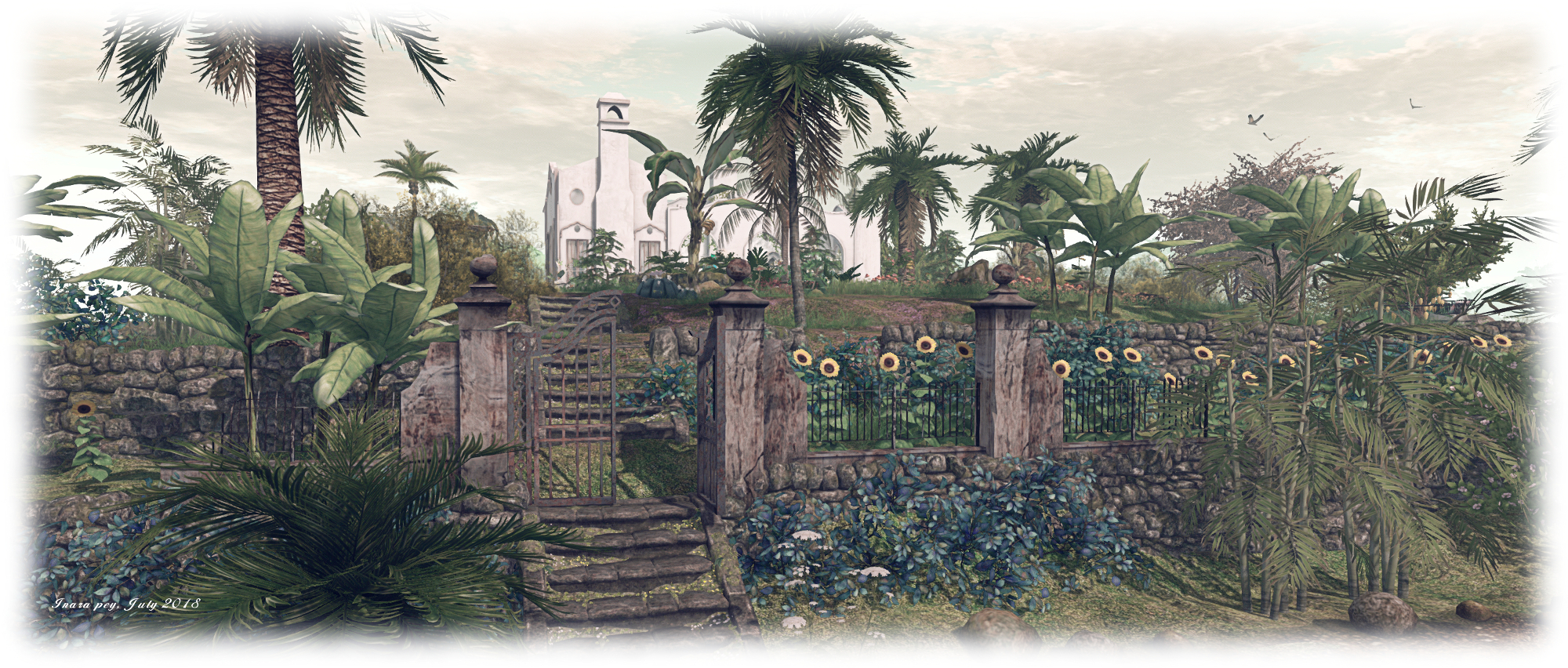
In its new guise, the region offers a curious mix of settings. On the one hand, there is a feeling that perhaps this is in part an old Spanish colonial plantation somewhere in the tropics. A grand house sits on the highest point on an island, steps descending down through what might have once been cultivated terraces to where the old road runs past the foot of the hill before snaking its way up to the house. In doing so, the road turns sharply past the single remaining wall of an old chapel. This may have once been a part of the estate, but time has not been kind, the lone wall with its forlorn bell sitting above the sea.

Some of the terraces below the house are still being cultivated, although these now appear to be more for personal use than for growing produce destined for market or export. The rest, sitting before the house and cut by both winding road and grassy footpath, are given over to an informal garden. Meanwhile, the house with its white, adobe-like finish cracked and broken in places and clearly roughly patched in others, has a sense of stately age about it, perhaps just a little at odds with the furnishings within and around it, which suggest the current occupants lean towards a more bohemian lifestyle than one focused on the cultivation of local plants and fruits.

Ponto Cabana; Inara Pey, July 2018, on FlickrPonto Cabana

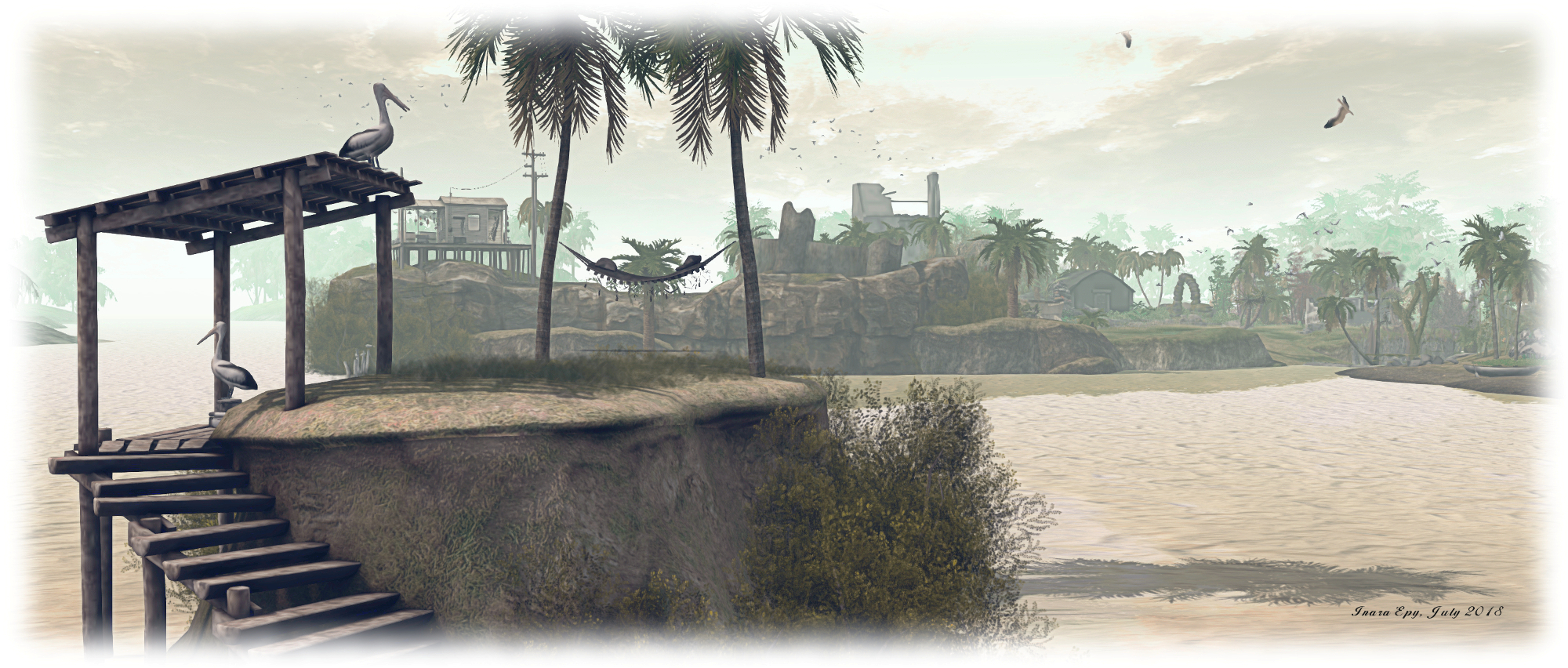
Across the water, on another rocky-sided island, there is a slightly different look and feel. The structures here are mostly more modern in style – if a lot more run-down than the adobe fronted house. A paved road, leading to and from nowhere, arcs past a large house – or about what’s left of it, given its broken form is now subject to nature’s claim. Across the short sweep of road sits an old swimming pool, a pelican perched on the rusting frame of a diving board perhaps wondering just what happened to the water.

Up on a headland, beyond the ruin of an old fort, sit a raised wooden hut with evidence of some occupancy scattered about it, but on the whole the feeling here is of a place now deserted; or at least in the process of being deserted. A car piled high with luggage sitting incongruously on the road outside of the ruined house as if ready to forever depart, a stubborn donkey standing before it, determined to stare it down. The road itself ends just behind the donkey, a set of steps leading down to another pat of the setting that again has a feeling of age about its occupancy in the form of the ruins of a stone chapel.

Ponto Cabana; Inara Pey, July 2018, on FlickrPonto Cabana

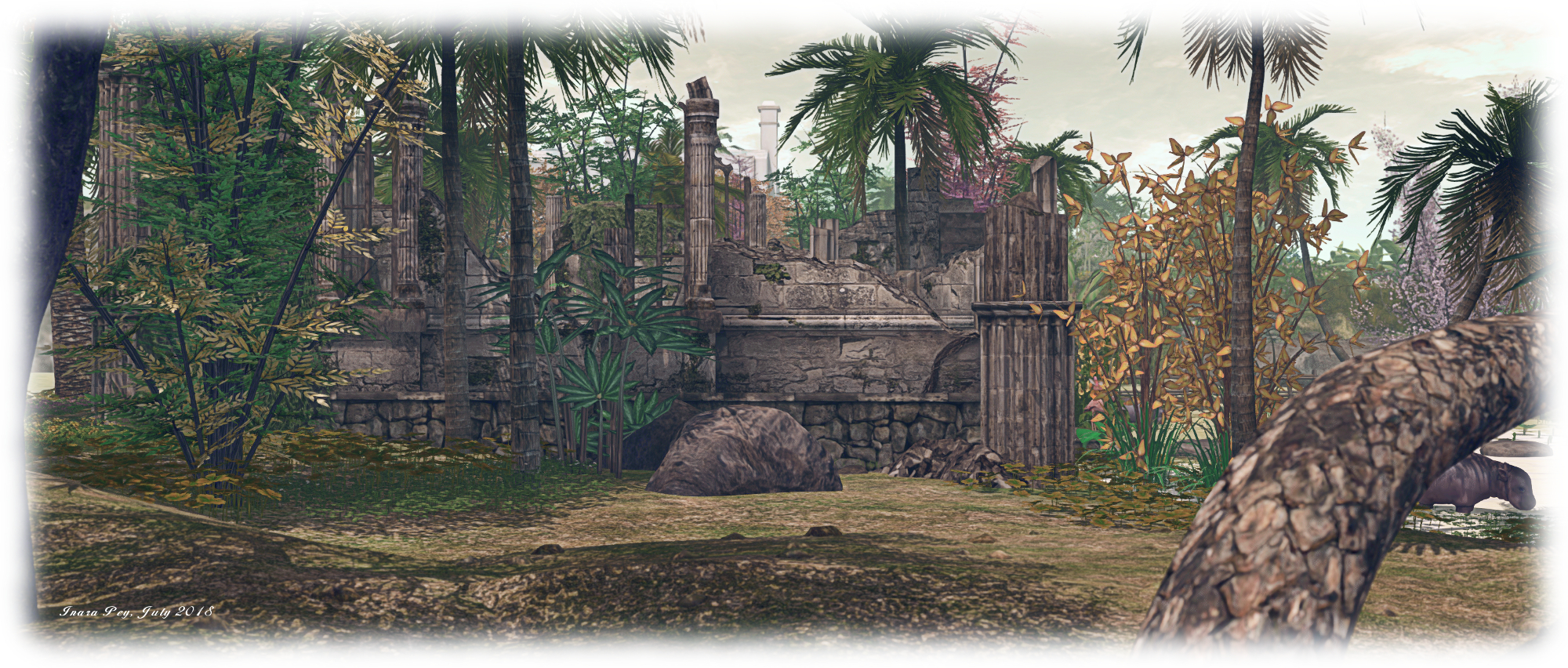
Of grander stature than the lone, bell-carrying wall near the old plantation house, this ruin speaks of a once proud centre of worship with something of a medieval bent in its design. The way to it has long since been flooded, but stepping-stones offer a way across the water to the foot of the steps leading up to its stone flagged floors even as a wooden bridge offers access to the lands around it. Flamingos wade through the water, while humming birds flitter busily around the flowers growing from it and – in another incongruous, but oddly acceptable touch – two little hippos stand knee-deep in the water.

All-in-all, Ponto Cabana is a strange and eclectic mix. However, it is an eclectic mix that works, and works delightfully well. With places to sit and relax – notably around the old plantation house, surrounded by off-sim islands heightening the tropical feel for the setting, and even a couple of off-shore perches to enjoy, Ponto Cabana makes for an ideal and photogenic visit.

Ponto Cabana; Inara Pey, July 2018, on FlickrPonto Cabana

SLurl Details