A Lost Lagoon in Second Life

Lost Lagoon, July 2019. Click any image for full size

Lost Lagoon is a Homestead region designed by knight676 and Jana Guyot that offers an engaging – if curiously populated – setting that also has the ability to look and feel much bigger than the  65,536 sq metres offered by a region.

The region description states Lost Lagoon is a “lost place in the South Seas. Witnesses of bygone days and paradise for those who seek solitude and nature.” Certainly, it has all the elements one might associate with the South Seas (which usually encompasses the South Pacific): a tropical feel, palm trees, balmy beaches, and so on. But there is enough here to throw something of a spanner in the idea that Lost Lagoon is a South Pacific paradise and which serve to make it a unique setting deserving of exploration.

Lost Lagoon, July 2019

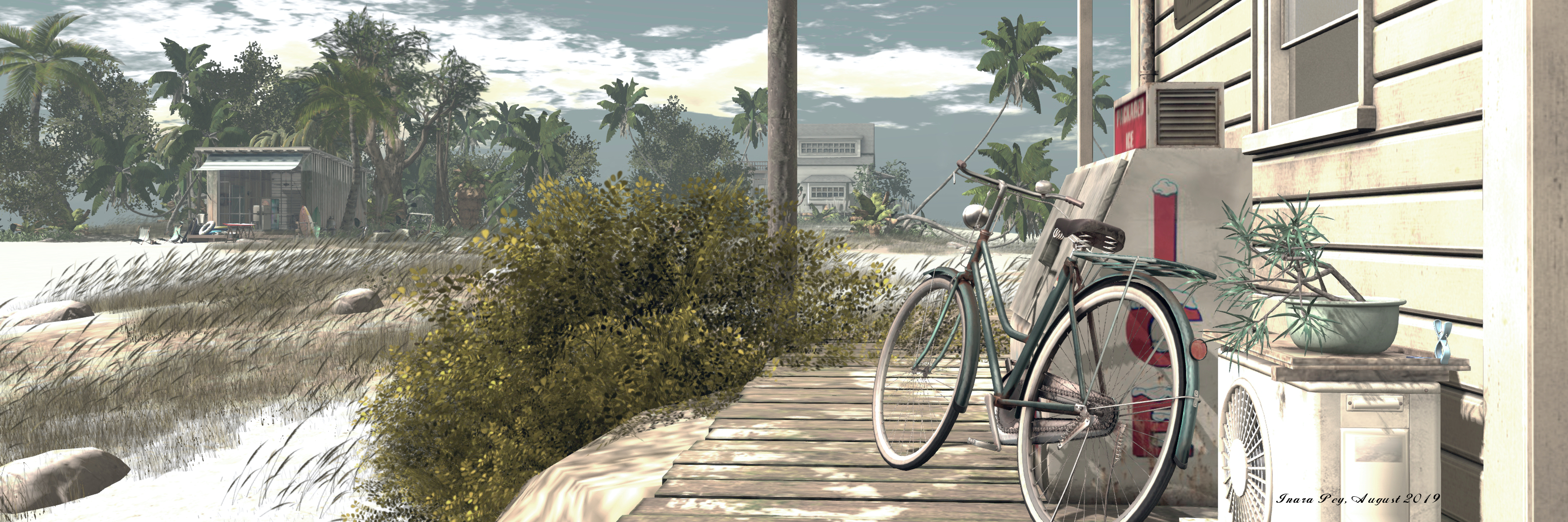
Surrounded by off-sim islands that perhaps in places look a little more temperate with there grass slopes, this is nevertheless a tropical setting, as evidenced by the presence of both palm trees and Moai, the latter of which certainly give the region a Polynesian twist. The island itself offers every sign of having once been the home of a lagoon: to the south is what appears to have once been a rock wall, long since breached by the sea, causing the former lagoon to become a bay cutting deeply into the island.

Within this bay are two much smaller islands,  little more than sandy humps. However, one of them is home to a small group of African elephants – the first hint, perhaps, that this really is a lost and unusual setting. They sit under the palm trees and even wade in the water, apparently unfazed that it is most likely salty seawater.

Lost Lagoon, July 2019

Of course, one might argue that the presence of African elephants might be excused by the fact that Asian elephants are in short supply in SL – but what then of the hippos with their slightly oversized tusks occupying the water by the second of the two little islands? They perhaps more directly throw a suggestion of Africa into the mix, contrasting strongly with the south seas idea, while the tigers roaming the island behind them further stirring the mix.

Thus, Lost Lagoon offers an intriguing mix, almost is if it is a kind of lost world in terms of the creatures to be found across it. And nor are the elephant, hippos and tiger the only curious mixing. Lions and meerkats also offer further hints of Africa – although the latter might be standing-in for mongoose. Also to be found across the island are snakes, waterfowl and birds of assorted kinds, all presenting  rich mix of wildlife.

Lost Lagoon, July 2019

There is also considerable evidence of human habitation to be found here, both ancient and modern. The latter perhaps most clearly comes in the form of the great, dome-topped finger of a lighthouse to the east of the island. Beneath it and almost within its lee, sits a nicely furnished cabin – perhaps that of those responsible for maintaining the lighthouse – built out of the cooling waters of a shallow bay.

Ruins to be found in the bay offer a more ancient setting, while the sometimes ramshackle cabins found around the coast help to give the impression that humans have been living here for some time. However, perhaps the most curious mad-made structure on the island is that of an aged submarine that appears to have grounded itself on part of the ancient lagoon wall. It had clearly been there so long that it has be claimed by the local foliage to the point where, from the landward side of the island, it looks like a metallic cavern sitting at the end of the trestle bridge that reaches out to it.

Lost Lagoon, July 2019

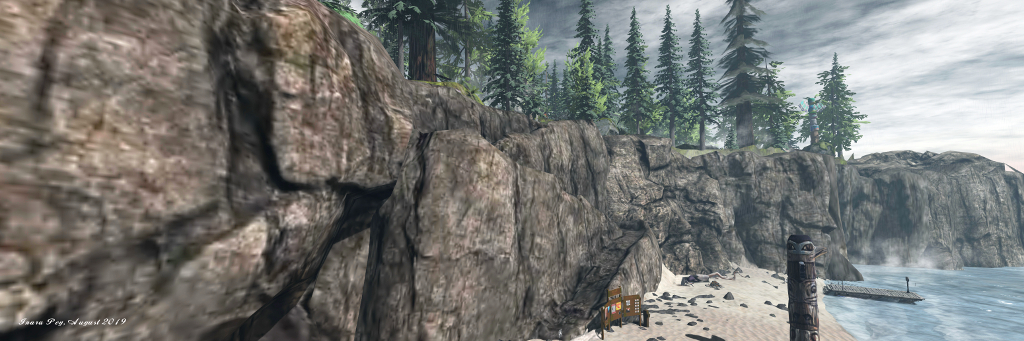
These low-lying man-made structures and ruins are overlooked by a old fortification and small chapel both of which stand on the island’s rocky spine. They are reached via a twisting path offering more chances for exploration, while on their far side, sitting on its own promontory and reach by passing under a rocky arch, sits the most wonderful ruin of a church or cathedral, beautifully repurposed.

With its rich mix of wildlife and range of influences – Moai, a Moroccan water pump house, a sitting Buddha, shrine to Shiva, and so on – Lost Lagoon really is an intriguing mix wrapped in an attractive tropical setting. There is a lot of take in, plenty to photograph (with a Flickr group for those who might was to share their images, rezzing rights available by joining the local group for L$150), and numerous places to simply sit and appreciate the location.

Lost lagoon, July 2019

SLurl Details

The beaches of Carolina in Second Life

Carolina, July 2019 – click any image full size

Warm sandy shores and tropical environs welcome you in this land filled with wildlife, relaxing beaches, and grassy areas. I hope you enjoy your stay and please remember to pick up after yourselves when you go.

– Arol Lightfoot, describing Carolina

Carolina, July 2019

Region designs by Arol Lightfoot are always guaranteed to generate a lot of interest, and so it is with her latest Homestead design, Carolina.

As Arol’s description of the region indicates, this is a very rural, open island setting. Three houses sit within its sandy banks and beaches, two on the coast and the third a little more inland. They sit amidst circling birds while Flamingos strut over the more grassy aspects of the island and horses stroll under the haze-heavy sky.

Carolina, July 2019

The surrounding waters cut into the island to form bays and channels, giving the low-lying land a richly natural look, grass and sandy mingling easily, waterfowl sitting among the piers and rocks that help define the landscape. A curious mix of trees – oaks, palms and Lebanon cedar – rise above smaller trees with bent trunks as if bowed under the weight of their boughs and leaves, but together they help further define the island’s look.

This is a genteel landscape where cats mix easily with dogs, donkeys and goats, all of whom add their own personalities to the region – some quite cheekily so. The only oddity within the setting is the battered and ageing humps of an old roller coaster. It’s not the kind of ride you’d want to take, given the state of the rail-less tracks, despite the cars being present – but it does made an interesting focal-point for photography.

Carolina, July 2019

Photography is very much a raison d’etre for Carolina, again as the About Land description notes. Rezzing in the region is open, but as auto-return is turned off, those who take advantage of it are asked to remember to pick their items when they are finished.

Peaceful, with multiple places to sit and relax and with its wildlife rounded-out by the presence of otters, sea lions – and pandas, Carolina makes for a quiet visit for those so minded, a cosy island with opportunities to explore, to sit and to contemplate – just mind the sharks if you go for a swim!

Carolina, July 2019

SLurl Details

  • Carolina (Margarita Isel, rated Moderate)

Of flying saucers and alien encounters in Second Life


Cornhub, July 2019 (click any image for full size

Cornhub is a rather curious region, one which apparently changes perhaps more regularly than other public regions (designer Mya Milena notes of the region, “we change themes like socks”!). At the time of writing this piece, it offers a look into one aspect of modern-day mythology: that of flying saucers and alien visitations.

We were dawn to the region after seeing Ricco Saenz’s pictures of Cornhub on Twitter (and you can read about his explorations here). But if I’m honest, they didn’t entirely prepare us for what we found: this iteration of Cornhub is quirky, unexpected, different and, well, strange, with the flying saucers just a part of the story. However, it is the one I’ll start with, as it is perhaps the most obvious.

Cornhub, July 2019

Sitting in the midst of this desert landscape is a crater out of which rises the crashed hull of a flying saucer, bodies of “greys” lying on the cracked ground where they were either thrown during impact or staggered to on escaping before collapsing. A second flying saucer is circling above, wobbling in its flight in the way such vehicles tend to do in those old 50s sci-fi B-movies.

A sign by the roadside that passes the crash site points the way to the “UFO Crash Site Roswell, New Mexico”. So, whether this crash is intended to represent that so-called incident is debatable. Certainly, other signs in the area suggest this is might actually be the legendary (in alien conspiracy theory circles) “Area 51” (officially, the  Homey Airport or Groom Lake in the middle of the Nevada Test and Training Range) – which is roughly 900 miles from Roswell.

Cornhub, July 2019

For those perhaps unfamiliar with the Roswell incident of mid-1947, it was triggered when a special high-altitude balloon being used by the (then) US Army Air Force in a top-secret endeavour came down some 75 miles from the town of Roswell. That secret endeavour was Project Mogul, an attempt to detect the sound waves generated by Soviet atomic bomb tests using special equipment suspended from high-altitude balloons.

Due to the sensitive nature of Project Mogul, various official statements were made about the nature of the crash were contradictory or simply didn’t match the facts (one USAAF report referred to the crash being a “weather balloon”, although the Project Mogul balloons were very different beasts). The event occurred just two weeks after aviator Kenneth Arnold made his famous report of seeing nine “saucer-like” flying objects near Mount Rainier, Washington State, so when a report was issued that a “disc” (albeit one apparently small enough to be held in the hands) had been recovered at the crash site, the press briefly went wild with speculation – something which, 30 years after the fact, resulted in Roswell becoming infamous as an alleged “UFO crash site”.

Cornhub, July 2019

Whether you chose to see the Cornhub flying saucer crash as being a play on the so-called Roswell UFO incident is up to you. For my part, I found myself leaning more towards the road sign with its arrow being more a passing reference to Roswell, and the setting within the region far more of a play on the whole mystique of “Area 51” and its place in both “UFO / Alien visitation” mythology and some science fiction films.

There are certainly enough clues for the latter being the case: the Area 51 signs, the military vehicles parked close by, and the spacesuited figures of humans also scattered about the crash site. The latter in particular take on more of a sci-fi meme: the suits carry the NASA logo and look to be modelled on modern US EVA spacesuits. However, they also appear to have been ineffective in projecting those wearing them from something undoubtedly nasty in the immediate vicinity of the crash.

Cornhub, July 2019

North of the crash site is what might be the edge of a town, one which might be taken as Roswell if one goes in that direction, or perhaps some little hamlet on the edge of the Nevada Test and Training Range. It offers a curious mix of buildings: there’s a very 50’s style diner and drive-in diner sitting alongside an 80s video game arcade, while SL table-top games can be found in the parking lot. Meanwhile, just across the road, there’s a concrete tower block that might at first appear to be a military-style structure (and thus suggestive again of “Area 51”), but which is in fact an apartment building, a trailer park (travelling UFOlogists?) located in the car park at its base.

Elsewhere, back towards the middle of the region, sitting between the flying saucer crash site and the region’s landing point, the top of the Statue of Liberty’s head rises from the dried sands, almost in a nod to the Planet of the Apes franchise and adding a further twist to the setting. Meanwhile, and off to the south where it stands alone, is the warehouse-like bulk of a television recording studio, apparently the home of “Cornhub’s Blind Date”.

Cornhub, July 2019

Eclectic, unusual, overlooked by a Hollywood-echoing hillside sign spelling out the region’s name, and with a pot-pourri of ideas, Cornhub in this current iteration makes for an undoubtedly a strange – but also curiously photogenic. But remember, it might not be around too long, so should you want to visit, it might be best to do so sooner rather than later!

SLurl Details

  • Cornhub (North Korea, rated Moderate)

Celebrating Apollo 11 in Second Life and Sansar

Recalling Apollo 11 in Sansar and Second Life – the Apollo Museum in Sansar

July 16th 2019 marks the 50th anniversary of the launch of Apollo 11 on its historic voyage to the Moon which saw Neil Alden Armstrong and Edwin Eugene “Buzz” Aldrin Jr. set foot on the lunar surface on July 20th, while Michael Collins orbited some 11 km (69 mi) overhead.

I’m re-tracing the flight of Apollo 11 in my Space Sunday articles – part 1, published to coincide with the launch of Apollo 11 is available now, and part 2, covering the Moon landing and the return to Earth will follow on the weekend of the landing. But you can also celebrate the audacious achievement of Apollo 11 in-world in both Second Life and Sansar (and, I’m sure, in other virtual worlds as well – but I am focusing on SL and Sansar here, as it is in these worlds that I spend my time nowadays).

Second Life

Note: there are likely to be more Apollo 11 celebrations than recorded here. These are simply two I’ve enjoyed visiting.

International Spaceflight Museum

Where better to immerse yourself in all things space than the International Spaceflight Museum? Covering two regions, and with the likes of NASA’s (slightly ageing) Jet Propulsion Laboratory region adjoining or close by, the ISM allows you to take a walk through the history of international space-faring achievements, see the massive launch vehicles, re-visit missions both crewed and automated, travel the solar system, and take a glimpse of things to come.

ISM features several elements related to the Project Apollo and its precursor Project Gemini programme; for example, in the shadow of the Rocket Ring sit models of an Apollo Lunar Module (also known as the Lunar Excursion Module or LEM) and the combined Command and Service Modules (the former the capsule in which most of the Apollo crews flew to the Moon and in which all returned to Earth, the latter the power and propulsion system for the Command Module). These include cutaway schematics and other information.

Commemorating Apollo 11 at the ISM

However, located on the ISM’s Spaceport Bravo region, and in the lee of the mighty Saturn V lunch vehicle that carried every crewed Apollo lunar mission on its way to the Moon, is a display dedicated to Apollo 11 (as also seen at the SL16B celebrations in June 2019). It features a combined model of the Command and Service Module and a model of the Command Module itself that allows visitors a peek inside.

Close the this display is a model of the LRV – the Lunar Roving Vehicle, or “Moon buggy”. While this did not fly to the Moon until the Apollo J-class missions (15 through 17), it still stands as a reminder of the technical abilities of the Apollo programme.

While it didn’t fly to the Moon until Apollo 15, the Lunar Roving Vehicle played an important role in humanity’s first foray to the Moon

And if you want to get a feel for how truly massive the Saturn V rocket really was, then hop up onto the Mobile Launcher behind the Apollo 11 display.

Sitting atop a crawler / transporter the Mobile Launcher comprises the massive slate-grey launch platform base and the massive Launch Umbilical Tower (LUT) that included all of the service arms required to support the rocket (nine in all) with fuel, power, and direct access. The most famous of these arms lay close to the top of the tower as it stood in attendance beside a Saturn V. This arm held the White Room – the room where the astronauts, assisted by pad technicians, boarded their Apollo Command Module. Sadly, the White Room doesn’t form a part of the ISM’s Saturn V Launcher model – but you can climb the stairs all the way up to the swing arm on which it sat, and in doing so gain an appreciation for the size of the rocket next to it.

Headline Apollo Exhibit

Headline Apollo  is a pop-up exhibition by Diamond Marchant taking place at the Beckridge Gallery curated by Emerald Marchant in Bellisseria. It takes as its theme a look at Apollo 11 from the perspective of a north Texas newspaper, the Fort Worth Star Telegram. In doing so, it offers a unique perspective on the mission – which was as we know, managed out of the Manned Spacecraft Centre (later renamed the Johnson Space Centre), located further south, near the Texas state capital, Houston.

Beckridge Gallery: Headline Apollo

Given the size of the Bellisseria Homes, they make for a cosy gallery space, but this actually makes Headline Apollo more of an intimate visit. A guide note card is available both at the entrance to the galley and in the foyer (and which includes copies of some of the images seen in the exhibition). The exhibition itself is broadly split in two: to the left of the entrance foyer the launch and the flight to the Moon, to the right, the surface mission and return to Earth.

What makes this exhibition engaging is that Apollo 11 and the Apollo lunar missions as a whole, tend to be remembered in a way that frame them on their own. There might be some ruminations on major events of the time – such as the Vietnam War -, but by-and-large they are presented in something of a bubble. Headline Apollo, however, with its reproductions of front pages and columns from the Fort Worth Star Telegram frames the story of the mission alongside that of daily life in Forth Worth and America as a whole.

For example, sitting alongside the reports of Apollo 11 are those of a more infamous event that took place in 1969, one that would become known as the Chappaquiddick incident, which involved the death of a young woman in a car driven by Edward Kennedy, the youngest brother of John F. Kennedy, who had started America on its journey to the Moon in 1961.

Beckridge Gallery: Headline Apollo

This story, and the more local ones appearing on the reproduced pages of the newspaper put the Apollo 11 mission is something of a different perspective. We’re reminded that for all its faults and weaknesses, humankind can raise itself up, seek to achieve something better, and the bravery of just three men in a tin can can unite us all in a hope for a better tomorrow.

Complete with archival NASA photos an cover pieces from the likes of Time and Life magazines, Headline Apollo offers a departure from the more usual Apollo retrospectives and will be open to visitors through until July 28th, 2019.

Sansar

Sansar may be anathema to some Second Life users, but if you have the hardware to enjoy it – and remember you can with a suitable PC and without the need for a VR headset – then frankly, there is no better way within a publicly accessible virtual world to celebrate Apollo 11 and the entire Apollo lunar endeavour than by visiting the Apollo Museum ant Tranquillity Base.

The Apollo Museum

The Apollo Museum remains one of the highlights of Sansar (if first wrote about it back in 2017). Developed by Sansar Studios, Loot Interactive and NASA, it reproduces the main hall of the Apollo/Saturn V Centre at the Kennedy Space Centre, Florida, to offer visitors a fully interactive guide to the Apollo programme.

The Apollo Museum: Apollo Lunar Module (r) and Saturn V

Here you can walk the length of a Apollo Saturn V launch vehicle, from the exhaust bells of its five mighty F-1 engines to the tip of the Launch Abort System tower. Along the way, and set out on  time-line, you can re-trace the journey of Aldrin, Armstrong and Collins from the launch of Apollo 11 through to its splashdown 8 days later.

This is done by walking up the left side of the Saturn V, where exquisite models (the Earth and Moon not being to scale admittedly) and photos mark the significant stages of the the mission as they unfolded, culminating in Apollo 11’s arrival at the Moon and Armstrong and Aldrin’s descent to the Moon’s surface. The story then resumes on the other side of the Saturn V’s nose, with the two men ascending back to orbit to link-up with Collins in the Command and Service Module, before charting the trio’s return to Earth and splashdown.

The Apollo Museum: the little models re-creating the flight of Apollo 11, these showing the TDE phase of the mission, when Michael Collins manually flew the Command and Service Module to dock with and extract the Lunar Module from the S-IVB upper stage of the Saturn V

With interactive disks available that play audio relevant audio recordings from the mission, it’s a marvellous way to understand the mission, even if I do have a small quibble with the Lunar Module’s legs being shown unfolded during the flight to the Moon (this was actually only the case with Apollo 13, when the LM was being used as a lifeboat).

Beyond this, on the upper sections of the gallery, are sections devoted to all of the Apollo crewed flights, from the tragedy of Apollo 1 through the triumph of Apollo 11 to the near-disaster of Apollo 13, and thence to the the sounding bell of Apollo 17. These also include interactive panels that will play audio when an avatar stands on them, and are bracketed by a complete model of an Apollo Lunar Module (also referred to as the Lunar Excursion Module, or LEM) and a model of the Apollo 13 Command and Service Module showing the damaged and exposed part of the latter after it had been crippled by an explosion within a liquid oxygen tank.

The Apollo Museum

From a large disk under the Saturn V’s Launch Abort System tower, visitors can jump to Tranquillity Base, the landing area for Apollo 11.

Tranquillity Base

Also by Sansar Studios / Loot Interactive and NASA, Tranquillity Base reproduces the Apollo 11 Lunar Module as it sat on the Moon whilst Armstrong and Aldrin were on the lunar surface. This is a more static display when compared to the Apollo Museum, dominated by the Lunar Module and an overhead display which, when correctly aligned, provides insight into the surface equipment placed out on the lunar surface around the LM.

Visiting the individual elements will trigger playback of audio elements relevant to the science packages, whilst closer to the LM Armstrong’s famous statement on setting foot on the Moon’s surface can be heard.

Tranquillity Base: showing the Apollo 11 lunar Module Eagle in the background. In the middle of the picture is the Laser Ranging Retroreflector (LRRR), designed to gain accurate measurements of the Earth-Moon distance by reflecting lasers shot at it from Earth, and on the right, Passive Seismic Experiment Package designed to record “moonquakes”

And if you want to know how small the Earth looks from the surface of the Moon, be sure to tilt your camera up and around.

In Conclusion

As noted above, there are doubtless numerous other Apollo 11 celebrations – be they exhibits, parties or something else – across SL and other virtual worlds. But these are the ones I wanted to start here during this historic week. I hope you’ll take the time to drop-in and visits them.

SLurl Details

A new (fae forest) in Second Life

(fae forest); Inara Pey, July 2019, on Flickr
(fae forest), July 2019 – click and image for full size

Update: (fae forest) has closed and the host region now home to Adult-rated activities. SLurls have therefore been removed from this article.

Miro Collas recently pointed out the Zuma Jupiter has relocated (and rebuilt) her (fae forest) region theme, prompting us to hop over and take a look at the new design in its new home.

I’ve previously written about (fae forest) in these pages in April 2019 (see Re-visiting Elvenshire in Second Life) and March 2017 (see A Mystical Fae Forest in Second Life). We enjoyed both visits due to the fairy-tale like look and feel to the designs, so I was looking forward to seeing what the relocation had led Zuma to create.

(fae forest); Inara Pey, July 2019, on Flickr
(fae forest), July 2019

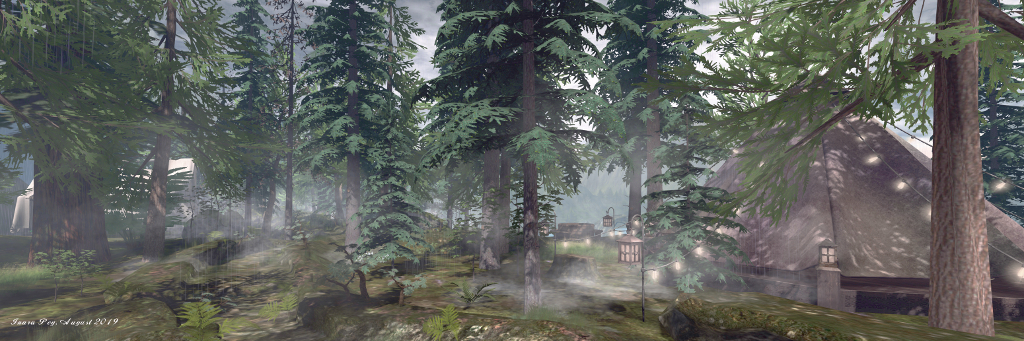
In keeping Zuma’s previous designs I’ve written about, this (fae forest) maintains the fantasy element with its touch of whimsy, but it also has something of a darker tone as well. This latter aspect is somewhat apparent on arrival: the default windlight casts a hazy blanket across the region, causing distant trees to look a little ghost-like, an effect enhanced by the stardust that in places drifts on the wind.

Sitting as a humped island rising from the sea, the region has a distinct north-west to south-east orientation. Towards its centre there rises a vertically-walled table of rock, its broad plateau, complete with taller pillars and curtains of rock that in places rise above it, resembles a great, natural fortress; its castle-like look further enhanced by the ring of water that surrounds it like a natural moat.

(fae forest), July 2019

The land spreading to the west and east around this great plateau undulates gently and carries with it a feeling of being windswept and exposed. It is largely home to scrub grass, some of if providing grazing for sheep, while a few trees sit further around its eastward arc, the horizon of which is broken by the blocky form of a stone-built chapel. The grassland also sweeps around to the west and south, where it washes against the dark shadow of woodland – but more of that anon.

The great plateau is accessed through a set of stone-cut steps that face the landing point across the grasslands. Like the plateau, the steps are on a massive scale – each of them practically needs a staircase of its own to climb it. They provide the single point of entry to the table-top of rock from the lands below, as if again suggesting this is a place of natural fortification.

(fae forest), July 2019

However, the top of the plateau is not in any way given over to ideas of war or defence. Instead, it offers the clearest reflection of previous iterations of (fae forest). Richly wooded, it offers a lot to discover in what is a glorious garden sitting beneath boughs draped in lights and between which shafts of sunlight fall around a central giant gazebo. Nevertheless, the echoes of castles persist: on the south side of the gazebo more huge steps cut their way up through another great up-thrust of rock that rises like a giant natural motte to the lower plateau’s bailey, albeit one lacking defensive walls around its top.

Beyond the plateau’s bulk the landscape takes a different turn. Great columns of rock cover the south-eastern side of the region, looking for all the world like some giant’s hammer has been used to randomly pound each of them into the ground. Just to west the of these great stone blocks stands the dark woodland mentioned above, a place where rain falls and mist creeps between shadowy tree trunks.

(fae forest), July 2019

Here the region takes on something of a darker tone, not only because of the mist and rain and dark hue to the trees, but because of what lies amidst the tall trees. A ramshackle cabin raised on stout wooden legs and  looking for all the world like it should be sitting within some dank, dark corner of a bayou crouches on one side of the path. Beneath it, and somewhat ominously, baby dolls have been strung up, while facing it from the other side of the path is a strange oversized display cabinet in which hang more dolls, these ones perhaps best described as Chucky’s distance cousins, watched over by a distinctly nervous-looking cat (one of Cica Ghost’s creations).

The wood with its strange tableaux can come as an odd turn for the region to take, standing as it does in opposition to the more fairy-tale heights of the plateau above and behind it. However, it also adds to the overall atmosphere of the setting, adding to its uniqueness.

(fae forest), July 2019

This uniqueness is further increased by the oddities scattered across the region: an aero engine here, offshore ring of standing stones there, sculptures rising in unexpected places, high and low, and more – there’s even a troll hiding within the arms of denuded trees.

Atmospheric, slightly haunting, but definitely photogenic, this version of (fae forest) perhaps offers a slightly different face to the world than previous builds, but it remains evocative and utterly worthwhile in visiting.

][Octopussy][ goes Cuba in Second Life

][Octopussy][ goes Cuba; Inara Pey, July 2019, on Flickr][Octopussy][ goes Cuba, July 2019 – click and image for full size

We were led to ][Octopussy][ goes Cuba on the recommendation of Shawn and Max, discovering in the process a sun-drenched tropical island with a lot to offer visitors.

A joint design by FleurLaRosa and WillkinThos, this homestead region is adult rated and does embrace nudity and adult activities – providing the clearly stated rules are followed; but this should in no way put people off paying it a visit, as there is a lot to appreciate.

][Octopussy][ goes Cuba; Inara Pey, July 2019, on Flickr][Octopussy][ goes Cuba, July 2019

This is very much a place of two halves, visually. There is the tall, rocky plateau of the island, and the low-lying beaches stretching out to the west and curling around to the south. The former is home to the main landing point, sitting towards the centre of the region, and a gaily-painted village location that sits above it.  The village, with its 50’s style cars and bright colours is obviously intended to evoke the Cuban feel suggested by the region’s title.

There might be a tendency to make allusions to James Bond given the region’s name, and certainly, the British spy has been to Cuba and other tropical locations, and in places the Octopus logo found the island kind-of offers suggestions of an inverted SPECTRE symbol. But really, any alignment of the region with Bond is purely in the imagination. Instead, this is a place for photography, fun and music.

][Octopussy][ goes Cuba; Inara Pey, July 2019, on Flickr][Octopussy][ goes Cuba, July 2019

The latter is catered for at several points around the island, but perhaps most obviously in the underground ][ Octopussy ][ Lounge. This can be found through the tunnel to one side of the landing point, and has is unique visual appeal. This makes imaginative use of the [Original] the Spa – Black edition by Abiss to provide an underground club space designed to give the feeling of being underwater; large screens around the walls present videos of fish swimming among rocks and coral, and the floor of the dance floor is, in part, glass sitting over coral and water through which more fish swim.

A set of steps connect the landing point with the broad western beach, which offers plenty of space to sit and relax in the sun, as well as broad walks extending out over the shallows to reed-covered sand bars. These are home to both birds and waterfowl, and offer more places to relax and enjoy company or the scenery.  One of these board walks extends well out to the north-west, offering visitors the chance to gain an off-shore view of the island – although it conveniently connects to the local rum bar should anyone get thirsty! For the more active, the board walk from the south beach connects to a wooden dance floor complete with line dancing options.

][Octopussy][ goes Cuba; Inara Pey, July 2019, on Flickr][Octopussy][ goes Cuba, July 2019

Two paths from the landing point lead up to the little village, the longer of them passing a little shrine and a place to sit before arriving at the village square. This offers another place where  music and dancing can be enjoyed, or for those who prefer, the opportunity to enjoy the local outdoor bar. A smaller square off the north-east corner of the village plaza provides access to a sunny, cliff-edge terrace, a wide path cut between the rocks inviting exploration.

This path reveals it actually runs along the far side of a box canyon that quickly opens up, in part separating the north side of the island’s uplands from the village. Water flows outward from the bottom of the canyon and a rope suspension bridge offers a means of crossing it from the north-east corner of the village. Follow the path as it slopes gently downwards and it’ll take you to a little log bridge spanning the canyon’s water just before it tumbles over high falls. The path then leads back to the landing point (but don’t miss the little look-out point!), making for a nice loop around the upper reaches of the island.

][Octopussy][ goes Cuba; Inara Pey, July 2019, on Flickr][Octopussy][ goes Cuba, July 2019

][Octopussy][ goes Cuba is a region rich in detail, including the support sound scape, and which also has its own sense of fun – including the late Stan Lee enjoying a twirl on one of the dance floors! His presence, and that of others dancing and static figures also help to add a little depth to the island, making it feel occupied even if you’re a lone explorer.

All told, an attractive region with much to offer visitors and nicely photogenic; whilst exploring, keep an eye out for the little gift envelopes waiting to be found.

SLurl Details