Distant Edge, August 2020 – click any image for full size
Distant Edge is a Homestead region designed by Remuera Seetan as “a quiet and serene place where you can reconnect with nature”, and inspired by the rugged islands of northern latitudes – although which side of the Atlantic those islands might be is up to the visitor.
A rugged setting offering a sense of the magnificent desolation only nature can create, Distant Edge is also a place where music has helped to form it, be it through the pub / club nestling within the shoulders of the western hills, or through the presence on a lone piano overlooking a windswept southern shore.
Distant Edge, August 2020
The pub is by far the largest building on the island, although the high cliffs and peaks to the west keep this fact hidden from view from the rest of the island.
Instead, when first arriving on the deck of the landing point, sitting on the edge of the bay that cuts deeply into the island, at treated to views across the water to a cottage and windmill occupying the north-eastern headland, and of the lighthouse further along the southern headland.
Distant Edge, August 2020
Finding the pub is a matter of following a sandy path through the grass, or cheating and using the teleport board at the landing point – which means potentially missing a lot of what else the island has to offer. The latter includes the aforementioned piano within its netted pavilion, a cosy summer house, numerous places to relax on the beach or on the water or the shrine tucked away on the northern coast.
Some of the paths are marked by old railway sleepers set out across the ground while others, such as the path up to the highlands – also worth following – are far more natural in nature. The coastal areas offer a mix of beaches to walk, sloping hills and low-slung cliffs.
Distant Edge, August 2020
Reached by passing through a rocky arch, the pub offers a large deck for dancing, while the interior – a converted fish warehouse by the looks of things – offers alcohol, pool and a place to relax. Music is provided three nights a week, although I couldn’t find a schedule at the time of our visits.
Distant Edge is one of those places that doesn’t require a lot of description – it genuinely speaks for itself. Caught under a cloud-laden sky that in places is releasing rain, rounded out by a local sound scape, it offers a rewarding opportunity to explore and take photographs. Those who do take photos are welcome to submit them to the region’s Flickr group.
Broken, August 2020 – click any image for full size
Shawn Shakespeare recently indirectly reminded me that it has been a year since I last wrote about Natalia Corvale’s Broken, the homestead region she has long dedicated to anyone who has lost someone they loved, offering setting that are rich in natural beauty and offering places to escape the madness of the world.
For the current iteration, Natalia offers strands of previous themes to the region design, as well as offering something entirely new with a touch of south of the border, down Mexico way.
Broken, August 2020
Surrounded by the high sandstone mesas of an off-region surround, and ringed at it edge by a slightly broken circle of rocks and plateaus that, from ground level appear to blend with the surround, the majority of the region sits as flat grasslands, dried and risking a turn towards yellow under the Sun. Joshua and Junipers with a mix of cacti give a further sense that the region sits on the edge of an arid region – one perhaps just beyond the surrounding rocks and mesas – although it is kept from drying out completely courtesy of the rive that sluggishly cuts though it.
The landing point sits offset somewhat from its centre, sitting close to a little adobe village built around a fountained-topped plaza. painted in different colours from yellow to a dour brown.
Broken, August 2020
The little houses may only be shells, but this is intentional, as they are really there to provide places to sit – and such places are one of the familiar elements found within Natalia’s designs. The majority of this seating in on the roofs, although a courtyard between three of the houses offers ground-level seating, while tables and chairs on the stone slabs of the little square are set with tables and chairs, an a outdoor tequila bar to one side offers refreshments.
Just beyond the incomplete wall of the village and across the other side of the landing point, sits a little church. Flat-topped, it may still have a row of bells strung from a metal frame, but this chapel is unlikely to be a place of worship now. The pews have all long gone, and the old upright piano that may have once accompanied hymns is now left with only a rusting lamp and crates of empty, ageing beer bottles for company.
Broken, August 2020
Horses are another motif from past Broken designs, and they can again be found here, out on the grasslands, brazen drinking from the village fountain and even keeping watch from up on a high peak, a couple of chairs close by for those wishing to do the same.
Indeed, such is the lie of the land that those who have a wearable horse might be tempted to slip it on and take to the hoof to explore. This is something this iteration of Broken has in common with the the August 2019 version, and is a manner of exploration that I can again recommend this time around, offering as it does a way of discovering all the various seating points in the region in a manner entirely in keeping with the setting – although admittedly, there are a couple of seating areas not well suited to horseback access!
Broken, August 2020
As is always the case with Broken, this is another engaging design from Natalia, one worth spending time exploring and enjoying, although for photography, you might want to experiment with environment settings.
Eterea is a homestead region designed by Coqueta Georgia that again offers visitors a sense of tranquillity and release, coupled with a certain sense of magic and a gorgeous sprinkling of artistic expression.
A Homestead region, Eterea may initially present itself to new arrivals as just another island garden; but looks can be deceiving, particularly first looks. The landing point sits on a north facing cliff, looking out over a shallow bay, the shoulder of the island rising behind it, steps offering a way up through arched trees to where a dodecagon greenhouse awaits.
Eterea, August 2020
Glass-sided and domed, and with a grand columned entrance, this greenhouse is delightfully furnished. Tall bookcases stand sentinel on two sides, wheeled steps placed for the convenience of those wishing to browse, two cosy arrangements of easy chairs, sofas and low tables at their feet. A gramophone and an old bakeite telephone give a sense of age to the setting, while a harp, grand piano and harpsichord vie for the attention of the musically inclined.
Bric-a-brac throughout gives this setting a decidedly cosy feeling, and its not hard to imagine it as a centre of conversation and companionship with a slight Bohemian edge, the drapes slung from the high dome helping to cool it during the day, and the light of the high chandeliers and other lamps spilling out through the wall walls in invitation to others to come join with the music and conversation by night.
Eterea, August, 2020
The greenhouse offers the first clues to the artistic nature of the region as well as it sense of magic. A finely-crafted boat floats over the grand piano, suspended beneath a pair of translucent balloons, whilst paintings lie stacked in corners or behind bookcases and some of the chandeliers also float serenely beneath the glass dome without any physical connection. It is here that some of the motifs found throughout the rest of the region may first be evidenced: the religious in the form of a swing with angel’s wings, together with a reproduction of the Netherlandish (Antwerp Mannerist) triptych The Last Supper (circa 1515-1520); the fantastical (the aforementioned floating boat), and the artistic.
Outside, this grand pavilion is surrounded by a garden of wild flowers and shrubs, whilst shaded patios offer more places to sit (including playable table-top games), while the island drops away from this high vantage point to curve west and north to its far headland. A long dogleg of stone steps runs down to the rest of the island, and from the top of the steps, it is possible to spot another of the island’s mystical elements as a great blue whale (somewhat popular among region designers) swims through the air, slowly circling an upland area just shy of that far headland, a smaller garden on its back.
Eterea, August 2020
The path running along the spine of the island leads the way past several areas where explorers can sit and appreciate the setting, together with multiple opportunities for photography within the little vignettes that have been carefully, but naturally set out along and just off the route. One of these, an octagonal greenhouse, sits as both a cosy retreat – cats allowing! – and a place from which to observe the local owls. Onward, the path passes under the circling Whale (mouse over it and sit if you wish to join the ride), passing above a small beach cupped in the island’s arms as it does so. before descending to where an old and damaged wooden pier extends out into the shallow waters that cover the bulk of the region.
It is on and over this water that the magical and artistic elements of Coqueta’s design flow together, fusing into a captivating scene. Small islands are spotted over the water, three little more that rocky plinths for statues, one as ribbon-like sandbank, and the largest the home to a fresh-water pool. Further out, aged board walks raise and fall above the waves, suggesting a path to be followed, a twin line of telegraph poles pointing the way to them.
Eterea, August 2020
Here, caught in rising sea mist is a fabulous mix of floating boats under balloons – larger versions of the one in the greenhouse -, chairs backed by angel wings floating flower lanterns and coloured umbrellas. Three spiral stairways of stone rise to coloured doors. ladders and strings of chairs alongside them offering opportunities for poses. Beyond the green door a wooden board walk spirals stairway-like up to the heavens, crowned by a chair that again sprouts angelic wings and has a halo floating above it.
Words don’t do justice to this northern element of Eterea, offering as it does such an expressive mix, it needs to be seen to be appreciated, whilst the region as a whole is marvellously presented and rich in detail, with multiple opportunities for photography.
ARNICAR India has opened another region design for people to enjoy in the form of Chapel Imagination. It’s a stunning design that brings together art, architecture, water and one or two fantastical touches to present a region rich in detail, yet subtle on the eye; a place where one can wander and dream, ponder and relax – and simply be.
Simplicity of design appears to have been the watchword here, with the region sitting as a trio of islands tucked within a bay surrounded by high peaks. All three of the islands are relatively minimal in size, with the largest running east-to-west, a low finger of land marked by a shingle path looping around it to enclose the ruins of what was once a substantial structure – the chapel of the region’s title, perhaps.
Chapel Imagination, August 2020
This structure comprises the Looking Glass Chapel Ruins, created by Marcus Inkpen, and The Looking Glass Enchanted Ballroom Walls by Sharnee Azalee, facing each other along the island’s length, with a Gothic archway walk by Abel Dreamscape stretching part-way between them. This mix of designs works exceptionally well to present a place of ancient splendour and mystical calling, shaded by the broadly spread arms of three monkeypod trees, while the older boughs of Alex Bader’s Skye Twisted Tree intertwine with the archways of the Gothic walk.
The two smaller islands sit to the south and north of this main island – which also forms the landing point – and are reached via short causeways. One of these again uses wall sections from The Looking Glass Chapel Ruins to form largely enclosed space marked by more of Alex Bader’s Twisted Tree, while the other again uses Abel Dreamscape’s Gothic archway, this time interspersed with Sourwood trees before giving way to more elements of TLG’s Chapel Ruins, together with some Lost Garden Columns.
Chapel Imagination, August 2020
It is this minimalist approach to choice of elements – The Looking Glass and Dreamscape – that gives Chapel Imagination part of its charm and appeal, offering as it does the sense of being within what was once an extensive building, which in turn gives the setting a wonderful sense of continuity as you explore.
But it is the details waiting to be found throughout that gives Chapel Imagination its unmistakable depth. Red-crowned cranes are waiting to greet arrivals at the landing point, the chapel behind them offering a fantasy garden / dressing room, a wedding dress waiting to be worn. Down through the Gothic arches are more suggestions of a wedding-in-waiting, whilst the circle at the end offers an entirely different surprise. Beyond it, a little pier extends over water rich with whimsy and fantasy as Bryn Oh’s Social Distancing canoe sits on the gentle waves.
Chapel Imagination, August 2020
To the north, the second chapel stands as a kind of music room, a grand piano sitting within it, together with pieces of art and more. All of this is watched over by a photographer who has found a most unusual perch – so much so, that he might easily be missed, thus adding a little twist of humour.
Despite the use of chapel parts throughout, it’s only the the south island that carries any real hints of religion within it, where pews, and a votive stand can be found, together with a curious gathering of nuns watched from a distance by a lone monk.
Chapel Imagination, August 2020
I’m being deliberately vague about all of this because Chapel Imagination deserves to be seen, not described – and seen directly rather than through the lens of a camera. A considerable amount of work has gone into presenting it as a place of retreat and peace, complete with a considered sound scape and a delightful sense of whimsy.
One of the most engaging region designs I’ve visited in a while, and a tour de force lesson that you don’t need to stuff a region full of bits in order to make it photogenic or worthy of people’s interest.
Update: Venesha has closed. SLurls have therefore been removed from this article.
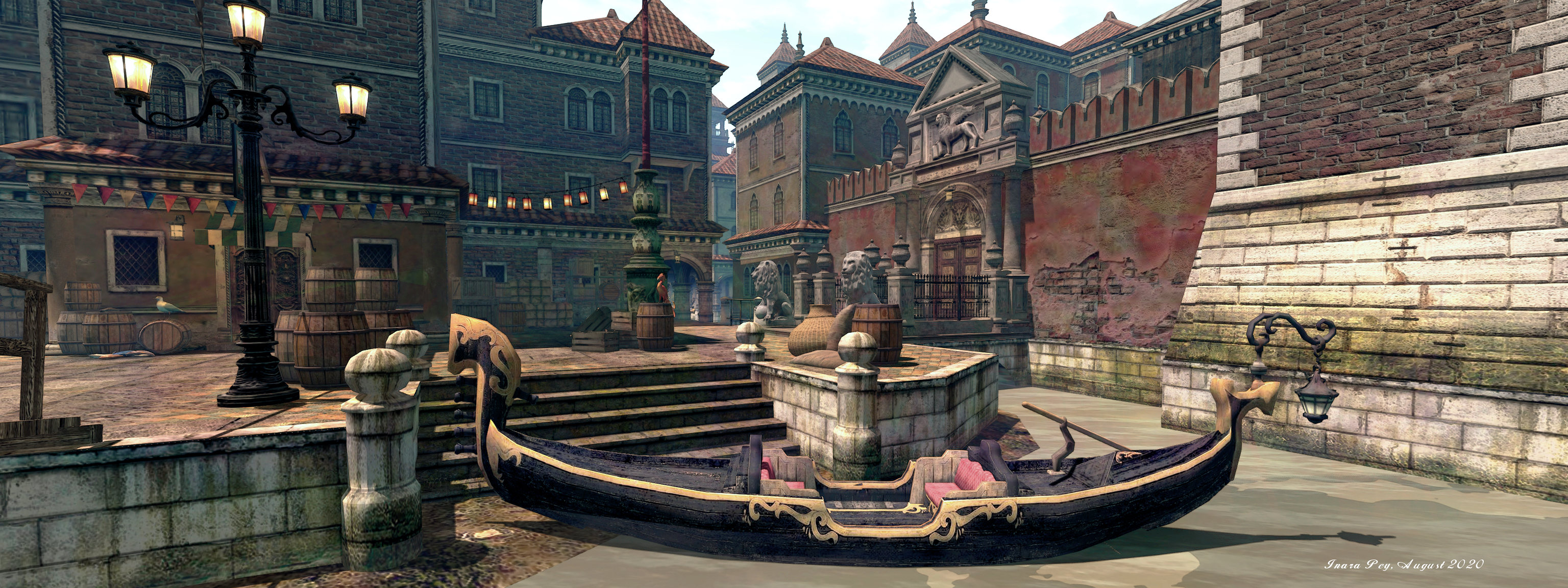
Once upon a time there was a place called Venexia. A full region, it offered a taste of Venice in something of a Gothic twist, largely built with role-play in mind – although it was a highly photogenic region – it was open to Second Life users between 2011 and 2015, when it and it’s “companion” region – as in, designed by the same people – closed (see: The passing of places in Second Life, June 2015).
In 2018, the spirit of Venexia returned when Zee9, one of the original region’s designers, created a Homestead region based on Venexia that she called Venesha. Referring to it as a “stripped down” version of Venexia, Zee9 nevertheless imbued much of what had made Venexia special within the mesh and prims of Venesha.
Venesha, the enchanted isle, August 2020
To be honest, I’ve no idea how long that iteration of Venesha remained in Second Life – I stopped by in something like August or September 2018, IIRC, but never wrote about it – and by the start of 2019, Zee9 had moved on to her futuristic 2019-XS city design, itself a recasting of her Drune build (which it was also to morph into over time (see Time at 2019-XS in Second Life, January 2019 and Drune IV: an Aftermath in Second Life, August 2019).
Now, with Venesha, the enchanted isle, Zee9 has brought all the magic of Venexia back to Second Life – and more. Once again occupying a Full region, Venesha, the enchanted isle has given Zee9 to completed rebuild the original and enhance it to offer a setting that is utterly captivating and rich in nuance and style.
Venesha, the enchanted isle, August 2020
Situated as a sky build in order to make use of the better performance people can oft experience with the viewer (no pesky Linden Water to render, which can affect viewer performance, particularly for those running EEP-capable viewers), Venesha offers an enticing mix of classic Venice with canals, gondolas (some of which act as site-to-site teleports within the build), humpbacked bridges, waterfront houses, narrow terraces, inner courtyards and one broad square that takes its lead from the famous Piazza San Marco.
But mixed with this is much more – the aforementioned Gothic element for example, together with something of a steampunkian edge, like the clockwork elevator that will take you up the inside of the clock tower, and the street lamps that look like they might be gas-powered. The docks, meanwhile are strong Renaissance period in styles (and shipping). Meanwhile, the taverns and tea houses look as if they’d fit into any period from the Renaissance through to the present day, whilst the preferred (but not enforced) dress-code is Victorian / Edwardian.
Venesha, the enchanted isle, August 2020
If all this sounds a bit of a hodge-podge, rest assured, it isn’t. Thanks to the architecture of the region, everything naturally flows together from waterfront to streets, to island gardens, going by way of theatre, churches, clubs, taverns. Rather, Venesha the enchanted isle is a genuinely immersive setting that suggests a place cut-off from time, and where role-play opportunities abound throughout. Those with a Gothic / supernatural bent will find places like the Tomb Garden and the great basilica to their liking; the interior of the latter is certainly not what you might expect from a house of God – but who said churches have to be places of worship in one particular direction? Across the region, the dungeons may similar offer opportunities for some role-play scenarios, whilst the island gardens and the library sit as quieter retreats.
Those with an interest in magic can always enrol in the local magic school, tucked away behind the Basilica and occupying a little island of its own. For the adventurous there is the ride to the top of the clock tower and a zip line ride down to a nearby tower, where a treat of wine and cheese awaits those who dare – just down drink too much, as the way back t the ground is via a pair of ladders!
Venesha, the enchanted isle, August 2020
As noted above, some of the gondolas found along the canals offer the means to teleport around Venesha, but I really recommend talking your time and walking around; there a lots of little corners and terraces that might be missed otherwise, as well as one or two secrets. Can you find the hidden entrance to the catacombs, for example?
Currently there are no plans to re-introduce formalised role-play into Venesha, Zee9 preferring to leave things open to visitors who wish to do so to engage in free-form RP. She does note, however, that any of the old Venexia RP groups that might still be active are welcome to hop over and try the region on for size.
Venesha, the enchanted isle, August 2020
Zee9 describes Venesha as her best build to date – and while I have always enjoyed her region designs, I’m not going to dispute her on that point: Venesha is fabulously designed and executed, and perfectly recaptures everything that made Venexia so popular. The default environment settings are recommended for maximum enjoyment, but with care, others also work well with the design.
I’m totally up to my ears in a variety of things at the moment, which has had something of an impact on my ability to blog with the usual frequency. Hopefully, I’ll be all caught up over the next couple of days, but I didn’t want to mission the opportunity to write a few words about Swan, the Homestead region held by Keely Mistwood as her personal space, but which she has opened to the public to visit.
The landscaping for the region is by Tab Tatham, whose design work is always worth seeing as she has an considered eye for creating natural environments – as can instantly be seen with Swan.
Swan, July 2020
The region is largely given over to a mountainous off-sim surround that joins with the island to present a low-lying tongue of land extending out into the waters of a bay, several other peaked islands rising from the waters to suggest a coastal archipelago, while the the trees of the lowlands suggest this is somewhere in the northern latitudes.
Rocky in nature and split by a stream that issues from one of the landscape’s rocky faces, the landscape is rich in fir and oak and climbs back to a high table close to the mountain backdrop, a finger of rock connecting the two, a screen of trees helping to curtain the join between region landscape and surround.
Swan, July 2020
This high bluff has prevented the sea complete separating the headland from the mountain, and thus turning it into an island. To one side is a channel that has eaten its way between headland and mountains; on the other is a sheltered arc of beach reached by wooden steps that descend from the flat top of the rock and watched over by a wooden deck.
The top of the plateau is largely given over to Keely’s house, which like the rest of the region, is open to the public. It has a delightfully bohemian feel to it, the indoor spaces open and breezy, seamlessly with the decks around it, and a cool looking rocky pool alongside in place of a more traditional swimming pool.
Swan, July 2020
Packed with detail, the house looks down on a further curved bay, this one with shingle rather than sand, this one arcing to another, lower table of rock, home to a more traditional swimming pool. It can be reached via the wooden steps leading up to the house from the landing point or via one of two zip lines.
The second zip line descends to the north-east and the tip of the headline, where an old cabin, now converted into a hidden summer house – although be warned that the trip down the line will take you through the local fir trees, so you could end up getting a few slaps from the boughs!
Swan, July 2020
Between the cabin / summer house and the landing point, the land is again rich in detail beneath the canopy of trees. Here might be found an open-air theatre, old terraces, open walks, decks and more, all making for a richly photogenic setting – although you’ll need you own pose HUD for avatar photography, as Keely hasn’t opened rezzing the region to avoid littering.
Superbly made, packed with opportunities to wander and / or relax (including the little island off-shore, although you’ll have to fly to it), Swan is a perfect destination for the SL traveller. I’m not sure if Keely intends to keep it open to visitors or if it may be a limited time opportunity to make a visit; so if you’re interested, hopping over sooner rather than later might be the way to avoid disappointment.




 Inara Pey: Living in a Modemworld