Reflections on art and geometry in Second Life

ArtCare Gallery, August 2023: Scylla Rhiadra – Geometries of the Human

Currently open at Carelyna’s ARTCARE Gallery is Second Life is another exploration of the human condition through art by Scylla Rhiadra. Scylla is an artist who has a reputation for getting the grey squishy stuff located within the upper portion of our skulls firing on all cylinders – and for that very reason, I always enjoy spending time within her exhibitions, even if it does mean the four cylinders of my own little brain have to work overtime….

Geometries of the Human is a deftly layered collection of images, thoughts, quotes and themes which offer the visitor opportunities to consider the exhibition along several parallel – and overlapping – lines. The most visual of these themes / lines is the relationship between art and geometry – the latter being perhaps one of the most important (and certainly one of the oldest) branches of mathematics. It is one which has and does hold influence over many aspects of our lives, as Scylla points out in her introductory notes for the exhibition: it has applications in the majority of the sciences (including other branches of mathematics), in architecture, design, and – of course – art. Thanks to the Fibonacci sequence, it is also very present in the natural world.

ArtCare Gallery, August 2023: Scylla Rhiadra – Geometries of the Human

It is geometry which so often gives art its form. Perhaps the most obvious influences here are those of ratio and proportion – the former notably through the use of the Golden Ratio / Fibonacci sequence, the latter most famously embodied within da Vinci’s Vitruvian Man, which brilliantly brings together mathematics and anatomical science and combines them with art (both classicism, and naturalism). Both individually and jointly, ratio and proportion can do much to give a sense of depth and / or sense of balance which more readily give pieces that have an intrinsic  – if indefinable – appeal.

Geometry therefore helps gives structure to art – much as it does the worlds, the very cosmos, around us. However, the fact that it does can actually be a limitation, particularly through slavish adherence. The rule of thirds, for example, and clearly a geometrical imposition, is intended to offer a rule of thumb within the visual arts; yet all too often it is taken as an immutable rule, any violation of which lessens the finished work – potentially to the point where it should not be considered art. Whilst the first of these views might (to a point, again it depends on the artist’s overall goal) be seen as “true”, the latter most certainly is not.

ArtCare Gallery, August 2023: Scylla Rhiadra – Geometries of the Human

Thus, within the pieces – and their accompanying descriptions – Scylla presents an engaging exploration of the relationship of geometry and art which is both a celebration of the beauty their interaction can create, and a questioning of the enforced rigidity and limitations they can place on art through consideration of the aesthetics of geometry alone when composing an image, painting or drawing. This leads directly into a wider  context of the exhibition: a questioning of perspectives and – and this is purely my term, not Scylla’s – slavish adherence to doctrines.

At the end of the day, geometry is purely a tool or tool set – an undeniably useful one which has allowed humanity to evolve in terms of knowledge, technology, science and understanding. But like any tool or tool set, it is not all-encompassing; like much in science, it is far from static. Whilst it is perhaps the most widely recognised, Euclidean geometry is far from alone, and since the 1800s in particular, differential geometry (through the likes of the Theorema Egregium and Riemannian geometry), together with computational and discrete geometry, play key roles in our understanding of the cosmos and science (even general relativity is underpinned by non-Euclidean geometry), and can lend themselves to art. Ergo, allowing oneself to be constrained by a specific set of rules or concepts is perhaps not the best position to take.

ArtCare Gallery, August 2023: Scylla Rhiadra – Geometries of the Human

This is as fundamental a truth in life as it is in science (and art). We are not uniform creatures; each of us is more than shape or form or colour; we have folds and volume (depth). We might all be the result of the same biological processes, but none of us is mass produced; we are all truly unique. And it is in our differences to one another – however those differences might be manifested – that we are perhaps the most precious, because it is through the understanding – and acceptance – of what makes us different which can lead to the best understanding of one another.

For me, this is aptly stated within What Would You Be without Me?, together with the accompanying quote attributed to Dürer alongside it. Yes, an understanding of geometry and its attendant use of ratio and proportion clear enhance the artist’s work – but it is still the subject of that work which should be central to it. Without such a focus, the work is diminished, emptied; the use of geometry pointless. Similarly, if we are unwilling to accept others can have outlooks on life different to our own, and instead seek to ostracism and “other” them simply because of they are “different”,  then we diminish ourselves as well, becoming – if I might mangle Shakespeare here somewhat: a walking shadow, a poor player that struts and frets his hour upon the stage … full of sound and fury, signifying nothing.

ArtCare Gallery, August 2023: Scylla Rhiadra – Geometries of the Human

Having a belief system or guidelines is not a bad thing – again, without our understanding of geometry, the world we’ve created and our understanding of it and the cosmos in which it sits, would potentially be a very different place. But to quote Scylla – too strong a faith in anything is dangerous. It can blind us to the beauty of creativity and artistic freedoms – and rob us of understanding and wisdom that might be vital to our future existence.

As I noted towards the start of this piece Geometries of the Human is a deftly and deeply layered exhibition, one in which both art and the words accompanying it offer nuanced opportunities for reflection on ideas on life and expression great and small. In its viewing, it is not so much an exhibition which should been seem so much as absorbed – and it is obviously thoroughly recommended to anyone who appreciates art with a message (and a conscience).

SLurl Details

Of art and a Caged Bird in Second Life

Red Dot Gallery

In July of 2023, I has the distinct pleasure of visiting  Auguries of Innocence, a thoroughly engaging exhibition of art by Janus Falls structured around William Blake’s poem of the same name. Within it, Janus echoed and extended ideas found within Blake’s work, uniquely re-interpreting theme through colour and image. As one can tell from my review of that exhibit, I was deeply captivated by the expressiveness found within it, and so – although admittedly somewhat belatedly – I made a point of visiting another collection of images inspired by a poem Janus is currently exhibiting.

Hosted within her own gallery space – Red Dot GalleryI know Why the Caged Bird Sings presents a series of 14 avatar studies inspired by Maya Angelou’s poem Caged Bird (also referred to as I Know Why the Caged Bird Sings, which is also the title of the first volume of Angelou’s autobiography, itself referenced by the poem). First published in her fourth collection of poetry entitled Shaker, Why Don’t You Sing? (1983), the poem is focused on the themes of freedom, racial oppression using the metaphors of the free and the caged bird.

Red Dot Gallery: Janus Falls – I Know Why the Caged Bird Sings

Through its structure use of mixed meter and irregular rhyme, Caged Bird is again a powerful statement oppression and hope for a brighter future. It’s a message that, in a world where basic human caring, acceptance and social concern are increasing seen as something to be reviled and differences in outlook, gender, sexuality and – yes, race – are reasons to ostracize and condemn, the poem stands not only as a reminder of the past, but also a very real underscoring of the fact that the oppression not only continues, but is spreading insidiously; that all of us who have an ounce of human dignity and compassion need to be firmly raising our voices against it, such that those who might otherwise find themselves caged by the ignorance of others might again have their voices – their rights and freedoms – accepted and restored.

In this, the art of I know Why the Caged Bird Sings presents a visual essay, one running sequentially through the gallery’s space from entrance (where Caged Bird can be read), and around the lower floor back to the upper and thence around the images there, which carries us from images of captivity to freedom and from sorrow to happiness (again reflecting the poem’s (admittedly more layered) mixing of joy and sadness).

Red Dot Gallery: Janus Falls – I Know Why the Caged Bird Sings

Within these images, Janus again shows a consummate skill in using visual contrasts  – light and dark, tone and shading, depth of field and focal point – to draw us into her art and the story it has to tell – as deftly as Angelou uses anapest and iambic meter and stressed and unstressed pairings of ideas   to draw us into the meaning of her poem.

In exploring these pieces, it is also hard not to escape the feeling there is a further message here; one directly connected to our digital world. Second Life is a place that, for many of us, is liberating; through it we can give wing to our innermost truths, wants and desires through the expressiveness of our avatars ad / or our creativity. It presents us with a place where the bars of life in whatever form they take – physical, mental, social, familial, etc., can be escaped (if only, admittedly for a time) and we can find comfort, joy, happiness – even acceptance. Given we have been so fortunate to be able to experience this richness and freedom of expression, do we not owe it to ourselves and those around us to ensure that no matter who and where we are, such freedom is to be as open, as cherished as available to all who seek it within the physical world?

Red Dot Gallery: Janus Falls – I Know Why the Caged Bird Sings

SLurl Details

Art and emotion: Theresa Hermit in Second Life

St Elizabeth’s University Original Campus Gallery: Theresa Hermit

Saturday, July 29th, 2023 saw the opening of an exhibition of photography and art from the physical world by Theresa Hermit at the Original Campus Gallery within St. Elizabeth’s University.

I believe this is the first time I’ve witnessed Theresa’s work, but am unsure as to whether this is her first complete exhibition, or the first to be widely advertised. The term “introducing” is used in the advertising, but I gather from chatting with Pat Wheelwright, Director of Residential Living at St. Elizabeth’s, that Theresa has displayed her work there in the past (she is also both the university’s Art History teacher and current president), but these may have been limited in terms of audience, being only advertised within the university’s membership. Either way, I’m glad to have had the opportunity to witness this exhibition, which offers quite the showcase for Theresa’s multi-faceted artistic talents.

St Elizabeth’s University Original Campus Gallery: Theresa Hermit

In the physical world, Theresa holds a Bachelor of Fines Arts (BFA) degree and has recently completed her Master of Fine Arts (MFA). For those not clear on the difference between these and the Bachelor of Arts (BA) and Master of Arts (MA), the latter two usually centre on the scholarly, academic and critical study, whilst the BFA and MFA centre on professional artistic practice within the chosen field of study. Her work encompasses multiple mediums including watercolour (including gouache), oil, and printmaking, whilst also enjoying drawing and  – as demonstrated in this exhibition – photography, where she also develops her own images as well as taking them.

The latter is located on the ground level of the gallery space – the exhibition covering a total of three floors within the gallery – presenting a fascinating series of black and white photographs, mostly taken at a farm in Connecticut. These show a keen eye for composition whilst the use of black and white film brings a sense of time and age to the buildings, furniture and hardware which is sublime in giving a deeper sense of narrative and history that might otherwise have not been apparent.

St Elizabeth’s University Original Campus Gallery: Theresa Hermit

Within this selection are also images quite fittingly captured at a property once owned by Edward Steichen. He was both a pioneer in the craft of fashion photography and, more particularly in this case, often credited with elevating photography into a recognised art form – and I have little doubt that were he to view the images here, he would embrace them as such.

The middle and upper levels of the gallery  – and the stairways linking them – are host to a selection of Theresa’s paintings covering a range of subjects. In this, and as Theresa herself notes, she is not so much led by the artistic opportunity of something she sees, but by the emotional response she feels towards what she sees. This is perhaps most clearly seen within Darkness Falls, a painting of sunflowers set against a backdrop of smoke / dust, painted as a personal response to the events of September 11th, 2001.

St Elizabeth’s University Original Campus Gallery: Theresa Hermit

Theresa also notes that she eschews “realism” in many of her paintings in favour of her emotions (what she refers to as her work being “representational”), and this further adds a personal depth to her paintings. Again, take GGP Wedding; this is a reflection of the wedding of Theresa’s great-grandparents, taken from a photograph of that event. Within it, the newly weds are shown almost ghostlike; figures and details blurred – a perfect reflection of an event that might be recalled from a time when the eye and mind were too young to capture and imprint all that was seen firmly into memory, allowing the details to become misty over time.

What is also striking about this exhibition are the notes Theresa provides (click the small, wall-mounted signs offered close to the entrances of all three levels of the gallery space). These offer a richness of information, examining the origins of the photographs and paintings, the influences that helped inform their creation, and insights into the approaches she takes to her work. These notes help carry us into Theresa’s creative processes in a very personal way.

St Elizabeth’s University Original Campus Gallery: Theresa Hermit

A genuinely personal, engaging exhibition, and my thanks to Cayla (YumiYukimura) for the invite to visit!

SLurl Details

The art of Raven Arcana in Second Life

Raven’s Eye Gallery

Today I’m shining a spotlight on the art of Raven Arcana, a Second life photographer-artist whose work I’ve seen featured a some ensemble exhibitions, but until June 2023, hadn’t really had the opportunity to focus on her work  in these pages. That was when her themed exhibition Destination Unknown opened at Artsville Galleries – although again, time being what it is, I also didn’t actually get the opportunity to write-up that exhibit at the time of its opening. However, at the time of writing this piece it remains available to visitors for a while longer, and so is touched upon here as well.

Raven’s primary gallery space is located with her own region of Clandestine, which is also dedicated to the Digital Arts Gallery, a collective of SL artists and bloggers. Thus, Raven’s gallery can either be reached directly or via the teleport area available at the DAG event space, which also provides access to other galleries and locations within the region (which are outside the scope of this article). For ease of reference, all SLurls to places specifically mentioned here can be found at the end of this article, rather than also being embedded in the text, per my usual approach.

Raven’s eye Gallery: Raven Arcana

Occupying a 2-storey space set within its own skybox, Raven’s Eye Gallery offers a rich introduction to Raven’s photography for those who might not be familiar with it. At the time of my visit, the lower floor presented a diverse selection of Raven’s landscape work, with all of the images beautifully evocative whilst demonstrating an eye for framing that within some rightly eschews so-called “golden rules” of composition in favour of a broader and more fitting artistic balance.

These are images which also demonstrate Raven’s talent for post-processing and effect, with some finished with photograph-like clarity and others treated to resemble watercolours or oils. A particular attractiveness in some of the latter lay in the way Raven has captured the spirit of the Impressionist and Romance landscape painters, the style and finish selected by Raven for each piece is perfectly matched to its focus and subject.

Raven’s eye Gallery: Raven Arcana

The landscapes continue on the upper floor – which at the time of my visit was only partially laid out – but are mixed with pieces that are more thematically inclined. Future Sunset, for example, would appear to offer a direct link to Destination Unknown, itself a powerful selection of pieces focused on climate change / global warming and the inherent threat they contain to life and civilisation. Meanwhile, When Fiction Becomes Reality presents a powerful commentary on the (predominantly patriarchal) suppression of women’s rights, whilst Biker’s Paradise offers an unapologetic celebration of the freedom and joy to be found travelling the open road.

I’m not sure how much longer Destination Unknown will remain open to the public – my apologies to Raven for not previously covering it in these pages; as such I’d recommend a visit alongside a trip to Raven’s Eye Gallery during August 2023, in the hope you get to see it before the next exhibition replaces it at Artsville. That said, make no mistake, a visit to Raven’s Eye is well worth the time for anyone with an appreciation for art.

Raven’s eye Gallery: Raven Arcana

SLurl Details

Note that Clandestine is rated Adult.

Art, AI and Totems in Second Life

Third Eye Gallery: Lalie Sorbet – Totem
Totem
tō′təm – noun
An animal, plant, or natural object serving among certain tribal or traditional peoples as the emblem of a clan or family and sometimes revered as its founder, ancestor, or guardian.
A representation of such an object.
A social group having a common affiliation to such an object.

So reads a typical dictionary definition definition for totem, a word believed to have entered the English language in the 18th century courtesy of the Ojibwe people, indigenous to the Subarctic and north-western woodlands of the North American continent. It is a term which perhaps most readily brings to mind the totem pole, although this is only one form a totem can take. It is also the one given by Lalie Sorbet to her latest exhibition of art, which opened at the Third Eye Gallery curated by Jaz (Jessamine2108) on July 29th, 2023.

Totem offers 16 AI generated, animated pieces representing plant totems intended not as emblems of a specific clan or family or ancestor, but in recognition of Nature itself – the greatest guardian for life and beauty there is on Earth.

Third Eye Gallery: Lalie Sorbet – Totem

Each of the pieces has been generated through the use of the Midjourney AI software, using a phrase or comment by Lalie, to produce images of leaves and flowers in exquisite close-up detail (thus mirroring Lalie’s equally captivating physical world macro photography). These images are then layered onto “blocks”, each with two faces (both facing the observer) each bearing an image, animated via script to move gently in opposition to one another to give the finished piece a sense of three-dimensional depth and life.

These are incredibly beautiful pieces, large in size, caught as if by a light breeze, their colours and brightness shifting in response to SL’s ambient lighting – make sure you are using the Shared Environment when visiting (World → Environment → Use Shared Environment) when visiting. They are rendered (presumably by considered post-processing by Lalie) to offer unique pieces, captivating in their presentation and potentially layered in their possible interpretation.

Third Eye Gallery: Lalie Sorbet – Totem

Take the pieces showing leaves for example. These have generally been rendered to present the lamina in a gossamer lightness, allowing major and minor veins to come to the fore, sometimes in a feather-like beauty, as they flow outwards from midrib to margins, gorgeously emphasising the life flowing through them.

In doing so, they reveal the marvellous complexity and elegance of nature’s design inherent in a leaf which otherwise tends to pass us by unseen. At the same time, the detail brought forth within each of these images echo other life-giving marvels of nature; the veins fanning outwards from the midrib, for example, are like the many outflow channels crossing the delta of a river, turning the wetlands between them into richly diverse living ecosystems.

Similarly, the pieces featuring flowers bloom not only present stunning studies which bring home the beauty and complexity of such blooms petals, stamen, stigma, anther, filament et al, their macro presentation reminds us, perhaps of both the interconnectedness of life on Earth through the simple, yet complex dance of pollination, and that it is also delicate and fragile; that if we do not learn to be better stewards of the world around us, to become better guardians of our planet, then its beauty, its very essence of life, will be all too fleeting.

Third Eye Gallery: Lalie Sorbet – Totem

I would have perhaps liked to have seen the terms Lalie used in initially used to generate each of the images through Midjourney displayed with each piece. However, this is a personal point of view and it does not diminish in any way from what is an engaging exihibition of AI art.

SLurl Details

More artistic beauty of steam machines in Second Life

IMAGO Suburbs Galleries, July 2023: Hermes Kondor – Mechanical Whispers

In 2020, Hermes Kondor presented an exhibition of his physical world photography focused – pun intentional – on the Tejo Power Station (and now museum) in Lisbon. It was a captivating collection of photographs, richly demonstrating Hermes’ skill as a photographer and in the manner in which it tweaked curiosity about this outstanding Portuguese landmark. It’s also one I covered in The beauty of steam machines in Second Life.

While I am admittedly getting to it a little on the later side – the exhibition having opened on July 7th, 2023 – Hermes is now back with a further collection celebrating another or Lisbon’s historical industrial landmarks, and which again offers an opportunity to both admire his photographic eye and to learn about an important physical-world landmark.

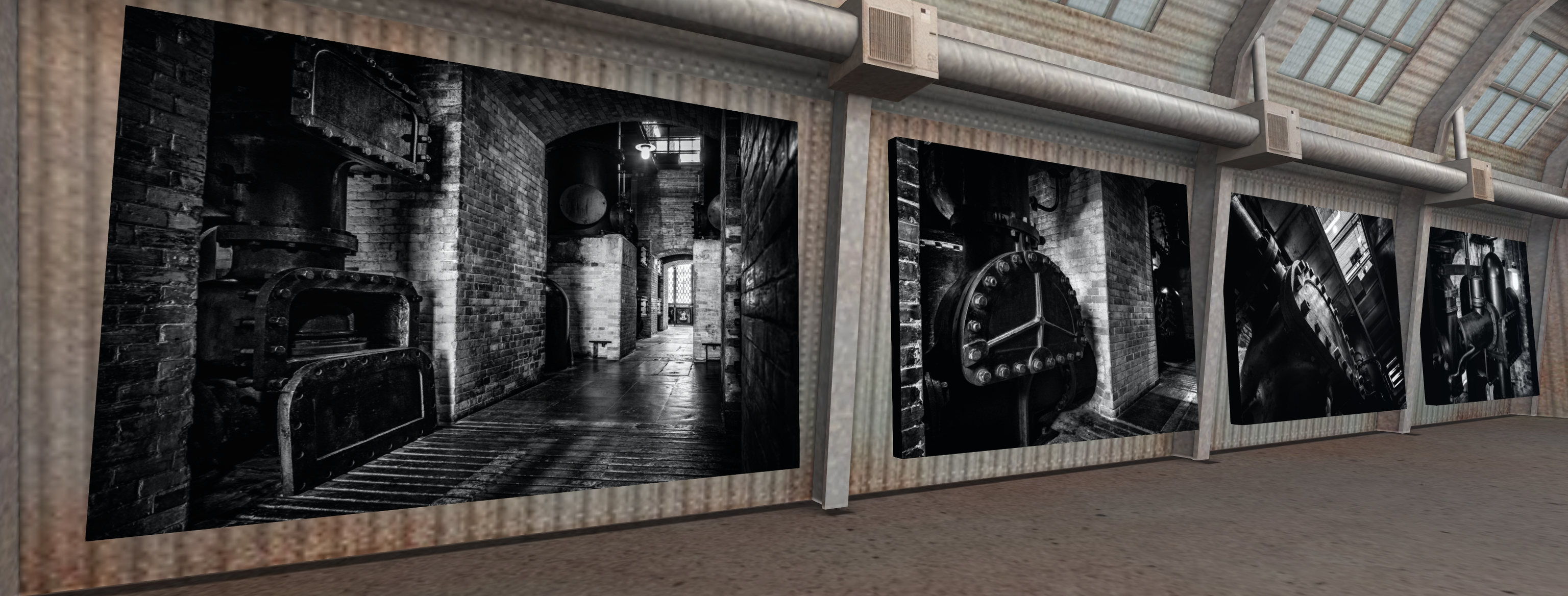
Mechanical Whispers, hosted by Mareea Farrasco via her IMAGO Suburbs Galleries, presents a series of monochrome images of Lisbon’s Museu da Água (Water Museum), formerly the Barbadinhos Steam Pumping Station, responsible for pumping fresh water to the city delivered to the artificial Barbadinhos reservoir by the Aqueduto das Águas Livres (“Aqueduct of the Free Waters”), itself one of the most remarkable examples of  18th-and 19th-century Portuguese engineering.

IMAGO Suburbs Galleries, July 2023: Hermes Kondor – Mechanical Whispers

From the 1880s through until 1928, the steam engines of the pumping station pushed water to more households across Lisbon that had been able to be reached prior to it entering service. Given its historical significance, safter its working life ended, the station eventually became a museum, retaining the great pumps and engines used to drive water from the reservoir to the city proper.

Such was the historical importance of the museum’s role in the conservation and dissemination of European cultural heritage, in 1990 it was the recipient of the prestigious Council of Europe’s European Museum of the Year Award, remaining (at the time of writing) the only Portuguese to be so honoured. Since then, the museum has continued to evolve, encompassing modern display areas offering insights into water and its importance to life, research, science, and topics such as developing sustainable supplies of fresh water in the face of climate change and population growth, as well as providing event spaces for conferences, etc.

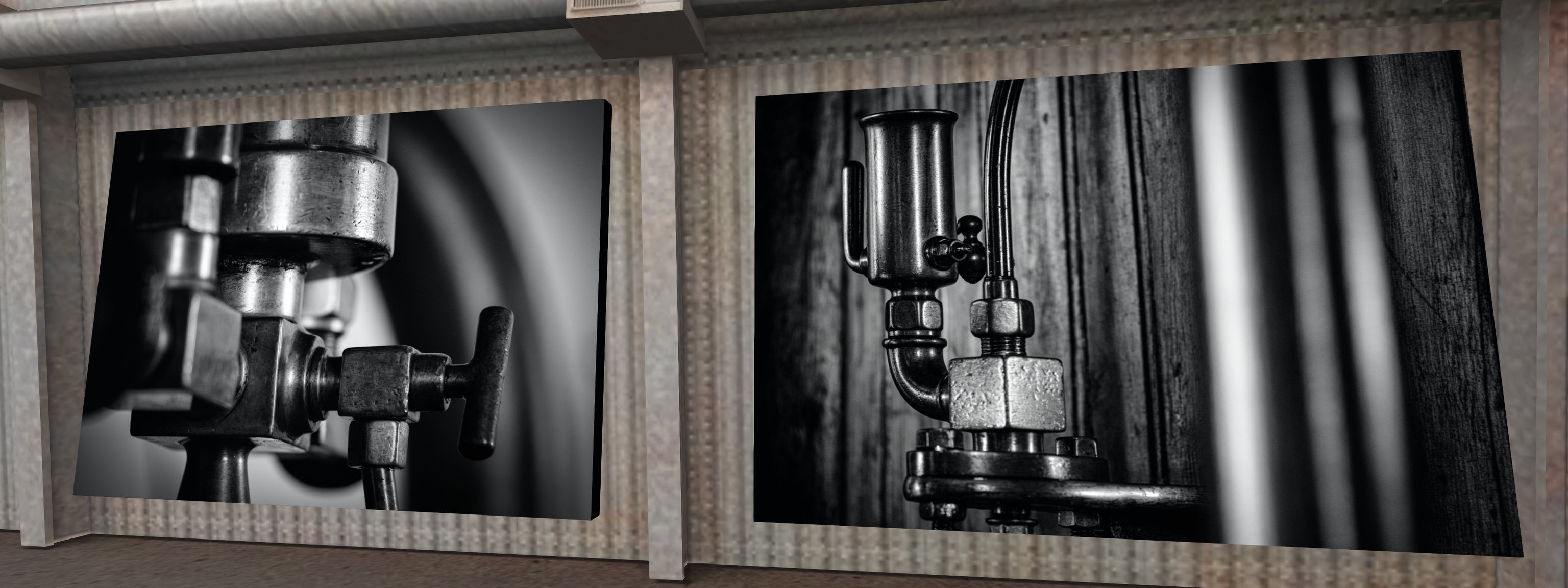
However, it is in the steam and pump rooms where the museum holds its magic, and it is these which are the subject of Hermes’ photography. Presented entirely in monochrome, Mechanical Whispers offers an entirely unique perspective of these once mighty machines by focusing not just on their bulk and hard-edged engineering, with its heavy iron forms of its boilers and bulky pipes with oversized nuts and bolts joining their various segments, but also on the smaller – but equally important – forms of the stations, gauges, pressure valves, pistons and pressure releases.

IMAGO Suburbs Galleries, July 2023: Hermes Kondor – Mechanical Whispers

That they are in monochrome, the images might be seen by some as missing the richness of colour evident in the actual museum, with is rich wooden floors, widespread use of brass / copper in its smaller piping and the polished steel of pressure caps and the like.  However, I’d actually disagree; the use of monochrome allows many of these pieces to use a chiaroscuro-like used of dark and light. The former, seen within the machinery itself, gives a sense of a brooding sense of presence, whilst the latter – in the form of the brickwork and natural light falling from skylights above – combines with that sense of brooding presence gives the machinery a sense of life, as if giants are asleep within the alcoves and the shadows, requiring only the slightest noise to bring them to heavy wakefulness.

Coupled with this is a marvellous use of near-macro levels of focus coupled with the use of depth of field. This again brings the small elements of the remarkable engineering present within the machinery to life, allowing us to see the beautiful simplicity of a simple spiral screw valve, together with the craftsmanship evident within something as simple as a pointer on a pressure gauge, and the elegant simplicity of making adjustments to a complex machine by simply altering the position of a piston arm.

IMAGO Suburbs Galleries, July 2023: Hermes Kondor – Mechanical Whispers

Occupying both “hanger” buildings of Imago’s Suburbs Galleries, Mechanical Whispers is a genuinely engaging exhibition by a master photographer; one which not only presents a unique view of its subject but also for the way in which encourages the visitor to learn more about that subject and its history.

SLurl Details