Quadrapop’s Art is What You Make It in Second Life

Ribong Gallery Artspace – Quadrapop Lane: Art is What You Make It

I’m starting this article with an apology for San (Santoshima), curator / owner of Ribong Gallery. In mid-February, she sent me an invite to attend Art is What You Make It, the (at the time) new exhibition by Quadrapop Lane … and I managed to mis-file it in inventory. As a result, I am late getting to it and writing about it – but the exhibition is currently still open and well worth viewing.

The easiest way – to a point – of explaining this installation is to use Quadrapop’s own words:

Art is What You Make It is an installation of art made from other art, starting with textures used on prims, mesh and particles from quad’s RL photos, designs created in photoshop, digital drawings, and quad’s physical drawings and paintings. These images are often recycled through SL screen shots that may further be manipulated and uploaded as textures.
The images have been altered and recycled repeatedly so that their source is often unrecognizable to the maker: Art is built of layers of experience, personal and cultural, built on an artist’s response to the world. The results may bear no resemblance to the initial motivation or concept.

– Quadrapop Lane

Ribong Gallery Artspace – Quadrapop Lane: Art is What You Make It

The result is a walk through 2D and 3D art that is genuinely and stunningly visual. There are elements of animation,  abstraction , particle and physical art. To see it at its best, you’ll need a reasonable Draw Distance (96m recommended) and have Advanced Lighting Model (ALM – Preference → Graphics → make sure the option is checked). The installation is divided into six areas – four on the same level, which can be visited in a counter-clockwise direction and end with a surprise (take the angled tunnel).

These four areas include 2D, 3D and animated art pieces by Quadrapop (with the latter including particle emitters). ALM is required as projectors are used throughout, so without the option being enabled, you’ll miss a lot. A spiral ramp rising from the centre on the four rooms, rising to a mezzanine level with further art, including a walk-through element which can be intense in terms of the lighting, and a marvellous 3D animated fresco hanging in space.

Ribong Gallery Artspace – Quadrapop Lane: Art is What You Make It

The remaining level is reached via teleport from the lowest level (look for the TP disk on the four of one of the rooms), and takes the form of a maze-like walk through light to the centre and the TP back to the low level.

Describing all that is here is a little wasted, as this is an entirely visual installation, one fully deserving to to be seen and enjoyed. So I’m going to shut up now and encourage you to visit while there is time enough to enjoy Quadra’s work for yourself.

Ribong Gallery Artspace – Quadrapop Lane: Art is What You Make It

SLurl Details

The natural beauty of Hera’s Shangdu in Second Life

Shangdu, March 2022 – click any image for full size

On Sunday, March 6th, Hera (Zee9) opened a new setting for people to visit and appreciate. Called Shangdu, its name might for some call forth thoughts of the original northern capital of the Yuan dynasty, the successor to the Mongolian Empire as founded by Kublai Khan; a place we in the west perhaps more familiarly know as Xanadu.

However, this build is not in any way reflective of, or inspired by, the words penned by Samuel Taylor Coleridge in his poem Kubla Khan, itself the result of an opium-fuelled dream, or anything to do with the city. Whilst fantastical in nature, the poem is nonetheless rooted in descriptions that, passing by way of Samuel Purchas (from whom Coleridge might be said to have gained his opening line for the poem, Purchas having written In Xandu did Cublai Can build a stately Pallace) all the way to Marco Polo, who did visit the fabled city some time in the late 1270s.

Shangdu, March 2022

Instead, Hera uses the name Shangdu to evoke a sense of the Yuan period, and to evoke a feeling of natural beauty, rather than the artificial opulence born of Coleridge’s poem or Purchas’ words.  In fact, what we have here is a painting in 3D, a watercolour we can walk through.

The difference here being the opulence is in natural beauty. I first did this about 20 years back in Unreal Tournament; I was looking for something completely different to create and I found these beautiful paintings of a Chinese water Village. [However,] this is a complete fantasy, I have not tried for any particular accuracy in the buildings, although the textures are all taken directly from photos of the village.

Hera (Zee9)

Shangdu, March 2022

The setting presents a walled village through which narrow canals run to both feed and be fed by a moat that encompasses around two-thirds of the village as its sits beyond the high walls and which is it turn directly fed from falls dropping from the northern-western uplands that cup the remaining corner of the village.

The landing point sits as the exit of a tunnel, a rutted track running from it to curve gently to the only landward gate into the village, presided over by an imposing gatehouse ready to defend the wooden bridge below. The tunnel offers the sense that visitors are travellers – perhaps on the Silk Road and following Marco Polo, even if this is not the Shangdu – coming to this place after a long journey.

Shangdu, March 2022

With watch towers sitting notably on the north and east walls of the settlement, it’s clear where the greatest threat to its security might originate – not that this is a particularly a place of war; far from it in fact: the overall impression is that this is a place that might be linked to fishing for sustenance, given the eastward lake sitting beyond the walls, and where at least one silk trader has established a presence, whilst in another resides an artist. However, outside of these and the local temple and a house, the majority of the building here are façades rather than furnished places.

But having so few interiors to explore in no way detracts from the setting; rather, it helps spur the imagination as to might otherwise lie behind the doors to the houses and other buildings, allowing us to add to Hera’s 3D painting with the colours of our own imaginations. As we wander along the narrow streets, cross the wooden and stone bridges, passing under blossoming trees and by stone seats and wooden benches, it is hard not to imagine the local denizens also passing along the same cobbled ways, the smells and sounds of cooking coming from within different abodes, mixed with the sounds of animals in the little yards and the shouts of merchants and other echoing down the alleyways.

Shangdu, March 2022

For those prepared to look for them – but within the village walls and beyond – lay places to sit and / or mediate. Signalled by the presence of small pillows, some of these are relatively easy to find, but one might require some care spying to locate 🙂 .

Set within its own EEP Day Cycle, as used in the images in this article, and including both an ambient sound scape and an appropriate music streams for those who would care to listen as they explore, Shangdu is another superb design and gift to all of us from Hera. Should you drop in, do please consider making a donation to the heron at the landing point to help Hera with the costs involved in building her creations (again, note that is common for Hera, the buildings to be found within the village are all of her own creation).


SLurl Details

  • Shangdu (Island of Jahesa, rated: Adult)

2022 CCUG and TPVD meetings week #9 summary

Ravenport Reclaimed, February 2022 – blog post

The following notes were taken from:

  • My audio recording and chat log of the Content Creation User Group (CCUG) meeting held on Thursday, March 3rd 2022 at 13:00 SLT. These meetings are chaired by Vir Linden, and meeting dates can be obtained from the SL Public Calendar.
  • My audio recording and the Video recording by Pantera (embedded at the end of this piece) from the Third-Party Viewer Developer (TPVD) meeting on Friday, March 4th, 2022 at 12:00 noon SLT.

This is a summary of the key topics discussed and is not intended to be a full transcript of either meeting in its entirety. However, the video does provide a complete recording of the TPVD meeting, and timestamps to the relevant points within it are included in the notes below.

Available Viewers

[Video: 0:41-2:10 and 7:41-9:00 + notes from CCUG]

This list reflects the currently available official Second Life viewers.

  • Release viewer: version version 6.5.3.568554 – formerly the Maintenance J&K RC viewer, promoted Monday, February 28 – NEW
  • Release channel cohorts (please see my notes on manually installing RC viewer versions if you wish to install any release candidate(s) yourself).
    • The Tracy Integration RC viewer version 6.4.23.563771 (dated Friday, November 5) issued Tuesday, November 9.
  • Project viewers:
    • Performance Improvements project viewer version 6.6.0.567604, dated January 24.
    • Mesh Optimizer project viewer, version 6.5.2.566858, dated January 5, issued after January 10.
    • Performance Floater project viewer, version 6.4.23.562625, issued September 2.
    • Legacy Profiles viewer, version 6.4.11.550519, dated October 26, 2020.
    • Copy / Paste viewer, version 6.3.5.533365, dated December 9, 2019.

General Viewer Notes

  • The release of the Maintenance J&K RC as the de facto release viewer should see crash rates reduced for those on the official viewer (and hopefully for TPVs as the code is adopted).
    • This is the first official viewer to by built using Python 3.x.
    • It includes a fix intended to prevent the updater falling over on Mac OSX.
  • The Performance Improvement viewer is still awaiting RC release, this is pending some final bug fixing.
    • [CCUG Meeting] The Performance Improvements viewer bumps the feature table version number. This means that those placed in the cohort when it goes to RC status will see their custom graphics presets reset (as will anyone else switching to it during RC and when it gets to release status).
  • [CCUG Meeting] It appears the Mesh Optimiser viewer has a bug that is causing it to re-order triangles in an upload. So, if an explicit ordering is contained within a Blender export (e.g. for alpha sorting, for example), the Mesh Optimiser will effective destroy the ordering when running the LOD optimisation on upload. It’s not clear on how widespread the issue might be, as it has only been reported with alchemy-next thus far.
  • [CCUG Meeting] the definitions for “Low”, “medium” and “high” on the graphics slider are being redefined within the Performance Floater project viewer. This will also see the number of non-imposter avatars set on a per detail level, rather than being set to 16 across the board.
  • [CCUG Meeting] the benchmark for determining low-end systems is being adjusted to better reflect the number of uses coming into SL using low-end GPUs.

MFA Viewer

[Video: 9:12-13:42]

  • Summary:
    • Multi-factor authentication (MFA) is coming to the viewer.
    • As MFA is implemented in the official viewer, there will be a “grace” period to allow TPV adopt the viewer code.
    • During this period, users will be able to access SL on TPVs as they currently do now, regardless of whether or not they have opted-in to MFA.
    • After this “grace” period, all users who have opted in to MFA will be required to authenticate themselves when using any viewer to log-in to Second Life (with the usual 30-day period of valid authentication, as per secondlife.com MFA), but those who have not opted-in to MFA will see no difference in their log-in steps, regardless of whether the viewer they are using supports MFA.
  • The viewer-side code is currently going through QA. If is passes, it is hoped it will surface in week #10 (commencing Monday, March 7th).
  • However, the decision has not yet been taken as to give it a dedicated viewer, or to merge the code into the next upcoming Maintenance RC viewer.

In Brief

From the Content Creation Meeting

  • Viewer project work: the focus is on getting the Performance Improvements viewer stabilised and promoted to RC status (and thence to de facto release). After this, it is not clear what may come next, the options being:
    • Clearing the current backlog of project viewers.
    • Further viewer-side performance improvement work.
    • Additional maintenance viewers.
    • Other work still in early planning.
  • Further materials / Bakes on Mesh (BoM) Discussion:
    • Materials support for Bakes on Mesh is commonly requested, but there are several impediments to this (e.g. the Bake Service would require significant update just to be aware of materials; there needs to be a means to define how materials should be ordered during compositing, how alpha channels are properly managed, etc.).
    • It was asked by LL if things might be improved with just the introduction of a new wearables type, capable of allowing a single materials map to be worn per outfit / look.
    • Cathy Foil has also demonstrated a possible approach – although this also requires some significant updates to SL, as well as work being carried out externally to to the platform by content creators – see the video below (originally produced as a demonstration for the Lab).

    • Before committing to considering any materials / BoM work, LL would like to see a properly scoped design documents explaining what is felt would be required (including supporting protocols, etc.), and how it might work.
  • BUG-225519 “Mesh Uploader] Add option for automatic convex hull physics shape”.
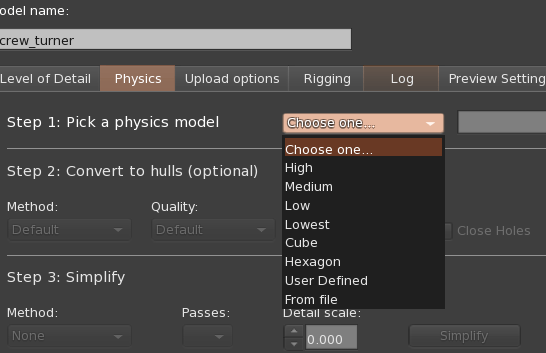
    • This was a subject of discussion at the previous CCUG meeting, the request calling the provision of simpler physics shapes to be available for use when uploading a mesh than are currently available – the simplest being a “cube” mesh physics asset. This is something Firestorm already provides:
Physics models offer through the Firestorm mesh uploader – the shapes being continued within the viewer for application. Credit: Beq Janus
    • The question was raised as to what to do when uploaded multiple mesh objects, and the physics shapes don’t match the expected number (so four when uploading 5 objects, for example). The consensus at the meeting appeared to be to use whatever is defined as the default physics shape within the file itself.

From the TPVD Meeting

  • [Video: 2:17-5:44] The Lab is considering moving the time of the TPVD meeting and adjusting the frequency so as to avoid running back-to-back (so to speak) with the Content Creation meetings, which inevitably leads to a lot of repetition between two meetings held less than 24 hours apart.
    • The straw poll of attendees pointed towards the meeting having a later start time than the current 12:00 noon. Exact time TBC.
    • There will be a move to try to have TPVD meetings on alternate weeks to the CCUG meeting.
  • [Video 6:10-7:23] During the log-in process, a series of flags are set on logging-in to SL, including one called “Gendered”. This apparently meant something in the past, but since around the time of the introduction of Viewer 2.0 (2010), it has effectively been ignored. LL are therefore looking to possibly pull the code relating to it, but wanted to make sure there are no TPVs using it for some reason before doing so.
  • [Video 13:54-17:14] The question was floated on the animation poser code contributed several years ago by NiranV Dean from his Niran’s Viewer, and whether it would be appropriate for TPVs to implement it if LL is not going to.
    • The Lab’s view is that the code does not support the “shared experience”, in that poses are only seen by the user setting them, nothing is sent to the simulator for over viewer to see. This requires additional code to overcome.
    • Currently, LL is planning some other work “related to avatar posing the movement”, and it is possible the poser code might get folded into that work.
    • While, in principle, there are no objections to other TPVs implementing the code, they would have to do so on the basis that the code only allows the user’s own avatar to be posed, and not extended to posing other avatars (which would not be seen by the users of those avatars).
  • [Video 17:28-32:00] There have been some recent overlaps / crossed lines in aspects of viewer work between Linden Lab and TPV. As a result the question was raised by the Lab as to what could be done to improve communications between TPV and LL and vice-versa to avoid future misunderstandings.
    • One suggestion was to make the TPVD meetings more of a two-way discussion in terms of what both the Lab and TPVs are working on, etc., particularly if appropriate action points could be produced when required.
    • Another suggestion was to have the Lab create a secure sandbox environment in which they could gain greater familiarity with TPVs and their capabilities as a part of their own work time (policy dictates – with good reason – LL employees are only allowed to use TPVs on systems and accounts that have no direct association with the Lab).
    • An alternative to the above that was offered would be for LL staff to peek into the support groups, etc., run by TPVs to get an understanding as to what users are asking for, and what is being responded to.


Cica’s Green Planet in Second Life

Cica Ghost: Green Planet
There is another world, but it is inside this one.

– Paul Eluard

This is the quote Cica Ghost has selected for the description of her March 2022 installation, Green Planet, which opened on Saturday March 5th. Whilst most quotations give Eluard as saying “in”, rather than “inside”, it is nevertheless an entirely appropriate quote for the installation, and for at least two reasons – which I’ll come to in a moment, and promise not to offer an entire treatise on them!

Follow the SLurl (or the LM, if you have that!), and you’ll be delivered to the bowl of what might be an ancient impact crater, almost completely ringed by green-covered hills. The only way out – worryingly – is a gaping maw overseen by a single large, roving eye, and from within which rise or hang green stalagmites and stalactites – or might they be teeth?!

Cica Ghost: Green Planet

However, the maw is not that deep and is not waiting to chomp down on you when you attempt to pass; rather it is a gateway to a curved gorge-like canyon, its walls and floor again almost slimed in green and from which green flowers point their trumpet-like blooms at the strange orange-green sky.

The far end of this valley opens out into an even more alien landscape, a place inhabited by strange slug-like creatures as green as the their surroundings, some with what we would regard as the normal complement of eyes, others with decidedly monocular vision and still some with no real indication of any form of eye or eyes. Fat-lipped and bulbous-headed, they are clearly not of Earthly origin, and the mix with more of the strange maw-like creatures and one or two that have legs.

Cica Ghost: Green Planet

Throughout this landscape, more of the trumpet-like flowers point to the sky, and many of the undulating features have the feel of having been extruded rather than formed, while green globs drool from fronds and rocks as if someone has thrown green paint across this place – or perhaps it is the gunk thrown out by whatever caused the impact crater that is home to the landing point! Also to be found here are little fumeroles that periodically burp forth green bubbles that drift upwards, while grass-like fronds that have escaped any smothering by the green goop curl gently.

Sitting pristine within the setting is a silvered metal rocket, panels heavily riveted and a single viewport looking out over the scene – but the creature with its face pressed to the thick beaded glass does not appear to be human. The presence of the rocket and its traveller, together with a glass-domed very Earthly-looking flower, add perfectly to the overall surrealism of the setting.

Cica Ghost: Green Planet

And surrealism is one of the reasons the quote Cica has chosen for the setting is so apt: Eluard was one of the founders of the Surrealist movement, dedicated to opening channels in the mind as a means for the unconscious mind to express itself.  In this respect, there is much to be said about Second Life and the manner in which we can use it to express ideas of our own and unlock our imaginations in a way that somewhat parallels surrealism’s attempts to unlock the subconscious.

The second element in the fitting choice of Eluard’s quote is that just as there is a myriad of worlds out amongst the stars of our galaxy, some of which  – perhaps many – might will harbour strange and exotic life that might be celebrated through the bizarre creatures Cica has given us here; we have only to look inwards to find equally fabulous “other worlds” as they sit within our imaginations. Worlds like Cica’s Green Planet – wonderfully bizarre and captivating, unusual, engaging and fun (be sure to mouse over things – there are hidden dances awaiting discovery and a number of fun poses to be had – although you might have to look up at what is drifting around overhead to find the latter!).

Cica Ghost: Green Planet

As always, another great installation from Cica, who never fails to offer something fresh and eye-catching each month, so do please consider making a donation to her on-going work when visiting! And don’t forget the gift at the landing point!

SLurl Details

LL issues a statement on Ukraine & assistance to Ukrainian SL users

We are all aware of the unwarranted and unnecessary attacks on the peoples of Ukraine that have been unfolding over the past week, and which have been the subject of condemnation that has been almost world-wide in its reach – including from within Russia itself, as the people there, also at no small risk to themselves, have taken to the streets in protest over the actions taken by their nation’s leadership.

With the increasing humanitarian crisis of dispossessed families fleeing the country increasing daily, together with the worsening state of affairs on the whole within Ukraine, on Friday, March 4th, Linden Lab issued a statement to the users of Second Life outlining the steps the company is taking to provide practical support to those in Ukraine and to help those in Russia who are opposed to their government’s actions – and which also includes some measure of assistance to SL’s Ukrainian community.

The statement reads in full:

Linden Lab strives to make positive change in the world by helping people connect, discover themselves, and grow both personally and financially. Ultimately, we build and support communities. Therefore, it is especially shocking to see the actions in Ukraine, to see the unwarranted attacks on people – on communities. We are heartbroken and horrified by the situation in Ukraine and the humanitarian crisis it has perpetuated. We are a proudly diverse team, and many of us have ties to these events – historically, emotionally, professionally, and socially. Our products reach worldwide, and many of our partners and customers are directly affected by this crisis. 
As a leadership team, this crisis has challenged us to better define and embrace what we believe to be the core principles at Linden Lab – our TAO so to speak.
Specifically, our TAO says:
MAKE CHANGE ON A GLOBAL SCALE
Our work brings people together, builds communities. Our work helps people understand who they are, helps them be better. Our work brings empathy, helps people see the world through others’ eyes. Settle for nothing less than changing the world for the better.
We intend to live up to this principle, and while there is much work to be done, we are starting with: 
Effective Monday [March 7th, 2022], we will be further supporting our eligible Ukrainian-based community members by granting them a temporary 30-day moratorium on recurring account fees such as Premium Membership and Land Maintenance fees.  We will review this again after 30 days and assess what we can do as next steps where necessary. We invite any of our Ukraine-based community members to contact support with any specific questions they may have.
Finally, we encourage our community to look at ways that they can help show their support. It is heartening to see the Second Life community come together to support each other with numerous in-world events and helpful initiatives that bring us together as a force for good in both the physical and virtual worlds.

.

VWBPE 2022 in Second Life: programme announced

via VWBPE

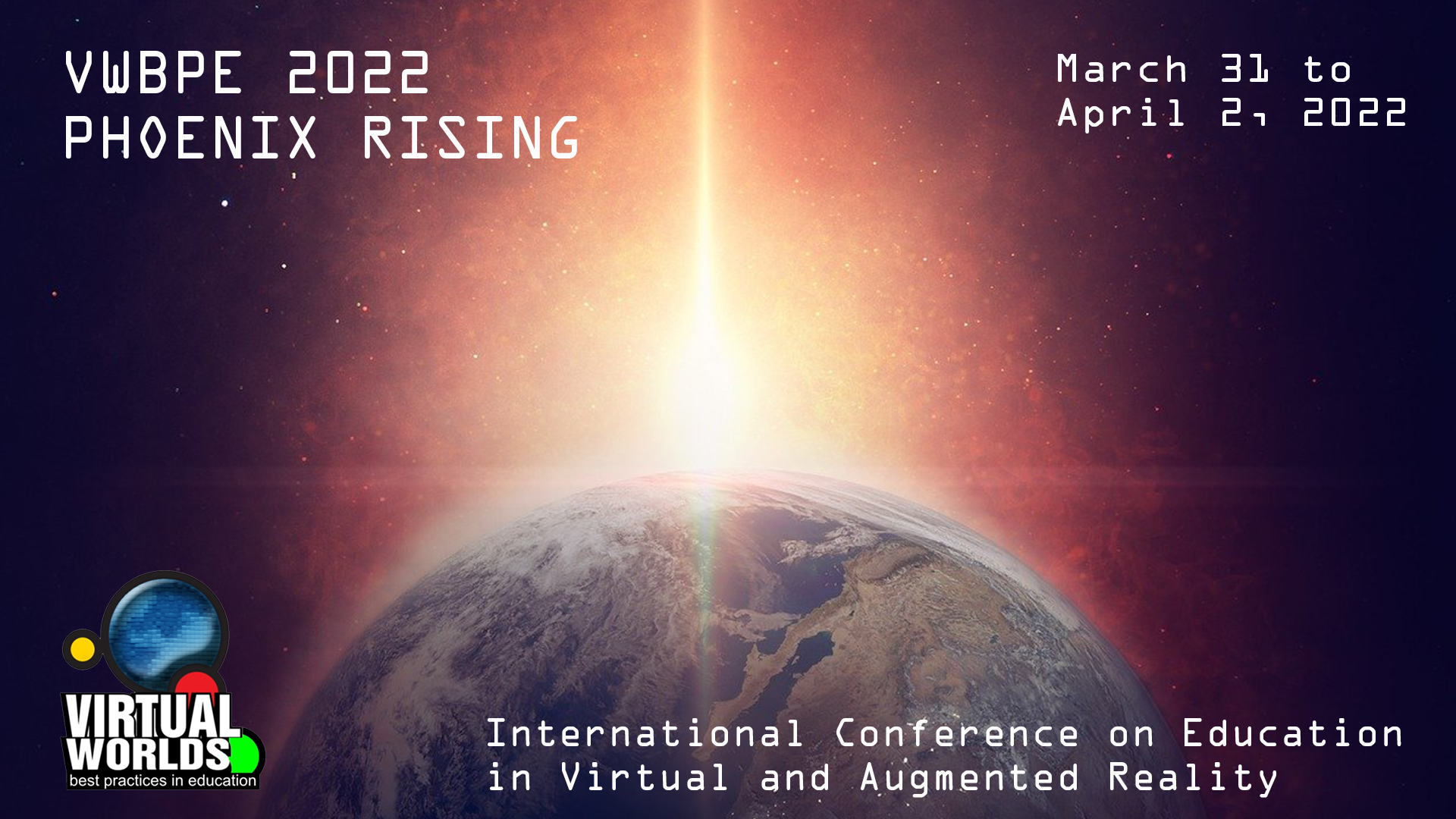
The 2022 Virtual Worlds Best Practice in Education (VWBPE) conference will be taking place between March 31st and April 2nd inclusive, and both a call for proposals and a call for volunteers to help run things has been issued.

The core schedule of events for the conference has been officially announced, and highlights include (all at the main auditorium and times SLT, unless otherwise stated):

  • March 31st:
    • 08:00-08:50: Kick-off event at the VWBPE Gateway.
    • 11:00-11:50 SLT: What’s up at the Lab? with Patch Linden and hosted by Kevin Feenan (Phelan Corrimal), VWBPE Director; Rockcliffe University Consortium.
  • April 1st:
    • 08:30-08:50 SLT: Keynote address – Randall Sadler, Professor of Computer-Assisted Language Learning Telecollaboration (incl. Virtual Worlds and Virtual Reality
  • April 2nd:
    • 18:00-19050 SLT: Closing ceremony.

This might sound like a brief set of highlights, and direct keynote events are limited this year, but the conference more than makes up for this in the range of presentations, workshops and education-focused Above the Book sessions that are to be held – so be sure to check out the schedule in full.

Call For Volunteers

Volunteers are still being sought to help with the conference. The organisers are looking for people willing to get involved in the following areas:

  • Event hosts.
  • Mentors.
  • Steaming support.
  • Technical support.

Those wishing to give of their time should visit the volunteer page and look at the tabs and then click on the volunteer button.

About VWBPE

VWBPE is a global grass-roots community event focusing on education in immersive virtual environments which attracts over 2,000  educational professionals from around the world each year, who participate in 150-200 online presentations including theoretical research, application of best practices, virtual world tours, hands-on workshops, discussion panels, machinima presentations, and poster exhibits.

In the context of the conference, a “virtual world” is an on-line community through which users can interact with one another and use and create ideas irrespective of time and space. As such, typical examples include Second Life, OpenSimulator, Unity, World of Warcraft, Eve Online, and so on, as well as Facebook, LinkedIn, Twitter, Pinterest or any virtual environments characterised by an open social presence and in which the direction of the platform’s evolution is manifest in the community.

Additional Links