2022 SUG meetings week #51 summary

The Pillars of Hercules, blog post

The following notes were taken from the Tuesday, December 20th, 2022 Simulator User Group (SUG) meeting. They form a summary of the items discussed and is not intended to be a full transcript. A video of the entire meeting is embedded at the end of the article for those wishing to review the meeting in full – my thanks to Pantera for recording it.

Note: this was a “Winter solstice Party” event, so not a lot to report. The core of any discussions in in the first hour of the video embedded below.

Server Deployments

  • On Tuesday, December 20th, the simhosts on the Main SLS channel were restarted with no deployment, leaving them on simulator version 576542
  • On Wednesday, December 21st, the simhosts on the RC channels should be restarted without any deployment or change to the current release.

Early 2023 Simulator Updates

AS per the previous SUG meeting:

  • I believe the RC deployment from week #50 (with 3-second sound loop support) was rolled back. If so, this is liable to be one of the first simulator updates for 2023 (targeted for January 11th, 2023), and / or possibly an update comprising a number of HTTP updates, including the accounting for custom HTTP headers (total space for headers will increase to 4k and the limit on the number of headers will be dropped).
  • Also early 2023 LSL will be updated with new cryptographic signing utilities: llHMAC (per BUG-233005) and llSignRSA and llVerifyRSA (per BUG-233009). These should be useful for script to script and script to external web service communications. These may be included in the above release.
    • BUG-226463 “llRequestSecureURL() uses self-signed cert” is also “on the radar” but no target date for potential delivery / deployment.
  • Further (unspecified) improvements will be coming to the Linkset Data (LSD) capabilities.

Available Official Viewers

This list reflects the current status of available official viewers at the start of the week:

  • Release viewer: Maintenance P (Preferences, Position and Paste) RC viewer version 6.6.8.576863 Monday, December 12.
  • Release channel cohorts:
    • Maintenance (Q)uality RC viewer, version 6.6.9.577220, December 16.
    • Performance Floater / Auto-FPS RC viewer, version 6.6.8.576737, November 28.
    • VS  2022 RC viewer, version 6.6.8.576310, issued November 4 – utilises Visual Studio 2022 in the Windows build tool chain.
  • Project viewers:
    • PBR Materials project viewer, version 7.0.0.577157, December 14.
      • This viewer will only function on the following Aditi (beta grid) regions: Materials1; Materials Adult and Rumpus Room 1 through 4.
    • Puppetry project viewer, version 6.6.8.576972, December 8.
    • Love Me Render (LMR) 6 graphics improvements project viewer 6.6.2.573263, July 21.

In Brief

Refer to the video below for more information on the following:

  • BUG-227303 “collisions makes a script stop running and revert its mono status” has been filed and lead to further discussion on region crossings.
  • LL is mulling an LSL call to allow the replacement of sub-strings in a string call (e.g. non-RegEx behaviour). If implemented, this might most likely be called either llStringReplace() or llReplaceSubString().
  • The above lead to a more general discussion on LSL and LSL extensions / transpilers (helping to make LSD more accessible), etc.
 

3Ms – Mountains, Mandalas and Magic in Second Life

Third Eye Gallery: Mountains, Mandalas and Magic
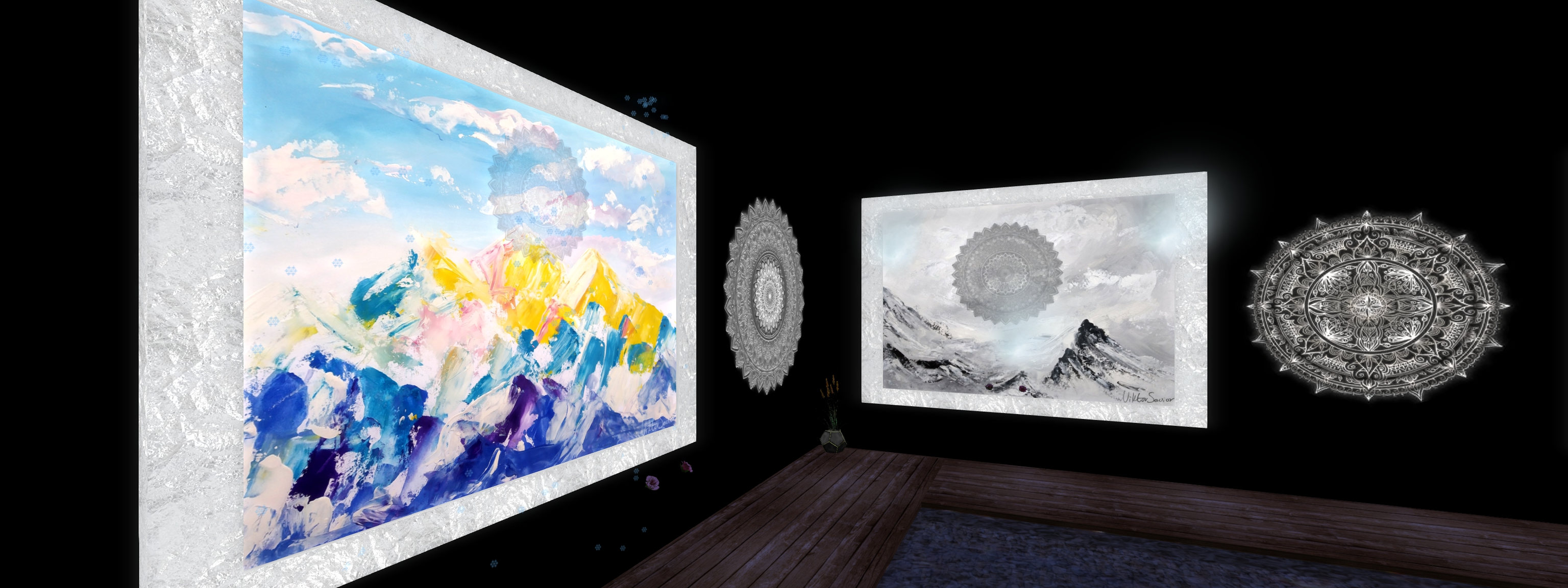
The idea behind this collaboration was to recreate the magic of nature that resonates with one spiritually and touches one either in the form of falling snow, gentle rain, or floating leaves. We hope you enjoy the creations as much as we did creating them.

– Introduction for Mountains, Mandalas and Magic, Third Eye gallery

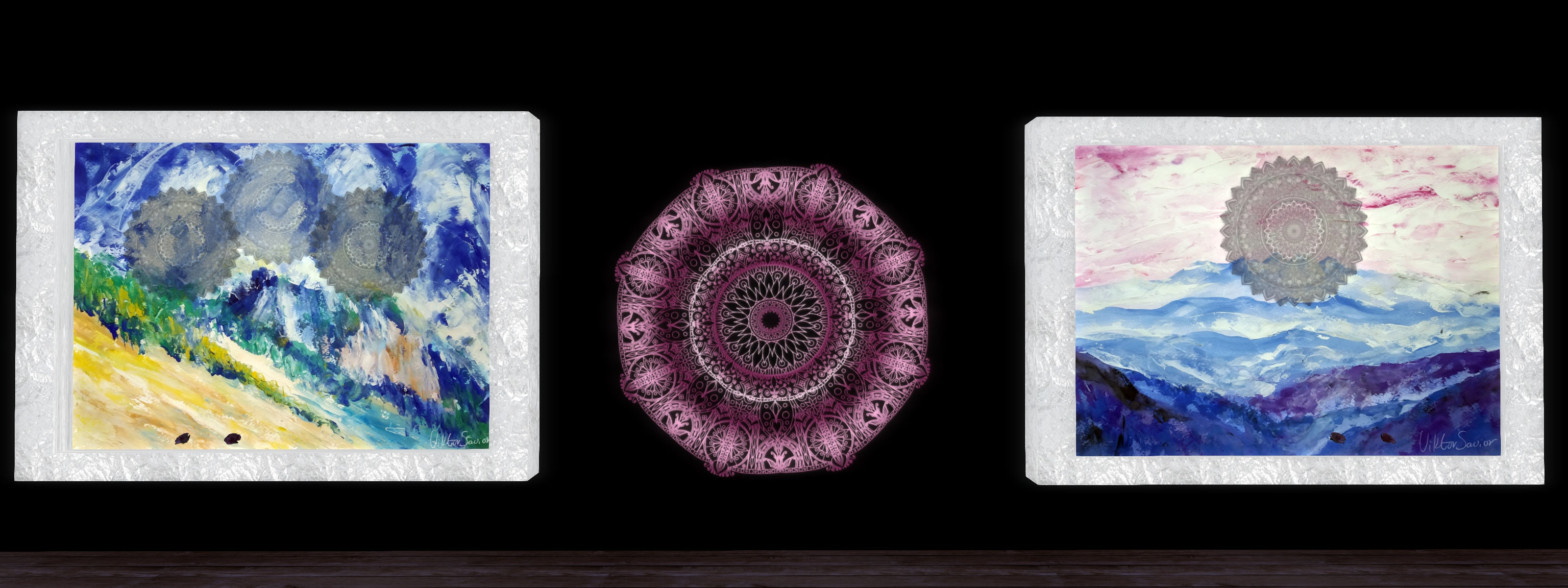
Currently open at the Third Eye Gallery, curated by Jaz (Jessamine2108), is a collaborative exhibition by Viktor Savior, Orpheus Paxlapis and Jaz herself, which, as the description above notes, is intended to offer a spiritual reconnection with nature. 

Mountains, Mandalas and Magic sees Vikor produce a series of paintings, the majority of them featuring mountain views (with one perhaps leaning more towards autumn leaves adrift on water, complete with what might be shadowy white Koi below the ripples), Orpheus a series of mandalas, some of which are animated, some of which are static and set within Viktor’s images, and Jaz the particle effects which accompany the paintings in reflection of them: falling leaves, the teardrops of rain, misty clouds and drifting snow…

Third Eye Gallery: Mountains, Mandalas and Magic

In addition, in front of the paintings are static poses – two per image – allowing visitors to take their own photograph before any of the paintings as a keepsake of the exhibition. 

The combination of mandalas with mountains is appropriate; while mandalas are common to the Eastern religions of Buddhism, Hinduism, Shinto and Janism, they are perhaps most noted in the west through the growing popularity of Tibetan Buddhism (even though they started in India in around the 8th century), and Tibet offer some of the most stunning mountainous landscaped in the world. 

Set around the water garden of Third Eye gallery, this is an engaging, easy to view exhibition with a spiritual content suitable for the time of year, if not entirely in keeping with the general theme of the yuletide time. 

Third Eye Gallery: Mountains, Mandalas and Magic

SLurl Details

2022 viewer release summaries week #50

Logos representative only and should not be seen as an endorsement / preference / recommendation

Updates from the week through to Sunday, December 18th, 2022

This summary is generally published every Monday, and is a list of SL viewer / client releases (official and TPV) made during the previous week. When reading it, please note:

  • It is based on my Current Viewer Releases Page, a list of all Second Life viewers and clients that are in popular use (and of which I am aware), and which are recognised as adhering to the TPV Policy. This page includes comprehensive links to download pages, blog notes, release notes, etc., as well as links to any / all reviews of specific viewers / clients made within this blog.
  • By its nature, this summary presented here will always be in arrears, please refer to the Current Viewer Release Page for more up-to-date information.
  • Note that for purposes of length, TPV test viewers, preview / beta viewers / nightly builds are generally not recorded in these summaries.

Official LL Viewers

  • Release viewer: Maintenance P (Preferences, Position and Paste) RC viewer version 6.6.8.576863 Monday, December 12.
  • Release channel cohorts:
    • Maintenance Q RC viewer, version 6.6.9.577220, issued on December 16.
  • Project viewers:
    • glTF / PBR Materials project viewer, version 7.0.0.577157, December 14.
      • This viewer will only function on the following Aditi (beta grid) regions: Materials1; Materials Adult and Rumpus Room 1 through 4.

LL Viewer Resources

Third-party Viewers

V6-style

  • No updates.

V1-style

  • No updates.

Mobile / Other Clients

  • Speedlight updates to version 26 on December 16 – release notes.

Additional TPV Resources

Related Links

A trip to the Arctic in Second Life

The Arctic Sanctuary, December 2022 – click any image for full size

Nailah Carlucci-Remain (Nailah Carlucci) recently invited me to visit her latest design, The Arctic Sanctuary. which she co-hold with Satria Pexington. Occupying a Homestead region, it is – as the name suggests – an Arctic setting, albeit it one with seasonal touches throughout and with the typical quirk of such settings in Second Life.

Walk through an arctic expanse, among the polar bears and penguins. Then climb onto the enchanted Hogwartz express. From there, stop for some tea and a look at the art and charming rooms at the classical chateau. Then warm yourself at the Christmas village for hot chocolate, ginger snaps, games and lots of skating. Take the balloon ride for a tour of the region.

– Nailah Carlucci-Remain (Nailah Carlucci)

The Arctic Sanctuary, December 2022

The balloon tour is actually one of the first elements in the region arriving visitors may encounter, sitting as it does alongside the landing point in the north-west of the setting. The landing point is perhaps a little unsteady, being an ice floe tipping and pitching in the waves. From here the path runs by way of ice passing around the base of an iceberg to where the flank of a larger iceberg blocks the way forward, necessitating a climb up the ice face.

A set of climbing poses rise at the ice cliff, but these appear to be poses only, not animations; to get to the top of the ice is a manual climb. From here it is possible to climb up to a small bivouac or continue onwards over the ice to the rest of the region, starting with a headland where penguins play and polar bears hunt for fish along the edge of the water. Hot pools, there sides formed by calcified sulphur, sit across the spit of land from where the polar bears are seeking a meal, suggesting this is a volcanic location.

The Arctic Sanctuary, December 2022

As the land opens out a little, visitors arrive at the express train mentioned in the description above – although a ride aboard it is liable to be problematic given the engine sits derailed with a snowdrift (not that it had anywhere to go; the rails end at the drift and rocks, presenting the train more for photographic purposes than a means of transit).

Within the carriages are the elements of the Harry Potter series also referenced in the description. These can be enjoyed by those boarding the train, the restaurant car offering tea and cakes via magically floating service tables. The best way to board the carriages is via the rails that bend away from the main track to the trestle bridge on which the carriages sit, and then entering the first carriage via the forward door.

The Arctic Sanctuary, December 2022

The chateau and village lie beyond the tunnel from which the train is emerging, the tunnel or the snow and ice at the foot of hill it cuts its way through apparently the only ways by which to reach either the village or the chateau on foot. The trip through the tunnel reveals another of the region’s little quirks (the first being the presence of penguins in an Arctic setting; a not unusual factor in winter / polar settings in SL despite the incongruity, as noted at the start of this article): whilst the tunnel has at one end a railway line exiting it, at the other it has a paved footpath passing over a stone bridge, a broad drive pointing north to the chateau, steps to the east descending  down to the little village.

The chateau is pleasing furnished as a period setting offering plenty of opportunity for photography; the village offers a range of attractions, including ice skating, a catch-a-Santa game, cosy indoor sitting and outdoor paces to enjoy roasted chestnuts or hot chocolate. Interactive elements exist throughout the region, both above and below the waves.

The Arctic Sanctuary, December 2022

When aboard the train for example, it is possible to obtain drinks from the elf and also touch the books for a few surprises; and should you be tempted by the treasure at the bottom of the waters under the rail bridge, you might find yourself becoming a snack for Bruce the Shark (film buffs may get the reference here). And even if you get past him, another surprise awaits at the treasure itself – you have been warned! In the meantime, for those who prefer their critters a little more sedate, there are a number of ice sculptures scattered around the setting.

An easy visit, The Arctic Sanctuary offers multiple opportunities for photography and interactive elements that help to make a visit fun and just a little bit different from the usual seasonal fare this time of year. All of which makes time spent within the region worthwhile.

The Arctic Sanctuary, December 2022

SLurl Details

Chuck’s Ghosts of Traditions Past in Second Life

UASL: Chuck Clip – Ghosts of Traditions Past
These days, the Twelve Days of Christmas aren’t kept as carefully as they once were, however, in the Middle Ages, it was commonplace for workers to put down tools and relax and celebrate Christ’s birth with masses and revels that stretched over almost two weeks. But why was the period so long when Christ’s birth happened in one day?

– Chuck Clip, Ghosts of Traditions Past, UASL, December 2022

This is the question Chuck Clip asks of his audience as the visit his new installation Ghosts of Traditions Past, which officially opens on Sunday, December 18th, 2022. In asking it, he sets the stage for an exploration of “Christmas traditions” in both images and words which explores how Christianity essentially usurped pre-Christian festivals associated with the end-of-year – notably that of the Roman festival of Saturnalia.

This usurping of already-popular / observed festivals from pre-Christian eras was pretty much de rigueur for the early Church, both to stamp its authority on things, and to bring people into the fold, so to speak. However, With its week-long festivities, Saturnalia was an obvious target for the Holy Roman Church for “conversion” to a “Christian” celebration, and in about the 4th century AD, it settled on December 25th  as the date of Christs birth (although in reality, He had most likely been born in the spring or autumn) – the date which, under the Julian calendar used the the Romans, the winter solstice fell.

In fairness to the nascent Christian church, the Romans had themselves sequestered the period in which Saturnalia was celebrated from earlier belief systems, notably those of the Celts in Western Europe and (particularly) the British Isles, who had in turn absorbed traditional going by even further into history – of which more anon.

UASL: Chuck Clip – Ghosts of Traditions Past

It is from Saturnalia (itself, as noted, “borrowing” for other pagan festivals of earlier peoples) that many of what we regard as “Christmas traditions” come: the giving of gifts (such as candles, intended to signify the growing return of the Sun after the solstice and small terracotta figurines known as signillaria); the placing of coins in food for dinner guests to find; the use of wreaths; and so on. And, of course, the celebration of a “king” (Saturnalicius princeps), which generally occurred within Roman households – albeit one far from being a redeemer born as a babe, one far more mischievous and disruptive (and so also referred to as the “lord of mis-rule”), seen as a means by which Romans could thrown off the invisible bonds of orderly society and simply revel in a (brief) period of disorder, pranks and generally having fun at the expense of others.

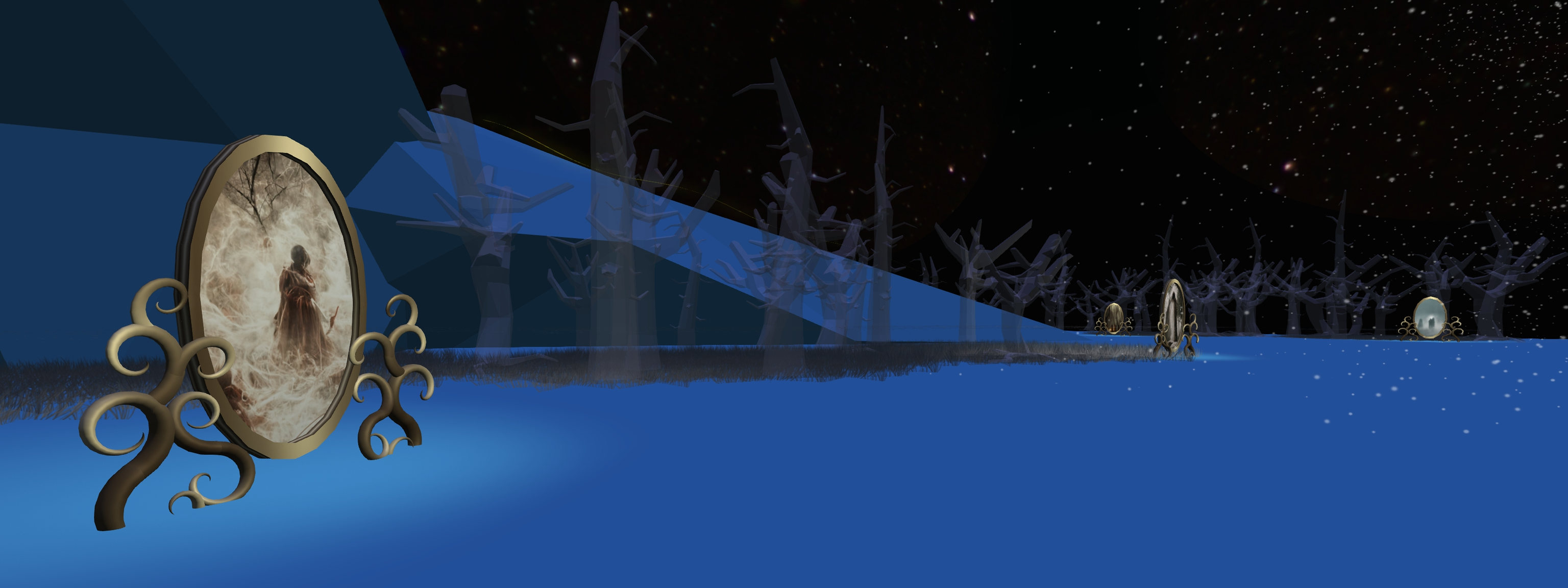
Within Ghosts of Traditions Past, Chuck takes his audience on a 12-chapter tour of Christmas, a walk through a snowbound landscape to view 12 individual images representative of the traditions we now associate with Christmas and their likely origins, each told through local chat as one approaches each of the images.

Starting with Saturnalia (which itself started as a single day of festivities before expanding to around 7-8 days commencing some 14 days before the end of the 29-day Julian month of December (all of which helped to formulate the notion of the “12 days of Christmas”), these chapters take us through many of the pagan rites and observances which have been either absorbed into the Christian observance of the birth of Christ either directly or through their prior acquisition by Saturnalia.

UASL: Chuck Clip – Ghosts of Traditions Past

Thus, following them in what amounts to a clockwise direction from the entry point (a tunnel leading into the landscape at its 6 o’clock position), the images run in an arc from the left, each one offering the story of a given Christmas tradition – the symbolism of the Christmas wreath, the pagan meaning of holly berries, the meaning of the yule log – even the significance of mistletoe in both pagan and Roman times.

The first 10 of the pieces are located to the snowy plain, backed by ghostly trees, with the final two on the rocky slope leading up to a Christmas tree sitting within Stonehenge, where visitors can obtain a special gift for the season from Chuck. And if you think that Stonehenge is somewhat out-of-place within this Christmas setting, being today more associated with summer solstice celebrations, you’d not be entirely correct.

Recent research (2017-2021) by a consortium led by the University of Bradford and the  Ludwig Boltzmann Institute for Archaeological Prospection and Virtual Archaeology, and involving the universities of Birmingham, St Andrews, Warwick, University of Wales Trinity Saint David, has revealed that Stonehenge sits within one of the largest prehistoric sites in the UK, a ring of 10m wide, 5m deep “shafts” encircling it, the Durrington Walls and Woodhenge. Dating back over 2,500, this ring of shafts  2km across, lends considerable weight to the idea that in Neolithic times, Stonehenge was the centre of extended winter solstice celebrations.

UASL: Chuck Clip – Ghosts of Traditions Past

In much the same way, I’d hazard a guess that the use of ghostly trees surrounding the installation sit as a reflection of the tree and The Green Man as a symbol of rebirth and renewal – themes also closely associated with Christ, but which hold their origins to multiple pre-Christian religions. The Green Man (is that him or the face of God looking down on the setting from above?) also sits as a reminder that, even in the midst of its attempts to stamp its authority on the “old ways”, Christianity fell subject to pagan motifs; many are the churches and cathedrals to be found with the face of the Gren Man carved over their entrances or within their halls.

In viewing Ghosts of Tradition Past, I’m reminded of an observation by W. Somerset Maugham: Tradition is a guide and not a jailer. With this exhibition, Chuck cleverly uses the strictures of Christian seasonal tradition to guide visitors to an understanding of the festivals, beliefs and symbols which are both enfolded within that tradition and yet pre-dates it.

SLurl Details

2022 week #50: CCUG and TPVD meetings summary

Power up for Charge, October 2022 – blog post
The following notes were taken from:
  • My audio recording and chat log transcript of the Content Creation User Group (CCUG) meeting held on Thursday, December 15th 2022 at 13:00 SLT.
  • My chat log transcript and video recording by Pantera Północy of the Third-Party Developer Meeting (TPVD) held on Friday, December 16th, 2022 at 13:00 SLT. My thanks to her for the video (embedded towards the end of this article).
These meetings are chaired by Vir Linden, and their dates and times can be obtained from the SL Public Calendar; also note that the following is a summary of the key topics discussed in the meetings and is not intended to be a full transcript of either meeting.

Official Viewers Status

[Video: 1:44-2:13]

Available Viewers

  • On Friday, December 16th, Linden Lab issued the Maintenance (Q)uality RC viewer, version 6.6.9.577220, with several new features and various fixes.
  • On Wednesday, December 14th, the Love Me Render (LMR) 6 graphics improvements project viewer updated to version 7.0.0.577157.
The rest of the current crop of official viewers is as follows:
  • Release viewer: Maintenance P (Preferences, Position and Paste) RC viewer version 6.6.8.576863 Monday, December 12 – NEW.
  • Release channel cohorts:
    • Performance Floater / Auto-FPS RC viewer, version 6.6.8.576737, November 28.
    • VS  2022 RC viewer, version 6.6.8.576310, issued November 4 – utilises Visual Studio 2022 in the Windows build tool chain.
  • Project viewers:
    • Puppetry project viewer, version 6.6.8.576972, December 8.
    • PBR Materials project viewer, version 7.0.0.576966, December 3.
      • This viewer will only function on the following Aditi (beta grid) regions: Materials1; Materials Adult and Rumpus Room 1 through 4.

CCUG Specific

glTF Materials and Reflection Probes

Project Summary
  • To provide support for PBR materials using the core glTF 2.0 specification Section 3.9 and using mikkTSpace tangents, including the ability to have PBR Materials assets which can be applied to surfaces and also traded / sold.
  • To provide support for reflection probes and cubemap reflections.
  • The overall goal is to provide as much support for the glTF 2.0 specification as possible.
  • The project viewer is available via the Alternate Viewers page, but will only work on the following regions on Aditi (the Beta grid):  Materials1; Materials Adult and Rumpus Room 1 through 4.
Status
  • Please also see previous CCUG meeting summaries for further background on this project.
  • The focus remains on bug and regression issue fixing within the viewer and quality of life improvements.
  • There has been a discussion on revising the workflow for setting reflection probes & in providing a debug setting to make things easier to see when manipulating reflection probes.
    • This has been prompted be those testing the PBR viewer setting-up their own reflection probes incorrectly (e.g. by making the probe sphere / cube shiny prior to converting it to a reflection probe – which should NOT be done), failing to achieved the anticipated results and then filing bug reports.
    • It is possible that some of the required workflow could be factored into the UI itself to off a more intuitive sense as to how reflection probes are supposed to work.
    • An alternative to this might be to introduce a new “reflection probe” prim type, which includes all the core parameters – however the additional work and messaging required to achieve this would lead to a further lengthening of the project’s development time.
    • Tutorials to help people get to grips with reflection probes (and, I presume, PBR as a whole are “in the works”).
  • Screen Space Reflections (SSR): Geenz Linden is working on this within the PBR viewer. Whilst a checkbox for SSR has been added to the viewer, there is further work to be done on the integration and rendering sides (e.g. getting SSR to work on water & transparent surfaces).
  • Hardware profiling / optimising the viewer is still on-going (although it is likely that whatever is done, SSR will result in a noticeable performance hit if enabled).
  • [TPV Video: 9:11-10:44] The decision has yet to be made on whether or not to axe the forward rendering (i.e. non-ALM) path from the viewer.
    • This decision is awaiting more information on hardware performance on lower-spec systems using the updated deferred rendering (i.e. ALM) rendering path.
    •  It is known that Mac rendering performance on the PBR viewer is particularly bad, which may be down to a configuration issue.

In Brief

  • Mirrors (in some capacity) are described as the “very next thing” the graphics team will commence work on after the PBR / reflection probes work gets to RC status (as Vir Linden pointed out, Mirrors currently require more reflection on how they are to be implemented!).
  • The meeting in places broadened into general discussion on content breakage (and the need, where possible, to maintain the functionality of content users have purchased in expectation of its longevity; the benefits / disadvantages with morph bones versus blend shapes for customising the avatar shape (and the possible routes to an “avatar 2.0”), the need for a better animation system (or even an actual animation system), etc.
    • Much of this was more esoteric in nature at this point in time, although the likes of Puppetry is laying the foundations for broader animation work; as does the glTF 2.0 specification, which is the baseline specification for the PBR / reflections probe work, and will be expanded upon in future projects  – such as with mesh uploads.
    • In terms of animation systems, some of the groundwork is already in place inasmuch as SL already effectively treats morph bones and animated bones as individual animation tracks, offering to potential for this to ne “unwrapped” and moved to a glTF approach to animation management.
  • Some of the above conversation touched on the ideas of market renewal / fragmentation. For example: the introduction of reflection probes offers a degree of market renewal for creators of buildings, skyboxes, etc., through the provisioning of new builds (or new versions of existing builds) leveraging the capability; however, the adoption of an upload schema for fully customised avatar skeletons might lead to greater market fragmentation (how do you ensure, for example, that human animation/pose A will work equally on custom human (style) avatar skeletons W, X, Y and Z, or will they each require custom animations?).

TPVD Meeting Specific

Inventory Thumbnails

[Video: 2:25-7:08]
  • A new project (commencing in 2023) to add thumbnail previews to inventory, allowing users to see a small image of a given object within inventory (thumbnails can be individual items or, if preferred an entire folder).
  • The first phase of the work is determining how to generate the thumbnail images in the first place on a manual or (preferably) automated basis, and then ensure it maintains an association with the object to which it is related (e.g. so if an item is sold or transferred to another user, the thumbnail goes with it).
  • Once this has been decided, the next phase will be to build-out the UI so that such thumbnails can be viewed from inventory
  • It is likely that thumbnails will have a fixed / limited size resolution, and will not be subject to any upload fee.
  • This work:
    • Is not an adjunct (or related) to the Outfit previews currently available in the viewer.
    • Will not prevent creators from including high resolution images with their products if they wish.
    • Will only apply to inventory objects where it makes sense (e.g. textures and notecards would likely be excluded).
    • Is seen as a possible foundational piece to adding new fields to the inventory database, which could open the door to further information fields being added to inventory in the future,

Github Move “Phase 2”

[Video: 7:12-8:18]
  • Following the switch-over to using Github for viewer code repositories on Monday, November 21st, 2022, work is now progressing on “Phase 2”.
  • This is remaining TeamCity operations with Github Actions for viewer builds (so those pulling an official viewer repo will be able to build it directly).
  • This work will also incorporate the rebuilding of those third-party libraries involved in the viewer build process, as and where required.

In Brief

  • [Video 16:10-18:41] LL has been digging into viewer crash rates by operating system, with the note that the number of crashes on the Mac OS appears to be disproportionately high. It is hoped that if the underlying causes can be readily identified, these issues can be subjected to rapid fixing. It was not clear at the meeting if those TPVs supporting OS X are seeing a similar elevated crash rate.
  • [Video 20:40-21:35] It is estimated that the split between viewer operating systems for the official viewer  is roughly:
    • 1-2% Linux (although this does not include running the Windows viewer under emulation on Linux).
    • 6% Mac.
    • The rest: Windows.
    • Firestorm appears to mirror the above.
    • [Video: 35:08-36:10] It is possible the the work on the viewer library refresh will allow LL to look again at the issue of providing a Linux viewer build.
  • The meeting has a general discussion on operating systems, & variants (64-bit vs. 32-bit), etc, and the lack of an official Linux build,
  • A reminder that Microsoft ceases official support for Windows 8 on January 10th, 2023. This means that from that date, Windows 8 will no longer be officially supported by Second Life as a viewer operating system, and LL will not guarantee the viewer will run as expected on Win 8 going forward from that date.

Linden Lab Holiday Closure

A reminder that Linden Lab will be effectively closed (outside of Support cover) from end of business (PST) on Friday, December 23rd, 2022 through until start of business (PST) on Monday, January 2nd, 2023.

Next Meetings

  • CCUG: Thursday, January 12th, 2023.
  • TPVD: Friday, January 20th, 2023.