Linden Lab has launched a new feedback form, inviting platform users to offer up constructive suggestions on how the Second Life experience might be improved.
The blog post announcing the new form reads in full:
What’s the one thing Linden Lab could do that would have the biggest impact on further improving your Second Life experience?
Many Second Life users have thoughts on this – from different approaches for the way things are done today, to brand new features that could dramatically improve their experiences, to seemingly small things that could have a big impact. Today, we’re launching an easier way to share your ideas with us, a new “Feedback & Suggestions” page on SecondLife.com. You can also find this page by going to Help and finding New Feature Suggestions in the drop down.
Just sign-in with your Second Life account, select the topic or category that’s most appropriate, and describe your suggestion in the text box. Once you submit, you’ll see a confirmation page and receive an automated email as well. We won’t be able to reply individually to each suggestion, but every idea will be routed to the appropriate Lindens and each one will be reviewed and considered.
We’ll of course continue to be on the lookout for ideas as they continue to surface in social media, direct conversations, or via JIRA, but this new page should make it easier than ever for any Second Life Resident to share suggestions directly with us.
The new form is easily accessible via your Second Life web dashboard
Covering a range of topic categories, including the likes of avatars, communications, content creation, groups, inventory, commerce, land, mesh, navigation, performance, scripting, teleports, tools, user interface, viewer, and the all-important “other/unknown”, the new form is simple to complete, and can be accessed directly from your Second Life dashboard and the support portal.
As the form notes, it is not intended for support requests, bug reports, and other inquiries; these should continue to be directed through the Second Life Support Portal and the JIRA.
Also, please do remember that suggestions are being sought – not statements. So, for example, a demand for reducing tier isn’t going to gain much traction. But if you actually have a considered plan for how tier might be lowered in such a way as to not damage the Lab’s ability to generate the revenue it needs to continue operating (and have some good figures to support your case) – now is the time to drop them into the form and let them take a look.
The suggestions form can also be accessed from the SL support portal via the link in the lower right corner of the portal web page
Obviously, not every suggestion will be acted upon; but this is still nevertheless a good move by the Lab.
Up until now, the most direct route of putting an idea to the Lab has been via a “feature request” submission through the SL JIRA. However, the JIRA has been something a lot of users have preferred to steer clear of, seeing it as confusing and / or intimidating when trying to complete a report. Therefore, the offering of a simple, clean form for people to use is to be welcomed, and kudos given to the Lab for offering it.
Update, March 21st: AMD have release a new set of Catalyst™ drivers, version 15.3 beta, which include a potential fix for the rigged mesh issues – see my notes here.
Update, February 28th: Singularity have issued a supplemental update to address mesh rendering issues.
Update, December 13th: Yoho Waco offers a work-around for this problem – see his comment following his article. As an Nvidia user, I cannot test the workaround myself, but feedback indicates it works. I’ve also added Yoho’s workaround with additional information as an article in its own right.
Update: I have been informed (see the comment following this piece from JC de Bes, that this issue also extends to the most recent Omega drivers release.
Whirly Fizzle dropped me a line concerning the latest AMD Catalyst™ drivers update, 14.12, which is apparently being pushed out by AMD via automatic update.
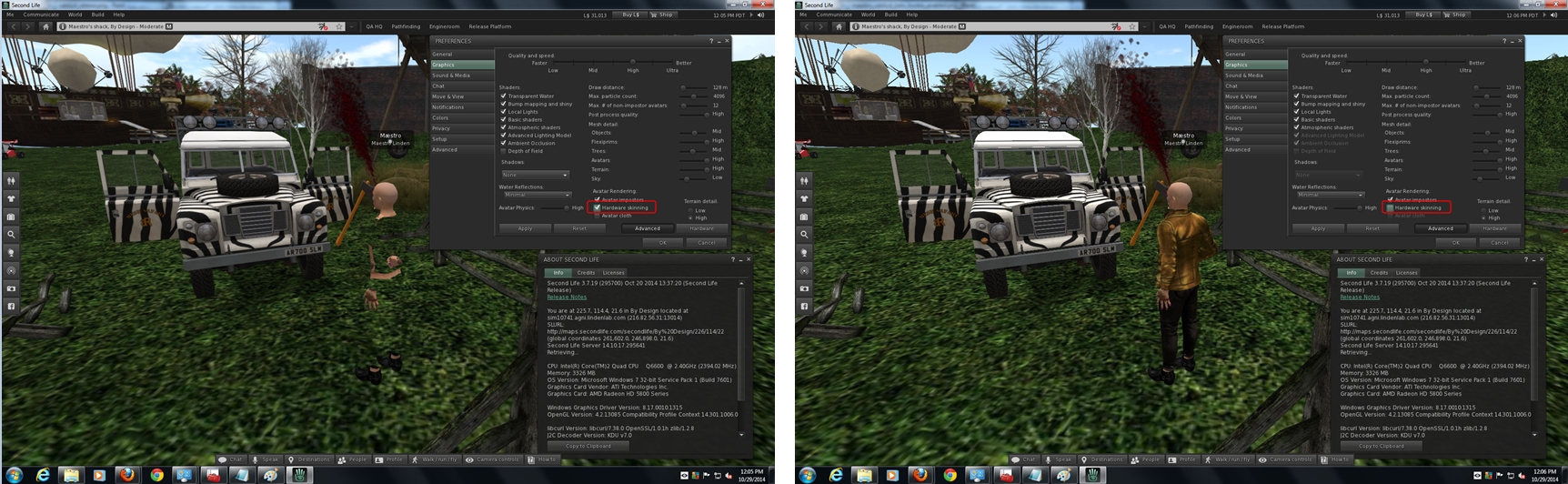
As those on systems using AMD graphics cards are likely to be aware, there have been ongoing issues with the Catalyst drivers which have impacted Second Life, notably with regards to rigged meshes which, since the deployment of the 14.9.2 drivers by AMD, cause rigged mesh to be invisible unless hardware skinning is disabled (see BUG-7653).
The 14.12 Catalyst™ drivers currently being deployed by AMD do not address this issue; worse, as it is being pushed via automatic update from AMD, it may see an increase in issues being experienced for anyone using an AMD GPU, regardless of the viewer they are using, and even if they have recently rolled back to an earlier version of the driver.
The latest AMD Catalyst™ 14.12 drivers currently being deployed via automatic update continue the issue of rigged meshes being invisible with Hardware skinning enabled (l), but visible with it is disabled. Image courtesy of Maestro Linden
The two ways of dealing with the problem / avoiding it, are to:
Either turn off hardware skinning off in the viewer (Preferences > Graphics > uncheck Hardware skinning), which is hardly ideal, or
Roll back to pre-14.9.2 Catalyst drivers via the AMD download site. Those affected should consider using (at the latest in terms of release numbers) version 14.9.1 – but be aware this driver has issues of its own (see BUG-7947 and BUG-7627). Therefore, the 14.4 drivers might be a better option.
Uninstalling the current AMD video drivers may be warranted prior to installing older drivers, and there is a request within the JIRA report linked-to above that those affected by the issue also raise a bug report directly with AMD to help bring this matter more to their attention.
Samsung’s Gear VR: now available in the US & pre-orders being taken in the UK
Can’t wait for the Oculus Rift consumer edition to arrive? Got a Samsung Galaxy Note 4 phablet (or thinking of upgrading your existing contract to a Note 4?) Then you can get into the VR revolution wirelessly, if still pretty much on a “beta” basis.
The Gear VR headset, featuring Oculus technology, is now available in the US for around $200.00. The headset can be ordered from the likes of AT&T and direct from Samsung US, which both price the headset at $199.00 – although a game controller is a purchasable extra (Samsung offer 30% off the price of their gamepad if purchased with the headset)
Offering a wireless, portable VR experience, the Gear VR headset requires the Samsung Galaxy note 4 phablet
Within the UK, advance order of the Gear VR headset are currently being offered by the likes of Expansys for £159.99 sans controller but inclusive of VAT. Handtec are offering the headset at £185.99 inclusive of VAT, or £239.99 (inc VAT) for the headgear and a controller. Handtec are also supplying a 16Gb micro SD card for the Note 4 along with both versions of the headset. This contains a collection of immersive trailers and film tie-ins, and a Cirque du Soleil 360-degree immersive experience, all of which are separately available through the Oculus Share store.
Samsung are offering 30% off the price of their game controller (which works with most of their smartphones) t US purchasers of the Gear VR headset – although the company also admits, a game controller isn’t the best way to partake of an interactive VR experience…
The Samsung Gear VR Innovator’s Edition headset combines the Note 4’s Super AMOLED 2560×1440 and software (remembering that the Note 4 is not included in the Gear VR’s retail price) with the Oculus Rift’s optics, head tracking and dedicated controls – you can see the full specs on the Samsung global site.
According to The Verge, the tracking controller is from the Oculus DK1. Also, note that although the finish product is more polished than the Oculus DK offerings, “innovator” in the name should be taken as indicative that it is still a “beta” unit.
This is something the company itself is emphasising, with Samsung virtual reality VP Nick DiCarlo carefully defining the marketing approach to this release of the Gear VR, “We’re very carefully trying to avoid overhyping this, but we think it’s going to be amazing.” DiCarlo also notes that while company’s game controller is being offered at a discount when ordered with the headset, game controllers are perhaps not the ideal companion for immersive VR experiences.
That Handtec are also offering offerings from the Oculus store helps to underline the fact that the Gear will work with content that is already available. In this regard as well, Titans of Space, already hugely popular with DK1 and DK2 users, is pointedly listed as being available for the Gear VR, as is cyberpunk hacking game Darknet. Oculus Mobile themselves are keen to point-out that they are working on both sides of the net with products suitable for both mobile options and for desktop / laptop options.
Titans of Space: an Oculus / Gear VR experience which allows users to experience the majesty of the solar system
Samsung is also promoting a new VR service alongside the headset – although this still, at the time of writing, has yet to be rolled-out. It’s called Milk VR, which the company defines as:
The company’s first virtual reality content service. Milk VR will deliver new and immersive 360° videos five days a week, with channels in music, sports, action and storytelling. The service also tracks what is trending across the VR landscape, to help viewers find the best VR content.
Samsung’s belief is that by making VR a mobile experience, they stand to help it gain more widespread acceptance as an entertainment medium – hence the Milk VR offering. “If VR is only ever for gaming, it’s going to be a great and successful business,” DiCarlo told The Verge in another interview. “But part of what we’re hoping to do is really have VR evolve over time towards a mainstream thing that people do in a lot of different cases.”
This is perhaps also reflected in the company’s recent launch of Project Beyond, a 3D, 360-degree camera rig designed to capture videos and stream them on the Gear VR.
However, not everyone is convinced that releasing the Gear VR now is necessarily a good move. At the end of November, having tried a pre-release version of the headset, TechRadar noted:
Where the Oculus Rift is tethered and feels like a “grown up” version of virtual reality, the Gear VR feels more accessible as a mainstream product. But this December may be too soon for Gear VR to hit the market. Sure, it’s targeted at early adopters and developers but making it widely available doesn’t seem to be the right move. Given more time to improve latency and allow more content to flow in, it could very well be a hit.
It might also be argued that while both Project Beyond and Milk VR are interesting concepts, they perhaps also demonstrate a lack of imagination, regulating VR to what James Cameron recently critiqued as little more than “stand and watch” (although it has to be said Milk VR could easily offer more in the way of involvement and interaction, depending upon the content curated through it). Nevertheless, by making VR more accessible and less reliant on slaving yourself to a computer, Samsung is more on the right track in making VR a more accessible medium with full freedom of use.
Nor are they entirely alone – Carl Zeiss recently launched their $99 (£79 / 99 Euro) Zeiss VR One, which is intended to work with a range of mobile ‘phones, starting with the Galaxy S5 and iPhone 6 (in a novel move, users are being asked to vote on which other ‘phone should be supported by the headset in the future). The headset is tied to an app supplied by the company, which may limit initial offerings, but Zeiss are also offering developers wanting to work with the Zeiss VR One access to their open source Unity3D SDK so that games and other offerings can be more easily developed.
Zeiss VR One – yours for $99.00 (£78.00 / 99 Euros)
While mobile headsets may well be the means by which VR could achieve deeper market penetration than being constantly slaved to a computer, they will require fair amount of maturing. The Gear VR Innovator Edition, for example, despite having a higher image resolution capability, thanks to the Galaxy Note’s screen, actually delivers pretty much the same per-eye experience as the Oculus DK2, so on-screen text can still appear blurred and hard to read.
Nevertheless, it will be interesting to see where this all leads, and what else might pop-up in the mobile sector of the new VR market ahead of the Oculus Rift eventually making its appearance. And on that point, please don’t see the arrival of the Gear VR as indicative that the Oculus Rift is now “just around the corner”; Brendan Iribe seems to have been pretty clear on that subject recently, and the emphasis at Oculus VR is still on getting it “right”, rather than getting it “out”.
All images of the Gear VR and the Milk VR logo courtesy of Samsung; image of the Zeiss VR One, courtesy of Carl Zeiss AG; image from Titans of Space courtesy of Drash VR LLC.
Update: Friday, December 5th, 2014: this Benchmark RC has now bee promoted to the the de facto release viewer.
On November 10th, the Lab promoted their benchmark viewer code to release status (viewer version 3.7.19.296094. This viewer removes the need for a manually-maintained list of GPUs (the GPU table) in order to identify the graphics system your computer is using, replacing it with a series of quick tests which are used to test the graphics system and set suitable initial defaults for the viewer (which only happens if you have no graphics settings already recorded for your viewer).
Despite extensive testing whilst a release candidate viewer, the promotion of this particular viewer to the de facto release viewer resulted in some people experiencing issues with the viewer immediately crashing on start-up due to a VFS failure – see this forum thread and BUG-7776, BUG-7783).
The problem didn’t affect everyone using the viewer, but for those who did, the usual fixes for VFS failures didn’t appear to work.
Since that time, there has been a further release viewer update – version 3.7.20.296724 (December 1st, formerly the Snowstorm contributions RC).
However, if you have resisted updating the viewer due the crash issue, or if you are still encountering the VFS crash issue, the Lab has released a new Benchmark RC viewer, version 3.7.22.297128 .
This release should address the start-up issue, and the Lab has requested anyone who may still be having problems install it, try it, and provide feedback via BUG-7783.
Marketing Second Life is something we all have an opinion about, and as such, Linden Lab has often taken a far amount of flak from users on the subject. I’m as guilty as anyone in this; in the past I’ve been particularly verbose on the subject through posts in this blog such as Business, Collaboration and Creative Growth, Tell me a story: marketing Second Life, and Advertising SL: the machinima effect (the latter of which has been somewhat overtaken by the Lab recognising the power of Draxtor Despres’ The Drax Files; World Makers series.
However, there is another potential marketing strategy the Lab is missing, something which was recently brought home by by a segment of The Drax Files Radio Hour.
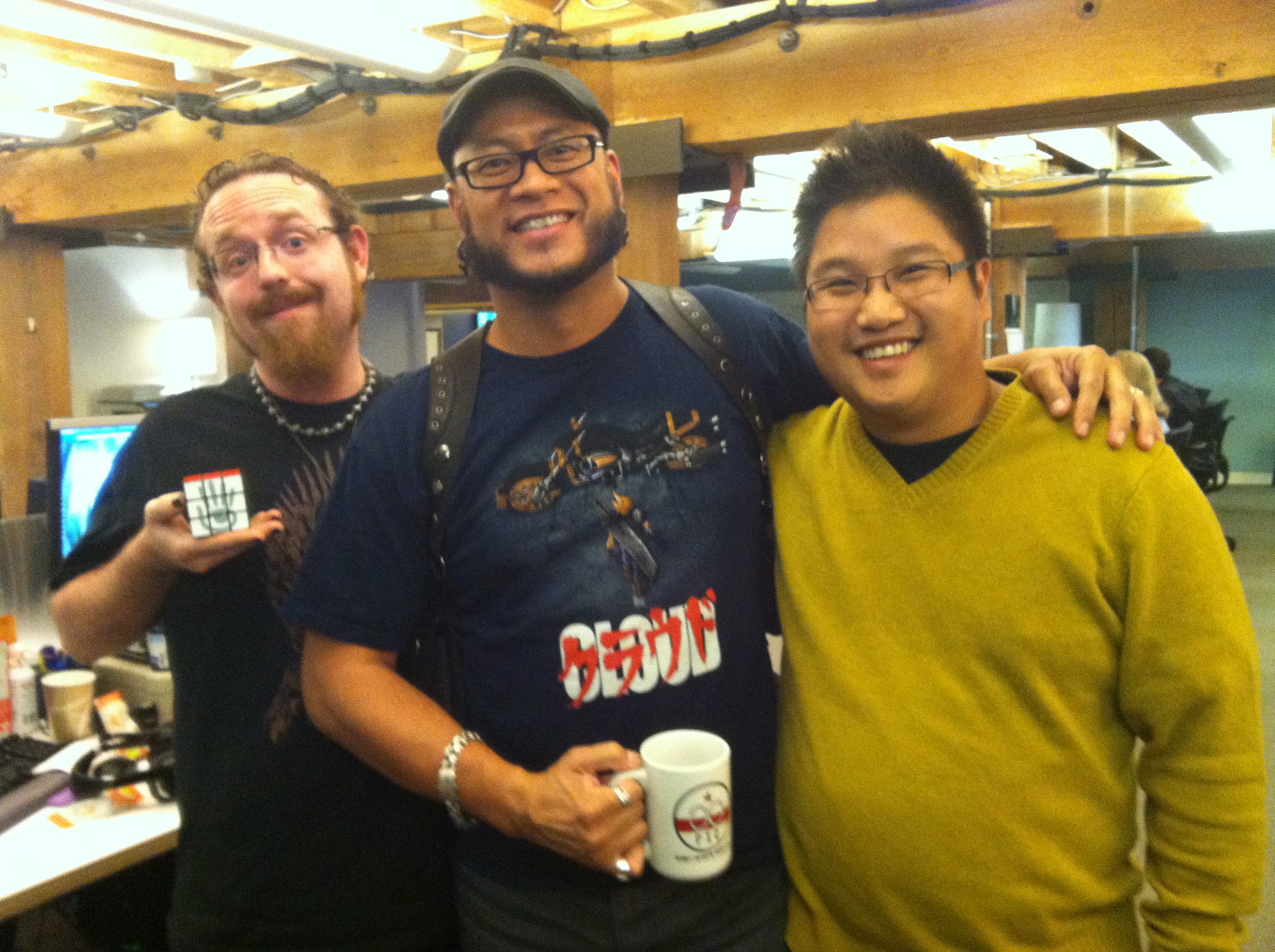
During a visit to the Lab’s HQ for the show, Drax had a chat with Shaman and Kona Linden, both of whom were holding items of merchandise available to Lab staff – a Rubik’s cube featuring the Second Life logo on one face, and a FIC (Fêted Inner Circle) mug. Lab personnel have also seen out and about wearing a certain t-shirt proclaiming their leading role in provisioning virtual worlds.
Shaman Linden holds a Rubik’s cube with the Second Life logo and Kona Linden, with an arm around Caleb Linden, holds a FIC mug (image: Draxtor Despres)
Other items were mentioned as being available, leaving Drax to wonder why the Lab doesn’t market these goods to users; and he has a point. True, there are issues of the Lab’s international user base and the cost of postage – but these are things that can be factored-in, and if the Lab doesn’t necessarily want to handle the additional weight of merchandise orders, etc., itself, there are companies who will do it for them for a small commission on sales.
Certainly, the appearance of the merchandise has sparked discussions in a number of areas since the show. Ciaran Laval, for example started a thread over on SLU (although admittedly, it got somewhat sidetracked into a discussion of the meaning behind a particular term, which eventually involved Kevin Bacon – who said the six degrees of separation was dead?); others elsewhere have expressed an interest in having at least some of the merchandise, and other items that have been seen in the past.
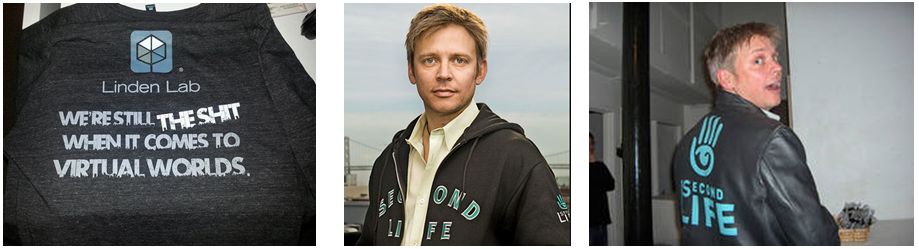
The Lab’s current t-shirt (l), and two styles of jacket / track suit top worn in the past by Philip Rosedale – all have been the subject of “want” attention from SL users
Take the jackets that were variously sported by former CEO (and co-founder of the Lab) Philip Rosedale; these were oft been admired and a subject of attention at the likes of the old SLCC events; so why not make them available?
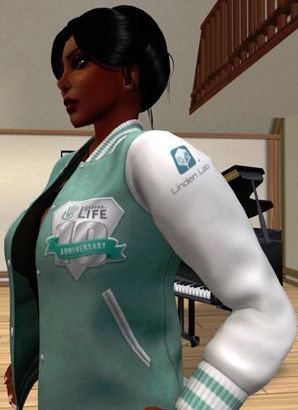
And how about an updated version of the 10th anniversary varsity-style jacket the Lab made available in-world in 2013? Replace the 10th anniversary logo with the SL logo, and it might well be something users would buy if offered in the physical world. I know I wouldn’t object to having the opportunity to buy one, although admittedly, that might be something a tad too expensive to produce and sell…
If I understand things correctly, there’s even a JIRA-related t-shirt, something which would likely prove popular within the coding community;
The in-world 10th anniversary varsity-style jacket: an updated version might have potential in the physical world
Some items made available in the past, such as a pendant, and Ciaran makes mention of Jack Linden once offering those at his office hours meetings a “bag of swag” (although where this was physical world items or not is unclear to me – I didn’t attend Jack’s meetings – but Ciaran seems to lean towards this being the case). Were they to appear again, they might prove popular enough to make it worthwhile.
The advantage to the Lab in making these items available for users is not just a potential (albeit modest) revenue stream through the sale of the goods – it’s the broader reach of marketing and promotion they offer. Of course, some might thumb their nose on seeing someone else wearing a Second Life jacket, but that’s no reason not to offer them; and a FIC mug in the office is a way to start conversations (and depending on the nature of the office politics, might end up being something everyone wants, regardless of whether they are SL users or not! 🙂 ).
So how about it Ebbe? Why not give thought to making merchandise available to your users? Even if you only dip a toe or two into the water to see how things go, it might prove worth your while.
The US Army’s Military Open Simulator Enterprise Strategy (MOSES) and AvaCon have announced the first Federal Consortium of Virtual Worlds (FCVW) workshop, which will take place in a specially built virtual conference centre on Friday, March 6th and Saturday March 7th, 2015.
The workshop will be an active experience, with on-line exhibits and presentations provided in an interactive manner. Workshop participants are encouraged to engage and interact with the presenters, and the exhibits will range from cultural training material in a mock village to scientific ethical dilemmas in a city landscape.
Virtual world technology has matured significantly and rapidly over the past eight years to the point where hundreds of people are able to simultaneously participate in an on-line event. The workshop is open to military and civilian personnel, including the public. The conference will be held entirely within an Open Simulator virtual environment, and reservations will be free for attendees.
The workshop will be a multi-track event, featuring keynote speakers and break-out sessions, and the FCVW and conference organisers are inviting proposals to be a speaker, presenter, or performer in one of the following tracks:
The Alternative User Interfaces track
The Metacognition
Military Applications track
Security, Privacy and Identity track
In addition, the Knowledge Transfer track seeks public sector participants for a panel entitled Public Service Education in Virtual Worlds: Past, Present, and Future, which will discuss public service education uses for virtual world learning simulations as well as will feature panelists’ views on public service virtual world education projects from the past, present, and future. Participants in this discussion will be able to showcase relevant Open Simulator virtual world learning simulations via OAR and IAR uploads to be coordinated with the workshop organisers.
Full details on the above tracks, including information on areas of interest applicable to each of them, can be found in the workshop Call for Proposals page of the official website. Proposals must be received by the organisers by Monday, January 5th, 2015.
About the FCVW
The Federal Consortium for Virtual Worlds (FCVW) supports individuals and organisations from government (federal, state, local, and international), academia, and corporate sesectors to improve government collaboration through the use of virtual worlds, enrich collaborative online experiences, explore technologies that may enhance telework, and foster cross-agency collaboration.
About MOSES
The Military Open Simulator Enterprise Strategy (MOSES) is operated by the operated by the US Army’s Simulation & Training Technology Center (STTC), a part of the U.S. Army Research Laboratory, Human Research and Engineering Directorate. It is a coalition of military, industry, and academic partners who share a common interest in the advancement of virtual world technology for simulation based training and education. The MOSES Project seeks to address issues surrounding current game based virtual environment training systems in the two key areas of scalability and flexibility, and create a practical and deployable virtual simulation-based training system capable of providing a learner with a means to test skills in an accreditable manner. http://militarymetaverse.org/
About Avacon
AvaCon, Inc. is a 501(c)(3) non-profit organisation dedicated to promoting the growth, enhancement, and development of the metaverse, virtual worlds, augmented reality, and 3D immersive and virtual spaces. We hold conventions and meetings to promote educational and scientific inquiry into these spaces, and to support organized fan activities, including performances, lectures, art, music, machinima, and much more. Our primary goal is to connect and support the diverse communities and practitioners involved in co-creating and using virtual worlds, and to educate the public and our constituents about the emerging ecosystem of technologies broadly known as the metaverse.
 Linden Lab has launched a new feedback form, inviting platform users to offer up constructive suggestions on how the Second Life experience might be improved.




 Inara Pey: Living in a Modemworld