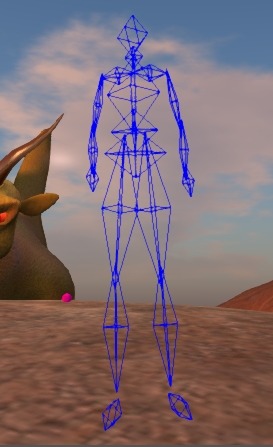
Andrew Linden departing the Lab

Andrew Linden: Departing the Lab

He’s been one of the longest-serving members of the Lab’s team, and actually out-lasted Philip Rosedale for time put in with the company, but after more than eleven years with Linden Lab, Andrew Linden is saying “farewell”.

He broke the news during his regular appearance at the Tuesday Simulator User Group meeting on December 17th, saying, “This is going to be my last User Group meeting as a Linden: I’ve decided to leave LL and pursue other things. I’ve really enjoyed these User Group meetings, which is why I’ve been showing up all these years.”

He confirmed that he will be joining Rosedale at the latter’s latest venture, High Fidelity, saying, “”I’m going to join Philip and his new project. Not because I don’t love SL or am not excited about what LL is working on, but because I’m ready for a change, and I really like working with Philip.”

Andrew’s final day with the Lab will be on Thursday December 19th, after which he’ll be off to join the High Fidelity team.

As a long-serving member of the Lab’s staff, he will be sorely missed. Over the years he’s been exceptionally popular among residents, and he has worked on many of the Lab’s server-side and other projects. Most recently, he has been instrumental in overhauling the platform’s interest list, massively improving the way in which in-world scenes and managed and loaded between the servers and the viewer, and which has also seen an overhaul of the viewer’s object caching capabilities (which are currently available through a release candidate viewer), all of which has significantly improved scene loading and rendering. This work was recently featured in a video narrated by Torley Linden.


The video demonstrating the interest list work: the last large-scale undertaking Andrew worked on

Also of late, Andrew has worked on a number of anti-griefing measures within the platform, and has currently project has involved LSL updates to enable the uniform scaling of objects and linksets (such as uniformly increasing or decreasing a linksets size by a factor of 2). This work should be appearing in an RC release in the New Year.
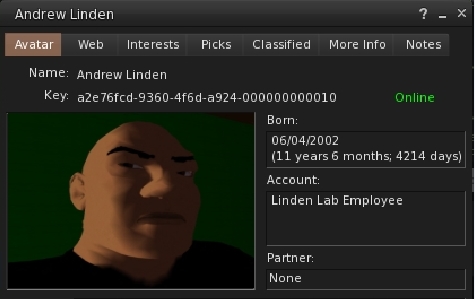
Andrew's profile: testimony to his time at the Lab
Andrew’s profile: testimony to his time at the Lab

In the time I’ve been attending the Simulator User Group meeting (formerly the Server/Sim/Scripting group), Andrew has always been polite, inquisitive and helpful to all, and demonstrated a willingness to readily delve into issues and see what he can find and / or put right. In response to the direct enquiries I’ve put to him in the past, he’s always been more than helpful in his replies, willing to provide concise explanations and offer additional information and guidance.

The news of his departure was met with a mix of sadness and best wishes from those at the meeting. For my part, I’d like to again extend my thanks to Andrew for his input to, and work on Second Life over the years, for his support of the Simulator User Group and to wish him all the best for the future.

Drax Files Radio Hour launches in January

radio-hourJanuary 2014 will see the launch of The Drax Files Radio Hour, a new weekly radio / podcast to be hosted by Draxtor Despres and Jo Yardley.

Tooting my horn a little, I’ve actually known about the series for a while. It’s pretty fair to say that the seed of the idea was likely planted during one of the many back-and-forth discussions Drax and I had and have about each segment of The Drax Files (he prodded me a number of times to do a podcast with him. While I passed at the time, I may still contribute to the show if there is interest from Drax and Jo in having me do so).

Balanced discussion of Second Life tends to be in short supply nowadays. While Metareality has returned, I have to say that I’d personally found that show to be increasingly biased (and at times under-informed) prior to if going off-air over summer, which is a pity. Hopefully, The Drax Files Radio Hour will be able to shine a light on the good, the bad, the strange and the wonderful within Second Life and virtual worlds as a whole and provide good, informed discussion across all.

The show is set to be broadcast “without permission somewhere from an attic in 1920s Berlin”, and will feature discussions, guests, visits to regions in-world, looks at emerging technology, and so on. I’m laying odds that two hot topics on the tech side which will be featuring are the Oculus Rift and Leap Motion, particularly given both Jo and Drax have an interest in each, and both are set to be coming to Second Life in 2014 :).

If you want to stay abreast of plans, there is a Facebook page for the show, but no website (as yet – I might prod Drax on that as well on behalf of all of us Facebook avoiders :)).

The first broadcast for the show is currently scheduled for Thursday, January 10th, 2014. I’ll be following things here, and will hopefully be able to help people keep up-to-date on things as the show develops and we move closer to the premiere. In the meantime, make a note in your diary!

LL give further clarification on tax requirements via e-mail

secondlifeOn November 21st, I posted an article about LL requesting tax information from some customers. Specifically, people had started receiving e-mails from the Lab asking them to complete IRS form W9, Request for Taxpayer Information, which caused some concern and confusion.

As a result, on Tuesday 19th November, Linden Lab moved to try to clarify matters, issuing a blog post entitled Required Tax Documentation. This indicated that the Lab is required by the US Internal Revenue Service (IRS) to collect and retain either Form W-9 (for US citizens) or Form W-8BEN (for non-US citizens) “at certain transaction volumes”. The blog post also noted that  those falling under the criteria who fail to submit a completed W-9 or W-8BEN  risk having 28% of their gross amounts received withheld. Finally, the post indicated that the Lab is required to file Form 1099-K with the IRS for US residents “with 200 or more transactions with a total amount in excess of $20,000” in a calendar year.

While this went some way towards clarifying the situation, it still left a number of questions and concerns unanswered; one of these being what exactly constitutes a “transaction”, as I noted at the time:

Is it related solely to cashing-out from Second Life, or is it based on the number of user-to-user transaction through the LindeX (i.e. the number of L$ sales a person makes per amount of L$ they offer on the LindeX? Or is it somewhere in between?

Long-term SL user and LL customer Desmond Shang decided to try to seek further information and answers from the Lab. As a result, he’s posted a couple of useful pieces on the SL Universe thread where some of the discussion on the matter has been taking place.

In the first, he recommends that anyone with specific questions / concerns should contact Linden Billing, noting that they have been reasonably responsive. He also points-out that while circumstances will vary from individual to individual, depending upon a range of factors, those who might be regarded as a “hobbyist” in SL might be able to claim some relief on revenue they receive through the platform. In particular he suggests IRS Publication 529 Miscellaneous Deductions might be worth a read, together with Can You Deduct Your Expenses From a Hobby? from Nolo.com.

More specifically, Desmond posts the Lab’s definition of a “transaction”:

Transactions are currently defined as sell orders placed on the LindeX and applies per person not per avatar. How that order is filled does not currently impact the transaction count. For example, if you place a sell order for L$5,000 and that order is matched with three different residents while being filled, it counts as one transaction.

The Lab also note that IRS criteria on withholding taxes is only on the transaction count itself and is only required if they do not have a valid W-9 or W-8BEN on file.

The key points here remain that firstly, these requirements will not impact everyone in Second Life. Secondly, if you have received a request for tax information from the Lab, it is important you do not ignore it, as you risk 28% of your gross amounts received withheld if you do. This applies whether or not you are a US citizen.

Additionally, those who have received a request from the Lab and who have questions / concerns should consider: a) contacting Linden Lab Billing for further information / with specific questions; b) seeking the advice of a tax professional.

LL issue notice on concierge phone and chat support for Thanksgiving Day

secondlifeThis week is Thanksgiving week in the United States, which means that not only will Americans be celebrating on Thursday and the weekend, it also means some disruption to the modus operandi in Second Life.

As I’ve noted in mt recent SL project updates, this week is a code freeze week, which means there are no planned server deployments or viewer RC releases. It also means that there will be some reduction in support for users in order to allow staff to enjoy time off with their families. In particular, concierge phone and chat support will be closed on Thursday November 28th, as announced in a Grid Status update which reads:

Concierge phone and chat support will be offline this coming Thursday, 28 November, so that team members can spend the Thanksgiving holiday with their friends and family.  Both services will close at midnight Wednesday evening and will re-open at 8am Pacific on Friday morning.

All other Customer Support departments will be staffed at customary levels.

LL issue password security warning

secondlifeFollowing-on from their reminder / warning about purchasing L$, the Lab has issued a warning about keeping SL passwords secure.

The main reason for the warning is as a result of the recent Adobe security breach which resulted in the details of some 152 million Adobe users accounts –  almost four times the amount admitted to by Adobe for incidents in October.

The blog post from the Lab carries the title Keep Your Account Secure – Never Reuse Passwords, and reads:

A recent security breach at Adobe gave hackers access to private information for users of Adobe sites and services. This included Adobe passwords, email addresses, and password hints. Second Life has not been compromised, but, this is a good reminder that it’s important to never use the same password for Second Life that you use elsewhere.

If you have reused your Second Life password on other services, particularly if you used it for an Adobe service, you should change it immediately.

After every large breach, fraudsters search for users who reuse their passwords on other sites, so if you use the same password for Second Life and other services, your Second Life account could be at risk if one of those other services suffers a security breach.

You can easily change your Second Life password by following this link, and for more info, check out this Knowledge Base article on Passwords and Account Information.

Anyone who has used their Second Life password with other on-line services may wish to consider taking the advice and changing their passwords as a precaution and for peace of mind.

Fitted mesh: “LL’s assessment here is mostly good” – Qarl

The major topic of conversation during the course of the week has been the Lab’s announcement that they have released a new project viewer which can be used to make suitably rigged mesh garments deform to match an avatars shape as it is adjusted using the viewer Edit Shape sliders. It does so by using a modified version of the avatar skeleton and collision bones, as I was able to preview just before the project viewer was launched.

Rigged mesh deforming to changes to the pectoral sliders in the Fitted Mesh project viewer

Since the Lab’s announcement, the response from various sections of the community have been mixed. Some have welcomed the new with open arms; some have questioned the overall flexibility of the solution compared to others, some have regretted the “loss” of the deformer and some have reacted in outright hostility towards the Lab.

In terms of the technical aspects of the solution, Karl Stiefvater (Qarl Fizz), who coded the mesh deformer, took time out to leave a comment on STORM-1716, the JIRA for that project, which reads:

Several people have asked me – this seems like the best place to answer.

LL’s assessment here is mostly good. In almost all situations, the simplest solution is the best one – and collision bones are indeed MUCH simpler than the mesh deformer. As I see it, collision bones have two downsides: 1) they are substantially harder to use for the person creating the garment and 2) probably don’t track as well to the avatar shape.

In the end, the evaluation must be made by the content creators who use the tool.

I will reiterate that the two-year delay and refusal to communicate are unacceptable.

Avatar collision bones (image courtesy of Gaia Clary)

This would seem to be a reasonable assessment. The use of collision bones is technically easier and, as noted elsewhere, is less reliant upon a large amount of code being added to the viewer which then needs to be managed and maintained as the viewer evolves, but it does have some drawbacks.

Commenting further on the subject in the Metareality podcast on Friday November 22nd, Karl added:

It [the avatar skeleton] already had a bunch of these bones in it for collisions. I have never, ever notices that someone shoots a bullet at me, and my avatar is fat, it actually hits me as if I were fat … It’s incredible that they put that kind of detail into it ten years ago. But, OK, they did. So my feeling – just to head-off any drama – is that it’s a nice solution. It is definitely a simpler solution, which is preferred in all software engineering, and probably all of life.

He went on to reiterate the fact that a downside of the approach is that it can making creating and rigging mesh garments harder, although as William Reed Seal-Foss observed:

Well, speaking from an artistic standpoint … and knowing how to rig, that’s already not fun, and it’ll make it more not fun, but it’s not going to be like you have to learn to do something new.

Pressed on the matter, Karl reconfirmed that while the Fitted Mesh approach may have weaknesses, he does feel that it is a good solution, noting, “Obviously, I’m invested with the one that we did, but this is good. This is good,” before also noting that as a technically simpler approach, Fitted Mesh is likely to hold-up better over time when compared to the deformer.

This still leaves the question as to whether personality may have played a part in the Lab’s decision. In the podcast, Kimberley asks Karl outright if he believes this to be the case, and he indicates that he believes so, stating, “I heard back from two different people inside the lab that told me that Linden Lab would never accept my code.” One would very much hope that matters weren’t influenced on the basis of personality; but the fact that the Lab previously rejected code from Karl for reasons which appeared tenuous at the time, would seem to be point to there being an issue of some description.

The debate over the pros and cons of each system will doubtless carry on in some quarters, as will the theories as to why one was selected over the other. In the meantime, feedback on the Fitted Mesh viewer is being generated and the Lab is working on updates. In terms of the technical aspects  / limitations of the system, it remains to be seen how they may impact things. As it is, the approach has arguably been used to good effect by the likes of Redgrave and other designers and has proven popular among consumers. Hopefully the same will prove to be the case as this solution proceeds through to a release status and as it is adopted by third-party viewers.

Related Links