The Drax Files Radio Hour interviews: defining the real and the virtual

radio-hourEpisode #22 of  The Drax Files Radio Hour was posted on Friday June 6th. With the “live” podcasts currently on hiatus until August 2014, this is the first of a series of more in-depth interviews with people from across Second Life and beyond.

As usual, and as well as being available on the show’s website and on Stitcher, episode #22 is also on YouTube, and embedded at the end of this article.

This first interview show primarily focuses on Tom Boellstorff (Tom Bukowski in SL), a professor of anthropology at the University of California, Irvine, who has studied such subjects as the anthropology of sexuality, the anthropology of globalisation, the anthropology of HIV/AIDS, and linguistic anthropology, publishing numerous books and papers along the way.

Tom has been involved with and in Second Life for over a decade, being one of the early pioneers on the platform, at a time (2004) when there were perhaps 2,000 active SL accounts and concurrency was measured in the hundreds. He has authored and co-authored two notable titles on the subject of virtual worlds in that time, namely Coming of Age in Second Life: An Anthropologist Explores the Virtually Human, (Princeton University Press, 2008), and Ethnography and Virtual Worlds: A Handbook of Method (Princeton University Press, 2012, co-authored with Bonnie Nardi, Celia Pearce & T. L. Taylor).

Tom’s name may also been familiar to some for his involvement in the story of Fran Swenson (Fran Seranade in SL), a Parkinson’s Disease sufferer, whom I wrote about in 2013, and who was also featured in The Drax Files: World Makers segment #13, in November 2013.

Tom Boellstorff (image: Univ. of California)

This is a wide-ranging interview, commencing at 05:06 into the recording,  which encompasses, but is not limited to, such diverse but inter-related topics as how we define – or perhaps should define – virtual worlds; the differences (and similarities) between virtual worlds and other digital spaces; the challenges of defining what is meant be “real” and what is meant by “virtual”; and a discussion on communities of intent and their role within Second Life – and SL’s role with them. Along the way there are some thought-provoking challenges to how we perhaps think about SL and how we may actually contribute, to a degree, to the broader misconceptions surrounding SL simply through the language we use when referring to it.

In terms of providing a definition of virtual worlds and virtual environments, Tom offers up the idea that they can be defined as any place or activity which allows you to “go AFK” (away from keyboard) – that is, you can stop interacting with others involved in the same space / place / activity and then return, and whatever was going on prior to your stepping away continues (and perhaps, in some cases, evolves) during your absence, and is still there where you return.

This is something of a mind-boggling concept and definition, particularly when Tom goes on to suggest that the very first virtual environment came about not in the digital era, but in the earliest days of the telephone, when two people were engaged in a conversation, and one momentarily put the telephone handset down to do something, then rejoined the conversation without actually hanging-up. As such, it’s liable to have some frowning at the idea.

However, when taken alongside his comments about place (or the sense of place), one can see where he is coming from. With place entered into the equation (actually, one of the foundations of the discussion), then it is easier to understand his contention, and to agree with his view that standalone games, as immersive to the individual as they may well be,  are not really virtual spaces in the sense that Second Life, or even a Skype call, can be considered virtual spaces. Second life continues after we log-off, the same way that life at either end of Skype call continues after the call ends; stop playing a standalone game, and that’s it, there is nothing else until you start playing it again.

Such definitions of virtual worlds might sound very academic: interesting for a thesis or a book, but with little other meaning. However, as Tom goes on to explain, this is actually not the case:

I actually think it’s very important because it is amazing how much confusion there is out there about all of these technologies. There’s a lot of misunderstanding and confusion, and so … I spend a lot of time doing definitions, and i think it is just as important as the interesting, sexy stories about the cool things people are doing, because if we don’t have a basic understanding of what we’re looking at, it really makes it hard to figure out why its important.

Continue reading “The Drax Files Radio Hour interviews: defining the real and the virtual”

Second Life machinima used in postgraduate law degree course

The University of Western Australia (UWA) in Second Life blog of how a Second Life machinima has, for the first time, been used in one of the major units for a degree programme at the university.

The film, Equity & Trusts: Estoppel Tutorial has been used within the LAWS5103 unit, Equity & Trusts, a 2nd Year compulsory postgraduate unit for the Juris Doctor (law degree), taught at the University of Western Australia. It is a collaborative effort between Metaworlds, based in Ulm, Germany, and the UWA, directed and edited by Laurina Hawks of Metaworlds and featuring a script by Professor Natalie Skead, Associate Professor – Faculty of Law at UWA.

Estoppel is a series of legal doctrines which preclude a person asserting something contrary to what has been expressed or implied by a previous statement or action by that person, or by a previous relevant judicial determination.

legal-movie
Professor Skead and students discuss the unfolding situation in the Equity & Trusts: Estoppel Tutorial movie (image courtesy of the UWA in SL blog

The film charts a situation which develops between a young student and her uncle, who initially offers to finance her tuition fees as she goes to university to study law – at his suggestion – before later withdrawing the offer.

At just under 8 minutes in length, the movie has been shown to students during tutorials designed to trigger  discussions on the Estoppel principle of law. Following the discussions, students were asked to evaluate the effectiveness of the film, and the overwhelming response was positive.

Commenting on the outcome of the presentations, Professor Skead indicated the use of the video resulted in far more rigorous and detailed assessment of the facts as presented in the movie. She added that she felt the discussion on the topic which followed the film was far more sophisticated and detailed when compared to previous exercises conducted using more conventional methods, thus marking Second Life as a valuable tool for connecting students to real life experiences.

Commenting on the approach, / said, “We are absolutely thrilled at how successful this has been, and hope to continue supporting more and more areas in the targeted use of Second Life where it adds value. We have the far have had various activities and outcomes across the School of Business, School of Education, School of Physiology, Anatomy and Human Biology aside from this newest venture with the School of Law.”

As well as this work, the UWA has also recently made a series of presentations on how they use  Virtual worlds to support teaching, research, architecture, international community development, art & film at the Digital Education Show Asia, which took place in May 2014 in Kuala Lumpur.


Linden Lab revamp the secondlife.com home page

secondlifeOn Wednesday June 4th, Linden Lab launched a re-vamp of the secondlife.com home page.

Gone is the old single image home page – which was perhaps already staid the day it was launched – and in comes a much bolder 3-part design with not only a fresh look, but a very welcome addition.

Obviously, to see the new page, you’ll have to log-out of your web Dashboard if you have been using it.

At the top is the expected splash-style image, with the familiar Join Now button replaced by a Play for Free button. This section of the page retains the login and local language options towards to top right corner, together with the Twitter and Facebook links, and a link to the Second Life You Tube channel.

The top section of the new Second Life website log-in / splash page

Scroll down from this and you get the What’s New section, which currently has – wait for it – a picture of the Oculus Rift headset-to-be (i.e. the image of how the production version should look, once it arrives), and a shot of the new starter avatars.

A Learn More button under the Oculus image opens the blog post on the Oculus Rift project viewer announcement,  while a Join Now button under the avatars takes you to the sign-up page.

The What's New section of the new page
The What’s New section of the new page

Beneath this is a section which may surprise some, but which forms – from my perspective at least – the very welcome addition.

Entitled Global Community, it presents The Drax Files: World  Makers, with a special trailer  Drax has put together for the new-look home page, allowing newcomers to grasp more of what SL is about. In addition, a Watch More button will take them to the You Tube channel for the series, which lists all episodes made to date.

The Global Community section

The presence of the series here indicates another change as well: Linden Lab are now officially sponsoring The Drax Files: World Makers, allowing it to continue on a monthly basis well into the future.  With the deal comes the promise that the Lab will not attempt to exercise any editorial or other influence over how the series is produced, or the stories it tells, nor will it impact any other projects Draxtor undertakes in relation to Second Life.

Below the Global Community section is the familiar corporate links bar.

The new design is crisp and clean, and the addition of The Drax Files: World Makers is an excellent move. Not only does this series truly capture the breadth and depth of Second Life in a way which perhaps hadn’t been seen prior to it, the trailer is fast and hits a good number of strong beats of what Second Life is and about, and the people who use it.

It will be interesting to see how the What’s New section is updated and the frequency with which it is updated. The danger with anything that’s labelled “What’s New” is that if it isn’t seen to be changing frequently, it can be mistakenly taken to mean that whatever it represents isn’t changing and is staid.

Whether this update is indicative of further changes to come with their web properties, remains to be seen. When I contacted the Lab to ask this very question, immediately after the new home page appeared, I was only given a tantalising “For now, this refresh is just of the SL.com homepage…” So we’ll have to wait and see if anything more does pop-up at some point down the road.

Overall, and from a first looks perspective, a most welcome move on the part of Linden Lab – and full kudos to them on striking the deal with The Drax Files: World Makers.

Second Annual OpenSim Community Conference announced

2014 banner

On Saturday May 31st, the Overte Foundation and Avacon have announced the Second Annual OpenSimulator Community Conference, with a press release on the announcement being circulated via e-mail on Tuesday June 3rd.

The conference will take place on the OpenSimulator Conference Centre grid on November 8th and 9th, 2014. It will be a celebration of the platform and the large and varied community using it. As such, it will feature two days of talks and presentations across four tracks, keynote speakers, panels and social events.

Anyone who is interested in the OpenSimulator software and the future of the metaverse is invited to attend, as well as OpenSimulator developers, grid administrators, and members of the community who participate on OpenSimulator grids.

The 2013 conference arena

The four presentation tracks will comprise:

  • Business & Enterprise: sessions will cover a broad range of topics on doing business in and with OpenSimulator. These include grid hosting, third-party development, private entrepreneurs, in-world and enterprise businesses, and also corporations and organizations using the platform for marketing, fundraising, product research, focus groups, etc
  • Content & Community: this track will examine different aspects of content (e.g. large scale immersive art installations, ballet, theatre, performance art, machinima, literary arts, clothing designs, virtual fashions, architecture, music performances and other cultural expressions) and community (e,g, role-playing groups, science fiction communities, virtual towns and interest groups, historical explorations, religious and spiritual communities, book clubs, etc.), within OpenSimulator
  • Developers & Open Source: will encompassing the technical aspects of OpenSimulator, and seeks presentations related to servers, viewers, external components, grid architecture, development, administration, and anything necessary to the installation, operation and use of an OpenSimulator system
  • Research & Education:  seeks presentations regarding the use of OpenSimulator in research applications in computer science, engineering, data visualization, ethnography, psychology, and economics. It will additionally feature sessions that cover a broad range of uses related to teaching and learning in and with OpenSimulator

In addition, the conference will feature  a new Learning Lab area. which will be available for hackerspaces, speed builds, and workshops for hands-on learning experiences guided by experts in the OpenSimulator community.

The Call for Proposals for all four tracks and the Learning Lab is now open, and all proposals should be submitted by July 1st, 2014.

Commenting on the event in the announcement, conference chair and organiser Chris Collins (Feep Tuque in OpenSim) said:

Last year’s conference was a terrific success with over 350 attendees from 45 unique grids and over 1000+ commits to the core code, which made OpenSimulator a much more stable and scalable platform.

This year we hope to build on that success by offering more opportunities for the community to be involved and doing more outreach to attract new users.  With all the hype surrounding the Oculus Rift and other virtual reality technologies, we think this is the perfect time to let the VR community know that OpenSimulator is a great platform for building the open metaverse.

Further information on the conference will be made available in due course – including details of keynote speakers, volunteer registrations, etc. Registrations will open on September 15th, 2014.

Sponsorship and Crowdfunding Campaign

While the conference is being held in virtual space, it does incur some expenses (such as the professionally managed set-up and operation of the conference grid and the streaming and other web services). As such, the organisers are seeking sponsorship from businesses, entrepreneurs,  and community members alike to help support the conference through a range of sponsorship opportunities, which have this year been updated and revised to better meet the needs of sponsors.

In addition, the conference is running a Crowdfunder Campaign to allow those wishing to make smaller donations to do so. Some unique rewards are on offer to those participating in the campaign, the full details of which can be found on the Crowdfunder Campaign page.

About the Organisers

The Overte Foundation is a non-profit organization that manages contribution agreements for the OpenSimulator project.  In the future, it will also act to promote and support both OpenSimulator and the wider open-source 3D virtual environment ecosystem.

AvaCon, Inc. is a 501(c)(3) non-profit organization dedicated to promoting the growth, enhancement, and development of the metaverse, virtual worlds, augmented reality, and 3D immersive and virtual spaces. We hold conventions and meetings to promote educational and scientific inquiry into these spaces, and to support organized fan activities, including performances, lectures, art, music, machinima, and much more. Our primary goal is to connect and support the diverse communities and practitioners involved in co-creating and using virtual worlds, and to educate the public and our constituents about the emerging ecosystem of technologies broadly known as the metaverse.


Gource visualisation posted by nebadon2025 charting the growth of the OpenSimulator project by code commits from core developers up until the time of the 2013 conference

Upcoming SL maintenance: grid to be closed to log-ins for one hour, May 28th

Update, May 28th: The Lab reports this work is now complete.

On Tuesday May 27th, Linden Lab gave warning that there will be a period of scheduled maintenance on Wednesday May 28th which will see log-ins suspended for around one hour, from approximately 06:00 SLT.

The notice, posted to the Second Life Grid Status Page reads in full:

The Second Life Service will be closed for logins for approximately one hour on Wednesday, May 28 beginning at 6am PDT.

Residents in world will not be logged out, but may experience loss of supporting services such as search and inventory. New logins will not be accepted, and Residents in world should not attempt to transfer or manipulate L$ or valuable (no-copy) assets until the ALL CLEAR is given.

As always, if the scope or the schedule of the work changes, we will update this post.

 Please check with the Grid Status page for updates nearer the time of the maintenance.

The maintenance work is most likely the work planned for Thursday May 22nd, which had to be postponed as a result of significant issues in Second Life services encountered on Tuesday May 20th. Among other things, those issues resulted in the server-side deployments for that day being curtailed, which directly impacted planned activities for the rest of the week.

Assuming the work is the same as that originally planned for May 22nd, it would appear to be  focusing on database hardware, with the result that sims should have slightly faster access time after the work has been completed, although the emphasis has been that if this is the case, it will not be major or noticeable.

Following the problems encountered in week 21, Landon Linden issued a blog post explaining some of the causes of recent problems within the platform, which is recommended reading for those who haven’t yet done so.

Related Links

Loki: using the Xbox Controller with the Oculus Rift

Earlier in May I reported on Dave Rowe’s work integrating the Xbox 360 controller with his CtrlAltStudio viewer, allowing it to be used with the Oculus Rift or Stereoscopic 3D viewing options in that viewer, as well as with the normal display mode.

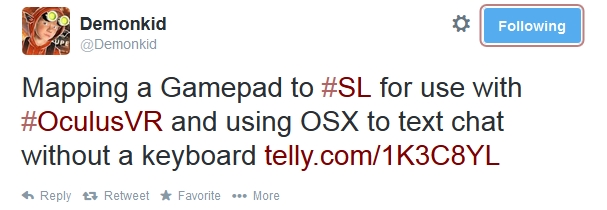
On Saturday May 24th, Loki Eliot tweeted that he’d been working on a similar approach, using the Xbox 360 controller and a dictation feature of OSX Mavericks to provide greater control over his avatar when using the Oculus Rift.

loki-tweet

Since tweeting, Loki has produced a blog post on his work, including links to the software he’s used and tutorials to help get things sorted out. his original video was posted to Telly, which WordPress.com doesn’t like, embedding-wise. However, Draxtor has, with Loki’s permission, reposted it to You tube, and so it’s that version I’ve embedded here.

Loki is the first to admit this approach doesn’t solve all of the Oculus related issues when using Second Life – he has a few wry observations as to where things will “suck” (his expression – not mine!). He also gives some musings on how technology might further assist things in the future.

Loki's work on integrating the Xbox 360 controller for use with SL and the Oculus Rift (image via Loki Eliot)
Loki’s work on integrating the Xbox 360 controller for use with SL and the Oculus Rift (image via Loki Eliot)

The use of HMDs brings with it a lot of challenges – some of which, the Lab freely admits in releasing its Oculus Rift project viewer, it has yet to really tackle. Seeing experiments like this is therefore interesting, as they demonstrate potential alternative (and not necessarily hyper-expensive) means of providing control over basic aspects of using SL with a headset which are not reliant on the keyboard and mouse and, in this case at least, also not dependent upon in-world voice (which many people don’t like to use for a wide variety of reasons). I wonder if approaches like this and Dave Rowe’s work with CtrlAltStudio might raise an eyebrow or two of interest at the Lab …?

Related Links