Orcinus Isle in Second Life

Orcinus Isle, June 2023 – click any image for full size

Shawn Shakespeare pointed me towards Orcinus Isle, a homestead region designed by Lana (Svetlana Pexie), and which offers an engaging and intriguing setting that will be attractive to explorers and photographers alike.

The regions draws on several influences, which in turn can lead to additional influences playing on thoughts about it, leading to some interesting musings – or at least, that was the case for me.

The first of those influences is that of Perissa Beach, Santorini (or Thira) – which is also the first of the attractions for me with Lana’s build. There is a mysticism and beauty with Santorini which has long attracted me. Famed for being a part of the Minoan Civilisation, the island was the site of one of the largest volcanic eruptions in recorded history, which took place in approximately circa 1600 BCE, destroying much of the island and perhaps helping contribute to the legend of Atlantis.

Orcinus Isle, June 2023

Today, Santorini is both a site of archaeological import and also a major tourist attraction. With towering cliffs, its famous buildings perch along the cliff tops and hills – such as Oia – the natural bay formed by the flooded caldera crater and its beaches, it is easy to understand why. With their distinctive red and black “sands” of volcanic dust the beaches of Santorini – Red Beach, Black Beach, Vlychada – are eye-catching, if not always easily accessible. As such, Perissa, with its rich black shores, has become the most famous, attracting tourists from all over Europe and the world at large.

From there, as Lana notes, the build draws on her love of coastal cliffs, waterfalls and oceans and – in another twist of attraction for me – mythology, to present a setting of the imagination, two island rising out of the sea on shoulder of cliffs, linked by a single arch of rock spanning the gorge which separates them, lending weight to the idea that there were perhaps once a single landmass which at some point became mostly split.

Orcinus Isle, June 2023

What caused the division is down to the imagination; perhaps it was the work of the sea, relentlessly pounding a weakness on the cliffs, eating away at the rock over the ages, deepening an opened crack, drawing down the mass from above and washing it away down through the years. Perhaps this island is influenced by volcanic or tectonic activity, the forces of nature breaking it enough for the sea to take over and create the gorge and bringing down the rock above until only  the mast span remains.

Whatever the cause, the two island masses now sit apart, the northernmost offering the most varied topography, with lowlands curving around a deeply cut bay, quickly giving rise to the sing to a curtain wall of high cliffs across the bay’s width, down which falls plummet in force, most likely adding to the bay’s expansion down the centuries and generating clouds of water vapour that hover cloud-like over the heads of the cliffs. Stratified and uneven, the back of this island suggests it may have been laid down by some form of process, again perhaps one volcanic in nature, successive eruptions adding another linear deposit of hardened volcanic rock.

Orcinus Isle, June 2023

To the south, the second island is more even, its near flat top covered in a head of grass and home to the remnants of a church at its southern end, whilst both island present a ribbon of volcanic shingles of a beach further suggesting they were once a unified mass of rock. Although split by the eastern exit of the gorge splitting the land the beach and landscape at the foot of the cliffs on either side of the water are sufficiently enough alike in terms of elevation and shingle / grassland mix to suggest both once run uninterrupted down the east side of the island.

But what of the mythological links? These can be found in the region’s name: Orcinus. Rather than a direct reference to the genus of Delphinidae we tend to refer to as “killer whales” (although a number of these majestic creatures can be seen swimming off the islands, Lana uses the term in its original meaning: “kingdom of the dead”, and / or “belonging to Orcus”, the god of the underworld in Etruscan and Roman mythology (the name Orca also being applied by the Romans to the genus of Orcinus).

Orcinus Isle, June 2023

The use of the name within the setting might be taken as a reference to is somewhat foreboding look, the evidence of ancient fortifications having once stood proudly here, perhaps long before the arrival Christianity and the church-builders, providing evidence that this was once a fortress or outpost, and thus may have had its name aligned with the god of the dead thanks to its remote location.

“Orcus” also has another connection to mythology, in that it is at times seen as being the origins for Tolkien’s “orcs”; from this use, countless other fantasy games and works of fiction have borrowed the concept of the orc. However, whether Tolkien directly derived his creatures from the name (by way of Anglo-Saxon) is debatable – not the least by Tolkien in his lifetime. However, there is something decidedly “Tolkienish” to the ruins and landscape here (or at least, faintly Nordic), which adds to the allure.

Orcinus Isle, June 2023

Wild and open and with numerous places to sit (not all of which may be easy to reach!), Orcinus Isle is an engaging and photogenic visit.

SLurl Details

A Summer’s return to Missing Melody in Second Life

Missing Melody, June 2023 – click any image for full size

For those of us in the northern hemisphere, summer is rolling around again with its promise of sunny skies, green fields and lazy walks along riverbanks, idling under the shade offered by the outstretched boughs of a tree, enjoying an afternoon tea or coffee in an easy-going café and more.

More particularly for me, this time of year marks the passing of almost 12 months since the last time I dropped into to Missing Melody, making it high time for a revisit.

Missing Melody, June 2023

Missing Melody is, alongside of the equally eye-catching Longing Melody, presented by Bambi (NorahBrent) as a place of comfort, retreat and relaxation; a place which is never far from thoughts and where a welcome is always waiting. Or to use Bambi’s words, as they are so apt:

What is a Missing Melody? It’s that song in your head that you can’t get out but not sure how it really goes. It’s that temptation you want to have in your life so you can fight to resist. It’s that place in your heart that is always waiting to be filled.

– Bambi (NorahBrent)

Missing Melody, June 2023

For this iteration, Bambi offers a setting which reflects all of my descriptions of summertime above: a rural location rich in the delights of summer, from a stream bubbling and tumbling from a pond high on a hill to follow the curve of the land as it steps down the slope in a series of rocky drops to finally vanish within a culvert, through to the cattle content to stroll the broad grasslands, mingling with horses who also appreciate the rich grazing, even if the local sheep are a little stand-offish!

As a regular supply of fresh water, the pond and stream have attracted much of the local flora over the years, such that the pond is now guarded by the weeping heads of willows and a curtain-like surround of shrubs and bushes which seem determined to protect the secrets of the ducks and geese happy to splash about in the water, and offer the local deer a private place to drink. However, it is a secret that has been penetrated, as the gabled boardwalk reaching out over the pond (but not reaching its opposite number on the far bank) shows.

Missing Melody, June 2023

This gabled boardwalk reaches the pond from a small gathering of garden outhouses sitting alongside a well. Looking a little careworn but still with potted plants being tended, even if the porch swing could do with a little TLC, this little garden space seems to also be a place of play for youngsters going by the tricycle and scooter waiting the return of their owners. How long they’ve been here is hard to say, but the presence of goslings playing in a tub of water, a cat happily sleeping in the sun and a deer and fawn close by, suggests the erstwhile owners of these wheeled means of transport have been gone some time.

Across a bridge spanning the tumbling stream, a path leads down form this little hideaway to reach the Oh Deer Café where refreshments and “sweet yummy moments” await, either indoors or served on the terrace overlooking the sloping growth of wild flowers washing upslope from the stream to counter the neatly-growth flowers in their planters along the edges of the terrace.

Missing Melody, June 2023

The café and the little hidden garden corner aren’t the only places of retreat / refreshment here.  Cross the stream and take a walk over the shoulder of the hill and past the grazing cows and horses, and you’ll spy brick walls and a small out sitting up on the flank of the setting’s uplands. The route to it will take you back past the pond, allowing you to join with another path that links it with the red brickwork. Within the high walls and shaded by trees still wearing their springtime blossom sits a fountained pond dominated by a flower-draped statue. Here, as koi swim in the clear waters, a couple might find a place to sit and sample a glass of burdock and wildflower wine.

For those who prefer to remain close to the babbling chatter of the stream, there is a tree house waiting at the end of a pair of rope ladders. With a bench seat / swing (I’d perhaps not try swinging it too far!), it allows a peaceful watch to be kept over the horses and cows below.

Missing Melody, June 2023

Finished with a pleasing sound scape (albeit one in which the café can sound like the Lunchtime Hordes have descended upon it), it really doesn’t need to be said that Missing Melody is, as ever, highly photogenic and makes for a genuinely easy-going visit … even if I just go a say it anyway 🙂 .

SLurl Details

The history of computing in Second Life

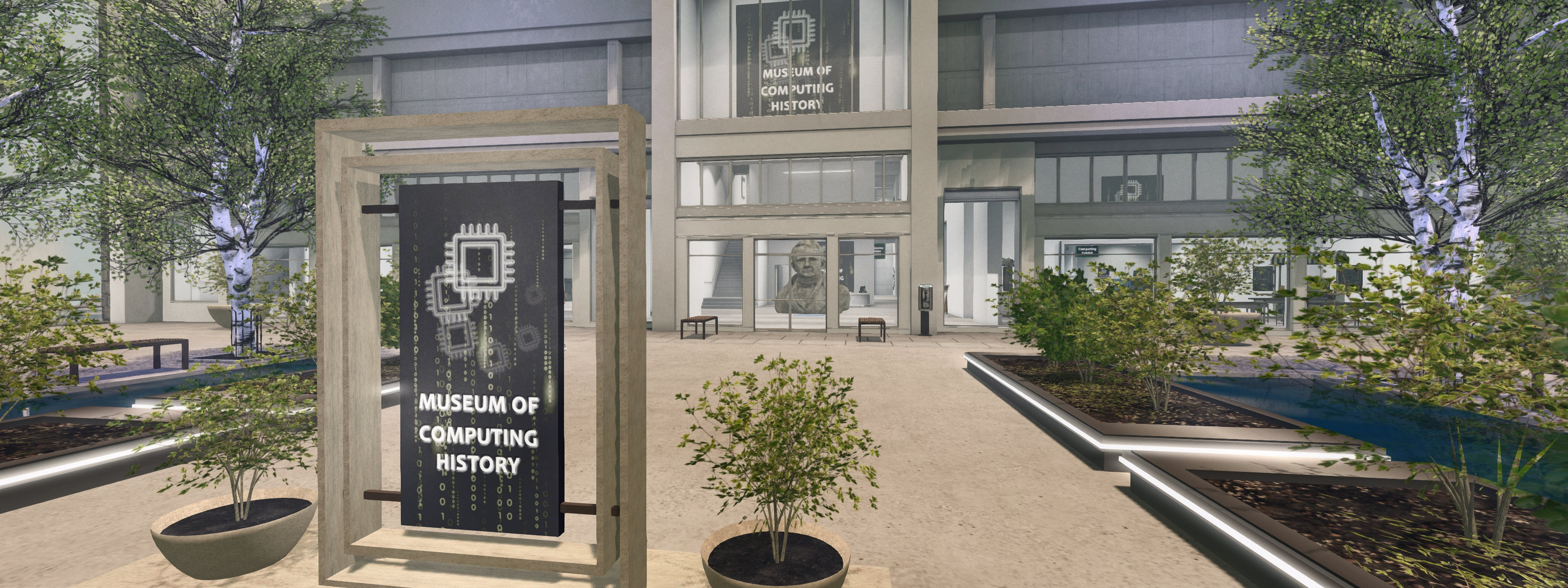
Museum of Computing History, June 2023

As a part of my on-going (and occasional) visits to museums in Second Life, I recently had the opportunity to drop in on the quite excellent Museum of Computing History, managed and curated by Brian Aviator, with the assistance of Timothy McGregor and Kevin Jackman.

Tucked neatly under Brian’s Blackslough Field Regional Airport and overlooking the inland seas and waterways of Sansara, this is one of two museums Brain operates / curates in Second Life, the other being the LGBTQ History Museum and Cultural Centre (also due to appear in these pages later this month, and which is – at the time of writing – featured as an Editor’s Pick in the Destination Guide in recognition of Pride Month).

Museum of Computing History, June 2023

Extending over two floors, and with an ample, well-tended forecourt / terrace public space before it, the museum offers an impressively comprehensive dive in to the history of computing, from the abacus to the blade server and the rise of AI, featuring not just the technology and technological innovations, but many of the the individuals who have contributed to the development of computers, computational engineering and computer science down through the centuries and decades.

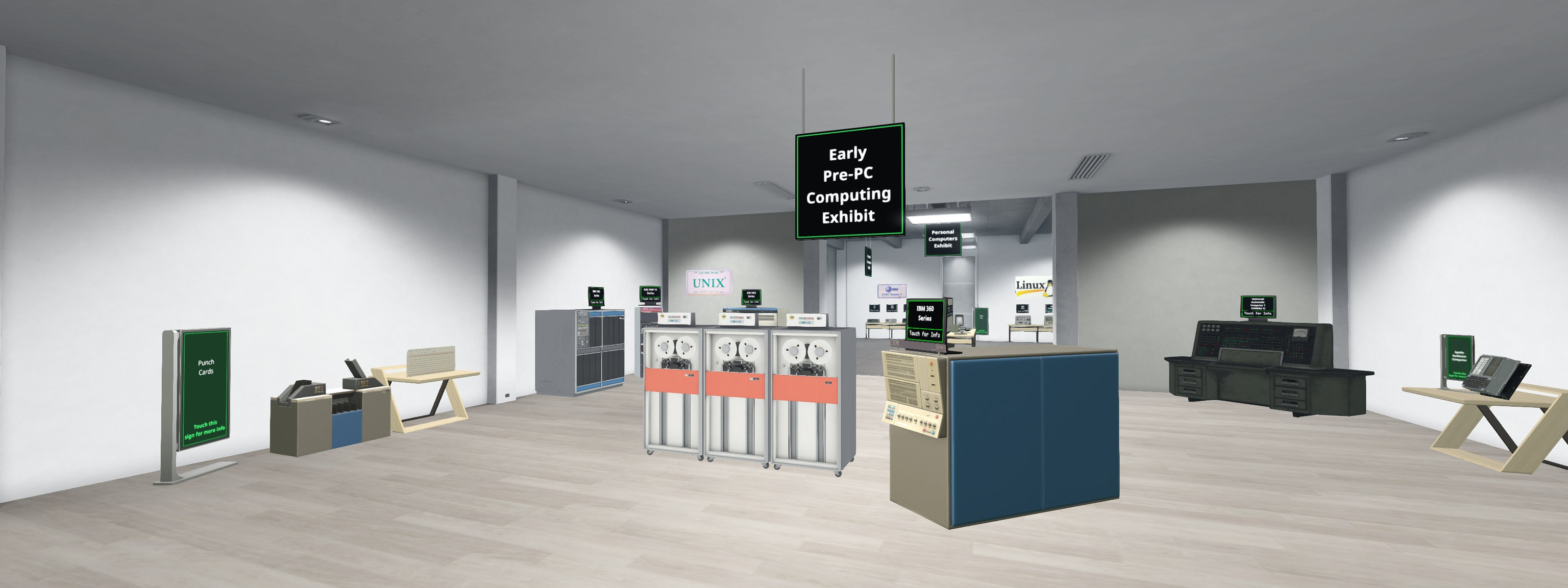
From the entrance foyer, dominated by a bust of Charles Babbage, the lower level of the museum comprises the Admiral Grace Hopper auditorium and four exhibition halls in which may be home to static exhibitions, and others have their displays rotated over time as new exhibits are developed (as is the case on the museum’s upper floor). At the time of my visit, the exhibits in these lower halls comprised:

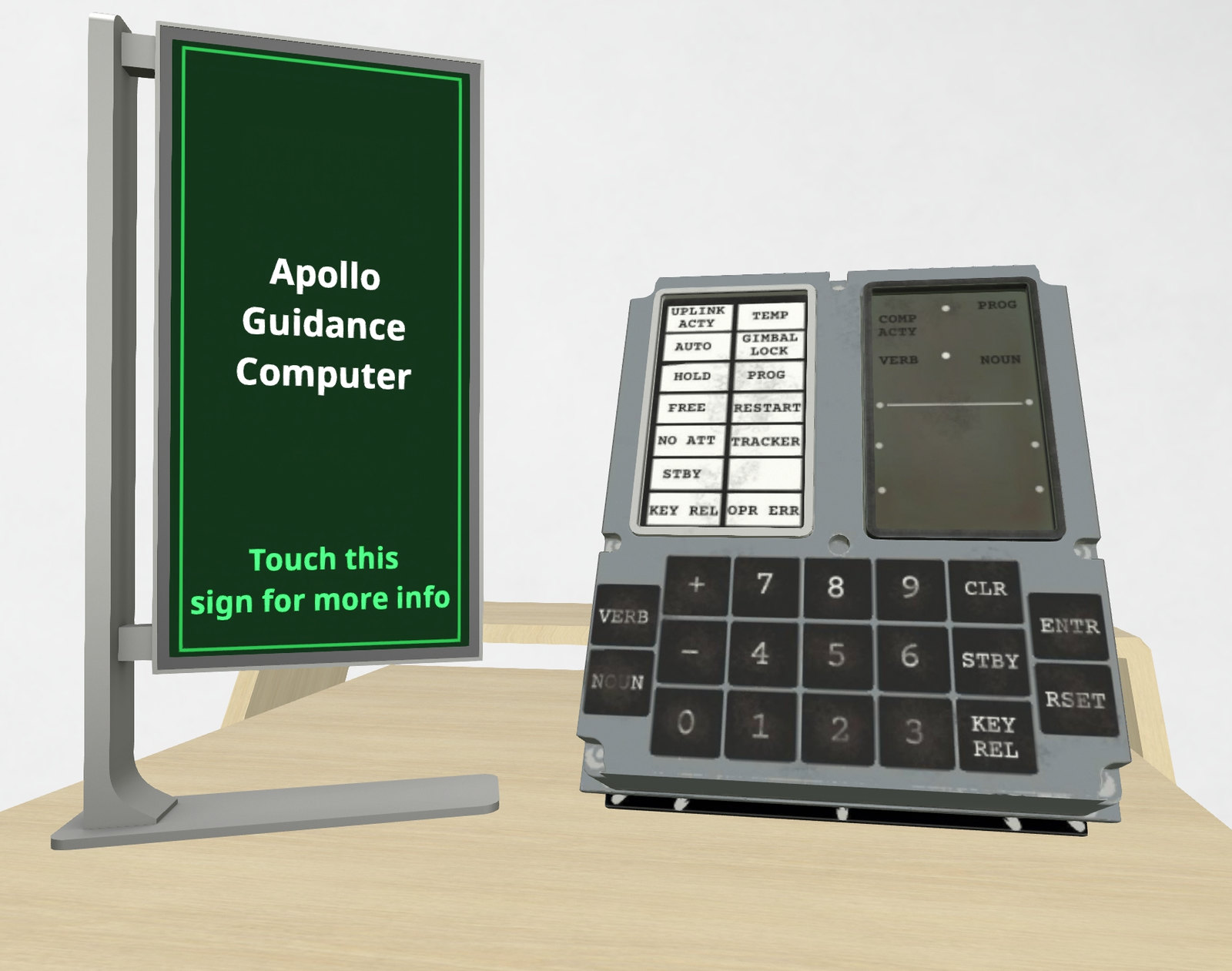
  • Museum of Computing History, June 2023. Made famous during the Apollo 11 landing mission, July 20th, 1969

    Early Pre-PC Computing, which includes one of the earliest computational machines known to Man (the abacus), alongside models of Babbage’s Difference Engine; the electro-mechanical devices which played major roles in the European theatre of World War II – the German Enigma code setting machine and the Polish-British code breaking Bombe; the machines from the early decades of the modern computer era:  punch-card and tape-driven monsters, and even a look at one of the first computers to be used extensively “off-world”: the Apollo Guidance Computer (thanks to Hollywood and numerous dramatizations of the Apollo 11 lunar landing, perhaps now more widely known as the “1202 alarm computer”).

  • The Personal Computers Exhibit, which is liable to raise fond smiles for some, including as it does models of Commodore, Sinclair, Apple, Tandy, IBM and other machines as well as their associated operating systems upon which many enthusiasts cut their computing teeth. I personally found myself smiling at the presence of the BBC Model B and (for reasons that are both convoluted and irrelevant to address here, but include personal travels, Sir Arthur C. Clarke and film director Peter Hyams) the Kaypro II).
  • An Interactive Fiction Exhibit, with its reminder that there was a lot of brain-engaging fun to be had with computers long before the arrival of graphical games and shooting the bejesus out of others. This is also supported by a video presentation called Get Lamp: the Text Adventure Documentary, available through the Admiral Grace Hopper auditorium.
  • A look inside what might now be regarded as an “old school” data centre with huge boxlike machines (rather than huge boxlike racks of machines), and the odd super computer.

These hall all feature models of the various systems, boards, boxes and computers which in turn represent the work of multiple creators from across Second Life – such as (but most certainly not exclusively) Crash Lunar and (appropriately, given the museum’s subject matter) Ozzy Wozniak, both of whom provide a range of free models of computers, handhelds and consoles for those interested. Additional models have also been provided by Brain himself, imported (I believe I’m correct in saying) from 3D models developed by the Universidad de Castilla-La Mancha, Spain – for whom Brian gives acknowledgement. All are presented with display boards which, when touched, will provide a notecard of contextual information (and it should be noted that even the posters on the walls in some of the halls can also be touched for information of their own).

Museum of Computing History, June 2023

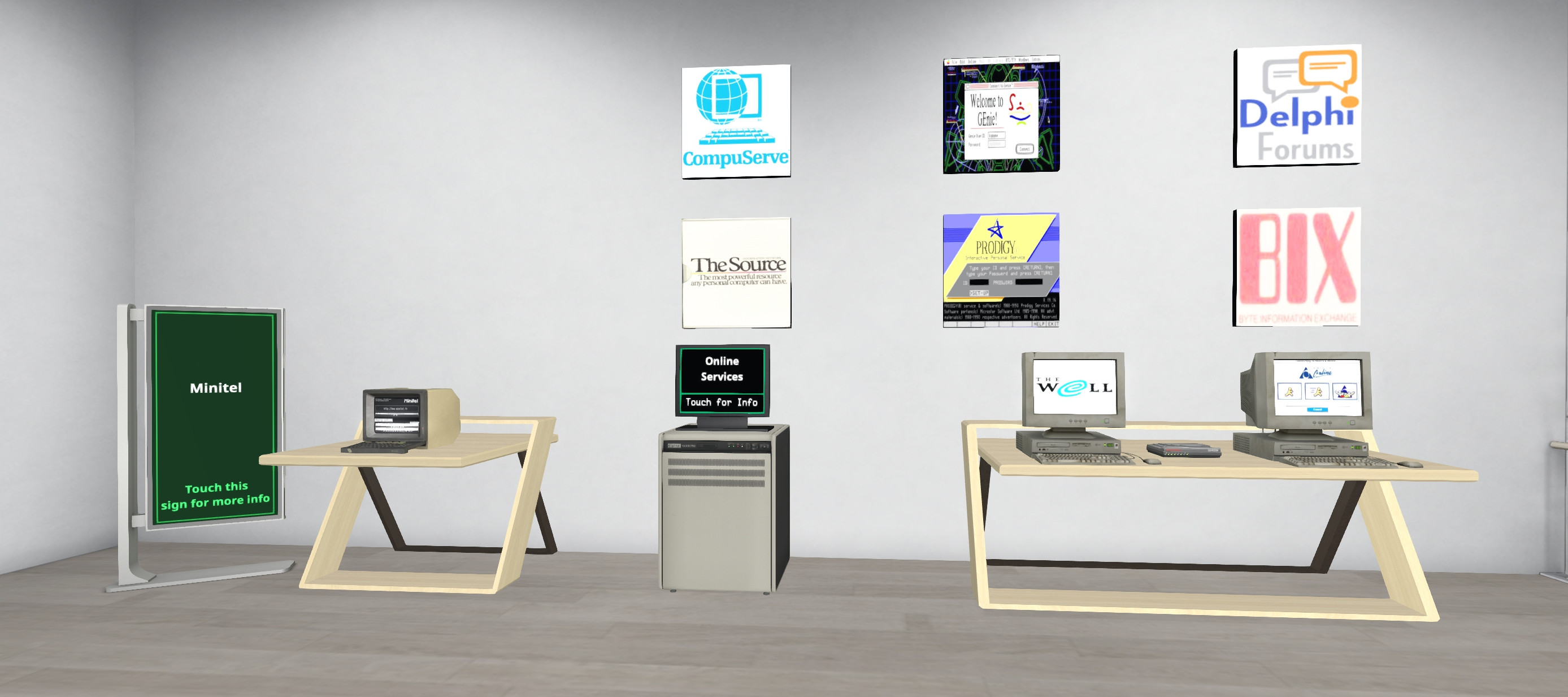
The upper floor if the museum comprises five exhibition halls, all following the same approach as the lower floor, with each focusing on a specific exhibit related to computing. At the time of my visit, these comprised: the relationship between computers and telecommunications and the rise of networking; video games and console systems; the development of artificial intelligence; the noble / ignoble art / act of hacking (which of these terms largely dependant on the who, what, where, when and how of the said hacking) , and biographies of some of the leading personalities and individuals who have played a role in the evolution of computers, mathematics, computer sciences, communications, and related subjects.

Comprising images of the individuals concerned which can be touched for a notecard-based biography, the latter covers people who – at least in name – are likely be  known to many: Augusta Ada King, Countess of Lovelace, Alan Turing, Steve Jobs, William Gates III, Steve Wozniak, Sir Tim Berners-Lee and Linus Torvalds, for example – and one Philip Rosedale; those who might be familiar (if not really known, such as Blaise Pascal; Seymour Cray; Vinton “Vint” Cerf (who has actually been in Second Life) and Robert Kahn; to those who really should have much wider recognition than they do, but whose achievements have perhaps been overshadowed by others – such as the aforementioned Grace Hopper, together with Margaret Hamilton and Dorothy Vaughan, who at times get pushed aside in the male-dominated history of computing, and Douglas Engelbart, whose work at times gets subsumed by the near-mythic achievements of Steve Jobs.

Museum of Computing History, June 2023

The latter’s work (with that of his team at the Stanford Research Institute – now SRI International) is the subject of a second video presentation within the museum, highlighting what would become retrospectively called The Mother of All Demos. The was a live event held in 1968, in which Engelbart interactively demonstrates his team’s oN-Line System (NLS), which is very much the precursor of just about everything we take for granted with computers today: the graphical interface with its cursor (or “bug” as they called it) and mouse; the ability to work collaboratively and share files dynamically; the use of hypertext and hypermedia – even teleconferencing. The video offered at the museum summarises Engelbart’s presentation, but for those interested, the entire demonstration – which lasted over 90 mins – is also available on You Tube.

I admit I did find myself a little conflicted over the use of notecards throughout the museum; not because it is a difficult format to understand, but rather because there are instances where the information is liable to change (such as with the biographies of some of those featured within the upper floor exhibitions, or on the subject of AI), which might lead to some information becoming out-of-date. As such, I wondered if offering a mix of web links as notecards, depending on the subject matter, might not be easier from a maintenance standpoint.

Museum of Computing History, June 2023
But, that is very minor quibble; there is no denying the Museum of Computing History has been extremely well put together, offering as it does something of interest for anyone with an interest in the subject – whether computer nerd or as someone simply interested in historical context and / or the influence of computing and computational machines have had down the centuries / decades. Information is easily accessible, and the range of topics cover and their associated depth means there is a lot of be absorbed without being overwhelming, and more than enough to encourage repeat visits.

 SLurl Details

Chang’an with a twist in Second Life

Chang’an, May 2023 – click any image for full size

It’s pretty well established in these pages that I tend to be drawn to things with an Oriental theme running through them in much the same way as a moth is drawn to a source of illumination. Part of this is doubtless the result of having spent some of my childhood years in Hong Kong (and some of my early adult years traveeling to places on that side of the world). However, it’s also likely born of the rich history of the Far East, a history which I’ve always found to be more engaging than the histories of western nations.

Which is a roundabout way of saying that when I copped the Destination Guide entry for Chang’an, I knew it would be skating up my list of places to visit; if nothing else, the DG description was enough to raise my eyebrow as curiosity was piqued.

Explore the virtual Chang’an, the capital of the Tang Dynasty (AD618-907) in China. You can see ancient Chinese (East Asian) cultural factors, including palaces, Buddhism temples, and gardens. Here you can dance, sing, entertain, and shop.
Chang’an, May 2023

This is an introduction which immediately gives a first hint of this Full private region’s over-arching theme: that of a fusion of Oriental / East Asian elements with a particular (but not exclusive) emphasis on China and Chinese history. Not that the setting is intended to be purely historical in context; in much the same way as it offer a fusion of influences, so too does it present a combining of periods, ancient and modern.

Designed and built by 大鱼 (Deo Rain), the region’s DG and About Land descriptions tell only a small part of Chang’an’s long history. The name belongs to what is now regarded as Xi’an, the capital of Shaanxi Province, and the third most populous city in north-western China. Over the last 40-ish years, and keeping pace with China’s overall modern economic development, Xi’an has re-emerged as an industrial, political and educational centre and, particularly, a cultural centre of note.

Chang’an, May 2023

As a centre of import, Xi’an’s roots go back to Neolithic times when it was a centre for the Yangshao culture, and areas within the city and its surroundings were used by several Chinese dynasties as their capital. These included the first half of the Zhou Dynasty, with centres at Feng Jing and Haojing, the Qin Dynasty, thanks  to China’s first emperor Qin Shi Huang (he of the Terracotta Army fame and responsible for starting construction of the Great Wall), moved the Qin capital to Xianyang in what is now the northern part of Xi’an. From here, it became central to the majority of the major dynasties through to the Ming and Qing Dynasties (the latter being the last imperial dynasty of China prior to the country becoming a republic in 1911).

The city of Chang’an is generally regarded as coming into being in 200 BC, when Emperor Liu Bang of the Han Dynasty ordered the construction of Weiyang Palace and, six years later, that of the first of the Chang’an city walls. However, it is under the Sui and – as noted by Deo in his descriptions for the region – the Tang Dynasties (which consecutively spanned a period from 581 CE through 907 CE) that Chang’an came to full prominence. This was kicked-off during the Sui Dynasty, when a new city was built south and east of the Weiyang palace, when it was initially called Daxing before being renamed Chang’an (meaning Perpetual Peace or Eternal Peace) during the Tang Dynasty.

Chang’an, May 2023

During this period, and prior to its destruction in 904 CE, Chang’an grew to enclose an area of some 84 km2 within its walls, split into three major districts: the civilian city, the imperial city and the palace itself.  During this period it was the third largest city in the world, boasting centres of commerce, learning, religion and culture, with paved roads and avenues of impressive proportions (Zhuque Avenue, the city’s grand street, was an impressive 155 metres across!).

As well as the palace, the city featured the Giant Wild Goose Pagoda, which together with the Small Wild Goose Pagoda survived the destruction of Chang’an (although it did suffer extensive earthquake damage in 1556 CE). It was built as the repository for sutras and figurines of Gautama Buddha that were brought back to China from India by Xuanzang, who also brought over 600 Sanskrit scriptures to Chang’an, where he established a centre for their translation, work which contributed enormously to the growth of both Chinese and East Asian Buddhism.

Chang’an, May 2023

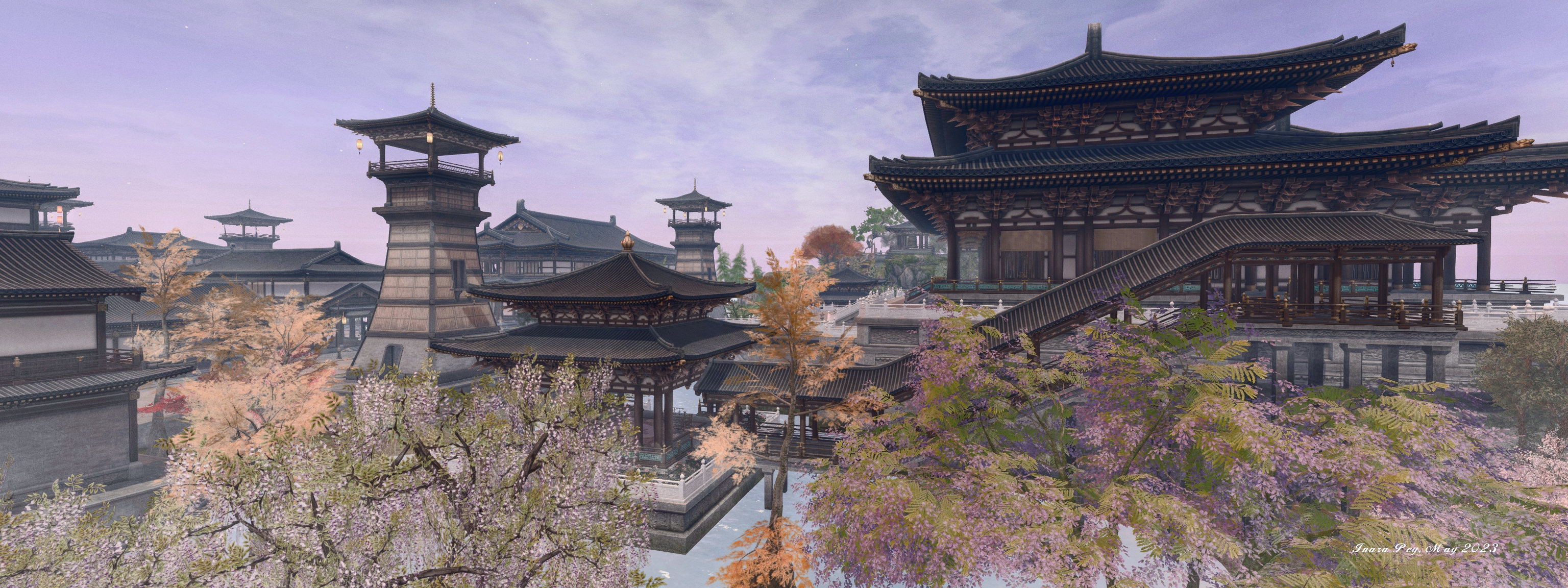
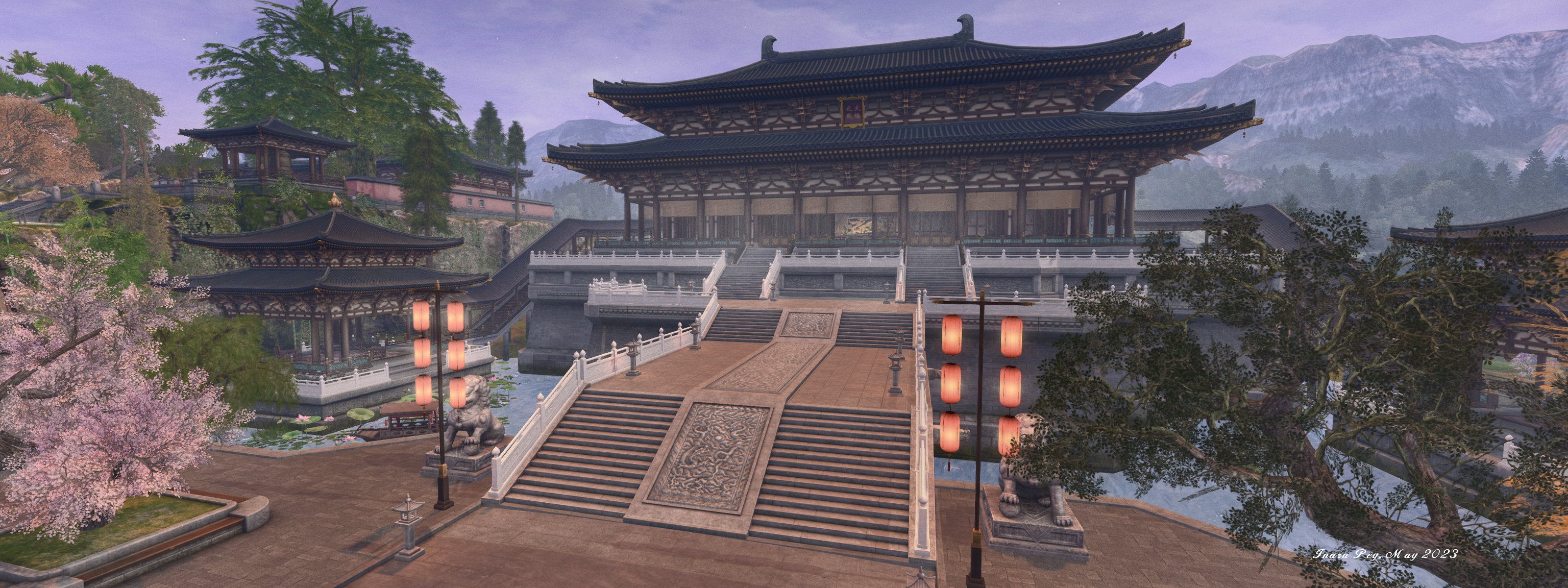
Much of this is celebrated in Deo’s build. Like its namesake, the later can be broadly split into three areas: the commercial centre (with stores available for rent), a cuisine district, and the palace-like Taiji Hall, sitting elevated at one end of the region, a broad paved footway running to it in the manner of Zhuque Avenue from the citadel gates, neatly separating the commercial and cuisine districts from one another in the process. The hall sits apart from most of the rest of the citadel as befitting its status as a near-palatial building, thanks to a broad body of water almost completely slicing through the northern part of the region.

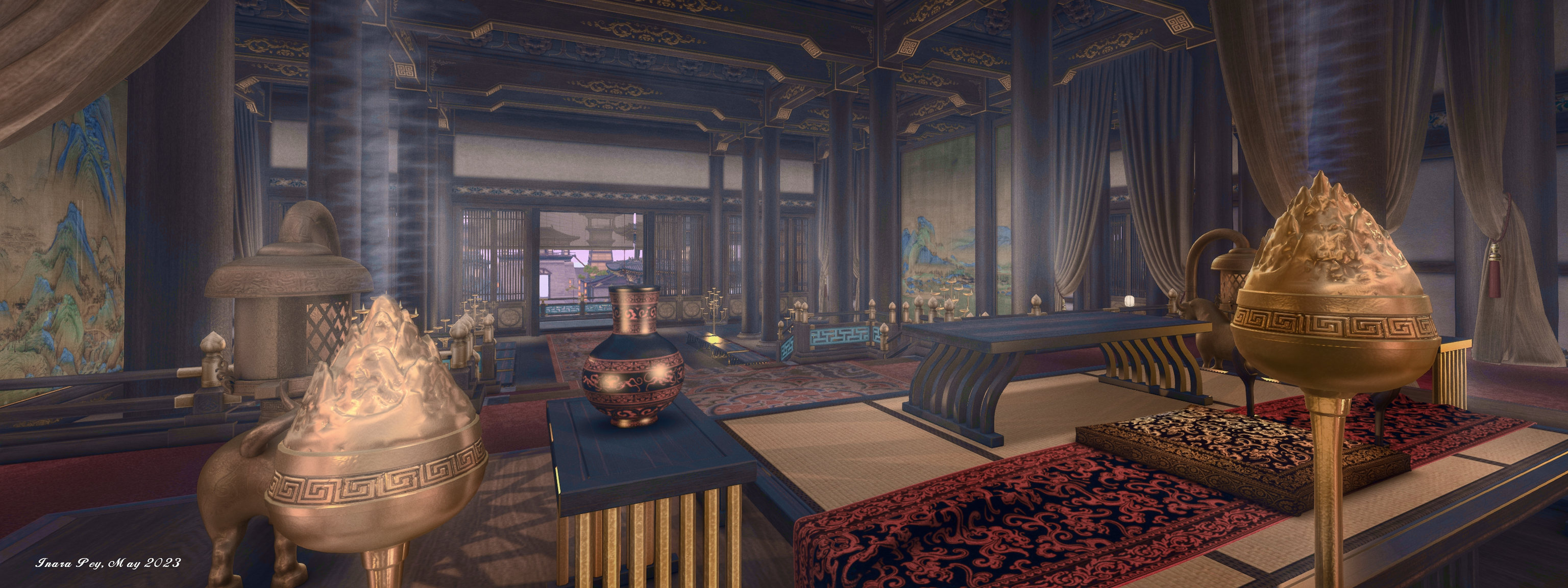
Two tall watchtowers stand guard on either side of the broad stepped bridge spanning the water to reach the main hall, and while these may not be particularly pagoda-like, but it is hard not to imagine them standing in for the Wild Goose pagodas of Chang’an. Taiji Hall itself is huge and of genuine beauty and craftsmanship (although apparently still under construction in places from what I saw whilst taking a sneaky cam around it!), which speaks to Deo’s skills as a designer: like the rest of the buildings within the region, it is entirely his own design.

Chang’an, May 2023

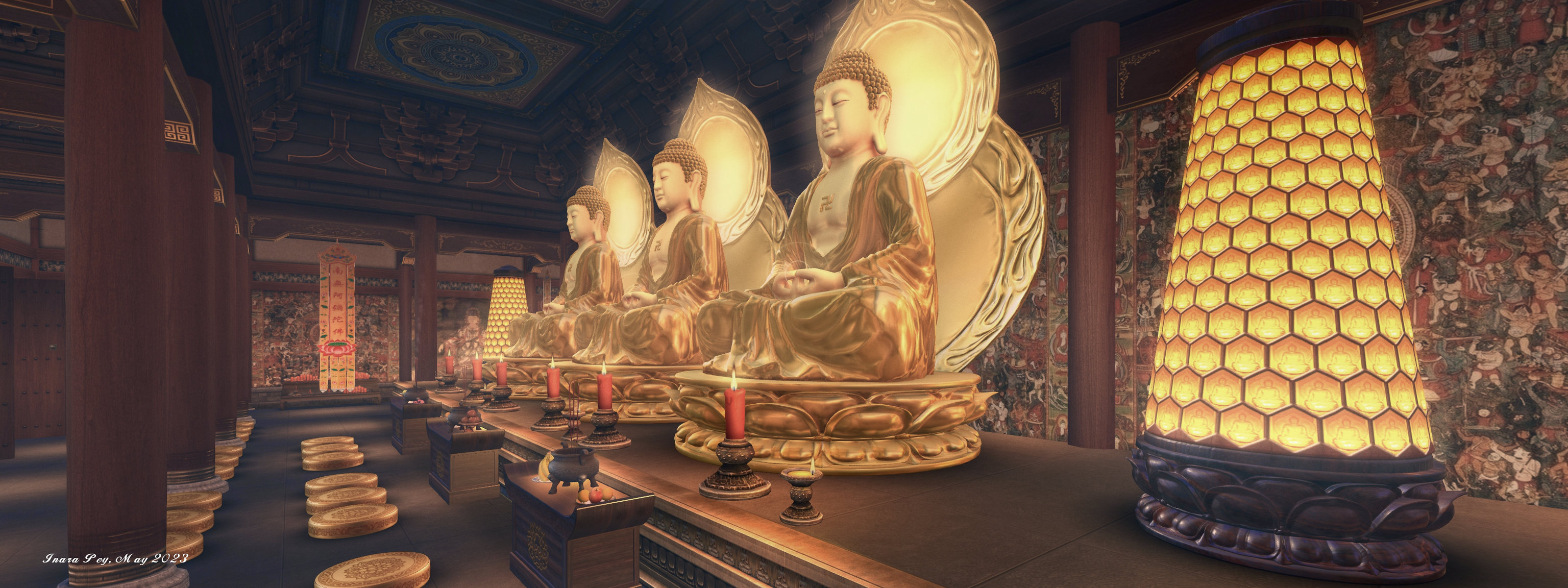
The most prominent elevated element of region sits to the north-west as a high plateau. It is topped by a temple which appears to offer a nod towards the Republic of China, carrying as it does the name of Anping. Built around a main courtyard, the temple has two primary buildings, the larger of the two dominated by three large figures of Buddha, and the smaller by a gold-covered figure of Guanyin, the East Asian representation of Avalokiteśvara. Thus, this retreat would seem to be an acknowledgement of Xuanzang and his seat of translation / study founded at Chang’an. But – how does one reach it? From the terraces of the palace and the paved streets below it, there does not seem to be an obvious route.

The answer lay close to the southern gateway where, between the eatery and the club-come-bathhouse which help fuse past and present within the build, a covered walkway might be found. Not only does this provide access to the engaging south-west section of the build (which hides its own pavilion and butterfly garden), and thence north to where a paved footpath meanders back towards the palace. As it does so, the paved path passes the start of a second, loosely-laid path winding into a gorge as it cuts into the base of the plateau. The far end of this path marks the start of a winding climb upwards. It’s a route of exploration I highly recommend, as it offers a sense of pilgrimage it is meandering route, as means to see parts of the region which might otherwise be missed, and a superb way to look out over the citadel as the path is climbed to reach a promontory just below the temple proper.

Chang’an, May 2023

When visiting Chang’an, I would recommend taking time out to study the map provided close to the landing point, as it will help point out the locations within the region – including those I’ve not mentioned or really described in this article. I would highly recommend a visit, as the region does offer an interesting fusion of ideas, and – quite frankly – Deo’s architecture is gorgeous.

 SLurl Details

A touch of rural Wales in Second Life

Seogyeo Town, Seogyeoshire, May 2023 – click any image for full size

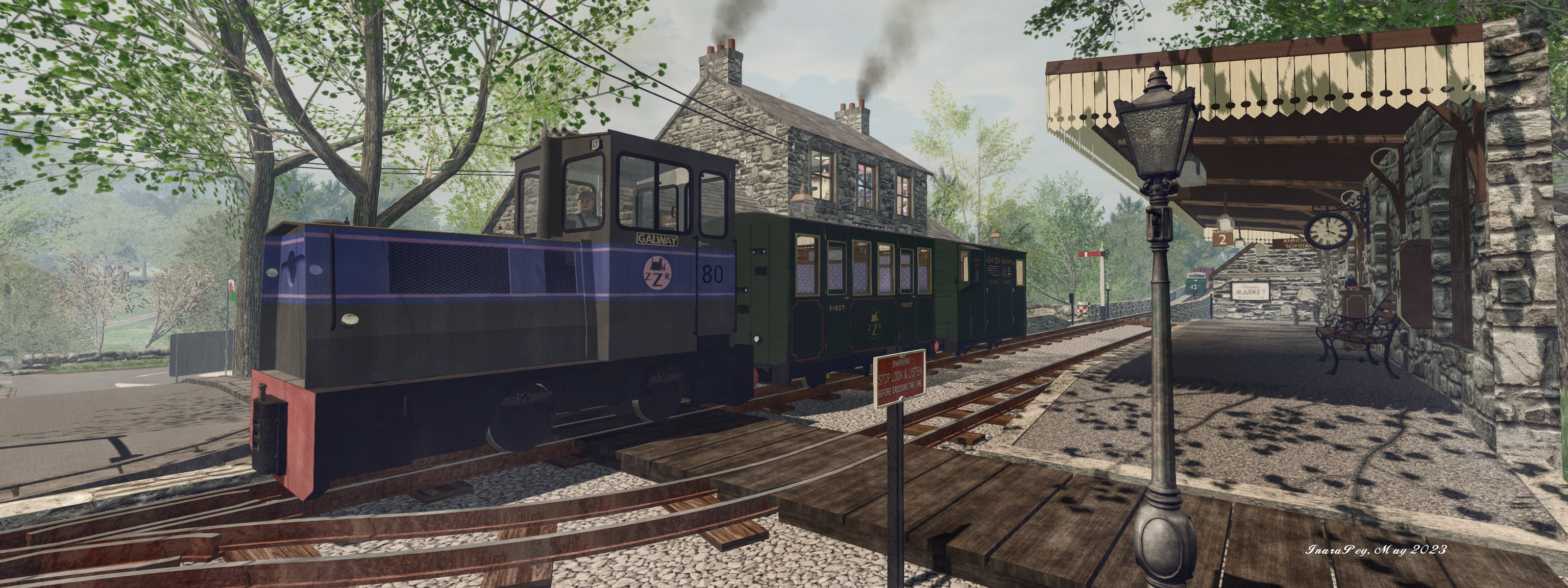
In April 2021, I took a trip on Zany Zen’s superb narrow-gauge railway as it charts its way through north-west Jeogeot (see: Letting off steam with Zany Zen Railway in Second Life). The results of the trip led to a short series on some of the narrow-gauge railways in Second Life (see: A Ride on the Valkyrie and Climbing a Mountain in Second Life and GLTSL 3: Dreamshire Village, Second Life).

The Zany Zen runs from the little coastal setting of Little Coverston to Somdari. In doing so, it runs through a total of seven settlements, all of which have come together to form the Welsh-themed Seogyeoshire, modelled after a traditional county of  the UK and centred on the county town of Seogyeo, which forms the official mid-point of the Zen’s route. The result is a truly engaging, picturesque setting that captures the scenic beauty of rural Welsh and (dare I say it), English counties bordering Wales.

Seogyeo Town, Seogyeoshire, May 2023

The seven villages and towns of Seogyeoshire comprise Little Coverston and Brigbymoorside to the north on the Gaori coast, Middle Claydon, Seogyeo Town itself, Verney Junction, Bempton and the delightfully named Little Framerate (which is anything but 🙂 ). These flow one to the next through landscaped countryside on either side of the Zany Zen, managed by the local community as overseen by the local town and parish councillors (aka Seogyeoshire’s admins).

As the largest of the population centres, I focused much of my visit which gave birth to this article on Seogyeo Town and its immediate surroundings – including Claydon House and its parklands – although some of the images herein are taken from other parts of the county, so if you want to truly experience the county, do make sure you visit it!

Seogyeo Town, Seogyeoshire, May 2023

The place to start explorations of the town is the local square – the target of the town’s landing point. Here, overlooked by a figure on horseback (who is, for reasons unknown wearing a pair of motorcycle goggles!), visitors can receive a map of the county which highlights the points of interest awaiting discovery.

This map demonstrates the care with which the community at Seogyeoshire maintains the overarching theme of presenting a touch of Wales / Britain: the map is clearly modelled after those produced by Ordnance Survey (OS), the national mapping agency for Great Britain, and the first such agency to be established (dating back to 1747).

Seogyeo Town, Seogyeoshire, May 2023

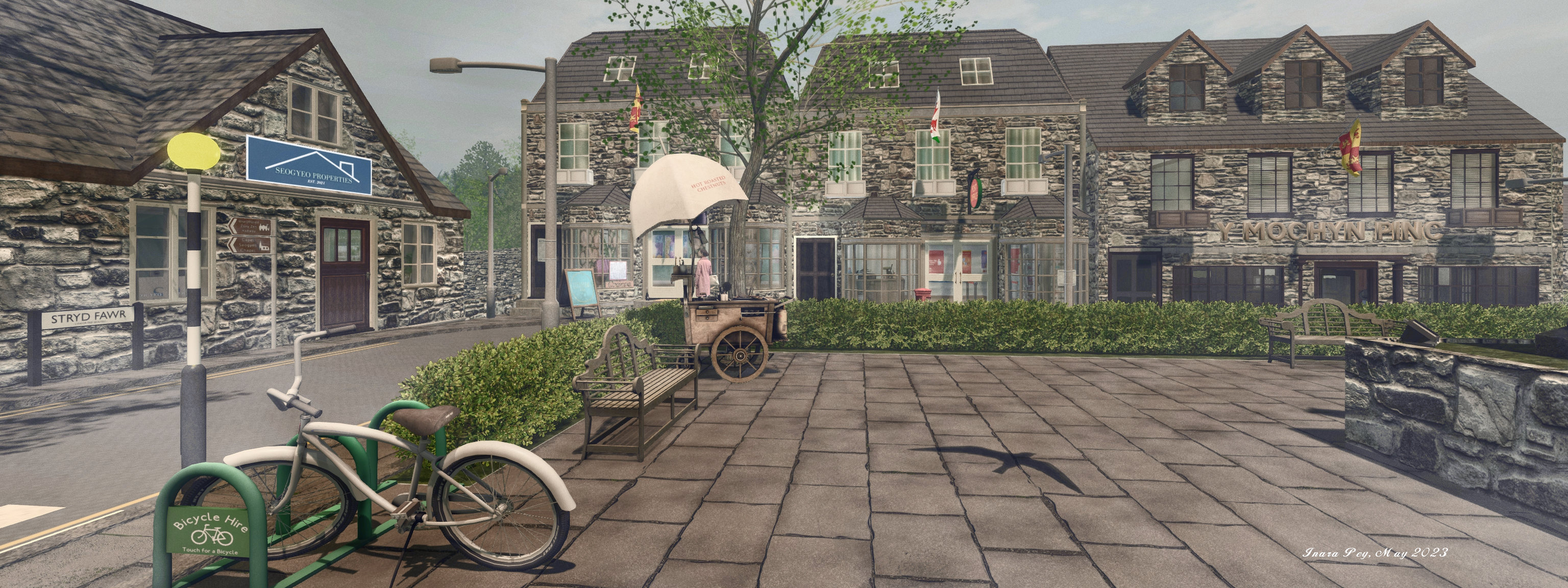
The attention to detail continues with the use of recognisably “British” street name signs (which, given this is a corner of Wales present names in both English and Welsh), road traffic signs and road markings, the use of Belisha beacons at public road crossings,  very British public rubbish bins, and so on. The humour is typically subtle and easy-to-miss unless you happen to be from these shores. I wonder how many visiting the town get the joke of the local OP-CO food store, or appreciate the dry humour behind the “Grimsby Would We Really Miss It?” election poster (in almost-Conservative-blue!) or recognise the intentional irony in the naming of Long Street.

Seogyeo Town and Seogyeoshire as a whole have a sense of age and history common to the majority of rural areas and older towns of Britain: modern buildings rub shoulders with those dating back hundreds of years; the local parish church sits well above the rest of the town to remind the people of its presence and to come to worship, its graveyard speaking to the long history of settlement here. Sites of antiquity are carefully marked and preserved, and more “modern” institutions have attempted to fit quietly within the community rather than setting themselves aside. For example, there’s the post office cuddled against the local pub; the local police station tucking itself quietly inside the converted ground floor of a house, the upper floor of which offering the officer and their family a small apartment-style home.

Seogyeo Town, Seogyeoshire, May 2023

This sense of history enfolds a length of canal which appears to have once reach all the way to the base of the hill on which the large bulk of a brewery sits. Whilst its western end has been built over and its eastern end converted into a pond and public space commemorated Queen Elizabeth II, the canal perhaps once brought grain and hops to the brewery in the early years of the industrial revolution, before steam trains robbed the longboats of their trade.
Incidentally, the brewery speaks to the manner in which some of the Seogyeo community’s neighbours have entered into the spirit of things. Whilst resembling a building born of the industrial revolution, it is in fact a façade which allows the Buildables SL building supplies store. Thus, it allows the store to blend into the Seogyeoshire’s general ambience rather than painfully clashing with it.

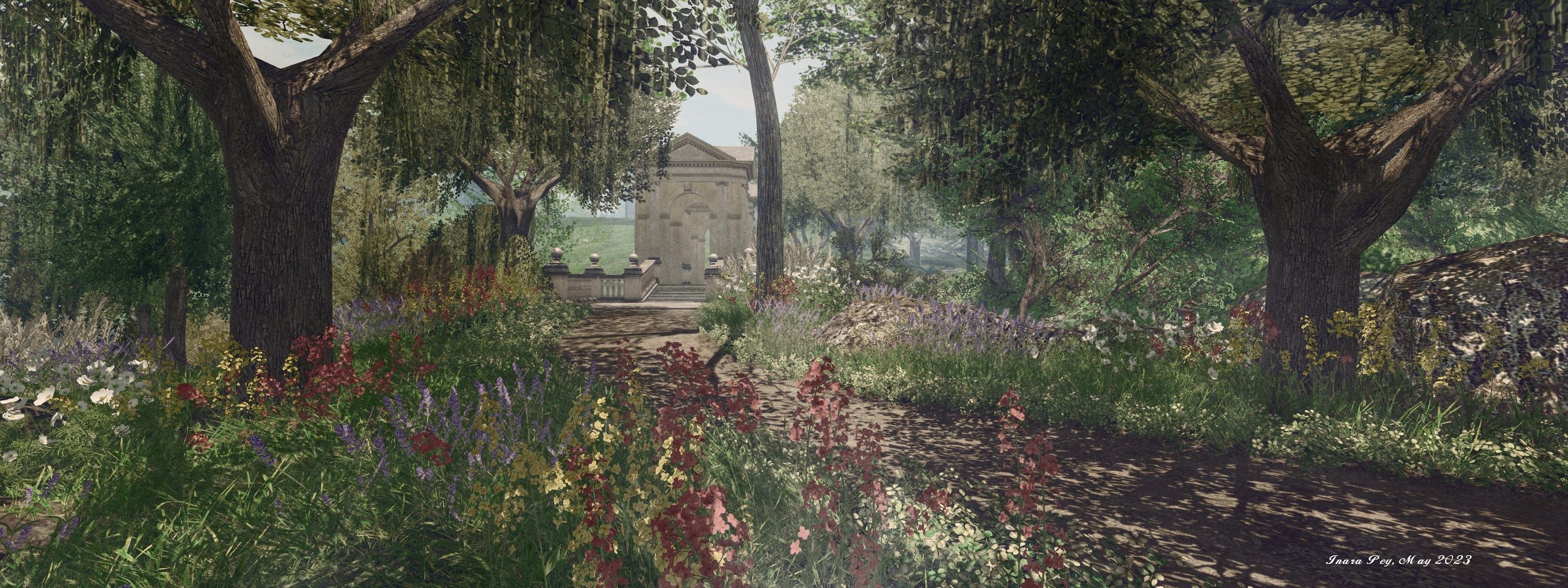
Across the road from the pond marking one end of the canal sits a much broader lake. This in turn marks the boundary of public parklands running up to the impressive Georgian-style estate of Claydon House. Backed by extensive coaching houses and stables, Claydon (although still under construction at the time of my visit), boasts its own large family chapel, formal gardens and lawns which all appear to be open to the public.

Seogyeo Town, Seogyeoshire, May 2023

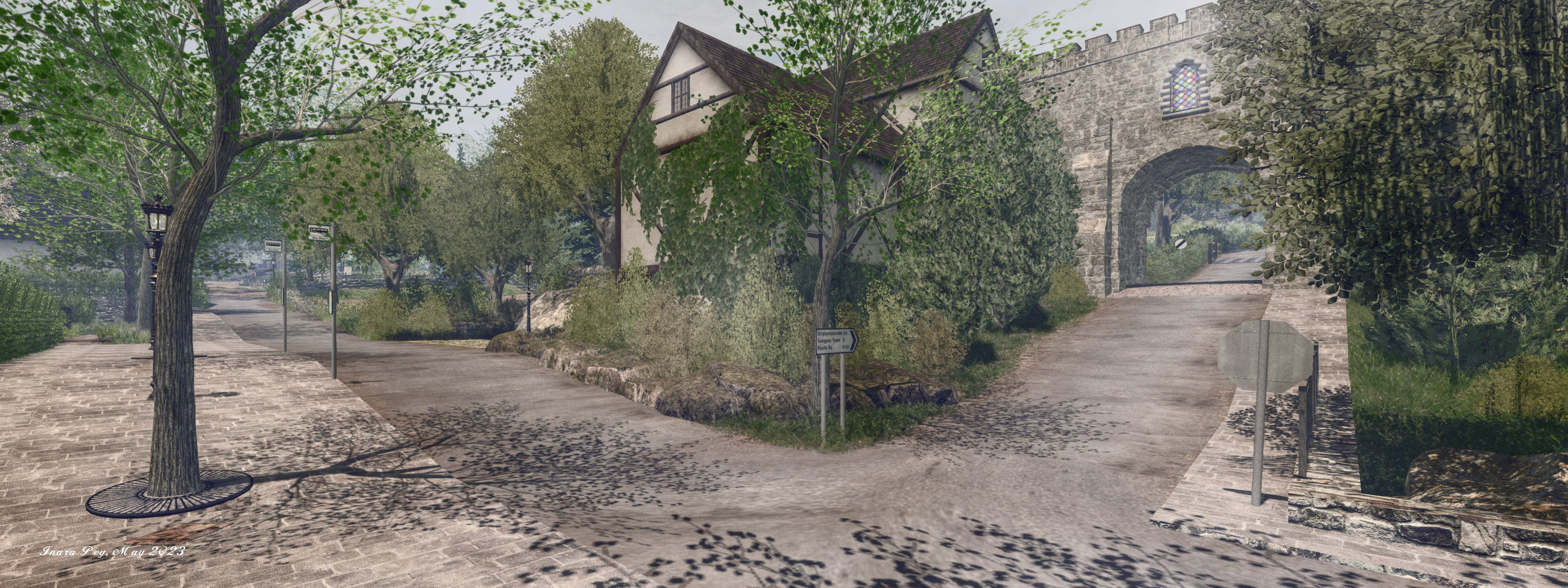
A further beauty of Seogyeoshire is the manner in which towns and villages have been blended with the landscape in a manner reflective of rural Britian. There are no hard lines, just a gentle blurring of fields available for crops or grazing and marked by dry stone walls with farmhouses, tended trees at the roadside, an increase of road signs – including those bearing the name of the town / village, and the arrival of a village itself which rises and then gently folds itself back into the surrounding fields and landscape once more. Here and there, ancient towers, gatehouses and the remnants of fortifications which also speak to Welsh-English history.

Outside of the Zany Zen railway, the roads running through the county offer the most obvious means of getting around and seeing all that is available; however, if walking doesn’t appeal, there are bicycle rezzers scattered around (one at the town square landing point at Seogyeo, for example), offering an entirely comfortable means of spending a pleasant time exploring.

Seogyeo Town, Seogyeoshire, May 2023

One thing I would say here when it comes to exploring is this. There are a number of individual EEP environments scatter through the setting. If you want to avoid the time of day transitions they create, do remember to apply your own preferred EEP asset to your avatar so you can maintain consistent environment lighting throughout your meanderings.

Now featured in the Destination Guide, Seogyeoshire makes for a thoroughly engaging visit. And with that said, I’ll simply point you in the direction of Seogyeo, and say, “Croeso i Sirol Seogyeo!”

Seogyeo Town, Seogyeoshire, May 2023

SLurl Details

  • Seogyeo Town and Seogyeoshire (Seogyeo, Gaori, etc, all rated Moderate)
Re-visiting Strandhavet Viking Museum in Second Life

Strandhavet Viking Museum, May 2023

In April 2021 I visited the Strandhavet Viking Museum, curated and operated by Katia (katia Martinek) and sitting within Second Norway, the estate which has been “home” for the last few years. At the time, I enjoyed my visit (see Strandhavet Viking Museum in Second Life). Unfortunately, life being what it is, Katia had to close the museum for a time and relinquish the half island on which it stood. However, it appears that Odin himself may have appreciated Katia’s work, because when she felt she wanted to re-establish the museum, the entire island on which it originally stood was available for rent, allowing her to both return to the museum’s roots, so to speak, and make use of the increased space to revamp it entirely, expanding the exhibition spaces. So when she dropped a note to me explaining all that had happened I knew I’d have to make a return visit.

Visits commence at the southern end of the north-south oriented island, where a wharf (landing point) sits with a ferry alongside, as if the latter had just disgorged visitors. A broad paved walkway runs north from here, passing outdoor exhibit spaces before reaching the imposing form of a Viking long ship sitting outside the museum’s new main hall.

Strandhavet Viking Museum, May 2023

It is not unfair to say that the Viking culture and society has (notably from the 18th century onwards) tended to be romanticised, leading to the popular – if incorrect – conceptions that Vikings were predominantly violent, piratical heathens driven by a need to plunder and subjugate; attitudes which also happened to drive them to intrepid acts of seamanship and exploration. In the 19th century and during the Viking revival – which also saw attempts in Scandinavia to put the Vikings on a correct historical footing – this romanticising of myth and legend particularly came to the fore in the United Kingdom and in Germany; for example: the idea that all Viking men tromped around wearing horned helmets owes more to opera by one Wilhelm Richard Wagner (and perhaps, by indirect extension, the influence of Warner Brothers cartoons on young minds in the mid-20th century!) than anything factual.

Whilst the Vikings did wage war where necessary (who didn’t in those times?), their society was actually highly structured, with laws and codes of conduct, own art and architecture, writing (runes) and religion (later subsumed by the rise of Christianity – easily as bloody a religion as Viking paganism)/ The majority of Viking men tended to be craftsmen, fishermen, builders, farmers and traders first, and warriors second. In this regard, it was – like most civilisations – the desire to trade and explore that led Vikings to spread out from their Scandinavian homelands and achieve an impressively expansive presence right across Europe to Asia, Iran and Arabia in one direction, and the continent of North America in the other.

Strandhavet Viking Museum, May 2023

This desire to trade and explore is recorded in one of Viking-style structures sitting alongside Strandhavet’s broad path. Within a two-roomed house of typical Viking design, visitors can learn about the extensive travels of Viking ships and Viking traders. through a series of maps and charts. These trace the routes taken through The Baltic, down through Europe and onwards and eastward, via and and river. They also chart westward travels to Iceland and onwards to Greenland and then what we now call Canada and the United States, and the voyages that sent Vikings to Britain, France, and down and along the Mediterranean.  From the settlement formed by many of these expeditions arose the Normans, Norse-Gaels, Rus’ people, Faroese and Icelanders. Of course, conflict inevitably arose from this expansion, and some of this is also recorded with the “Map House” as well.

Across the path from the “Map House” and standing within a cobbled, open-sided courtyard between the excavated Viking long ship mound and the museum’s main hall, can be found a slideshow open for anyone to use. It offers further insight into one of the elements of Viking society – its spread across Europe as far as Miklagard (or Miklagarðr, from mikill ‘big’ and garðr ‘wall’ or ‘stronghold’) – the city also known as  Byzantium or Stamboul or Constantinople, and which we today call Istanbul. This slideshow is just one of several interactive elements to be found within the museum.

Strandhavet Viking Museum, May 2023

Within the expanded main hall of the museum there is much to be admired and appreciated. The lower floor has been divided into a series of topic-based exhibition areas through which visitors can amble. These cover subjects such as Viking mythology, Norse heroes, the role played by magic / ritual / religion, the use of runes, a timeline of the Viking era, insights into the Viking lifestyle, laws, beliefs, and the legacy left by Viking society.

Superb use is made of the increased floor space within the building, and Katia should be congratulated not just on the wealth of information she has drawn together (available through note cards obtains by touching individual display plinths and stands), but in the way she has brought together items from multiple Second Life content creators and use them to create miniatures and models, together with artefacts we might imagine to have been uncovered by archaeologists. These help to give the museum a mix of authenticity and immersion that builds on the legacy of original whilst also broadening it.

Strandhavet Viking Museum, May 2023

On the upper floor of the museum is what might be rotating displays related to Vikings. At the time of my visit, these included representations of the Överhogdal tapestries – textures dating back 1,000 years and in remarkably good condition, and which appear to incorporate both pagan and Christian influences within them. The actual Överhogdal tapestries are carefully preserved and displayed at Jamtli, the regional museum of Jämtland and Härjedalen in Östersund, central Sweden – and the reproductions within Strandhavet are nicely annotated as being “on loan” from that museum!

Also on display on the upper level is Viking Women, presenting the opportunity to learn about 12 actual Viking women of extraordinary stature in Viking society down the years.

Strandhavet Viking Museum, May 2023

Richly expanding on its original concept and build, Strandhavet Viking Museum’s return to Second Life is both welcome and deserved; the love and care put into it by Katia can only be admired, and a visit to the museum by any and all with any interest in medieval history is to be highly recommended (and do consider a donation towards the museum’s continued existence should you pay it a visit!

SLurl Details