Singularity’s look at Sansar and Second Life

Writing in Singularity Hub, the on-line publication of Singularity University, Aaron Frank, principal faculty at the university lecturing on augmented and virtual reality, offers an interesting piece that covers both Second Life and Sansar.

New Virtual World Sansar is Ready to Pick Up Where Second Life Left Offwhich appeared on Friday, June 23rd, may have another slightly misleading title (see Sansar: thoughts around Kotaku’s hands-on), starts with a look back to May 2006, when the story of Anshe Chung’s rise to millionaire status marked her appearance on the cover of Bloomberg Businessweek. The event marked the start of SL’s broader rise in the consciousness of the media (and the general public), and Mr. Franks quickly runs through what followed, culminating in the so-called “failure” (i.e. writing-off by the media) of Second Life – before pointing out that for a “failed” venture, it is still here and still generating an economic throughput sufficient enough for some users (land owners in particular) to draw down a collective US $60 million in income from the platform in 2016.

Aaron Frank

True enough, nothing new here for those of us familiar with Second Life, and the Lab’s popular talking-points for the platform. These include referencing SL’s 2016 “GDP” of half a billion dollars, references to the use of the platform by Texas A&M University, which are again doubtless familiar to many SL users. But as well-trod as these point might be, it’s still good to see another writer willing to look openly at the platform within feeling the need to rub against the “seedier” (as others might wont to have it) side of Second Life.

After his look at Second Life, Mr. Frank takes a dive into Sansar – carefully noting it is the Lab’s new venture while avoiding any reference to it being in any way a “replacement” – because, as we’ve established elsewhere, it isn’t.

Here we’re again treated to a run through familiar territory: the description of spaces visited, the nod towards emerging mechanics on the platform (bouncing and throwing basketballs), the fidelity of the rendering, the spatial sound, etc. Before moving to equally familiar statements about the core differentiator between Sansar and SL (other than the former’s “built for VR” aspect) – the underpinning revenue generation model, before touching on the familiar analogies between Sansar and WordPress.

But within the familiar there are a couple of points worth noting, and which may have been missed along the way, despite being mentioned elsewhere. The first is the re-affirmation that Sansar spaces could be as big as four kilometres on a side – the equivalent of 16 SL regions by 16 SL regions.  While this has previously been intimated, it still seems to be something that is missed in some quarters, so seeing it referenced again here in no bad thing.

The SingularityHub article reminds us that spaces in Sansar could cover an area equivalent to 256 regions in SL: four kilometres on a side

The other element is the confirmation that scenes can be interconnected. This is something that has again been stated by the Lab in the past, but is also something that may have been missed in SL circles – a certain amount of the negativity towards Sansar has been the idea that spaces within it are all “standalone”.

Obviously, “interconnected” does not mean Sansar spaces are in any way contiguous with one another as Mainland and places like Blake Sea in Second Life are. However, it does suggest the ability to at least hop from one Sansar experience to another in a similar manner to teleporting in Second Life. In this, it’s also interesting to note that Ebbe Altberg himself first referred to teleporting between Sansar spaces in an interview a year ago, and it’s interesting to note Cecilia D’Anastasio referred to teleporting between Sansar scenes in her piece for Kotaku (linked to earlier in this article). Of course, this could mean going via the Sansar Atlas, which we’ve already seen – but “teleporting” does seem to suggest a more direct route than leaping via a directory of spaces.

Also noted in the article is something I’ve touched on before – that “creator” in Sansar has a wider meaning than we’re accustomed to seeing in Second Life. In the latter, “creator” is pretty much focused on those who ho design and make the goods we use to dress our avatars and furnish our land; it not a terms closely linked with those who obtain land in SL and design environments using the goods they have purchased from creators. Within “Sansar” the term clearly applies to both in equal measure, which also offers a broader scope for the idea of “democratising content creation” (after all, a region, even if designed using good purchased from others is as much a part of SL’s content as the goods themselves).

The Sansar Marketplace. Credit: Linden Lab, via SingularityHub

Towards the end of the article, there is a discussion on the cultural changes technology has brought about , with Mr. Franks notes with this that, “Society has become native to virtual living.”

And we have; the creative freedoms we have today to socialise across geographic boundaries, to share out thoughts through blogging, our images via photo sharing, our lives through video – and to combine all three – really didn’t exist on the scale we see today when Second Life started out. But that doesn’t mean that the world at large is ready to leap into Sansar (or any similar platform), be it with or without VR hardware, simply to carry on / do more of the things people are already doing through other means. As such, Sansar could  – in terms of the general populace and acceptance / use – face as big a mountain to climb as Second Life did.

But then, if Sansar lays claim to enough of those market verticals where it appears to have clear potential, and can leverage revenue from them, Sansar need not actually need to go “mass market” in the manner once envisioned for Second Life in order to be a success; it could do very nicely as a lead player in a variety of market niches.

Sansar: thoughts around Kotaku’s hands-on

The Sansar Apollo Museum, unveiled LOOT Interactive’s The Art of VR event in New York on June 22nd, allows visitors to virtually explore true-to-scale models of the Saturn V rocket, Command and Service Module, and Lunar Excursion Module used to reach the Moon, then walk the entire mission from launch to re-entry via a Museum-length mission map; and teleport to a recreation of the Apollo 11 lunar landing site. Credit: LOOT Interactive / Linden Lab

While it doesn’t offer any revaluations of epic proportions about Sansar, and is headlined by the somewhat misleading Hands On With Sansar, the New Second Life, Cecilia D’Anastasio’s June 21st, 2017 piece for Kotaku, still makes for an interesting read, offering as it does further looks inside Sansar for those keen to get a look at environments there, and some food for thought.

Cecilia is a journalist I greatly admire, and who has excellently covered Second Life in the past (see A Perspective On Avatars and Identity and Motherboard Looks at Second Life). She got to spend time in Sansar, which appears to be currently on the road, visiting various events (Canada last month, now New York City) in which might be part of the Lab’s efforts in ramping-up public awareness of the platform as they roll towards an “open beta” phase with the platform.

Cecilia D’Anastasio: a hands on and thoughts about Sansar

Along the way, she visited several spaces within Sansar, and while treading the familiar ground of Sansar being the “WordPress of VR”, a “VR first” environment, etc., she also took time to point out the side of the platform which isn’t perhaps pushed quite so hard by the Lab: that it can be access and experienced by anyone using a PC system, regardless as to whether they have a VR headset.

True, the focus of development in Sansar thus far has leant towards the VR end of the scale because the Lab is convinced VR will be a major factor in people’s lives (and as readers know, I’m not so convinced of that argument), and the desktop side of things still needs work. However, that Sansar can be accessed via a PC sans headset, is something that perhaps should be underlined more, simply because sales of PC-based VR headsets really aren’t that stellar right now, and are likely to remain less-than-exciting for the next few years – something I’ll come back to in a moment.

Early in the piece, Cecilia drops a couple of comments which, while interesting, might require reading with care. For example, in one she references Sansar being subscription based. However, given the Lab hasn’t really been that forthcoming about the revenue model for Sansar, it’s impossible to determine what is meant by “subscription” in the article. Does it really mean anyone wishing to use Sansar will have to subscribe first, or is it a reference to that fact things like hosting space for Sansar experiences will have an associated fee?

But rather than nitpick, let’s come back to the “Sansar from a desktop” aspect of the piece. I found this particularly interesting because while the Lab has pointed to Sansar being “PC accessible” without a headset, many of those aware of it still see it only as a VR platform – and this could be a problem for Sansar, at least in the near-term.

Now, to be clear, and as I’ve tended to say in the past, there are vertical markets where VR – and thus, by extension, Sansar –  has exceptional merit and could gain significant traction in the near-term:

  • Gaming
  • Education – both for practical teaching, and for the ability to visit / recreate historical environments and bring them to a broader public. Hence the recreation of an Egyptian tomb created from LiDAR mapping, while the real tomb can only be accessed in the physical world with permission from Egypt’s Ministry of Antiquities,  and the just unveiled  Apollo Museum and the Harold Lloyd Stereoscopic Museum.
Another look at the Sansar Apollo museum, showing the complete “Eagle” Lunar Excursion Module (LEM) sitting on the Sea of Tranquillity (and with visitors!). Credit:  LOOT Interactive / Linden Lab
  • Architecture and design: allowing companies large and small work in VR to develop immersive models for clients, which can be toured, examined for issues or things like changes clients would like to see, all before any work is undertaken. Hence why (as I’ve previously pointed out), it was no accident that the first public demonstration for Project Sansar came during San Francisco’s month-long 2015 Architecture and the City Festival.
  • Simulation and Training: Sansar could again offer significant benefits to those requiring immersive and flexibility VR-based training and simulation without the need to heavily invest in dedicated work spaces / environments.
  • Healthcare: VR is already demonstrating its value in a wide variety of applications, including helping with post traumatic stress disorder, pain relief for burns victims, cancer care, and more.

BUT, the fact is that many of these sectors work just as effectively sans a VR headset. OK, so the depth of immersion would be lost, but that doesn’t mean they cannot be practically used. Thus, by pushing the VR-centric aspect of the platform so aggressively, the Lab could risk turning those institutions, companies, etc., that might be interested in exploring Sansar away from the platform, simply because they are unwilling to make the investment in VR systems, but are waiting to see how the market growth and what products appear.

No, it’s not a home in Second Life, it’s a home in Sansar. Credit: Linden Lab, via Kotaku

Within the mass market of home users, this focus on VR hardware could impact Sansar’s reach even further. Simply put, the “humble” PC with its “barriers” (as Philip Rosedale from High Fidelity would call them) of the mouse and keyboard, still has a far, far greater reach into people’s homes than VR is likely to achieve for several years at least. So again, putting the heavy emphasis on Sansar “being about the VR” could so easily turn people away from trying it, simply because they are also unwilling to put money into headsets and associated hardware, and won’t be until they see prices come down to the level of “affordability”.

Of course, the Lab state they are in Sansar for the long haul – pointing towards Second Life’s longevity; and as noted above, there are market sectors where VR perhaps is starting to gain traction and which Sansar could comfortably leverage. Even so and as Cecilia suggests, a more open approach to how Sasnar can be used with or without VR headsets and hardware, could broaden the new platform’s appeal even as VR goes through its own growing pains.

Lab engages on Reddit about Sansar

Sansar. Credit: Linden Lab

As Linden Lab gradually continue to ramp towards  more open access to Sansar, Peter Grey, the company’s Director of Global Communications has taken to Reddit and the Sansar sub-Reddit to address questions from those interested in Sansar and who may or may not be Second Life users.

While Peter’s responses to questions don’t reveal much about specific technical aspects of Sansar or reveal potential dates for the upcoming “creator beta” (again, the Lab has always indicated it using capability and functionality as the driver for opening the doors more widely, rather than a set-in-stone (or arbitrary) date marked on a calendar), his response to question thus far do make for interesting reading.

The thread starts with a simple enough question – has anyone been accepted into the Creator Preview yet? For those following Sansar, the response is fairly obvious (yes, several thousand now), and a re-iteration that more people will be invited over them coming weeks / months, together with an invitation for people to apply for access. Within the thread there is a series of questions which, although familiar with Sansar, have their answers summaries below for completeness:

  • There is no specific date on which the more open “creator beta” will be launched
  • Pricing for Sansar has yet to be finalised
  • Sansar is a platform for VR experiences that are also accessible via PCs (i.e. an Oculus Rift or HTC Vive recommended and preferred, but not necessarily 100% required)
  • What appear to be “delays” in opening the “creator beta” is because the Lab is approaching Sansar carefully as they effectively build it from the ground up.
Sansar. Credit: Linden Lab

However, perhaps the most interesting responses follow two questions which have been raised in numerous forums  besides this sub-Reddit:

  • How does the Lab think SL regulars are going to like Sansar?
  • Is there a policy on adult content in Sansar?

In reply to the first question, Peter states:

To be totally honest, I think there will initially be a mixed reaction from SL regulars. Some will love Sansar and what’s possible with this platform from the start, while others will be disappointed that it doesn’t (yet, at least) meet their expectations or hopes of what it should be.

I’ve seen both reactions from SL creators who have joined preview. Some are excited about what they can create and do now, and what they’ll be able to do in the future. Others – particularly if they’re expecting Sansar to be “SL2” – can be disappointed about things not working the way they’re used to in SL, capabilities that are important to them in SL but not (yet, at least) available in Sansar, etc.

We try to be as clear as we can in repeating that Sansar isn’t intended to replace SL nor to be a sequel version of it. I’d encourage SL regulars to check out Sansar from that perspective and to bear in mind that even when we open creator beta, there will still be many features and further functionality yet to come.

All that said, creators in preview have already made some awesome social VR experiences with Sansar, and some of my personal favourites have been made by SL users, so I’m eager to see the swell of creativity when we open creator beta and even more creators join.

That reaction has been mixed among SL users accessing Sansar isn’t surprising – and it is likely to be something that will continue through the “creator beta”, simply because the view that Sansar is supposed to be some kind of “SL 2.0” does persist quite strongly within the SL user base, despite repeated comments from the Lab to the contrary.

There are a number of areas where Sansar, in the first instance, will take getting used to by those more at home with the full spectrum of SL capabilities. Some of these will likely be a case of having to accept – such as the editing environment which will remain distinct and separate to the run-time environment where most users will experience Sansar environments and interact, even if “native” creation tools are added to it at some point. Others – such as the avatar and avatar customisation capabilities – may initially appear limited, but will hopefully improve over time.

Sansar. Credit: Linden Lab

In response to the adult content question, Peter stated:

Adult content won’t be allowed at the opening of Sansar’s creator beta this summer. Ultimately, we want Sansar to be an open platform that enables creators to make all kinds of experiences, but early on we also want to be careful that a single genre of content doesn’t come to define the platform and potentially limit its appeal to other creators.

While it may seem like censorship, limiting adult themed activities from Sansar does make some sense given the way that when Second Life did tend to hit the headlines from 2006 onwards, it was often in terms of the sexual content rather than the wider aspects of the platform. So  wanting to limit the risk Sansar will be similarly tarred is understandable. Of course, this still raises the question over how people react when “adult” content / activities are eventually permitted within the platform – but at least the Lab won’t be forced into fighting some kind of “rear-guard” action against any salacious reporting /  reporting bias towards focused only on adult activities from the minute the platform débuts to a wider public.

Sansar. Credit: Linden Lab

Taken as a whole, this Sansar sub-Reddit is worth reading in full, both for Peter’s comments and the broader questions and feedback from other users. Certainly, seeing peter engaging through it is positive, and it’ll be interesting to see if / how feedback like this grows over the coming months, and whether it extends to other forums.

Sansar: new video from Linden Lab

Sansar from Linden Lab

On March 7th, 2017, Linden Lab issued the most insightful video thus far on Sansar, their next generation virtual environment platform. While it may not plumb quite the depths some might like to see, it offers far more in the way of glimpses and outright looks of what Sansar will look like and gives a teasing look at some of the capabilities currently present within it.

At just four seconds under the 2 minute mark, the video offers a narrative tour of the new platform, showing the runtime and editing environments, detailed shots of Sansar avatars, a look at the Sansar Marketplace – or Store – and more. It also touches on some of the market verticals and environments the Lab is hoping to attract to the platform, albeit with a clear slant towards education.

Sansar avatars. Credit: Linden Lab

Starting with the words, “Something is coming. Something revolutionary…”, over a slow, letterbox-style reveal of the platform, the video is polished, smooth and tantalising in what is shown. From scenes within Sansar we’ve witnessed before – the Golden Gate bridge, the fantasy realm with its enigmatic red door it flows to environments entirely new to the wider public eye. As such, it is an excellent piece of teaser advertising, clearly geared towards those the Lab hopes to being to Sansar’s worlds.

There is the inevitable pointer towards VR headsets – which is to be expected, given Sansar is primarily (although not exclusively) a platform for the fully immersed, consumer VR age, but it the video, by its nature, helps to demonstrate that Sansar can be used by those without head mounted displays (HMDs) as well.

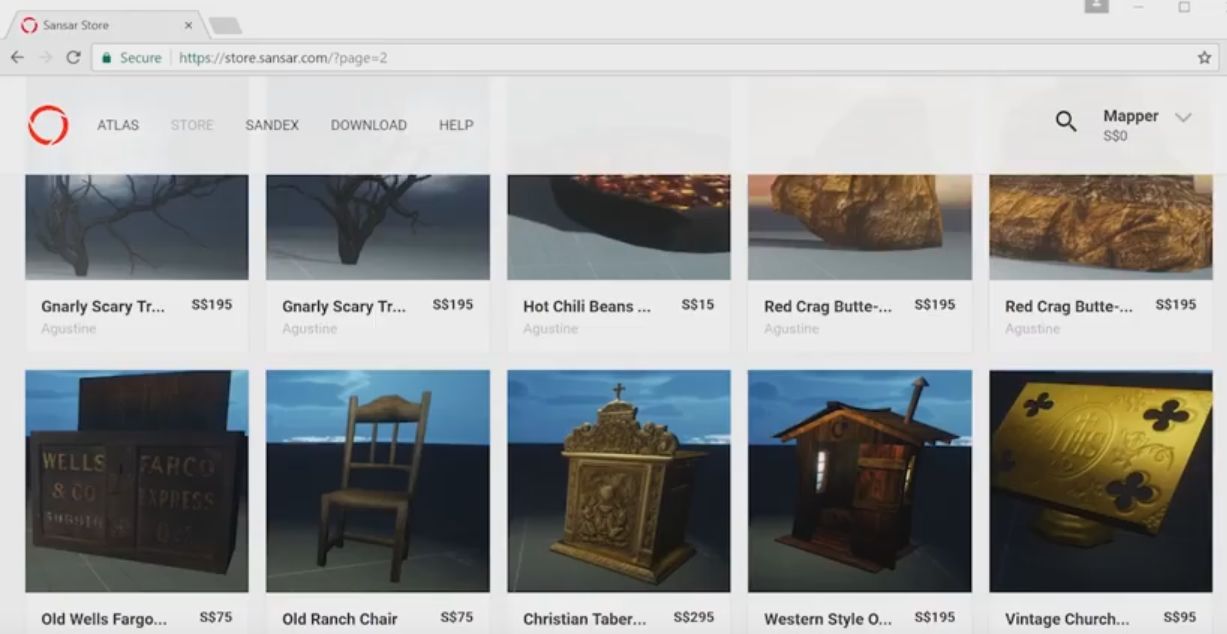
A glimpse of the Sansar marketplace – or store. Credit: Linden Lab

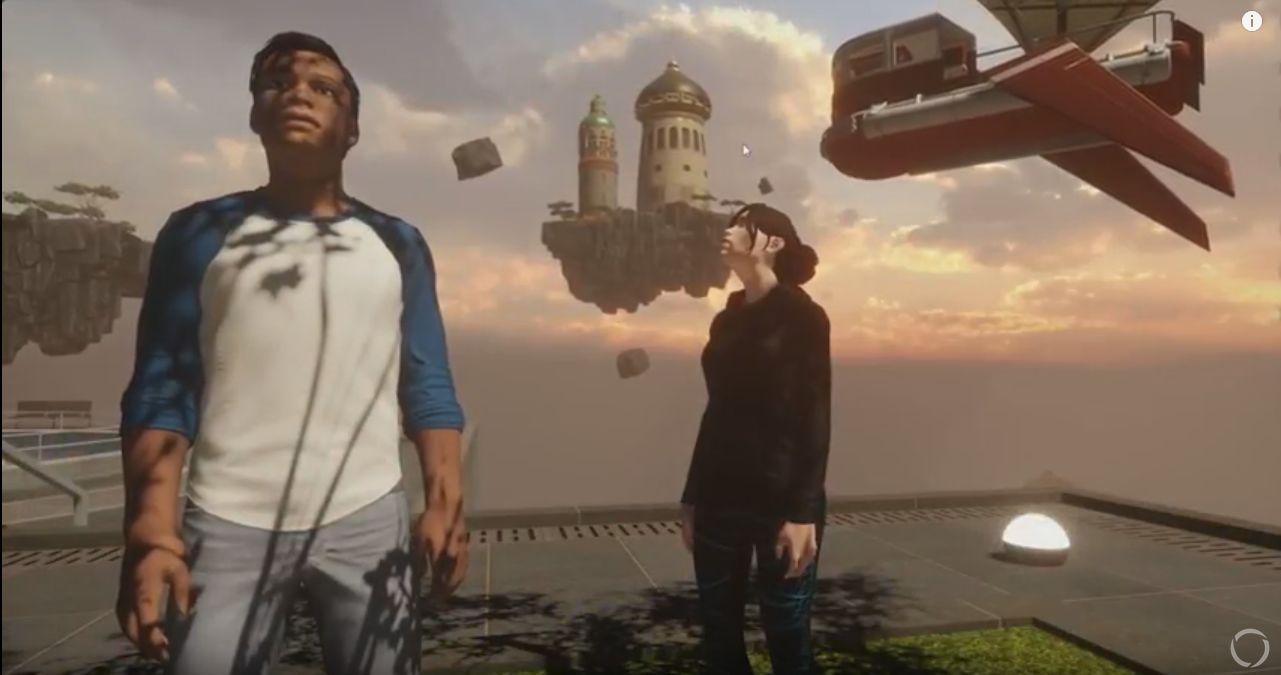
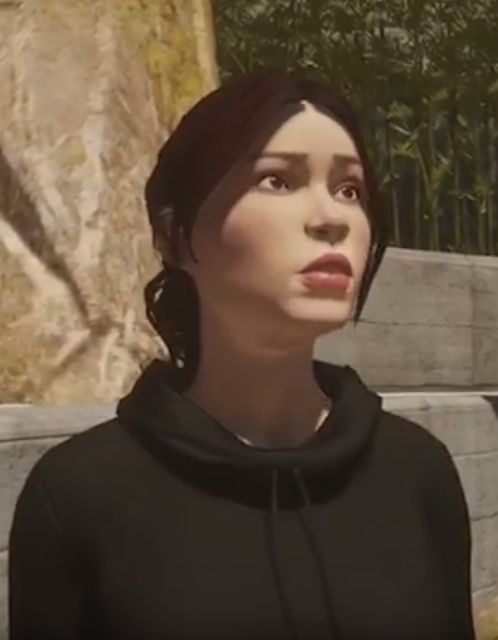
For me, some of the points of interest in the video are the snippets of the UI we get to see, particularly when in the edit environment, and the first close-up looks of Sansar avatars offered to the world at large. While the latter may well still be in development, they are already impressive, and potentially a match in looks for Second Life avatars.

A closer look at a Sansar avatar. Credit: Linden Lab

Admittedly, the avatars shown in the video are all restricted to humans, so we don’t get to see the fully range of potentials, but again given that Sansar is being pushed towards the idea of “social VR”, where people are interacting with one another as humans, the emphasis shouldn’t be seen as negative. There’s also the fact that it’s unclear at the moment how far down the road the avatar system is when it comes to supporting non-human avatar types.

Voice syncing is also very cleverly indicated in the video, when the female voice used to narrate the piece is smoothly integrated with a Sansar avatar right at the end of the video, suggesting she has been our guide through this inside look.

A further point of interest for me is the video closes by adding a strapline to Sansar: Created Reality.

Back in September 2015, Ciaran Laval and I ruminated on a domain name filing made by the Lab around the time that the company was filing papers for “Project Sansar” and “Sansar” (see “Created Reality”- possible contender for Project Sansar’s name?). At the time we speculated whether “Created Reality” might be a possible alternative name for the Lab’s platform (still  at that time known only by the “internal” name of “Project Sansar”). Obviously, that didn’t prove to be the case – but it is still interesting to see the term, if not the domain, finding use in reference to the platform

And for those wondering when they’ll be able to step into Sansar, the video offers “Spring 2017”. But enough of the waffling. Here’s the video.

Sansar via Road to VR: opening “first half” of 2017, monetisation and sundry thoughts

The new Sansar logo (courtesy of Linden Lab)
Sansar. Image courtesy of Linden Lab

In ‘Sansar’ Will Open to All in First Half of 2017 with a New Approach to Virtual Worlds (January 15th, 2017), Ben Lang of Road to VR becomes the latest tech journalist to sit down with Linden Lab to try out and discuss Sansar.  While he covers a lot of what has come to the for in other, similar recent articles, he also provides some further confirmatory / interesting tidbits, some of which allow for a little speculative thinking.

The biggest piece of information is perhaps right up there in the title: Sansar will open in the first half of 2017 (my emphasis). This actually comes as no surprise, as Sansar is a new project, and time frames for new projects of any description tend to slip a little as the work progress. Further, and as I noted in discussing Dean Takahashi’s recent look at Sansar, a degree of slippage appeared to be on the cards when he referred to Sansar opening to the public in “early” 2017, rather than the “Q1 2017” the Lab had previously indicated might be the case.

Ben Lang, Road to VR

At the top of the article, Lang touches on the aspect of Sansar being focused on “creators” rather than “consumers”.  Again, as I’ve previously mentioned, defining “creator” here is perhaps important.

By and large, “creator” in SL tends  to be used in reference to those who design and make the goods we use to dress our avatars and furnish our land. Outside of lip service, it’s perhaps not a term closely linked with those who obtain land in SL and create environments using the goods they have purchased, rather than building and scripting everything themselves. With Sansar, however, it is pretty clear “creator” is intended to encompass both, and thus perhaps encompasses a broader cross-section of users than might be seen as the case with Second Life.

The focus on “creators” shouldn’t be taken to mean Sansar is “only” for “creatives”. Spaces hosted on the platform will obviously require an audience, be it the public at large or drawn from specific, more niche audiences. It simply means that from a technical standpoint (and most likely outside of the UI), Sansar’s focus is tipped towards those wishing to build environments within it. As an aside to this whole “creator” thing, it’s also worthwhile noting that where previous articles had pointed to around 600 creators being involved in Sansar’s Creator Preview, Lang mentions the number might be around 1,000.

Further into the article, Lang references moving between Sansar spaces, specifically noting “hopping” from one to another via web pages. This is unlikely to be music to the ears of many in SL; however, it’s important to note that this approach is not necessarily the only means to move between experiences.

In the past, Ebbe Altberg has mentioned the potential for “portals” between environments which might be see as “linked” (although it is by no means certain this idea is still be pursued). More particularly, in June 2016, when talking to Mark Piszczor of Occipital about Sansar, he referenced the idea of “teleporting” between Sansar spaces, and more recently we’ve had a glimpse of a Destination Guide style capability in Sansar (apparently called “Atlas”) for moving between different spaces.  So the web page approach might simply be one of several means to get from space to space in Sanar. Time will tell on that.

Inside Sansar. Credit: Linden Lab, via Road to VR

When referencing creators being able to monetise their creations, Lang touches on the previously noted ideas of selling virtual goods and creations (up to and including entire experiences) through the Sansar marketplace, and the potential for creators to charge people an entry fee to their experience if they wish. However, beyond this, Lang indicates some of the broader brainstorming going on at the Lab – such as the ability for consumers to pay money to a virtual object which would hold the money and pay it out to its owner at regular intervals.

As Lang points out, this opens the doors to a whole range of potential items – pay-to-play pool tables, vending machines (think broader than the gacha machines we see in SL), rides, etc. So –  and slipping into the realm of pure speculation for a moment – might this allow experiences creators to “rent out” their experiences – say an events venue – to others, and receive a fee each time it is used / instanced anywhere in Sansar, rather than simply selling them for a one-off fee on each copy purchased? The could be an intriguing route to take, if at all possible.

Might Sansar offer the means for experience creators to "rent out" their spaces as a means to monetise them?
Might Sansar offer the means for experience creators to “rent out” their spaces as a means to monetise them? Credit: The O2 Arena

But to come back to Lang’s Road to VR article. He notes that in terms of capabilities, Sansar’s graphics are “actually quite good”, although the physics are lacking. The former is perhaps something of a step down from verdicts passed by other journos, while the latter is promised to be improved in a forthcoming update. He also underlines the “style agnostic” approach to Sansar, which again is a potential differentiator to SL in that creators of experiences in Sansar are likely to have far greater freedom in how they visualise the spaces then build than can be achieved in Second Life.

Overall, ‘Sansar’ Will Open to All in First Half of 2017 with a New Approach to Virtual Worlds, makes for a further interesting read on Sansar, offering some apparent insights that help build the picture of what the world at large might expect once allowed in the platform. Definitely worth a read – as are the comments which follow it.

Sansar: preview video more images, currency and monetisation

The new Sansar logo (courtesy of Linden Lab)

On Wednesday, January 4th, Linden Lab issued a “showcase” video alongside the public launch of the Sansar YouTube channel.

The launch of the channel is part of the Lab’s promise to gradually reveal more and more of the platform as they move towards opening the doors to public access. Its launch was accompanied by some in-depth media pieces in which Sansar is discussed in far more details than has until now been the case – including word on the platform’s currency, and the overall progress on the platform towards public access.

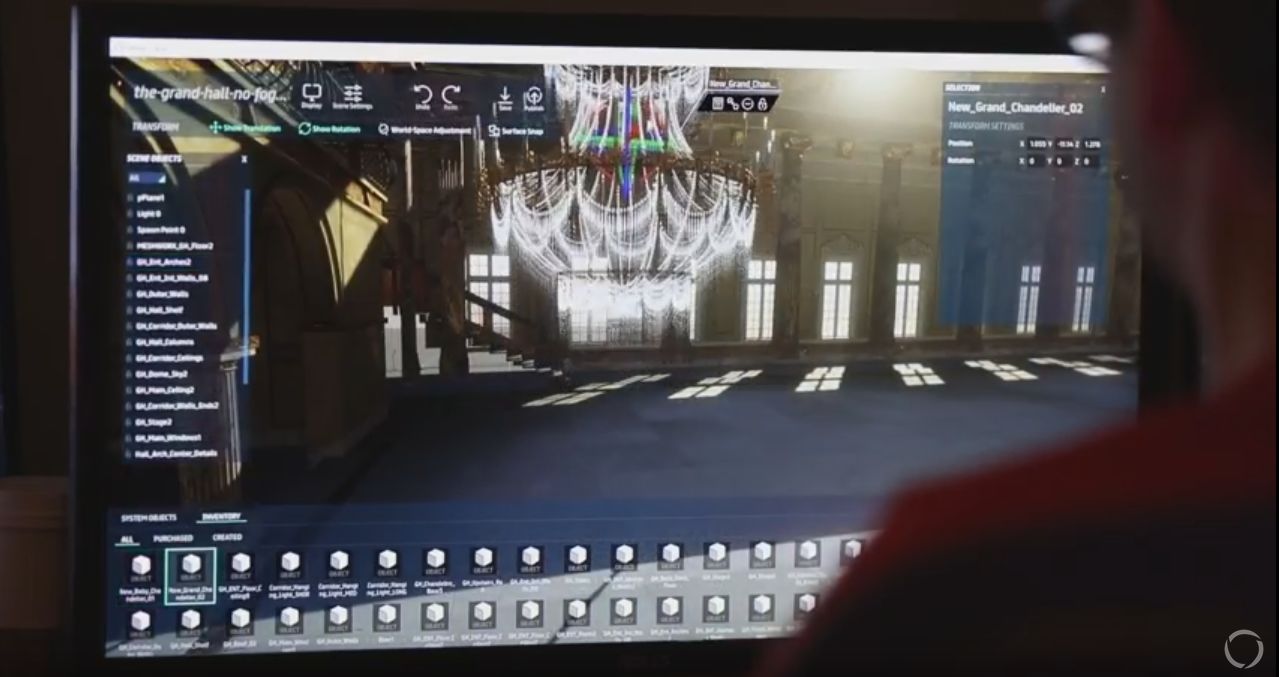
The video itself – embedded at the end of this article –  was filmed by Draxtor Despres and features Loz Hyde of Meshworx fame,  the video runs to just over 1 minute 30 seconds, and demonstrates the build environment of Sansar as used without a headset and controllers as Loz puts together a grand hall.

Loz Hyde working in the Sansar editing environment
Loz Hyde working in the Sansar editing environment. Credit: Linden Lab / Draxtor Despres

There’s actually not a lot to see in terms of the mechanics of the environment, but Loz’s view of the overall rendering (by which I assume he means the run-time environment, is “amazing”.

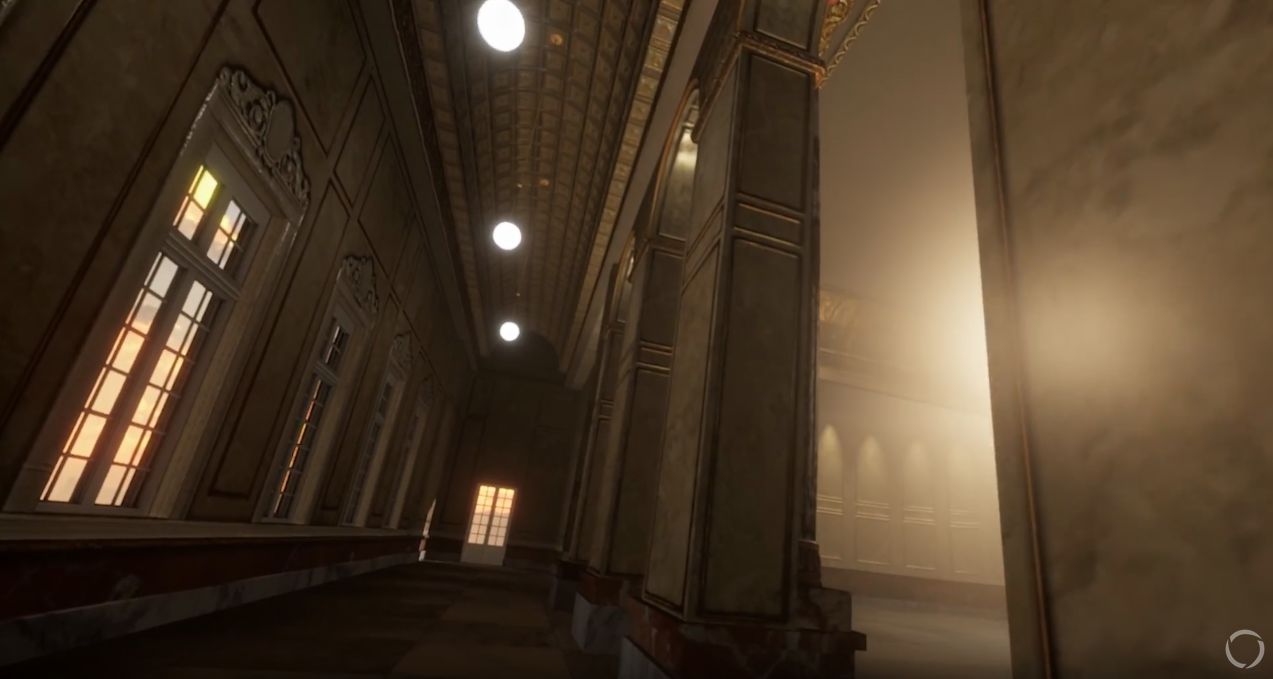
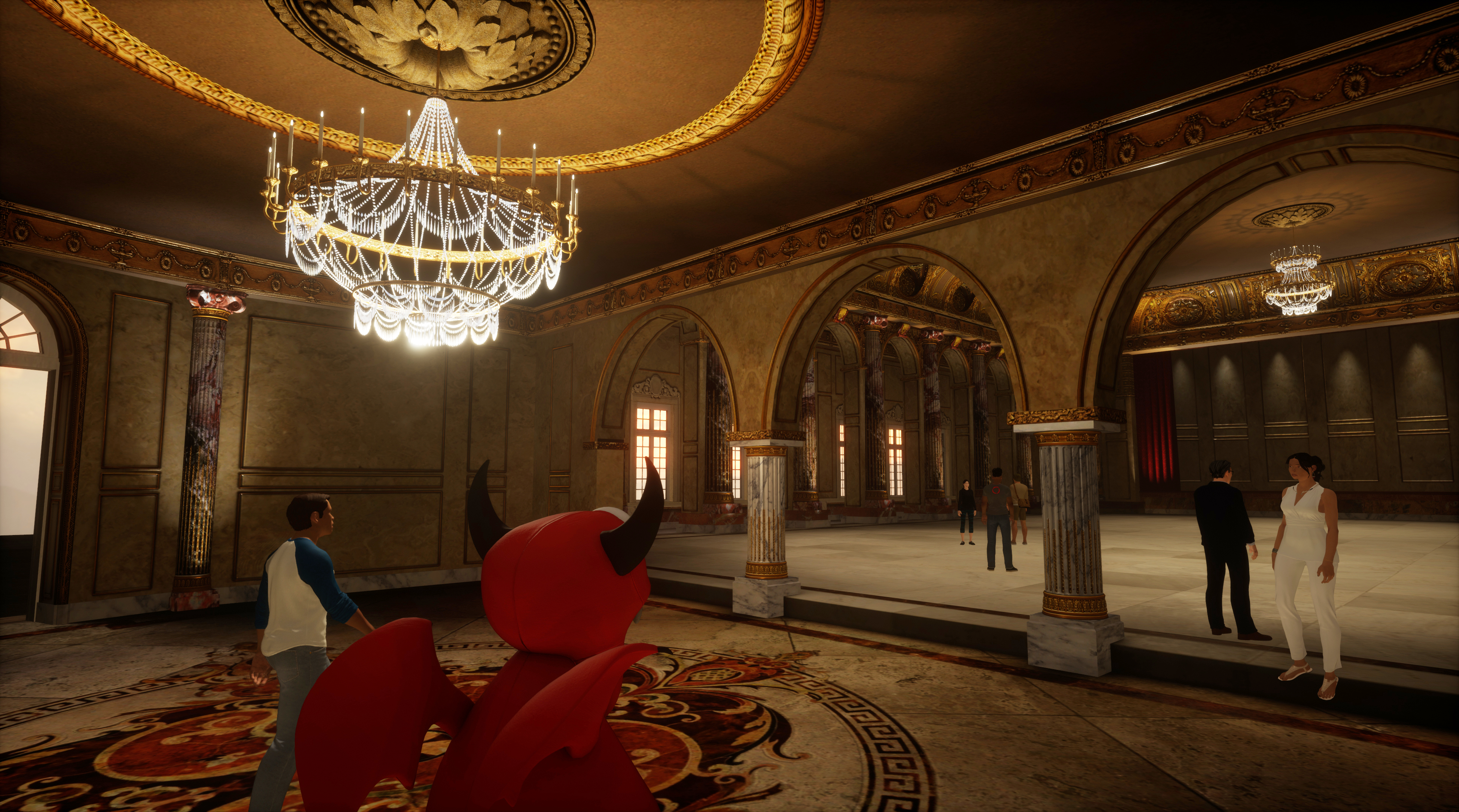
We do get to see the latter as well – or what appears to be the latter – when Drax takes us inside via a HTC Vive. The environment, lighting and detail certainly looks impressive, but again, may from SL are liable to be unimpressed with the detail shown, simply because it is a single interior space, and nothing is shown of it in situ as it were. Hopefully more comprehensive shots of spaces within Sansar will come in time. Certainly what is shown offers an impressive taster of what can be achieved in terms of architecture and fittings.

Inside Sansar - the run-time environment (?)
Inside Sansar – the run-time environment (?). Create by Loz Hyde. Credit: Linden Lab

Elsewhere come hints of the size of the Creator Preview programme, and why content creators like Loz are being asked to showcase their work, with the Lab’s CEO noting:

We have over 12,000 creators registered for access to the platform, so we have way more creators than we need to get the feedback, and to ensure they get the tools they need to be successful. We’re really asking these early creators to explain what it is they want to do in Sansar, and if we think the platform is not yet ready to do that, we’re asking them to wait.

Of these 12,000, around 500-600 have so far been accepted into the Creator Preview, and the Lab has revealed that the Sansar currency is now in operation: the Sansar Dollar (S$), which will be traded on the SandeX  – both of which, I assume – are operated under LL’s subsidiary, Tilia Inc, and are something of a port of the facilities and “currency” services the lab built around the Linden Dollar and LindeX. Like the Linden Dollar, the Sansar Dollar will be exchangeable for fiat money, and the system supports payout at least via PayPal.

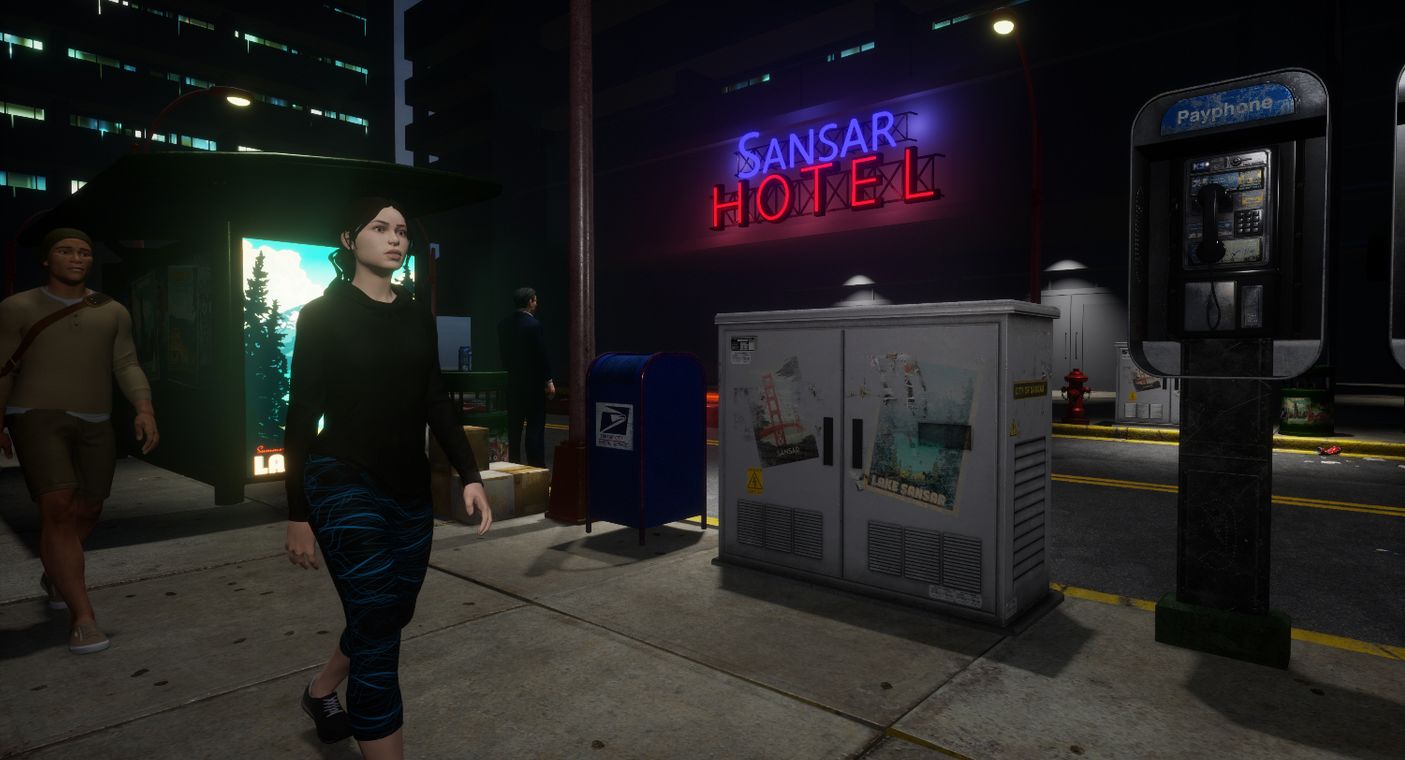
Sansar Avatars. in a city street scene in Sansar created by Paul Lapointe Credit: Linden Lab

What’s interesting here is that the “currency” system (the Lab will doubtless refer to Sansar Dollars as “tokens”), is that it is in operation, with the creators currently engaged in Sansar able to buy and sell their creations among themselves, with the Lab’s Director of Global communications, Peter Gray, noting:

With this new step, they’re [creators] also able to start buying and selling their creations with one another. And so, it’s the start of that sort of economic engine that’s getting warmed up in this creator preview period, and ultimately it will expand. Today they’re able to buy and sell items—pieces of content, but ultimately, creators will be able to monetize entire experience.

This actually makes a lot of sense, not only in terms of kick-starting the Sansar economy and establishing a nascent revenue model for both creators and the Lab, it also means that Creators and leverage one another’s creations to build out their experiences and  – as Peter Gray notes – sell those on as well.

How much the Lab might be generating in revenue from these initial creator-creator transactions – given a “sales tax” is a core part of the revenue model – isn’t indicated (I would actually be surprised if any is at this point being leveraged – outside of a “purchase fee” for S$, simply because the Creator Preview is supposed to be a cooperative venture). However, Dean Takahashi at VentureBeat notes, there will also be a small “hosting fee,” or a property tax equivalent in the real world, for the spaces that you create in Sansar. Again, this isn’t entirely a surprise, but seeing it stated clearly is interesting.

Like the L$, the Sansar Dollar will operate on a user-to-user basis, with the Lab functioning as an exchange operator, not a bank. Currently the exchange rate is running at around S$100 per US dollar, making the S$ more expensive than the L$. However, this is only an initial exchange rate; ultimately, the Lab expects the market to define the exchange rate naturally, so the value might over time move towards something more in keeping with the L$.

Inside Loz Hyde's creation. Credit: Linden Lab / Draxtor Despres
Inside Loz Hyde’s creation. Credit: Linden Lab / Draxtor Despres

One risk that comes with opening the exchange mechanism to a limited audience of users (creators) is the risk that the exchange itself could be manipulated through things like volume purchases of S$. The Lab is seemingly aware of this with CEO Ebbe Altberg noting that various caps are in place and thresholds are deliberately low at this point in time.

For those hoping to get into Sansar “soon” as a part of the opening-out to the public, the interviews accompanying the video release suggest that they might have to remain patient:

Toms Hardware: So, you’re running the private creator preview for Sansar for the next quarter or so?

Ebbe Altberg: Yeah. We’re trying to be data driven in the process as opposed to date driven. I wouldn’t say we have all kinds of luxuries and that we’re taking our sweet time, but we want to make sure that it’s incredibly great by the time any user can get access.

Again, this really shouldn’t be a surprise. As I’ve mentioned previously, building something like Sansar is a huge undertaking, one in which time frames are bound to slip. As such, we shouldn’t be holding

T articles from VentureBeat, Tom’s Hardware and UploadVR cover a lot of ground, and I highly recommend reading them all – links below. In the meantime however, and to give myself more time to digest them, I’ll leave you with the preview video.

Media Links