Space Sunday: Jupiter revealed, methanol found

Jupiter’s chaotic polar regions as revealed by JunoCam. Credit: J.E.P. Connerney et al., Science (2017)

The first science findings from NASA’s Juno mission were published at the end of May 2017, revealing Jupiter to be far more complex a world than had been previously envisioned.

The Juno mission hopes to answer many questions about Jupiter – the structure and composition of its atmosphere, a greater understanding of the forces driving that atmosphere and the distinctive upper layer cloud formations, its magnetic field, weather patterns, and so on. It is also hoped the mission will resolve the question of what actually lies at Jupiter’s core.

Two theories have tended to dominate thinking around the latter: that Jupiter either has a relatively compact solid core 1 to 10 times as massive as Earth or it has no solid core at all, just gases compressed to a liquid state. However, the data returned by the spacecraft since it arrived in orbit around Jupiter in July 2016 doesn’t support either hypothesis. Instead, it suggests Jupiter has a large, partially dissolved core of ices and rock.

Juno is probing deep into Jupiter’s atmosphere in an attempt to understand the planet’s structure and driving forces Credit: NASA/JPL / SwRI

This conclusion comes via measurements of the magnitude planet’s magnetic field, which has not only proven to be significantly higher than expected, but also exhibits large spatial variations, being significantly higher than expected in some locations, and markedly lower in others. These results suggest that Jupiter’s core has a molecular hydrogen layer which appears to be the dynamo layer driving Jupiter’s magnet field, sitting over a metallic hydrogen layer which gradually transitions into a “fuzzy core” of ices and rock.

The Juno data also suggest the turbulent “meteorological layer” of Jupiter’s atmosphere, where the familiar bands of cloud exist, extends downwards more than 1,000 km (625 mi), with the tropical zoning of banded cloud layers extending down to pressures of up to 100 bars – or 100 times Earth’s air pressure at sea level), before transitioning to slightly less turbulent regions.

It had been thought that somewhere beneath the cloud layers the gasses present in the atmosphere would be more well mixed. But again, the Juno data suggests otherwise. “We’re finding that that’s just not true at all,” Dr. Scott Bolton, Juno’s principal investigator said as the first set findings was published on May 25th. “There’s structure down deep, but it doesn’t seem to match the zones and belts. And so we’re still trying to figure it out.”

“What we’ve learned so far is earth-shattering. Or should I say, Jupiter-shattering,” he also stated. “Discoveries about its core, composition, magnetosphere, and poles are as stunning as the photographs the mission is generating. Juno is re-writing all we thought we knew about Jupiter.” It is also adding new mysteries to Jupiter’s story as well.

One of the most remarkable aspects of the Juno mission so far have been the amazing images of the planet’s north and south polar regions. Rather than being banded, as with the rest of the atmosphere, or uniformly regimented into a geometric form, like Saturn’s north polar region, the atmosphere over Jupiter’s poles is a chaotic mix of swirling cyclones and storms, some of them 1,400 km (870 mi) across, towering bove the bluish backdrop of Jupiter’s deeper atmosphere.

“it’s ‘s unclear what, exactly, drives these polar cyclones,” Bolton states. “Over the course of the mission, we’ll be able to watch the poles and see how they evolve. Maybe these cyclones are always there, but maybe they just come and go.”

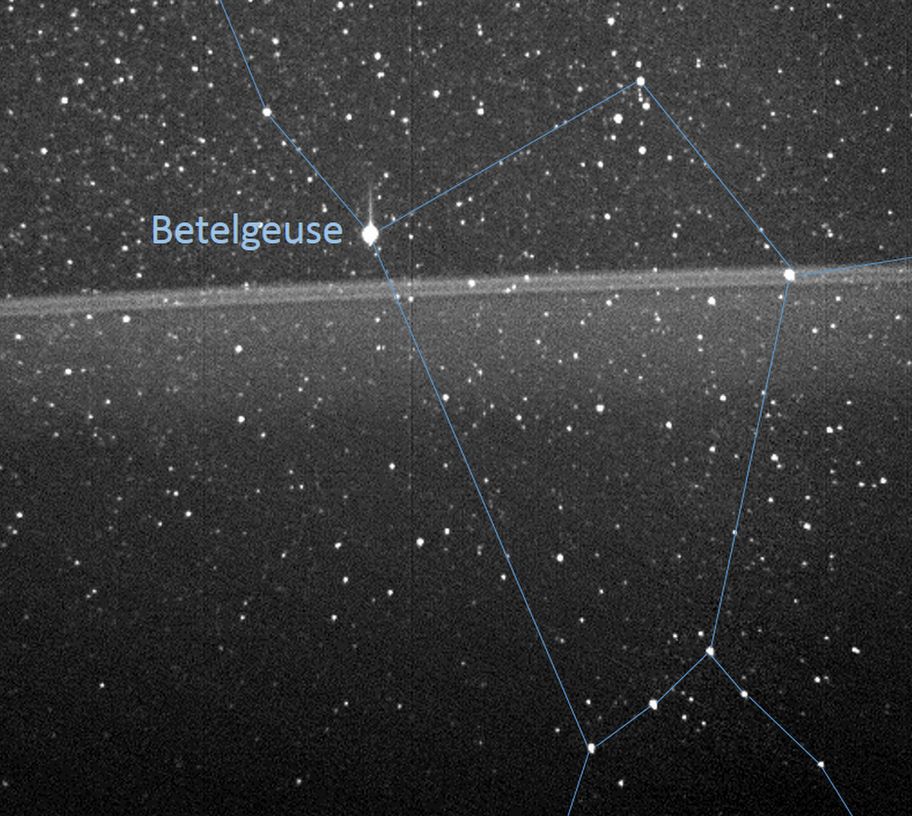
Captured by Juno’s Startracker navigational camera, is Jupiter’s ring system, which lies some 64,000 km (40,00 mi) out from the planet. Outlined in the backdrop of stars is the constellation of Orion (an excellent navigational aid), showing Betelgeuse (named), Bellatrix (Orion’s other shoulder, sitting on the line of Jupiter’s “gossamer rings”), and the stars apparently forming the line of Orion’s belt: Alnitak, Alnilam and Mintaka (l-to-r) sitting below the haze from the broadest and innermost ring as it disperses sunlight. This image was captured by the Juno mission on August 27th, 2016, during the vehicle’s first operational pass over Jupiter’s cloud tops. Credit: NASA/JPL / SwRI

Juno has also suggested the cause of Jupiter’s auroral displays might be more complex than previously thought.

Earth’s auroras result when the solar wind — charged particles streaming from the sun — are funnelled by the planet’s magnetic field to slam into the atmosphere over the north and south pole in a complex two-way interaction which results in the glow of the northern and southern lights.

It had been thought to be the massive flux tube linking the polar regions of Io, Jupiter’s innermost Galilean moon, and Jupiter’s own polar regions was the driver of the planet’s auroral displays thanks to the 5 million ampere electrical current flowing through the flux. However, data from Juno, which has been combined with observations from Japan’s Hisaki  satellite and the Hubble Space Telescope suggest the gases spreading outward from Io as a result of its extreme volcanism, undergo a complex interaction with the “shock wave” formed by the solar wind as it strikes the outer limits of Jupiter’s massive magnetic field.

An auroral display over Jupiter’s south pole captured by Juno. Shown if false colour, the light colours indicate auroral emissions at high altitudes, the redder colours, those occurring deeper into Jupiter’s atmosphere. Some of these may be caused by the flux tube interaction between Io and Jupiter, others possibly by the energetic interaction involving gases from Io and the solar wind. Credit: NASA/JPL / SwRI

This interaction deflects energy from the gases back towards Jupiter at velocities of between 400 and 800 kilometres a second (250 and 500 miles per second). When this energy strikes and penetrates Jupiter’s atmosphere, it gives rise to bright, transient aurora. In addition, it is being theorised that this energy, when it reaches icy Europa and Ganymede – both of which are thought might harbour basic life in the oceans beneath their icy crusts, could provide support for chemical processes on their icy surfaces. This is liable to be something scientists will be considering carefully as more data from Juno is scrutinised.

Continue reading “Space Sunday: Jupiter revealed, methanol found”

Space Sunday: planets, stars and spacecraft

Artist’s impression of the planet Proxima b orbiting the red dwarf star Proxima Centauri, the closest star to the Solar System. Credit: ESO/M. Kornmesser

Proxima b, the planet discovered orbiting the closest star to our own, Proxima Centauri (see here for more), has been the subject of much speculation regarding its potential habitability (see here for more). Now a new study is underway which may bright us a lot closer to understanding the conditions on the planet.

Located 4.25 light years away, Proxima Centauri is a M-type red dwarf star. Such stars are highly variable and unstable compared to other types of stars, and this might weigh heavily against Proxima b having the right conditions for life to arise. The new study involves a team of astrophysicists from the University of Exeter, England, and staff from the UK’s Meteorological Office, who have been using the latter’s state-of-the-art Unified Model (UM).

This infographic compares the orbit of the planet around Proxima Centauri (Proxima b) with the same region of the Solar System. Credit: ESO

Used to study Earth’s atmosphere, with applications ranging from weather prediction to the effects of climate change, the Unified Model allowed the team to simulate what Proxima b might be like if it had a similar atmospheric composition to Earth, and also what it might be like if had a much simpler atmosphere – one composed of nitrogen with trace amounts of carbon dioxide. Last, but not least, they made allowances for variations in the planet’s orbit.

This last point is important because given the planet’s distance from its parent – around 7.5 million km (4.6 million mi) – Proxima b is likely to either be tidally locked so that one face constantly faces its sun, or it is in a 3:2 orbital resonance, rotating three times on its axis for every two orbits around its sun. In the former situation, the main atmospheric gases on the night-facing side would likely freeze, leaving the daylight zone exposed and dry; in the latter, a single solar “day” would last a long time, resulting in the sunward side of the planet being extremely hot and day and the night side very cold and dry.

Taking all of this into account, and using data from previous studies, the UK team found that Proxima b, with either a complex or a simple atmosphere, could have regions where water might exist in liquid form. In addition, any substantive eccentricity in the planet’s orbit around its sun could further increase its potential habitability.

It will still be some time before more can be directly discerned about Proxima b, but it is hoped that the study will help in our understanding of the potential habitability of other exoplanets, and demonstrates how the study of conditions here on Earth can be used to predict what may exist in extra-solar environments.  It may also improve our understanding of how our own climate has and will evolve.

US Military “Close” To Awarding Spaceplane Contract

The US Defence Advanced Research Projects Agency (DARPA) is reportedly “close” to awarding a contract to build its XS-1 spaceplane launch vehicle.

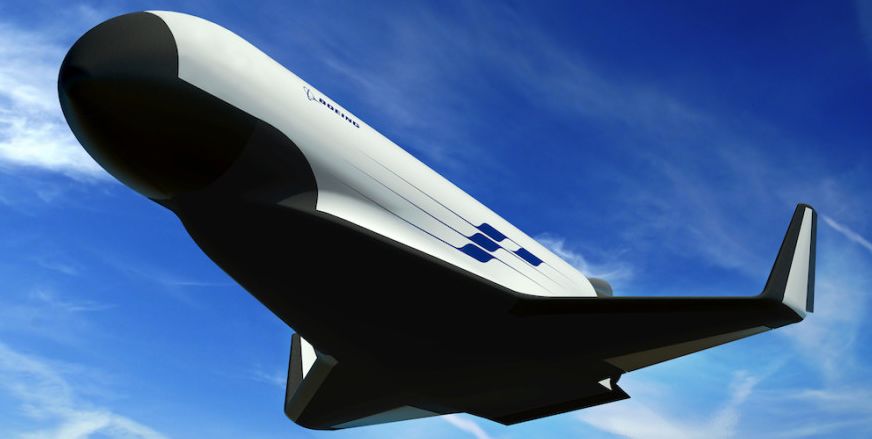
An artist’s impression of the Boeing XS-1 concept vehicle

Announced in 2013, the XS-1 is intended to provide the US military with the means to rapidly deploy small satellite payloads to Earth orbit using a re-usable first stage and expendable upper stage which may be carried piggyback by the first stage vehicle. The goal of the programme is to provide an uncrewed launch vehicle capable of delivering payloads of up to 2,300 kg (5,000 lb) to orbit, which can be rapidly re-used – the target of the development programme is to have the vehicle complete 10 launches in 10 days. In addition, the vehicle must:

  • Be capable of hypersonic flight to Mach 10 (12,250 km/h) or higher
  • Lifting an expendable upper stage unit which it can then launch, and which can carry the payload to orbit
  • Operate with a launch cost less than 1/10 that of current launch systems (i.e. around US $5 million per flight).

Three groups of companies were awarded initial design concept contracts:  Boeing and Blue Origin, Masten Space Systems and XCOR Aerospace, and Northrop Grumman and Virgin Galactic. None of these may be awarded the development contract, which is intended to see the project to a point where test flights could commence in 2020.

To be successful, the vehicle will make use of advanced materials, cryogenic tanks, durable thermal protection, and modular subsystems. These, coupled with a reliable, re-usable propulsion system, would make it possible for the vehicle to achieve the hoped-of low-cost, rapid launch and re-use capability.

Continue reading “Space Sunday: planets, stars and spacecraft”

Space Sunday: launches, storms, simulations, and space walks

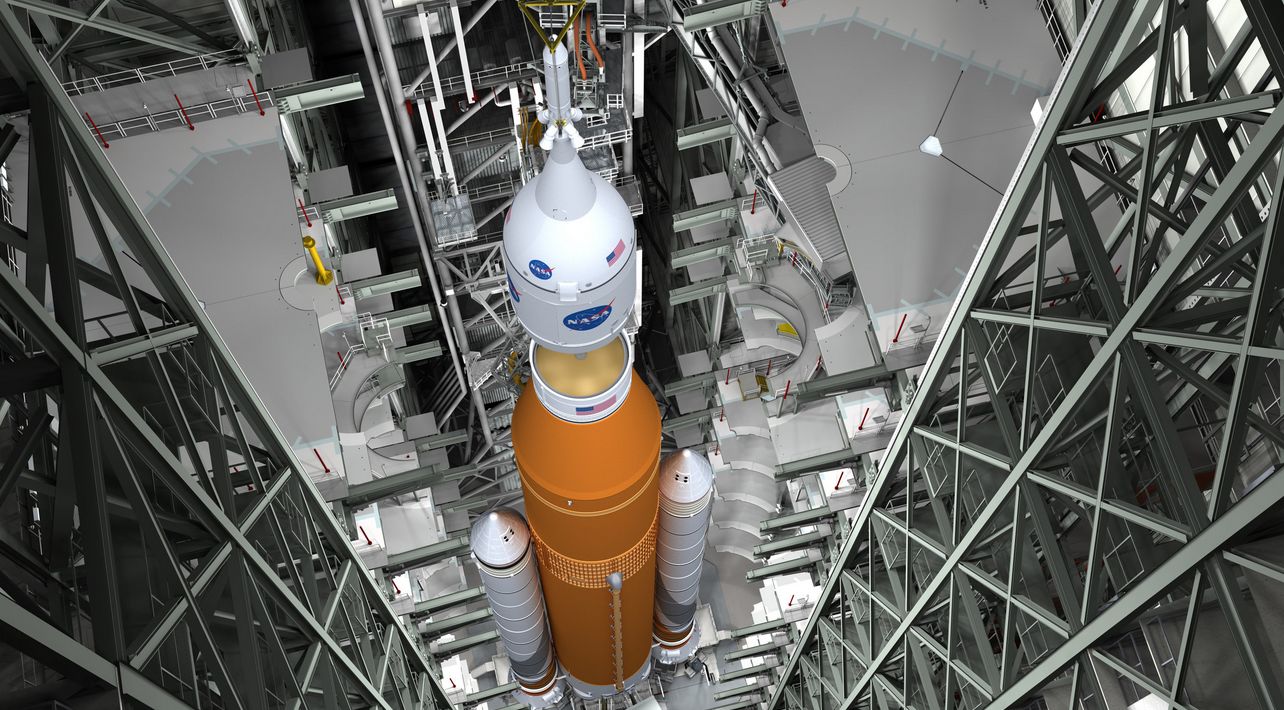
An artist’s impression of the Orion vehicle, in its launch shroud and with attached launch abort system, being attached to is SLS launch vehicle in NASA’s Vehicle Assembly Building. Credit NASA

NASA has confirmed the first flight of the Orion / Space Launch System (SLS) will not include a crew. As I recently reported, the US space agency had been considering shifting gear with with the new combination of launch vehicle and the Orion Multi-Purpose Crew Vehicle to include a crew on the maiden flight, referred to as Exploration Mission 1 (EM-1). The change in direction was prompted by a request from the Trump administration to acting NASA Administrator Richard Lightfoot, in an attempt to accelerate the human space flight programme.

On Friday, May 12th, Lightfoot indicated that while it would be technically feasible to make EM-1 a crewed mission, the agency would not do so on the grounds of costs. For an uncrewed flight, the Orion vehicle does not need to be equipped the life support, flight control and other additional systems a crew would need. would require. Doing so would require an additional expenditure of between US $600 and $900 million  – costs which would otherwise be deferred across several years in the run-up to the originally planned crewed launch for Orion / SLS – called EM-2, slated for 2021. However, EM-1 will still be delayed until mid-2019.

Orion’s first deep space mission, EM-1 will remain an extended uncrewed flight to cislunar space, and will take place around mid-2019. Credit: NASA

The reasons for the EM-1 delay are due to unrelated issues with various parts of the Orion / SLS programme. Again, as covered in recent Space Sunday updates, the European-built Service Module, which will provide the Orion capsule with power, consumables and propulsion, is running behind schedule. In addition, the programme is also experiencing delays in developing key software.

These issues mean that pushing back the EM-1 launch was fairly inevitable. Had NASA been able to comfortably combine equipping the Orion vehicle for a crewed launch in 2019, then it would have roughly coincided with the 50th anniversary the first human lunar landing by NASA astronauts Neil Armstrong and Buzz Aldrin during the Apollo 11 mission in July 1969.  Instead, NASA will continue implementing the current baseline plan, with the second Orion / SLS flight carrying a crew into space. However, this mission may also be pushed back beyond 2021.

Saturn’s Hexagon to Star in Cassini’s Finale

As I’ve been covering, the joint NASA-ESA Cassini mission to Saturn is now in its last phase, as the spacecraft makes a final series of 22 orbits around the planet, diving between Saturn’s cloud tops and its rings in the process.

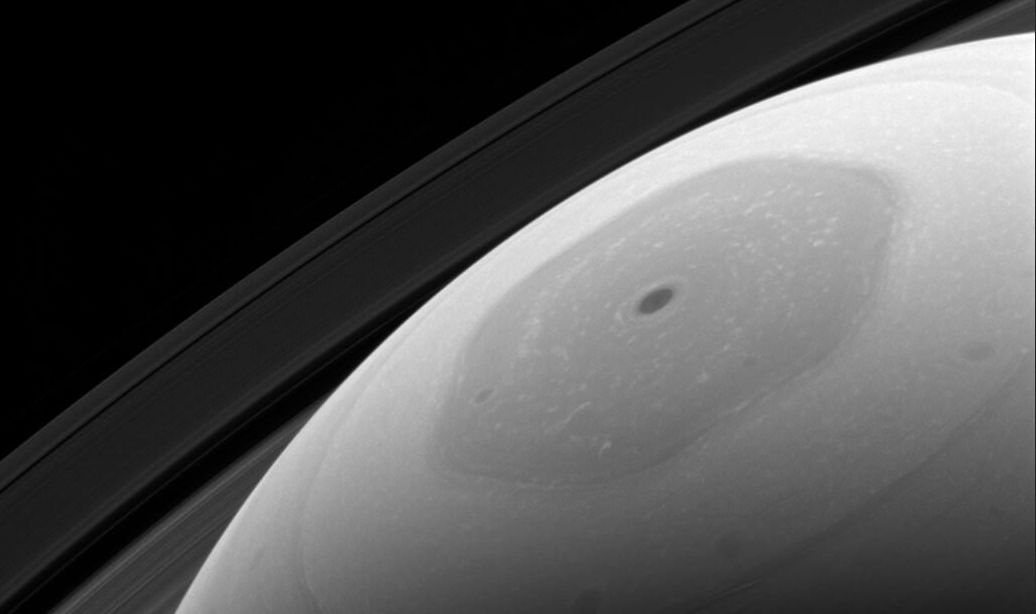
Saturn’s enormous north polar hexagonal storm, as imaged by Cassini on January. 22nd, 2017. Credit: NASA/JPL

However, in addition to exploring a region of space no other mission has properly examined, Cassini’s final series of orbits around Saturn provide an unprecedented opportunity to study the massive hexagonal storm occupying the atmosphere of the planet’s northern polar region.

First seen by the Voyager missions which flew by Saturn in 1980 and 1981 respectively, the storm is of a massive size – each side of the hexagon measures around 13,800km (8,600 mi), greater than the diameter of Earth.; it rotates at what is thought to be the speed of the planet’s interior: once every 10 hours 39 minutes. However, due to Saturn’s distance from the Sun (an average of 9.5549 AU) and its axial tilt (26.73°), the northern polar region only gets about 1% as much sunlight as Earth does; making steady observations of the storm difficult. Cassini’s final series of orbits, passing as they do over Saturn’s north pole offers a unique opportunity to examine the storm in some detail.

During the first passage between Saturn and its rings on April 26th, Cassini captured a string of black-and-white images of the region, include the vortex at the centre of the storm, which were subsequently stitched together into a short movie (above).

The passes over Saturn during these final orbits should allow Cassini to use its wide-angle camera to gather detailed images of the storm whenever possible, which may in turn help scientists probe its secrets – including what is powering it, and why it has such a clearly defined boundary between itself and Saturn’s atmosphere at lower latitudes.

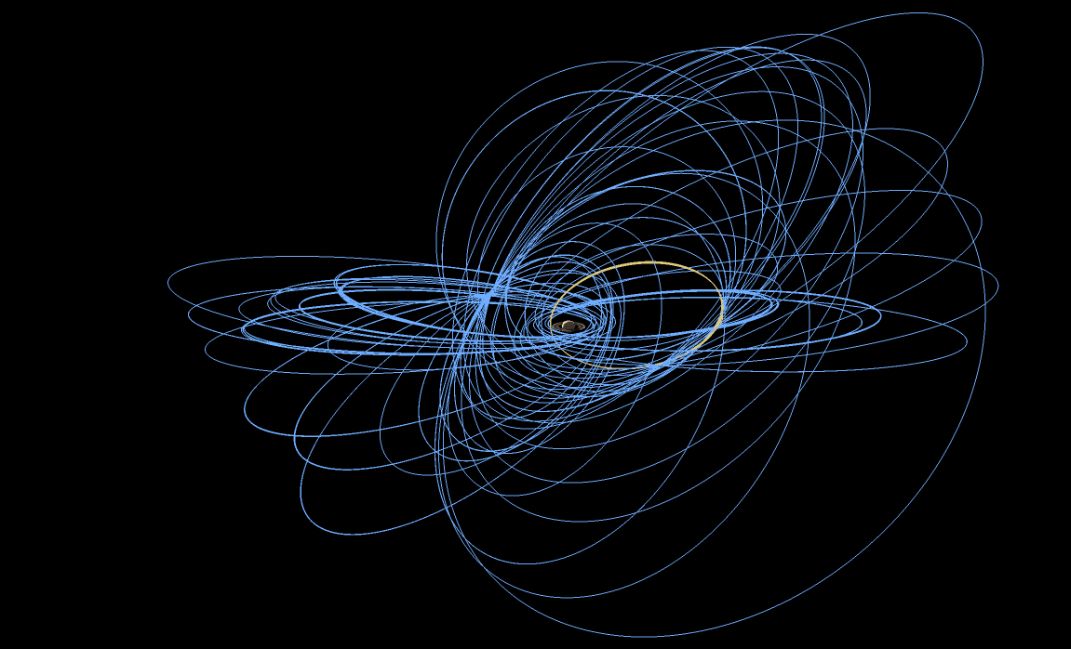
Graphic of some of Cassini’s many orbits around Saturn, which over the years have been designed to allow study of some of Saturn’s moons as well as the planet. Credit: NASA

Cassini has already completed two “ring dives”, with the third scheduled pass occurring on Monday, May 15th. The mission as a whole will end on September 15th, when the vehicle will enter the upper reaches of Saturn’s atmosphere and burn-up.

Continue reading “Space Sunday: launches, storms, simulations, and space walks”

Space Sunday: solar systems, flying telescopes, and spaceplanes

An artist’s impression of the Epsilon Eridani system, which might be very similar to our own. Credit: NASA/JPL

To Babylon 5 fans, Epsilon Eridani is (will be?) the home to our “last, best hope for peace”. To some loosely versed in Star Trek lore, it is credited as being the star orbited by the planet Vulcan (although somewhat more officially, Vulcan is placed in the 40 Eridani star system). To astronomers, it is a very Sun-like star some 10.5 light years away, which may be the home of two (or more) planets. And now it appears it is something of a younger version of our own solar system.

The star has long been of interest to astronomers as  the possible location of exoplanets, and in 1987, it appeared as if a Jupiter-sized planet had been discovered orbiting Epsilon Eridani at roughly seven times the distance of the Earth from the Sun, and with an orbital period of some 7 terrestrial years. Initially called Epsilon Eridani b, the planet has been strongly contested over the decades for assorted reasons – even though in 2016 it was granted a formal name: AEgir (sic).

Observations of the system also revealed that the star appears to be surrounded by a cometary ring, somewhat akin to out own Kuiper Belt, and in 2008, the Spitzer Space Telescope revealed that the Epsilon Eridani system may have two major asteroid belts. the first of which correlates to the position of the asteroid belt in our own system, and the second, much broader and denser belt lying roughly at the same distance from the star as orbit of Uranus around the Sun.

The Epsilon Eridani system compared to our own. Credit: NASA/JPL

Like Epsilon Eridani’s planets, the existence of the debris material surrounding the star as two distinct asteroid belts has been contested.Because the Spitzer data failed to indicate a clearly defined band of “warm material” of gas and dust within each of the rings, it has been hypothesised that rather than being two individual belts, they might actually mark the inner and outer boundaries of a single accretion disk.

The difference here is important. If the debris exists as to separate rings of material, it raises the prospect that there are planetary bodies orbiting Epsilon Eridani which may have both helped order the rings and remove debris from the space between them. If there is only one extended accretion disk around the star, it reduces the potential for planets having formed. Now the results of a 2-year study, published in the April edition of Astronomical Journal, sheds new light not only on the asteroid belts, but on the Epislon Eridani system as a whole.

The study, led by Kate Su, an Associate Astronomer with the Steward Observatory at the University of Arizona, used data gathered during a 2015 observation of Epsilon Eridani by the remarkable Stratospheric Observatory For Infrared Astronomy (SOFIA) observation platform developed by NASA and the German Aerospace Centre, DLR. This is a specially modified 747 jet aircraft designed to carry out extended studies of celestial targets.

The Stratospheric Observatory for Infrared Astronomy (SOFIA) observation platform developed by NASA and the German Aerospace Centre, showing the open observation bay at the 2.5 optical telescope. Credit: NASA

Operating at almost 14 kilometres (45,000 ft) altitude, SOFIA flies well above the major distorting effects of Earth’s atmosphere, allowing it to use a 2.5 metre optical telescope with 3 times the resolution power of Spitzer, together with an ultra-sensitive infra-red imaging system called FORCAST, the Faint Object infraRed CAmera for the SOFIA Telescope, to observe targets.

Su and her team used the data gathered by SOFIA’s 2015 observations of Epsilon Eridani, coupled with the Spitzer data and the results of other ground-based observations of the star to build a series of computer models of the system. The results of the models tend to very much confirm that Epsilon Eridani does have two asteroid belts, each with its own distinct “warm band”, and that there could be at least three Jupiter-sized planets within the system helping to organise the rings.

Inside SOFIA. Credit: USRA / NASA / DLR

Not only that, but the study suggest that the Epsilon Eiridani system might be directly comparable to our own as it was not long after the inner planets formed.  If this is the case, the study of Epsilon Eridani could help astronomers gain greater insights into the history of our own Solar System.

Continue reading “Space Sunday: solar systems, flying telescopes, and spaceplanes”

A salient warning about “social VR”?

Will social VR of the kind currently being developed really be what a mass market is looking for? (image via Upload VR)

Balaji Krishnan appears to be a man on a mission: to offer a wake-up call to those engaged in the nascent world of “social VR” that the kind of future they’re chasing might not exist. He’s most notably pursuing this mission in op-ed pieces. In March he put his case Upload VR under the succinct title: In Why Social VR Probably Won’t Work the Way Social VR Developers Think, (subsequently reprinted on May 1st by PSFK.com). In April he followed it up with a more targeted piece for VentureBeat: Sorry, Zuck: AR & VR won’t replace TVs or phones.

In the first article Krishnan – the founder and CEO of Dabkick, which credits itself as developing the first “true Social VR experience“, states his case pretty clearly through the title of the Upload VR article: that social VR may not work the way most “social VR” developers – he notes Valve, High Fidelity, AltSpace VR, Linden Lab and Facebook in particular – expect.

Balaji Krishnan

This is not to say he thinks these will fail; rather than they won’t achieve the kind of mass-market prevalence we’ve seen with the likes of smartphones – the technology VR is often touted against as having the same disruptive potential.

Now, to be fair, I don’t agree with all of his points. In particular, the slow growth in the volumes of shipped headsets to date is not indicative that they won’t grow faster in the future; particularly as the technology finds its footing and the price-point computational power required for high-end systems comes down and overall quality and ergonomics of headsets improves with future generational developments. But – and here’s where I do agree with Krishnan: the hardware and the price-point aren’t the key to getting VR to appeal to a mass market.

Rather, the key to getting VR viral in the manner of smartphones is presenting it as having a convenient relevance to people – whether as a source of entertainment or social engagement or business or gaming or whatever – that’s important. And that’s actually a tough nut to crack.

The pervasiveness of smartphones is in part down to their sheer convenience and in part down to the organic way in which their capabilities have naturally grown to encompass applications and uses outside of voice communication. In trying to find the “killer app” for VR, it feels as if it is being forced down various paths in which it is unlikely to succeed in the same way as the smartphone (image via the BBC)

Take smartphones for example – as Krishnan does.That they have become a central pillar of many people’s social activities, spawning an entire ecosystem of applications and opportunities for sharing and creative experience wasn’t planned or engineered from the outset. It came about because someone realised that just as MP3 players could offer music on the go, then so could a ‘phone. And if you stuck a camera on a ‘phone, people might like to take pictures with it. It was an organic process – one which never lost sight of the ‘phone original intent: a convenient means of communicating, and built on that convenience over time until the smartphone became an indispensable part of our daily lives.

DabKick’s “social VR experience”

However you look at it, VR isn’t anywhere close to the ubiquitous nature of something like a smartphone – nor, really, can it be.  So trying to present or engineering a future where it can be is perhaps shooting wide of the mark. And really, the idea of “social VR” is another way of trying to engineer a future for VR which might not really stand up to the litmus test of what a “mass market” actually wants.

As it is, we’ve had around a decade of organic development and growth of a “digital social ecosystem”; one that offers many, many ways of engagement which are flexible enough to meet our needs wherever we are, and whatever we’re doing.  Krishnan argues that if “social VR” is to succeed, it must feed into this ecosystem, nurture it, support it and add value to it; seeking to simply “revolutionise” it isn’t enough. It must be intuitive enough to be used quickly, easily and conveniently wherever someone is and whatever they might otherwise be doing. if not, then it’s unlikely to spark people’s imaginations enough to buy into it as massively as is hoped.

So where does that leave something like Sansar? On the one hand, and as I’ve oft stated, it is pretty clear that there are markets where VR can have a significant impact. As such, if Linden Lab can hit all the desired nails on the head, then the platform could enjoy considerable success within those markets. On the other, the idea that it could become a broad-based “social” environment, outside of very specific use-cases, perhaps doesn’t stand up so well, for the reasons outlined above. Simply put; people can already undertake wide-ranging social activities through digital means, individually and collectively; simply dangling “VR” in front of them may not necessarily persuade them they need to change how they’re doing so.

Space Sunday: Saturn, spacesuits and printing a base on the Moon

An artist’s impression of NASA’s Cassini passing Titan, Saturn’s largest moon, on its way to the first of its Grand Finale dives between the planet and its ring system

NASA’s Cassini mission has completed the first of its final 22 “dives” through the gap between  Saturn its ring system. In the process, the craft came to its closest past so far over the planet’s cloud tops.

As I noted in my previous Space Sunday update, after 20 years in service and with manoeuvring fuel running out, the mission is set to end on September 15th, 2017, when the veteran spacecraft will enter the upper reaches of Saturn’s atmosphere and burn up, preventing any risk of the vehicle colliding with one of Saturn’s moons and risk contaminating it with the radiation from its plutonium power cells.

Two images of a vast hurricane-like vortex at Saturn’s north pole. Left: the raw image captured by Cassini as it passed over the planet on April 27th, 2017 (UT). Right; a colour enhanced image (from a slightly different angle) showing the complex mechanics of the atmosphere around the vortex. Credit: NASA/JPL / Jason Major. Click for full size

This first pass between planet and rings was a complete dive into the unknown – so much so, that the spacecraft was out of contact for 20 hours during the critical part of the pass. This was because prior to making the pass, the vehicle had to be oriented so that its 4-metre (13 ft) diameter communications dish was facing away from Earth and into the direction of flight, so it could act as a shield to prevent any dust particles within gap impacting more sensitive parts of the vehicle.

NASA’s Deep Space Communications network lost contact with the vehicle at 09:00 UT, on April 26th, as Cassini cross Saturn’s ring plane. The signal was successfully re-acquired at 06:56 UT on April 27th, after the vehicle had cleared the gap and could re-orient itself and point its communications dish back towards Earth. The transfer of data gathered during the pass commenced a few minutes later.

A dramatic image from April 27th (UT) showing the darkened limb of Saturn with a thin band of the upper atmosphere catching the sunlight. Above the planet are the hazy, sunlight reflecting major rings of the planet with the bright wedding ring of the G-ring brightly catching the Sun’s light. Credit: NASA/JPL / Jason Major

“No spacecraft has ever been this close to Saturn before. We could only rely on predictions, based on our experience with Saturn’s other rings, of what we thought this gap between the rings and Saturn would be like,” said Cassini Project Manager Earl Maize at NASA’s Jet Propulsion Laboratory, California, as the data from the spacecraft started flowing. “I am delighted to report that Cassini shot through the gap just as we planned and has come out the other side in excellent shape.”

The gap between the rings and the top of Saturn’s atmosphere is about 2,000 km (1500 mi) wide, and Cassini came within 3,000 km (1900 mi) of Saturn’s cloud tops, in an area where there was a risk of smoke particle sized motes of dust being encountered. Small as they might be, the fact that the probe was travelling at some 124,000 km/h (77,000 mph) relative to Saturn meant that any dust striking an unprotected part of the vehicle could have been catastrophic, hence using the communications antenna (which could suffer some damage without serve loss of capability) as a shield.

Tipped on its side, this true colour image of Saturn shows the planet’s north polar region and vortex (just visible, bottom right), caught in sunlight, together with the planet’s ring system. Credit: NASA/JPL / Sophia Nasr

“In the grandest tradition of exploration, NASA’s Cassini spacecraft has once again blazed a trail, showing us new wonders and demonstrating where our curiosity can take us if we dare,” said Jim Green, director of the Planetary Science Division at NASA Headquarters.

The data from Cassini is already being analysed and revealing more about Saturn and it’s atmosphere, but it has been the images that were released following the pass which have stunned observers on Social media – although some needed to have their perspective adjusted as the first of the raw images appeared.

“Hey, it’s a GIF of something you think’s gonna be cool, but it’s Cassini proving it’s no better at camera s*** than somebody getting shot at,” one commentator chose to Tweet. This prompted a quick response from fellow space enthusiast, Jason Major (whose images are used in this article); “Cute. Now realise Cassini is taking these pics w/a camera built in 1996 while travelling 65,000 mph where sunlight is 100x dimmer than here.”

Cassini’s second ring-dive will occur on Tuesday, May 2nd.

Continue reading “Space Sunday: Saturn, spacesuits and printing a base on the Moon”