Space Sunday: ancient oceans, comets from beyond, and exoplanet hunting

Dawn mission patch. NASA/JPL

Studies of Ceres, the largest dwarf planet within the orbit of Neptune, and the focus of the joint NASA / ESA Dawn mission for the last 30 months, are beginning to be published at a high rate of knots. In my previous Space Sunday I covered the report that the water ice discovered around Ernutet crater was likely of local origin. Now, two further studies point to Ceres once having a liquid water ocean.

The first study used gravity measurements to characterise Ceres’ interior, the second sought to determine its interior structure by studying its topography. Both came to similar conclusions.

The NASA team conducting the gravity measurements used data gathered by the spacecraft, together with an analysis of gravity-induced variations in the vehicle’s orbit around the dwarf planet as tracked by NASA’s Deep Space Network (DSN) and an analysis of the gravity anomalies associated with four of Ceres’ most notable surface features: the craters Occator (famous for having bright deposits in its basin which caused excitement in the early months of the spacecraft’s time at Ceres), Kerwan and Yalode, and Ceres one significant mountain, Ahuna Mons. This allowed them to draw a number of conclusions, the most notable being Ceres was once very geologically active, and that its surface crust has an overall density closer to that of ice than rock.

The second study focused on investigating the strength and composition of Ceres’ crust and deeper interior by studying the dwarf planet’s topography. By modelling Ceres’ crustal flow, the researchers determined that it is a mixture of ice, salts, rock, and clathrate hydrates, crystalline water-based solids resembling water ice but with up to 1,000 time its strength.

Diagram showing a possible internal structure for Ceres. Credit: NASA/ESA/STScI

The researchers further determined this high-strength crust probably rests on a softer layer that contains some liquid, allowing Ceres’ topography to deform over time, smoothing down features that were once more pronounced and producing the surface environment we see today.

Taken together, these studies suggest that Ceres once had a sub-surface ocean, likely kept liquid by internal heating (which has been suggested by other studies). This ocean may have been similar to the liquid water oceans thought to exist under the surfaces of Europa and Enceladus today. However, in the case of Ceres, much of it has long since frozen out into the dwarf planet’s crust. Most, but not all. The studies, together with the visual evidence of cryovolcanism on Ceres suggest that beneath the frozen crust there is a “soft” layer, possibly a slushy, semi-frozen layer of liquid.

It’s not clear how liquid this residual ocean might be, but as Julie Castillo-Rogez, the Dawn project scientist at JPL and a co-author on both studies, explained, “More and more, we are learning that Ceres is a complex, dynamic world that may have hosted a lot of liquid water in the past, and may still have some underground.” It is also further evidence that many of the smaller bodies in the solar system from Pluto to the asteroid belt, have histories every bit as complex as the major planets in the solar system.

Have We Just Witnessed an Extra-Solar Visitor?

We’re familiar with the concept of comets. They generally originate from one of two points in the outer solar system. The Kuiper Belt,  extending from the orbit of Neptune (at 30 AU) to approximately 50 AU from the Sun, gives rise to what we call “short period” comets which follow a predictable orbit that swings them past the Sun on a regular basis. Halley’s Comet, with its 76-year period, is perhaps the most famous of these.

Then there is the Oort Cloud, predominantly comprising icy planetesimals believed to surround the Sun to as far as somewhere between 50,000 and 200,000 AU (0.8 and 3.2 light years), and thought to be the origin for “long period” comets with orbits around the Sun measured in the hundreds of years.

However, some astronomers believe the solar system might currently be being visited by an altogether rarer type of comet: one that originated in another star system.

A fast-moving object, designated A/2017 U1, was initially spotted on October 18th in Hawaii by the Pan-STARRS 1 telescope. Since then it has been closely tracked by astronomer around the world.  What is particularly interesting about it is that Sun-orbiting eccentricity of between 0 (a circular orbit), and 1 (a parabolic orbit). Anything above 1 would tend to point to an object being entirely extra-solar in origin. A/2017 U1 has an orbital eccentricity of 1.2.

Because of this high eccentricity, the Minor Planets Centre put out a call for more observations on the object in attempts to confirm it is likely extra-solar in nature. It passed around the Sun on September 9th, and was detected as it crossed back over Earth’s orbit on its way back out into space. At the time it was spotted, the comet was about 30 million km (19 million mi) from Earth, and travelling at a velocity of 26 km/s (16 mi/s) –  much faster than the velocity required to escape the Sun, but within ~5 km/s of other stars within the Sun’s stellar neighbourhood, further indicating an interstellar origin.
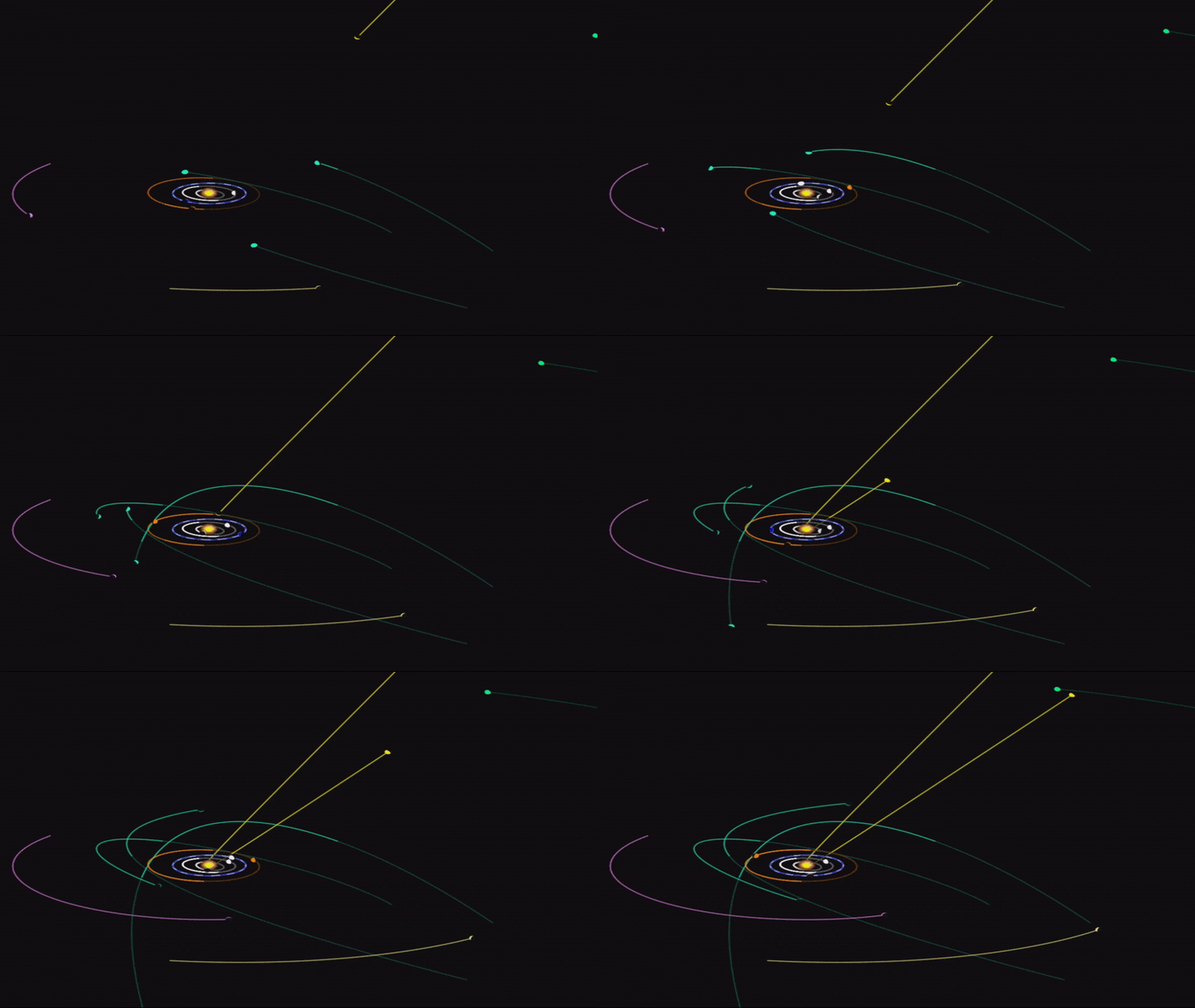
A simulation of A/2017 U1’s flight through the solar system. At the centre is the Sun and the inner planets, including Earth. The purple item in Jupiter, and the yellow object just beyond it is Saturn. The three pale green items are comets originating within the solar system, and the outermost bright green item represents the orbit of Uranus. A/2017 U1 is indicated by the yellow high inclination parabola, which has swung the object around the Sun. Travelling at 26 km/s, it will escape the Sun’s influence and head back out into interstellar space. Credit: Tony Dunn.

The object’s trajectory is also unusual, approaching the Sun from high above the plane of the ecliptic, and observations made from the Pan-STARRS 1 telescope in Hawaii, the William Herschel Telescope in the Canary Islands and the Very Large Telescope in Chile suggest the comet is a rocky / ice object roughly 160 metres along at least one of its axes.

Tony Dunn, an undergraduate physics and astronomy teacher at San Francisco State University has been running a series of computer simulations using tracking data on the comet, which he has been publishing on his Twitter feed. These suggest the comet may have originated as a body orbiting the star Vega, some 25 light years from the Sun; however, the likely point of origin is still being hotly debated and may never be accurately known.

Another simulation of the object’s passage through the inner solar system. Credit: NASA/JPL

If the object did originate in another star system, then it would suggest the other stars have rings or clouds or material surrounding them at great distances in a manner similar to the Oort cloud. It would also be confirmation of the idea that other stars passing within a few light-years of the Sun disturb the Oort cloud, causing objects there to be disrupted in their orbits, some of which fall towards the Sun and become long-period comets. Presumably, the Sun and other stars can influence rocky clouds around their neighbours in the same way – and that as well as falling towards their local star as comets, the disturbed objects can be kicked out of their local system to become interstellar wanderers.

“We have been waiting for this day for decades,” said Paul Chodas, responsible for NASA’s Centre for Near-Earth Object Studies (CNEOS), which has also been observing the object. “It’s long been theorised that such objects exist — asteroids or comets moving around between the stars and occasionally passing through our solar system — but this is the first such detection.”

“We have long suspected that these objects should exist, because during the process of planet formation a lot of material should be ejected from planetary systems,” Karen Meech, an astronomer at the Institute for Astronomy, Hawaii which operates the Pan-STARRs telescope, added. “What’s most surprising is that we’ve never seen interstellar objects pass through before.”

Continue reading “Space Sunday: ancient oceans, comets from beyond, and exoplanet hunting”

Space Sunday: when neutron stars collide

When neutron stars collide: an artist’s impression of the point when two neutron stars collided in the galaxy NGC 4993, 130 million years ago, and which are now increasing our understanding of neutron stars and the universe. Credit: SF/LIGO/Sonoma State University/A. Simonnet

Around the world on August 17th, 2017, some 70 telescopes and observatories – including the Laser Interferometer Gravitational-Wave Observatory (LIGO), responsible for confirming the existence of gravitational waves (see here and here for more) – quietly turned their attention on the same spot in the constellation Hydra.

“I don’t think it’s out of the question that this is the most observed astronomical event ever. It’s a thrilling notion, and a little overwhelming,” said LIGO spokesperson David Shoemaker. “We’ve got somewhere between a quarter and a third of all the world’s astronomers working with us.”

The reason? Hours earlier, an observatory in Chile had detected gravitational waves followed by a burst of gamma radiation – potentially the signature of two neutron stars colliding far beyond our galaxy. If so, the detection would be the first time gravitational waves have been observed originating from something other than the merger of two black holes. Hence, an alert was issued to observatories around the globe, resulting in the massed focusing on instruments on that single point in space.

Over the coming days, the data revealed that a collision between two neutron stars in what is referred two as a “kilonova”  – which sits between a star going nova and a super-massive star going supernova.  It marks the first confirmation that neutron star mergers can cause gamma ray bursts. However, there is much more to the event.

Neutron stars are the dense remnants of massive stars that long ago exploded as supernovae. The two stars in question are located in galaxy NGC 4993, 130 million light years from Earth. Originally, these stars were each around 10-20 times the mass of our sun; after each went supernova, they collapsed down to bodies around 16 km (10 mi) in diameter, comprised entirely of neutrons so densely packed, that despite their small size, each still had a mass perhaps twice that of our own Sun.

These two neutron stars, located close together, were gradually drawn together over the course of perhaps 11 billion years by their mutual gravities until they collided, venting huge amounts of energy across the spectrum and space-time in what astronomers call a “multi-messenger event”. It was the arrival of the light waves and gravitational waves here on Earth, 130 million years later, that astronomers from around the world were keen to observe, marking the first time a cosmological event of this nature has been observed in both gravitational waves and light, producing a huge amount of data for researchers to study.

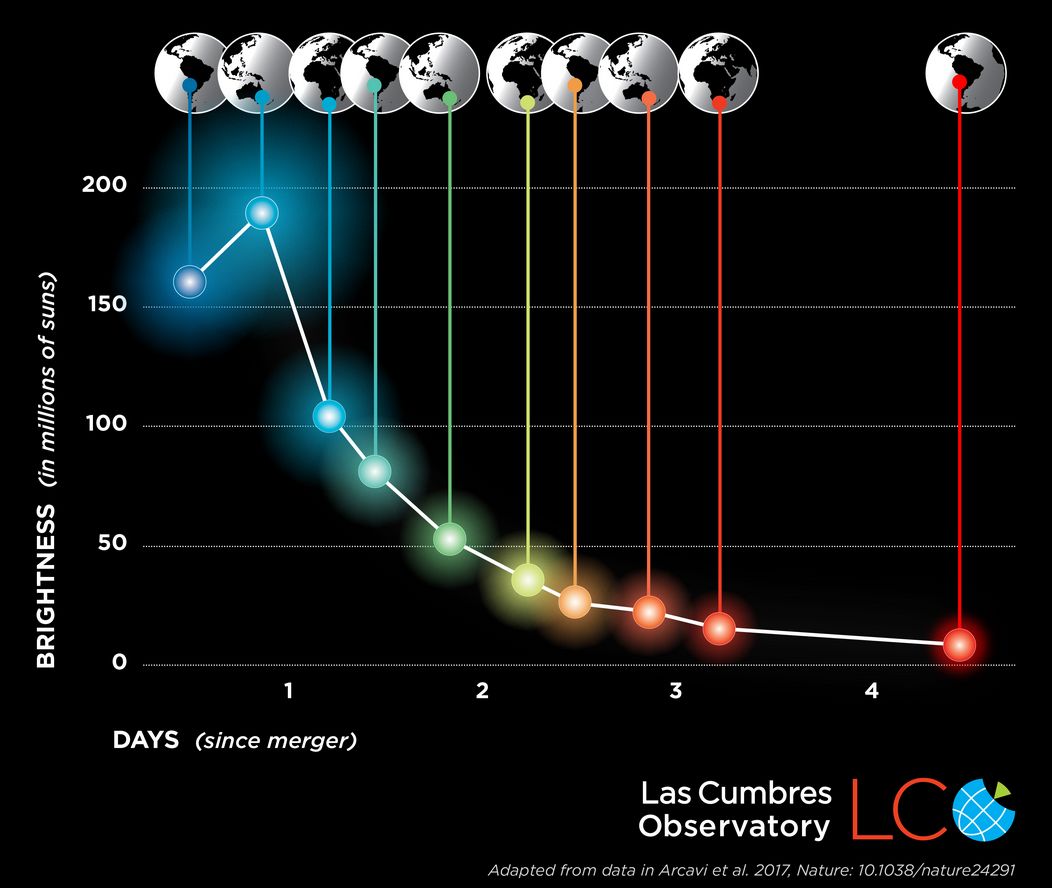
How the kilonova was initially observed through the initial days of visible light observation following the first indication of the collision through to the falling off of light from the initial explosive outburst of energy. Credit: Sarah Wilkinson / LCO.

Thanks to the alert sent out by the Chilean observatory, over 3,500 astronomers and more than 100 instruments  – including LIGO and a the Hubble Space Telescope responded, making the event the first to be observed through the detection of visible light and gravitational waves. Their findings are now being made public, and include some remarkable facts.

These include the first confirmation that neutron star mergers can cause gamma ray bursts – although there is some questions over what this might in fact mean. It also marks the first measurement of the universe’s expansion using gravitational waves.In addition, as the collision was recorded in wavelengths right across the electromagnetic spectrum, from radio to gamma rays, it is the first time a cosmological event of this nature has been observed in both gravitational waves and light. A further result of the observations is that astronomers have witnessed heavy elements being formed from the aftermath of the event.

“People have long suspected that heavy elements were made in neutron star mergers, but this is really the first time we’ve nailed that down,” Andrew Levan, an astronomer at the University of Warwick in the UK. “This merger made something like the mass of the Earth in gold, along with other heavy elements such as platinum, lead and uranium.”

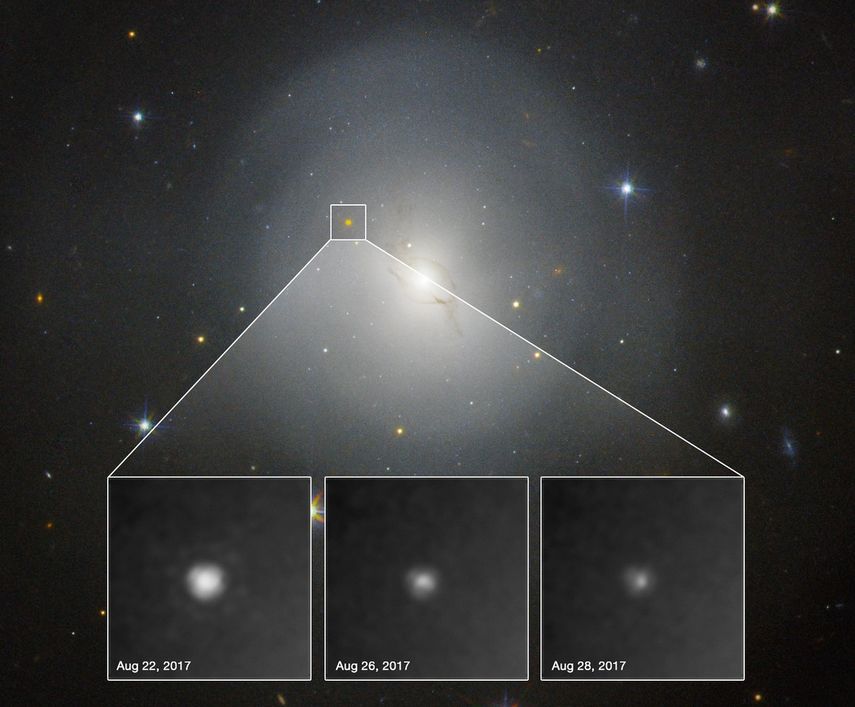
The kilonova as seen from the Hubble Space Telescope a few days after the explosion, tracking it as the initial light faded. Credit: NASA and ESA. Acknowledgement: A.J. Levan (U. Warwick), N.R. Tanvir (U. Leicester), and A. Fruchter and O. Fox (STScI)

It was actually the discovery that heavy elements were being formed in the material resulting from the collision which confirmed the event was an actual collision of two neutron stars. The elements would only be formed if neutrons were being ejected from the two stars to collide with lighter atoms in the surrounding space. Material would only be ejected if the objects in collision each had a surface, something black holes don’t have – they only have an event horizon.

This in turn indicated the event was far closer that the previous five detections of gravitational waves which have occurred since 2015. These have been the result of pairs of black holes merging, none of which have been closer than 1.3 billion light years away. That the gravitational waves were observed alongside of light waves also gave further confirmation of another of Einstein’s general relativity predictions: that light and gravitational waves travel and more-or-less the same speed.

Observations and data gathering continued after the initial explosion was detected, although the light from the collision faded over the 6-8 days following the event, and astronomers are keen to discover what has been left behind. Currently, the region of NGC 4993 where the kilonova occurred is obscured behind a cloud of matter and heavy elements, leading to questions on whether or not the two stars may have merged to form an even larger neutron star, or whether they collapsed into a black hole. Some of those studying the data gathered believe the gamma ray burst recorded after the initial detection of gravitational waves might be indicative of the latter, the result of matter left over from the event and collapse being drawn into the event horizon.

Summing up the significance of the event, astronomer Tony Piro from the Harvard–Smithsonian Centre for Astrophysics said, “The ability to study the same event with both gravitational waves and light is a real revolution in astronomy. We can now study the universe with completely different probes, which teaches things we could never know with only one or the other.”

Continue reading “Space Sunday: when neutron stars collide”

Space Sunday: radiation, rings and pollution

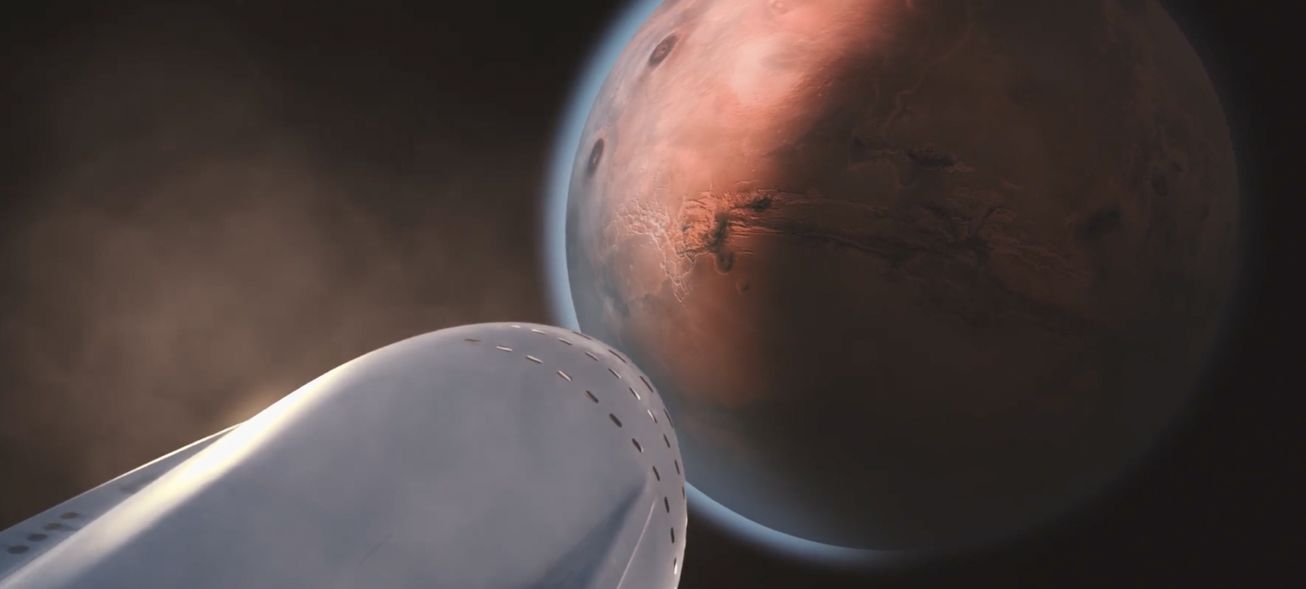
Missions like Elon Musk’s hopes for Mars need good radiation protection for crews – and NASA is working to bring this about. Credit: SpaceX

I’ve written several times about the risk radiation poses to dee space missions; particularly Galactic Cosmic Rays (GCRs), the so-called “background radiation” left over from the big bang. As I’ve noted, while solar radiation – up to and including Solar Particle Events (SPEs or “solar storms”) can be reasonably well dealt with, on account of the particles being relatively low-energy – 13 centimetres (5 inches) of water or similar liquid – is pretty good protection against the primary radiation threat of SPEs, for example – GCRs are far harder to deal with.

However, there are materials which can block them. Again, I’ve written about Hydrogenated boron nitride nanotubes (BNNTs). These are something being developed by NASA’s Langley Flight Centre in Virginia; extremely flexible, they can be used in the construction of key elements of space vehicles – walls, floors, ceilings, for example – and can even be woven into a material used as a lining in space suits to protect astronauts.  Similarly, borated polyethylene – already used for radiation shielding in nuclear reactors aboard US naval vessels, medical vaults and linear accelerators, among other applications – offers a means to provide primary radiation protection within the structure of space vehicles.

However, these are only effective in stopping primary radiation damage – that is, damage cause by the direct impact of radiation on living cells. A far, far greater risk people in deep space will face is from so-called secondary radiation,  particularly in the case of GCRs.  simply put, when a GCR particle collides with another, it sends energetic neutrons, protons and other particles in all directions, which can collide with others. It’s like a bullet striking something and scattering shrapnel, potentially doing damage to a lot of cells if they strike a living body. The problem here is that the more material used to block the effects of primary radiation damage, the more the risk of secondary radiation damage is increased.

Materials such as BNNTS and borated polyethylene could be used for surface vehicles and equipment as well

This means that there is unlikely to be a single solution to the issue of radiation exposure on deep space missions such as to Mars. Which is why scientists aren’t looking for one. NASA, for example has been conducting research into technologies such as BNNTs and magnetic shielding for space vehicles for over a decade. The latter, if possible, would use a magnetic field around a space vehicle to protect the crew, much as Earth’s magnetic field protects us. The problem here is that such systems currently require huge amounts of electrical power and can add a significant amount of mass to a space vehicle.

Another avenue of research being investigated is the use of pharmaceuticals as possible radiation inhibitors. Drugs such as potassium iodide, diethylenetriamine pentaacietic acid (DTPA) and the dye known as “Prussian blue” have for decades been used to treat radiation sickness. The theory is now that they could be used as part of a preventative regime of preventative treatment for astronauts on deep space missions.

The whole subject of radiation protection has become a focus in light of NASA’s “new” directive to return humans to the Moon and also because of Elon Musk’s determination to send humans to Mars, possibly as early as the mid-2020s. Because of this, NASA has been highlighting its research into radiation exposure management of late, which also includes solar weather forecasting (to help warn crews in deep space about the risk of SPEs, etc.), and in looking at 20+ years of orbital operations aboard the shuttle ISS and Russia’s MIr space station. All of this is leaving some at NASA feeling very positive about efforts to send humans beyond Earth orbit, as Pat Troutman, the NASA Human Exploration Strategic Analysis Lead, stated in a NASA press statement on the matter:

Some people think that radiation will keep NASA from sending people to Mars, but that’s not the current situation. When we add the various mitigation techniques up, we are optimistic it will lead to a successful Mars mission with a healthy crew that will live a very long and productive life after they return to Earth.

Whether progress on all fronts will be sufficiently advanced to encompass something like Elon Musk’s aggressive approach to human missions to Mars remains to be seen. However, with the “new” directive for NASA to return humans to the Moon, there’s a good chance we’ll see some of the current initiatives in radiation protection bearing fruit in the next few years.

The Risk Posed by Tiangong 1

Tiangong 1 (“Heavenly Palace 1”), the first Chinese orbital facility has been creating some sensationalist headlines of late.  Launched in 2011, the facility saw two crews spend time aboard it, prior to it being run on an automated basis from 2013. On March 21st, 2016 the Chinese Manned Space Engineering Office announced that they had disabled the facility’s data service in preparation for shifting their focus to the (then) upcoming Tiangong 2 facility and in allowing Tiangong 1’s orbit to decay so it would burn-up re-entering the upper atmosphere.

Tiangong 1. Credit: CMSE

The time-frame from re-entry was predicted to be late 2017 / early 2018. However, around the time Tiangong 2 was launched the Chinese space agency admitted they’d lost attitude control of the laboratory, so they could no longer orient it as it orbits the Earth. As a result, the facility has been under scrutiny from Earth by individuals and groups monitoring the rate of its orbital decay.

One of these observers is astrophysicist Jonathan McDowell of Harvard university. In early October he released a statement indicating that as a loss of attitude control coupled with increased atmospheric friction has resulted in a sharp decline in Tiangong 1’s altitude to the point where it could see the vehicle re-enter the Earth’s atmosphere in the next few months. He also noted – accurately – that some elements of the 8.5 tonne vehicle could survive re-entry and reach the surface of the Earth (something the Chinese have always noted).

Unfortunately, his report led to some sensationalist responses from portions of the media. For example, one UK media tabloid blasted: “Out-of-control space station to smash into Earth THIS MONTH…and it could hit ANYWHERE. … A MASSIVE space station is hurtling towards Earth!” (block capital their own, not mine); other newspapers also highlighted the upper-end of the risk posed by the vehicle’s re-entry.

Needless to say such reports wildly over-egg the situation. The reality is that Tiangong’s orbit carries it over vast swathes of ocean and large areas of sparsely populated land. As such, while there is a risk of parts of the station reaching the ground, the chances of them hitting a populated area are remote. In this, Tiangong reflects the US Skylab mission in 1979 and the Russian Salyut 7 / Cosmos 1686 combination of 1991. Both of these where much larger than Tiangong 1 (77 tonnes and 40 tonnes respectively), both made an uncontrolled re-entry, and in both cases, wreckage did not cause loss of life.

Continue reading “Space Sunday: radiation, rings and pollution”

Space Sunday: Tabby’s Star, NASA’s plans and the Moon’s atmosphere

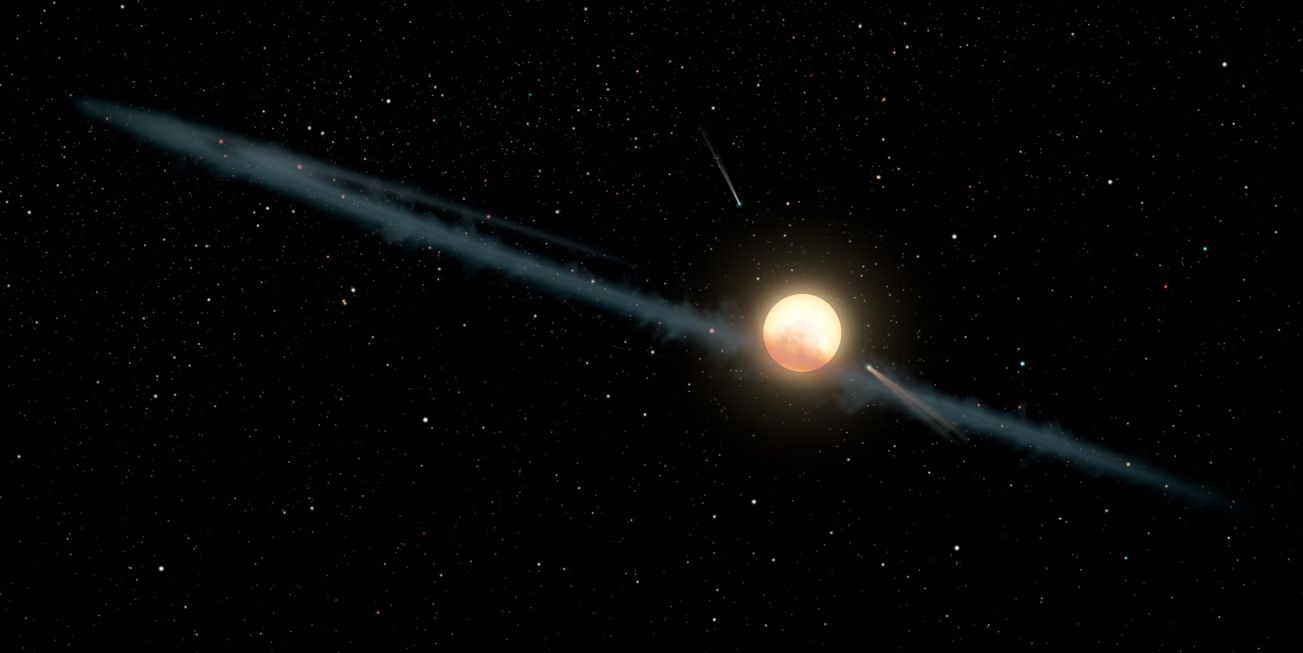
Is a circumstellar dust ring responsible for the irregular dimming of Tabby’s Star? Credit: NASA/JPL

Yet another study has appeared in an attempt to shed light (pun intended) on the mysterious behaviour of Tabby’s Star.

Regular readers of my Space Sunday columns will recognise this name as belonging to the more formally titled KIC 8462852, an F-type main-sequence star located in the constellation Cygnus approximately 1,480 light years from Earth (and which is also called Boyajian’s Star). This star experiences odd periods of dramatic dimming in its light output every so often (with the Kepler Space Observatory recording a loss of up to 22%), with the fluctuations lasting several solar days before it suddenly resumes its normal luminosity as observed from our solar system.

Many theories have been put forward for what is happening – most of which I’ve covered in these pages. They range from theories about vast alien mega-structures – such as a Dyson sphere, to theories of the star itself suffering what is called “avalanche” activity within itself, to ideas involving huge cometary clouds and giant ringed planets,  or just a single giant ringed planet being responsible.

In the most recent study, Extinction and the Dimming of KIC 8462852, a US / Belgian team of scientists suggest that “none of the above” might actually be the correct answer on why the star goes through its irregular dimming cycle. Instead, they argue it is the result of a huge but thin and uneven dust ring rotating slowly around the star.  What makes this theory particularly compelling is that it draws on three independently gathered sets of data in order to form the hypothesis.

The first of these data sources is NASA’s Spitzer Space Telescope, used to gather data on Tabby’s Star in the infra-red wave band during December 2016. The second is the Swift Gamma-Ray Burst mission, which gathered data on the star in the ultraviolet band during the same period of observation; also at the same time, the Belgian AstroLAB IRIS Observatory’s 68-cm (27-in) reflecting telescope gathered data in the visible light spectrum.

Artist’s concept of KIC 8462852, which has experienced unusual changes in luminosity over the past few years. Credit: NASA/JPL

What the team found, essentially, was that Tabby’s Star experienced less dimming in the infra-red band than in the ultraviolet – a strong indication that there was a mass of materials, each particle just a few micrometres in diameter, passing between the star and the observatories. While it had been previously suggested the dimming could be the result of an interstellar dust cloud lying somewhere in space between Earth and Tabby’s star, the team discounted this as a possible culprit.

Instead the team took their findings and charted known periods of dimming witnessed with Tabby’s Star and determined a circumstellar dust ring surrounding the star, and rotating around it one every 700 days would actually account for the majority of dimming periods observed from Earth. However, two types of even still do now fit the model.

The first of these is some very short-term “spurts” of dimming which have been noted during 2017. The second is the really large dips in luminosity seen by the Kepler Space Observatory. One potential explanation for the “spurts” of dimming, confirmed through multiple independent observations, is that they might be the result of a cometary cloud orbiting the star and coming between it and Earth. This was actually one of the earliest theories put forward to account for all of Tabby’s Star’s odd behaviour, but it fits the “spurts” of dimming a lot better.

The really big dimming periods, when the star appeared to lose up to 22% of its brightness pose their own problem. They were only observed by Kepler, and have yet to be seen to the same magnitude during any other period of observation, making quantifying them hard. Kepler itself is now studying stars in another portion of the galaxy, so cannot be used to further observe Tabby’s Star to see if such huge dips can again be seen.

Thus, there may yet be another mystery to Tabby’s Star waiting to be solved – or other theories on the fluctuating brightness which may yet be put forward. But for now, the circumstellar dust ring seems to be the most fitting explanation for much of the star’s odd behaviour.

The Moon’s Ancient Atmosphere

That’s the startling conclusion of a new study, supported by NASA’s Solar System Exploration Research Virtual Institute, and recently published in Earth and Planetary Science Letters.

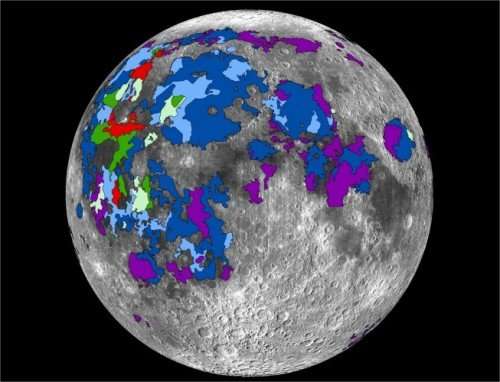
Map of basaltic lavas that emitted gases on the lunar nearside. Credit: Debra Needham
Map of basaltic lavas that emitted gases on the lunar near side. Credit: Debra Needham

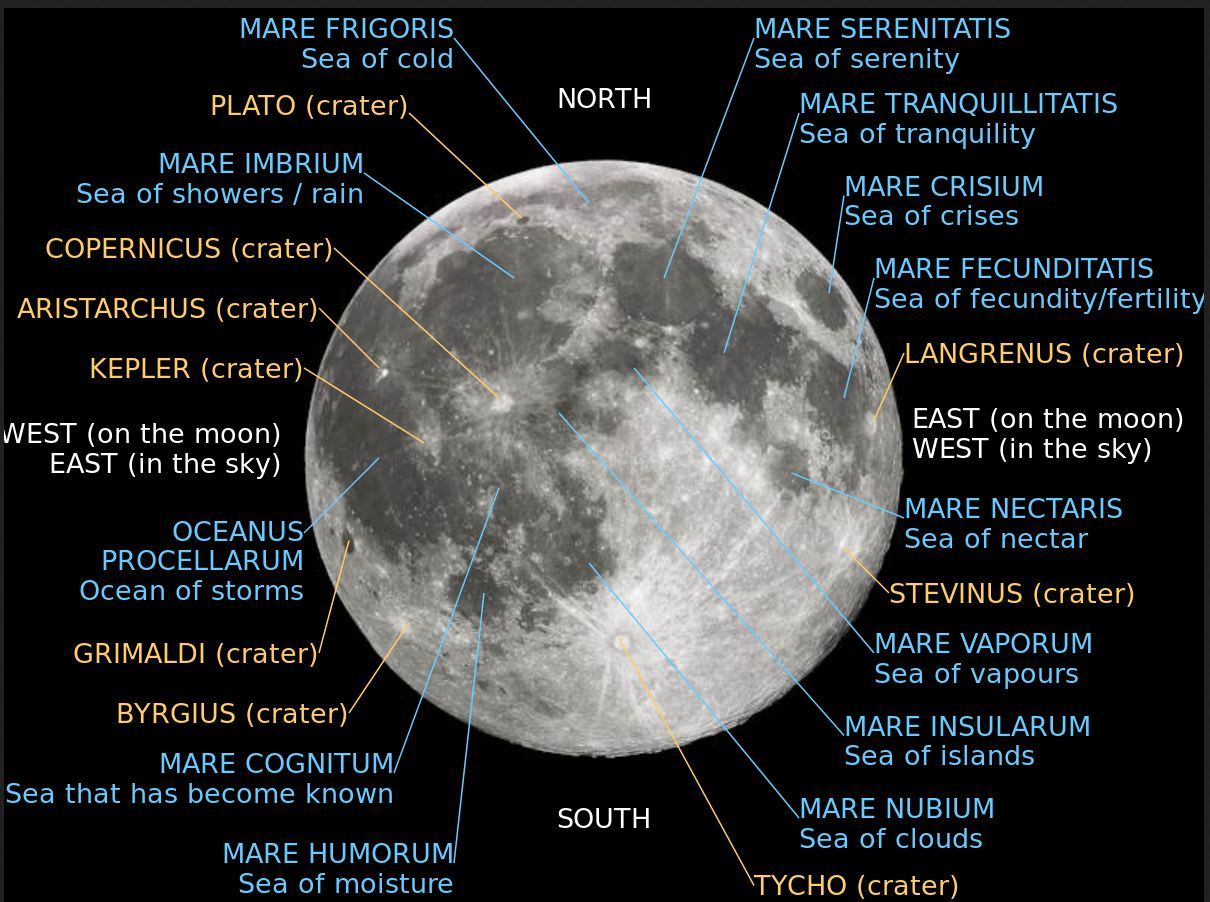
That the Moon was subject to intense volcanic activity in its early history is evidenced by the massive  volcanic basalt maria (“seas”) on its surface. From Earth, these form the dark patches and patterns we can see with the naked eye. They were created three to four billion years ago, when the interior of the Moon was still hot and generating magmatic plumes. In places, these broke through the lunar crust, flowing outwards for hundreds of kilometres. Analysis of rock sample returned to Earth by the Apollo astronauts has long revealed these lava flows carried with them gases like carbon monoxide and the ingredients for water, sulphur, and other volatile elements.

In the study, work, Dr. Debra H. Needham, Research Scientist of NASA Marshall Space Flight Centre, and Dr. David A. Kring, Senior Staff Scientist, at the Lunar and Planetary Institute (LPI), used the amounts of trace gases and volatiles in the Apollo samples as a baseline for calculating the probable amount of gases released during those ancient lunar eruptions. Their findings suggest that the gases were released is sufficient quantities over a long enough period of time, reaching its peak around 3.5 billion years ago, to form a transient  lunar atmosphere. It then persisted for about 70 million years after the volcanic activity ended, before the bulk of the gases were lost to space.

Distribution of the volcanic “seas” of the Moon (in blue) – sites of ancient eruptions. Credit: Nasa

The two largest pulses of gases were produced when lava seas filled the Serenitatis and Imbrium basins about 3.8 and 3.5 billion years ago, respectively. The margins of those lava seas were explored by astronauts of the Apollo 15 and 17 missions, who collected the samples that provided the ages of the eruptions.

This new picture of the Moon has important implications for future exploration. The analysis of Needham and Kring quantifies a source of volatiles that may have been trapped from the atmosphere in the cold, permanently shadowed regions near the lunar poles and may well provide a source of ice suitable for a sustained lunar exploration programme. Volatiles trapped in these icy deposits might be used  provide air and fuel for astronauts conducting lunar surface operations.

“We Chose To Go to the Moon, Because That’s What We Were Doing Anyway”

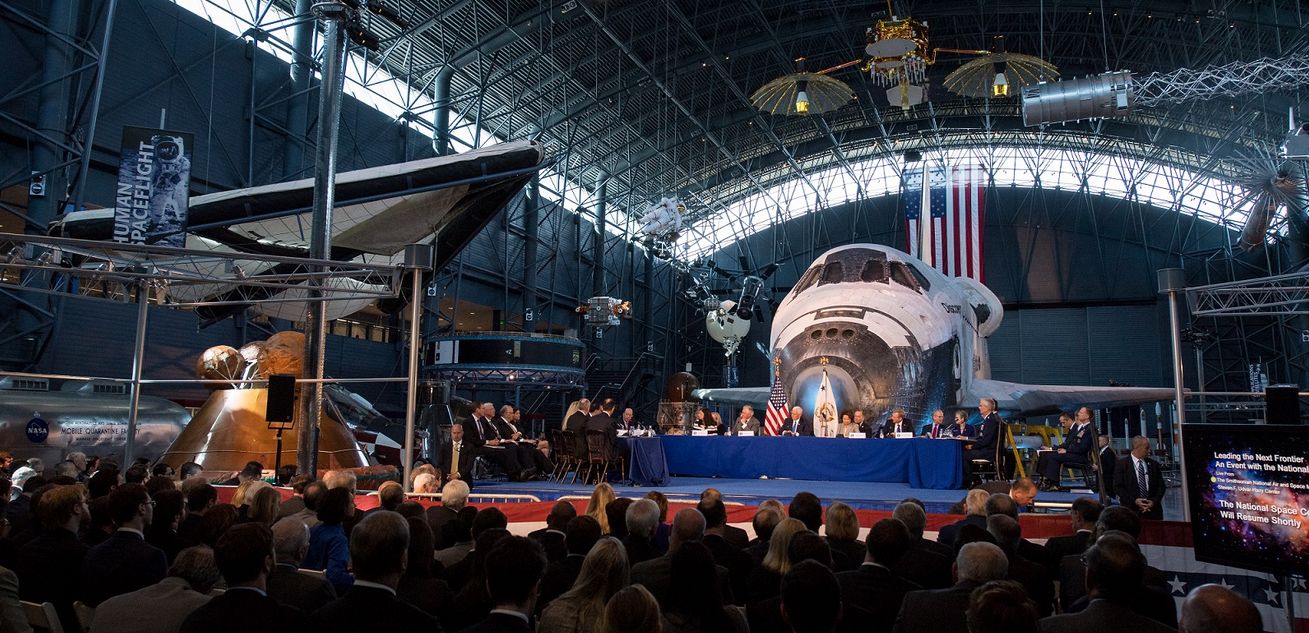
The re-invoked US National Space Council (NSC) held its inaugural meeting n Thursday, October 5th, 2017 at the Smithsonian National Air and Space Museum’s (NASM) Steven F. Udvar-Hazy Centre.

Chaired by the Vice President, the Council was originally  established in 1989 by then-President George H.W. Bush to serve the same purpose as the National Aeronautics and Space Council, which oversaw US space policy between 1958 and 1973. That NSC was disbanded in 1993 by the Clinton administration.

In this first meeting, the NSC sought to overturn NASA’s “Journey to Mars” endeavour in favour of a more focused plan to return to the Moon – or did they?

The inaugural meeting of the re-formed NSC, October 5th, 2017. Credit:  NASA / Joel Kowsky

But how new and bold is this directive?

The reality is, what Pence announced on behalf of the NSC on October 5th and despite all the hurrahs, is pretty much what NASA was already doing anyway, and had been doing since President Obama signed the NASA Authorisation Act of 2010. That is: build the Orion Multi-Purpose Crew Vehicle and the Space Launch System, establish the Deep Space Gateway in cis-lunar space as an “enabler” for lunar missions and missions to Mars, and develop a presence on the Moon while deferring Mars to some nebulous 2030s time frame. The only significant difference is the instruction for NASA to actually flesh-out the lunar outpost element.

On the one hand, this is good, as it means no mass overturning of the apple cart (a favourite past time of incoming administrations)  and a scramble to sort the apples out again. On the other, it still leaves NASA pursuing goals of questionable need – such as the Deep Space Gateway itself. Which, despite all the hype surrounding it, isn’t actually required for either for getting to the Moon or Mars. Rather, it is an objective that’s become fixed in the NASA mindset, and is now being rationalised on the basis that it is part of the mindset, rather than it offering a means to achieve things that cannot be better (and more cost-effectively) achieved through other methods.

What’s in a Name?

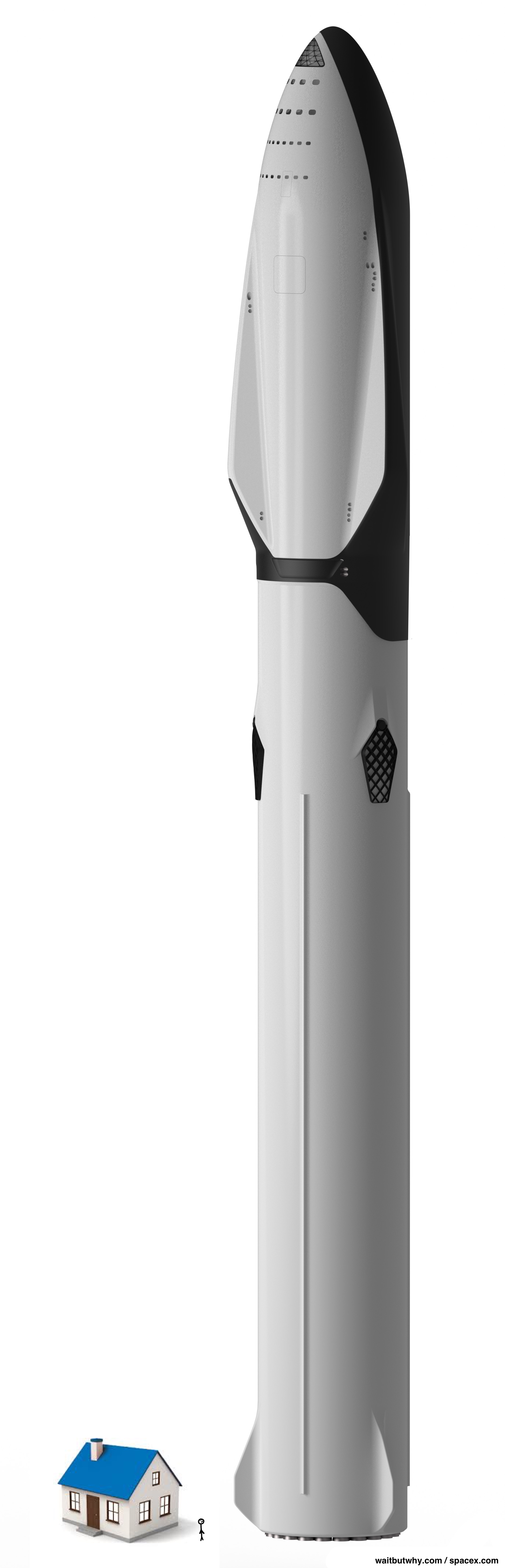
Making it safe to reference the “BFR” – the Big “Falcon” Rocket! Credit: SpaceX

At the 68th International Astronautical Congress (IAC) at the end of September, Elon Musk unveiled more of his thinking around sending humans to Mars.

The linchpin of his aspirations is the massive Interstellar Transport System (ITS) rocket SpaceX is developing. This has caused not a few parents some headaches when explaining things to their children, or created a dilemma when explaining the concept in polite company.

It’s not that explaining the ITS concept in complicated. Far from it. Rather, it’s the fact that Musk has chosen to present the ITS launch system using the acronym he originally defined for it: BFR. This, as just about everyone interested in space exploration knows, stands for “big f***ing rocket”. Descriptive yes, given the size of the beast (see right). But suitable for sensitive or young ears? Er, no, possibly not.

So, how does one deal with explaining what “BFR” means to said sensitive / young ears? SpaceX President Gwynne Shotwell recently offered a solution.

While addressing the National Space Council on October 5th, Shotwell – quite probably with a twinkle of humour in his eye –  played on the company’s use of “Falcon” in naming their rockets (the Falcon 9 and Falcon Heavy) to get around the BFR acronym.

“Last week,” he said. “Elon announced — or, basically, gave an update on,” he then paused a bit, before continuing, “the Big Falcon Rocket programme. The Big Falcon Rocket and Big Falcon Spaceship.”

So there you have it, a non-offensive and semi-accurate way to explain “BFR” to the kids!


AltspaceVR acquired by Microsoft

Courtesy of AltspaceVR

What a ride. We cried, we laughed, we overdosed on caffeine… but now we’re dancing in our headsets! For those of you that didn’t witness the drama of the last few months, we had to close down in July but thanks to the love you sent out to the internet, others took notice.

With the AltspaceVR team on-board we look forward to building the world’s pre-eminent mixed reality community.

So opens a blog post from AltspaceVR announcing the company has been acquired by Microsoft, as confirmed by an announcement by the tech giant at its Mixed Reality Event. It marks the end of a rough couple of months for the company.

In July (as I covered here), the AltSpaceVR was set to say “goodbye” in early August. It would have been a sad end to a company which had done much to lay the basis of “social VR”, and had hosted events featuring the likes of Reggie Watts, Drew Carey and Bill “the Science Guy” Nye; the company even hosted events with NBC news during the 2016 US Presidential election.

However, rumours soon began circulating that perhaps the company might continue, and on August 15th, barely a week after closure, the company confirmed this looked like it would be the case and theey were in talks with a third-party. At the time, many thought Oculus VR co-founder and wannabe political backer, Palmer Luckey might be behind moves to rescue / revive AltspaceVR (see here). ow we know that third-party was in fact Microsoft – led, apparently, by Alex Kipman.

Kipman, a 17-year veteran at Microsoft, cut his teeth with the company on the Xbox, and created the Kinect motion controller. Since 2015, he has been a technical fellow for the company’s Operating Systems Group, with a specific focus on the company’s evolving AR systems, such as the HoloLens, which he also credited with inventing. The AltspaceVR blog post notes in reference to him:

Many members of the AltspaceVR team worked hard in the following days and weeks to make sure the technology lived on. They connected with Alex Kipman and found a natural overlap between his goals for mixed reality and their hopes for the future of AltspaceVR. 

Alex Kipman, the man behind Microsoft’s HoloLens, and seen as key to the company’s acquisition of AltspaceVR

The AltspaceVR blog post also lays things out pretty clearly: not only has Microsoft acquired Altspace VR, they have no plans to absorb it: the company will apparently be free to continue working with other platforms and maintain its identity as a business entity.

AltspaceVR will stay AltspaceVR. Microsoft is most interested in preserving the current community that uses AltspaceVR to connect and interact with new and old friends. These first few months will focus on fostering our community and making sure AltspaceVR remains a friendly, welcoming and vibrant place to hang out in virtual reality.

AltspaceVR will continue to work on PC and Mac in 2D mode, HTC Vive, Oculus Rift, Daydream by Google, and Samsung Gear VR.

Does this mean AltSpaceVR will be integrated into the AR offerings Microsoft has and is planning? Insofar as the HoloLens itself is concerned, the answer appears to be “no” – at least for the present.

However, the Microsoft is aiming to distinguish its “mixed reality” platform for VR headsets running Windows 10. and will be releasing a slew of headsets with OEM partners at an aggressive Us $299 pricing start point. So it might be that they see AltspaceVR  – or capabilities developed from it – as a potential fit into this arena as it grows. Again, as the AltspceVR blog post notes:

Microsoft is excited to incorporate communications technology into our mixed reality ecosystem. AltspaceVR takes personal connections, combines them with real-time experiences, and leverages immersive presence to share experiences. Situations of people, places, and things have deeper meaning and in turn, are more memorable. We’re excited to see how far this technology can go.

Inside AltspaceVR: avatar customisation

Of the move, Microsoft had this to say via a press release:

AltspaceVR is one of the pioneers in immersive communications bringing people together in virtual reality from over 160 countries to attend meet-ups, comedy shows, yoga classes, dance parties, and large-scale events …

With the AltspaceVR team on-board we look forward to building the world’s pre-eminent mixed reality community.

The full terms of the deal have not been released. Prior to hit financial difficulties earlier in 2017, AltspaceVR had raised some US $26.3 million in funding through two rounds of investment, with US $16 million raised in 2014, and a further US $10.3 million raised in a second round of funding led by Raine Ventures.

Space Sunday: Mars visions, gateways and James Webb

Elon Musk has bold plans for building a permanent human presence on Mars. Credit: SpaceX

The 68th International Astronautical Congress (IAC) ran from September 25th to September 29th, 2017 in Adelaide, Australia, and brought forth a plethora of announcements, presentations and updates from all those involved in space exploration.

one of the more attention-grabbing announcements came – unsurprisingly – from Elon Musk and SpaceX. Already leading the way in private sector launches and launch vehicle reusability,  SpaceX has in many respects set the bar for the launch industry as a whole. Musk, meanwhile has raised eyebrows with his longer-term goals, which focus on human missions to Mars and – eventually – the colonisation of the Red Planet. At the September 2016 IAC, he laid the outlines for achieving these goals, and in 2017 he returned to the IAC to offer further updates and insights to the SpaceX approach.

Most surprisingly, given the company’s reliance on it for revenue generation, Musk indicated that he is prepared to phase out all Falcon 9 launch operations, including the yet-to-fly Falcon Heavy, at some point in the near future in order to focus the company on the development and operation of its Interplanetary Transport System (ITS), which Musk still likes to refer to as the BFR (for “Big F***ing Rocket” on account of its overwhelming size).

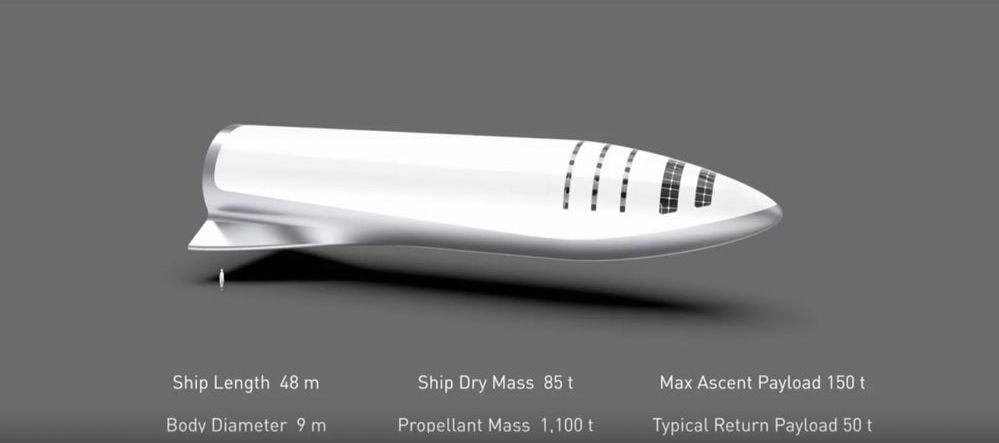
The updates ITS launcher, seen here in comparison to the Falcon 9 and Falcon Heavy, will be 106 metres tall, powered by 31 first stage engines (down from the original 42), and capable of lifting 150 tonnes to low Earth orbit. Credit: SpaceX

Fabrication of parts of the first ITS launcher – which is the linchpin for Musk’s Mars ambitions – has been in progress for some time, and SpaceX hope to start on the assembly of the first vehicle in the series in mid-to-late 2018. Musk is now so confident in the vehicle’s development status, he is hoping to have two of the launch vehicles ready to fly cargo missions to Mars during the 2022 launch opportunity – although he emphasised this time frame is “aspirational” rather than a fixed deadline.

This version of the ITS will be slightly scaled-down from the version announced last year, reducing the overall launch height and mass of the vehicle, and the number of main engines it will require – 31 instead of 42. The 2022 mission will have a two-fold purpose: deliver core components required for human operations on Mars to the surface of the planet; located subsurface water / water ice which could be extracted and used to generate oxygen which could be used within the atmosphere of a future base, and as an oxidizer in fuel used by vehicles making the return flight to Earth.

The upper stage of the ITS is an interplanetary craft powered by a mix of methane (CH4) and oxygen (both of which can be manufactured on Mars, allowing the craft to be re-fuelled there for return flights to Earth) and carrying either cargo in its upper section, or up to 100 passengers in 40 cabins and common crew spaces which offer living space in excess of the space found in an Airbus A380 airliner. Credit: SpaceX

According to Musk, should this mission proceed to plan, it will be followed in 2024 by four craft carrying a mix of equipment, supplies and crews to Mars to commence human exploration of the planet.

All of this is highly ambitious, technically and financially. On the technical front, there are significant issues to be addressed, most notably – but not limited to – that of the radiation threat posed by Galactic Cosmic Rays (GCRs). As I’ve pointed out in past Space Sunday articles on this subject, solar radiation – often seen as “the” radiation threat – can be managed relatively well, simply because it is generally low-energy radiation.

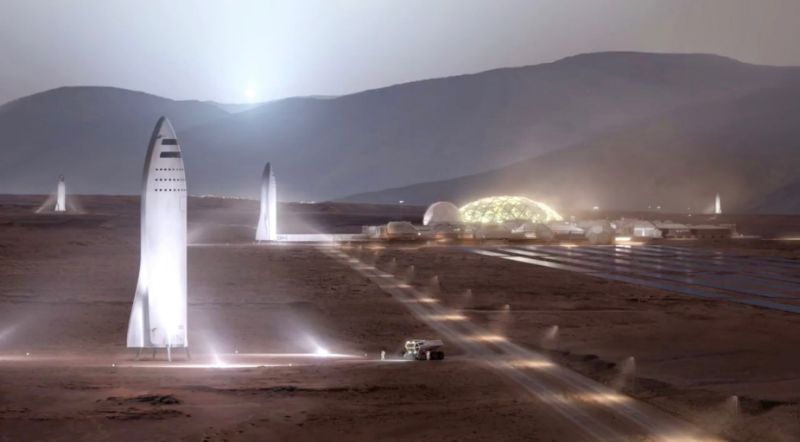
The ITS upper stage on the pad at Musk’s future Mars colony and awaiting refuelling / a return to Earth. Credit: SpaceX

GCRs, however, are high-energy particles which are much harder to deal with: and there is a lot of them in interplanetary space to deal with. Data from the Mars Science Laboratory’s flight to Mars in 2012 revealed that an unprotected astronaut on a similar flight would face the equivalent radiation dose as having a full-body CAT scan every 5-6 days for six months – definitely not a healthy proposition. There are technologies  being developed which can mitigate GCRs, such as such as hydrogenated boron nitride nanotubes (BNNTs), but these are still some way from being available for general use in spacecraft and spacesuit designs. Musk didn’t expand on how SpaceX plan to handle things like GCRs.

He was, however, more forthcoming on how SpaceX would finance the construction and operation of the ITS system. firstly, SpaceX will build up a “stock” of Falcon 9 units which could be used (and re-used) as launchers and components for Falcon Heavy launchers. Secondly, and once available, the revised ITS will be offered as a commercial launch vehicle capable of placing 100 tonnes into low Earth orbit and delivering objects to geostationary orbit or the moon; payloads could be single large items or multiple items. The plan is to use the stock of Falcon boosters through until customers have confidence in the ITS launcher (which will also be reusable) in order to switch over to using it, after which, all Falcon operations will be phased out.

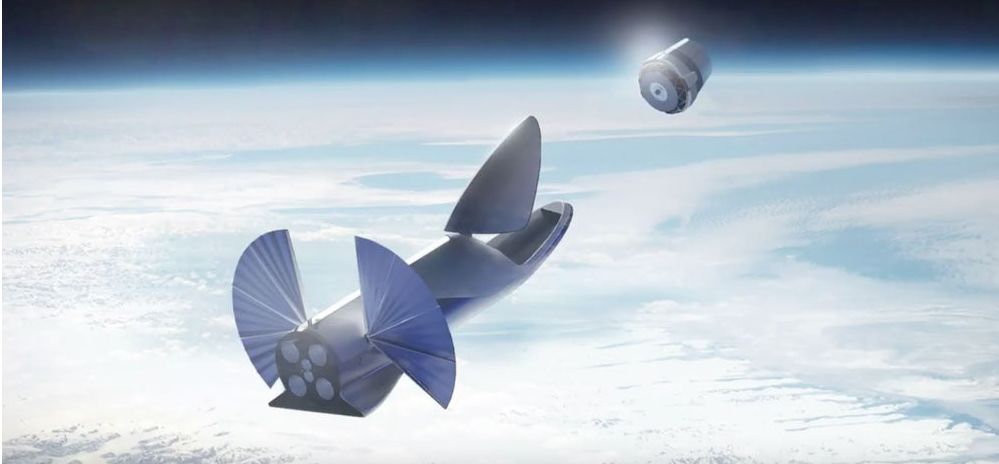
Musk plans to offer the ITS for launches to LEO, the space station, geostationary orbit and even to the Moon for cargo flights, etc. Shown here, an ITS upper stage with solar panels deployed, releases a large single payload into LEO. Credit: SpaceX

In addition, and with usual Musk showmanship, the entrepreneur indicated further revenue could be obtained by offering sub-orbital aerospace flights between major cities in record time. According to his calculations, he claimed that such flights could ferry customers between Bangkok and Dubai in just 27 minutes, or between Tokyo and Delhi in 30 minutes, using a smaller variant of the ITS.

Quite how these system would work or how the necessary support infrastructure needed to support launch / recovery / refurbishment operations around the globe would be financed was not made clear – nor was the potential cost of tickets.

Continue reading “Space Sunday: Mars visions, gateways and James Webb”