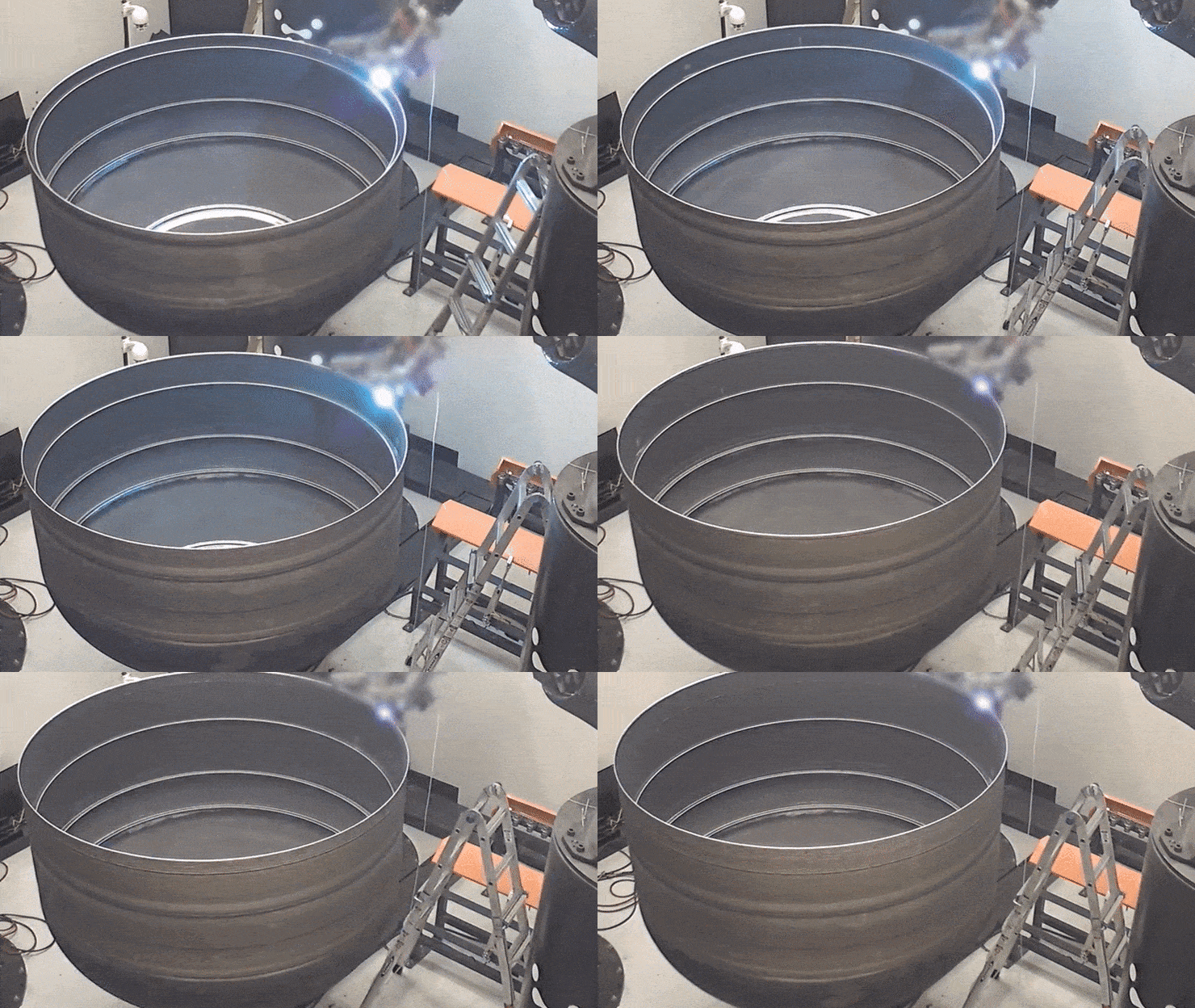
A time-lapse image of a fuel tank for the Relativity Terran-1 rocket being constructed using 3D printing techniques. Credit: @thesheetztweetz
Not too many years ago, the only organisations that were seen as being able to operate space launch systems were governments, notably the United States, Russia, Japan, China and India, although France has a long track record of launch vehicle development, while nations like the UK have also dipped a toe or two into the waters.
However, over the last 20 years, we’ve seen a major paradigm shift with launcher development that has seen much of it move away from government-sponsored development and purely into private hands (although actual launch contracts awarded by governments can oft help grease the wheels of commerce for these companies).
The most obvious commercial launch vehicle developers have frequently been mentioned in these pages: SpaceX, Blue Origin, United Launch Alliance, Northrop Grumman, and so on (note I’m deliberately avoiding certain names such as Arianespace, because while they are the oldest commercial launch provider in the world, they don’t actually develop the rockets they launch; and the big boys of Boeing and Lockheed Martin, as outside of their involvement in ULA, they are focused on government-funded launch vehicle development).
However, there are many, smaller commercial companies that are involved in launch vehicle development and operation. Two of the more interesting of these are Rocket Lab, which I have mentioned in these pages in the past, and Relativity Space.
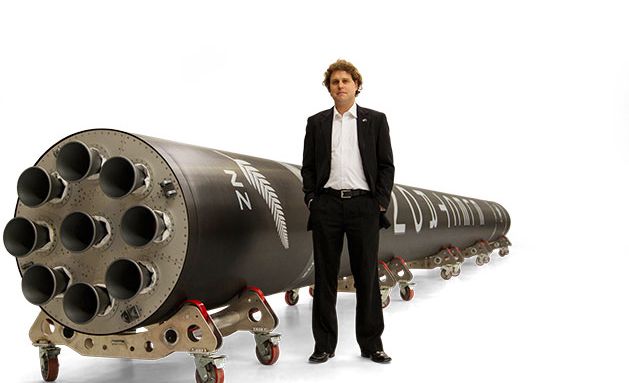
Founded in 2006, Rocket Lab is the mini-me SpaceX of small payload launchers. Established by its current CEO, New Zealander Peter Beck, the company originally operated in Auckland, New Zealand, but now is primarily headquartered in the United States as a US company (the New Zealand arm being a wholly owned subsidiary).
The Electron rocket with Rocket Labs’ CEO, New Zealander Peter Beck
Rocket Lab operates the Electron Rocket, flying commercial payloads of up to 300 kg to low Earth orbit (LEO) or up to 200 kg to a sun synchronous orbit (SSO). A two-stage vehicle, Electron uses the electric pump-fed Rutherford rocket motor in both stages, making it the first launch system to use an electric pump system to deliver fuel to the engines.
Currently an expendable launch system, Rocket Lab plan to follow in the footsteps of SpaceX and make the first stage of Electron reusable, although they will not be using a propulsive landing system like SpaceX, but will use parachutes / a parafoil. In addition, the company plans to start providing customers with an optional third stage for the vehicle that can provide a “kick” to motor payloads can use to circularise their orbits.
Up until the time of writing, the company has only launched out of a purpose-built facility on the Mahia Peninsula on New Zealand’s North Island, where it has a 30-year licence to launch rockets every 72 hours. To help with this, the facility offers two launch pad complexes; however, the real ability to meet such a high rate of launches (assuming Rocket Lab grows the customer list it needs to warrant such a fast launch rate) is in the rocket fabrication and assembly process.
The extensive use of composites in the fabrication of both the Electron rocket and its motors means that Rocket Lab can fabricate and assemble a launch vehicle every seven days. Credit: Rocket Lab
Thanks to the high use of composite throughout the Electron and its motors which accounts for around 95% of parts in both, Rocket Lab has been able to develop a fully automated and very flexible fabrication facility that can produce all the composite parts for the single launch vehicle in just 12 hours. This in turn allows the company to assemble and test a new rocket every seven days.
Starting in 2020 – and potentially in the next couple of weeks – Rocket Lab will commence launch operations from the Mid-Atlantic Regional Spaceport, Wallops Island, Virginia, USA (located at the southern end of NASA’s Wallops Flight Facility). Should it go ahead, the UK’s proposed Sutherland Spaceport, Scotland, may also become a base of operations for Rocket Lab, offering launches alongside the UK’s Orbex, a company a small-scale, reusable launcher capable of delivering up to 150 kg to a 500 km SSO.
Through the long grass – an Electron Rocket undergoing static tests at Rocket Lab’s new launch facilities at the Mid-Atlantic Regional Spaceport, Wallops Island, Virginia, USA. Credit: Rocket Lab
As well as the commercial launch capabilities, Rocket Lab has also been developing its own satellite system – Photon – which the company has indicated could also be used as a carrier vehicle for small interplanetary science missions.
In this, CEO Peter Beck has long been a proponent of exploring Venus, and has been contemplating sending a small mission that planet for the last two years – something he believes Rocket Lab could achieve for as little as US $30 million, utilising Electron as the launcher and Photon as the ferry vehicle, delivering a small science probe massing around 37 kg to Venus. With the discovery of phosphine in the planet’s atmosphere (see Space Sunday: phosphine on Venus, test flights and Jupiter), Beck has indicated Rocket Lab may well accelerate these plans.
Rocket Lab has also developed is own satellite – Photon – which it is considering as the carrier for a small science mission to Venus in the wake of the discovery of phosphine in the planet’s atmosphere. Credit: Rocket Lab
Venus, the second planet out from the Sun and roughly the same size of Earth, is well known for being the prime example of a runaway greenhouse effect. Shrouded in dense, toxic clouds that hide its barren surface from view, the planet has an average surface temperature 464°C, its dense, carbon-dioxide dominant (96%) atmosphere places an average pressure on that surface around 92 times the mean pressure at sea level here on Earth – or roughly the same pressure as exerted by the sea at a depth of 900 metres (3,000 ft).
Yet, as I’ve recently reported (see: Space Sunday: Venus’ transformation, SLS and an asteroid), there is evidence to suggest that Venus started life as a warm, wet planet with liquid water seas of its own, only to be started on the road to becoming the hothouse we know today thanks to Jupiter’s wandering influence.
However, if this theory is correct, and Venus was once warm and wet, the question of whether it was sufficiently so to give rise to the earliest forms of basic life becomes a very real one – as does what might have happened to that life as the planet started its long transformation in the superheated, super pressurised world we see today.
Did the changing conditions simply wipe out any microbes that may have arisen there, or did those microbes themselves have been transformed, moving to the upper reaches of the Venusian atmosphere where they could survive on the heat from both the Sun and rising from through the planet’s atmosphere without necessarily being dry roasted, while drawing on the minerals and chemicals also floating within the high-altitude clouds?
The idea of entirely atmosphere-borne forms of life on planets like Venus and Jupiter is not new, but this past week, the potential for some form of organic activity on Venus became a lot more real with the detection of a compound this is usually the off-shoot of organic processes within the mid-levels of the Venusian cloud layers.
Phosphine is a colourless, flammable, very toxic gas compound made up of one phosphorus and three hydrogen atoms (PH₃). It is most commonly produced by organic life forms, thus its presence within the atmosphere of Venus raises the tantalizing possibility that something is alive in that atmosphere – although it should be noted, it can also be created artificially.
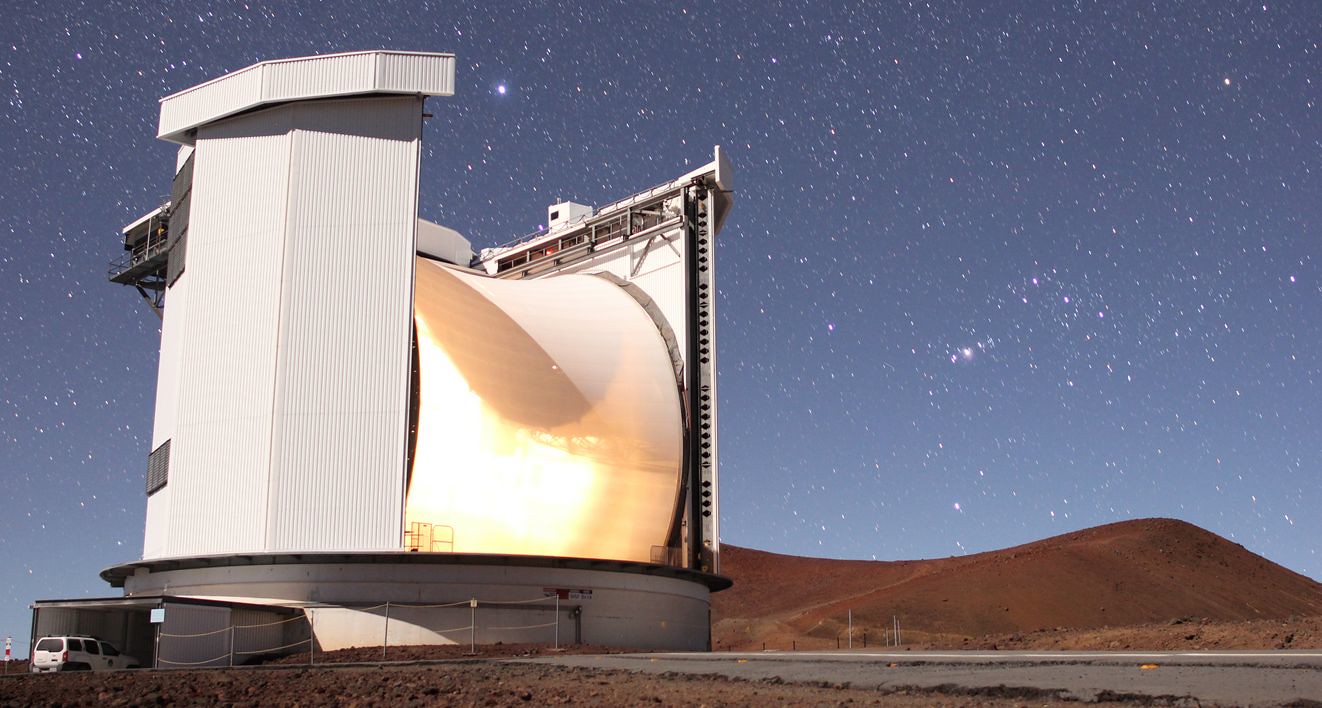
The detection of phosphine in Venus’ atmosphere was made by an international team using two different telescopes in different parts of the world. The team, led by astronomers working out of Cardiff University in the UK, first identified the compound using the James Clark Maxwell Telescope (JMCT), located in Hawaii. They then turned to the Atacama Large Millimetre/sub millimetre Array (ALMA) in Chile, equipped with more sensitive detectors than JCMT, to confirm their findings.
The James Clark Maxwell telescope, Hawaii. Credit: Will Montgomerie/EAO/JCMT
It’s important to note that while the phosphine has been identified, the team responsible for identifying it are not jumping to the conclusion it means there is life within the Venusian atmosphere. While – in our experience – it is generally the result of organic interactions, it can be produced in the laboratory, as noted, through chemical interactions – and Venus is a veritable chemical hothouse.
What is surprising is the amount of phosphine calculated to be in the cloud layer: roughly 20 parts per billion. While a comparatively tiny amount, it is astonishing to planetary astronomers because it’s long been assumed that if any phosphorus existed in Venus’ atmosphere, it would long ago have bonded with oxygen atoms, of which there are a lot around Venus, albeit the majority being bound within the dominant carbon dioxide.
Following their discovery the team, led by Jane Greaves of Cardiff University and ideo Sagawa at Kyoto Sangyo University, Japan, sought potentially natural means for the formation of phosphine around Venus. These included things such as chemical reactions in the atmosphere driven by strong sunlight or lightning, or the interaction of chemicals coming from volcanic activity, or delivered by meteorites. However, none of these mechanisms could account for the volume of phosphine Venus appears to have.
Even so, this doesn’t necessarily mean that the phosphine is the result of tiny Venuisan organisms; as the team note, it could be the result of as yet unknown photochemistry or geochemistry mechanisms within the planet’s atmosphere or the planet itself.
Although we concluded that known chemical processes cannot produce enough phosphine, there remains the possibility that some hitherto unknown abiotic process exists on Venus. We have a lot of homework to do before reaching an exotic conclusion, including re-observation of Venus to verify the present result itself.
– Study member Ideo Sagawa
Obviously, to determine whether or not biotic or abiotic processes are responsible for the phosphine, further study – preferably close-up – of Venus’ atmosphere is required. Although further Earth-based observations from Earth can help confirm the volume of phosphine within the planet’s atmosphere, satellites orbiting Venus will offer a far more complete picture, simply because they can study the planet in detail over the course of years, building up a complete picture of its composition using spectrographic analysis.
Two Venus missions – VERITAS, the Venus Emissivity, Radio Science, InSAR, Topography, And Spectroscopy orbit and DAVINCI+, an atmospheric penetrator, are already being considered by NASA as planetary missions among missions to other destinations, with one of this group of proposals due to be selected in April 2021. Either could help sniff out the phosphine and potentially help identify its cause. Japan’s Akatsuki orbiter may also help in further studies of phosphine around Venus.
The private company Rocket Lab has been developing plans to mount its own mission to Venus for some time, using their Electron rocket, which has been operating since 2018, and their new Photon upper stage, which made its début in august 2020. Rocket Lab founder and CEO Peter Beck believes that Venus has been undervalued as a place for stud (although there have been some 30 fly, orbital and lander missions since 1962).
Courtesy of the Ivan Allen College of Liberal Arts, Georgia Tech
The Moon and Mars are very different places, but for the last 40 years, the idea of sending humans to Mars has been tied very closely to the idea of a return to the Moon. However, whether this point of view has helped or hindered either a return to the Moon with a human presence or the goal of sending humans to Mars is highly debatable.
In 1989, for example, NASA was challenged to develop a plan to get humans back to the Moon and then on to Mars. Much was made of the idea that the former was necessary because it would ultimately make the means to reach the latter easier and cheaper; however, the blueprint NASA eventually proposed for achieving both a return to the Moon and the onwards exploration of Mars – called the Space Exploration Initiative – required a 30-year time frame to complete and a bill of US $450 billion – or more in comparable terms, than the United States spent on World War 2. Result: any idea of going to the Moon or Mars was quietly pushed aside in favour of just building the International Space Station.
Much of this plan cited the idea that the Moon could be used to form a “cheaper” launch venue for reaching Mars and elsewhere in the solar system, with materials gathered from the surface of the Moon making it “cheaper” to build and test the required hardware needed to reach Mars, whilst the lunar environment could offer the means of testing technologies needed in the attempt to reach Mars such as landing systems, use of local resources. Similar claims were made in the early 2000s with NASA’s Vision for Space Exploration, which similarly ended up pushed to one side on the grounds and time frame.
In actual fact, when things like the amount of energy required to launch humans to the Moon and to launch them to Mars, there is actually very little difference – in fact, when you take into consideration the energy needed to slow a mission into lunar orbit, the energy needed to land it on the Moon, and the energy to re-launch from the Moon to reach Mars, and going to Mars via the Moon actually becomes more expensive in terms of your energy budget – particularly when you consider that regardless of whether they go directly to Mars or via the Moon, all crews will commence their mission directly from Earth. And when you add in all the costs and complexities involved in developing a lunar launch capability – fabrication facilities for vehicle production, development of fuel depots and so on – then the bill for going to Mars via the Moon starts to outstrip the bill for going to Mars directly from Earth.
This point was pretty much demonstrated in the 1990s by aerospace engineers Robert Zubrin and David Baker. Following that US $450 billion bill, they looked at how humans to realistically and cost-effectively be taken to Mars and back safely. Their work resulted in the Mars Direct mission proposal which, in 1996, would have cost around US $10 billion for the first mission and then $1 billion per mission thereafter, with two launches taking place every 2 years.
One of the unique aspects of Mars Direct was the idea of sending the Earth Return Vehicle (ERV) to Mars 2 years ahead of the crew, with the crew following in the “hab” – a combined spacecraft and home. Credit: Mars Society UK
While there were issues with the Mars Direct proposal (for example: the small number of crew – just 4 people – in the original profile, and a certain cavalier attitude towards cosmic radiation exposure), it offered a “lifeboat” option for getting a crew back to Earth, and it held up to scrutiny as a practical means to reaching Mars within a 10-12 year development cycle. So much so, in fact, that it became the basis for a generation of NASA Mars mission proposals (the Design Reference Missions), and former NASA Administrator Michael Griffin pushed the agency into starting work on the development of the Ares launch vehicles identified as being required for the Mars Direct proposal, under what became known as the Constellation programme (although ultimately, Constellation was cancelled after just one flight of an Ares 1 booster to make way for the Space Launch System).
In terms of technology development, the Moon is also of questionable benefit in terms of missions to Mars. Much has been made of testing landing systems for use on Mars through missions to the Moon, but the fact is, such tests are of limited value: the Moon has little practical atmosphere, ergo, there’s no means to test atmospheric entry systems. A lunar landing also requires an entirely propulsive means of slowing a vehicle and bringing it to a safe landing. However, the tenuous Martian atmosphere allows for aerobraking as both the demands of atmospheric entry and immediately afterwards. It also allows the use of a certain degree of aerodynamic flight capabilities and – potentially and depending on the mass of the landing vehicle – the use of parachute braking systems in addition to propulsive means of slowing and landing.
The atmosphere of Mars readily lends itself to ISRU – in-situ resource utilisation, than allows a 19th century process, the Sabatier Reaction, to generate water, methane and oxygen, using just a small amount of hydrogen feedstock carried to Mars by the ERV. Credit: Orange Dot Productions / Inara Pey
Similarly, while there is plenty of scope for in-situ resource utilisation on both the Moon and Mars – the production of fuel stocks, air and water, for example – the fact that Mars has an atmosphere that can be used in the production of these elements, whilst on the Moon they must be obtained through processing the regolith, again means the respective technologies needed for doing so on Mars are very different to those needed on the Moon.
So does this mean the idea of using the Moon as a proving ground for going to Mars is a complete misnomer? Not entirely. There are opportunities for testing technologies and procedures that will be required on Mars through a human presence on the Moon – but they do need to be put into perspective. And this is pretty much the findings that have come out of the annual Humans to Mars summit organised by Explore Mars and held virtually at the start of September 2020.
In particular, the summit noted that currently, we only have two data points for human activities in gravity environments: hear on Earth, and the micro gravity environment of Earth orbit. Therefore, even though the Moon’s gravity is half that of Mars, it would still provide a vital data point on things like muscle atrophy and bone calcification, cardiovascular impact, etc., allowing scientists gain greater information on how the human body adapts to a range of gravity environments over extended periods.
Also, things like basic rover systems for use on Mars could be practically tested on the Moon, because when all is said and down, engineers estimate that the requirements for a pressurised rover vehicle intended for use on Mars are around 70-80% the same as those for a pressurised rover intended for use on the Moon. The Moon also offers the potential for testing automated systems that could play a significant role on Mars: such and guidance systems for landings, self-deploying base stations, etc.
Pressurised rovers designed for use on Mars have much in common with similar vehicles intended for use on the Moon. Therefore, it makes sense for technologies for the former be tested / employed on the latter – something that also helps lower development and operating costs. Image credit: JAXA / Toyota
Crew activities could also benefit from lunar operations – although here, caution should again be exercised. For example, the summit identified the use of the Lunar Orbital Platform-Gateway (LOP-G) as a means of simulating transit flights to / from Mars to study the physical / psychological / practical challenges of 6-7 month transit times – but frankly, work like this could be carried out just as effectively from Earth orbit. However, options for providing greater protection against cosmic and solar radiation could benefit enormously from lunar-based testing.
Overall, the idea of integrating lunar and Mars mission requirements – where there are natural and genuine cross-overs – could ultimately assist humanity’s move from going back to the Moon to moving onwards to Mars than might be the case in viewing them as separate goals. But in order for this to work, how using the Moon to genuinely assist in undertaking human mission to Mars needs to be clearly understood and stated. The report from the Humans to Mars summit, although it does contain one or two questionable assertions, is nevertheless a positive step towards doing so.
NEOs: One Reason Why Amateur Astronomers are Important
There’s been a lot of late about near-Earth objects (NEOs) – asteroid that can come close to Earth in their orbits and so present a risk of striking Earth at some point. For example, on August 31st, I wrote about this over-excitement around 2018 VP₁ despite the fact it can never present a significant threat (see Space Sunday: Venus’ transformation, SLS and an asteroid).
However, on September 10th, 2020, a much larger asteroid crossed Earth’s orbit, and served as a reminder that there are sizeable bodies out there we have yet to find and which could represent a serious threat – and the importance of amateur astronomers in finding them.
2020 QU6, measuring roughly a kilometre across, passed by Earth at a distance of 40 million kilometres. That’s far enough away for it not to be classified as a near miss, although its orbit is still being assessed to see if it might become a future threat. Certainly, given its size, 2020 QU6 is substantial enough to cause a massive level of devastation were it to make contact. However, what is of key interest here is that, just two weeks prior to its passage past the Earth it was entirely unknown.
The negative image in which Leonardo Amaral identified NEO 2020 QU6. Credit: Leonardo Amaral
Despite its size, 2020 QU6 was not stopped until August 27th, 2020, when amateur astronomer Leonardo Amaral, working at the Campo dos Amarais observatory in Brazil, observed it for the first time. A keen asteroid hunter,Leonard identified the asteroid using equipment he had obtained via a 2019 grant from the Planetary Society that allowed him to significantly upgrade his equipment. In this, he is part of a global network of amateur astronomers the Planetary Society support in the work hunting down asteroids that might pose a threat to Earth.
Thus, his discovery of 2020 QU6 both underlines the importance of amateur astronomers in the finding and tracking of NEOs – particularly given that the major space agencies believe they’ve thus far only identified around 90% of large NEOs that pose a very significant threat to Earth should they collide with us. Leonardo’s work also highlights the importance of amateur astronomers operating in the southern hemisphere, where the larger agencies carrying out similar work don’t have such a pronounced presence as they do in the northern hemisphere., so there is a greater reliance on professional and amateur astronomers. This in a particularly valid point to remember, because knowing there could still be several hundred objects of 1 km or larger routinely crossing the orbit of Earth that we’re completely unaware of is a little unsettling.
A Falcon 9 Lifts-off from SLS-40 at Cape Canaveral Air Force Station, carrying an Earth observation into a polar orbit – the first such launch fro CAS since 1969
SpaceX has been keeping busy over the last week.
On Sunday, August 30th, the company launched Argentina’s SOACOM-1B Earth observation satellite (and two other payloads piggybacking on the flight) from Space Launch Complex 40 at Cape Canaveral Air Force Station, utilised a Falcon 9 first stage make its fourth successful launch and landing (returning to the SpaceX Landing Zone, also at Cape Canaveral, nine minutes after lift-off), after boosting the rockt’s upper stage and payload safely on its way.
The launch marked the first into a polar orbit – vital for Earth observing satellites as it allows them to pass over just about every point of Earth at some point during their orbits – from Cape Canaveral since 1969. Such launches were suspended that year after a section of a Thor rocket launch came back to Earth over Cuba, allegedly killing a cow on impact, and causing something of an international incident.
This 333 second exposure captured via the 4m Blanco telescope at the Cerro Tololo Inter-American Observatory, shows at least 19 streaks crossing its line of sight created by the second batch of Starlink satellites launched November 2019. Credit: Clara Martínez-Vázquez and Cliff Johnson / CTIO
On Thursday September 3rd, and after delays due to weather, the company launched another Falcon 9 vehicle, this time from Pad 39A at Cape Kennedy. It carried 60 Starlink Internet satellites into orbit, the rocket’s first stage successfully returning to Earth to land on the autonomous landing ship Of Course I Still Love You.
Starlink is designed to provide a global Internet service from orbit using a constellation of some 12,000 satellites operating in three “shells” (different altitudes) around the Earth. However, the system has come in for fierce criticism for the way – with less than 1,000 satellites currently in orbit, it is already causing noticeable levels of pollution is is impacting astronomers.
While SpaceX has tried to minimise the amount of light the satellites reflect, CEO Elon Musk has also demonstrated a cavalier attitude towards the concerns of astronomers, and also towards those voicing concerns over the potential for the system to greatly add to the amount of debris orbiting the Earth over time, particularly if SpaceX opt to expand the programme to a long-term goal of flying 42,000 Starlink satellites.
Also on September 3rd, the company completed the second successful Starship prototype launch from their Boca Chica, Texas, facilities. Starship is the upper section of their huge interplanetary launch vehicle that is central to Musk’s “plan” to “colonise” Mars (although initially the vehicle will be used to ferry cargo such as multiple satellites to orbit – for example, a single Starship could carry 400 Starlink satellites).
The second Starship prototype flight, utilising vehicle SN6 (which again only comprises the cylindrical fuel tank section of the vehicle, topped by a 23-tonne mass simulator, all powered by a single Raptor engine), was again to a modest 50 metres altitude, the same height as achieved during the SN5 prototype flight some 3 weeks ago. This was sufficient for the vehicle to clear the launch platform and translate a short distance to the landing area and make a successful landing.
As I noted following the SN5 flight (see: Space Sunday: Hops, glows, plans and Perseids), SpaceX plan to build out a test programme incrementally, moving from an unspecified number of low-altitude flights to flights of increasing height and complexity, including those using a “complete” prototype vehicle flying up to 20 km, allowing the vehicle’s horizontal descent and handling capabilities using the planned aerodynamic surfaces, as well as the vehicle’s ability to translate to a vertical orientation for landing.
Alongside the ongoing Starship prototype flights, SpaceX plan to commence test of prototypes of the reusable Super Heavy booster intended to push Starship vehicle reach orbit. The launch platform for the prototypes of these behemoths is currently being constructed at Boca Chica, as is the enormous “high bay” building where the prototypes will be assembled.
A conceptual image of a Super Heavy returning to land after launching a Starship vehicle. Elon Musk recently indicated the lower end of the vehicle will be revised to have just four landing legs rather than the 6 finned units seen in this image, and which will deploy in a similar nature to the three on the Falcon 9. Credit: SpaceX
Initial Super Heavy prototypes will be powered by just two of the enormously powerful Raptor engines, with the production vehicle likely being powered by 28 of the motors. This is reduction in the number of motors from 31 or 32, and this number may decrease further if SpaceX can further improve on the Raptor’s performance as they aim to try to operate it as an very of 250 tonnes of force (that’s well over half a million pounds of thrust) per motor. If this can be achieved operational Super Heavy boosters will have slightly more than twice the launch thrust as both NASA’s Saturn V rocket and the agency’s upcoming Space Launch System.
Musk reckons the the first Super Heavy prototype vehicle is liable to fly in early 2021. That’s also the year he has timetabled for the first Starship prototype flight to 20 km altitude flights.
Toyota’s Lunar Rover Gets a Name
Back in July 2019, I reported on an agreement reached between the Japan Aerospace Exploration Agency (JAXA) and the world’s second largest manufacturer of motor vehicles, Toyota, for the latter to develop a pressurised rover for use on the Moon.
Since then, both JAXA and Toyota have been working on the design and developing / testing elements of the vehicle, which has the goal of being powered by fuel cells and capable of an operational cruising range of up to 10,000 km (allowing it to practically circumnavigate the Moon on one set of fuel cells). At just over 6m in length and 5.2m wide, the vehicle is intended to provide some 13m³ (460 ft³) of living / working space for crews of 2-4 at a time, and will be delivered to the lunar surface by a dedicated automated lander to be built by Mitsubishi Heavy Industries.
An artist’s impression of the Toyota Lunar Cruiser showing it with its stowable solar cell arrays deployed to supply additional electrical power when parked, and an astronaut added for scale. Credit: Toyota
At the end of August, Toyota and JAXA announced the unofficial name for the rover: Lunar Cruiser, a nod towards Toyota’s Land Cruiser 4×4 utility vehicle, first developed in the 1950s and which are still in production today as luxury and capable SUVs. The Land Cruiser in turn has a heritage rooted in rugged 4×4 designs – notably America’s original Willy’s Jeep and the UK’s Land Rover (from which Toyota “borrowed” the first part of their 4x4s name).
Japan plans to fully develop the vehicle and its lander over the next 8 years, and make it available in support of human missions to the Moon, such as the Artemis programme.
China launches Secretive Space Plane
China launched an experimental reusable spacecraft on Friday, August 4th, following months of low-key preparations at the Jiuquan Satellite Launch Centre. It was delivered to orbit via a Long March 2F launch vehicle, with the launch reported by the Chinese state media Xinhua some three hours after the rocket lifted-off.
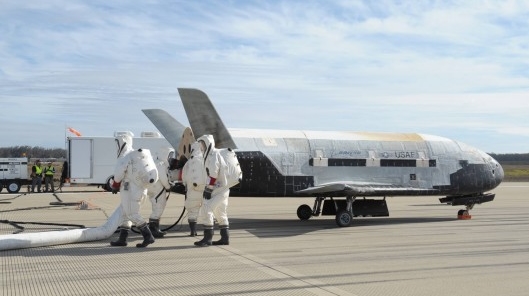
No images of the launch vehicle or the space plane have so far been released; however, orbital images of the Jiuquan facilities captured in July revealed modifications being made to a launch pad there, which suggest it has been updated to handle Long March Long March 4F with a 5 metre diameter payload fairing. This in turn suggests the Chinese space vehicle could be roughly comparable to the US Air Force X-37B automated space plane.
While little is known about it, the Chinese experimental space plane could be of a similar size ro the USAF’s X-37B space plane, seen here.
The vehicle remained in orbit for several days, during which time it is reported to have been used to test reusable technologies that will be used to provide “support for the peaceful use of space” according to the Chines state media agency.
China first indicated it is in the process of a space plane in 2017. Under a “space operations roadmap” released at the time, the China indicated it plans to have a single stage to orbit (SSTO) space plane capable of taking off and landing horizontally. It’s not clear if the launch of this experimental vehicle was part of the programme, or a separate initiative. However, Chinese officials have indicated this will be the first in a series of launches of the vehicle to verify rapid re-launch and repeated use capabilities, and to reduce the country’s cost of payload access to space.
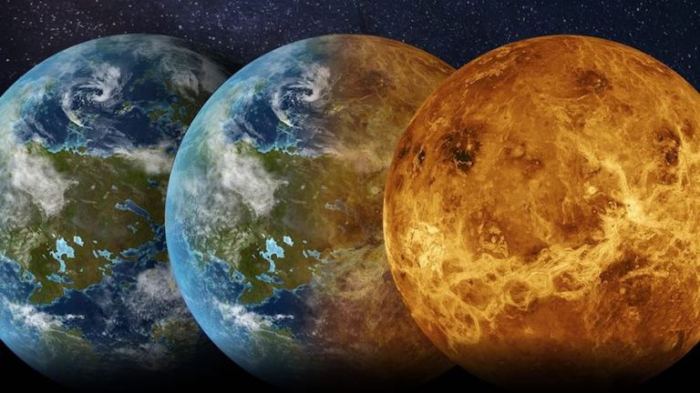
An artist’s depiction of Venus evolving from a potentially habitable water world to the hot desert it is today. Credit: NASA Goddard
Venus has been the subject of a number of recent studies, one of the most intriguing of which suggests it’s runaway greenhouse effect was started by what might at first seem an unlikely candidate: Jupiter.
Our solar system is a place of mysteries, both in itself and in comparison with many exoplanet systems. While of the latter have Jupiter-size worlds, unlike our solar system, these tend to be found fairly close in to their parent planet (although there are some exceptions). It’s believed that these planets actually formed further out from their parent stars, but then migrated inwards under gravity, until a point of equilibrium / resonance was reached.
This idea of planetary migration has led to theories on how our own solar system may have developed early it its life, with one of them in particular being of interest here. Called the Grand Tack Hypothesis, it suggests that Jupiter likely formed some 3.5 AU from the Sun (1 AU = the average distance separating the Earth from the Sun) – or about 1.5 AU closer to the Sun that its present orbit. During the initial evolution of the solar system, it gradually migrated closer to the Sun, perhaps getting as close as 1.5 AU – a little further out from the Sun than the present orbit of Mars, before the combined gravities of the other outer planets – most notably Saturn – gradually teased it back outwards again, until that point of equilibrium / resonance was reached, leaving them all in the orbits we see today.
What is particularly interesting about the Grand Tack Hypothesis is that it accounts for a number of inconsistencies visible in the solar system today if it is assumed the planets all formed more-or-less in their current orbit sand never shifted very far from them. These can be summarised as:
Why is Mars so small when compared to Earth and Venus? If the planets all formed within or close to their current orbits, then most models built around this idea result in Mars being of a comparable size to Earth.
Why don’t we see a “super Earth” (or “mega Mars”) between the orbits of Earth and Jupiter? Again, models based on all the planets forming in their present day orbits around the Sun indicate that there would have been sufficient accretion disk material in the region of Mars for a solid planet 1.5 times the mass of Earth (or greater) to have formed.
Why is the asteroid belt so relatively uniform? Again, if Jupiter formed 5-5.5 AU from the Sun, then the material within the accretion disk should have resulted not only in a Earth-size Mars, or a possible “mega Mars”, but should also have resulted in the formation of many more planetismals or “mini Marses” forming, smaller than Mars as weknow it today, but potentially somewhat larger than the likes of Vista and Ceres within the asteroid belt.
Many models of solar system suggest that, had it not been for Jupiter migrating from it’s point of initial formation in towards the Sun and then back out again, our solar system would look very different today, with an Earth-sized (or larger) “mega Mars” and an asteroid belt that includes multiple “mini Marses”. Credit: Sean Raymond
A migration of Jupiter towards the Sun accounts for the first two of these inconsistencies in much the same way: as it moved in towards the Sun, Jupiter both “ate” a lot of the material of the accretion disk sitting between the current orbits of Earth and Mars and also “pushed” some of it inwards, helping in the eventual formation of both Earth and Venus.
Then as it reversed course, it “ate” more of the debris, whilst pushing some of it away. Thus, the inward and outward movements of Jupiter left only sufficient material occupying the area of Mars’ orbit to accrete and form a relatively small rocky world. By the same measure, this pushing / absorbing of material within what would become the asteroid belt meant that material was much more widespread and unable to accrete sufficiently in order to create multiple “mini-Mars” planetismals.
But what does this have to do with starting the extreme greenhouse effect on Venus? The answer to this is quite complex.
In effect, Jupiter’s motion inwards not only pushed material towards the Sun that helped Earth and Venus to form, it also became sufficiently close to them both to encourage them into exaggerated elliptical orbits around the Sun, which at the time was somewhat cooler and dimmer than it has been for most of its adult life. Thus, Venus likely formed within what was then the Sun’s habitable zone, allowing an abundance of liquid water to form across the planet’s surface, whilst its elliptical orbit meant it experienced significant seasonal changes during the course of it’s “year”.
In particular, whilst “close” to the Sun, during its “summers”, the ocean-rich Venus would be subjected to greater amounts of evaporation of water from its oceans, which would in turn be subject to greater amounts of UV radiation. This radiation would split the water vapour into elemental oxygen and hydrogen, with the latter easily stripped away from the planet’s atmosphere by the solar wind, leaving the oxygen to combine with carbon to form carbon dioxide, generating what is called a “moist greenhouse” effect.
Jupiter’s migration would likely have helped Venus initially develop into a substantially wet world – which in turn likely started it on its way to having the runaway greenhouse effect we see today. Credit: NASA
At the same time, the mass of water in the Venusian seas gave rise to a process called tidal dissipation which over time, gradually “dampened” Venus’ exaggerated orbit around the Sun, allowing it to be pulled into the kind of circular orbit it has today, eliminating the seasons whilst holding the planet closer to the Sun than it had been, further increasing temperatures and accelerating the moist greenhouse effect. This in turn would be aided but the Sun increasing in it radiative output, further accelerating the greenhouse effect as more and more water evaporated from the surface oceans, until the point of no return was reached.
A further result of the Sun’s increasing outflow of heat meant that its habitable zone was pushed outwards to encompass the Earth – but being that much further away from the Sun and under a greater influence of the gravities of the outer planets, Earth didn’t suffer either form that initial kick into a moist greenhouse effect, allowing it to maintain its seasons, and remain a more comfortably warm, wet planet.
It’s not 100% certain Jupiter’s migration was the kickerstarter for Venus’ greenhouse effect. There are, for example other mechanisms that may have dampened Venus’ orbital eccentricity without the influence of a massive planet like Jupiter – such as Milankovitch Cycles. But given the way the Grand Tack Hypothesis helps explain a good deal about the early solar system, it seem likely it may well have been responsible. And if it is correct, it has significant implications for any Venus analogues orbiting other stars and our understanding of the mechanisms at work in the development of exoplanets.
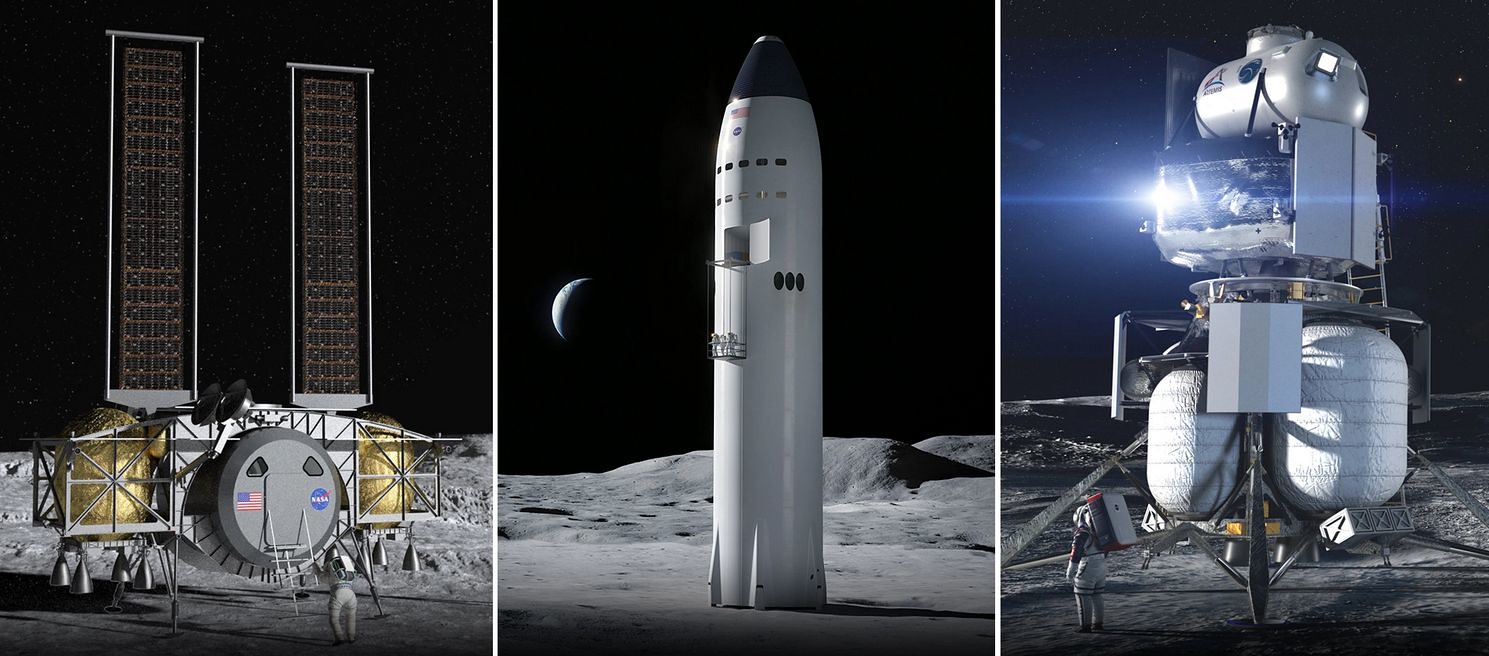
The three proposals for NASA’s Human Landing System vehicles under consideration of the US Artemis programme. Left: the Dynetics lander / ascent vehicle; centre: the modified SpaceX Starship; right: the National Team’s descent / ascent modules. Credit: NASA
In late April, NASA awarded funding to develop human landing systems for the agency’s Artemis lunar programme to three commercial groups: SpaceX, Dynetics and the so-called “National Team” of Blue Origin, Lockheed Martin, Northrop Grumman and Draper.
All three are taking different routes to supply vehicles capable of landing humans on the surface of the Moon and then returning them to lunar orbit for onward transit to Earth. For the initial mission, which NASA has time-tabled for 2024 – a highly ambitious date – one of the three vehicles must be capable of delivering a crew of two to the south polar regions of the Moon and then back to orbit.
On August 20th, 2020, the National Team delivered a full engineering mock-up of its proposal lander / ascent vehicle to NASA’s Johnson Space Centre (JSC).
For those familiar with the Apollo lunar lander, the National Team’s vehicle is a veritable monster, standing over 12 metres (40 ft) in height. It comprises three elements: a descent element that physically lands on the Moon and that is topped by the ascent element, both of which are helped down to the lunar surface by a transfer element.
The National Team design. From left-to-right: the transfer vehicle (Northrop Grumman), the descent module with the ladder and landing legs (Blue Origin), and the Ascent stage (Lockheed Martin). Credit: Blue Origin
It’s a combination of vehicles that build on a definable heritage. The descent element is being designed by Blue Origin using the technology the company has been developing over the last three years for its automated lunar lander, Blue Moon.
The ascent stage, meanwhile, is being developed by Lockheed Martin leveraging technology used in NASA’s Orion Multi-Purpose Crew Vehicle (MPCV), the capsule vehicle that will be used to ferry crews to and from Lunar orbit. Finally, the transfer stage uses technology and elements from Northrop Grumman’s automated Cygnus resupply vehicle serving the International Space Station (ISS).
The newly delivered mock-up will remain at JSC through until early 2021. It will be used by NASA engineers and astronauts to ascertain how the vehicle works, what is required, and helping engineers within the National Team to validate the team’s approach to getting crew, equipment, supplies, and samples off and on the vehicle.
In all, the three contractors were awarded a total of US $967 million that would be used to meet the costs of the first 10 months in developing each of their proposals of a Human Landing System (HLS). Of the three, the National Team took the lion’s share of the funding, some US $579 million. As well as delivering the engineering mock-up to JSC, the National Team is also preparing for a certification baseline review of their proposed design, with NASA expected to release a draft of the call for proposals for the next phase of the programme in early September.
For their design, Dynetics is also working with Draper and with Sierra Nevada Corporation, the developers of the Dream Chaser space plane. Their design is the smallest of the three proposed HLS vehicles – and potentially the most flexible. It is effectively a two-stage craft comprising a core lander / ascent vehicle of a squat design, supported by “drop tank” units that provide fuel for the initial stages of descent to the lunar surface, and which are jettisoned as their supplies are used.
The core craft is designed to carry crew or cargo down to the surface of the Moon and return crews back to orbit to rendezvous with an Orion MPCV or the Lunar Gateway. In addition, the uncrewed cargo variant is designed so that once cargo has been unloaded, it can be utilised as an additional module for a lunar base, providing a means for the base to be routinely expanded.
SpaceX – a surprise receiver of funding for HLS – is proposing the use of a modified version of its Starship vehicle, one sans aerodynamic surfaces, as these will not be required for operations to / from the surface of the Moon.
It is expected that NASA will de-select one of the proposals in early 2021, allowing the remaining two to continue. However, there has been a crimp put in plans: NASA requested some US $3.3 billion specifically to fund the HLS programme in fiscal year 2021, but under the proposed House budget, only US $670 million is allocated to HLS development, and the Senate’s budget proposal may not significantly raise this.
Was the Sun Once Part of a Pair?
A theory published in the Astrophysical Journal Letters on August 18th, 2020, dips into the theory that the Sun was once part of a binary pair.
The theory itself isn’t new: the Sun was one of a number of stars formed around the same time in the “local cluster”, and so may well have been twinned with another early in its life, before the gravitational influences of other stars in the cluster forced them apart. In fact, in 2018, astronomers from the Instituto de Astrofísica e Ciências do Espaço in Portugal announced they may have discovered it in the form of star HD 186302, some 184 light-years away – although this has yet to be proven.
An artist’s impression of the Sun (foreground) with its former twin. Credit: unknown
In the new publication, scientists from Harvard University point to the Oort cloud – a complex combination of a ring of icy planetesimals (the Hills Cloud) and a larger, more distant sphere of such objects, both of which lie beyond the heliosphere, as indicative that the Sun once had a companion.
Conventional thinking has it that the Oort cloud formed from debris left over from the formation of the solar system and its neighbours. However, models designed to show this have been unable to produce the expected ratio between scattered disk objects within the Hills cloud and outer Oort cloud objects. But if a relatively close stellar companion is introduced to the mix, modelling the formation of the Oort cloud elements and the distribution of objects within them becomes clearer, the paper’s authors claim. Not only that: it may actually help explain how life on Earth started.
Oort cloud objects are rich in water ice and the minerals and chemicals essential to starting life. Having a stellar companion for the Sun dramatically increases the amount of perturbations that might ripple through the Oort cloud and send some of its objects to fall into the solar system – and potentially collide with Earth, bring that water and those compounds with them.









 Inara Pey: Living in a Modemworld