OpenSimulator Community Conference registrations open

2014 banner

Registrations have opened for the 2014 OpenSimulator Community Conference. Attendance is free, but for those wishing to donate to the supporting this and future conferences, there are a number of options to do so, ranging from $10.00 USD through to $200.00 USD, all of which offer various benefits to purchasers.

For the full range of ticket options and their repsective benefits, and to book your place at the conference, please visit the conference ticket page.

Note that tickets will be available strictly on a first come, first served basis, and that the conference will be streamed via UStream for those unable to secure a ticket.

The current keynote speakers for the conference are:

  • Dr. Steve LaValle, a professor of Computer Science at the University of Illinois, is the principal scientist for Oculus VR, who will be addressing attempts to bring the Oculus Rift headset to the mass consumer market
  • Philip Rosedale, CEO of High Fidelity Inc., who will address the question, “What is the Metaverse?” and discuss the opportunity to develop an open platform for virtual reality over the internet, including new hardware devices that catalyze entirely new kinds of interactions between avatars.
OSSC keynote speakers Steve Lavalle (l) and Philip Rosedale (r)

About the OpenSimulator Conference

The OpenSimulator Community Conference is an annual evnet that focuses on the developer and user community creating the OpenSimulator software.  Organised as a joint production by the Overte Foundation and AvaCon, Inc., the conference features two days of presentations, workshops, keynote sessions, and social events across diverse sectors of the OpenSimulator user base.

The 2014 OpenSimulator Conference will take place on the OpenSimulator Conference Centre grid on November 8th and 9th, 2014, with registrations opening on September 15th, 2014, and interested parties can sign up to receive an email reminder to register.

The conference will include four themed tracks and a Learning Lab for hands on hackerspaces, speedbuilds, and more:

About the Organisers

The Overte Foundation is a non-profit organization that manages contribution agreements for the OpenSimulator project.  In the future, it will also act to promote and support both OpenSimulator and the wider open-source 3D virtual environment ecosystem.

AvaCon, Inc. is a 501(c)(3) non-profit organization dedicated to promoting the growth, enhancement, and development of the metaverse, virtual worlds, augmented reality, and 3D immersive and virtual spaces. We hold conventions and meetings to promote educational and scientific inquiry into these spaces, and to support organized fan activities, including performances, lectures, art, music, machinima, and much more. Our primary goal is to connect and support the diverse communities and practitioners involved in co-creating and using virtual worlds, and to educate the public and our constituents about the emerging ecosystem of technologies broadly known as the metaverse.

 Related links

This is as Easy as it gets

HF-logoOn August 14th, the High Fidelity team issued a blog post featuring the first number by AKA, the company’s informal group of singers of Emily, Ozan and Andrew. While light-hearted in nature, the video further demonstrated HiFi’s work on facial expression and gesture capture.

I wrote about the video and post as a part of a quick update on HiFi, and noted at the time that “executive producer” (and HiFi co-founder) Ryan Karpf would be providing more information on what went into the video and session.

Ryan Karpf, HiFi co-founder and "executive producer" for AKA's cover of "Easy"
Ryan Karpf, HiFi co-founder and “executive producer” for AKA’s cover of “Easy”

Keeping to his word, Ryan did just that on Tuesday August 26th, releasing a video on how it was all done (embedded below), together with a brief blog post inviting those already in the Hi Fi Alpha testing programme to consider submitting their own videos … assuming, that is, they have the hardware.

Ryan’s piece explains how the team put together the music video and overcame some stumbling blocks, although I admit I’d probably have a better chance of understanding Brad Hefta-Gaub’s explanation of a server crash issues had he been speaking Klingon (which is probably why I’m not in the Alpha)! Fortunately, Ryan is on-hand to offer a single-sentence translation into English. The video also reveals how the team were unable to film the song as a single “live” performance, as had been hoped, but in the end had to rely on traditional post-recording editing to produce the finished piece.

As well as being informative, Ryan’s video is also somewhat hypnotic … I confess to becoming quite captivated by the level of conversation going on between his eyebrows even before he presents us with more exaggerated facial movements to underscore a point! 🙂

It’ll be interesting to see how this work develops, and whether the HiFi team really do get to the point of being able to record a completely fluid and “live” performance; I rather suspect they will. But even without this, the Easy video tends to demonstrate how much more engaging something like a musical set could be when one can see more of the performer’s facial expressions and actions when playing a musical instrument reflected in their avatar.

In the meantime, and for ease of reference (and because I like it and find myself singing along with Emily), is the music video itself, complete with Chris and Ryan’s “outtakes”.


High Fidelity founder to address OpenSimulator Conference

2014 banner

On Thursday August 28th, Chris Collins, writing on behalf of the 2nd OpenSimulator Community Conference, announced a further keynote speaker at the event will be Philip Rosedale, co-founder of Second Life and most recently a founder of High Fidelity Inc.

The press release states that:

Mr. Rosedale’s keynote presentation will address the question, “What is the Metaverse?” and discuss the opportunity to develop an open platform for virtual reality over the internet, including new hardware devices that catalyze entirely new kinds of interactions between avatars.

Philip Rosedale: Opensimulator Community Conference Keynote Speaker
Philip Rosedale: OpenSimulator Community Conference Keynote Speaker

In 1995, Philip Rosedale created an innovative Internet video conferencing product called “FreeVue”. This was subsequently acquired by RealNetworks, where he was appointed Vice President and CTO in 1996.  During 1999, Rosedale left RealNetworks to co-found Linden Research Inc., operating under the name of Linden Lab, with the intention of developing an open-ended, Internet-connected virtual world. In 2003, Linden Lab publicly launched Second Life.

Rosedale departed Linden Lab in 2010, after serving twice at the company’s CEO and as the chair of the board. Since then, he has established both Coffee & Power and Worklist.net, both focused on distributed work and computing. In 2013, he co-founded High Fidelity Inc. to explore the future of a next-generation virtual reality system.

Commenting on his appearance at the OpenSimulator Community Conference, Chris Collins said, “Philip Rosedale is one of the foremost thinkers about virtual reality and the Metaverse today,” said conference chair Chris Collins. “We look forward to hearing his thoughts on the next generation of open Metaverse platforms, including OpenSimulator.”

About the OpenSimulator Conference

The OpenSimulator Community Conference is an annual evnet that focuses on the developer and user community creating the OpenSimulator software.  Organised as a joint production by the Overte Foundation and AvaCon, Inc., the conference features two days of presentations, workshops, keynote sessions, and social events across diverse sectors of the OpenSimulator user base.

The 2014 OpenSimulator Conference will take place on the OpenSimulator Conference Centre grid on November 8th and 9th, 2014, with registrations opening on September 15th, 2014, and interested parties can sign up to receive an email reminder to register.

The conference will include four themed tracks and a Learning Lab for hands on hackerspaces, speedbuilds, and more:

About the Organisers

The Overte Foundation is a non-profit organization that manages contribution agreements for the OpenSimulator project.  In the future, it will also act to promote and support both OpenSimulator and the wider open-source 3D virtual environment ecosystem.

AvaCon, Inc. is a 501(c)(3) non-profit organization dedicated to promoting the growth, enhancement, and development of the metaverse, virtual worlds, augmented reality, and 3D immersive and virtual spaces. We hold conventions and meetings to promote educational and scientific inquiry into these spaces, and to support organized fan activities, including performances, lectures, art, music, machinima, and much more. Our primary goal is to connect and support the diverse communities and practitioners involved in co-creating and using virtual worlds, and to educate the public and our constituents about the emerging ecosystem of technologies broadly known as the metaverse.

 Related links

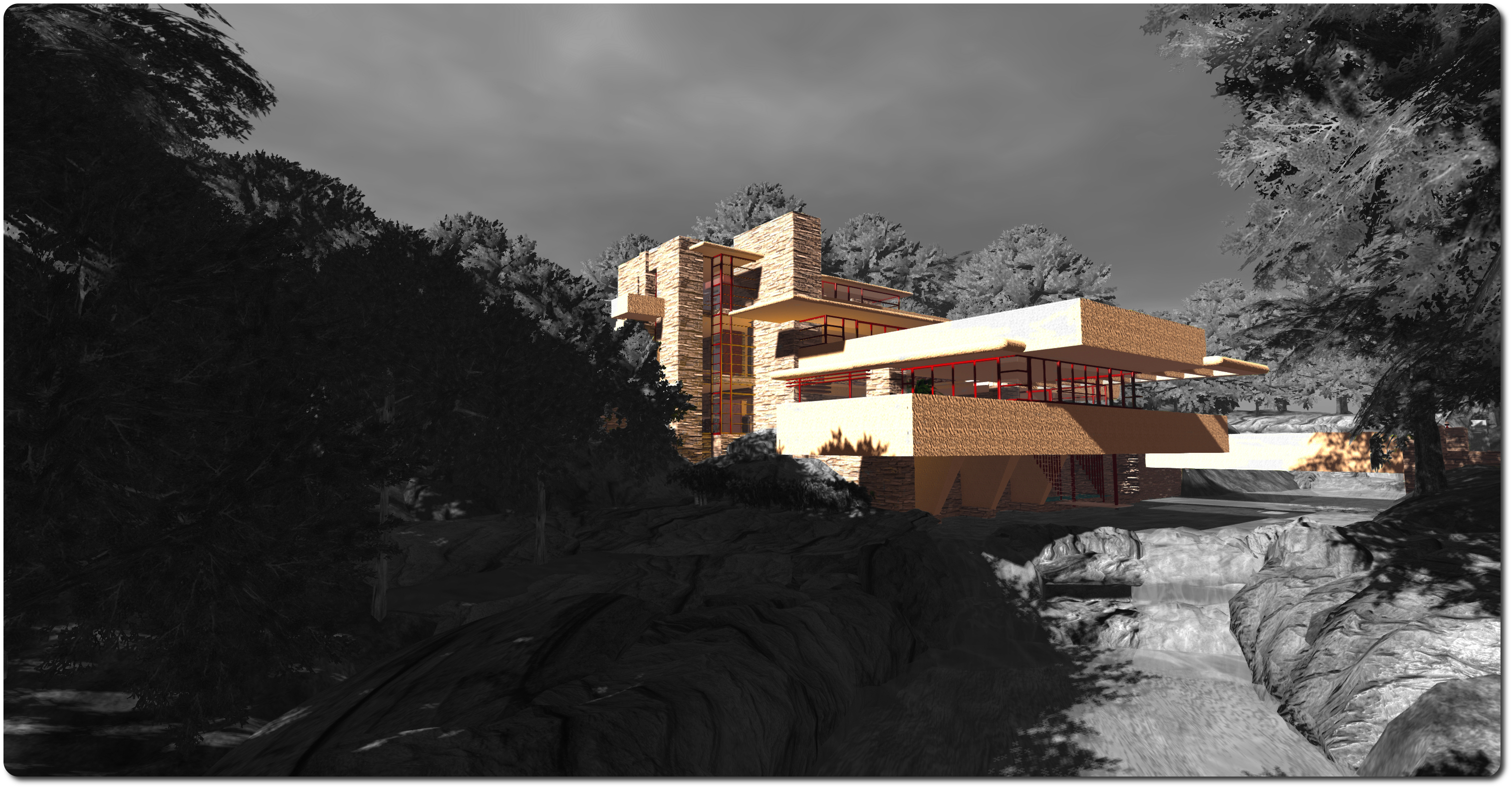
Fallingwater at Seanchai Kitely ready to open its doors

Fallingwater at Seanchai, Kitely (Image idea borrowed from Shandon Loring!)

As I’ve recently posted, in June I donated my Fallingater build on Kitely to the folk at Seanchai Library to become a part of their new home world on that grid, and I’ve been working to overhaul and upgrade it since then.

The work on the place is now more-or-less complete, with just a few nips and tucks remaining, and the folk at Seanchai are now ready to open the doors to Fallingwater’s first official engagement as a storytelling venue.

So, on Saturday August 30th, at 09:00 PDT (SLT), Shandon Loring from the Seanchai team will be presenting Out Of Time, Tales of Time Travel, described as:

Individuals rewriting their own pasts. Brave souls safeguarding the world today from yesterday. Fools tampering with Einstein’s laws of physics. Stories exploring the wonders and perils of time travel, and humanity at its best and worst.

Anyone with an interest in storytelling in voice, and all the traditions which stand therein, and / or who wish to hear engrossing tales from Second Life’s and Kitely’s premier group of storytellers, are welcome to drop by the Seanchai Library’s Kitely home world and Fallingwater.

Related Links and Resources

Tony Parisi joins High Fidelity

HF-logoOn Thursday August 21st, Philip Rosedale announced that Tony Parisi has joined High Fidelity.

Precisely what Mr. Parisi’s position at HiFi is, isn’t stated, but Mr. Rosedale does say:

Tony has just joined us as an advisor, and is also working with us on some secret High Fidelity stuff that is coming soon. He’s a perfect person to add to the High Fidelity team.

Tony Parisi (via SVVR)

Tony Parisi is the co-creator of the VRML and X3D ISO standards for networked 3D graphics, and a 3D technology innovator. He’s a career CTO / software architect and entrepreneur, has and is serving on a number working groups, and may also be familiar to some as one of the SVVR Creating the VR Metaverse  panel in April 2014. More recently, he was featured in a Drax Files Radio Hour feature-length interview, which I also reviewed (and am embedding again at the end of this piece, as it really is worth listening to if you missed it the first time around).

Tony’s full bio can be found here, and while the work he’ll be doing at HiFi is currently “secret”, Philip Rosedale does expand on why his involvement is a good fit for the company:

What we are building at High Fidelity is a bigger project than any one designer or company.  To bring virtual reality to everyone will mean a broad set of standards and open systems, and Tony has been designing and championing big pieces of those standards for his whole career, most recently with WebGL.

There can be no doubting Tony’s background and understanding of the potential for consumer-focused VR – again, just listen to the interview below for proof of that.

So interesting times at High Fidelity just got more interesting!

(Nice touch on the updated website as well, with the video header.)

Taking it Easy with High Fidelity, aka AKA sing

HF-logoThe folks at High Fidelity has been blogging a lot lately. I covered recent moves with improvements to the avatar facial expressions and synch the mouth / lips to better reflect their movements as we speak (and sing!), and one of the more recent blog posts is something of a follow-up to this, with members of the Hi Fi team having a little fun. It’s fair to say that if they keep things up, Emily and Ozan and (I think that’s) Andrew on backing vocals could find themselves in-demand for gigs virtual and otherwise!

Anyway, we’ll get to that in a moment.

The other two posts are focused on Philip’s favourite subject: reducing latency, particularly where sound is concerned. As the oldest of the posts Measuring the Speed of Sound, from August 13th, reducing latency is something of an obsession at High Fidelity, and the post talks about various experiments in trying to reduce audio latency. I’m still not convinced on Philip’s big downer on voice communications over mobile devices, where he’s in the past referred to the 500 msec delay as a “barrier” to communications; I’ve yet to find it silting conversations.

That said, I can see his point in ensuring that audio and video remain synched when it comes to direct interaction, particularly given the nature of what High Fidelity are trying to achieve with the likes of facial and gesture capture to achieve a greater sense of presence. Within the post, Philip discusses the most recent work HiFi have been carrying out in comparing various mediums and how they handle audio and audio latency.

Paloma’s Javascript Project touches on the work of 17-year-old Paloma Palmer. A high school student, Paloma has been honing her JavaScript skills during the summer vacation as an intern at High Fidelity. Video interviewed by HiFi’s Chris Collins, she describes her project in coding voxels to respond directly to volume inputs over a microphone in real-time, coding a form of graphic equaliser in voxel cubes which responds, with minimal delay, directly to both her and Chris’ voices and intonations as they speak – a further demonstration of the low latency goal HiFi are aiming towards, and one which, as the blog post notes, “opens up a bunch of new creative content areas for the virtual world”.

HiFi's Chris Collins talks with Paloma Palmer, the 17-year-old intern who has been working at HiFi through her summer vacation (inset)
HiFi’s Chris Collins talks with Paloma Palmer, the 17-year-old intern who has been working at HiFi through her summer vacation (inset)

However, it is with High Fidelity’s AKA covers Easy, which sits sandwiched between Measuring and Paloma which offers the most fun, as well as demonstrating some intriguing elements of HiFi’s capabilities.

The post actually takes the form of another music video (and embedded below) in which Emily, with Ozan on guitar and I think (and I see Ciaran Laval is of the same mindset as me) Andrew Meadows (himself aka  – or at least previously aka – Andrew Linden) providing the backing vocals. Together they’ve formed HiFi’s own band, AKA (as in Also Known As), a name chosen because, as Emily explains, it allows them to be anyone they want to be. Chris Collins and Ryan Karpf are also on hand, although they don’t participate in the song.

The video this time is a cover of the Commodore’s Easy. We’re promised a deeper explanation of some of the technicalities behind it from “Executive Producer” Ryan at a later date. What is great about the video is that it is totally informal (witness the start, and keep running right until the end when you watch it).

The video is worth watching for the way Emily’s avatar clearly reflects her emotional response to the lyrics, and for the way Ozan’s avatar appears to be playing his guitar, rather than simply strumming it one-handed, as we’re perhaps used to seeing with avatars; his response to the music is also clear. I assume this has been done by some form of motion capture via whatever camera system he is using, but we’ll have to wait for Ryan’s follow-up to know more.

There are other great delights in the video – Andrew’s surfacing from the pond waters to give the backing “ahs” had me snorting coffee; they are delightfully surreal. I have to say that Chris Collin’s avatar looks somewhat blissed out (aka a little stoned – no offence, Chris!), an impression heightened with the cutaway to Emily’s look on his comment about feeling very cool and relaxed prior to the song starting!

All told, the video is an absolute delight, and also reveals some interesting little elements within HiFi (witness Ryan’s enthusiastic hand-clapping at the end).

Anyway, enjoy!