“When I consider your heavens….” – SunAeon update

The SunAeon team have been working on the primary site, and adding a raft of new features, which launched on Wednesday 26th September. Once again, I was very honoured to be asked to contribute to the site, providing information on the Earth, the Moon, the Sun and little Pluto.

Launching SunAeon presents you with a new introductory video, a virtual tour of the Sun, the eight planets and Pluto, showing each in turn, together with notable surface features in the case of the Earth, the Moon and the Sun, and cutaway views of the interiors of the major planets.

The main screen navigation tools remain unchanged, although the Navigate drop-down menu (accessed from the SunAeon button, top left of the screen), now includes the Sun, Earth, Moon and Pluto. Clicking on any of these will take you to your topic of interest and present the familiar surface view of the target, and the data display options.

Data Display for the Sun

The amount of information available for each target is currently a little variable – Earth and the Sun, for example, have a lot more data options available for them, including panels for their atmospheres as well as internal structures (blame me for that – I may have overloaded Mito and the team with text!). Surface features are also now annotated for them, and for the Moon, allowing specific points / features to be focused upon and dedicated information panels displayed for them. I confess I wasn’t involved in these panels, but now I’ve seen them, I hope very much that Mito and the team will include a similar approach for the other planets as well – such as coverage of Olympus Mons, Gale Crater, Gusev Crater, the Vallis Marineris on Mars; Jupiter’s Great Red Spot, and so on.
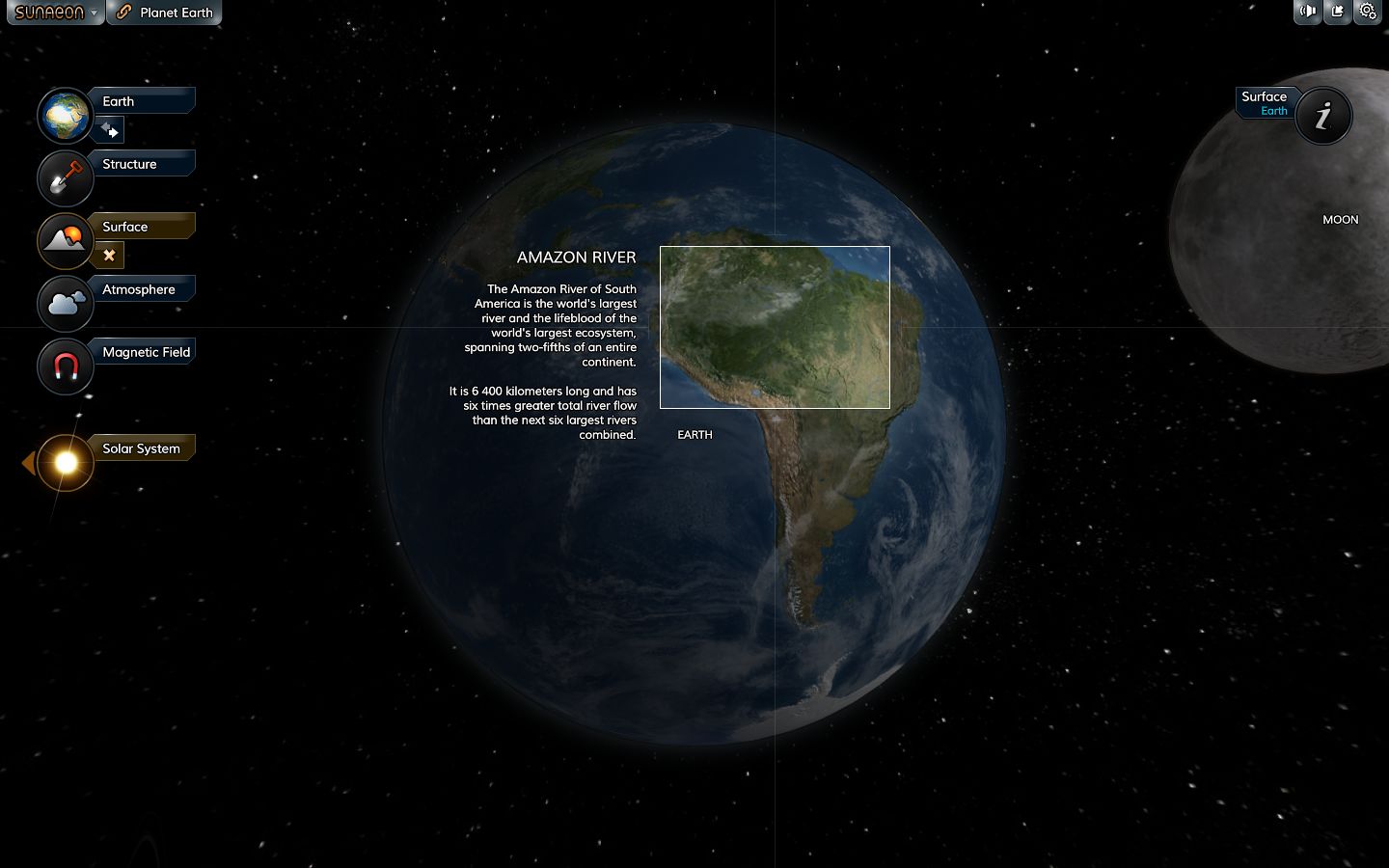
An additional surface features pop-up panel for Earth

Some of the planetary data display pages now also include videos, provided courtesy of NASA. The pages for the Sun, the Moon and Mars all now incorporate optional videos, one of which features the upcoming MAVEN mission to study the upper atmosphere of Mars, and which is scheduled for launch at the end of 2013.

Ace of Space

This update also includes a very simple game as well. Called Ace of Space, This is essentially racing a small spaceship around the eight planets of the solar system, passing just close enough to each to make a checkpoint. The race is against the clock, and planets can be tackled in any order (although there is a degree of planetary alignment which can be used if you hit on the right course). Controls are simple – the arrow keys, with UP firing your main engines and DOWN firing your retro motors (both burning your fuel allowance, which can be renewed), and LEFT and RIGHT turning your ship. For those that feel up to it, you can also activate the planets’ gravity wells, which you can use to assist your flight – as long as you’re careful!

Flying past Mars in Ace of Space

Ace of Space is lighthearted fun, and includes a “free flight” mode. It’s hopefully a sign of more sophisticated space flight / exploratory capabilities will be added to SunAeon as time goes on, in accordance with the original roadmap for the site. The game can also be downloaded, for those who prefer to play it directly on their desktop / laptop, and the code is available to embed into webpages as well. If I have any critique at all, it is that the only way to get back to the main SunAeon solar system model appear to be going via the HELP option in the game or clicking the BACK button on your browser – an on-screen option would make things easier.

This is another nice update to SunAeon, and I’m again honoured in being asked to assist with a small part of it. I’m now looking forward to seeing it grow to include more details on the planets, moons and other bodies in our solar system.
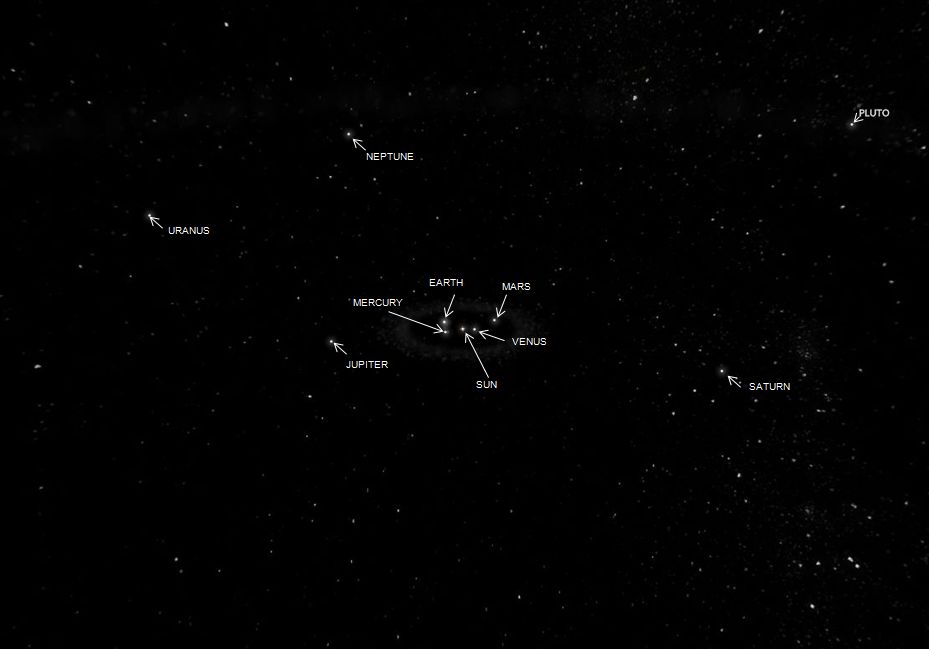
The Solar System is seen from space with SunAeon

Related Links

Kitely: faster worlds, transfer stations and more

Over the course of the last month, Kitely, the on-demand virtual world service, has continued to refine their megaregion offering introduced at the start of August, improving their OpenSim performance in the process. They’ve also announced an upcoming feature called “Transfer stations”.

Traditionally, working with megaregions is limited in some ways due to the viewer code being geared towards handling regions which are 256×256 metres in size. Editing terrain textures, for example, is something which usually cannot be done when working on a megaregion. While megaregion mode can be disabled to allow work to be carried out on a per-region basis, it can also lead to problems: landmarks can stop working, in-world objects may show at the correct location, etc.

Kitely have solved this problem by introducing an Advanced Megaregion option, which works relatively seamlessly with the viewer. When a world owner / manager using a megaregion attempts to carry out an operation such as changing the terrain settings, a pop-up is displayed advising them that the operation cannot be performed with the world running in Advanced Megaregion mode. A link on the pop-up allows the world owner to switch to their browser and disable the Advanced Megaregion  option via their Manage World webpage. This then allows them to work on the world as if it were a series of individual regions. Once terrain work has finished, the Advanced Megaregion mode can be turned on once more.

The Advanced Megaregion also allows parcel media to be heard right across a megaregion (rather than being limited to the south-west corner region).

“Oren, We Need Warp Speed!”

As well as working on megaregions, Kitely has been optimising the OpenSim code running on their cloud-based servers. In the same blog post announcing the Advanced Megaregions, Oren Hurvitz, Kitely’s co-founder and VP of R&D describes the improvements thus:

We have made numerous improvements to OpenSim to make big worlds work faster on Kitely. These changes reduce OpenSim’s CPU usage up to 80%! This makes the user experience smoother and allows for the use of more complex worlds and more avatars than regular OpenSim. The following chart shows how much we reduced CPU usage compared to regular OpenSim. These tests were done on a world running in its own server, with one avatar in the world.

Kitely CPU server optimisation (courtesy Kitely)

This optimisation allows Advanced Megaregions on Kitely to run up to 5% faster than regular megaregions.

Transfer Stations

Transfer Stations are an upcoming Kitely feature. They are described as, “Miniature worlds that users wait in while their world is being loaded.” The blog post announcing them goes on:

Kitely is a cloud-based virtual world provider, so when a user tries to enter a world that is currently offline we need to start the world first. This is fairly quick, but not instantaneous. Currently users look at a progress bar on our website while the world is being started, and once the world is ready their viewer is automatically launched. Transfer Stations are going to change this: when a user tries to enter an offline world their viewer will start immediately, but they will enter a Transfer Station instead of the desired world. Once the world is ready the user will be teleported to it automatically.

The Transfer Stations will be located on dedicated worlds specifically set-up for them, and could, in the case where more than one user is logging-in to the same offline world, allow people to meet and chat while awaiting their destination to load (not that the wait should in any way be extensive!).

To encourage the development of Transfer Stations, Kitely are inviting world owners to submit themed Transfer Station designs of their own, which other world owners and managers will then be able to pick from when setting-up a Transfer Station on their world(s).

Kitely Transfer Station conceptual drawing (courtesy Kitely)

There are certain requirements which must be met for Transfer Station submissions, and these can be found in the Kitely blog post. Reviews of submissions, which will be performed by the Kitely Mentor’s Group, will commence on October 1st.

New Avatars

On September 21st, Kitely updated their default avatars with a range of seven new avatars, using modified assets based on ones provided by designer Linda Kellie. The avatars are available to new users signing-up to Kitely, and the assets are currently also available at in-world Linda Kellie malls for those who wish to use them as their base model.

Kitely’s new default avatars (image courtesy of Kitely) – click to enlarge

Related Links

Relay for Life of InWorldz kickoff rally

August 25th will see the start of the first ever Relay for Life season held in InWorldz, with a special kick-off rally.

The three-month event will run through until November 17th and has the full support of the American Cancer Society.

Other key dates for the season include:

  • Saturday September 22nd: RFL of InWorldz Half-way Event
  • Friday November 2nd through Sunday November 4th: RFL of InWorldz Relay for Life Weekend
  • Saturday 17th November: RFL of InWorldz Closing Party.

The theme for this inaugural season is Colour of Hope, as featured in the season’s banner, as seen in the video, above.

The kick-off rally will be held on Dreamscapes of Poseidon (IWurl), commencing at midday IW time (PDT). It presents a chance for participants to learn how their involvement benefits the American Cancer Society’s goal to save lives and create more birthdays and the opportunity to meet the Society’s IW representative as well as gain inspiration from DJ KyFire Oakleaf’s library of originals created by all those who have been involved in the fight against cancer, including survivors, caregivers and loved ones of those who sadly succumbed to the disease.

Kick-off Rally Schedule

  • 12:00 pm KyFire Oakleaf – RFL Songs
  • 12:15 pm Hairy Thor Chair
  • 12:22 pm RFL Video
  • 12:30 pm TIGGS Beaumont
  • 12:37 pm KyFire
  • 12:40 pm Sting Raymaker
  • 12:50 pm KyFire Oakleaf- closing.

Following the kick-off rally, the season will comprise a number of events held within InWorldz, culminating in the Relay Weekend itself at the start of November. In it, individuals and teams will camp out, picnic, dance, play games and take turns circling around a track “relay” style to raise funds and fight cancer. The Relay Weekend will open  with cancer survivors leading the way around the track and being honoured in the Survivor Lap. They will be followed throughout the day by groups, teams and individuals participating in the track walk which will continue over 24 hours, and the weekend will include the beautiful, moving and silent luminaira ceremony, in which lights are lit in memory of a loved one who won the fight against cancer or in remembrance of a special someone who lost their battle.

Relay For Life represents hope in that those lost to cancer will not be forgotten, that those who face cancer will be supported, and that one day, cancer will be eliminated.

Related Links

Kitely goes mega

I’m a little late getting to this, as I’ve been swimming through a lot of SL-related stuff and other bits, so apologies to Oren and Ilan. 

On the 17th August, Kitely announced the addition of high performance big worlds and world pictures to their on-demand service.

Public World Page Images

Taking the second of the new additions first, Kitely users can now add an image of their world(s) to the Public Worlds listing. Previously, the Public Worlds list was just that – a text list of all worlds in Kitely available for public access. The use of images makes the list more visually appealing and gives those browsing the list a glimpse of the world prior to clicking on the image to access the region’s World Page.

Adding a Public Worlds image via the Manage World Advanced tab

Pictures can be set in one of two places – the World Page, and in the Advanced tab of the Manage World dialogue box. Submitted pictures are automatically resized to fit the available space on upload.

The Public Worlds page has been redesigned to support the new images,  with world images being displayed 12 to a page, with the world name below the image with the world owner’s name. Those worlds that have not yet had an image uploaded for the page will show the Kitely logo, and will generally be listed after all those that have an uploaded image available.

The updated Public Worlds page layout, with my own region in the list 🙂

Big Worlds

Following-on from the promise in the last update, Kitely have implemented their “big world” feature. This allows large, high-performance worlds to be created which can be up to 16 regions in size (i.e. 4 regions x 4 regions). In addition to the 16-region world, big worlds are also offered in four region (2×2) and nine region (3×3) sizes.

The free worlds offered within the Silver and Gold subscription plans can be used to create  various mixes of big worlds and standard regions, according to the user’s requirements. For example: a Silver plan might be used to create 10 individual regions, or two 2×2 big worlds and two “standard” individual regions or a 3×3 big world and single individual region, etc.

However, the size of a world can only be set when it is created, and cannot be changed afterwards. Therefore, single region worlds already created in Kitely cannot be converted to big worlds, regardless of the remaining quota of free regions in a silver or gold plan (e.g. if a user has 3 regions left in their free quota, they cannot combine them with an existing single-region world to create a 2×2 big world).

Additional worlds beyond a plan’s quota can be purchased using Kitely Credits (KC) at the rate of 10KC per region per day. So a 4-region (2×2) big world would cost 1200KC a month (4 regions x 10KC x 30 days), or as little at $4 a month when purchasing Kitely Credits at the maximum discounted rate. The costs of copying, exporting, and replacing big worlds are also dependent on the number of regions in the world. For example, copying a 4-region world will cost 40 KC (10KC per region).

Additional points of note about big worlds:

  • Big worlds have a “root region”, which is always the region in the South-west corner of the world
  • Big worlds have a “default region”, which is initially the root region (SW corner region) of the world, where incoming visitors arrive
    • This can be altered through the use of a tele hub, which can be placed in any region in the world, making it the default for incoming visitors
    • Deleting the telehub will not alter the updated default region
    • Moving the default region does not change the location of the root region
  • There is a limit of 100,000 prims for a world, regardless of the number of regions it contains.  How the total allocation is distributed among the regions within a big world is up to the world owner, but the total of 100,000 prims cannot be exceeded
  • When running in megaregion mode (see below), region crossings are completely eliminated
  • Vivox works seamlessly across all regions in a big world.

By default, Kitely’s big worlds use the OpenSim megaregion mode, wherein multiple regions have been merged into one contiguous region. This eliminates region crossings within a big world and all the dependent issues around them for building, vehicle movement, etc., and provides a much smoother overall performance.

However, Megaregions are an experimental feature so some OpenSim features don’t work properly (e.g. parcel audio only works in the root region). Kitely therefore allows big worlds to be run as either megaregions or non-megaregions; a check-box is provided in the Advanced Tab of the Manage World dialogue box to switch any inactive world (i.e. a world not currently running on a Kitely server) between the two modes.

Kitely have also added a new world template to help in the creation of big worlds. This is the Universal Campus, a 2×2 region build created by Michael Emory Cerquoni (a.k.a. Nebadon Izumi), and licensed under the Creative Commons Attribution-ShareAlike licence.

To support the safe archiving of big world builds, Kitely have extended to the OpenSim Archive (OAR) file format to support the saving of a multi-region world as a single OAR file. Currently, the file format cannot be used to export builds elsewhere, but the code has been submitted for inclusion in standard OpenSim, and once adopted by OpenSim, will allow the exchange of multi-region OAR files between Kitely and other grids (with limitations to protect 3rd party content), although pre-existing multi-region OAR files may require replacing should the file format change as a result of adoption by OpenSim.

In the meantime, Ilan Tochner, Kitely’s CEO has offered a workaround for people to import their own multi-region builds to Kitely ahead of the new file format being adopted.

Related Links

Kitely restructures subscriptions, payment options and more

July 17th. Kitely has today announced extensive pricing restructuring which has come about in part as a result of requests from users asking that they be able to spend more time in-world rather than receiving additional Kitely Credits (KCs).

New Subscription Options

Under the new subscription system, monthly KC awards are abolished and in-world times revised. This means the basic Bronze level subscription now provides 30 hours in-world per month (up from 25 under the old system of combining free minutes and awarded KCs), with the Silver plan now providing 120 hours in-world, up from the 100 hours offered under the old minutes + KCs model. With both Bronze and Silver plans, the number of supplied regions remains unchanged (two and 10 respectively).

The old Kitely subscription model (top) and the new (bottom)

The biggest changes are at the top end of the subscription model, with the Platinum plan being completely abolished and the Gold plan reduced in price from $50 a month to $35 a month. Gold does also sees a reduction in the number of offered regions (down from 30 to 20), but Gold plan users now get unlimited time in-world.

The new subscription plan comes into effect for Bronze and Silver subscribers from August 1st, 2012. Gold and Platinum subscribers have the option of continuing with their old plans if they wish, or swapping to the new system.

There is also a small change to the free plan: new users signing-up to this now receive six hours of free in-world time during the month in which they create their account. After this (i,e, at the start of the next month), their free usage reverts to 2 hours a month.

Further pricing Updates

In addition to this:

  • The costs for setting-up and/or storing additional regions (over and above the free allocation of regions within each subscription plan) has now been increased. The one-off cost of establishing an additional world increases from 1KC to 10KC, while  the cost of storing a region similarly rises from 1KC to 10KC per day
  • Users can now buy up to $500 USD of KCs at any one time (up from a maximum of  $50 USD in a single purchase), options rising in $100 USD increments from $100 onwards
  • It is now possible to pay for a subscription plan using Kitely Credits as well as PayPal at the start of each month. Three options are available:
    • Via PayPal: as per the current system
    • Via PayPal, or Kitely Credits whenever possible: providing your account has sufficient Kitely Credits, payment will be made via KCs at a rate of 300 KC per $1. Otherwise, your PayPal account will be billed
    • Using KCs only: this option is only recommended for those who purchase large amounts of Kitely Credits and / or who prefer not to use PayPal for their subscription payments. If there are insufficient KCs in an account when payment is due, the plan risks cancellation (a warning e-mail will be sent out in advance of cancellation).
Setting your preferred subscription payment option

Setting a Price for Visiting Region

Until now, users have only been able to decide whether they pay Kitely for the time others spend visiting their worlds (effectively making the region “free” for visitors), or whether they pass the charge onto visitors. In either case the rate was 1 KC per minute a visitor spent visiting a region.

These options continue unchanged, but as from July 17th, users are able to charge visitors directly for the time they spend in a region; KCs earned can then be used towards subscription plan payments, for example (subject to the notes above). Further, the new functionality allows region holders to pay others for the time they spend visiting the region.

Pricing can be defined in terms of group access and is calculated on the basis of minutes spent visiting the world.

Changing options for visitors to a region

This approach offers a tremendous flexibility of use, including:

  • The ability to charge different amounts on the basis of the group a visitor is in. For example, a RPG region could charge one rate for all members of the associated RPG group and a slightly higher rate for people visiting the region out of curiosity
  • The ability to automatically pay others for visiting your world – the blog post uses the example of paying performers for their time performing in a region
  • The ability to initially have a region set, for example, to free access ahead of an event (allowing people to come and sample it), and then turn on the additional pricing as the event is about to start; users are then presented with an pop-up dialogue asking them to confirm their willingness to pay or to be disconnected from the region if they do not
  • Payment options can be mixed within a single region, so it is possible to charge visitors for their time in the region while also paying performers.

All charges applied to a region are in addition to the basic rate of 1KC per minute. Furthermore, Kitely charge a 10% commission on all Kitely Credits that are earned using these monetization options (i.e. so if you charge 10KC per minute to visitors, you will receive 9KC; if you pay a performer 10KC a minute, they will receive 9KC). This commission  does not apply to any of the other ways users can transfer KC to one another.

Related Links

Cloud Party: island rentals, search and more

As per their promise at the start of the beta, Cloud Party have started offering island for rent.

Two island types have been initially offered, the wording of the FAQ suggesting more may be in the pipeline. These are termed “Private” and “Deluxe” and have the following specs:

Cloud Party islands

Each island comes with its own URL – allowing you to access it directly from any web-browser (logging-in to CP in the process). Currently,  there is no access control for islands – they are open to anyone using the navigation option or who “bubble hops”, although access controls are a promised future feature. This point aside, island rental does give you:

  • “Full” control within the bubble surrounding the island, so you can alter the colour / direction of the light, change the time of day and the look of the sky in general
  • The ability to remove the default island itself and replace it with something you’ve uploaded, such as a space station or “underwater base” or whatever captures your imagination.
  • Build rights, and the ability (as of July 4th) to define who else has build rights on your island (see below for further details).

Additionally, deluxe islands have the option to rework the external mesh of the bubble itself from the default transparent sphere.

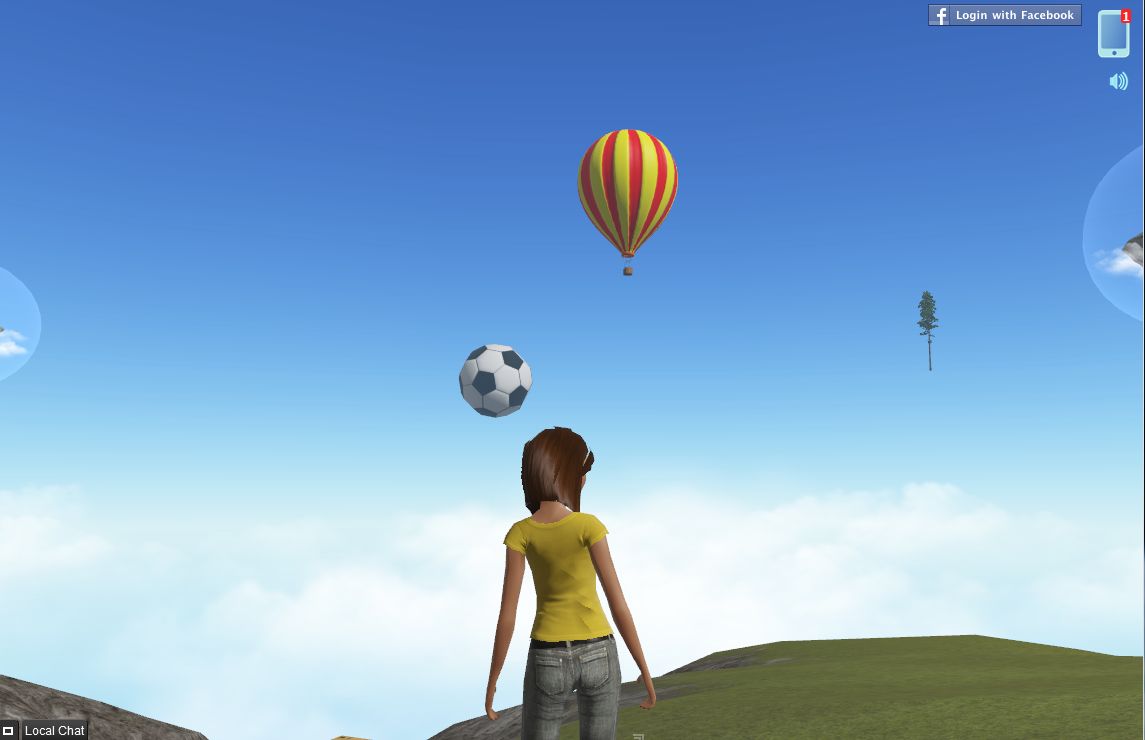
The football and the balloon are not objects stuck in the sky – they are actually deluxe islands with exterior meshes

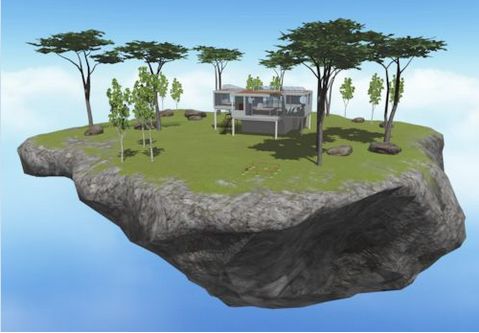
Give the volumes quoted for the islands would appear to refer to the bubbles surrounding them rather than the actual sizes of the islands themselves, it’s hard to get a grip on the physical surface area available with each type of island. However, I’d estimate a private island has a surface area of around 6,000 sq metres and a deluxe at around 190,000 sq metres.

I base both calculations on the maximum circular area available within each sphere (again, taking the quoted sizes of 100 and 500 metres as diameters, rather than radii) and then allowing for a small “gap” between the islands and the sphere boundary and making an allowance for the irregular shape of both islands. The “gap” allowance seems reasonable  given it is possible to “fall off” the edge of an island rather than hitting the sphere boundary  (you get returned to the middle of the sphere if you do, presumably after “hitting” the boundary of the sphere).

Promotional shot of a private island in Cloud Party, with a standard “system” house

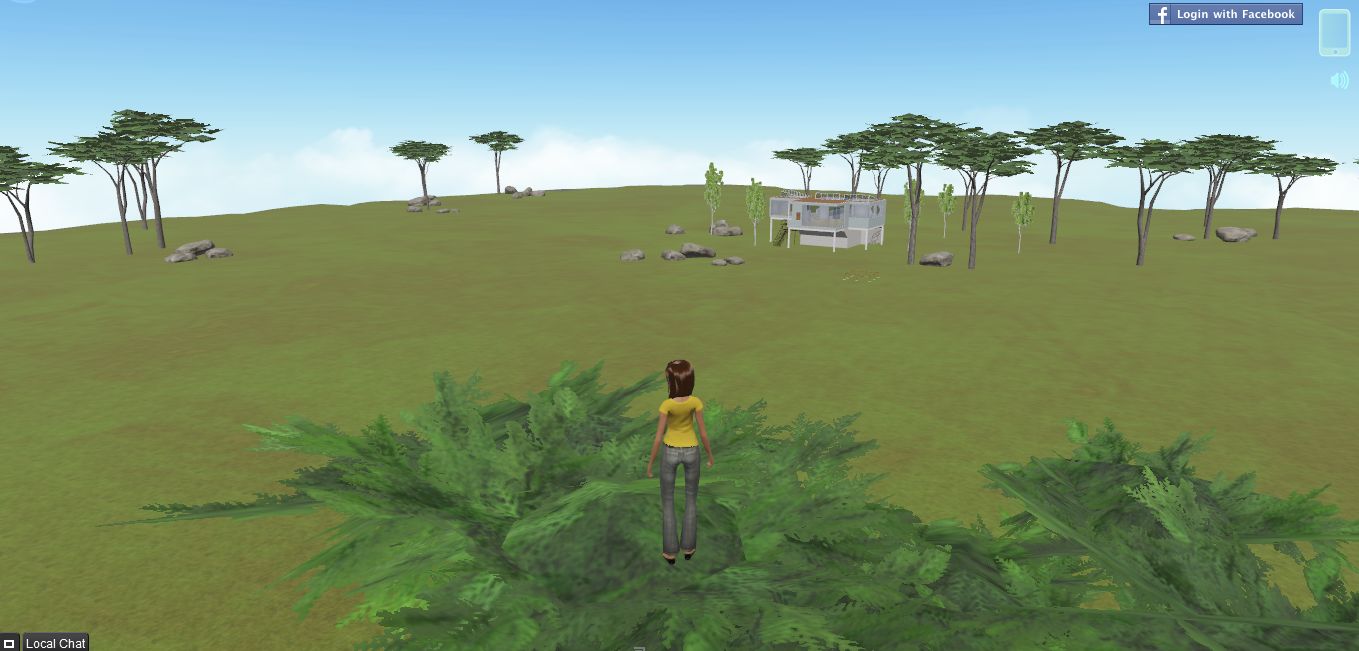
Even at 6,000 sq metres, the private island would seem to provide enough room to establish a comfortable home and should suit most personal requirements. The deluxe island appears to be around the same size as the residential islands that were rolled out at the start of the beta, and which offer individual homes available to those with Facebook accounts. As such, they do provide an appreciable amount of space that could be put to a wide variety of uses.

Tree-top view of a deluxe island – not the comparative land area around the house (same model of house) in this image and the one above

Each island type includes a set of quota for building. This is defined in three ways: objects, dynamic objects and triangles. Mesh elements can comprise up to four material faces, each of which itself actually counts as a single “object”. So while it may appear to be a single object, it comprises a material face count (just like an SL linkset comprises prims and sculpts), and it is the material face count that impacts an island’s object quota, not the mesh object itself (just like the objects in a linkset count towards land impact in SL, not the linkset per se).

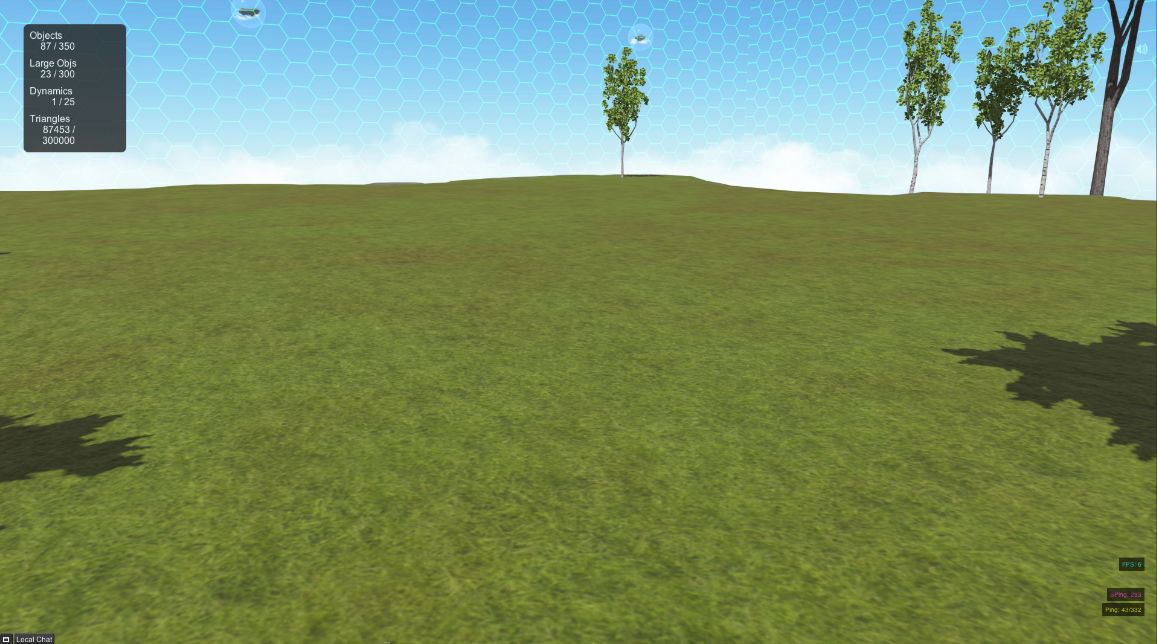
Displaying information on objects is potentially confusing at present. Right-clicking on an in-world object and displaying an information pop-up for it, for example, only reveals the triangle count. Going to the Build mode, however, does provide counts for triangles, objects and dynamic objects – but also introduces a further category, that of “large objects”. Quite how this relates to the primary object count is unclear, and as I don’t have build rights myself in CP, it is not something I’ve been able to investigate in any real detail.

Build mode showing objects counts for a private island (with thanks to Botgirl Questi)

It’ll be interesting to see how objects and goods are defined when the Cloud Party marketplace is rolled out. From a purely lay perspective, one would suggest that the baseline measure should be “material faces”, as this seems to be the most accurate means of comparing actual content with the object allowances of each island type. However, it is probably fair to say that triangle counts may also be a contender from a technical perspective.

Search and Build Permissions Updates

In introducing the rental islands, CP have also updated the Navigation option of the Cellphone to include a basic search option, allowing you to search for locations either by name or user name.

On July 4th, Cloud Party added the capability for those renting islands to let friends build on their island. This can be enabled via the island information page (Cellphone->Navigation-> Personal Tab->Current Island->Edit Info button). This now includes a Build Permissions: Edit button. Clicking this displays a list of Facebook friends with Cloud Party accounts, and names can be dragged to the FULL ACCESS box. This allows them to build on your island, and they can move / delete anything you have placed on your island. They cannot, however, edit or duplicate objects. Further information on CP’s permissioning system will apparently be announced “Once the marketplace is closer”.

Command Line Options

Something that hasn’t appeared to have been widely covered in blogging about Cloud Party is the availability of command line options. Whether this is because they are a new feature or not, I’ve no idea, but they provide a range of interesting options. Commands can be entered in chat and are preceded by “/”. Entering a single letter after the slash (e.g. “/a”) displays a list of commands starting with that letter. While visiting Claudia222 Jewell I had a play with a few of the commands, including the avatar rescaling, which allows you to instantly alter your avatar’s size (between 1.5 times and 0.5 time the default size).

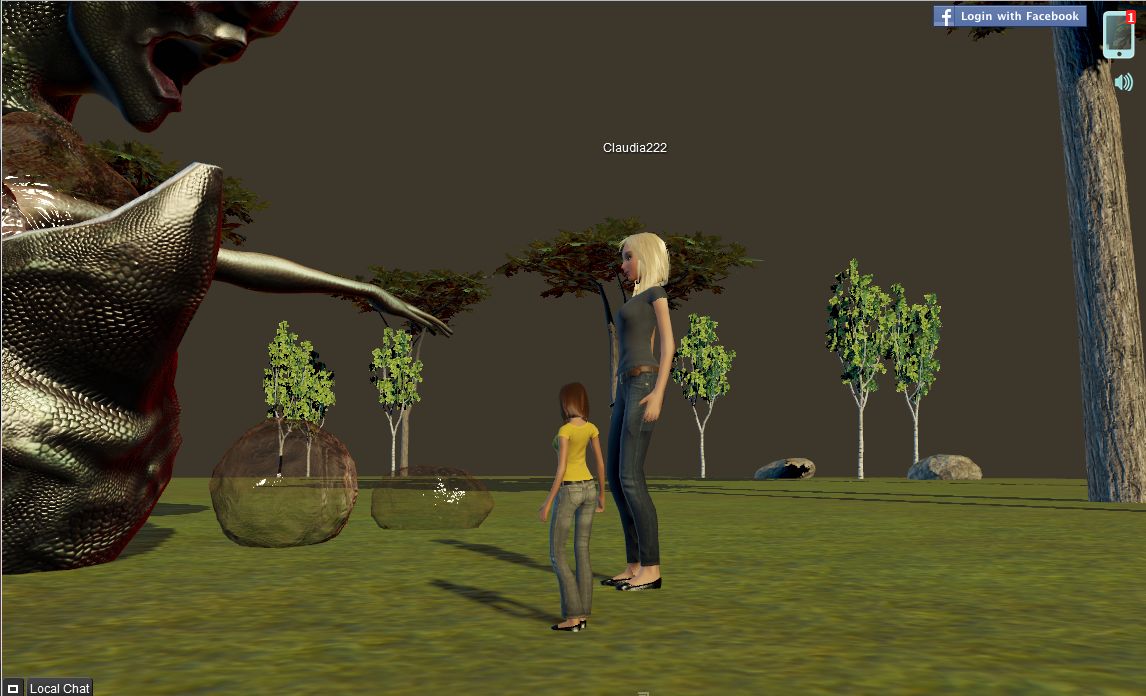
Playing with avatar heights: Claudia222 at the default avatar size, I scale to 0.5

So rentals are now available within Cloud Party. How popular they prove to be after the initial “curiosity rush” has passed remains to be seen. As others have stated, the platform has a good way to go before it can be considered a serious contender in the VW ring – and I still remain unconvinced on building a platform purely around a land revenue model. I’ll be continuing to watch developments as best I can as they are announced / rolled-out and allowing for the fact there is still – as yet – nothing within Cloud party sufficient enough for me to sign-up with Facebook in any capacity whatsoever.

With thanks to Botgirl Questi.