The Drax Files Radio Hour interviews: Emily Short

radio-hourEpisode #23 of  The Drax Files Radio Hour was posted on Friday June 13th. With the “live” podcasts currently on hiatus until August 2014, this is the second of a series of more in-depth interviews with people from across the metaverse and beyond.

As usual, and as well as being available on the show’s website and on Stitcher, episode #23 is also on YouTube, and embedded at the end of this article.

The featured interview with this show is with none other than interactive fiction writer, narrative design consultant, co-founder of Little Text People, co-developer of Inform 7, the interactive fiction system, co-developer of Versu – I could go on and on, such is my admiration for her – Emily Short!

Given the above, you might be able to guess that this is an interview I’ve been looking forward to, and while time wasn’t the best, I tried to assist Drax in getting ready for it (although even then, some of the planning went out the window as we were overtaken by events!), so my thanks to Drax for the shout-out at the start of the show,

Emily Short on the IF panel, PAX East, 2010

The interview, which commences at the 3:44 mark, is extremely wide-ranging, covering topics such as the creation of Little Text People, the time Emily and her LTP colleague, Richard Evans spent at Linden Lab, the nurturing of Versu, Emily’s own background and how she came to be interested in interactive fiction (IF) via the work of games design pioneer Scott Adams (not to be confused with the creator of Dilbert!) and moving forward from there.

Since the announcement that Versu – albeit is a slightly different Versu to the one initially marketed by the Lab – would be able to continue under its own banner, there have been musings as to the deal struck between Linden Lab and the Versu team. Had the IP been fully released by the Lab? Had an agreement on revenue sharing been achieved? Were there other strings attached?

Obviously, such questions may not be the easiest to answer; commercial arrangements between companies tend to be saddled with NDAs and the like, and the Versu / Linden Lab arrangement is certainly one of those. As such Emily has to be circumspect when answering such questions. However, she does indicate that there may potential for some of the titles from the “app version” of Versu to reappear, such as the Office Politics titles by Deirdra Kiai. Whether these will be direct ports or will see anything added to them, should it come to pass, remains to be seen.
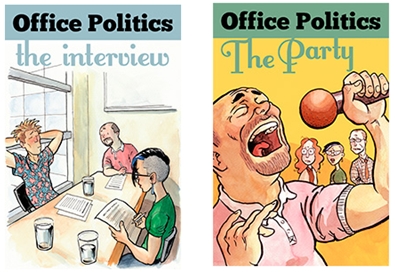
The Office Politics titles, by Deirdra Kiai, were written for the original Versu app, and might appear with the new Versu in the future
The Office Politics titles, by Deirdra Kiai, were written for the original Versu app, and which might appear with the new Versu in the future

It’s important to note that the Versu we see with Blood & Laurels is somewhat different from the Versu which first appeared under the Lab’s banner. As Emily notes, the “first” Versu was more an app into which IF games could be plugged. Versu as we see it now is geared more towards developing self-contained titles – as Blood & Laurels is, and just as Bramble House will be. Packaging titles in this way offers the ability to build much more involved games – as has been noted, Blood & Laurels has some 240,000 words of interactive content, only 7% of which is liable to be encountered in a single play.

Author and Linden Jake Forbes (via Amazon)

With the original Versu, much was made of the potential for people to create their own IF games for use on the platform. Whether this is still the case is unclear. The system itself would apparently need more work to support this, and the agreement with the Lab may limit what can be achieved in this area. Currently, story development remains confined to the Versu team and select other authors such as Bramble House’s Jake T. Forbes (himself a Linden as well as an author in his own right) and, possibly as noted, Deirdra Kiai.

An interesting aspect of Versu’s modularity is that it needn’t necessarily be limited to a text-based front-end. but could be embedded into something else or skinned by an alternative front-end. This means it could, for example, potentially be used in other game types or in business training or in education. These latter areas were somewhat upon in May 2013, when Versu co-creator Richard Evans presented his paper Versu: A Simulationist Interactive Drama, at the Games and Media Event at the Imperial College London, which prompted Douglas Heaven to write AI makes social game characters all too human for New Scientist Online, and which I wrote about at the time.

Whether this flexibility with the Versu components means it might see use in support of better AI-driven NPCs within Second Life, as many have speculated in the past, remains to be seen. This is another area Emily is not in a position to comment upon – which shouldn’t necessarily be taken to mean something is being worked on.

Another interesting aspect with Versu is the potential for it to be used in a multi-player format. While there are no plans for it to be used in this way at present, Emily offers some intriguing speculation on the matter:

The Versu engine is capable, under the hood, of doing multi-player as well as AI characters. And something that we talked about a long time ago, in the early days of the project … you would be able to play in the multi-player, and you would actually be able to add new content to the story. So if you got to the point where you were playing with somebody and you wanted to say something that wasn’t already coded into that scenario, you would actually be able to, right at that moment, write a new piece of content…

It’ll be interesting to see if this does come to pass down the road, as the team hopefully develop the resources they need to enhance and develop Versu, and as opportunities of perhaps working with third parties arises.

There is so much more to this interview than can be covered here. Where AI may go in the future; cautionary notes on how governments or private organisations might employ AI technologies alongside the huge amounts of data (social and otherwise) we’re allowing to be accrued on ourselves; caveats about tests used to determine whether or not the conditions of the Turing Test really have been met; have been met; even dreams of holodeck-style IF are explored!

All of which makes this a fascinating conversation, one well worth taking the time to sit down and listen to, whether or not you’re directly interest in interactive fiction (and you likely will be by the end of it!).

congrats to Drax on his Best Machinima award at the New Media Film Festival

Versu’s Blood & Laurels arrives in the App Store

versuFollowing the announcement that a deal had been reached which allows Versu, the interactive fiction engine, to continue after Linden Lab had discontinued it in February, comes the news that, as promised, the much-anticipated Blood & Laurels is now available.

As I noted in my report on Versu’s return, Blood & Laurels is the first title to be released under the new Versu banner, and will be followed in the near future by Bramble House by Jake T. Forbes.

New Versu titles will, for the forseeable future only be available on the iOS operating system and focused on the iPad. As the Versu team has noted, while they would like to have an Android version, resources are such that right now that it just isn’t possible.

So what is Blood and Laurels about? The slip notes provide an overview:

It’s the eight hundred and twenty-first year of the city of Rome, a year of bad omens and unrest. The Emperor is bloodthirsty and watches keenly for anyone who might be trying to overthrow him. The grain dole is running out and the people are going hungry. Romans are beginning to put their faith in foreign cults, as their old gods seem indifferent.

In this dangerous environment, Marcus is concerned with two things: his poetry, and keeping his patron Artus happy. But when Artus sends him to ask a secret question of an oracle, Marcus is forced to get involved, with conspiracies, politics, and a woman he is trying to forget.

Blood & Laurels offers dozens of outcomes for Marcus, his friends, his enemies, and Rome itself. The choices you make for him will decide not only how he ends up, but what kind of man he is when he reaches the end.

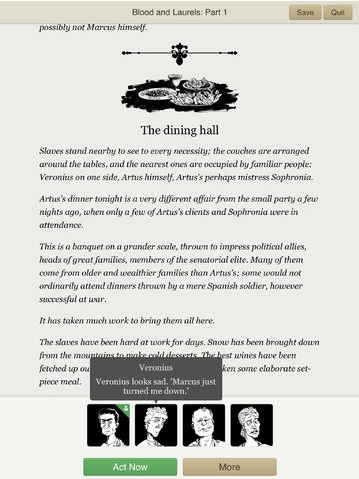
A page from Blood & Laurels (via the App Store)

Blood & Laurels might best be described as a piece of theatre; play is heavily influenced by the evolving conversations as much as by the actions of the protagonist, Marcus the Cowardly (that’s you, by the way, should play the game). As Marcus, you have to steer your way through the complex situations which develop around you, some of which are a direct result of your actions and words, while others may be the result of things you perhaps didn’t do or say earlier in the game. Your interactions with other characters (and their interactions with each other) can be reflected in the changing expressions on their little portraits. In keeping with most intrigue in life, few things go unnoticed and repercussions can be positive or negative.

The complexity of Blood & Laurels is staggering: 240,000 words of interactive content, a branched, two-part storyline and a large cast of dynamic characters. All of this adds up to a piece in which a player is only likely to encounter around 7% of the content in any given play through.

Alongside of the launch, the Versu team also issued a teaser video of movie-like quality and presence.

Blood & Laurels can be purchased from the App Store for $2.99 / £1.99.

Related Links

Note that Emily Short of the Versu team, and the creator of Blood & Laurels, will be featured in a Drax Files Radio Hour interview on Friday June 13th. Also, coverage of the “new” Versu and Versu titles in this blog can now be found under the Versu category or via the menus: Pey’s Travelogues > Other Worlds > Versu.

Kitely’s Metered Worlds become Premium Worlds

kitely-logoOn Wednesday June 11th, Kitely, the on-demand virtual world provider, announced that their “Metered World” offering has been restructured as a “Premium World” offering.

“Metered Worlds” were one of two world types offered by Kitely to customers, the other being Fixed Price Worlds (which remain unaffected by this change). Rather than being paid for through a fixed monthly fee, “Metered Worlds” were paid for through small fees charged for various actions performed on them, as specified in the Kitely Services web page.

Up until the June 11th announcement, both Premium and Regular Account holders had been able to add  new Metered Worlds to their accounts at a cost of 10 KCs per world, per day. However, as of the June 11th announcement, only Premium Account holders remain able to so; hence the product being renamed “Premium World”.

Furthermore, from July 1st onwards, any existing Premium Worlds held by Regular Account holders will only be accessible to Premium Account holders. This means that Regular Account holders must consider what they want to do with their existing Premium Worlds.

For example: to retain access to their own Premium Worlds beyond July 1st, Regular Account holders will need to either upgrade to a Premium Account, or convert their world(s) to one of Kitely’s Fixed Price World plans. Alternatively, they could allow their Premium Worlds to continue “as is”, and simply not be able to access them until such time as they do upgrade their account or convert these worlds to a Fixed Price plan. Because only Premium Account holders will be able to access these worlds, no additional charges will accrue in the interim.

As noted in the Kitely blog post, Regular Account holders can even, up until July 1st, opt to export their Premium Worlds to OAR files for use elsewhere (subject to object permissions and the normal export fee of 150 KCs per world).

Fallingwater, my region-wide build on Kitely utilises was was a Metered World. I now face a decision on what to do about its future ...
Fallingwater, my region-wide build on Kitely utilises what was a Metered World. I now face a decision on what to do about its future …

A single Premium World will continue to be provided to new users signing-up to Kitely’s Regular Account. However, only the account holder and Premium Account holders will be able to visit it during the initial 6-hour trail period supplied to Regular Accounts – the world will be closed to other Regular Accounts and Hypergrid users. At the end of the trial period, if the user wishes to continue using the world, they must either convert it to a Fixed Price world plan or upgrade to a Premium Account.

Again, please note that these changes do not affect Kitely’s Fixed Price worlds, which remain available to both Premium and Regular Account holders.

Reaction to the announcement has been mixed, with some expressing disappointment at the move, and others appearing to be somewhat confused, at least initially. Some of the disappointment has perhaps been the result of Regular Account holders feeling they are being disenfranchised from land ownership in Kitely.

However, an alternative viewpoint to this is that the move might actually help to further stimulate Kitely’s in-world economy by allowing land rental businesses to develop, particularly where Fixed Price worlds are concerned. If so, this could have a further benefit of allowing themed estates to develop, which in turn may help give in-world locations more of a “community” feel than might currently be the case.

US Army targets Second Life and virtual worlds for healthcare

An interesting article published by the Official Home Page of the US Army came to light recently highlighting the use of virtual worlds as a part of studies into providing better healthcare and support to US soldiers and veterans.

For the last three years, Colonel Valerie Rice, Director of the US Army Research Laboratory’s Human Research and Engineering Directorate located at Fort Sam Houston, in San Antonio, Texas, has been spearheading a team studying the use of Mindfulness-based Stress Reduction (MBSR) as way of teaching army personnel and veterans how to manage PTSD and similar disorders which have resulted from their military service. The work is part of a broader series of research activities funded by the US Army aimed at providing suitable care and support for those afflicted by PTSD.

Colonel Vice Rice
Colonel Valerie Rice

Mindfulness –  “being in the moment” – is a means of stress and anxiety relief using age-old techniques such as meditation and yoga to help focus and clear the mind. It has become a popular means of therapy and support in many areas of life.

The studies being undertaken by Dr. Rice and her colleagues have a twofold purpose. Firstly, to determine the effectiveness of MBSR techniques in helping US Army personnel and veterans deal with PTSD and related issues. Secondly, to identify whether a programme using these methods could be reasonably and effectively adopted by the Army for widespread use.

In this latter regard, MBSR is seen as a particularly worthwhile means of assisting service personnel and veterans because not only is it a proven means of treatment in civilian life, but also because instructors do not need to be qualified healthcare professionals; they only need to have successfully completed a comprehensive training and certification programme. This significantly eases the challenges involved in leveraging it for more widespread deployment and use.

MBSR is also something ideally suited to leveraging the use of virtual worlds, notably Second Life and All These Worlds LLC, which bring with them unique opportunities and benefits which are not necessarily achieved with courses and therapy conducted in the physical world.

The Mindfulness studies take place as 2-hour weekly sessions over a period of eight weeks apiece, and involve some 66 participants at a time, 36% of whom were soldiers on active duty, and the remaining 64% veterans. Half of each batch of participants meet face-to-face in real life, the other half in a virtual world environment.

In both the physical and the virtual environments, sessions are experiential in nature; participants in the study meet, go through various exercises designed to focus the mind, ease tension, and reduce stress. Classes as cumulative, each building on and reinforcing the last, providing techniques participants can carry with them into their daily lives. There are also opportunities for discussion and feedback on individual’s experiences with the techniques, and so on.

Those participating in the virtual classes are encouraged to physically perform the exercises rather than just perform them with their avatar. There is a high degree of interaction between session leaders and participants, and courses include homework sessions – exercises participants are asked to carry out when away from the sessions.

A US Army MBSR session being held in All These Worlds (via alltheseworldsllc.com)
A typical US Army MBSR session being held in All These Worlds (via alltheseworldsllc.com)

Virtual world environments are seen as a particularly beneficial for conducting sessions due to the level of anonymity they offer. There is still something of a stigma attached to seeking help for disorders such as PTSD which can make individuals shy away from any involvement in actual behavioural health classes due to misplaced feelings of embarrassment, inadequacy or shame. The use of what is essentially an anonymous avatar in a virtual environment helps eliminate these feelings, and any associated stress or anxiety which might otherwise be experienced.

The multiple ways in which participants can provide feedback through a virtual world is also seen as beneficial. Giving voice to the feelings, responses and emotions one is experiencing when in a public forum is not always easy. But in a virtual environment, a participant can, for example, opt to give their thoughts and feedback via IM to the session leader, who can in turn relay the salient points to the class in a way that also doesn’t cause the individual any additional stress or embarrassment. Even the use of voice morphing is seen as advantageous, as it again offers participants relief from any fear that their voice might otherwise be recognised.

Participant in both the physical and virtual studies receive "homework" assignments (via alltheseworldsllc.com)
Participants in both the physical and virtual studies receive “homework” assignments (via alltheseworldsllc.com)

Additional benefits in using virtual worlds are those of accessibility and the ability to establish social networks among peers. Writing in Advanced Computational Intelligence Paradigms in Healthcare 6, Jacquelyn Ford Morie, the founder of All These Worlds, and who also one of Dr. Rice’s collaborators in the study, notes:

Today’s returning soldiers are most likely geographically dispersed, which may make it difficult to get to centres where medical help is typically aggregated. In addition, a social support structure may be lacking, leaving veterans unable to socialise with comrades in person on a regular basis … Online shared virtual worlds, however, are easily accessed from any personal computer, and can support the formation of social networks, facilitate access to care, and provide social activities between soldiers where geography is no barrier.

Jacquelyn Ford Morie. All These Worlds, her company, has also provided virtual environments for the US Army's MBSR studies
Jacquelyn Ford Morie. All These Worlds, her company, has also provided virtual environments for the US Army’s MBSR studies

She goes on to note that most service personal today are comfortable with using technology and in playing computer games, so accessing virtual worlds should not present them with significant barriers to entry or from engaging with online communities.

Dr. Rice and her team report that taken as a whole, the MBSR courses have seen positive results across both actual and virtual sessions, with participants registering lower blood pressure, reduced anger and increased calmness in their lives, as well as  exhibiting increased energy levels and faster reactions. Her team also note that anecdotal evidence suggests that those who have participated in courses are still practicing techniques six months later.

However, the team also acknowledge that further research into the overall effectiveness of MBSR with military personnel is required before any definitive findings on its overall applicability to widespread use within the US Army can be determined.

Even so, despite the fact that such formal determination has yet to be reached, the work carried out to date is encouraging, and stands as another fascinating example of how virtual worlds can be used for the betterment of our health and welfare.

Related Links

With thanks to Ziki Questi for the initial pointer to the US Army article on this research.

Versu is reborn!

versuOn Friday June 6th, Emily Short announced through her blog that Versu, the interactive fiction engine she and Richard Evans developed while working at Linden Lab, and which was cancelled as a part of the Lab’s product review in February 2014, will now continue, and that Blood & Laurels, the interactive novel she has been working on for 15 years, will be launched on June 12th.

Following the announcement of Versu’s cancellation by the Lab, many of us speculated whether it  might be allowed to live on separately to the Lab’s involvement, and Emily herself confirmed she was talking to the Lab on matter of IP. However, hopes this might happen seemed to have been completely dashed in March, when the Lab said no to any idea of selling the IP involved. However, they’ve since had a change of heart.

The notification that this is the case came in the form of a blog post which first appeared on the  new Versu wesbite, and then reblogged on Emily’s site, which is where I came across it.

The announcement reads in part:

Nu-versu-1
Versu was lauched to considerable acclaim prior to being cancelled by Linden Lab. Now it is set to continue (image from the Versu website)

Until February of this year, the Versu project had its home at Linden Lab, exploring the possibilities of interactive storytelling with advanced character AI by Richard Evans (Sims 3, Black and White) and dialogue modeling by Emily Short (Galatea, Alabaster), as well as work by authors Jake Forbes (Return to Labyrinth) and Deirdra Kiai (Dominique Pamplemousse).

When the Lab decided to refocus its offerings and cut support for Versu, the project was only three days from launching a Roman political thriller called Blood & Laurels. Blood & Laurels represented a significant step forward in complexity and depth from previous Versu stories: a large cast of characters, a richly branched two-part storyline, and over 240,000 words of interactive content — of which a player is likely to see only about 7% in a given play through. Character behaviour and relationships were modeled with at least as much fidelity as in earlier examples, but in a context with much higher narrative stakes. What other characters think of you affect whether your character lives or dies, thrives or fails — and those relationships are driven by both large and small decisions.

After Versu’s cancellation, it looked for a long time as though neither the underlying technology nor the finished stories had a future. However, we are delighted to be able to announce that Linden Lab has negotiated a new arrangement that will allow us to release these stories and explore a future for the engine.

The Versu blog post reveals that Blood & Laurels has been made possible by a language called Prompter, which is used by Versu and has been designed by Graham Nelson of Inform fame. Graham is also now a part of the new Versu team, joining Emily and Richard Evans.

Emily Short and Richard Evans are joined by Graham Nelson, the man behind the Inform IF language, and the creator of the Promptor language used by Versu
Emily Short and Richard Evans are joined by Graham Nelson, the man behind the Inform IF system, and the creator of the Prompter language used by Versu

Blood & Laurels is set to be followed by Bramble House, an interactive fantasy story written by  Jake T. Forbes, the author of Return to Labyrinth, a four volume graphic novel sequel to the Jim Henson film Labyrinth, and the English-language versions of the best-selling manga series Fullmetal Alchemist, Fruits Basket, One Piece and others.

Bramble House focuses on the character of 15-year-old Penny, who is “bound in service to the witch Stregma, forced to deal with everything from mundane dishwashing to evicting monstrous guests”. In it, the reader takes on the role of Penny, progressing through various situations and events in two stories set within the Bramble House world.

There is no publication date available as yet for the title.

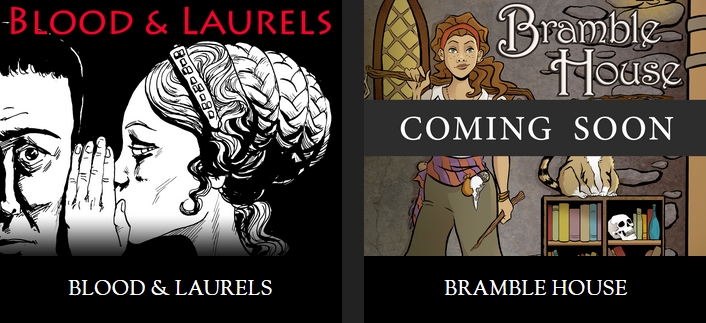
Blood and Laurels (due June 12th) and Bramble House will be the first two titles released under the new Versu banner
Blood and Laurels (due June 12th) and Bramble House will be the first two titles released under the new Versu banner (from the Versu website)

The new titles will be appearing on the iOS platform. At the time of writing, it is not clear as to whether there are still plans to make Versu and its titles available for the Android platform; the website only goes so far as to state, “While we would like to support Android, we do not currently have an Android version available.”

This is excellent news for all with an interest in or passion for interactive fiction. Congratulations are extended to Emily, Richard and Graham with the launch to this new venture, and kudos, as well, goes to Linden Lab for reversing their decision on the Versu IP and allowing the project to continue.

Be sure to listen-in to an upcoming edition of the Drax Files Radio Hour interviews, when Drax will be talking to Emily Short about interactive fiction, Versu and more!

Related Links

Second Annual OpenSim Community Conference announced

2014 banner

On Saturday May 31st, the Overte Foundation and Avacon have announced the Second Annual OpenSimulator Community Conference, with a press release on the announcement being circulated via e-mail on Tuesday June 3rd.

The conference will take place on the OpenSimulator Conference Centre grid on November 8th and 9th, 2014. It will be a celebration of the platform and the large and varied community using it. As such, it will feature two days of talks and presentations across four tracks, keynote speakers, panels and social events.

Anyone who is interested in the OpenSimulator software and the future of the metaverse is invited to attend, as well as OpenSimulator developers, grid administrators, and members of the community who participate on OpenSimulator grids.

The 2013 conference arena

The four presentation tracks will comprise:

  • Business & Enterprise: sessions will cover a broad range of topics on doing business in and with OpenSimulator. These include grid hosting, third-party development, private entrepreneurs, in-world and enterprise businesses, and also corporations and organizations using the platform for marketing, fundraising, product research, focus groups, etc
  • Content & Community: this track will examine different aspects of content (e.g. large scale immersive art installations, ballet, theatre, performance art, machinima, literary arts, clothing designs, virtual fashions, architecture, music performances and other cultural expressions) and community (e,g, role-playing groups, science fiction communities, virtual towns and interest groups, historical explorations, religious and spiritual communities, book clubs, etc.), within OpenSimulator
  • Developers & Open Source: will encompassing the technical aspects of OpenSimulator, and seeks presentations related to servers, viewers, external components, grid architecture, development, administration, and anything necessary to the installation, operation and use of an OpenSimulator system
  • Research & Education:  seeks presentations regarding the use of OpenSimulator in research applications in computer science, engineering, data visualization, ethnography, psychology, and economics. It will additionally feature sessions that cover a broad range of uses related to teaching and learning in and with OpenSimulator

In addition, the conference will feature  a new Learning Lab area. which will be available for hackerspaces, speed builds, and workshops for hands-on learning experiences guided by experts in the OpenSimulator community.

The Call for Proposals for all four tracks and the Learning Lab is now open, and all proposals should be submitted by July 1st, 2014.

Commenting on the event in the announcement, conference chair and organiser Chris Collins (Feep Tuque in OpenSim) said:

Last year’s conference was a terrific success with over 350 attendees from 45 unique grids and over 1000+ commits to the core code, which made OpenSimulator a much more stable and scalable platform.

This year we hope to build on that success by offering more opportunities for the community to be involved and doing more outreach to attract new users.  With all the hype surrounding the Oculus Rift and other virtual reality technologies, we think this is the perfect time to let the VR community know that OpenSimulator is a great platform for building the open metaverse.

Further information on the conference will be made available in due course – including details of keynote speakers, volunteer registrations, etc. Registrations will open on September 15th, 2014.

Sponsorship and Crowdfunding Campaign

While the conference is being held in virtual space, it does incur some expenses (such as the professionally managed set-up and operation of the conference grid and the streaming and other web services). As such, the organisers are seeking sponsorship from businesses, entrepreneurs,  and community members alike to help support the conference through a range of sponsorship opportunities, which have this year been updated and revised to better meet the needs of sponsors.

In addition, the conference is running a Crowdfunder Campaign to allow those wishing to make smaller donations to do so. Some unique rewards are on offer to those participating in the campaign, the full details of which can be found on the Crowdfunder Campaign page.

About the Organisers

The Overte Foundation is a non-profit organization that manages contribution agreements for the OpenSimulator project.  In the future, it will also act to promote and support both OpenSimulator and the wider open-source 3D virtual environment ecosystem.

AvaCon, Inc. is a 501(c)(3) non-profit organization dedicated to promoting the growth, enhancement, and development of the metaverse, virtual worlds, augmented reality, and 3D immersive and virtual spaces. We hold conventions and meetings to promote educational and scientific inquiry into these spaces, and to support organized fan activities, including performances, lectures, art, music, machinima, and much more. Our primary goal is to connect and support the diverse communities and practitioners involved in co-creating and using virtual worlds, and to educate the public and our constituents about the emerging ecosystem of technologies broadly known as the metaverse.


Gource visualisation posted by nebadon2025 charting the growth of the OpenSimulator project by code commits from core developers up until the time of the 2013 conference