Lab issues call for Oculus Rift beta testers

secondlifeOn Wednesday March 12th, Linden Lab issued a call for people willing to help beta test the upcoming Oculus Rift enabled SL viewer.

The call, made via a blog post, reads in full:

The Oculus Rift offers exciting possibilities for Second Life – the stereoscopic virtual reality headset brings a new level of immersion to our 3D world, making Second Life a more compelling experience than ever before.

Though a consumer version of the headset isn’t available yet, we’ve been working with the development kit to integrate the Oculus Rift with the Second Life Viewer. We now have a Viewer ready for beta testers, and if you have an Oculus Rift headset, we’d love to get your feedback.

If you have the Oculus Rift development hardware and would like to help us with feedback on the Viewer integration, please write to sl_oculus_beta@lindenlab.com to apply for the limited beta.

Oculus Rift: the headset-enabled viewer is now ready for beta testing

As noted in the post, the headset isn’t commercially available as yet, but the pre-release version with the Oculus Software Development Kit is currently available for $300.00 directly from Oculus VR themselves. If you have a kit already, now is the time to sign-up!

As I reported in December, VoidPointer Linden had indicated that the work on making the viewer operate with the Oculus Rift headset was “feature complete”. This fuelled an expectation that a project viewer might make an appearance either before, or soon after Christmas, 2013.

However, Oz Linden shortly afterwards indicated the “soon” might be something of a relative term. Since both of those announcements, the Rift viewer has been working its way through the Lab’s QA process, and while it didn’t appear as quickly as perhaps VoidPointer had hoped. Even so, when commenting on the status of the viewer back in December, he was able to confirm a few things about it:

  • The same viewer can be used in both a “normal mode” and a “Rift mode”
  • There will be no apparent changes to the viewer / UI when in “normal mode”
  • Frame rates when in “Rift look” will be very much down to the user’s own hardware  (unsurprisingly).

Elsewhere, it had been indicated that when in “Rift Look”, UI menus may float over the user’s head, keeping them out of the field of view until such time as needed. This was certainly the case when Simon Linden tried the viewer earlier in “013, but it is unclear if this approach has been carried forward – so that’s one for the beta testers to discover.

There is no timescale for how long the beta testing will last, but this announcement brings official support for Occulus Rift (users can also use David Rowe’s CtrlAltStudio viewer, which provides preliminary support for the headset) a step closer to reality.

castAR, the “Oculus competitor”, gains $500,000 in three days on Kickstarter

Back in May 2013, and courtesy of The Verge,  I was able to report on the development of castAR, an Augmented Reality headset, a prototype of which made an appearance at the May 2013 Maker Faire in New York.

The project, initially started by Jeri Ellsworth and colleague Rick Johnson while both were employed by Valve, came about by accident. However, development work in-house at Valve came to an end in February 2013 when both Ellsworth and Johnson were let go by the company. But in a generous move, Gabe Newell, co-founder and Managing Director of Valve, gave them his blessings to take the idea and the associated IP with them.

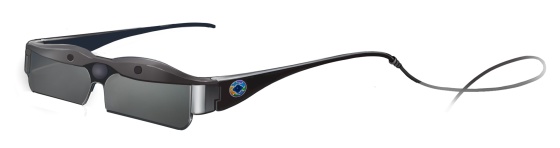
The castAR glasses (image coutesy of Technical Illusions)
The castAR glasses

As I reported back in May, convinced the idea had legs, Ellsworth and Johnson founded their own company, Technical Illusions, and have been hard at work developing things further.

The castAR system differs from the likes of Oculus Rift in that in its primary function is augmented reality, rather than immersive virtual reality. It projects images onto a retroreflective projector screen. A camera also built-in to the glasses  tracks the exact position of your head so that the software can adjust the 3D perspective in real-time. The result is a holographic-like projection of images and objects from the computer as 3D objects which you can move around and examine.

At the time of the May 2013 Maker Faire, the team had managed to put together a very rough-and-ready prototype of the system, and have since been working to further refine the technology and the idea. In September, they were back in New York for another Maker Faire, where they were awarded blue and red ribbons with a win of Editors and Educators Choice. Buoyed by this, the team set-out to move ahead with their planned Kickstarter project in order to secure funding which would allow the work to continue and would hopefully see the system further refined, including the creation of a software development kit which might in turn help with adoption of the system.

The Kickstarter launched on October 14th, 2103 together with a video expanding on the idea and their plans. They’d hoped to raise $400,000 in a one-month period to November 14th, 2013.

As of October 18th, over $500,000 had been pledged by more than 2,000 people.

The castAR wand (image coutesy of Technical Illusions)
The castAR wand

Interaction with the virtual projections can be achieved through both the use of traditional games controllers and joysticks, or via a dedicated “magic wand”. The latter allows for a wide range of interactions, with Sean Hollister of The Verge using it to play a virtual game of Jenga. Other elements, such as an RFID grid and “bases” which can be attached to physical objects allows such objects to be used within the virtual projection, with movement of such objects interactively plotted, etc.

As with Oculus Rift, uses for the system are potentially huge. Not only could castAR be used for computer games and virtual worlds, it might equally be used for playing board games (with players sitting anywhere in the world), or for it to be used in diverse fields as research, data visualisation work, 3D design, virtual worlds and so on.

For those wishing to experience more of an immersive, Occulus-like virtual reality experience, such as when using castAR in a virtual environment like Second Life, Technical Illusions are developing what they call the “AR & VR Clip on”. This allows users to dispense with the retroreflective surfaces and experience images projected onto a pair of screens, the result matching that of the Oculus Rift.

The AR & VR Clip-on is designed to allow castAR to function in amn Uvuls Rift-like manner
The AR & VR Clip-on is designed to allow castAR to function in an Oculus Rift-like manner (images:Technical Illusions and Netlinked Daily)

Continue reading “castAR, the “Oculus competitor”, gains $500,000 in three days on Kickstarter”

Cloud Party: Oculus Rift support and more

It’s been a while since I last reported on developments over on Cloud Party. There’s a lot that has been going on and which I’ve received e-mails about; I’ve just not had time to sit down and write-up everything.

The platform has recently started introducing features and capabilities on a weekly basis which have seen one or two new features introduced each week. The most recent of these is an official announcement of support for Oculus Rift.

Cloud Party’s CTO Conor Dickinson using Oculus Rift (courtesy of Cloud Party)

The blog post, issued on Wednesday October 9th, gave details on the support being provided,  including the regions within Cloud Party which have been set-up for use with the headset.

There’s currently no native Rift support within Cloud Party, so those with an Oculus Rift SDK kit will need to go one of two routes: either run OculusBridge, a standalone app which bridges the headset and a web browser via websockets, or via vr.js, a browser plugin which works directly with the headset (although the blog post notes this is not recommended as a result of Google’s announcement that Chrome will cease support for plugins in 2014).

The blog post additionally provides general advice on using the Rift – including notes about head movement (the visual stimulus and sudden head movements have been known to cause nausea and other issues as a result mismatched inner-ear cues).

One of the builds within Cloud Party supporting Rift use is a hoverbike race, which appears to be based on the race launched in late September and promoted via a short video.

Other recent updates over the past two months or so have seen a revamp of the Cloud Party website, which had it take on far more of a social environment feel, with the ability to preview people’s builds, “Like” them, share them via social media, etc., and which included the ability to embed builds in things like YouTube, etc.

August also saw the introduction of a new membership structure, with free accounts replaced the limited-functionality “anonymous” accounts together with a two-tier subscription option for general users. Thes free account option provides users with an unlimited number of “small” builds (up to 10MB bandwidth per build), 5 marketplace listings and knowledge base access.

The Basic subscription option, at $14.95 a month ($11.95 if paid annually), includes the “free” membership features and:

  • 2 medium sized builds
  • 20 free marketplace listings
  • Billing / Fraud Support
  • Privacy / group edit settings on builds

The Pro subscription, at $99.95 a month ($79.95 if paid annually) features the above and:

  • 4 medium sized Builds, 2 large Builds
  • 100 free marketplace listings
  • Live tech support

There is also an Enterprise subscription / billing option, but details of this have to be applied for from Cloud Party directly.

Further recent updates have seen avatars within Cloud Party become more customisable, with facial customisations and animated attachments, while builds have gained customisable skies and the ability to play videos.

A key factor with many of the updates is that they’ve also been accompanied with tutorials on how to make use of them’ such as with the customisable skies, helping users make the most of the updates. One has been promised for the Oculus Rift support as well.

For those not already aware of the fact, Cloud Party is no longer tied to Facebook for access. You can now do so via Facebook or Google+ or via account registration. As a formally “anonymous” user, I switched to using my Google+ account back in August. Logging-in with it was smooth and hassle-free – although I did experience an odd moment of deja-vu when an avatar picker looking remarkably like the one used in Second Life many moons ago popped-up!

The avatar picker in Cloud Party. Reminiscent of the "old" SL avatar picker
The avatar picker in Cloud Party. Reminiscent of the “old” SL avatar picker

All told, Cloud Party continues to hum along, and while it may not be to everyone’s taste, it’ll be interesting to see what else pops up in the coming weeks.

Oculus Share: discover and explore games & experiences using Oculus Rift

Wired UK carries an article announcing the launch of a new service from the creators of Oculus Rift.

Oculus Share, launched in a beta mode on August 20th 2013, is described as “a platform to enable users to discover games and experiences which use the technology” and is initially aimed at those with the Oculus Rift development kit. However, plans will see the service transition into a fully fledged marketplace for for heaset-ready games, applications and experiences; a move which will likely coincide with the official launch of Oculus Rift as a consumer product some time in 2014.

Oculus Share beta (Image courtesy of Oculus Rift)

A blog post issued by Oculus Rift provides a description of the intended use of the service in this first iteration:

Oculus Share (or simply, Share) is the first of many steps we’re taking to build the best virtual reality platform. With Share, you can host Oculus-ready games and experiences that you’ve created, browse and download content from other developers, rate experiences on quality and VR comfort level, provide feedback to devs on what you enjoyed (and what you didn’t), and tip fellow developers for their work in cash, should you feel so inclined.

Experimentation, iteration, and actual playtesting are at the heart of pushing virtual reality forward. One of the main goals in building Share was to help developers on all these fronts by creating a centralized community portal for Oculus content. And while it’s simply a sharing service today, over the coming months we’ll work toward making Share an incredible marketplace for Oculus-ready games, experiences, and applications.

The service offers six categories under which items can be uploaded / shared: Full Game, Demo, Experience, Alpha, Beta and Mod, with a further sub-class of genre for items: Action / Adventure, Casual, Exploration, Puzzle, Simulation, Sports, and Strategy. As might be expected with the initial launch, content is currently light, but will doubtless grow as word spreads. For now the Demo category is the most heavily populated section, featuring a number of Oculus Rift’s own commissioned demonstrations, such as the Tuscany World from Fenix Fire.

Applications, mods and games are each featured on a page of their own, some with screen caps, others with a video (or both), together with a description, system requirements and set-up instructions – think Steam or Desura for the Rift, and you get the idea.

Within the current set of uploads there are intriguing hints at how additional technologies might be used with the headset. In the Trial of the Rift Drifter, for example, head gestures can be used for communications, while in another demo, the potential for eye movement to be used for in-game object control is outlined.

The content categories are currently focused on games, which is not surprising, given that is perhaps where the most interest with the technology lies. However, it would be nice to see a couple of non-game categories added to the service to cater for the likes of virtual environments (such as SL, OpenSim and others looking into the technology) and for real-world applications (medical, engineering, research, training, etc., simulations – although it might be argued that the Simulation genre is the catch-all for these; not ideal, but it is there).

Oculus Rift are currently vetting all submissions to Share in order to prevent the upload of offensive or malicious content. As a result, they do warn that items submitted to the service might take a while to appear, and ask for patience from those making submissions. As a beta service, Share is also liable to some teething problems as well – Wired UK reports it was down for maintenance just a few hours after launch – so again, patience may well be the order for the day for those wanting to make use of Share, as things are bedded-in and improved.

The potential for the platform is clear. By launching a service of their own, rather than relying on portals such as Desura and Steam, etc., Oculus Rift are presenting a “one stop shop” through which Rift developers and users can both promote and discover products specific to the headset without either necessarily having to use or peruse multiple web stores. As such, it will be interesting to see how Share grows in the months leading up to the commercial launch of the headset – and beyond.

Related Links

CastAR: looking at the virtual through a different pair of glasses

There has been a lot of excitement about Oculus Rift (OR) over the last few months and how it could revolutionise immersive gameplay, including the potential it offers to SL (and vice-versa).

Now The Verge reports on another innovative development using a headset system called  CastAR, and augmented reality system aimed at the gaming market and formally announced at the 2013 Maker Faire in New York. Whether it might find a suitable use within Second Life remains to be seen. However, whether it does or doesn’t, it is a fascinating concept which could potentially bring the world of high-end, ultra-expensive augmented reality capabilities directly into the home (and workplace?) for a variety of uses.

Currently in the earliest stages of development, CastAR essentially projects virtual environments into the real world, where you can directly interact with them in a variety of ways. It is the brainchild of former Valve employees  Jeri Ellsworth, a hardware engineer, and programmer Rick Johnson. “Former” because they were let go by the company in February 2013, along with 23 other engineers, after spending a year on the project. However, not only did Gabe Newell, co-founder and Managing Director of Valve let Ellsworth and Johnson go – he gave them his blessings to take the idea and the associated IP with them (a remarkable move in itself).  Since then, they’ve founded their own company, Technical Illusions, and have been hard at work developing a system which, according to The Verge, they’ve already poured a better part of a year of their lives.

Conceptual art for the production CastAR glasses (image courtesy of Technical Illusions / The Verge)

The system comprises a special pair of glasses which house a set of projectors which beam the image from your computer – such as a game – onto a retroreflective projector screen. A camera also built-in to the glasses sees infrared LEDs positioned around the edges of that projector screen, allowing the glasses to track the exact position of your head so that the software can adjust the 3D perspective in real-time. The result is the projection of images and objects from the computer as 3D objects which you can move around and examine.

This is in marked contrast to the likes of Oculus Rift, where images are displayed on screens within the headset. The result is that even on the small-scale prototype the team have so far developed, it is possible to move around the projected image and interact with it: Sean Hollister from The Verge demonstrated playing a Jenga-like game which allowed him to dismantle virtual towers of block using a hand-held wand. He was also able to demonstrate playing a two-player shoot-’em-up, with both players using the same retroreflective surface, but each seeing views unique to their relative position and head movement.

The initial CastAR prototype glasses shown at the 2013 Maker Faire
The initial CastAR prototype glasses shown at the 2013 Maker Faire (image courtesy of The Verge)

Right now, CastAR is in a very rudimentary stage of development, as indicated in the coverage found in The Verge, as are the potential uses for the system.  Ellsworth and Johnson have presented an early prototype of the system at the 2013 Maker Faire in New York,  where they have also been soliciting feedback on possible uses for CastAR.

One suggested idea would be to make the retroreflective surface room-sized, allowing for complete augmentation / immersion in  3D environment where one and not only look around, but also interact with the objects they find. Quite how this would be achieved is open to debate; redecorating an entire room as a holodeck environment isn’t something that is likely to be welcomed in the average home – although the potential for low-cost specialist environments might be another matter.

However, entire holorooms aren’t necessarily what Technical Illusions are considering. As The Verge states, the team are still very much open to idea, and while Rick Johnson “envisions little children filling their Tonka trucks with virtual sand; family board games; and incredible sessions of Dungeons & Dragons“, Jeri Ellsworth is quoted as saying, “I suspect we’re going to be very surprised about what people find fun in this space,”

One of the aims the team has is to keep overall retail cost of the unit low – around $200 once it is available on the market, largely thanks to their ability to use readily available components, and also in being able to design their own chips and code. To fund the project, the team plan to launch a kickstarter fundraiser in the near future, and will be making a Software Development Kit available to game-makers. However, the aim is very much to try to make the system a commercial product in its own right. This may start small, with simple games played on a small projection surface and a couple of headsets with control wands – but how far the system goes beyond that could be anyone’s guess.

Related Links