On the day Linden Lab announced the arrival of the Oculus Rift capable project viewer, news also came that ZeniMax Media has pulled the trigger on a lawsuit against Oculus VR and company founder Palmer Luckey alleging, among other things, the misappropriation of trade secrets by Oculus VR.
The lawsuit, filed in the U.S. District Court for the Northern District of Texas has been widely reported in the on-line tech media, makes some heavy reading. As well as the claim of misappropriation of trade secrets relating to virtual reality technology, the Maryland-based company also alleges infringement of ZeniMax copyrights and trademarks and asserts claims for breach of contract, unjust enrichment, and unfair competition against the defendants.
The move is the latest in a war of words which initially erupted in the form of public correspondence between ZeniMax and Oculus VR – who obviously strenuously deny all claims made by ZeniMax. The latter first informed Engadget of their intentions at the start of May, 2014, and in which they specifically pointed at John Carmack’s involvement in the development of Oculus Rift at a time when he was working for ZeniMax subsidiary id Software, as well as pointing to a non-disclosure agreement (NDA) signed by Palmer Luckey in 2012, relating to the use of ZeniMax technology.
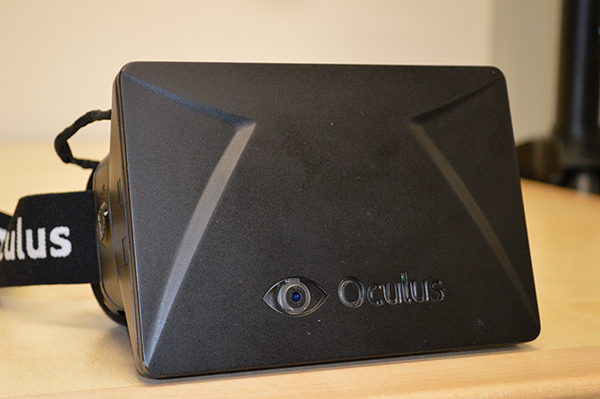
Oculus Rift: ZeniMax lawsuit specifically related to the early development of the headset, alleged use of their technology, possible IP infringements and breach of contract (image courtesy of BGR.com)
Cormack himself took to Twitter in an immediate rebuttal of the ZeniMax allegations, noting that while he recognises that any code he wrote while under ZeniMax’s employment is clearly theirs, at the same time the company never once patented any ideas arising from his work – placing the burden of proof on ZeniMax to demonstrate trade secrets / IP has been misappropriated where no patents exist.
John Carmack, Oculus VR’s CTO used Twitter in an immediate rebuttal of ZeniMax’s claims at the start of the month.
With the claims following on the heel of Facebook acquiring Oculus VR, the latter also commented on the ZeniMax allegations, framing them in terms of the Faceback acquisition, stating:
It’s unfortunate, but when there’s this type of transaction, people come out of the woodwork with ridiculous and absurd claims. We intend to vigorously defend Oculus and its investors to the fullest extent.
Daniel Nye Griffiths, writing for Forbes Online provides a solid examination of the initial claims made by ZeniMax and the response by Oculus VR, which although somewhat superseded by the lawsuit’s filing, help frame the two companies respective positions. In their response to the claims by ZeniMax, and without using the actual words, Oculus VR pretty much demanded ZeniMax to put up or shut up.
On Wednesday May 21st, Linden Lab publicly released the Oculus Rift project viewer. Version 3.7.8.289834 of the viewer offers initial support for Oculus Rift, and is focused on getting started with the Oculus Headset (which has yet to be commercially released, although there are currently some 75,000 SDK 1 models in the world, and shipping will commence soon on the updated SDK 2 version).
For Windows, Oculus Rift requires Windows Vista or later, and with Mac OS X, version 10.7 or later is required.
The blog post announcing the release reads in part:
The early beta testers of our integration have provided some valuable feedback, identifying bugs as well as providing suggestions for additional features and options that would improve the experience of using the Oculus Rift with Second Life. Today we’re pleased to announce that our Oculus Rift integration is now available as a Project Viewer, the first step toward becoming a part of the default Second Life Viewer.
Like our initial beta release, this Project Viewer is more about making it easy to get started using the Oculus Rift to view Second Life than it is about optimizing the UI for headset users. We’ve made some minor adjustments to the regular Second Life UI in order to present it in head-mounted display (HMD) mode, but the UI headset users will experience with this project Viewer is still essentially the same as you’d see without an Oculus Rift.
A new Toolbar button makes toggling the Oculus Rift on / off easy
Features in the viewer include:
Full Oculus Rift Hardware Support – includes automatic hardware detection and display calibration for quick and easy setup
HMD Mode – activated via Me > Display Select or via CTRL-SHIFT-D / CMD-SHIFT-D or via the HMD Mode toolbar button. This command also allows one to display the stereo rendering output intended for the Oculus Rift on their primary display
HMD configuration via Preferences > Move and View > click the HMD calibration button
Display A new Preferences pop-up provides additional display configuration options
Full UI Support – users can access the entire Second Life UI and HUDs while in Oculus Rift mode, so there are no limitations on what a user can do in-world while using the headset
Avatar Head Motion – Oculus Rift head-tracking data is mapped to the avatar, so users’ avatars look where they do
“Align to Look” [Q] – allows users to quickly start moving the direction they are looking
New First-Person View – allows users to enjoy the immersion previously available with Mouselook mode, but allows the mouse to be used to control the cursor, allowing for interaction with the UI and objects in-world
Action Key – [“X”] It is now possible to activate action items (i.e. Opening Doors) from Mouselook mode. Aim the crosshairs at the item you’d like to activate, and press the “X” key. In First-Person mode, the Action Key [“X”] will have the same functionality as clicking the mouse button in Mouselook mode (i.e. it will “trigger” guns or other held items).
To display the viewer with the best results, Linden Lab recommend that the Oculus Rift is configured as an Extended Desktop in Windows (do not Duplicate Displays), and that Mirroring Mode (Settings > Displays) is enabled on Mac OS X.
There are some known issues with the viewer, as noted in the release notes. These include, but are not limited to:
Alt+Tabbing out of the viewer confuses the Rift – RIFT-22
File Browsers cannot function in HMD mode – RIFT-20
Snapshots disabled while in HMD mode because:
HUD and UI elements always drawn in snapshots –RIFT-30
Save to my Computer adds a blank screen between refreshes when trying to take snapshots – RIFT-31
Toggling HMD mode sets the focus wrong and you have to click in world before doing anything else, on Macs – RIFT-110
There are also known limitations with the Action Key [“X”] – please refer to the release notes for a list of known issues and to JIRA raised under the RIFT project.
To go with the project viewer launch, the Lab has also created a new Oculus category in the Destination Guide, which is intended to list “places that are particularly compelling with the Oculus Rift.”
The blog post includes an introductory video, embedded below. Please note, this video refers to downloading the release version of the SL viewer – this is incorrect. The Oculus Rift capabilities are only available via the Oculus Rift project viewer, which is correctly linked-to in the blog post.
With the SVVR Conference and Expo underway in California, now is perhaps a timely opportunity to take a peek at what is being billed as an open-source competitor to the Oculus Rift.
Techcrunch, along with several other technology blogs / websites, covered the news a few days ago that a Chinese start-up, ANTVR Technology, is developing an open-source, cross-platform virtual reality gaming set, called the ANTVR kit.
The kit is said to be compatible with games designed for the Oculus Rift and with most PC and console platforms. It can connect to any device offering direct HDMI output, or via an HDMI adapter if no direct HDMI output is available. Supported systems include computers, games consoles, iOs devices, Android devices, and even Blu-ray players.
The ANTVR kit headset design (image courtesy of ANTVR Technology)
The new headset is currently a part of a Kickstarter campaign, which despite the backlash over the eventual acquisition of Oculus VR by Facebook, has already seen 450 people commit (at the time of writing) almost $170,000 of the $200,000 goal in just seven days, suggesting that if the rate of pledges is maintained, the ANTVR Kit could end-up going that same way as both Oculus VR and Technical Illusion’s castAR, and exceeding its modest target by a good margin.
The headset unit has a 1920 x 1080 high definition, 1.03 megapixel per eye, display with a 4:3 ratio offering a 100-degree diagonal field-of-view. A dual aspherical lens arrangement is apparently included to help eliminate image distortion when projecting standard ratio images. Like the Oculus Rift, it has an internal 9-axis Inertial Measurement Unit (IMU) for head rotation and movement tracking, and it can be worn with prescription lens glasses.
Comparing the ANTVR with Oculus SDK2 (which actually has a 5-inch screen) and Sony’s Morpheus (credit: TechInAsia)
A novel aspect of the headset is the inclusion of a “glance window”, a slide-up port on the front of the unit which can be pushed up to allow the wearer to re-orient themselves in the real world or their keyboard. While still not a real solution for those needing to use the keyboard and can’t re-orient finger positions easily (no tactile indicators on F, J, and numeric pad 5, for example), it at least means the headset itself doesn’t need to be pushed up to the forehead to see things.
Is it a Controller? Is it a Joystick? Is it a Gun? It’s all Three – and more
A further interesting feature of the kit is the inclusion of the multi-function handset controller. When completely assembled, this forms a gun which can be used in first-person shooter games and the like. However, the “barrel” of the gun can be detached, and the “pistol grip” becomes a joystick, suitable for use with flight simulators, etc., or as a Wii-style controller. This further opens-out into a game controller handset.
A further unique aspect of the handset unit is that it also includes a 9-axis IMU, which tracks body movement and actions, allowing the wearer to control a degree of on-screen character movement via both head and body movement, and to simulate a range of actions (crouching, jumping, throwing a grenade…).
The dual 9-axis IMUs translate body movements into on-screen character movements (stills via ANTVR promotional video, YouTube)
An additional WHDI unit can be added to the assembled handset (and is shown in the image above), allowing for a reported low-lag (less than 1ms) fully wireless gaming experience. The WHDI unit is not supplied as standard, but the company states it will offer it for $200.
As with the Oculus Rift, a software development kit (SDK) is to be made available with the ANTVR kit. The open-source nature of the kit means that there is potential for it to be used with a range of systems beyond those for which it initially supports.
“We wanted to make a gaming system that is universal, but it’s very difficult to make your product compatible with every kind of gaming platform,” Qin Zheng, ANTVR Technology’s founder, said in the Techcrunch report. “We’ve worked on making it compatible with Xbox, PC, and PlayStation, but there are many other gaming systems. If there are developers with other gaming systems or just device developers, they can choose to modify the firmware inside our hardware.”
The Kickstarter campaign is being run along very similar lines to the Oculus VR, up to and including an opportunity to visit the ANTVR Technology studios in Beijing for those willing to pay-out $5,000 (plus meeting their own airfares, etc.), which will also include guided tours of China’s capital. For $270-$300, supporters get the ANTVR kit and other goodies, while for $470-$500, supporters get the kit with a WHDI wireless unit as well.Those offering less that $270 get to choose from other reward options. Qin hopes that following the kickstarter campaign, ANTVR Technology will be able to start shipping kits in September 2014.
The following promotional video examines the ANTVR kit, and shows it in use with the additional WHDI wireless adapter.
In a wide-ranging discussion at the TechCrunch Disrupt New York event (May 5th-7th), Oculus VR CEO Brendan Iribe has spoken about why the company the Facebook acquisition was a good thing, and has described a desire expressed without both companies to make VR a social experience for a billion users, perhaps in the form of a MMO.
The discussion – described as a “fireside chat” with TechCrunch co-editor Matthew Panzarino – is available as a video in a Techcrunch article. It was followed by a backstage interview with TechCrunch’s Josh Constine.
Brendan Iribe, Oculus VR CEO, talks to Matthew Panzarino at TechCrunch Disrupt NY (image via TechCrunch)
in discussing the attractiveness of the deal for Oculus VR, Iribe indicates that one major consideration was the fact that the company was offered the opportunity to more-or-less continue to operate fairly independently of Facebook, a-la Instagram. Another was that Facebook were prepared to provide Oculus with access to their enormous technical capabilities and services, while offering Oculus the ability to practically cherry-pick which of them they’d like to leverage.
The majority of the conversation, however, focuses on the development of an immersive, VR-focused “MMO” (a term used interchangeably with “virtual worlds” and “metaverse”) with a billion users world-wide. “Metaverse” is a term which has been used by the Oculus team in the past, indicating that they’ve held aspirations in that direction and beyond the gaming market, and Iribe frankly admits that having Facebook behind them immediately means that Oculus VR has a huge network behind them – not only in terms of infrastructure and tech, but in terms of users (1.2 billion of them), which could very much help speed up adoption and acceptance of VR. Commenting at around the 4:35 mark, Iribe states:
We know with Oculus, with a virtual world, if you’re putting on this pair of glasses and you’re going to be face-to-face communicating with people, you’re gonna be jumping in and out of this new set of virtual worlds, this is gonna be the largest MMO ever made. This is going to be an MMO where we want to put a billion people in VR. And a billion person virtual world MMO is going to require a bigger network than exists today. Why not start with Facebook and their infrastructure, and their team and their talent that they’ve built up?
While this is not a short-term goal – the figure of around ten to twenty years is mentioned when discussing how this will all come about. Iribe also notes that there has to be something of a further upscaling of computing power in order to make it all happen, as well as the technology needing to become less cumbersome and intrusive and more readily acceptable and wearable. He suggests it should look more like a set of sunglasses – a direction several VR companies are already heading in.
Exactly how this billion-user environment will come about and what form it will take is unclear. Towards the end of the video, Iribe wisely points-out that VR is still in its infancy, and that it’s hard to predict precisely where it will lead or the impact it will have. However, it seems from his comments that the “MMO / Metaverse” Oculus VR are considering isn’t a single platform (although they see Facebook’s users and network as a good starting-point, as mentioned), but potentially a range of interconnected worlds / environments.
An interesting aspect of the discussion around the MMO / Metaverse concept is that Iribe in some respects echoes much of the work that is going on at High Fidelity. He mentions that one of the attractions Facebook held for Oculus was that it already operates a complex payment system (worth around $3 billion in revenue), which negates the need for Oculus to have to develop one – a problem High Fidelity is still mulling over. More particularly, at some 12 minutes into the video, he describes the working going on at Valve in terms of development avatars and projects this work into the future where he sees avatars have head tracking capabilities, can mimic facial expressions and carry people into the Uncanny Valley – a path High Fidelity are already walking, and would appear to be a good deal further along.
In the backstage interview with Josh Constine (embedded below), Iribe also talks about issues of trust and identity security, and having the confidence that as you move between apps and environments, you maintain control of what aspects of your identity are exposed. This is another issue which has very much been at the forefront of High Fidelity’s thinking with regards to a metaverse of virtual worlds.
Towards the end of the discussion, Iribe mentions the fact that Oculus VR are now starting to work more closely with the education sector in a drive to expand the whole VR ecosystem.
The Silicon Valley VR (SVVR) Meet-up at the end of March featured a series of presentations from people within the VR field, including those by Brian Bruning, VP of Business Development and Marketing at Technical Illusions (castAR) and Philip Rosedale of High Fidelity.
The full video of the presentations is provided below, and I’ve included notes on each of these two presentations in particular. When reading, please be aware that these are notes, and not a full transcript.
Brain Bruning – castAR
Brian Bruning’s presentation commences at the 0:05:48 mark.
I’ve covered the early work on castAR in the past, some of which is touched upon at various points in the presentation, so I don’t want to repeat things here. What is interesting is that the system’s development has been following a similar route to that of the Oculus Rift: Technical Illusions have been out attending technology shows, conferences, exhibitions, etc., to gain visibility for the product , they ran a successful Kickstarter campaign for castAR which raised $1,052,110 of a $400,000 target.
[07;10] castAR has three modes of operation:
Projected augmented reality (AR), which presents a 3D hologram image projected onto a retro-reflective surface in front of you. allowing you to interact with it via a “wand”
Augmented reality of a similar nature to that of Google Glass
Virtual reality of the kind seen with the Oculus Rift.
castAR projected AR gaming with the castAR wand (image via Technabob)
The emphasis is that the headset is natural, comfortable-looking (a pair of glasses) which has three product features built-in. As a result of the Kickstarter, the company has now grown to 10 people, and the technical specifications for the system have been decided:
Glasses
Less than 100 grams in weight
Fits over most prescription glasses
Ultra flexible micro coax cable
Active shutters with 50% duty cycle
Projectors
1280 x 720 resolution per eye
120hz refresh rate per eye 24 bits of color per pixel
65 degree horizontal field of view 93% fill factor
Tracking System
110 degree FOV
120hz update rate
8.3ms response time
6 degrees of freedom
Absolute positioning Over 200 unique tracking points
0.07mm accuracy at 1.5m
AR & VR Clip-On
90 degree horizontal FOV
Very low distortion freeform optics
5mm by 8mm eye box
Removable flip-up shutter for AR mode
[11:20] castAR has its roots within the gaming environment and has been developed with the games market in mind (again, as had pretty much been the case with Oculus Rift), although they had recognised the potential for wider applications – they just hadn’t anticipated that someone like Facebook would step into the VR / AR arena and potentially add impetus to the wider applications for VR / AR.
[11:45] One of the benefits seen with a combined approach to VR / AR is that there are situations in work, in education, in research / medical fields where a completely occluded view of the real world – as required by head-mounted displays (HMDs) such as the Oculus Rift – are simply not appropriate (Mr. Bruning jokes that there are even some activities associated with gaming where a HMD is inappropriate – such as simply trying to eat a snack or take a drink without interrupting the game flow!). In these situations, the projected AR or the Google Glass-like” AR are seen as more beneficial, and hence the drive to address all three modes of operation.
[13:20] Technical Illusions believe that many of the challenges faced by AR and VR content creators are similar in nature – such as dealing with UI issues, both seeing UI elements and interacting with those UI elements, or dealing with physical objects which my be places within a VR / AR scene. As such, Technical Illusions are focused on educating content creators to the needs of immersive / augmented environments and are producing dev kits to assist content creators in developing suitable environments / games / activities which take such issues into account.
[14:57] Current planning is for Technical Illusions to have their dev kits and the Kickstarter sets shipped in summer 2014, and to have the consumer version ready to ship by the fourth quarter of 2014, and it is indicated that price-point for consumer kits (glasses, tracking components, retro-reflective surface and input wand) will be “sub $300”.
The castAR update is an interesting, fast-paced piece, primarily focused on the projected AR capabilities of the glasses. Little or nothing was said reading the ability of the system to be used as a VR system, and no disclosure was given on the VR clip-on system.
This is apparently a deliberate decision on the part of the company, in that they are allowing VR HMD focused companies promote the potential use of VR, While Technical Illusions focus on the potential of projected AR capabilities. While an interesting approach to take, I can’t help but feel that (assuming the VR clip-on is at a “feature complete” status) promoting all capabilities in castAR wouldn’t be better, as they help present the product as a more versatile tool.
MENLO PARK, CALIF. – March 25, 2014 – Facebook today announced that it has reached a definitive agreement to acquire Oculus VR, Inc., the leader in immersive virtual reality technology, for a total of approximately $2 billion. This includes $400 million in cash and 23.1 million shares of Facebook common stock (valued at $1.6 billion based on the average closing price of the 20 trading days preceding March 21, 2014 of $69.35 per share). The agreement also provides for an additional $300 million earn-out in cash and stock based on the achievement of certain milestones.
So opens a press release issued by Facebook on Tuesday March 25th, 2014.
This is a pretty stunning announcement, and shows that, as Mark Zuckerberg states in the release, “Mobile is the platform of today, and now we’re also getting ready for the platforms of tomorrow. Oculus has the chance to create the most social platform ever, and change the way we work, play and communicate.”
The news has sent shock waves rumbling across the social media sphere, with many reacting positively to the news, and other reacting negatively. Following the announcement, Cory Ondrejka at Facebook was unsurprisingly excited by the news.
While Markus Persson of Minecraft fame responded to the news with as less favourable response, which was quickly picked-up by the games media.
Others also didn’t appear to be initially impressed by the news, either, including those who funded the original kickerstarter. Meanwhile, Techcrunch reported a slide on Facebook’s share price which, while closing on the day overall, saw Facebook’s share value below its open price of $64.25, resulting in a loss of $1.5 – $1.8 billion market cap. However, as Techcrunch also notes, this isn’t the first time Facebook’s shares had dropped following the announcement of an acquisition.
Theories as to why Facebook have made the move abound, with some pointing to the company tripping-up on the explosion of the mobile market and so are perhaps afraid they might miss-out on the growth of VR if it takes off suddenly. Others are suggesting Facebook is keen to jump on the possible marriage of the Oculus with mobile technology.
I’ve been somewhat skeptical that VR will explode in quite the immediate way many have been predicting – which is not to say I don’t think it will be big; I just think it’ll take longer to get there on all fronts (i.e. beyond gaming) than some pundits are perhaps allowing. It seems I’m not alone in thinking this. Speaking to The Verge, Oculus investor Chris Dixon believes Facebook are playing the long game – rather like Google did with their acquisition of Android in 2005.
It appears Zuckerberg agrees with him. Commenting in a teleconference held on the afternoon on March 25th to discuss the acquisition, Zuckerberg said, “There are not that many companies building technologies that could be the next computing platform, and Oculus is the clear leader.”
But this is just the start. After games, we’re going to make Oculus a platform for many other experiences. Imagine enjoying a court side seat at a game, studying in a classroom of students and teachers all over the world or consulting with a doctor face-to-face — just by putting on goggles in your home.
This is really a new communication platform. By feeling truly present, you can share unbounded spaces and experiences with the people in your life. Imagine sharing not just moments with your friends online, but entire experiences and adventures.
Oculus founder Palmer Luckey has a lot to smile about (image via Popular Mechanics)
Concerns have already been raised over the future of Oculus Rift as an open platform, something Oculus VR founder Palmer Luckey attempted to allay in a statement on the company’s Reddit page:
Facebook is run in an open way that’s aligned with Oculus’ culture. Over the last decade, Mark and Facebook have been champions of open software and hardware, pushing the envelope of innovation for the entire tech industry. As Facebook has grown, they’ve continued to invest in efforts like with the Open Compute Project, their initiative that aims to drive innovation and reduce the cost of computing infrastructure across the industry. This is a team that’s used to making bold bets on the future.
Whether such comments will quell concerns and upset, remains to be seen, although i’m not putting money on it doing so. Facebook undoubtedly have the financial and technical clout to boost Oculus Rift and VR into more mainstream consciousness. Whether this will come tied to a Facebook log-in requirements, again as some are already predicting, remains to be seen.
It’ll also be interesting to see how Facebook, after dabbing with virtual world environments through Cloud Party, consider virtual worlds, and the direction in which they might move. Could it be the “Facebookisation” of SL (or rather, perhaps, Linden Lab) may yet come to have a significantly new meaning? Or, less tongue-in-cheek, what about Philip Rosedale’s High Fidelity coming under the FB eye? Now there’s something to chew on (ETA: and in this regard, Palmer Luckey’s sign-off to his blog post announcing the acquisition is interesting: We’ll see you in the Metaverse!)
P.S. Techcrunch may score the biggest hit in this latter regard with their latest headline on the subject: Facebook Buys A Virtual World – that’s bound to get people rushing to their doors!






 Inara Pey: Living in a Modemworld