VR: HTC Vive hands-on

The Vive from HTC:  a VR headset developed with Valve
The Vive from HTC: a VR headset developed with Valve

On Sunday, March 1st, HTC held a presentation on the eve of the Mobile World Congress, Barcelona. During the course of the event, they revealed a new VR headset they’re developing in partnership with Valve.

I pulled together news on the announcement from a variety of sources a few hours after it was made. Since then, more information has hit the media, the results of numerous opportunities for hands-on demonstrations. And going by the feedback, it would appear Oculus VR has some very series competition on its hands.

The big thing everyone has been pointing to as being the real secret sauce for VR is a sense of presence. With so many different systems in so many different states of development, how this will be properly achieved has perhaps been hard to judge. Some headsets are managing it in part, some third-party peripheral makers are looking at various means of providing it with room sensors, body kits, etc. However, from all the hands-on reports, it would seem that HTC are the first to nail it in one fairly straight forward package.

“With the original Oculus Rift and things like Samsung Gear VR, that sensation of really being somewhere else is present, but fleeting,” Carlos Rebato says, writing for Gizmodo. “Those can’t track your body, so as soon as you lean just slightly, the illusion is shattered. The Oculus Rift DK2 did it better, with a motion tracking camera that at least let you lean, but you were still a sort of an armless half-body. Sony’s Project Morpheus improved it further by using controllers keep track of your hands.

“But the Vive? It’s like nothing that’s ever come before.”

The HTC Vive headset with a pair of "base station" scanner below and to the left of it, and a pair of the hand controllers in the foreground (image courtesy of PC Gamer)
The HTC Vive headset with a pair of “base station” scanner below and to the left of it, and a pair of the hand controllers in the foreground (image courtesy of PC Gamer)

Gareth Beavis, over at Techradar, is equally gushing. “There’s a TV show from the early 1990s called Red Dwarf that depicted the last human (and a group of humanoids) that were lost in space in the future, desperate to get home. One of the big ways they stayed entertained was with a holographic headset that let them play in hyper real worlds, like they were living in the action sequence … I always thought that idea, that experience, would never be real.

“But with the HTC Vive I took my first steps into that world.”

Both reports – and others in a similar vein – point to the distinguishing factors that make the Vive the complete package: the laser “base station” scanners and the dedicated hand controllers. Details of both of these were rough at the time of HTC’s announcement, but the various hands-on demonstrations taking place at the MWC and, under the Valve banner, as the Game Developers Conference in San Francisco, more information on them has filtered into the tech media.

The scanners are small, box-like objects designed to be mounted on wall at 90-degrees to one another. As noted in my original article ion the Vive, these can then scan a square area up to 4.6 metres (15ft on a side), accurately tracking multiple sensors on the headset, and the motions of the wearer’s body and recreating them within a virtual environment, allowing the wearer to move around “inside” a virtual space. To reduce the risk of collisions with physical objects, the scanner also map the location of walls and furniture, and the system fades these into the wearer’s field of view should they get too close.

A closer look at one of the "base station" laser  scanners used with the Vive (image courtesy of PC Gamer)
A closer look at one of the “base station” laser scanners used with the Vive (image courtesy of PC Gamer)

Continue reading “VR: HTC Vive hands-on”

HTC enters the VR arena with Vive and Valve

The Vive from HTC: a VR headset developed with Valve
The  Vive from HTC: a VR headset developed with Valve

On Sunday, March 1st, 2015, Taiwanese smartphone manufacturer HTC caught the VR world and tech media somewhat off-guard when, among a series of product announcements on the eve of the Mobile World Congress (March 2nd-5th, 2015, Barcelona), they revealed a new high-end VR headset they have been developing in partnership with Valve, the on-line gaming service.

The revelation comes after a week of speculation on what Valve; statement they’d be revealing a “previously unannounced” Steam VR Development Kit, thought to comprise a new headset and other goodies, at the upcoming Game Developer’s Conference  in San Francisco.

As reported by Engadget among other tech journals, the HTC headset is called the Vive, and is both the headset Valve have been dropping hints about and is a direct competitor to the Oculus Rift, rather than being a headset for use with mobile devices, despite being announced at a an event focused on mobile devices.

As reported by Gamespot, it’s unit offering a 1,200 by 1,800 pixel screen in front of each eye, each with a 90 fps refresh rate to eliminate image judder and offer “photo realism”. It also features a gyrosensor, accelerometer, and laser position sensor. The latter tracks the rotation of your head, allowing you to look around a virtual environment naturally.

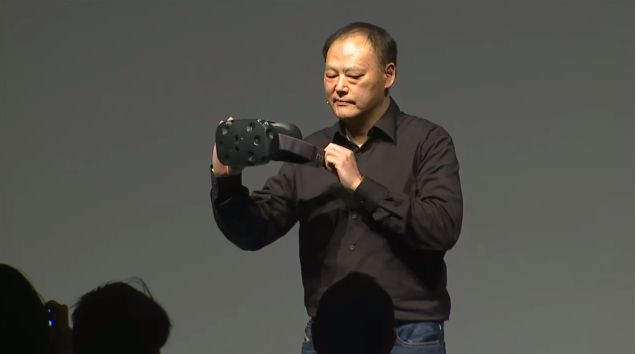
Peter Chou, HTC's CEO, unveils the Vive on the eve of the Mobile World Congress in Barcelona, March 1st, 2015
Peter Chou, HTC’s CEO, unveils the Vive on the eve of the Mobile World Congress in Barcelona, March 1st, 2015

According the HTC, the new headset will have high fidelity audio capabilities as well. But what is particularly interesting about it is that HTC are claiming it “will bring the first room-scale [VR] experience” to the world.

This is apparently achieved by combining the headset with a pair of SteamVR “base stations”, and some 70 movement sensors within the system. When placed out, the “base stations” can scan a square space up to 4.6 metres (15 feet) on a side, and any body movement, walking, jumping, turning, etc., captured within that space will be tracked and reproduced within the VR space being seen through the headset.

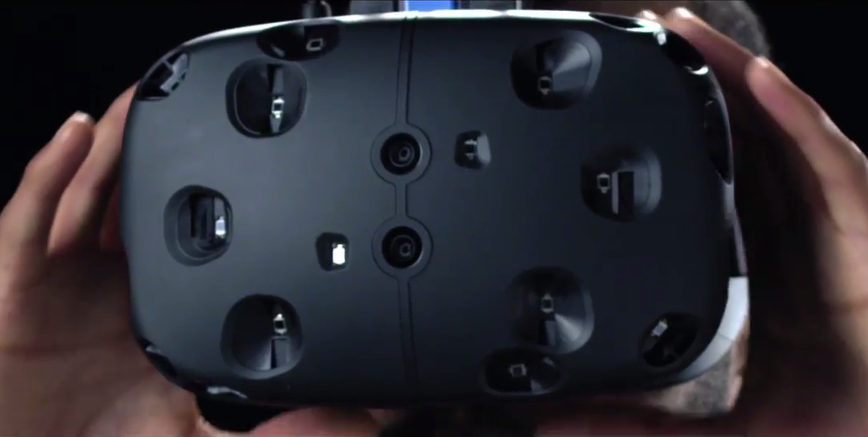
If that wasn’t enough, HTC are also indicating that they have solved the issue of interacting in virtual spaces. They’ve done this by pairing the headset with a set of wireless hand controllers of their own design. These apparently allow the wearer to use their hands, point, hold things, etc., with sensors mounted on the front of the headset tracking all such movements / actions and again reproducing them in the virtual environment.

The front of the HTC Vive, showing the sensors for capturing hand movements
The front of the HTC Vive, showing the sensors for capturing hand movements / tracking head movements

Like the Oculus Rift, the headset is being initially aimed at the games market, with HTC indicating that Dovetail Games, Fireproof Games, Cloudhead Games, Owlchemy Lab, Bossa Studios, Steel Wool Games and Vertigo Games already having signed-up to support the device.

In addition, and as reported by The Road to VR (see the link earlier in this article), Valve have also been putting out the word that they want to hear from developers and a link from the HTCVR website, launched at the same time as the announcement was made, directs any developer wishing to register their interest in working with the new headset to the Steam website, where they can do so.

Continue reading “HTC enters the VR arena with Vive and Valve”

Yes, you can have a View-Master with your virtual reality

The re-vamped View-Master for VR from Mattel, and one of the scenic discs that accompany it
The re-vamped View-Master for VR from Mattel, and one of the scenic discs that accompany it (image: Mattel Inc.)

Alongside all the the news and hype surrounding VR in 2014, there were a lot of witty / dour comments relating to the old Mattel View-Master system, and how people would prefer to have that, rather than strapping a plastic brick to their forehead.

Well, it looks like the laugh might be on those cracking such jokes, as Mattel have announced that the View-Master brand is to be revamped as a virtual reality headset system utilising Google Cardboard software.

Announcing the move at the New York City Toy Fair, which opened to the public in – wait for it – New York City on February 14th, 2015, Mattel’s Senior Vice President of Global Brands, Doug Wadleigh said the aim of the partnership is “to create the View-Master brand for the next 75 years,” and offer kids the chance to have “a collectible they can keep in their room.”

The iconic View-Master has been through many iterations during it 75-year history
The iconic View-Master has been through many iterations during it 75-year history, but has always had the same basic functionality (image: doyouremember.co.uk)

The original View-Master, which incredibly celebrated its 75th anniversary in 2014, was once a staple part of many children’s toy boxes. With it, kids could load circular reels of 3D images into a hand-held, binocular-like device with a lever on the side which is used to flip through the pictures, providing the user with a stereoscopic views of landmarks, scenery, historic events, and so on.

The new system announced at the NYC toy fair retains much of this original functionality. It comprises a hand-held  device into which a mobile phone running the Cardboard software can be fitted.

Like the original, it is designed to use special scene “reels”; only rather than being placed in the unit, the disc-like reels are placed on a flat surface in front of the user. When viewed through the device, they generate AR-style navigational environments which the user then “enters”. This allows, for example, the key locations in a virtual “tour” to be visualised AR-style, and then individual locations within the tour selected and viewed immersively, with additional information on sights and locations being provided by pop-up text boxes.

In actual fact, the “reels” are optional, if people prefer, they will be able to download the immersive experiences directly to their smartphone for us with the new View-Master. However, the reels are being provided to maintain the “collectible” aspect of the original View-Master system, which Mattel see as an additional selling-point for the system. They plan to grow the range of available reels over time to provide many different types of experience, some of which – in a possibly canny move – might be built around the company’s other products.

For example, Mattel is already talking in terms of a video shot from within one of their “Hot Wheels” toy cars as it races through a “Hot Wheels” track, putting the person watching “behind the wheel” of the car.

Commenting further on the re-vamp, Wadleigh said, “The View-Master was first introduced in 1939, giving consumers access to spectacular 3D worlds by simply selecting a reel and looking through a device. By working with Google’s Cardboard platform, we are now able to take that experience even further, bringing the discovery and immersive viewing experience of the View-Master to the digital age.”

Google are also delighted with this further move into a broader VR presence for Cardboard, which comes hard on the heels of LG launching their VR for G3 virtual reality headset. Commenting on the partnership with Mattel, which doesn’t include any licensing arrangement or revenue sharing for Google, Cardboard Product Director Mike Jazayeri, said in a press release, “We developed Google Cardboard as an open platform to inspire companies like Mattel to rethink how to deliver new user experiences through technology. Many of us on the Google Cardboard team grew up playing with View-Master, so we were excited to collaborate with Mattel and to see the viewer evolve and work with Google Cardboard.”

The new View-Master is due to go on sale from autumn 2015 at a suggested price of $29.99 (£19.50) for the headset (sans smartphone), and the company hope to have it available for both Android handsets and iPhones. One image disc will be supplied with the device, and additional discs will be sold at $14.99 (£9.75) each.

Source Links


LG morph Cardboard into plastic to rival Samsung in the mobile VR world

LG's VR for G3 uses Google Cardboard to bring VR to users of their G3 'phones
LG’s VR for G3 uses Google Cardboard to bring VR to users of their G3 ‘phones

In June 2014, Google informed the world that, in order to enjoy a VR experience on your mobile ‘phone, all you need is … Cardboard. Then, as I reported at the end of 2014, Samsung announced the availability of its Gear VR headset, which utilises their Galaxy Note 4 phablet and technology from Oculus VR, while Zeiss released VR One for the Samsung Galaxy S5 and iPhone 6.

Now, not to be outdone, Samsung’s home-grown rival in the world of mobile devices and consumer electronics, LG, is also getting in on the act.

On Monday, February 9th, LG announced the availability of VR for their G3 handsets. Like Google’s DIY cardboard kit (made available in full kit form by Dodocase, to save you having to source the parts yourself), VR for G3 is a hand-held unit providing a set of optics into which LG’s new range of G3 ‘phones can sit. In fact, not only does it look like Google Cardboard’s grown-up cousin, it is actually based on the cardboard headset design and is intended to be used with the Google Cardboard development environment for mobile VR experiences, and any apps built using that environment.

What’s more, it’s free. Well, free for those buying a new LG G3 handset, and then possibly only for a limited time period. Currently, no details have been released on pricing once the promotional period has ended. It is also currently unclear if VR for G3 will be made available as a separate accessory for the G3 ‘phone.

The hand-held headset is modelled on Google's original Cardboard DIY headset, and utilises the Cardboard development environment and applications
The hand-held headset is modelled on Google’s original Cardboard DIY headset, and utilises the Cardboard development environment and applications

“This is just the beginning of the virtual reality movement, which until recently was expensive and inaccessible to everyday consumers,” Chris Yie, vice president and head of marketing communications at the LG Electronics Mobile Communications, was quoted as saying in a press release from the company announcing the move. “By leveraging Google Cardboard, not only are regular consumers able to participate in the VR experience, we’ll be able to introduce this technology to future developers who may one day show us how VR can be used to improve our lives.”

VR for G3 will be rolled-out across LG’s global markets over the coming month, and the promotion will include a code allowing purchasers of the handset and headset to download the VR game Robobliteration.

With a screen resolution of  2560 x 1440, and packing a whooping 538 pixels-per-inch, the G3 handset is seen by LG as an ideal candidate for running immersive VR applications, and the hand-held headset includes optics specifically designed to leverage the screen’s capabilities.  As with Google’s original Cardboard design, a ring mounted on the left side of the headset, together with a small magnet within the unit work with the gyroscope sensor in the G3 to select applications and scroll through menus without the user needing to touch the display.

The G3 'phone sits within the snap-one cover of the headset, but the unique design of the 'phone, with it's back-mounted sleep button meanes that it doesn't have to be removed in order to place the phone into, or bring it out of, sleep mode
The G3 ‘phone sits within the snap-one cover of the headset, but the unique design of the ‘phone, with it’s back-mounted sleep button means that it doesn’t have to be removed in order to place the phone into, or bring it out of, sleep mode

Google are also keen to emphasise their involvement in LG’s entry in to the VR marketplace. “With Google Cardboard, we wanted to create more immersive and delightful experiences for anyone on their mobile devices,” Andrew Nartker, Product Manager for Google Cardboard is also quoted as saying in the LG press release. “We are excited about VR for G3, and the rich ecosystem of developers and manufacturers who are innovating with Google Cardboard and making VR more easily accessible.”

How much of an actual market exists for mobile VR has yet to be seen (by necessity, VR-on-the-go is more suited to sitting down rather than wandering the streets, so many might perfer to await the arrival of Oculus Rift CV-1 and similar headsets). However, it would appear that manufacturers like LG might see it as a way of reinvigorating ‘phone sales in the face of an saturated market.

Source links

All images courtesy of LG Electronics Mobile Communications Company.


The man whose novel helped inspire Second Life takes a Magic Leap

It has been announced that science-fiction author Neal Stephenson has become the latest high-profile individual to join the ranks of Magic Leap, the still-mysterious company that seems to be doing something highly innovative with augmented reality – and perhaps virtual reality as well.

Stephenson, who wrote Snow Crash, the novel which first coined the term “metaverse” and is often referred to as one of the influences behind the development of Second Life, has accepted the position of “Chief Futurist” at Magic Leap, in news being broken by the likes of Wired and The Verge.

Neal Stephenson, Magic Leap's new
Neal Stephenson, Magic Leap’s new “Chief Futurist” (image: Bob Lee via Flickr)

Writing in a blog post for Magic Leap, Stephenson states he had been approached by the company months ago – and in a rather unique way:

A few months ago, two Irishmen, a Scot, and an American appeared on my doorstep with Orcrist, aka “Goblin-cleaver,” the ancient sword forged during the First Age of Middle Earth by the High Elves of Gondolin, later retrieved from a troll hoard by Thorin Oakenshield. It’s not every day that someone turns up at your house bearing a mythic sword, and so I did what anyone who has read a lot of fantasy novels would: I let them in and gave them beer. True to form, they invited me on a quest and asked me to sign a contract (well, an NDA actually).

The use of Orcrist in the offer is cleverly symbolic: one of the Board of Directors of Magic Leap is Sir Richard Taylor, founder and head of WETA Workshop, the company behind the models, costumes and special effects seen in the Lord of the Rings and Hobbit trilogies directed by Peter Jackson.

Precisely what Magic Leap is developing is something of a mystery, although as I’ve previously reported in these pages, what has been shown to the likes of Google, Legendary Pictures, Andreessen Horowitz and others led them to invest some $542 million into the company in October – and that on top of $50 million of investment at the start of the year.

What little is known about Magic Leap is that it is currently working on what it calls “cinematic reality”, which uses a headset which may eventually look something like a pair of sunglasses to overlay anything the wearer sees in the real world with 3D digital images that move and respond to the wearer’s own head an eye movements, and which appear to “interact” with the physical world around the wearer.

You'll believe a whale can fly - or that's perhaps Magic Leap's hope (among more practical things)
You’ll believe a whale can fly – or that’s perhaps Magic Leap’s hope (among more practical things)

Recently, Sean Hollister over at Gizmodo followed the lead set by Tom Simonite, a bureau chief at MIT Technology Review, in tracing down patents filed by Magic Leap in an attempt to find out more about what the company may actually be producing. As I again reported, their findings make fascinating reading for anyone interested in emerging AR and VR technologies – and in the history of Magic Leap, which up until the huge investment by Google et al, had been quietly flying under the radar for a number of years.

In that same report, I also covered the fact that what might be on of Magic Leap’s first major public demonstrations could be at the Manchester International Festival here in the UK in July 2015.

The Age of Starlight is a new film bringing together Oscar-winning director Kevin MacDonald, the visual effects team behind the 2013 George Clooney / Sandra Bullock blockbuster Gravity and science pundit and physicist Professor Brian Cox. The film will tell the story of the cosmos around us utilising Magic Leap technology, allowing audiences of up to 50 people at a time witness – and be immersed in – the unfolding majesty and mystery of the universe in what is billed as being a transformative, emotional experience.

The Age of Starlight: an immersive, transformative film using Magic Leap technology will be shown at the Manchester International Festival in the UK in 2015

It is apparently this transformative power within the Magic Leap technology that has attracted Neal Stephenson. Again, on the Magic Leap blog he states:

Here’s where you’re probably expecting the sales pitch about how mind-blowingly awesome the demo was. But it’s a little more interesting than that. Yes, I saw something on that optical table I had never seen before–something that only Magic Leap, as far as I know, is capable of doing. And it was pretty cool. But what fascinated me wasn’t what Magic Leap had done but rather what it was about to start doing.

Magic Leap is mustering an arsenal of techniques–some tried and true, others unbelievably advanced–to produce a synthesized light field that falls upon the retina in the same way as light reflected from real objects in your environment. Depth perception, in this system, isn’t just a trick played on the brain by showing it two slightly different images.

Magic Leap is not exclusively about games. It’s also going to be a great tool for readers, learners, scientists, and artists … What applies to games applies as well to other things of interest, such as making the world safe for books, doing new things with science and math visualization, and simply creating art for art’s sake.

We still don’t know precisely what Magic Leap will present or how it will work, and truth be told, there is an awful lot of hype and hyperbole surrounding the emerging new market for AR and VR it is hard at times to separate fact from fiction. But when the likes of Sir Richard Taylor and Thomas Tull (CEO of Legendary Pictures) pour their own money into a project, and it attracts names such as Brian Cox, Kevin MacDonald and now Neal Stephenson – you have to suspect something very special might well be sitting just over the horizon.

Related Links

Magic Leap: bringing augmented reality to film in 2015

The Age of Starlight Promotion picture
Magic Leap technology is to be “premiered” at a UK festival in 2015, in a special film / show entitled The Age of Starlight (image: Manchester International Festival)

Professor Brian Cox may not be a familiar name to everyone, but in the UK and for those with an eye for science on television, he has become something of England’s answer to Neil deGrasse Tyson.

Professor Brian Cox
Professor Brian Cox

Cox, who played keyboards in the pop group D:Ream whilst studying physics at the University of Manchester in the 1990s, started his television career in 2005, appearing on the BBC’s science and philosophy series, Horizon.

Since then, he has fronted a range of science programmes and series, as well as appearing on chats shows on both sides of the Atlantic. He’s even  had a guest starring role in the adventures of the very master of time and space itself, Doctor Who.

Now, the BBC reports, he will be presenting in a cutting edge show / film (which he is also scripting) entitled The Age of Starlight, telling the story of the universe, intended to be one of the focal events of the 2015 Manchester International Festival. The production will also feature visual effects by Framestore, the team that won an Oscar for their work on the 2013 George Clooney / Sandra Bullock sci-fi vehicle Gravity, and will be directed by Kevin MacDonald whose films include the Oscar-winning Last King of Scotland and One Day in September and the BAFTA-winning Touching the Void.

But what makes The Age of Starlight particularly interesting is that it will utilise augment reality technology being developed by Magic Leap, the company that hit the headlines in October 2014, when it received $542 million in funding from a broad range of investors.

For those of you who missed it, Magic Leap is the company behind a headset that uses augmented reality to combine realistic computer graphics with everything the wearer sees in real time, in what the company calls “cinematic reality”. The results can be startling, going on the available promotional material: tiny elephants in the palms of your hands, dragons flying among flocks of birds,  yellow submarines sailing through streets, humpback whales floating over crowded beaches, and more.

One of the Magic Leap promotional images: a yellow submarine apparently floats down a street the Magic Leap wearer is walking along
Magic Leap merges realistic computer graphics with everything the user sees in the real world, in what the company calls “cinematic reality”.

However, beyond the stunning promotional images and video, the company has publicly revealed very little about what it is up to. But what they have shown behind closed doors has been enough to get John Markoff from the New York times very excited, and has been sufficient to get Google to lead that US$542 million (£346 million) round of investment in October, which itself came on top of an initial $50 million of funding earlier in 2014.

Given all the apparent mystery surrounding Magic Leap, Sean Hollister over at Gizmodo, decided to spend a little time digging around trying to find out more on what Magic Leap is all about.

In his article, Hollister starts out by framing something of the company’s history, revealing that Magic Leap has been chipping away at things for quite a while. In a fascinating track through the company’s history, he references their 2011 collaboration with Weta Workshop on something called The Hour Blue, as reported by Dice (see the video, below). This still appears to be around today, although exactly what it is, isn’t clear. This collaboration may have been the reason why Weta’s co-founder, Richard Taylor, opted to make a personal investment in Magic Leap during the $50 million round of funding and now sits on the board of directors.

Making augmented reality of the kind Magic Leap is trying to achieve is a significant challenge, as Hollister explains:

If you’re looking at the real world, your eyes are focusing at a variety of different distances, not necessarily on a tiny piece of glass right in front of your face. The real world also reflects a lot of light into your eyes, which is why the images from heads-up displays like Google Glass appear transparent and ghostly. Because you need to see the real world, you obviously can’t have a projector covering the front of the glasses: that light has to be bounced in from the side, which generally results in a narrow field of view.

And of course, you need some way to track your head and your surroundings so that CG objects appear to occupy a real place in the world, instead of looking like a flat image— which, sadly, is how many existing augmented reality specs do it.

Given this, Hollister reasoned, the best way to understand what the company might actually be developing is to take a look at the patents they have filed and which address such challenges. In taking this line, he’s actually following the lead set by Tom Simonite, a bureau chief at MIT Technology Review.

Continue reading “Magic Leap: bringing augmented reality to film in 2015”