Linden Lab has issued a number of blog posts concerning Second Life account security recently. All of them should be read with care and heeded. Most relate to external issues – so-call viewer wrappers, or links to website Phishing scams.
On Friday, September 22nd, the issued a further warning, again about a phishing scam, but which is being circulated in-world and which appear to be a pseudo-notification pop-up claiming that a user’s account has been compromised.
In the interests of clarity of reading and understanding, I’m including the full text of the post below. Please read it through in full, be aware of the scam and do not be fooled by it – and the blog post states. Linden Lab and / or their support agents would not attempt to contact users on account security in the manner described.
It has come to our attention that some Residents are sending messages – which may appear as pop-up windows in some viewers – informing other Residents that their accounts have been compromised and encouraging them to contact Support, using a phone number that is not associated with Linden Lab.
These messages are phishing attempts to gain access to your Second Life account. Neither Linden Lab, nor Second Life Customer Support, would attempt to contact you in this manner. You can always find Linden Lab’s official customer support contact methods within the following links:
As always, please be wary of suspicious messages and contact from other users. If you believe your account has been compromised, please contact us via support case at https://support.secondlife.com/
Tyrah and the Curse of the Magical Glyches – bonus region portals
On Monday, September 18th, 2017, Linden Lab announced the launch of their latest Experience Key based game for Second Life users to enjoy. Entitled Tyrah and the Curse of the Magical Glytches, it is something of a departure from previous games such as Linden Realms, PaleoQuest and the Horizons adventure. Not only is it grid-wide in nature (the first time Second Life experiences have been used on a grid-wide basis), it will in time also allow parcel holders to host the game on their land if they so wish – possibly attracting traffic to their locations.
I was able to see and try the game ahead of its launch, and thought I’d offer an overview and some feedback, as well as take the opportunity to ask a few questions of Dee and Patch Linden about the game and the reasoning behind it.
Tyrah and the Curse of the Magical Glytches is a combination hunt, capture game and first-person shooter. It builds on elements seen in previous games from the Lab, but is far broader in scope. There are two basic aims of the game:
Capture mischievous Glytches as they wander SL and perhaps gain gems from them, and / or an immediate prize of a Glytch – which might be a shoulder / head pet, held pet, or follower (all of which can be traded between users) or even complete avatars.
Collect coloured gems – which can be redeemed for weapons upgrades, and/ or access into the game’s bonus regions and / or prizes
A video outlines the game’s back story. I’m not going to say much on this other than, “alas, poor Magellan, I knew him, Horatio. A fellow of infinite drinking ability and most assured desire for food…” – or something (with apologies to W. Shakespeare, Esq).
Hartyshire
Game-play Essentials
There are several aspects to playing the game, which are covered in another video; but for those who prefer to read things, I’ve outlined them below.
Hartyshire
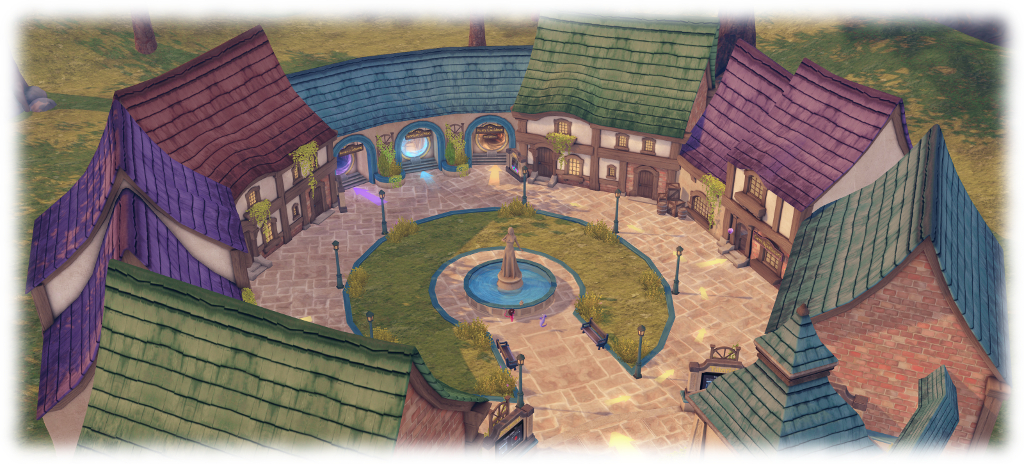
Hartyshire is the heart of the game. Reached via the Portal Park, it is the place where people can learn more through the aforementioned videos, and where players obtain their Glytch Starter Kit, can upgrade their weapons, claim prizes or – gem and weapons upgrades allowing – access the special bonus regions. There is also a range of free gifts for visitors, whether or not they join the game. There are three important areas in Hartyshire:
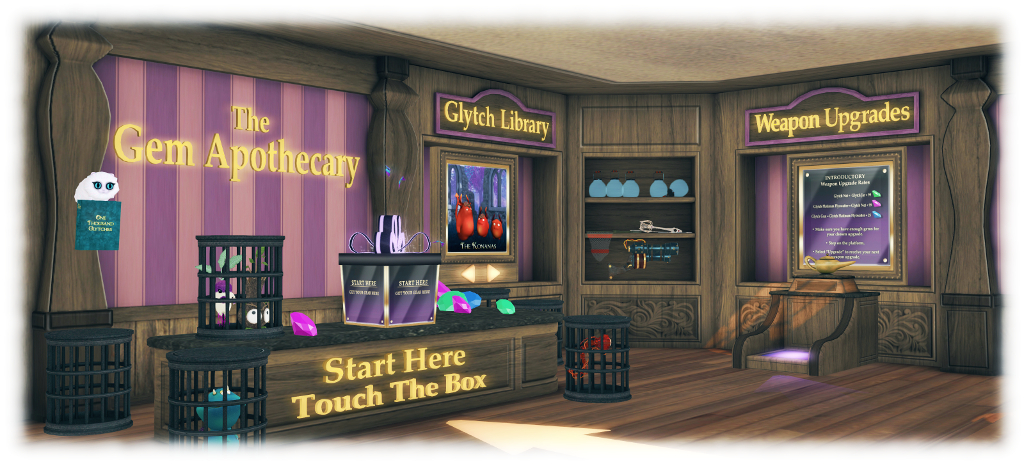
The Gem Apothecary is where players can:
Obtain a game Starter Kit: with everything needed to start playing: a note card of instructions, the game HUD (see below) and a jar – your first Glytch catching weapon. The kit is delivered as a folder to your Inventory.
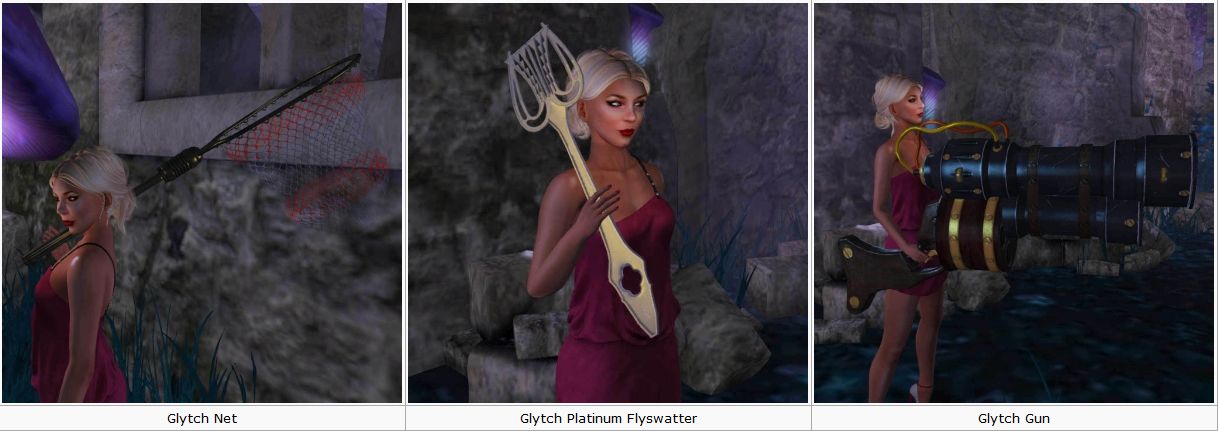
Upgrade their Glytch catching weapon: use gems given by Glytches to upgrade from jar through swatter and net to gun. Each weapon improves the chances of catching Glytches. Replacement weapons can also be obtained here.
Claim Gem Lottery Prizes: contains prizes from the Lab’s previous games, split into three groups – Common, Rare and Epic, corresponding to the three gem colours – Green, Pink and Blue. Prizes in each category can be obtained by redeeming the required gems of each colour.
Inside the Gem Apothecary – start kit, weapons upgrades and “captured” Glytches
The Gift Shop is where visitors to Hartyshire can collect game-related free gifts and hatch their SL14B gift egg to gain their first Glytch.
The Bonus Region teleport portals – of which, more below.
The Glytch catching weapon upgrades. Credit: Linden Lab
The HUD
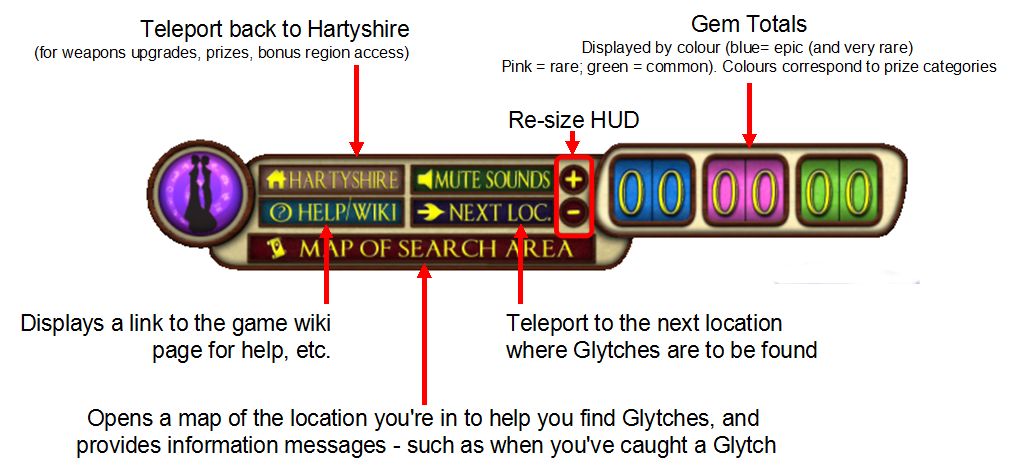
To play the game, players must wear the game HUD. Removing this at any time stops all game-play, saving the player’s current status (e.g. gems taken, current weapon upgrade, etc). Players can re-join the game at any time simply by wearing the HUD once more; there is no need to return to Hartyshire in order to do so. The Glytch catching weapon can also be worn, although the game will also function without it.
The main game HUD
With the HUD worn, players click the Next Loc(ation) button to teleport to a location where they can hunt Glytches. On arrival, the Map can be opened to see where the Glytches are. A maximum of five Glytches can be caught per location, after which players should use Next Loc to move to another location to continue the hunt.
At the moment, Glytches can only be found on assorted Linden / LDPW regions and parcels. In the future, residents will be able to apply for their land to be added to the game – of which more anon.
Glytches
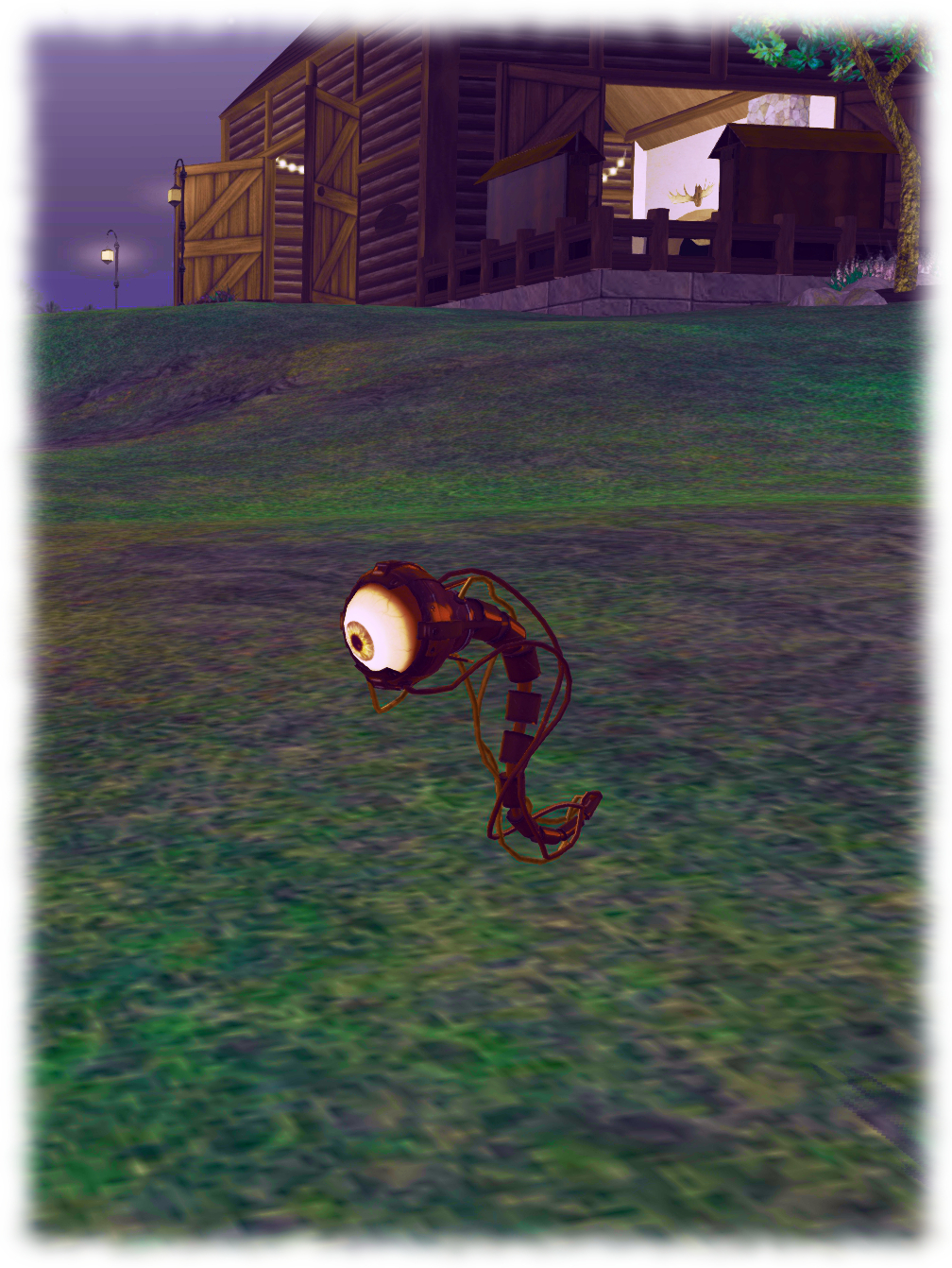
A Glytch in the wild – is worth more in your cage
Glytches can be hunted in either first- or third-person view, but must be captured in first-person (Mouselook) view by clicking on them with the left mouse button. Note the range at which a Glytch can be caught varies with the weapon being used, and not all captures will be successful.
A failure to catch a Glytch can result in it casting a spell on the hunter. They’ll also use spells if startled or to protect one another. Spells vary from silly dances to anvils dropping on heads, but they will allow the Glytch to escape by de-rezzing (another will rez nearby).
A successful capture will result in a cage appearing around the Glytch and a message displayed on the game HUD. The Glytch may also offer you a reward. This might be gems or it might be a Glytch prize – or both.
Note that when a glitch prize is given, players must switch to third-person view (ESC) and Accept the Glytch via the notification displayed in the top right of the viewer window. Failure to do so may result in the prize being lost. If the notification collapses before it is clicked on, it can be re-opened via the Notifications tray.
To help keep the game fresh, new Glytches will be added over time A wiki-based Glytchopedia will also be published in due course, listing all the Glytches.
Ever since Sansar was announced in 2014, many have seen it as a sign that it is intended to be a “replacement” for Second Life – or if not, that the Lab is diverting all of its resources into Sansar at SL’s expense.
Neither assessment is accurate – asthe Lab has repeatedly tried to state. In fact, over the last three years, the Lab has continued to invest in Second Life, both in terms of features and improvements and in an overhaul of the Second Life infrastructure: hardware, network and so on.
On Tuesday, August 29th, Ebbe Altberg, CEO at linden Lab and the Second Life team outlined the future for the platform. Hopefully, it will further help further quell the doubts surround the Lab’s intentions for Second Life.
It’s been an exciting summer at Linden Lab. Second Life celebrated its 14th anniversary, and shortly thereafter we also opened Sansar’s creator beta to the world. In addition, we are thrilled to announce a set of investments into Second Life and its communities that will include enhancements to our engineering support, customer support, billing systems and upgrades, and customer acquisition outreach. In all, we’ve budgeted many millions (USD, not L$…) in the coming year to make SL even better, and we’ll keep everyone up to date on improvements as they roll out (or sooner).
The post then goes on to bullet-point some to the core aspects of these investments, some of which – such at animated objects / mesh (“Animesh”) and the Environmental Enhancement Project (EEP) to extend SL’s Windlight capabilities, I’ve been covering in the pages of this blog (see my Content Creation User Group meeting notes and my initial write-up on EEP).
The blog post also notes forthcoming new Premium account benefits will be announced soon. Hhowever, the two biggest aspects of the news are infrastructure updates and a new grid-wide Experience.
The infrastructure work has been on-going for some time – most recently the Lab has deployed a new simulator build using a more recent version of Linux, and a further operating system update will also be forthcoming. However, what is interesting about this blog post is that it confirms something first mentioned publicly by Landon Linden at SL14B – the infrastructure updates include moving Second Life to the cloud.
This work will not be short-term, but if successful, the Lab hopes for a number of benefits, including:
Making Second Life more performant for Residents across the world from us.
Possibly allowing the Lab to introduce new products with more flexible pricing.
The new Experience may not appeal to everyone, but it will see a new capability added to Second Life: grid-way experiences. This will initially be in the form of a new grid-wide game developed by the Lab; whether or not it will – in time – allow interested region / parcel owners participate in grid-wide Experiences of their own making remains to be seen.
However, the continued investment in Second Life infrastructure which perhaps stands as the greatest demonstration of the Lab’s commitment to Second Life, and I hope to be able to follow the work through these pages as the Lab provides updates and news.
Eclipse 2017: the Moon’s umbra passes over the Earth as witnessed by the astronauts aboard the International Space Station, August 21st, 2017. Credit: NASA.
Eyes were on the sky across the world on Monday, August 21st, 2017, either directly or via live stream and television broadcasts, as people watched the 2017 total eclipse of the Sun. Millions of people in the continental United States were particularly well-placed to enjoy the spectacle first-hand as the line of totality tracked diagonally cross the country from Oregon to South Carolina.
NASA reported that some 90 million people viewed their Eclipse 2017 website on the day, with 40 million staying to watch their live stream of the event. Other organisations providing live streams of the eclipse also reported high numbers of hits / views of their coverage.
As one might expect, the event gave rise to some stunning photos and images which have been posted on Pinterest, Flickr, and other photo sharing websites, plus videos and animations. So much so that picking some out to highlight the event is tough task – I suggest anyone wanting to recapture the event spend time on-line Googling the 2017 eclipse for reports and images. However, there were a couple of images that did leap out to me when looking through reports and photo sites.
The crew of the International Space Station (ISS), Commander Fyodor Yurchikhin and Sergey Ryazanskiy from Roscosmos, Randy Bresnik, Jack Fischer and Peggy Whitson from NASA and Paolo Nespoli from the European Space Agency), witnessed the Moon’s shadow on the Earth three times as the ISS repeatedly crossed the path of the eclipse as the space station orbits the Earth. This resulted in some remarkable images, including the one at the top of this report.
Uncredited image of an airliner passing between the eclipse and the photographer – note the solar prominence at the 1 and 3 o’clock positions. Click for full size.
One of the reasons astronomers are interested in total eclipses is that they provide ideal opportunities for studying the Sun’s corona and prominences – of which there were a number to be observed during this event. This is reflected in the second of my choices (above), which shows two prominences at the one and three o’clock positions rising “above” the Moon’s disk, as an airliner passes through the shot as well.
Jeff Seibert posted a video of images he captured of the eclipse from Santee, South Carolina. These offer a time-lapse of the start of the eclipse, views the famous “diamond ring” which immediately precedes / follows the period of totality and totality itself, revealing the Sun’s corona.
Five eclipses will take place in 2018. Two of these are total lunar eclipses and three are partial solar eclipses:
January 31st, 2018: total lunar eclipse, visible from north / east Africa, Antarctica, Asia, Australia, north / east Europe, India, North America, north / west South America.
February 15th, 2018: partial solar eclipse, visible from Antarctica and southern South America.
July 13th, 2018: partial solar eclipse, visible from southern Australia
July 27th/28th total lunar eclipse: Africa, Antarctica, much of Asia, Australia, much of Europe, southern part of North America, South America.
August 11th, 2018: partial solar eclipse, visible from Arctic, north / west Asia, north / east Europe, northern North America.
The next two total solar eclipses will occur on July 2nd, 2019 and December 14th, 2020. he line of totality for both runs across South America.
Tabby’s Star: Giant Ringed Planet to Blame?
I’ve written several times over the last year about the mystery of Tabby’s Star – more formally known KIC 8462852, an F-type main-sequence star located in the constellation Cygnus approximately 1,480 light years from Earth. It’s been of particular interest to astronomers because it experiences massive and irregular dips in brightness of up to 22% at a time, which last for several days before it reverts to its “normal” brightness once more.
Numerous theories have been put forward on why the star is acting so oddly, from the idea that a race of aliens are building a mega-structure – perhaps a Dyson Sphere around it, through to it being a cloud of comets orbiting the star at a great distance, or that it is some kind of “avalanche” type of activity within the star itself.
In April / May, 2017, KIC 8462852 started on a further cycle of dimming, leading to a world-wide bulletin for astronomers to observe it. This resulted in a further theory that the cause of the dimming might be a combination of two clouds of asteroids and a giant ringed planet orbiting the star.
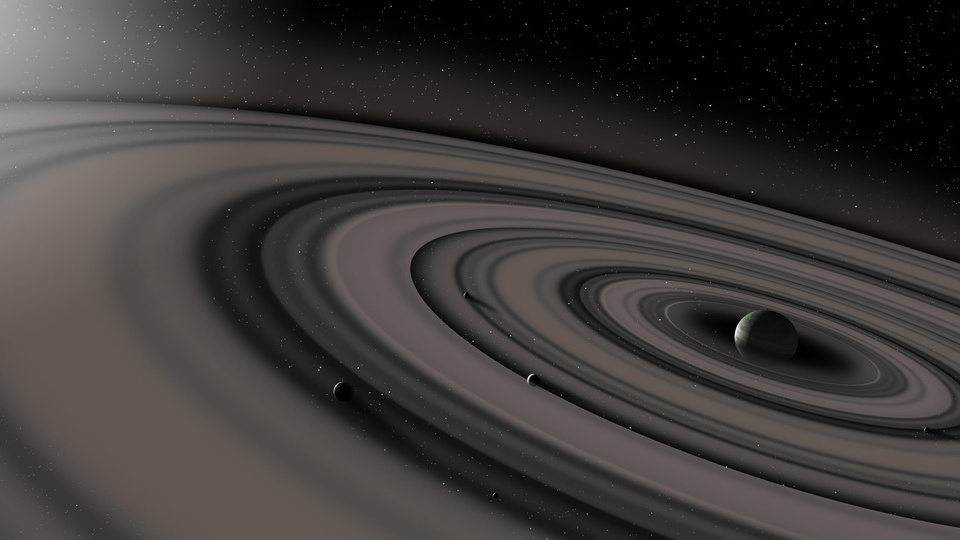
An artist’s impression of exoplanet J1047, thought to have an extended ring system around it. Could a similar planet and ring system account for the fluctuations we see in Tabby’s Star’s brightness? Credit: Ron Miller
This last theory relied on the asteroids occupying the trojan positions either side of the planet as all three orbit the star, making it a complex model. However, another team of researchers from the University of Antioquia in Colombia have now also suggested a ringed planet might be responsible, but in a way which doesn’t require the existence of massive asteroid clouds sharing in the planet’s orbit.
The researchers used data from past dimming events at KIC 8462852 to build a model of the system which shows that a Jupiter / Saturn sized gas giant, orbiting the star at a distance of about 0.1 AU and with an extended Saturn-style system of rings tipped at an angle relative to the planet’s orbital plane around the star could account for KIC 8462852’s apparent fluctuations in brightness.
At such a distance from the parent star, an inclined ring system would not remain relatively constant if form and position, as is the case with Saturn’s rings. Instead, it would undergo short-term changes in shape and orientation as a result of KIC 8462852’s gravitational influence. The researcher’s model shows that these changes would likely lead to changes of the depth of opacity in the ring system, further contributing to the witnessed irregularities in the star’s apparent brightness. As the rings and planet periodically transit between the star and observers on Earth.
A further compelling aspect of this research is that the oscillations in the proposed ring system of any planet orbiting Tabby’s Star could also explain the strangeness witnessed in the light-curves found in a number of other stars believed to have planets orbiting them. In other words, it is entirely possible astronomers have already observed similar planetary ring systems elsewhere in the galaxy, but simply haven’t been recognised as such.
Like the other theories for KIC 8462852’s behaviour, this latest idea is not definitive; further, better studies of the star – potentially by the James Webb Space Telescope – are required before anything might be known with certainty. However, of all the proposals put forward thus far for the star’s odd behaviour when observed from our solar system, this one does have the virtue of being perhaps the simplest and the first to offer incidental corroboration through the behaviour seen when some other stars believed to have planets orbiting them.
Tuesday, August 22nd was not a particularly good day for Second Life, with an extended period of unscheduled maintenance with log-ins suspended and those in-world advised to refraining from rezzing No Copy objects, or making any LindeX related transactions, etc.
If these words sound familiar (except the date), it’s because I wrote them a year ago to the day, on August 23rd, 2016, when Second Life experienced some significant issues.
Back then, the problem was the core database. The initial problems on August 22nd, 2017 weren’t software related, nor were they related to the Main (SLS) channel deployment taking place at the time. Instead, they lay with a piece of hardware, as April Linden, writing in the Tools and Technology blog, explained in another concise explanation of the problem, which started:
Early this morning (during the grid roll, but it was just a coincidence) we had a piece of hardware die on our internal network. When this piece of hardware died, it made it very difficult for the servers on the grid to figure out how to convert a human-readable domain name, like www.secondlife.com, into IP addresses, like 216.82.8.56.
Everything was still up and running, but none of the computers could actually find each other on our network, so activity on the grid ground to a halt. The Second Life grid is a huge collection of computers, and if they can’t find other, things like switching regions, teleports, accessing your inventory, changing outfits, and even chatting fail. This caused a lot of Residents to try to relog.
We quickly rushed to get the hardware that died replaced, but hardware takes time – and in this case, it was a couple of hours. It was very eerie watching our grid monitors. At one point the “Logins Per Minute” metric was reading “1,” and the “Percentage of Successful Teleports” was reading “2%.” I hope to never see numbers like this again.
Unfortunately, as April went on to explain, the problems didn’t end there, as the log-in service got into something of a mismatch once the hardware issue had been resolved. Whilst telling viewers attempting to log-in to the grid their attempts were unsuccessful, the service was telling the simulators the log-ins had been successful. Things didn’t start returning to normal once this issue had been corrected.
There is some good news coming out of this latter situation however, as April goes on to note in the blog post:
We are currently in the middle of testing our next generation login servers, which have been specifically designed to better withstand this type of failure. We’ve had a few of the next generation login servers in the pool for the last few days just to see how they handle actual Resident traffic, and they held up really well! In fact, we think the only reason Residents were able to log in at all during this outage was because they happened to get really lucky and got randomly assigned to one of the next generation login servers that we’re testing.
Testing of the new log-in servers has yet to be completed, but April notes that the hope is they be ready for deployment soon.
Thanks once again to April for the update on the situation.
Saturday, August 5th marks the opening on the August edition of Art at the Park at Holly Kai Park, which run through until Sunday, September 3rd.
The artists who have accepted our invitations to display at the park through the month are: Dido Haas, Cecilia Nansen Mode and Jes Mode, Wintergeist and our 3D artist for the month, Diamond Marchant. You can read more about them below.
The opening of the exhibition will be marked by a party, with Joy Canadeo providing the music from 2:00pm SLT onwards. The dress code is smart / formal, and we invite all those so minded to attend.
About the Artists
Dido Haas
Dido Haas
Dido really needs no introduction, as words simply aren’t enough to describe her. She’s a long-standing artist in Second Life, having enjoyed her first public exhibition of her work in 2012. Not long afterwards, she and her partner, Nitro Fireguard started the Nitroglobus gallery, with Dido taking on the role of gallery curator and manager, although she and Nitro both showed their work there.
Nitroglobus quickly built a reputation as one of the foremost galleries in Second Life, and it was through visiting the exhibitions there that I first met Dido. She has a gift for finding some of the most unique talents in Second Life and getting them to exhibit, and I’ve long enjoyed covering her exhibitions at the gallery in these pages.
Sadly, Nitro passed away in 2015, bringing the original Nitroglobus gallery to a close. However, Dido continues to curate art exhibitions through Nitroglobus Roof Gallery, which continues to host some incredible exhibitions, as well as commemorating Nitro himself through the display of many of his mesh sculptures. The gallery also continues to be the home of music events every Sunday at the Nitroglobus Cafe. Between managing all that, Dido continues with her own photography, and we’re delighted to have her at Holly Kai Park.
I first encountered the work of Cecilia Nansen Mode and Jes Mode almost simultaneously, if quite coincidentally at two separate exhibitions in the same month. Jes was exhibiting at DixMix Gallery, and Cecilia at Artful Expressions, run by my dear friend, Sorcha Tyles. I was immediately struck by their art, and discovering they are SL partners encouraged me not only to invite them to exhibit at the park, but to ask that they do so together as a part of our occasional “partners” invitations.
For the August exhibition, they’ve taken this invitation quite literally, and are presenting a joint exhibition under the title One Love, One Life. Across the two display areas, “the Modes” display images of a loving relationship which has forging a shared passion for photography. They are a combination of the cold North and the warm South. The dramatic and the calm. The expressive and the subtle. Together they are tied by a deep and profound connection, which shows in their pictures, both when working together, as well as individually.
Jes has a history of photography in RL with some knowledge as well as experience. He restarted after some years as a photographer, this time in SL and is slowly finding his own style and personal expression, with mainly black and white pictures. Cecilia started a little over a year ago as a SL photographer and is slowly finding her own style, still experimenting and learning day by day. Together they support, mentor, teach and are each others first filter of approval in a balance of synergy and seeing each other grow.
If you are interested in seeing more from their work, please visit their Flickr streams:
Diamond Marchant is, in the physical world, a photographer and software developer. In SL, she creates boat and sail textures for the sailing community as well as numerous fishing products.
I first became aware of her interest in building models at SL13B, when she exhibited a Mars lander. For SL14B she was even more ambitious, building a simply stunning and exceptionally accurate model of NASA’s Cassini orbiter, which for the last 13 years has been adding immeasurably to our understanding of Saturn and its moons.
2017 is a special year for the Cassini mission, as it brings to an end the work of this remarkable probe, which has been in operation some 20 years from launch to the present day, including a 7-year journey from Earth to Saturn (by way of Venus, Earth and Jupiter). Right now Cassini is in the Grand Finale part of its mission, orbiting Saturn over its poles and repeatedly diving between the planet and the innermost of its magnificent rings. In September, not long after the exhibition at Holly Kai closes, Cassini, its manoeuvring fuel all but used up, will enter the upper reaches of Saturn’s atmosphere and burn up, forever becoming a part of the planet it has observed and studies for so long.
Of the model presented at Holly Kai – which is interactive (touch the probe itself and almost make sure you try the media links) – Diamond says, “Spacecraft modelling is a new thing for me. I was inspired to build the Cassini orbiter after seeing the 3D model on their website and noticing that the shapes on the orbiter are similar to the shapes you can make out of system prims.”
Wintergeist
Wintergeist, aka Fuyuko Amano, is both a photographer and gallery curator at the Club LA and Gallery. Her photographic work spans both the physical and digital worlds. In the physical world, she started with photography when she was about 10, and it has remained a passion for her. When she started playing video games, she realised their potential for photography and started experimenting and developing an approach to digital imaging, which in turn led to her modding game environments and taking pictures of them.
Then she discovered Second Life. After initial resistance to it, she signed-up – and became immersed in SL photography.
“What do I like in pictures?” she asks rhetorically. “I do love colours – strong colours, contrast and a motif that is more than the simple ‘my avatar in front of fancy background’. Mostly I don’t know beforehand what kind of picture I want to do. When I see a motif, I get a vague idea of angle and composition and I try to capture that. Sometimes it works, but I am far from perfect. I haven’t reached my goal to make the perfect picture. I guess that is even something no one can achieve….. but, you can try.”
 Linden Lab has issued a number of blog posts concerning Second Life account security recently. All of them should be read with care and heeded. Most relate to external issues – so-call viewer wrappers, or links to website Phishing scams.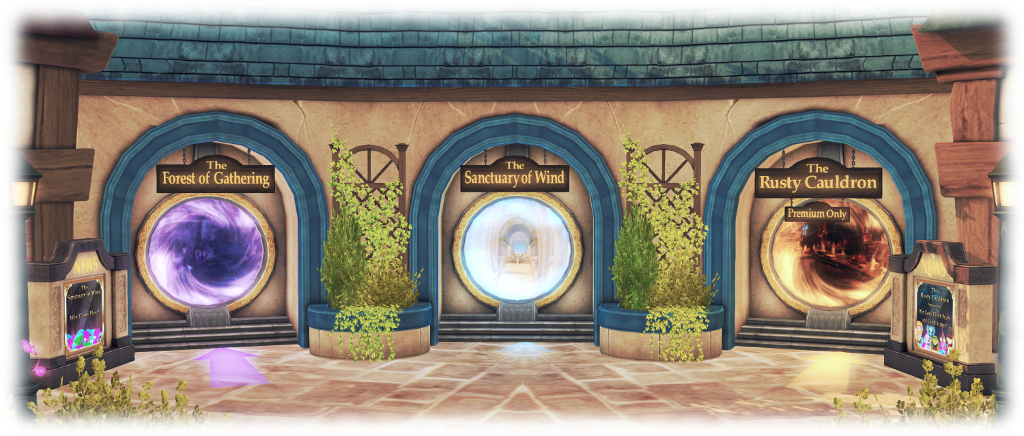






 Inara Pey: Living in a Modemworld