Logos representative only and should not be seen as an endorsement / preference / recommendation
Updates from the week through to Sunday, November 23rd, 2025
This summary is generally published every Monday, and is a list of SL viewer / client releases (official and TPV) made during the previous week. When reading it, please note:
It is based on my Current Viewer Releases Page, a list of all Second Life viewers and clients that are in popular use (and of which I am aware), and which are recognised as adhering to the TPV Policy.
This page includes comprehensive links to download pages, blog notes, release notes, etc., as well as links to any / all reviews of specific viewers / clients made within this blog.
By its nature, this summary presented here will always be in arrears, please refer to the Current Viewer Release Page for more up-to-date information.
Outside of the Official viewer, and as a rule, alpha / beta / nightly or release candidate viewer builds are not included; although on occasions, exceptions might be made.
Sei Fiore, November 2025 – click any image for full size
I came across the region design of Sei Foire (“flowers for you”), within the Destination Guide. Its description immediately caught my attention, offering as it does a clear invitation to visit.
Sei Fiore is a whimsical daydream brought to life, where rolling meadows of daisies sway like tiny suns in the breeze and every path feels touched by a bit of magic. Here, the world softens, ponds shimmer with quiet secrets, petals twirl like confetti, and joy tiptoes back into your heart as naturally as breathing.
– Sei Fiore Destination Guide description
Sei Fiore, November 2025
On my arrival, I was delighted to discover this Full private region design is the work of Raven Fairelander (RavenStarr Fairelander). She was the creator of Posey Wildes, a setting I visited back in August 2024, finding it to be a beautiful and evocative setting rich in poetry and short stories by classical writers such as Eliot, Dickinson, Poe, Wordsworth, Yeats, Wilde and more. I was captivated by that visit, and remembering it caused no small amount of anticipation as I started to explore Sei Foire.
That said, I should state from the outset that while there are some passing similarities between Posey Wildes and Sei Fiore, particularly in terms of the touches of whimsy, the two are very different – and richly engaging – settings, with Sei Fiore being unique to itself.
Sei Fiore, November 2025
It is a setting perhaps most perfectly described through Raven’s words in the setting’s Destination Guide and About Land descriptions, the latter of which states:
A meadow-born dream where joy grows wild. Rolling fields of daisies stretch beneath a golden sky, their petals whispering laughter to the wind. In Sei Fiore, joy isn’t chased, it’s found, blooming right where you stand.
– Sei Fiore About Land description
Sei Fiore, November 2025
I found this description particularly apt because as soon as I stepped out of the Landing Point gazebo, the joy carried by the region immediately surrounded me. This is very much a setting where trying to view it logically is to face defeat; this is a place to simply be accepted and relished as it is explored.
In this, the various locations awaiting discovery – the pond with its giant frogs and sea serpent, the dinosaurs gossiping on the shoreline, the pink elephants, the crystal walk burrowing through the neck of a hill, the giant plants, and so much more – are all very different one to another, yet the all flow together into a unified whole.
Sei Fiore, November 2025
Within the setting it is possible to wander, to sit, to meet the locals in all their forms (from the aforementioned dinosaurs et al to dapper-dressed mice, little fairies, mythical beats and more), or find your way to a beached pirate’s ship or to platform-hung tree, and visit gardens where dragons sleep and meadows where a horse awaits you as its rider…
With giraffes watching over terraces held aloft by balloons to a certain tea party sitting atop waterfalls that give rise to the setting’s modest brook, Sei Fiore is a tumbling mix of themes and ideas, all woven together with a sense of laughter and happiness within a landscape rich in detail and photogenically attractive.
Sei Fiore, November 2025
This is a place to watch out for the smaller details as well as the large; where table-top games rub shoulders with the option to sit back in meditation or contemplation; where the gentle rocking of a boat on the water might send you to sleep or interactive elements might take you by surprise (do mouse-over things!).
And when you feel you’ve roamed enough, you can make your way up to the island’s hilly middle, past the Curious ‘Shrooms and under the living arch of a tree to reach the Green Witch Café, and available yourself of the company of Althea The Green Witch within the cosy walls of her establishment.
Sei Fiore, November 2025
Beautifully crafted and a joy to explore, Sei Fiore is well worth taking the time to visit.
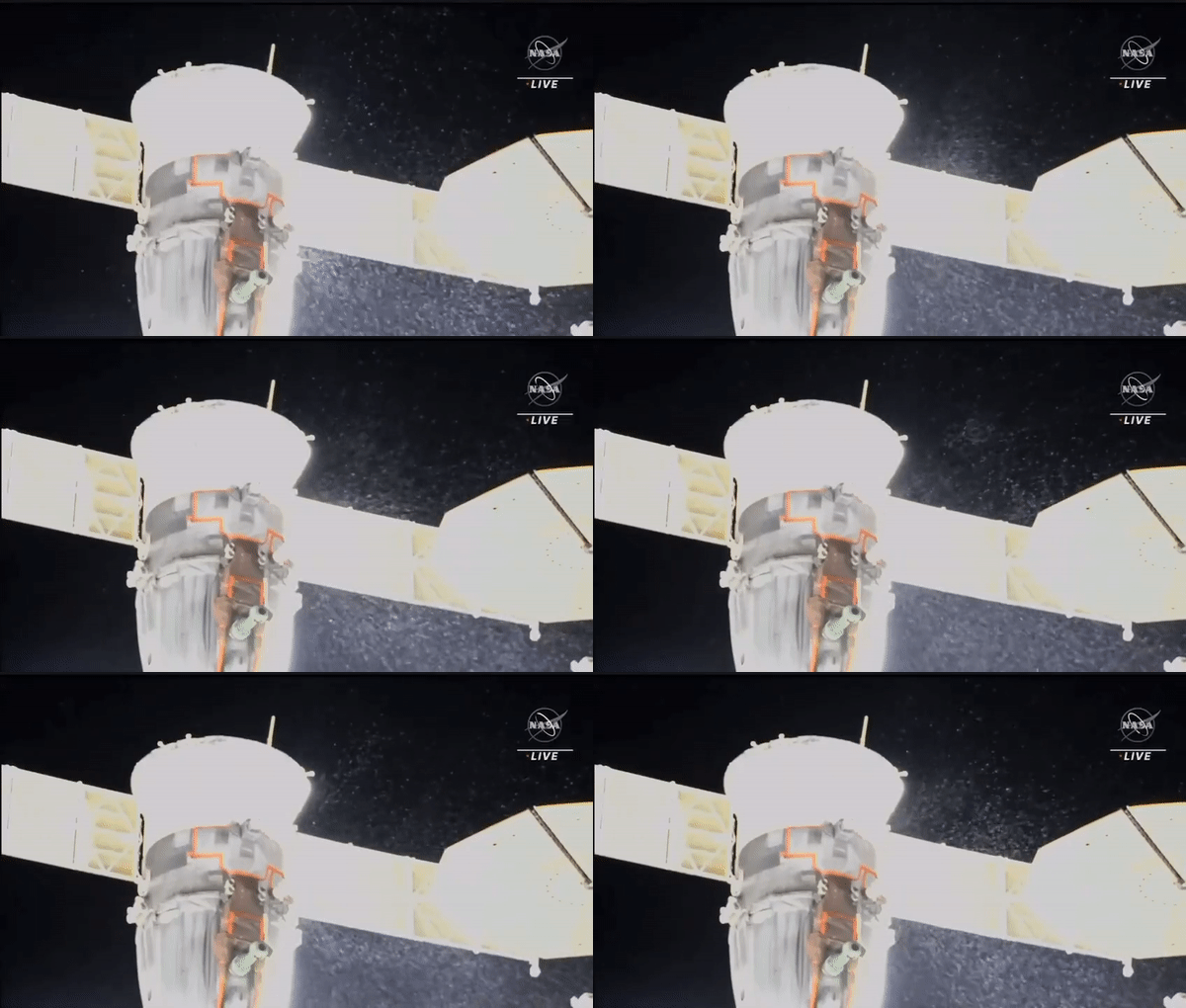
The three “stranded” Shenzhou-20 tiakonauts aboard the Shenzhou-21 vehicle, about to depart the Tiangong space station. Credit: CMSA
“Stranded” runs the risk of becoming one of the most over-wrought terms used by the by western media in regards to on-orbit human space operations. In recent times it has been used on two occasions, both involving US astronauts, when calling on it was for more about creating sensational headlines than reporting the overall situation.
The first came in 2022/23 when Soyuz MS-22, docked at the ISS, was struck by a small meteor in December 22, severely damaging its lift support cooling systems. Following reviews of the impact, it was agreed that the crew of three – Sergey Prokopyev, Dmitry Petelin, and NASA astronaut Francisco Rubio – would remain on the ISS until the next Soyuz vehicle could be launched uncrewed in February 2023 and then serve as the means to return the three to Earth.
However, this decision did not leave the three men “stranded” in orbit. After extensive testing and computer modelling, Roscosmos determined that should an emergency evacuation of the station be required, Soyuz MS-22 could make a return to Earth carrying Prokopyev and Petelin and without broiling them to death. Arrangements were therefore made for Rubio to b3e able to return to Earth alongside the NASA / SpaceX Crew 5 astronauts should the need arise. Ultimately, these contingencies were not required; the uncrewed Soyuz MS-23 arrived at the ISS ahead of the MS-22 vehicle departing, resolving the issue. MS-22 subsequently made an automated return to Earth during which temperatures within the descent module did not exceed the upper safety limits for flying a 2-man crew home.
Video of the Soyuz MS-22 coolant leak, December 14th 2022. Credit: NASA
In 2024 much of the news media positively relished the idea that two US astronauts – Barry Wilmore and Sunita Williams – were “stranded” in space when the Boeing CST-100 Starliner they were testing had issues with its thruster systems. Whilst Boeing were confident the issues did not put the astronauts at risk (and indeed, the vehicle made a successful automated return to Earth in September 2024), the decision was made to keep Wilmore and Williams on the station until the next crewed mission to the station – NASA / SpaceX Crew 9 – could be launched, but only with two crew aboard so as to leave the remaining seats free for Williams and Wilmore.
The Crew 9 vehicle eventually launched in September 2024, after the Starliner vehicle had departed the ISS to make room for it. To ensure Wilmore and Williams were not “stranded” in an event of an emergency during the period between the departure of Starliner and the arrival of Crew 9, contingencies were put in place to enable them to return to Earth with the crew of NASA / SpaceX Crew 8. But again, none of this was required. Wilmore and Williams continued to work alongside their colleagues on the ISS, fulfilling the roles vacated by the two Crew 9 astronauts left on the ground, and came home on that vehicle in March 2025, never once having been truly “stranded”.
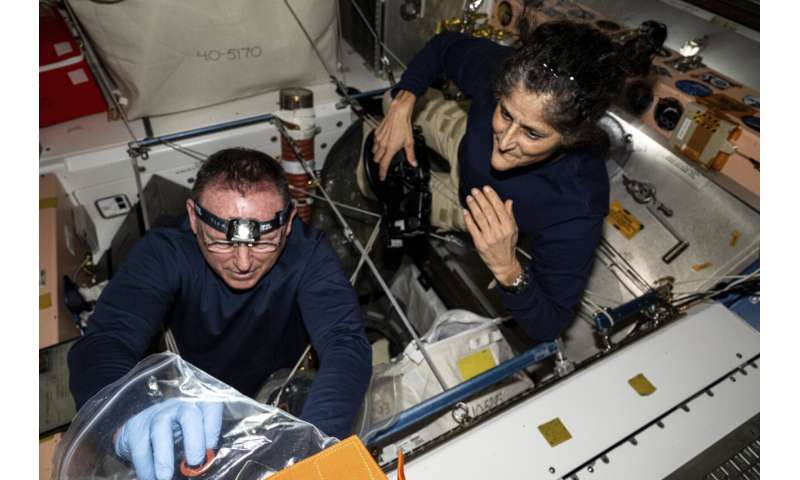
The “stranded” Barry “Butch” Wilmore and Sunita “Suni” Williams working aboard the ISS during their longer-than-originally-planned stay in 2024/25. Credit: NASA
In the past couple of weeks “stranded” has again been rolled-out by the media, this time in reference to the Chinese Tiangong space station – and this time it does have an underlying cause for concern.
On October 31st, 2025, Shenzhou 21 arrived at the Chinese space station with three crew aboard – mission commander Zhang Lu, Wu Fei and Zhang Hongzhang. They were due to carry out several days of formal hand-over with their comrades Chen Dong, Chen Zhongrui and Wang Jie, who has been aboard the station since April 2025, prior to the latter three boarding their Shenzhou 20 spacecraft and making a return to Earth.
However, at the start of November, 2025, tiny fragments of debris struck Shenzhou 20, and the homecoming crew’s departure would be delayed until the damage to their vehicle had been fully accessed. This assessment revealed the integrity of a viewport on the vehicle’s orbital module had been compromised, and as a result Shenzhou 20 was deemed unsuitable for returning the crew to Earth. Instead, they came home on Shenzhou 21 on November 21st, thus leaving the crew of that mission, Zhang, Wu and Zhang without a means to evacuate the station in an emergency.
And this is where their situation differs to those of the Boeing Starliner crew and Soyuz MS-22: there are no contingencies available except for CMSA to launch an automated Shenzhou vehicle to Tiangong at the earliest opportunity. Fortunately, CMSA work their manned launch vehicles in pairs so that while launches are 6-months apart, at the time of any given launch the vehicle intended to follow it is in a state where it can be readied for launch in a relatively short time should it be required. In this case, CMSA appear to be targeting November 25th, 2025 as a launch date for Shenzhou 22 – although this has not been officially confirmed.
The Shenzhou 21 crew of Zhang Lu (centre), Zhang Hongzhang (left) and Wu Fe, now awaiting the automated launch and arrival of Shenzhou 22 to become their ride home at the end of the 6-month stay aboard Tiangong. Credit: CMSA
This still leaves the Shenzhou 21 crew in an uncomfortable position, and highlights a growing concern about human space operations in low Earth orbit: it’s getting increasingly crowded with junk and debris, and collisions and impacts are growing increasingly likely. As it is, both the ISS and Tiangong have to make at least 2 significant orbital adjustments a year to avoid debris (with the ISS having to do so five times in 2023), whilst a 2024 European Space Agency study highlighted the fact that there are more than 6,000 items of man-made debris on low Earth orbit of 10 cm or greater in size spanning altitudes of between 375-600 km, marking many of them as potential threats to both the ISS and Tiangong, which orbit between (370-460 km).
Nor does it end there. A study carried out in 2023 revealed that low Earth orbit is seeing debris of 6cm and larger increase at a rate of 2,400 object per year.
A 2023 axonometric view of Earth showing the space debris situation in different kinds of orbits around Earth. Note how the low Earth orbit is seeing an annual net increase in debris estimated at 2,400 items a year (includes objects down to around 6 cm in size). Credit: Pablo Carlos Budassi
As such, the Shenzhou 21 crew situation has given rise to renewed calls for some form of “space rescue” system to be implemented. The problem is – how? There is a degree of commonality in space vehicle design – docking mechanisms for connecting modules to one another and for connecting spacecraft to said modules or, potentially, to one another, are now built to a common standard: the International Docking System Standard (IDSS). However, it’s not entirely clear how closely nations like China adhere to the IDSS. Further, while IDSS may allow rendezvous and docking between craft, it doesn’t specify standards for things like consumable transfers between craft, such as might be required in an emergency (e.g. air, water, propellants).
In addition, the majority of crewed vehicles currently operating aren’t really designed to go pottering around from point-to-point offering assistance. A Soyuz or Crew Dragon from the ISS can’t simply pootle over to Tiangong and offer assistance were its required. The two stations are in very different orbits relative to one another, and the nature of orbital mechanics mean that trying to get from one to the other would likely exhaust a vehicle’s propellant reserves.
This means that in order to be effective, any rescue system need to be both specialised and available on a launch-as-needed basis. But again, this is easier said than done. Who should develop and operate such a system? Who should pay for it? Where should it be based; on the ground, with an entire supporting launch infrastructure with all the complexities that entails, or in orbit – with all the very different complexities that entails? Should the system be crewed, and if so, by whom and on what basis (civilian? military?) or fully automated?
Currently, there are no easy answers – but with commercial activities in Earth orbit about to increase tenfold as companies look towards flying their own orbital research and tourist facilities and their own crew vehicles to link them with Earth, then it is becoming increasingly imperative serious thought is given to try to find answers – and act on them.
Never Tell Me the Odds Comes Home, Blue Origin Reveal Plans
The first stage booster used in Blue Origin’s highly-successful NG-2 mission (see Space Sunday: New Glenn “welds” it on second flight!) has returned to Blue Origin’s facilities at Cape Canaveral Space Force base on November 20th. It will now undergo a examination and refurbishment in readiness for its next flight, which could be as soon as January or February 2026.
The 57.5 metre tall New Glenn first stage Never Tell Me the Odds sits proudly on the deck of the Landing Vessel Jacklyn after the highly successful NG-2 mission of November 13th, 2025. Credit: Blue Origin
The Booster, called Never Tell Me the Odds in a reference to the difficulties involved in bringing a 57.5 metre tall, 7 metre diameter booster back to Earth from the edge of space and landing it smoothly on a vessel 600 km out in the Atlantic – appeared to be in remarkably good condition following its flight as it was delivered to the company’s launch preparation facilities close to Launch Complex 36, from where it had launched on November 13th.
The reason for looking so pristine (particularly in reference to the sooty state of recovered Falcon 9 boosters) is really down to the “clean burn” of the BE-4’s liquid oxygen / liquid methane propellants; it should not be taken as any indication the stage is fit to fly at this point in time. That determination will only come following a complete and careful examination. However, simply seeing it back at CSSF and LC-36 is undeniably a positive further step for Blue Origin.
At around the same time as Never Tell Me the Odds returned to base, Blue Origin revealed its future plans for New Glenn.
New Tell Me the Odds being wheeled into the Blue Origin hanger at Launch Complex 36, Canaveral Space Force Station on November 20th. In the hanger it will undergo extensive inspection and refurbishment in readiness for its next flight. Credit: Blue Origin
In the near-term, the company plan to start operating the vehicle with uprated engines, with the seven BE-4 first stage motors able to generate 4.5 million pound of thrust at lift-off (up from 3.9 million) and the two BE-3U motors of the upper stage increasing their combined thrust from 320,000 pounds to 400,000. Engines of both types capable of handling this increased output have already been tested on the ground, so it might not be too long before they start to be used on New Glenn launches.
In the medium-term, the company also hopes to make the payload fairings recoverable / reusable. Doing so could help support increased flight rates and lower launch costs. However, as SpaceX discovered (albeit by having to go for a complex recovery system of parafoils and high-speed chase boats which looked spectacular but proved impractical), making payload fairings recoverable and actually recovering them in a cost-effective manner might not be that easy.
Most intriguingly and long-term, Blue Origin announced an entirely new variant of New Glenn – the “9×4” – a reference to the fact that it will use 9 BE-4 engines in the first stage (rather than seven) and four in the upper stage (rather than two), whilst maintaining the same overall design and diameter across the two stages (although both will be longer to account for the increased propellant requirements).
This new behemoth is intended to deliver up to 70 tonnes to low Earth orbit, 14 tonnes to geosynchronous orbit and 20 tonnes to the Moon, all with the first stage reusable. In addition the diameter of the payload fairings atop the second stage will be increased from 7 metres to 8.4 metres to handle particularly large payloads (such as space station modules).
A composite image released by Blue Origin CEO David Limp showing the comparative sizes of the current New Glenn (left, mounted against its launch support arm), Saturn V (centre) and the proposed New Glenn 9×4. Credit: Blue Origin
It is because of the latter capability – 20 tonnes to the Moon compared to New Glenn’s 7 tonnes – that some are already suggesting the “9×4” should be given a name of its own: the “New Armstrong”, after Neil Armstrong, the first man to set foot on the Moon. Blue Origin has not responded to these calls as yet.
Exactly how commercially viable such a vehicle would be within the commercial sector is hard to say. The SpaceX Falcon Heavy has already demonstrated that launchers with lifting capabilities of 50 tonnes or more really don’t play much of a role in the commercial launch business, instead primarily relying on government contracts. One potential area of use for the New Glenn “9×4” could be in lifting elements of the in-development Orbital Reef commercial space station, a project being led by Blue Origin and Sierra Space – but such work is liable to be niche, rather than a mainstay of revenue generation.
The GEO capability perhaps has more appeal – a 20-tonne capacity could in theory allow the “9×4” to rideshare communications satellites to orbit, reducing the launch costs to customers, with the company’s Blue Ring orbital “tug” positioning them. However, it is in the government sector and lunar operations theatre that the new behemoth would potentially have a role. A 14-20 payload capacity would be very attractive for military launches and to efforts such as Artemis and in launching deep-space science missions into the solar system.
The increased payload capability for New Glenn 9×4, together with the size increase for payloads its new fairings would enable, could significantly benefit the development of Orbital Reef, the space station facility being developed by Blue Origin in partnership with Sierra Space and the support of Boeing and others. Credit: Blue Origin / Sierra Space
Again, Blue Origin has offered no time frame on when the “9×4” will enter service; however, the degree of commonality it has with New Glenn likely means its development cycle could be relatively brief. In reporting on it, some pundits have suggested the “9×4” could have a maiden launch in 2027, although this does seem a tad ambitious, particularly given Blue Origin’s “soft and gentle” approach. As such, 2030 would seem a more reasonable time frame for “9×4” to start flights.
Some have already suggested that “9×4” could be a viable replacement for NASA’s Space Launch System (SLS) rocket in carrying crews to the Moon. However, and as I’ve noted in these pages, replacing SLS is easier said than done. Whilst New Glenn has been designed from the ground-up to be capable of making crewed launches (something SpaceX’s Starship most definitely is not in its current configuration), there is currently no crewed vehicle it is actually capable of launching. Orion, for example, the only crewed vehicle the US has that is specifically designed to handle carrying crews from Earth to Cislunar space, is currently completely incompatible with New Glenn.
An artist’s rendering of New Glenn 9×4 launching. Credit: Blue Origin
But that said, it is not entirely inconceivable that, given a suitable amount of time (and remember, SLS systems for Artemis 2 through 5 are already well in hand in terms of construction), and with Artemis 5 realistically unlikely to launch before 2031, there is potential for Lockheed Martin and Blue Origin to put their heads together to see if they could develop a means by which Orion could be launched by New Glenn “9×4” to launch Orion. This would still likely require some form on on-orbit propellant resupply – but that would likely only be a single additional launch, so it’s not entirely out of the question (given SpaceX plan to launch around 8-12 Starships for every vehicle it sends to the Moon).
That said, New Glenn being used in crewed lunar missions is not something I’d personally put my money on right now; it just seems so much better suited to rapid cargo delivery to the Moon, again particularly when compared to Starship – even if the latter could in theory carry 5 times more per vehicle to the Moon.
Please note that this is not a full transcript of either meeting but a summary of key topics.
Meeting Purpose
The CCUG meeting is for discussion of work related to content creation in Second Life, including current and upcoming LL projects, and encompasses requests or comments from the community, together with related viewer development work.
This meeting is generally held on alternate Thursdays at Hippotropolis and is held in a mix of Voice and text chat.
The OSUG meeting is a combining of the former Third Party Viewer Developer meeting and the Open Source Development meetings. It is open discussion of Second Life development, including but not limited to open source contributions, third-party viewer development and policy, and current open source programs.
This meeting is generally held twice a month on a Friday, at 13:00 SLT at the Hippotropolis Theatre and is generally text chat only.
Release Candidate 2025.08 – 7.2.3.19375695301 – maintenance update with bug fixes and quality of life improvements – November 4 – NEW.
Second Life Project Lua Editor Alpha (Aditi only), version 7.1.12.14888088240, May 13 – No Change.
General Viewer Updates
2025.08 is to be the last viewer release for 2025. This is likely to be promoted to de facto release status after the US Thanksgiving holiday.
At the time of writing, 2025.08:
The crash rate is improving.
This viewer includes the VHACD convex decomposition library.
Mesh content creators are encouraged to try the current beta of the the viewer to make sure physics hulls are working in-world, etc., given that many settings with the library are different to those used by Havok, the longer-term plan being to eliminate Havok sub-libraries from the viewer.
The next viewer version will by 2026.01 – details of which will be made available once its likely contents have been initially settled on by the Lab.
However, it looks like 2026.01 will include the new code for faster log-in loading of inventory for those with very large inventories, and a dedicated Linux build of the viewer.
During the OSUG meeting, Geenz Linden indicated that another project he hopes to start moving forward with in 2026 is the Current Outfit Folder (COF) updates contributed by Kitty Burnett (Catznip), and the current plan is to get this into 2026.01.
You Tube Embedding Issue
As a reminder:
You Tube recently updated elements of their video embedding code such that non i-frame youtube.com/embed/NNNNN style links will not work within Second Life (whilst youtube.com/watch/NNNNN style links will still function correctly – although this latter format does expose all the You Tube on-screen video controls, etc).
This is an issue liable to impact a variety of in-world television and similar systems utilising You Tube.
It is very much a You Tube issue, so there is no guarantee they would remain valid / useful for any length of time.
Those finding further information on issues arising from this You Tube change should report them via the SL Feedback Portal.
SLua Update
Back-end support for SLua is now available in Beta on Agni, the main grid.
The SLua beta viewer, available from the official Alternate Viewers page, must be used for writing SLua code, but no specialised viewer to view SLua scripts running in-world.
The latest SLua viewer includes the websocket to Visual Studio.
VSCode plugin + documentation (Wolfgang Senizen – likely be discontinued and contributions shifted to support the official documentation).
CCUG Discussion – In Brief
glTF animation upload support: this is “on the radar” for development, but is not currently an active project, and needs to be added to the current viewer roadmap.
A request to review animation priorities was also requested, and it was suggested this might be something that could possibly be looked at within the current animation support framework.
A general discussion on animations and priorities continued through the early part of the meeting, but no-one from the Lab with sufficient up-to-date knowledge of the animation system to provide meaningful input to the discussion.
A request was made for an independent alpha channel (i.e. not linked to Diffuse/Colour channel) and available to both both Blinn-Phong and PBR that could help reduce the number of unique textures required for things like terrain, and without having to atlas huge sheets of layered details. The short answer was that this is unlikely until there is (at the very least) an opportunity to revisit texture streaming at the very least, with Geenz noting:
We’re already on some razor thin memory margins on some of our potato machines – so if we did that we’d need to find a way to make some stuff more scalable in our texture streaming tech. This isn’t a no – we need that for other things. But it’s not a 30/60/90 days thing I’m sorry to say.
Bakes on Mesh (BoM) Layering
Better layer ordering has been put to the UI/UX team with not promises as to when it might be worked upon, although there are “other projects” the Lab is planning which would also benefit from this.
The above led to a discussion on BoM improvements (e.g. PBR materials support; blend modes of different layers; etc).
In response to this, Geenz noted he would like to get PBR specular support, if only as a migration path from Blinn-Phong (and with the noted, “if you do this expect things to not quite look right if you mix these two”).
This discussion involved the potential complexities / straightforward aspects of PBR specular support, providing BoM support to alpha channels, before circling back to the benefits of having better texture streaming in general and prioritising the latter to different texture slots, etc.
Signal Linden revealed that Friday, November 21st, 2025 was his last day at Linden Lab after 10 years with the company, rising to the position of Director of Engineering.
Signal has been the major driver in overhauling and improving the Lab / third-party/open-source relationship, which is to continue along the path Signal has set for it, improving and refining things where appropriate.
Roxie Linden noted that there has been a WebRTC voice server update. This provides HRTF (better spatialization) as well as server crash fixes. It’s still regarded as “beta”, but the WebRTC team is looking for feedback on its usability.
Further work on WebRTC is in progress, including spatial moderation.
Thought is still being given to replacing Echo Canyon (Vivox Voice testing region) with a WebRTC equivalent, with Roxie Linden indicating this is now a matter of scheduling and implementation.
Roxie’s preferred approach would be to have an ‘echo’ option with Preferences which, when used, does a full round trip to the server and back, allowing both device verification on the WebRTC service and network quality. If adopted, this will require both a server update and some viewer UI work.
A brief discussion on potentially replacing Chrome Embedded Framework (CEF) in the viewer (e.g. to something like Servo – as this matures). The response was that CEF is unlikely to be replaced in the foreseeable future, which does not mean there will not be fixes, etc., for identified issues.
Request for LL to provide SGV support, including for text on prims / test rendering in-world, including the following two requests:
In response, and specifically in terms of in-world text rendering, Geenz Linden suggested that something like MSDF might be more appropriate for SL, as it allows pre-rasterizing a large collection of fonts into some really tiny textures, and get some pretty sharp text rendering that scales “pretty easily”.
This led to a discussion on potential uses of SVG, and the advantages of SVG over MSDF, and vice-versa, and other options for in-world text rendering (and the use-cased thereof – such as notice boards, etc.).
Geenz requested tat if there are SVG-specific use-cases before text rendering, these be recorded in a feature request Canny.
A request was put forward to have TPV stats (usage per OS, crash rates and crash types) on a more frequent basis once more (they were at one time monthly, then switched to weekly before becoming more sporadic once more). This will be looked into.
Artsville, the art and entertainment hub under the joint management of Frank Atisso and Vitoria Galli, has once more relocated for what I believe is the second time in 2025 (the first being at the start of the year, which I covered here).
Now occupying roughly one quarter of a Full private region which leverages the Land Capacity bonus, the overall design remains the work of Megan Prumier, working in collaboration with Frank and Victoria. It offers what might be said to be a setting of two halves: art and entertainment, which between them contain faint hints of the former Artsville design – most notably with the Landing Point, the symmetry of which calls to mind the prior location, together with the overall rugged elevation of the setting.
Artsville, November 2025
The two “halves”, as it were, of the setting lie to either side of a sheer-sided gorge, the waters of which flow from tall falls from its southern extent to the open waters at its northern end. It is mid-way along this gorge that the Landing Point sits, straddling the waters in the form of a pergola-covered paved walkway bordered by open seating areas.
The lands at either end of this bridge are of unequal size, with the western side of the the setting offering the smaller footprint. With the façades of city building running along its western edge, this part of Artsville might be regarded as the entertainment district and – at first glance at least – apparently comprises three main elements.
Artsville, November 2025
Directly facing the Landing Point is a large warehouse structure, given over to a music / event space, presumably for hosting music events and art exhibition open entertainment. Flanking this to the left and right when facing it are, respectively, a train station and a garden area offering seating and an old London buss now painted yellow and converted into bar space.
It is within the garden space that the “hidden secret” fourth part of this side of the setting is to be found: sitting below the sign and entrance for a London Underground station can be found a stairway leading down to a further event space laid out in the manner of a private club rich in wood finishes, low lighting and deep, comfortable armchairs, with the walls, wooden floor and low ceiling studded with lights twinkling gently light a star scape.
Artsville, November 2025
On the eastern side of the setting is the art-focused elements of Artsville, centred on another large warehouse style of building split into two indoor gallery spaces. At the time of my visit, these were hosting exhibition by two excellent Second Life photographer-artists: Cecilia Nansen and Christian Carter.
To the north side of this is a sculpture garden featuring the work of Mistero Hifeng which shares the space with a small café with an over-the-water seating area located over a small pond. Further water features to the eastern end of the sculpture garden, complete with seating. Bracketing the gallery warehouse is a further raised plateau, home to a music bar / lounge.
Artsville, November 2025: Cecilia Nansen – Light Enough to Land
The two exhibitions hosted with in the gallery space are entitled Light Enough to Land, by Cecilia, and Hands that Speak by Christian. Both are captivatingly exquisite, with Cecilia’s black-and-white images featuring a butterfly, and which Cecilia describes in part thus:
In this series of ten photographs, the little black and white butterfly becomes both a mirror and a symbol – a fragile creature suspended between strength and dissolution. Each image captures a fleeting moment where light and shadow, movement and stillness, existence and disappearance co-exist. … This little exhibition invites the viewer to linger in the in-between – where the ephemeral becomes eternal and where vulnerability reveals its quiet yet beautiful strength.
Artsville, November 2025: Christian Carter – Hands that Speak
Meanwhile, Christian’s work, also comprising ten images – these offered in colour – also have a specific focus that of the human (in the form of the avatar’s) hand, and for which Christian offers (again, in part), the following description:
I became fascinated by the stories that we can see in people’s hands; stories of resilience, care, and connection etched into their lines, the gestures that convey comfort, strength, and vulnerability without a single word. … I hope that as you gaze at these images, you’ll be reminded of the quiet power of the human connection, the unspoken stories carried in our hands, and the profound empathy we can find in the simplest touch.
Artsville, November 2025
The new Artsville is both unique in its setting whilst carrying on its long tradition of promoting art in SL, and I highly recommend a visit – particularly to catch Cecilia and Christian’s exhibitions. My thanks to Frank for the invitation to visit, and my apologies for not being able to do so sooner.
Wild Silence, November 2025 – click any image for full size
I’m not quite ready to start exploring all the wintertime settings that are currently arriving across Second Life to match the northern hemisphere as it welcomes its end-of-year weather. I’m sure this outlook will change over the next couple of weeks, but right now, I remain in the mood for warmer spots in which to roam, take photographs and generally blather about. There’s also the fact that given my current health situation, I’m naturally drawn to places physical and digital which offer calm and opportunities for peace and reflection.
Fortunately for me, Sorcha Tyles provides just such a place; one which has recently opened to visitors under her Dutch Pavilion land group. I’ve known Sorcha for a long time, both as a region designer as and a photographer-artist and gallery owner, and had always appreciated her work. As a result, I was quick to hop over to Wild Silence after coming across it in the Destination Guide.
Wild Silence, November 2025
Like the most recent iteration of Dutch Pavilion, which I visited in June 2025 (and after it had been relocated and downsized from the Homestead region I first visited in September 2024), Wild Silence occupies a parcel within a region – in this case a quarter(ish) of a Homestead to present a beautiful wild yet also delicate natural setting.
Really, the best way to describe this setting is to use the description found in its Destination Guide entry, a shorter version of which can also be found in the setting’s About Land description:
The Wild Silence is an untamed expanse where the pale water and whispering reeds hide a vibrant world. This sanctuary is home to countless birds and offers refuge from the noise of man. Explore the winding shores and witness a fragile beauty found only in the profound, untouched stillness.
– Wild Silence Destination Guide description
Wild Silence, November 2025
Surrounded on three sides by curtain walls of rock which will serve to nicely separate the setting from the rest of the region as it is developed (at the time of my visit, the rest of the region – Moonlight Lullaby – was undeveloped open water), Wild Silence looks southward out over open Linden Water, the majority of the setting given over to a low-lying island of shingle, rocks, scrub grasses and gravel, dotted here and there with hardy trees and upon which an enterprising soul has established a little café inside a greenhouse (coffee houses and tea houses are a creative signature of Sorcha’s builds and always a welcome sight).
Whilst “silence” appears in the location’s name, this is more a reflection of the lack of human occupancy (despite the presence of the café and a fishing boat), as reflected in the setting’s description; the island itself is alive with swishing ebb and flow of a gentle tide along the shoreline and the song and cry of birds and waterfowl and the occasional moo of the two cows as they help keep the grasses somewhat trimmed to size.
Wild Silence, November 2025
The majority of the birds and waterfowl within the setting are located at the far end of a tongue of water curling in to the island from the southern sea, forming a tear-drop of water with surprising depth. Here can be found ducks, geese, gulls, heron, godwits, ibis and more, all adding their voices to the local chorus.
A second ribbon of water attempts to make its way around the land, hugging the curtains of cliffs and in one place broad enough to provide shelter to the aforementioned fishing boat. Both of these inland bodies of water are also home to a couple of rowing boats offering both singles and couples seating.
Wild Silence, November 2025
Nor are the rowing boats the only outdoor places to sit, as those following the island’s gravel path from the Landing Point around to where the greenhouse café at the south-east extent on the island. The café itself is an utter charm, warm and welcoming, presenting both indoor and outdoor seating for those wishing to spend time there.
In talking to Sorcha during my visit, I learned that she will be closing Dutch Pavilion in the near future so she can focus on Wild Silence. Given this, if you have visited the former, I’d strongly suggest you do so before at least the end of the month as it really is worth the time, and to perhaps do so in concert with a visit to Wild Silence, as they complement one another perfectly.







 Inara Pey: Living in a Modemworld