Space Sunday: total eclipse and a nova

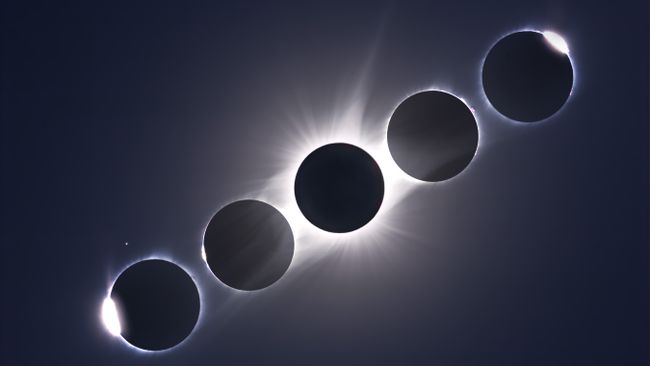
Total eclipse of the Sun. Credit: Alan Dyer/VW Pics/UIG via Getty Images

Monday April 8th 2024 marks 2024 only total solar eclipse of the year (and only one of two which might be witnessed during the year the other being an annular eclipse on October 2nd, 2024), with North America being treated to the spectacle.

A total eclipse is when the Moon crosses directly between Earth and the Sun in a manner which means it completely blocks the face of the Sun from view to those directly “under” the Moon’s path across the sky. This is the region known as the path of totality, marked by the Moon’s shadow marching its way across the face of the Earth as the Moon passes between planet and star. Within that path, the full light of the Sun is blocked for a brief period, plunging the land into twilight before the face of the Sun re-emerges from the limb of the Moon as the latter continued on in its orbit.

As I’ve mentioned before in these pages, a total solar eclipse is the most intense and fascinating of the various types of eclipse that can be observed from Earth, and they tend to occur roughly every 12-24 months, affecting different parts of the world depending on factors such as the Earth’s rotation at the time, the position of both the Sun and Moon relative to Earth, etc. Thus, not every total eclipse is necessarily so easily visible; the path of totality can often be in very remote places or over sparsely populated regions or even far out at sea.
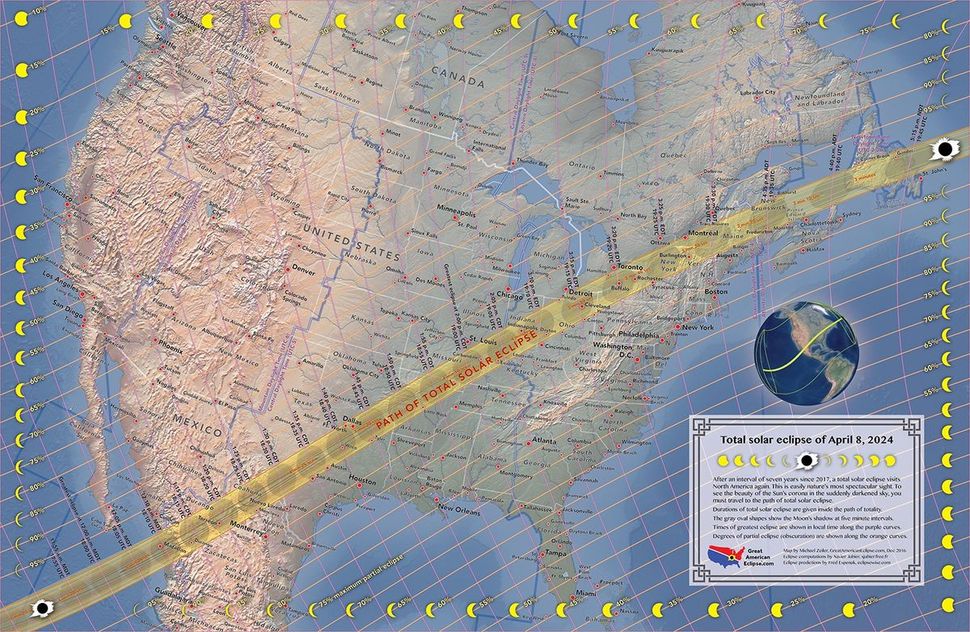
Track of the April 8th, 2024 total solar eclipse across North America, showing the main path of totality. Michael Zeiler/GreatAmericanEclipse.com

The event on April 8th 2024, however, is a little different. The 184-km wide path of totality will extend across 15 US states, whilst its ground track across North America will include Sinaloa, Durango and Coahuila in Mexico and Ontario, Quebec (where it will brush both Toronto and Montreal respectively), New Brunswick and sweep over the Labrador coast of Newfoundland close to St. Johns. This means it will be potentially visible (weather permitting) to around 32 million people in the US alone. What’s more, and in a rarity for total eclipses, it comes just seven years after the last total eclipse was visible from the continental United States (prior to that, the previous one to occur over the contiguous US was in 1979, and the next will not be until 2044).
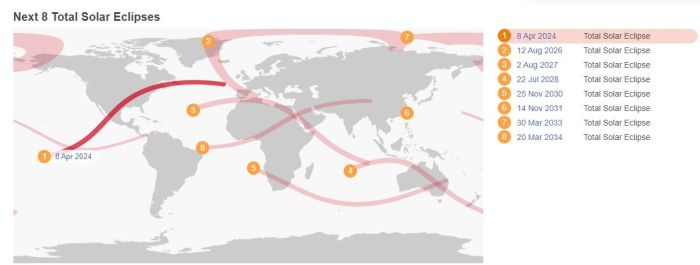
Upcoming total solar eclipses and their visibility on Earth. Via timeanddate.com

If you are lucky enough to lie along the path of totality, and the weather is suitable for you to view it, please keep in mind these common sense guidelines:

  • Never look directly at the Sun – even with sunglasses or by using dark material such as a bin bag or photo negative; these filters do not protect your eyes against infrared radiation and can cause permanent eye damage.
  • Only look at the sun if you have certified eclipse glasses and are wearing them.
  • Only use a telescope or binoculars to project an image of the Sun onto white card, and never use either instrument to observe the Sun directly unless you have a certified solar filter fitted.

The best way to view an eclipse if you do not have eclipse glasses or have a telescope or binoculars to project the Sun’s image onto card, is via a pinhole camera:

  1. Cut a hole in a piece of card.
  2. Tape a piece of foil over the hole.
  3. Poke a hole in the foil with a pin.
  4. Place a second piece of card on the ground.
  5. Hold the card with the foil above the piece of card on the floor to project an image of the Sun onto it, and look at the image. Do not use the pinhole to look directly at the Sun.
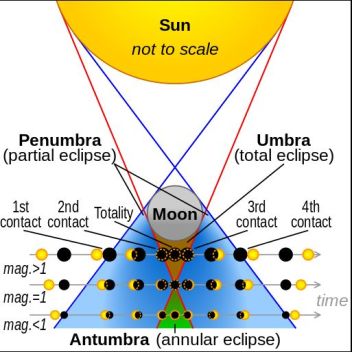
Eclipse Types (Moon and Sun not to scale). Credit: Cmglee

There are a number of terms common to eclipses which are worth mentioning for those who wish to follow the event, but are unfamiliar with the terminology. Specifically for a total eclipse these are:

  • The umbra, within which the object in this case, the Moon) completely covers the light source (in this case, the Sun’s photosphere).
  • The penumbra, within which the object is only partially in front of the light source.
  • Photosphere, the shiny layer of gas you see when you look at the sun.
  • Chromosphere, a reddish gaseous layer immediately above the photosphere of the sun that will peak out during the eclipse.
  • Corona, the light streams that surround the sun.
  • First contact, the time when an eclipse starts.
  • Second contact, the time when the total eclipse starts.
  • Third contact, the time when the total eclipse ends.
  • Fourth contact, the time at which the eclipse ends.
  • Bailey’s beads, the shimmering of bright specks seen immediately before the moon is about to block the sun.
  • Diamond ring, the last bit of sunlight you see right before totality. It looks like one bright spot (the diamond) and the corona (the ring).
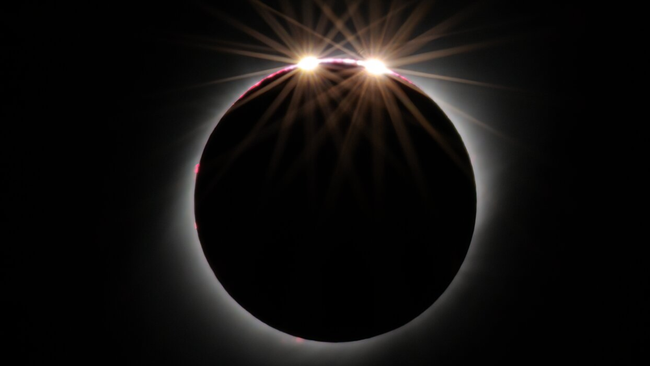
Baily’s beads and the “diamond ring” effect seen during a solar eclipse on July 2, 2019 from the Cerro Tololo Inter-American Observatory in Chile. Credit: CTIO/NOIRLab/NSF/AURA/D. Munizaga

As noted, a total eclipse occurs when the observer is within the path of totality marked by the Moon’s shadow – which is formally called the umbra – passing along the surface of the Earth. For those in Mexico, much of the USA and Canada outside of the umbra, there is still the opportunity to see a partial solar eclipse if you are located within the penumbra.

If you are observing the eclipse (particularly along the line of totality), you might keep an eye out for some / all of the following:

  • If you look at the ground around you just before totality occurs and the Moon completely covers the disk of the Sun; you might see the phenomenon of fast-moving shadows, called shadow bands, racing across the ground under your feet. These might also occur as the Sun starts to re-emerge from behind the Moon.
  • During totality, keep an eye out for the brighter stars becoming visible during totality, together with the following planets:
    • Jupiter: roughly 30o above and to the left of the Sun / Moon.
    • Venus roughly 15o below and to the right of the Sun / Moon.
    • Saturn and Mars (both very faint) roughly 20o below Venus, close to the horizon and further to the right.
  • The very keen eyed might also be able to spot comet 12P/Pons-Brooks as a fuzzy dot just off to the right of Jupiter (although you will need to be very keen-eyed!
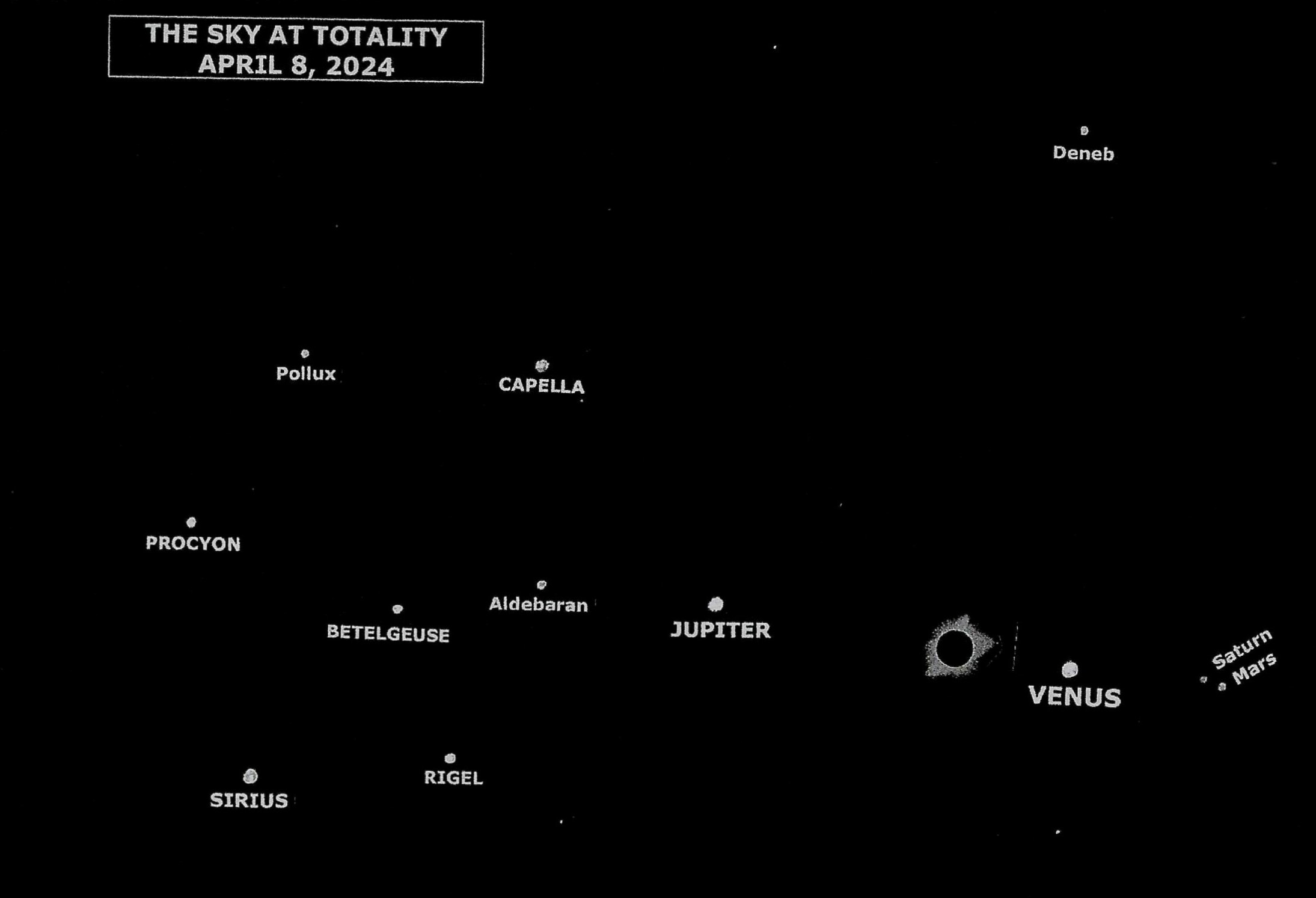
Sky chart showing the most conspicuous stars and planets that might be visible in the vicinity of the totally eclipsed sun. Credit: Joe Rao
  • Watch and listen to the local animals and wildlife (if present). Birds may stop singing, with some flying to their roosts, cattle might behave is if it is evening , etc., as they become confused by the local twilight.
  • During the solar eclipse, you may see colours shifting, giving familiar objects unusual hues. This natural shift in colour perception is caused by fluctuating light levels resulting from the darkening of the sun.
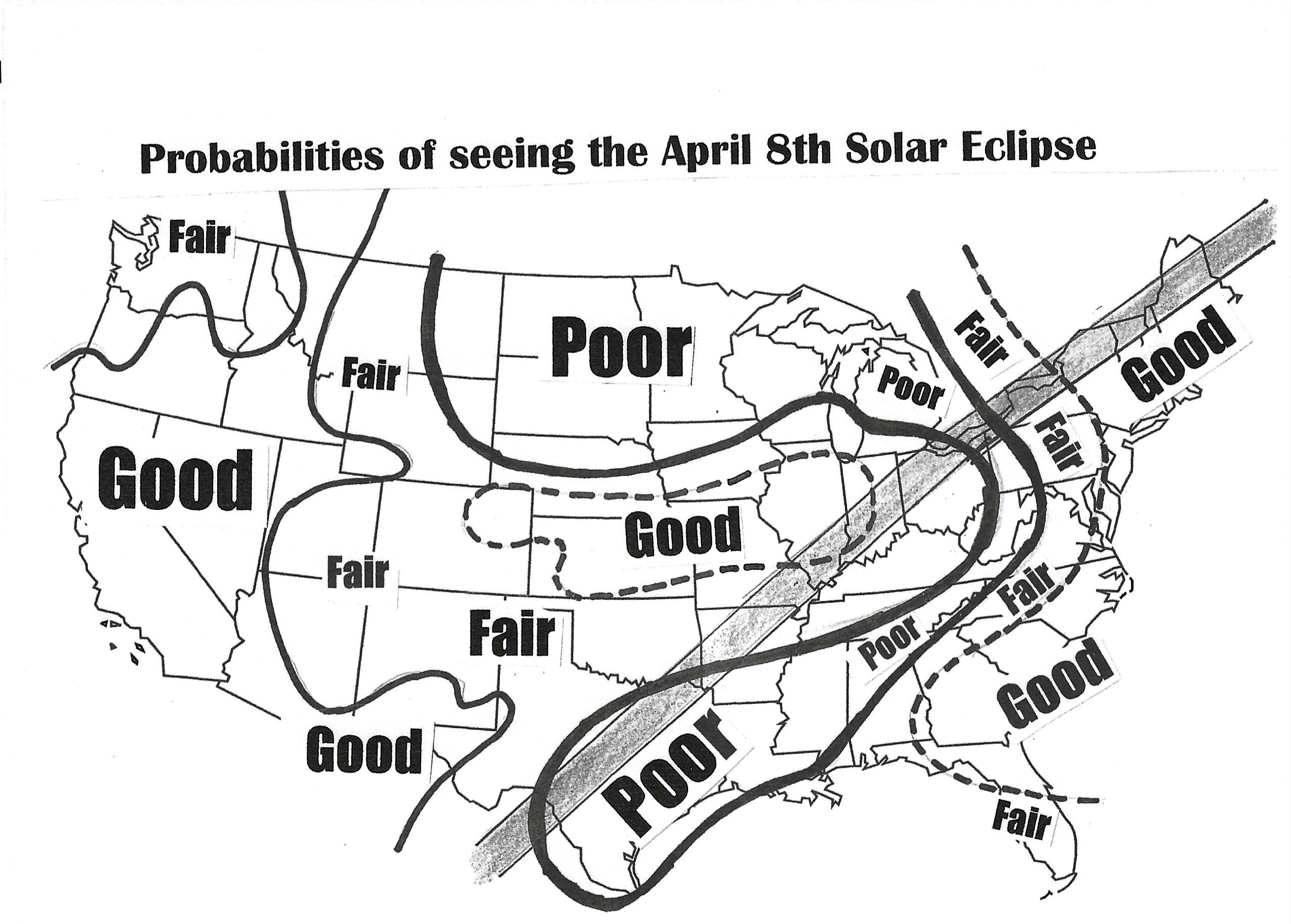
US Viewing probability map for the April 8th, 2024 total solar eclipse. Credit: Joe Rao

If you prefer not to watch the eclipse directly, or are not lucky enough to live along the path of totality (is the weather is pooping on you seeing it if you are), then it can be followed on-line at the following resources:

Totality Times (UTC) for Notable North American Locations

  • Mazatlán, Sinaloa, Mexico – 18:07; duration: 4 minutes 20 seconds.
  • Durango, Durango, Mexico – 18:18; duration: 3 minutes 50 seconds.
  • Piedras Negras, Coahuila, Mexico/Eagle Pass, Texas, U.S – 18:27; duration: 4 minutes, 24 seconds.
  • Dallas, Texas – 18:40; duration: 3 minutes 52 seconds.
  • Indianapolis, Indiana – 19:06; duration: 3 minutes, 51 seconds.
  • Cleveland, Ohio – 19:13; duration: 3 minutes, 50 seconds.
  • Erie, Pennsylvania – 19:16; duration: 3 minutes, 43 seconds.
  • Rochester, New York – 19:20; duration: 3 minutes, 40 seconds.
  • Niagara Falls, Ontario, Canada – 19:18; duration: 3 minutes, 31 seconds.
  • Montreal, Quebec, Canada – 19:26; duration: minutes 57 seconds.
  • Tignish, Prince Edward Island, Canada – 19:35; duration: 3 minutes, 12 seconds.
  • Catalina, Newfoundland, Canada – 19:43; duration: 2 minute, 53 seconds.

Note that part of north Europe  – notably the UK – will be able to witness a partial solar eclipse.

Continue reading “Space Sunday: total eclipse and a nova”

Elvion’s Blackbird sings in Second Life

Elvion, April 2024 – click any image for full size

Update: Elvion closed in June 2024.

It is always a pleasure to visit Elvion, the ever-popular work of Bo Zano (BoZanoNL) and his SL/RL partner, Una Zano (UnaMayLi). From its earliest beginnings and throughout all its iterations, Elvion has always been a place of eye-catching and photogenic beauty, often ensconced within a Homestead region and occasionally within a Full region.

With its latest iteration, which I was able to drop into at the start of April 2024, Elvion retains its reputation as a place of beauty and relaxation, although it has once more switched to being founded on a Full private region, one leveraging the Land Capacity bonus available to such regions. And whilst I’ve always enjoyed Bo and Una’s designs, I have to say this one is particularly gorgeous.

Elvion, April 2024

Referenced as the Blackbird Edition, this version of Elvion offers everything which has over the years made Bo and Una’s work so highly regarded amongst Second Life explorers, photographers and bloggers – natural beauty, a sense of life imbued by the presence of wildlife and hints of human presence, together with far more of a sense of location and of a rich tapestry of life down through the generations.

Indulge yourself in this green land full of history and natural beauty. From stunning water views and forest trails, to the cosy harbour and city.

– Elvion Blackbird Edition, About Land

Elvion, April 2024

With the landing point to the south west and sitting on a rugged upland overlooking the local natural harbour and coastal walk, those arriving within the setting have the choice of either following the old cart tracks of the Mountain Trail for their explorations or of using the local teleport board to hop to one of the listed locales within the region. Of these two choices, I would obviously recommend the former, lest some of the the details present within the region.

Depending on which way you go in following the Mountain Trail, the first of the locations, as listed on the teleport board you’re likely to reach will be either the old gatehouse standing guard on one side of the local town, or the ruins of the abbey that once occupied the north-western extent of the region, flanked on two sides by open water and on the third by a deep gorge of a water channel which cuts through the setting north-to-south, fed by waterfalls and streams and crossed in several places by stone and wooden bridges.

Elvion, April 2024

The ruins of the abbey – an absolutely perfect use of elements from The Looking Glass Ruined Chapel, a long-standing favourite of mine – give a sense that this is a place long inhabited, even if once only as a religious retreat. The ruins look out across the waters to a rugged coastline which gives the impression that this iteration of Elvion sits as a small island which may have once been joined to that rugged coast, before the surrounding waters had forever sundered the two.

Across the gorge, and reached by the single stone bridge spanning it, the gatehouse leading to the town demonstrates a similar sense of age, together with a certain French turn in its architecture as it sits with its portcullises open to welcome visitors into the town.

Elvion, April 2024

The latter is a pleasing mix of buildings and styles, neatly suggesting it has grown organically over time, its two cobbled footpaths are split between elevations, offering a please walk through the town and down to the harbour. This sits within a natural bay into which the region’s water channel flows. Such is the nature of the this little port of call that it sensibly requires both a lighthouse and large marker buoys to help guide small vessels into the harbour’s arms and a safe mooring.

The lighthouse sits on a small isle which forms one side of the harbour and presents a pleasing walk in its own right, offering as it does a loop back to the town or a means to reach another of the region’s locales, the local windmill. The latter sits towards the north-eastern corner of the region, and which also sits at one end of the Mountain Trail.

Elvion, April 2024

But it is the natural look and feel to the setting, together with Una and Bo’s inevitable attention to detail that really bring this iteration of Elvion so memorable as a place. The ruggedness of the island perfectly matches the mountains off-region surround, giving the setting that sense of the two being properly related geologically, rather than the surround simply being a backdrop for the region’s landscape.

The detail extends to the rich mix of wild and domesticated animals found throughout the region, with the former coming in a variety which makes it hard to pin down where in the world this edition of Elvion might represent – if any at all -, further adding to its magic and attractiveness. Further attractiveness is given through the provision, again as is common and always welcome within Elvion, of multiple places to sit and pass the time.

Elvion, April 2024

Definitely not n iteration of Elvion to miss.

SLurl Details

2024 week #14: SL CCUG summary

Memories of Dreams, April 2024 – blog post

The following notes were taken from my audio recording and chat log transcript of the Content Creation User Group (CCUG) meeting held on Thursday, April 4th, 2024.

Meeting Purpose

  • The CCUG meeting is for discussion of work related to content creation in Second Life, including current and upcoming LL projects, and encompasses requests or comments from the community, together with related viewer development work. This meeting is held on alternate Thursdays at Hippotropolis.
  • In regards to meetings:
    • Dates and times are recorded in the SL Public Calendar.
    • Commence at 13:00 SLT on their respective dates.
    • Are conducted in a mix of Voice and text chat.
    • Are open to all with an interest in content creation.
  • The notes herein are a summary of topics discussed and are not intended to be a full transcript of the meeting.

Official Viewers Status

  • On Wednesday, April 3rd, the Materials Featurettes RC viewer updated to version 7.1.5.8472515256.
  • On Tuesday, April 2nd, the Maintenance X RC viewer (usability improvements) updated to version 7.1.5.8443777128.

Both of these updates were to bring the above viewers to code parity with the current release viewer (with bug fixes to to the Featurettes viewer as well). The rest of the official viewers remain as:

  • Release viewer: version 7.1.4.8149792635, formerly glTF PBR Materials Maintenance-2 RC viewer, promoted March 26, 2024.
  • Release channel cohorts:
    • Maintenance-W RC (bug and crash fixes), version 7.1.5.8443591509, March 29.
    • Maintenance Y RC ( My Outfits folder improvements; ability to remove entries from landmark history + Maint Z RC integration), version 7.1.5.8448596295, March 29.
  • Project viewers:

It is possible the glTF Maintenance-2 RC viewer might be promoted to de facto release status early in week ’13 (commencing Monday, March 25th, 2024).

Graphics / glTF

  • Work continues on the GLTF Featurettes viewer + support.
    • The view is in RC, but the simulator-side support is still working its way through the system for full deployment on Agni (the Main grid).
    • The RC viewer has been undergoing numerous bug fixes related to both PBR Terrain textures and Mirrors, some of which are in the most recent update, others of which will be included at the viewer continues to be updated.
    • The UI/UX changes required for Mirrors to overcome confusion relating to the placement of things like Mirror reflection probes (with the creation of Mirrors described a “not intuitive”) is still under discussion at the Lab and so yet to be implemented within the Featurettes viewer.
    • The pricing structure for uploading 2K textures is currently being finalised, although it is not ready to be formally announced.
      • As with other services / uploads, the pricing looks like it will be based upon subscription level (e.g. cheaper for the likes of Premium Plus / Premium than for Plus / Basic) and the overall resolution of the texture.
      • Further work will also be required on the back-end services to fully support the upload of 2K textures.
      • An upshot of this is that at the time of writing, there is a communications mismatch between the viewer and the Aditi test regions supporting 2K texture uploads, resulting in such attempts falling over.
  • The HDRI support (replacing the sky with an HDRI file when rendered locally within a viewer to assist creators in checking to confirm their objects render in SL as they are seen within the tools they use to create their content – e.g. Substance Painter – and any variations are not related to the shader / import pipe) is still being tweaked.
    • In particular, now it has been tested internally and seen as offering some potentially interesting uses over and above pure EEP settings, consideration is being given to making HDRI an actual sky setting with simulator-side support.
    • One aspect of this would be the ability to use the lighting effects of HDRI within EEP sky settings, thus providing more true-to-life lighting without losing the use of existing EEP settings. Another might be using HDRI maps inside buildings and structure and not having the sky setting lighting leak into the structure.
    • Again, it’s important to not adding back-end support for HDRI is a future implementation, rather than anything being worked on right now, and would require work on both the simulator and back-end services (e.g. a new asset type to support HDRI would be required).
  • Light sources: there have been requests for the likes of point light shadows (e.g. so a map on a table casts is own shadows); the ability to explicitly state whether or not a light source casts a shadow or not; ability to support shadows from multiple light sources (depending on rendering settings).
    • Some of this might be addressed through glTF scene import, and / or through further adoption of the glTF specification for lighting (e.g. punctual lights / physical lights  – such as spotlight cones, etc.).
  • The work of glTF scene imports officially commenced in week #14. This work will be tackled in a similar manner to the Featurettes viewer – elements added to the viewer but placed behind debug flags until such time as they can be properly tested as the simulator support can be added (initially via Aditi, the Beta grid).
    • The will allow the viewer to be worked on and tested (with user testing) iteratively, rather than the work disappearing into a viewer fork that doesn’t see the light of day for months.
  • It was asked whether or not EXR might be a better option for SL skies rather than EEP + HDRI.
    • Runitai Linden noted he has experimented with EXR alongside of EEP and found that while EXR comes “close” to matching EEP skies, its doesn’t quite have the same range, whereas the HDRI lighting overlap with EEP offers easier flexibility of use.
    • He also noted again that the primary reason for providing HDRI support was to allow creators that means of reference checking their content between SL and their modelling tool to ensure it is appearing as expected after going through the SL upload pipe, etc., when compared to its appearance into their development tool.
  • Does the emissive map “knock out” the normal map if it is bright? No, but it can overpower the normal may and cause bumpiness, etc., to be less distinct.

In Brief

  • There was a general discussion on reflection probes and why they are limited in terms of shape (sphere or cube) and supporting other shapes+ illumination issues where probes overlap.
    • The shapes are necessarily limited largely as a result of performance stability.
    • It was acknowledged that blending lighting between probes is more a matter of improving / altering SL’s default ambient lighting model – which may well be looked at down the road.
    • The current advice is to – if necessary – “bomb” a scene with reflection probes  – and if that doesn’t work, disable probe ambience in favour of the global ambience – it will still allow the probe radiance and so generate reflections.
  • Occlusion volumes: the question was asked if it will ever be possible to have occlusion volumes in SL such that a room and its contents are never rendered in a viewer until the user actually enters the room in question.
    • It was acknowledged that this is the kind of thing the work with reflection probes might lead to, in terms of the basic mechanics being similar from a user’s perspective.
    • However, there are no current plans for developing such occlusion volumes at present, and a feature request on how user might want to use them / see them as working has been requested so the idea can be more formally reviewed / considered.

Next Meeting

† The header images included in these summaries are not intended to represent anything discussed at the meetings; they are simply here to avoid a repeated image of a gathering of people every week. They are taken from my list of region visits, with a link to the post for those interested.

Cica’s Bubbles in Second Life

Cica Ghost: Bubbles, April 2024

Under the sea,
Under the sea.
Cica makes it better
Down where it’s wetter
Take it from me.
Up on the shore we work all day
Out in the sun we slave away
While down in the Ocean
We can be floatin’
At Bubbles for free.

OK, so those aren’t exactly Howard Ashman’s lyrics (and yes, they are probably cringe-inducing – but then, that’s what I’m here for 😀 ), but they do apply to Cica’s Ghost’s April 2024 installation Bubbles, a fun trip down into the ocean depths (well, semi-depths at least).

Cica Ghost: Bubbles, April 2024

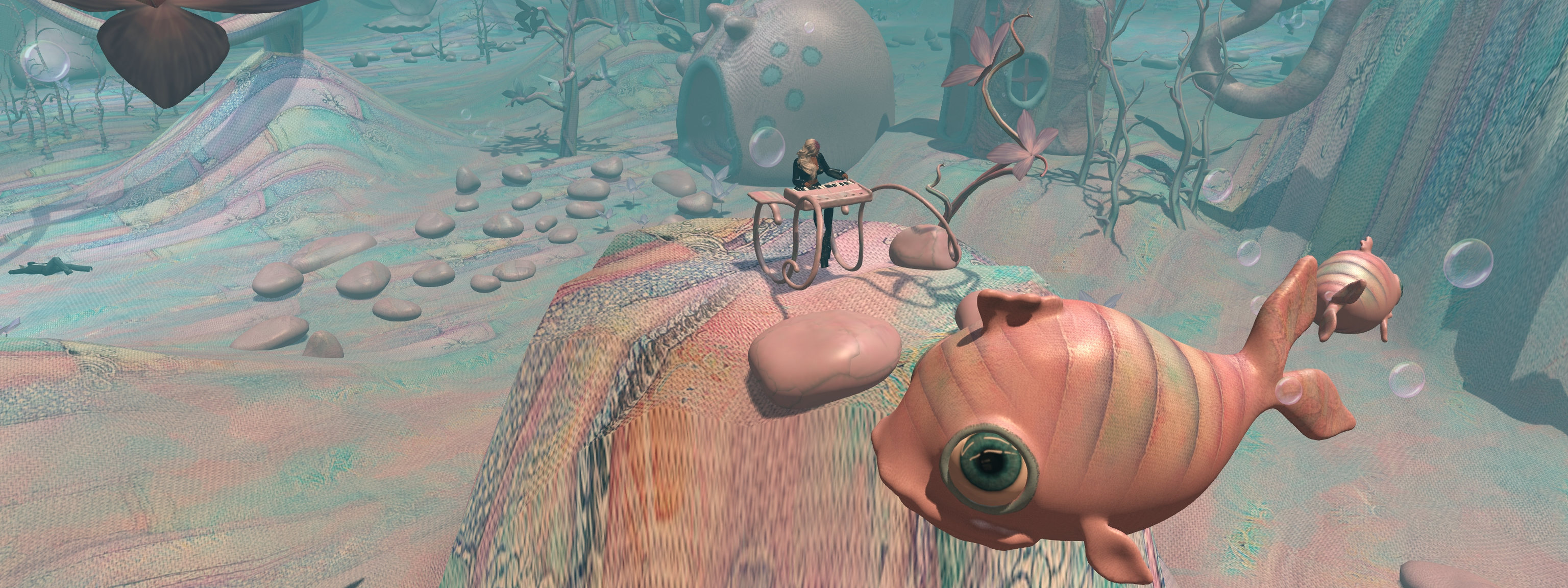
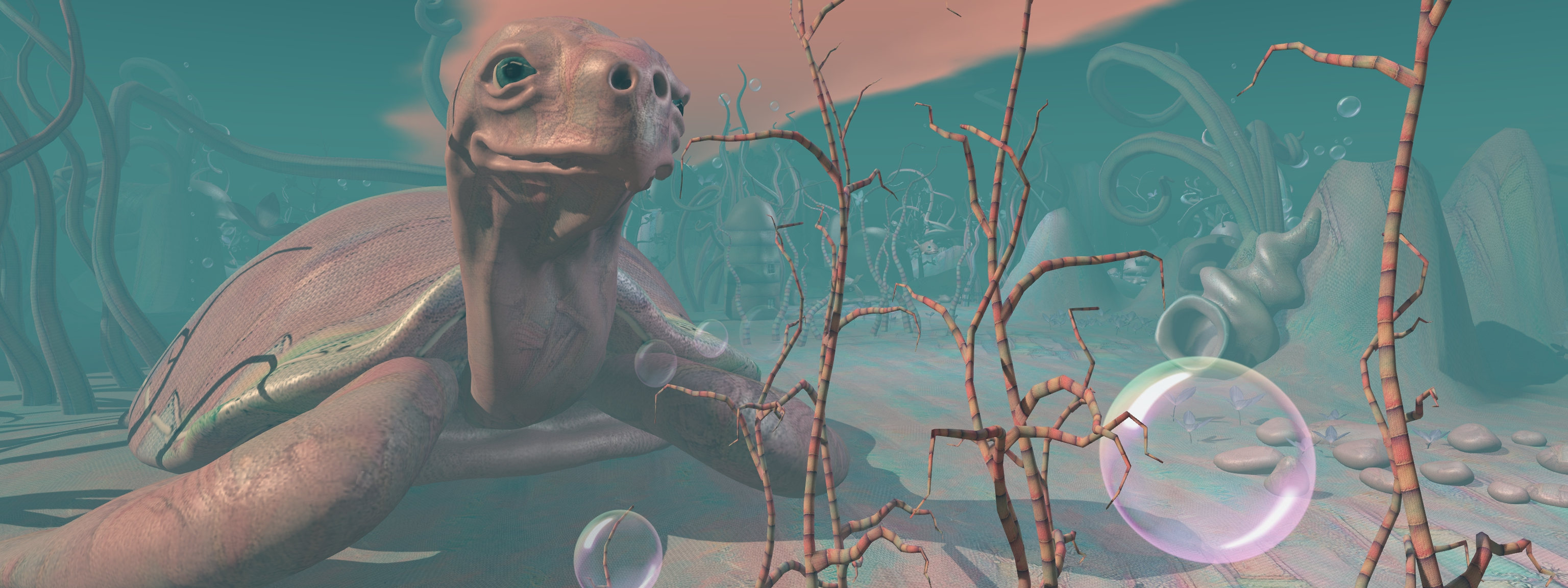
This is a place where fronds of seaweed rise from a quilted sea floor, their growths interspersed with small carpets of flowers while the flat patchwork of the sea floor is interrupted by gatherings of pointed, steep-sided knolls and lumpy rocks, the latter often sprouting plant growths from their tips / tops. Within this undersea realm bubbles rise effortlessly and a host of sea creatures are waiting to greet visitors – some of which might be responsible for the strange little houses scattered throughout the setting.

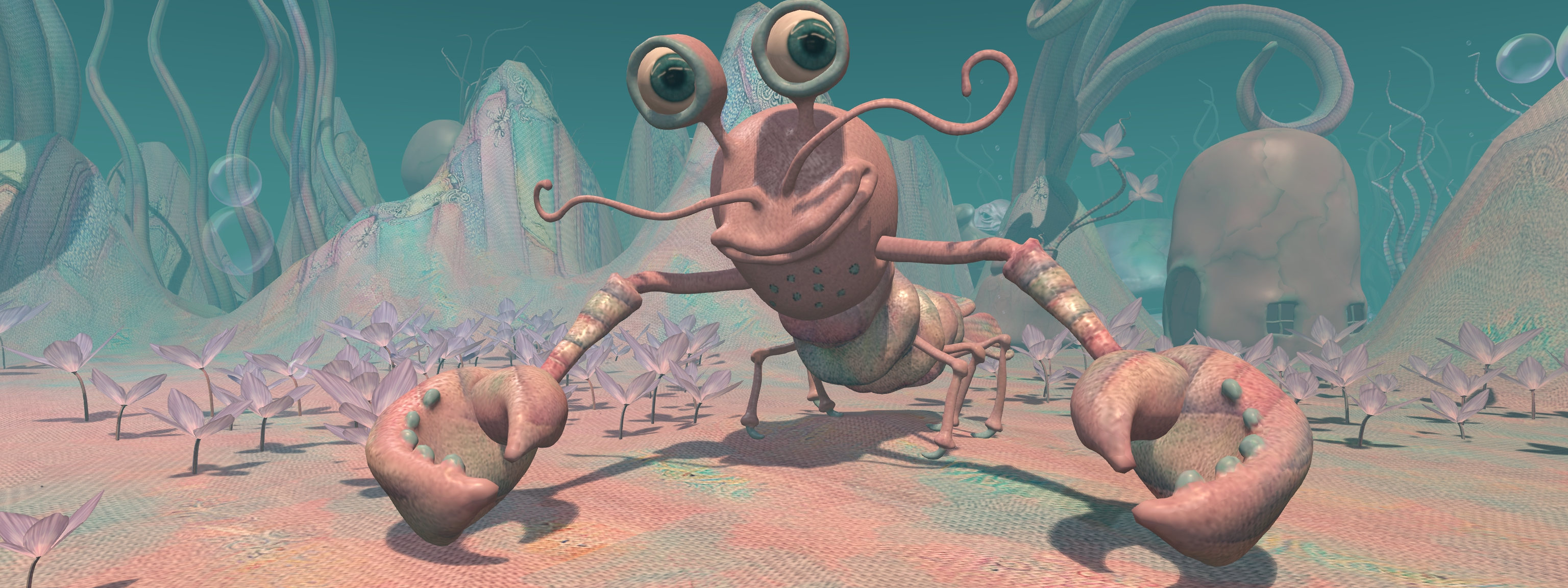
From a static clam (or possibly an oyster – you decided which!) that sits open as a place to sit, through little fishes happily swimming in circles to a giant sea turtle, the denizens of this realm pose no threats to visitors. Indeed, several offer opportunities to sit on / with them or to play with them as you do handstands, whilst a starfish clings to the side of one of the houses as if engaged in a game of hide-and-seek and hoping it will not be discovered.

Cica Ghost: Bubbles, April 2024

The little houses are all unfurnished, but that’s fine; fish rarely need a bed to sleep on and chairs offer little comfort to lobsters or octopi. However, the shells to be found outside the front of some of the houses do offer the chance to get together and dance for a while (perhaps while singing Ashman’s actual lyrics from The Little Mermaid). For those who prefer to make some music, Cica has provided a little electronic piano sitting on a hill – and the fish circling it  seem only too willing to listen to anyone opting to tinkle the keyboard.

When visiting, do keep an eye out mer-like couple who may be the custodians of this little underwater realm; they might appreciate a little hello from you as well!

Cica Ghost: Bubbles, April 2024

SLurl Details

  • Bubbles (Mysterious Isle, rated Moderate)

SL21B: theme and Exhibitor applications

via Linden Lab

June 2024 will mark the 21st anniversary of Second Life opening to public access – and to mark it, Linden Lab has announced the 2024 Birthday celebrations as being marked across an entire month – from Friday, June 21st through until  Sunday July 21st, 2024.

Theme

This theme for Second Life’s 21st birthday (SL21B) has been given as Elements, which the Lab describes thus:

This theme invites us to explore the fundamental components that make up our vast virtual landscape and the diverse communities within it. From the fiery passion of creators and artists to the fluid adaptability of our social environments, from the solid bonds within our communities to the fresh breezes of innovation that propel us forward, “Elements” is a celebration of the core forces that shape our experiences in Second Life.

– From the official SL21B announcement blog post

Exhibitor Applications

The announcement also notes that applications for those wishing to host exhibits within the Birthday regions are now open, with the following notes:

  • Applications will be accepted through until Sunday, May 12th, 2024.
  • There will be both General and Adult rated regions available to exhibitors.
  • Exhibits do not have to be in keeping with the Elements theme – LL are keen to showcase the passions, interests and creativity of the platform’s users and many groups and communities.
  • Full rules for Exhibitors can be found in the application form.

In 2023, Exhibitor parcels were expressly stated as being 4096 sq m in size, with a Land Capacity of 1872 LI. While this is not stated in this year’s application form, there is no direct reason to suppose this will not be the case this year as well – although clarification from LL would be welcome.

Related Links

April 2024 SL Web User Group summary

The Web User Group meeting venue, Denby

The following notes cover the key points from the Web User Group (WUG) meeting, held on Wednesday April 3rd, 2024. They form a summary of the items discussed and is not intended to be a full transcript. A video of the meeting, recorded by Pantera Północy, is embedded at the end of this summary – my thanks as always to Pantera for recording it and making it available.

This meeting was more a seeking feedback type of discussion than it was an update on web project projects, etc.

Meeting Overview

  • The Web User Group exists to provide an opportunity for discussion on Second Life web properties and their related functionalities / features. This includes, but is not limited to: the Marketplace, pages surfaced through the secondlife.com dashboard; the available portals (land, support, etc), the forums.
  • As a rule, these meetings are conducted:
    • On the first Wednesday of the month and 14:00 SLT.
    • In both Voice and / or text.
    • At this location.
  • Meetings are open to anyone with a concern / interest in the above topics, and form one of a series of regular / semi-regular User Group meetings conducted by Linden Lab.
  • Dates and times of all current meetings can be found on the Second Life Public Calendar, and descriptions of meetings are defined on the SL wiki.

Official Viewer Search

  • It was noted by some users at the meeting that the official viewer takes longer to index new users so they appear within the web search People tab, whereas TPVs using the legacy search seem to index them a lot faster.
  • It was similarly noted that very short user / place names (3 letters of less) don’t always show up in search results.
  • It was asked why there is a L$30 fee for creating a Classified ad in a user’s profile / Search (short answer: to provide an additional search service of more “curated” locations over general search) and why such classifieds are not categorised (short answer: they are, via a pre-defined drop-down).
  • There have been some reports of the viewer search constantly requesting cookies be accepted, either on every use, or the first time Search is used during a user’s current log-in session.

In Brief

  • Ability for MP merchants to have their own “featured items” display pinned to the top of their store page on the first page of their MP store.
    • This idea has been floated by Sntax Linden a couple of times, and would allow Merchants to select items from their store (e.g. new items, best selling items, etc.) highlighted in some manner as featured items (possibly in a similarly distinctive manner to the Featured Items displayed on the MP home page).
    • It was met with broad approval / agreement.
  • LL are still looking at the way thumbnails of products are selected for display within users’ Favourite Stores lists on the MP, with a view to making it more useful to Merchants. This might be by:
    • Displaying thumbnails of their most recent releases, so people can use the list as a quick reference to what is new in their favourite MP stores.
    • Tying the selected thumbnails to the store “featured items” capability discussed above (if implemented).
  • General discussion on in-world store activity.
    • Some felt that the large volume of shopping events is having a negative impact of in-world store footfall, as people are event-focused, rather than opting to visit stores directly.
    • Some reported experiencing a steady decline in footfall within their stores, others no change / a potential increase in recent months.
    • It was pointed out that besides events, creator-merchants don’t necessarily help themselves by not updating the SLurls to their stores / items as listed on the Marketplace when they move (probably in part because there is no easy mechanism for them to do so on the MP if individual listings include SLurls).
  • The above led to a broader discussion on market forces, such as the fact that content creation is now for more the purview of these wishing to do so on a full-time basis (in order to remain competitive) rather than something the “hobbyist” creator can enjoy as a means of generating revenue as a means to help support their in-world activities (land tier, etc.).
  • Th question was raised as to whether CasperVend should / will be remained as it is now a LL property (just as OnRez and XStreet SL were purchased, with the latter going on to become the SL Marketplace).
    • The above included comments relating to the unfortunate / unwarranted knee-jerk reactions some users have had towards the Lab (and CasperVend users) in the wake of a certain article published within the social journalism website Medium, and which has been officially commented upon here (and, if interested, I’ve offered my tuppence worth of commentary here).
  • It was asked whether people have made any attempt to use generative AI in their content creation. The broad feedback was – no. This saw a series of follow-up questions:
    • Do people think AI tools could be useful – possibly, but not far enough developed to be sure.
    • Should content produced using AI tools and sold on the MP be marked as such – yes.
    • Are there any preferred tools already in use with content creators – not really.
    • This lead to a subjective (i.e. only a handful of creators) discussing how AI tools are viewed  / currently used within SL (e.g. to generate vendor images).
  • Sntax noted that feature requests made via the Feedback Portal board for the MP /Web are recorded and used to help inform and direct WUG meetings, particularly where it is felt broader / deeper feedback on ideas is required.
  • A further request was made for store / brand names on within SL to be unique (as with avatar account names), to both help secure branding against copycats and also to make it easier for users to find the content they want when searching the MP.
  • A suggestion that when there are Marketplace issues and updates, a mechanism is put in place to pop-up a notice when users access the MP, rather than replying purely on GridStatus (+ its outlets on Social Media), as many users aren’t even aware of the latter, whilst having notices actually on the MP means they are eyeballing them directly.

Next Meeting

  • Wednesday, May 1st, 2024.